Physical Address
304 North Cardinal St.
Dorchester Center, MA 02124
Physical Address
304 North Cardinal St.
Dorchester Center, MA 02124

Some flower and insect pairings feel obvious, but the lily and butterfly combination earns its place for a different reason. A butterfly’s wings can mirror the symmetry of a lily’s petals, or they can break that symmetry entirely by tilting off to one side mid-flight. That flexibility gives tattoo artists a wide playground, whether someone wants something barely-there or a full statement piece.
Part of the appeal comes down to how easily this pairing adapts to different moods. A butterfly can sit still and quiet on a petal, or it can be caught mid-flight with wings blurred from motion, and either choice changes the entire feel of the tattoo without needing to touch the lily itself. That kind of range is harder to pull off with pairings that rely on a single fixed pose.
There’s also the practical side of getting inked. Because both the lily and the butterfly can shrink or scale up without losing their shape, this combination works just as well as a tiny wrist piece as it does a full back scene. Anyone weighing size options before booking an appointment will find this pairing gives more room to decide later than most other floral tattoos allow.
A lily with butterfly tattoo pairs the layered, structured shape of a lily with a butterfly resting on or flying near it. Some versions keep both elements simple and outlined, while others push into full color and heavy shading. Anyone who liked the hummingbird and lily pairing covered in an earlier post will notice a similar softness here, though the butterfly tends to allow for even more variation in wing shape and pattern than a bird does.
Lilies are often linked to renewal and purity, and butterflies carry their own long history as symbols of transformation, largely because of the dramatic shift they go through during metamorphosis. According to the Smithsonian’s National Museum of Natural History, a butterfly’s transformation from caterpillar to winged adult is one of the most complete metamorphoses in the animal kingdom, which is part of why the insect shows up so often in art tied to change and growth. Paired with a lily, the tattoo often reads as a moment of stillness meeting a moment of change.
Readers who explored the earlier rose and owl design or the lily paired with a tiger will notice this combination sits on the gentler end of the spectrum, since the butterfly rarely overwhelms the flower the way a larger animal might.
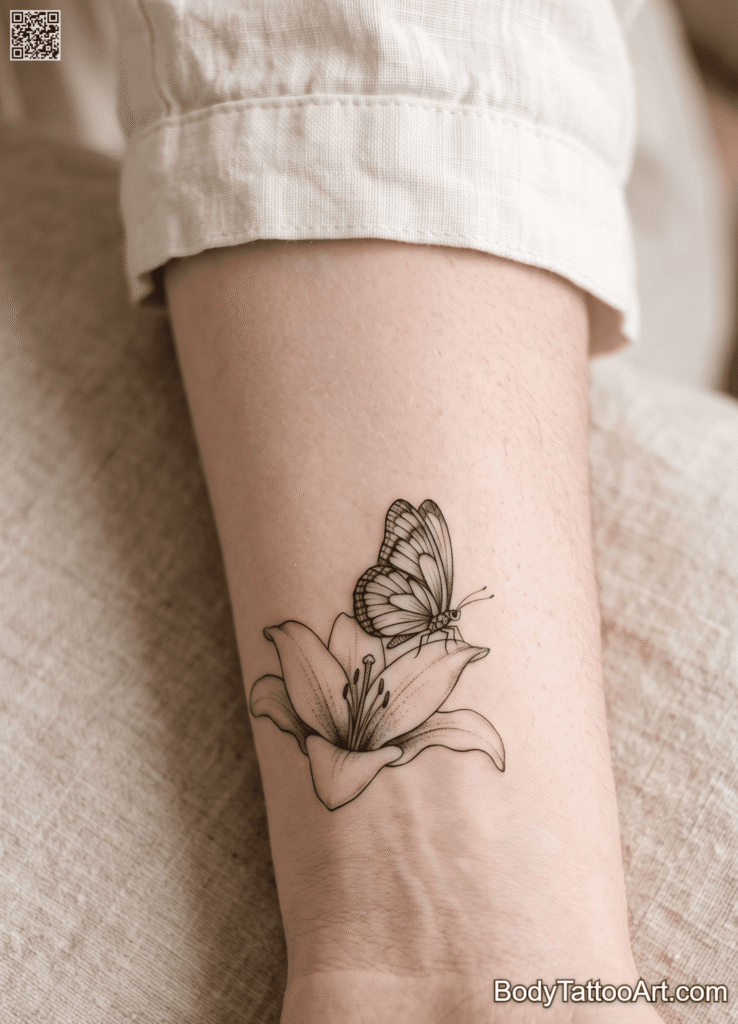
A single butterfly sits perfectly still on the edge of an open lily petal, wings folded upright rather than spread wide. The linework stays thin and precise, with just a touch of shading along the petal’s curve to give it some depth. Nothing else fills the space, so the eye goes straight to that one quiet moment.
Placement – Inner wrist or ankle
Style – Fine line Lily With Butterfly Tattoos
Why it stands out – The folded wings create a calm, still moment instead of the usual mid-flight pose, which makes the piece feel more like a quiet pause than a dramatic scene.
Ideal for – First-timers, minimalist lovers, anyone wanting something subtle
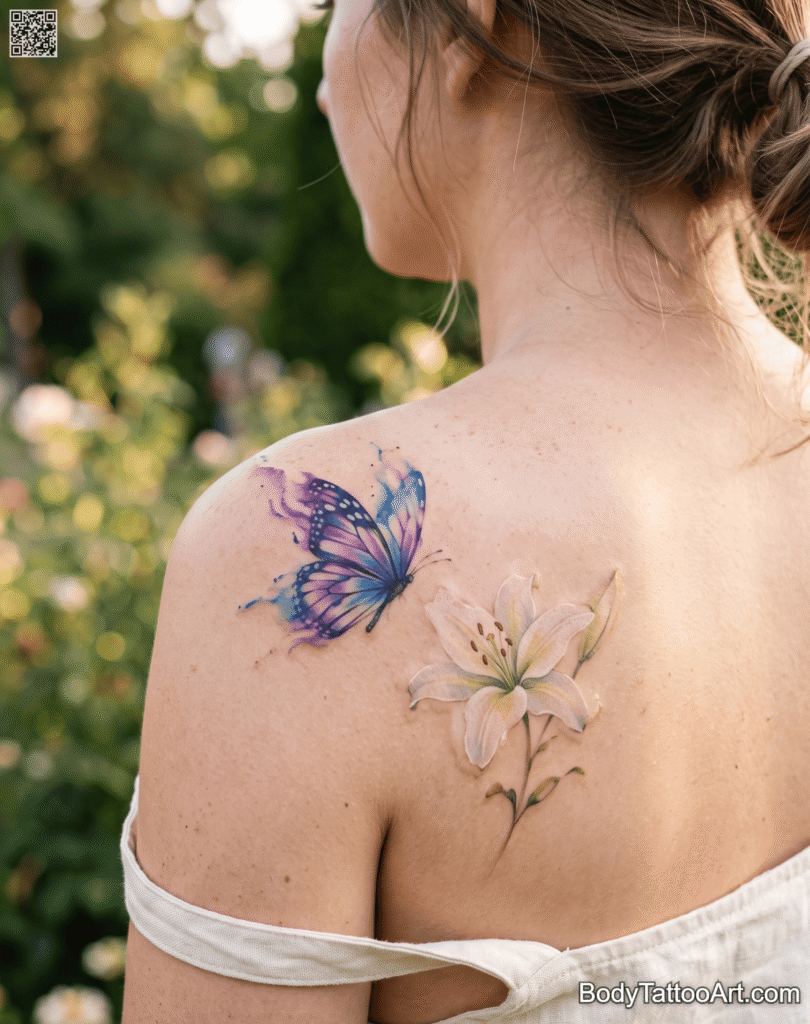
Here, the butterfly is mid-flight, wings blurred into loose streaks of purple and blue that bleed past their own edges. Below it, the lily blooms in soft washes of white and pale yellow with no hard outline holding either shape together. The whole design looks more like a splash of paint than something drawn with a needle.
Placement – Shoulder or upper arm
Style – Watercolor Lily With Butterfly Tattoos
Why it stands out – Without any outline, the ink looks like it’s soaking into the skin rather than sitting on top of it, giving the piece a painterly, almost accidental beauty.
Ideal for – Color lovers, fans of abstract art, people wanting something that doesn’t look like a typical tattoo
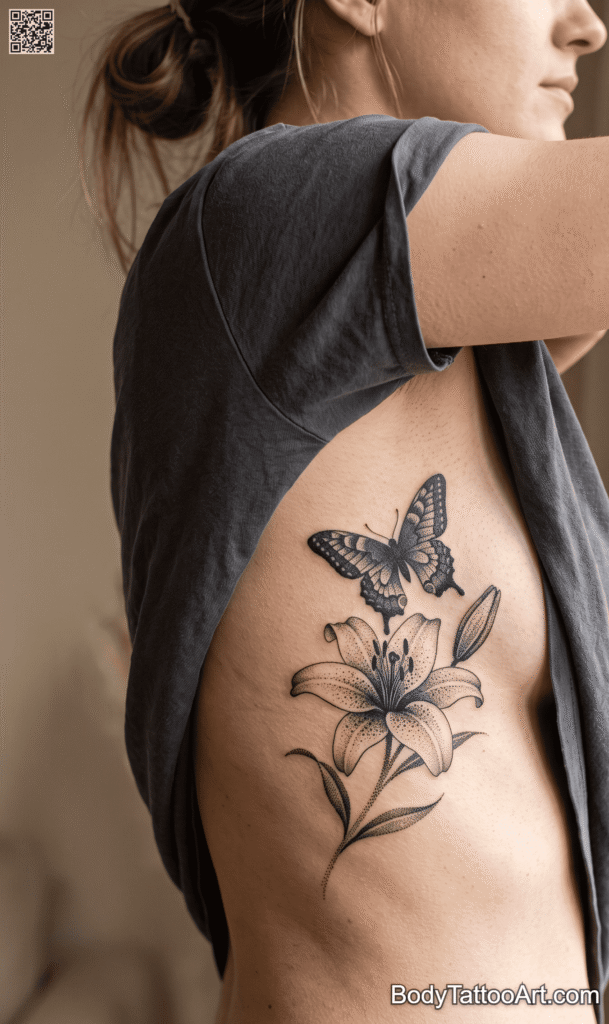
Built entirely from small dots, this design shows a dark silhouette butterfly with wings spread wide, hovering just above a lily made of graduated dot density, dense and dark near the center and thinning out toward the petal edges. There’s no color and no solid line work, just careful stippling that creates real shadow and texture.
Placement – Ribcage
Style – Blackwork dotwork Lily With Butterfly Tattoos
Why it stands out – The dot gradient does the work that shading usually does, giving the piece real depth without a single traditional shaded line.
Ideal for – Blackwork fans, texture lovers, people wanting a design that photographs beautifully in black and white
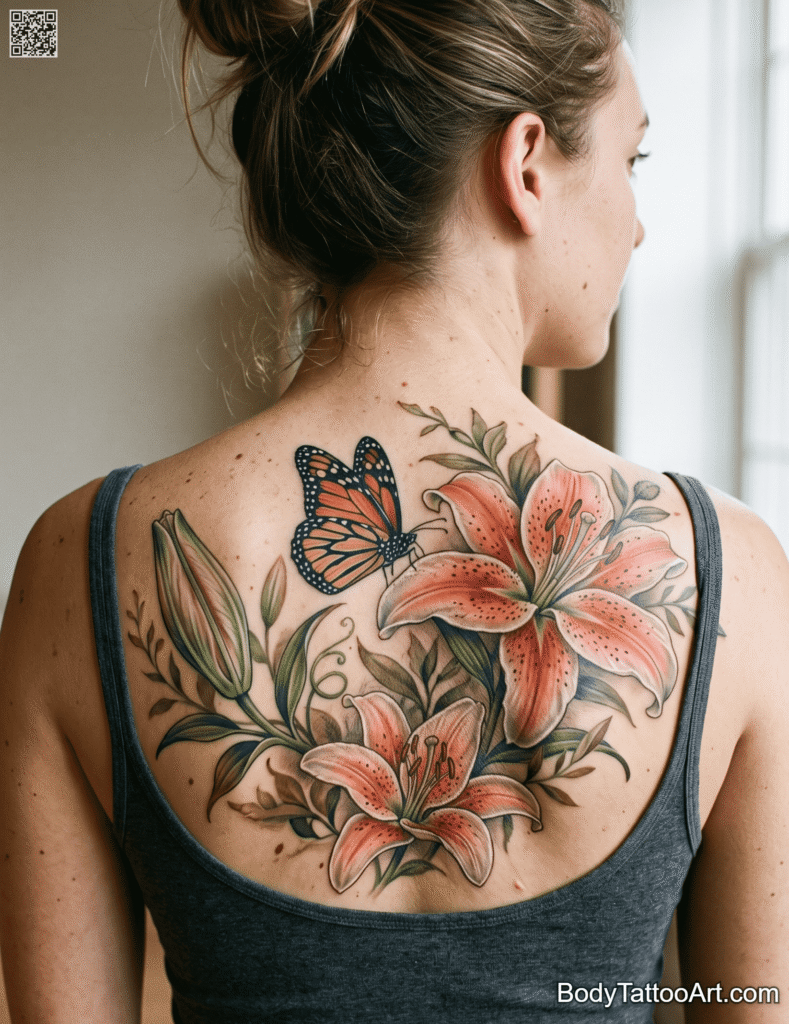
This larger design fills the space with three lilies at different stages of bloom, a butterfly weaving between them as if caught mid-visit. Shading gives real dimension to the petals, while a few loose leaves and stems tie the whole scene together, giving it the look of a small painted garden rather than a single flower study.
Placement – Upper back or thigh
Style – Realistic color Lily With Butterfly Tattoos
Why it stands out – Showing the lilies at different bloom stages gives the piece a sense of time passing, something most single-flower tattoos can’t capture.
Ideal for – Collectors of large detailed pieces, nature lovers, people wanting a true statement tattoo
Drawn without lifting the pen, this design reduces the butterfly and lily to their simplest shapes, connected by one flowing line. There’s no shading, no color, and no extra detail, just a single curve that shapes both the wings and the petals in one clean motion.
Placement – Behind the ear
Style – One-line minimalist Lily With Butterfly Tattoos
Why it stands out – The unbroken line makes the whole design feel deliberate and calm, more like a signature than a typical tattoo.
Ideal for – Minimalist lovers, first-timers, anyone wanting something barely noticeable
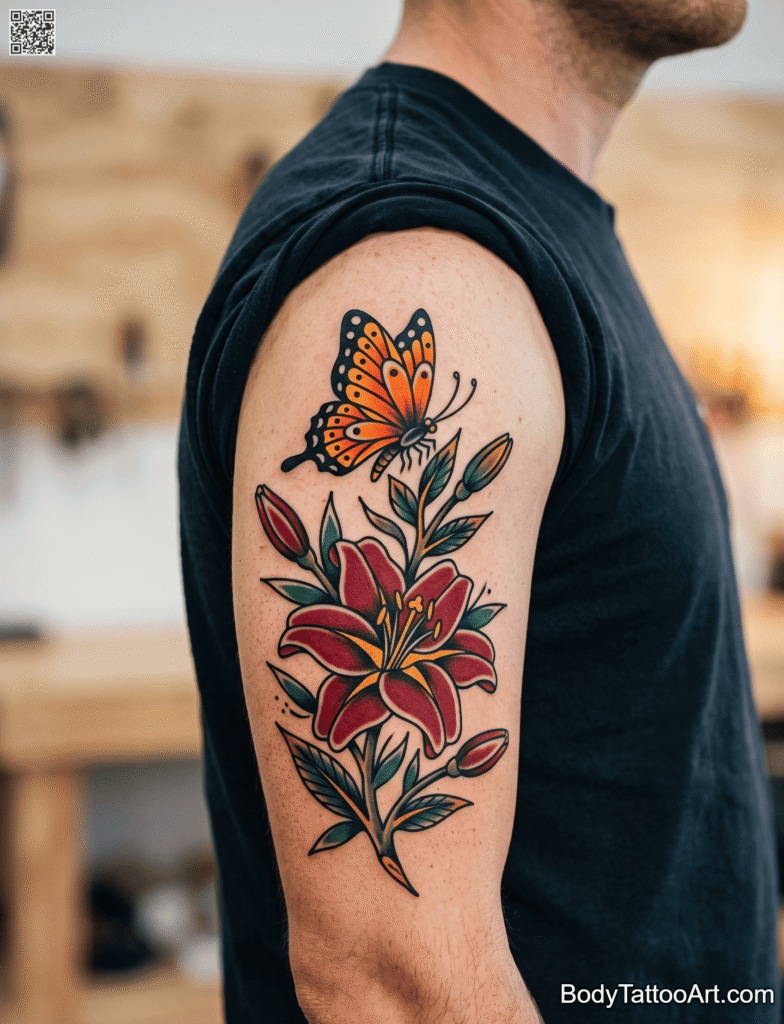
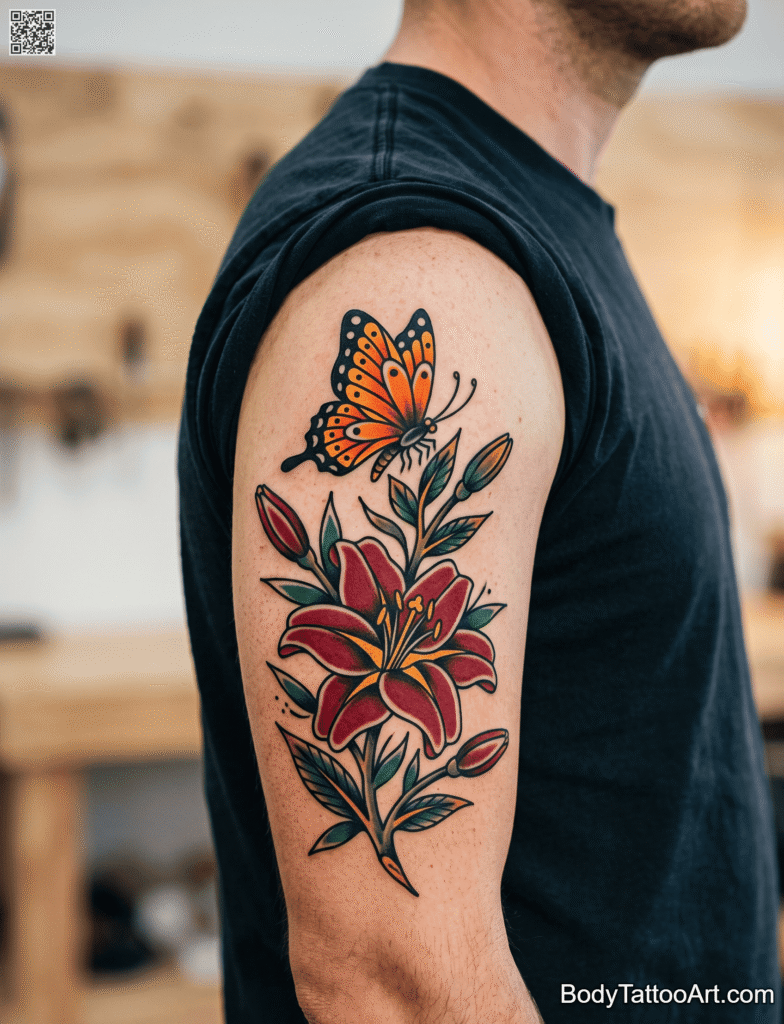
Leaning into old-school tattoo style, this piece uses thick black outlines and flat saturated colors. The lily sits in deep red with a golden center, while the butterfly above it carries bright orange and black wings in a classic spread pose. There’s no attempt at realism, just strong shapes and bold contrast that reads clearly from a distance. This same bold approach shows up in the earlier rose and dragon design, proving the traditional style works just as well on softer subjects.
Placement – Upper arm or calf
Style – Traditional (American) Lily With Butterfly Tattoos
Why it stands out – The heavy outlines and flat color blocks give it a vintage tattoo parlor feel that holds up well over the years.
Ideal for – Traditional tattoo fans, bold style lovers, people wanting a design with strong visual clarity
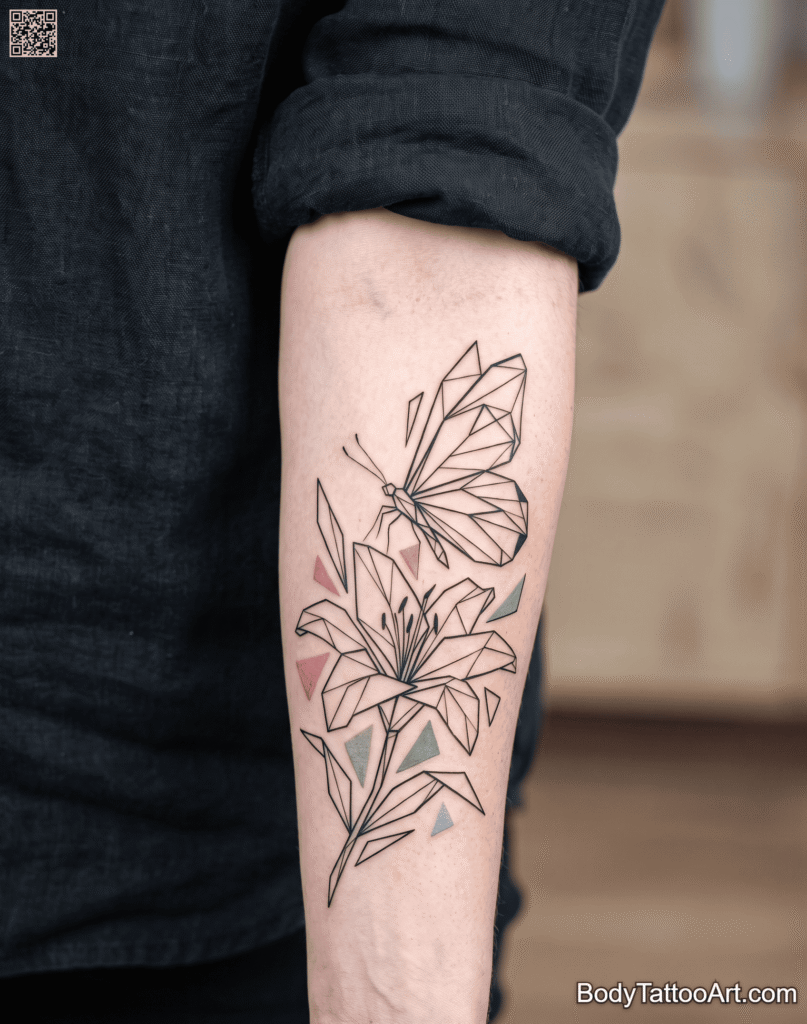
Both the lily and butterfly are broken into angular geometric shapes here, like the whole image was cut into triangles and reassembled at slightly shifted angles. The palette stays mostly black lines, with a few triangles filled in muted color for contrast. It’s a modern, almost digital take on a classic pairing, similar in spirit to the geometric hummingbird and lily design covered before.
Placement – Forearm
Style – Geometric abstract Lily With Butterfly Tattoos
Why it stands out – Breaking the shapes into triangles gives the piece a structured, architectural feel that most floral tattoos don’t have.
Ideal for – Modern art lovers, geometric tattoo fans, people wanting something distinct
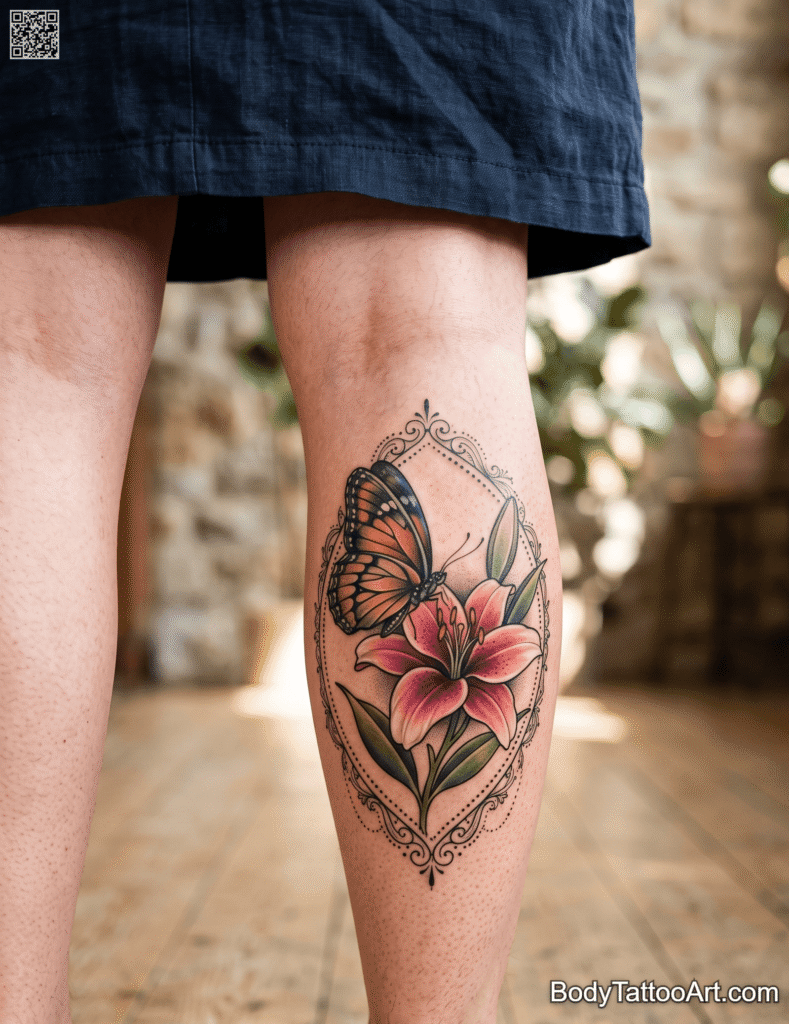
This piece takes the boldness of traditional tattooing and adds finer detail with a decorative frame. A butterfly rests beside a lily, both shaded in soft gradients instead of flat color, with the whole scene sitting inside a thin border made of small dots and delicate line patterns. Anyone who liked the ornamental hummingbird design from an earlier post will recognize the same finishing touch here.
Placement – Calf or collarbone
Style – Neo-traditional Lily With Butterfly Tattoos
Why it stands out – The decorative border gives the piece a finished, framed quality, making it feel like a small piece of art rather than just a tattoo.
Ideal for – Neo-traditional fans, people who like decorative detail, anyone wanting a design that feels complete on its own
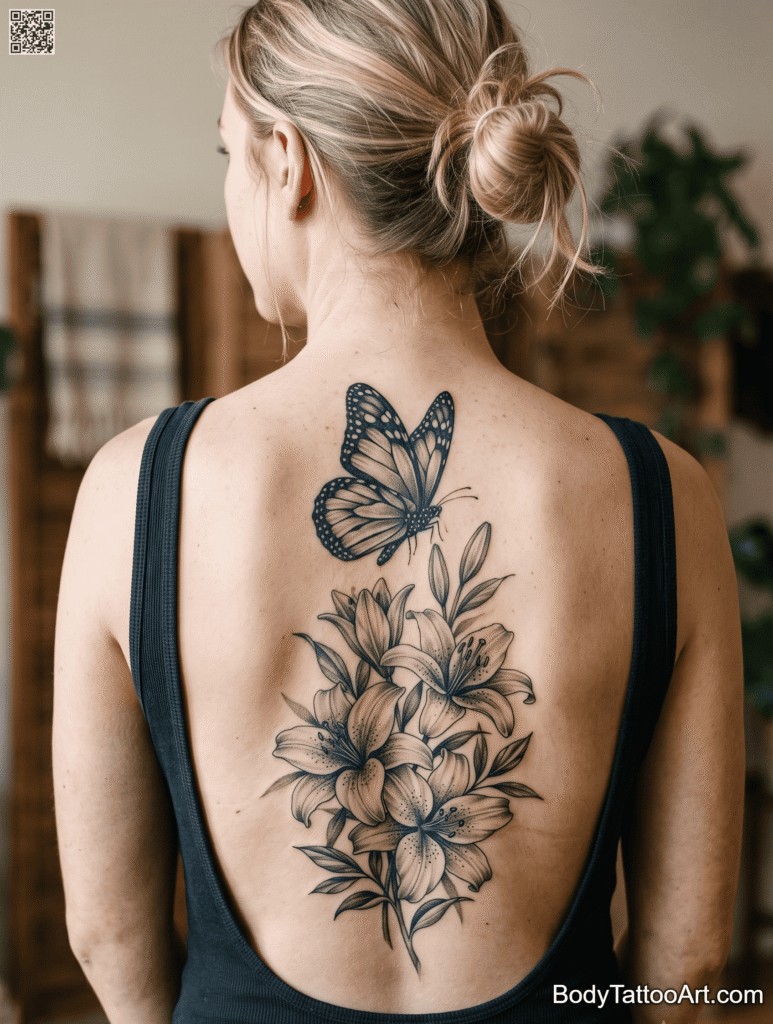
A large vertical piece running along the spine, this design shows a butterfly descending toward a cluster of lilies below. Everything stays in grey-wash tones, no color at all, just detailed shading that gives real weight to both the wings and petals. The vertical layout gives the tattoo a sense of movement flowing down the body.
Placement – Spine
Style – Grey-wash realism Lily With Butterfly Tattoos
Why it stands out – The vertical composition uses the spine’s natural line to build a sense of downward motion, something horizontal designs rarely achieve.
Ideal for – Collectors of large detailed pieces, fans of black and grey work, people who want the tattoo to follow the body’s shape
Lily with butterfly tattoos bends easily into almost any style, from a barely-there fine line piece tucked behind the ear to a full grey-wash scene running down the spine. The butterfly’s wing shape gives artists room to experiment in ways a solo flower tattoo can’t, whether that means bold traditional color or a delicate one-line outline. For more floral inspo, also check Rose with Butterfly, Butterfly with Lotus and Sunflower with Butterfly.
Anyone still comparing this pairing to other combinations, like the earlier lily and hummingbird design or the rose and snake piece, will find the butterfly brings a lighter, quieter energy of its own. Whichever version someone picks, the mix of a still flower and a creature built around change makes for a tattoo that carries a little more depth than it first lets on.
Choosing between these nine designs often comes down to lifestyle as much as taste. Someone who spends a lot of time in professional settings might lean toward the fine line wrist piece or the one-line design behind the ear, since both stay easy to cover when needed. On the other hand, someone drawn to bold, visible art might go straight for the traditional color block or the full garden scene, both of which are built to be seen rather than hidden.
It’s also worth remembering that placement affects healing just as much as it affects looks. Areas like the ribcage and spine tend to be more sensitive during the tattooing process, while spots like the forearm or upper arm are usually easier to sit through. Anyone weighing these nine ideas should think through both how the tattoo will look years down the line and how comfortable the session itself is likely to be before booking a final design.
Deciding between these ten ideas often comes down to how visible someone wants the tattoo to be on a daily basis, and how much attention they’re comfortable drawing. Those who need something easy to keep private, whether for work reasons or just personal preference, might lean toward the fine line wrist piece or the minimalist design tucked behind the ear, both of which stay small enough to go unnoticed unless someone’s looking closely.
On the other hand, anyone who wants a tattoo that’s meant to be seen and talked about would probably get more satisfaction out of the bold traditional color block or the full garden scene stretched across the back, since both are built to command attention rather than blend in.
Healing time and comfort during the actual session matter just as much as the final look, and they’re often the part people forget to think through until they’re already in the chair. Spots like the shoulder blade and spine tend to be more sensitive, partly because of thinner skin and closer proximity to bone, while areas like the forearm and upper arm are generally easier to sit through for longer sessions.
Taking a little time to weigh both the visual impact of a design and the realities of the tattooing process itself will make it much easier to land on the right choice from this list, rather than picking based on looks alone and being caught off guard by the session length or discomfort later.