Physical Address
304 North Cardinal St.
Dorchester Center, MA 02124
Physical Address
304 North Cardinal St.
Dorchester Center, MA 02124

Koi fish tattoos have been a staple of tattoo culture for centuries, and it’s easy to see why. The long, flowing body of a koi lends itself beautifully to the curves of the human form. Whether it’s a single fish rendered in black ink or a pair of koi swirling in vivid colour, these tattoos have a natural sense of movement that very few other designs can match.
What makes koi fish tattoos truly special is how versatile they are. They work across a massive range of styles — from hyper-realistic Japanese-inspired pieces to minimalist fine line sketches. They can be small enough to sit on a wrist or large enough to take over an entire back. That range is exactly why koi tattoos have stayed popular across so many generations and cultures.
This list covers 27 different koi fish tattoo ideas, each one visually distinct from the next. No two designs here look the same — different styles, different compositions, different placements. Whether someone is getting their first tattoo or adding to a growing collection, there’s something here worth bookmarking.
Koi fish have deep roots in East Asian culture, particularly in Japan and China. In Japanese tradition, koi (also written as 鯉) are associated with perseverance, good fortune, and strength. The fish is often depicted swimming upstream — a metaphor for pushing through adversity and coming out stronger on the other side.
In Chinese culture, koi are connected to abundance and success. Paired koi — often in a yin and yang arrangement — represent harmony and balance between opposing forces.
The colour of a koi fish also carries meaning. Red and orange koi are often linked to love and courage. Black koi represent transformation. Gold koi symbolise wealth. White koi with red markings — the classic Kohaku variety — are considered the most prestigious in Japanese koi culture.
For a deeper look at the cultural history of koi fish, visit the Wikipedia page on Nishikigoi — the ornamental carp that inspired centuries of art, folklore, and now, some of the most striking tattoo designs in the world.
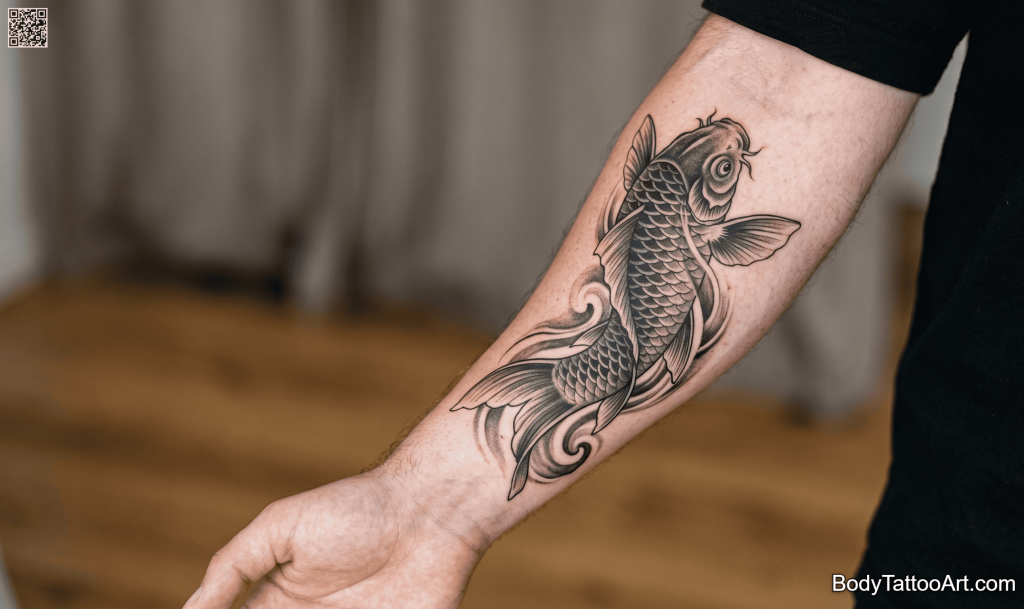
A single koi fish is rendered entirely in black and grey, with smooth gradient shading across its scales. The tail fans out behind it like soft smoke, and the fins are traced with clean, deliberate linework. There’s no background — just the fish floating against bare skin, which makes the form pop even more.
Placement: Forearm
Style: Black and grey realism Koi Fish Tattoos
Why it stands out: The absence of a background forces all attention onto the fish itself. Every scale catches the light differently, giving the piece real depth without visual clutter.
Ideal for: Minimalist tattoo lovers who still want detail, first-timers going for something bold but clean.
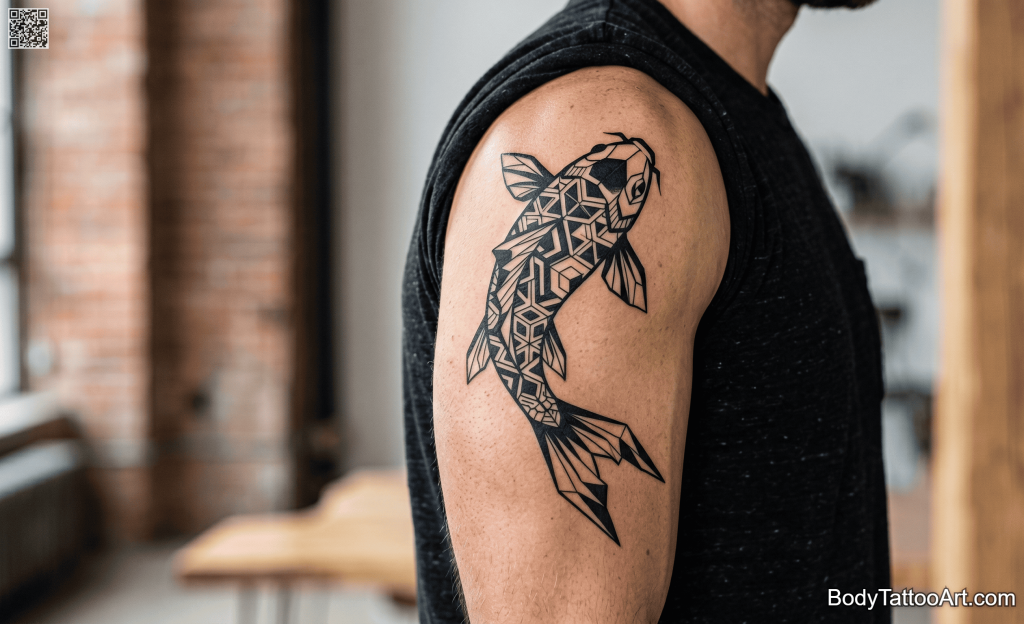
Instead of soft, organic scales, this koi is built from repeating triangles and hexagons. The body is made up of angular geometric shapes that lock together like a mosaic. The outline is clean and precise, with thin black lines dividing each geometric section. The overall silhouette is still clearly a koi, but the interior is entirely abstract.
Placement: Upper arm / bicep
Style: Geometric blackwork Koi Fish Tattoos
Why it stands out: The contrast between the recognisable fish shape and the entirely geometric interior creates a striking visual tension. It reads as modern and architectural.
Ideal for: Fans of abstract tattoos, people who want something that bridges traditional subject matter with contemporary design. Apart from Koi Fish Tattoos, popular shark tattoo styles and trends are gaining traction among tattoo enthusiasts and ocean lovers alike. Many individuals are opting for detailed designs that highlight the majesty and power of these creatures. In addition, some artists are incorporating vibrant colors and unique patterns to create eye-catching interpretations that stand out.
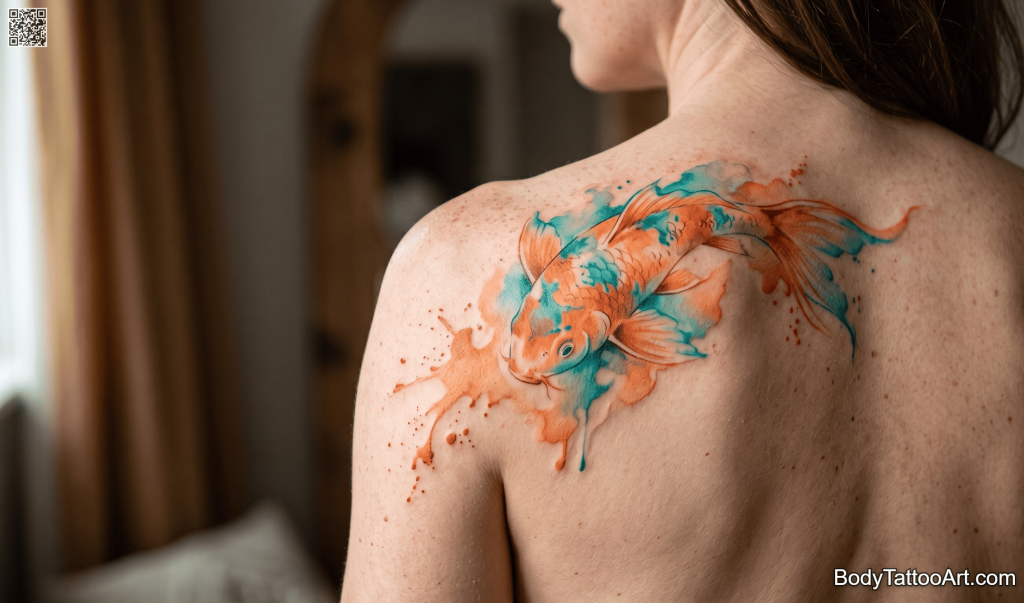
Loose washes of orange and teal bleed beyond the fish’s outline, giving this koi an almost painterly quality. The core of the fish is more defined, with a few structured scale lines, but the edges dissolve into splashes of colour that spread outward. It looks like the fish is mid-swim through coloured water.
Placement: Shoulder blade
Style: Watercolour Koi Fish Tattoos
Why it stands out: The colour bleed technique makes the tattoo feel alive and in motion, even when the person is standing still. The orange-teal contrast is visually electric.
Ideal for: Colour tattoo fans, people drawn to art-inspired tattoos that break the traditional outline-first approach.
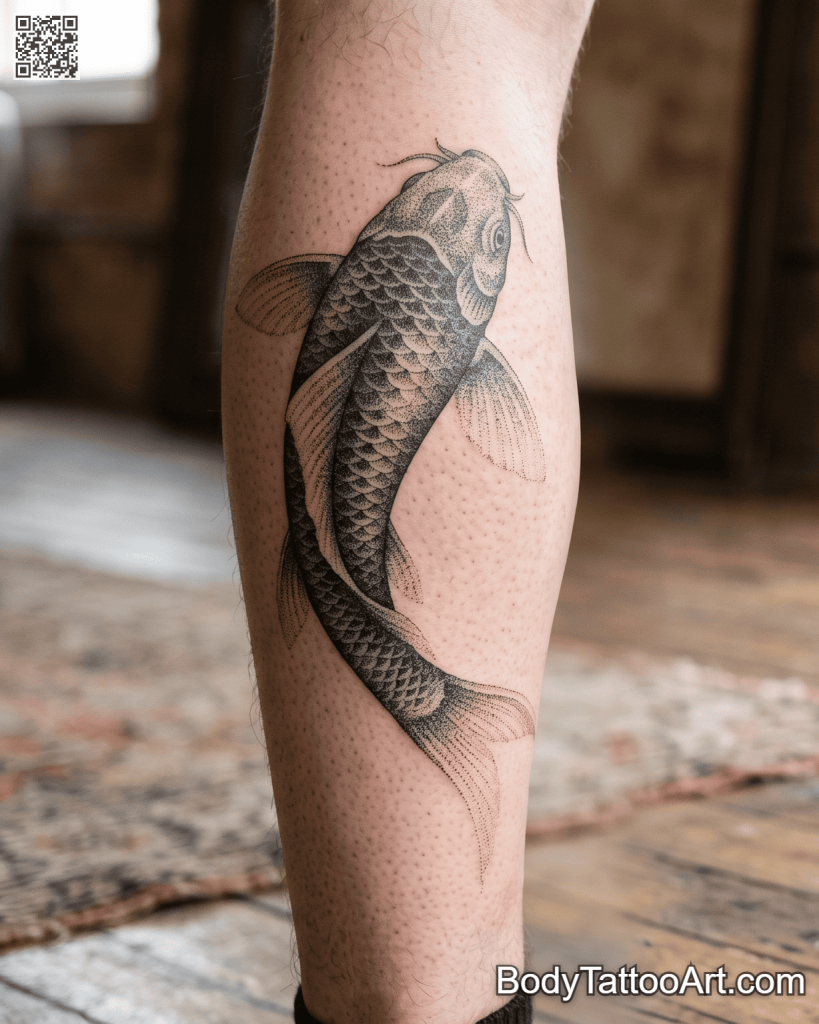
Every scale on this koi is shaded using thousands of tiny dots rather than traditional line shading. The result is a soft, almost velvety texture that gives the fish a three-dimensional quality. The fin edges are traced with particularly dense dotwork, fading out toward the tips like the fish is dissolving at its extremities.
Placement: Calf
Style: Dotwork / stippling Koi Fish Tattoos
Why it stands out: The all-dot technique gives the piece a handcrafted, almost engraved quality. It looks like something that belongs in a natural history illustration rather than a conventional tattoo.
Ideal for: Tattoo enthusiasts who appreciate fine craft, people building a nature-inspired collection.
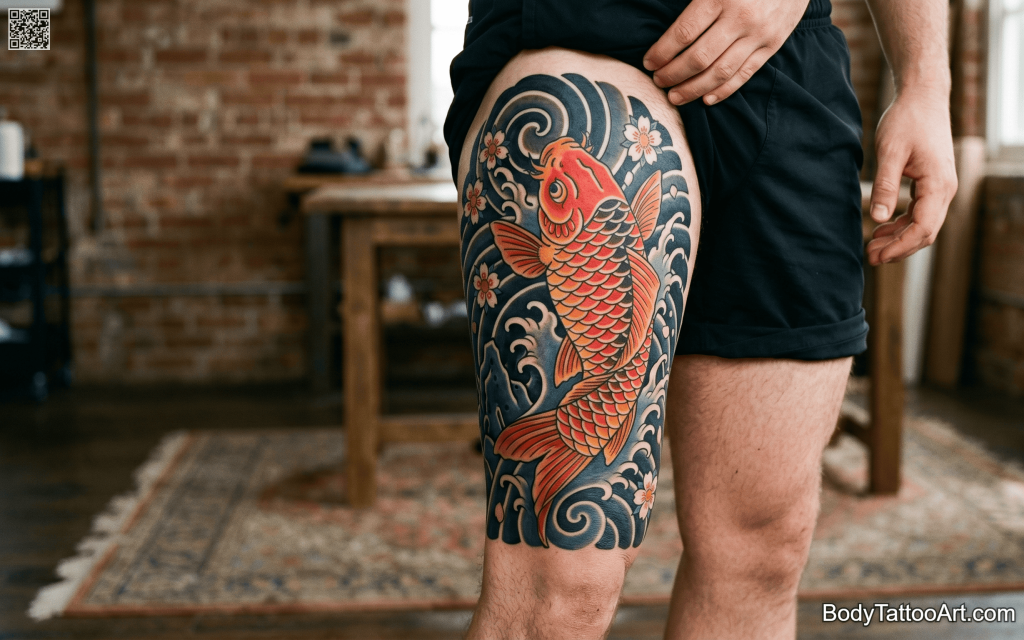
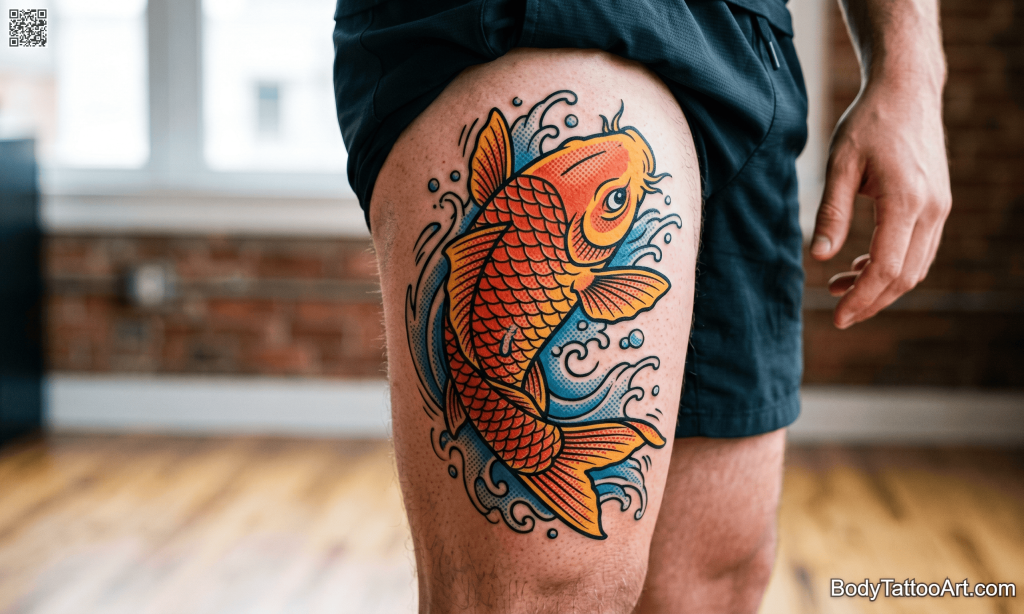
This is a classic — thick black outlines, saturated red and orange fill, and stylised wave patterns in the background. The scales are bold and clearly defined, each one outlined individually. The composition follows traditional Japanese tattooing conventions, with a strong sense of upward movement and visual weight at the centre.
Placement: Full thigh
Style: Traditional Japanese (Irezumi-inspired) Koi Fish Tattoos
Why it stands out: There’s a reason this style has endured for generations. The bold linework and flat colour fill are visually powerful and age beautifully compared to softer techniques.
Ideal for: Fans of traditional and neo-traditional styles, people building Japanese-themed sleeves or leg pieces.
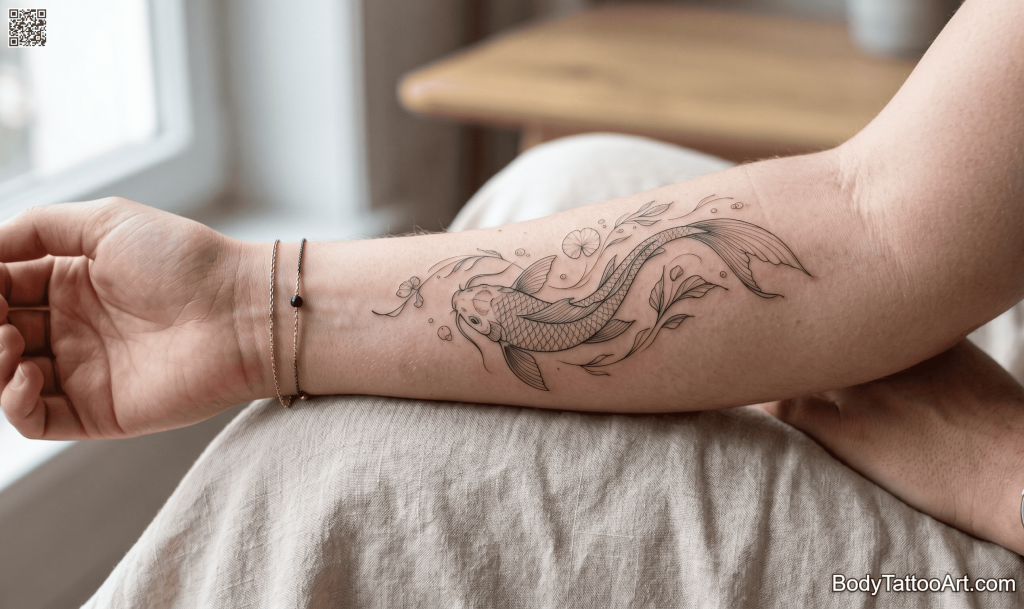
The linework here is almost impossibly fine — hair-thin lines trace the body of the koi with surgical precision. Small botanical elements like leaves and lily pads are scattered around the fish, drawn in the same delicate line style. The whole piece looks like a botanical illustration come to life.
Placement: Inner wrist / inner forearm
Style: Fine line Koi Fish Tattoos
Why it stands out: At this scale, the precision of the linework is what elevates the piece. Every detail is intentional and controlled, making it feel precious rather than understated.
Ideal for: Minimalists, people who want something delicate and wearable for professional settings.
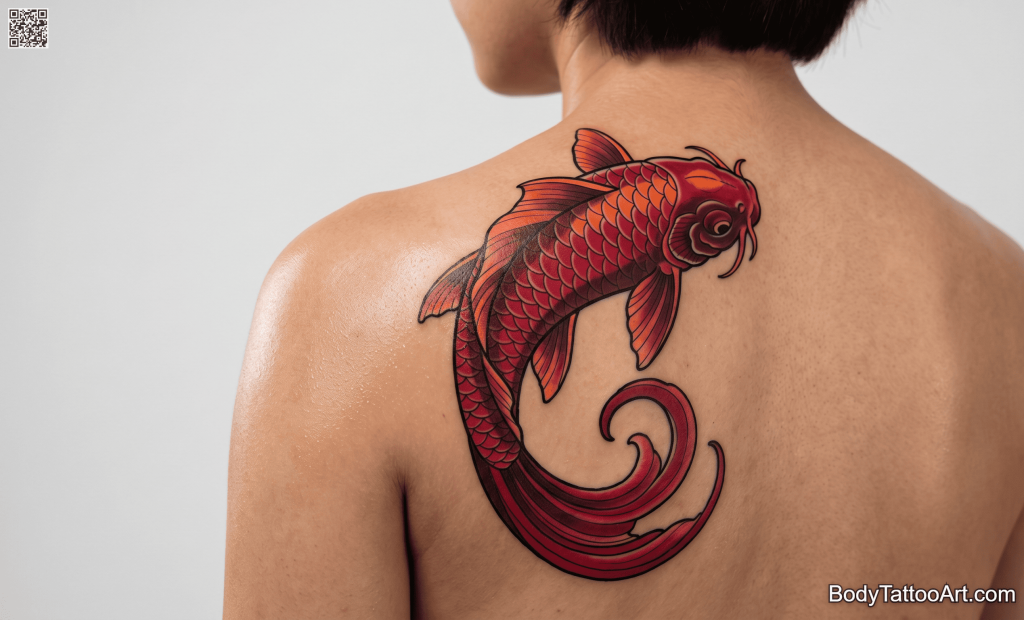
Neo-traditional takes the bold outlines of traditional tattooing but adds more refined shading and subtle colour gradients. This red koi has a solid crimson body with orange highlights and deep burgundy shadow tones. The linework is thick at the outlines but narrows at the fins. There’s a slight art nouveau quality to the way the tail curls.
Placement: Upper back / shoulder
Style: Neo-traditional Koi Fish Tattoos
Why it stands out: The tonal range within the red creates dimension that flat traditional colouring doesn’t achieve. The art nouveau curve on the tail keeps it from feeling like a standard koi piece.
Ideal for: Colour tattoo lovers, people who want traditional boldness with more painterly execution.
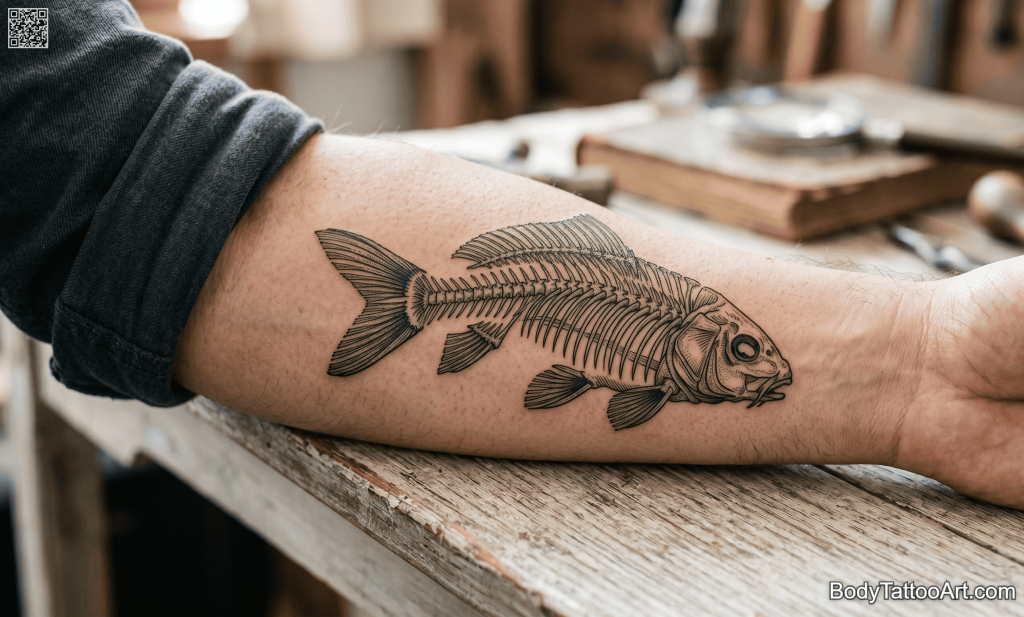
Instead of a living koi, this design shows the detailed anatomical skeleton of a koi fish — vertebrae, rib structure, fin bones — rendered in a precise etching style. The lines are fine and even, like something out of a Victorian naturalist’s notebook. It’s unusual, precise, and genuinely original.
Placement: Forearm / shin
Style: Etching / engraving Koi Fish Tattoos
Why it stands out: The memento mori angle gives this koi tattoo a completely different energy from every other design on this list. It’s intellectual and visually striking without relying on ornamental elements.
Ideal for: Collectors who like unusual concepts, science or biology enthusiasts, people who want something that sparks conversation.
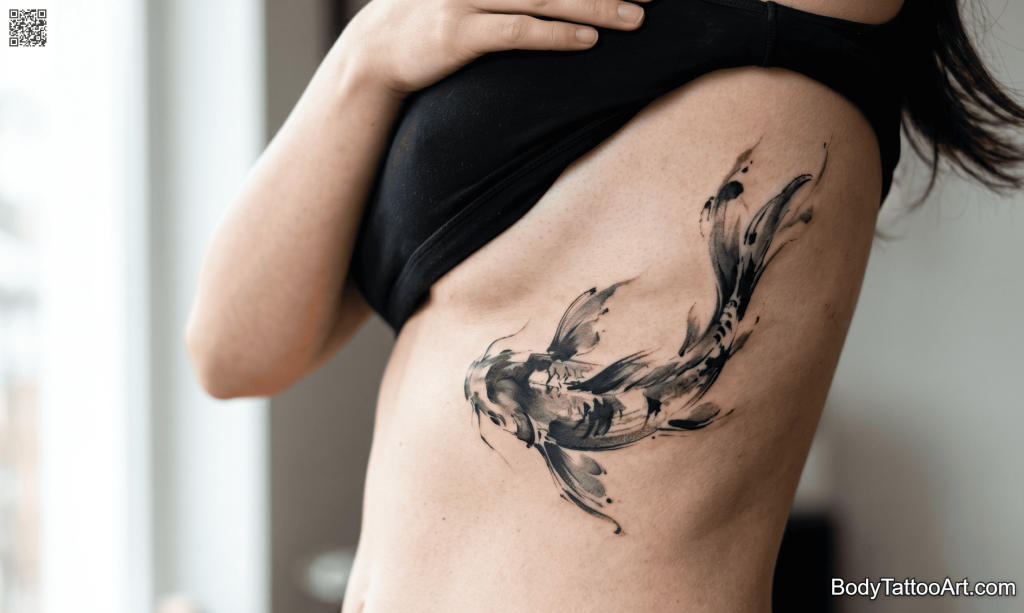
Inspired by Japanese sumi-e painting, this koi is made up of confident, gestural brushstrokes rather than precise outlines. The fish is instantly recognisable but loosely rendered — there’s intentional incompleteness, with parts of the body implied rather than fully drawn. It feels spontaneous and energetic.
For those exploring Japanese-inspired tattoo art beyond koi, these dragon tattoo designs draw on similar artistic traditions with equally bold visual energy.
Placement: Ribcage / side torso
Style: Sumi-e / abstract brushwork Koi Fish Tattoos
Why it stands out: The looseness is the point. This tattoo doesn’t try to be perfect — it tries to be expressive. The confidence of each brushstroke is what gives it character.
Ideal for: Art lovers, people who appreciate traditional Japanese painting aesthetics, those who want something that looks hand-made in the truest sense.
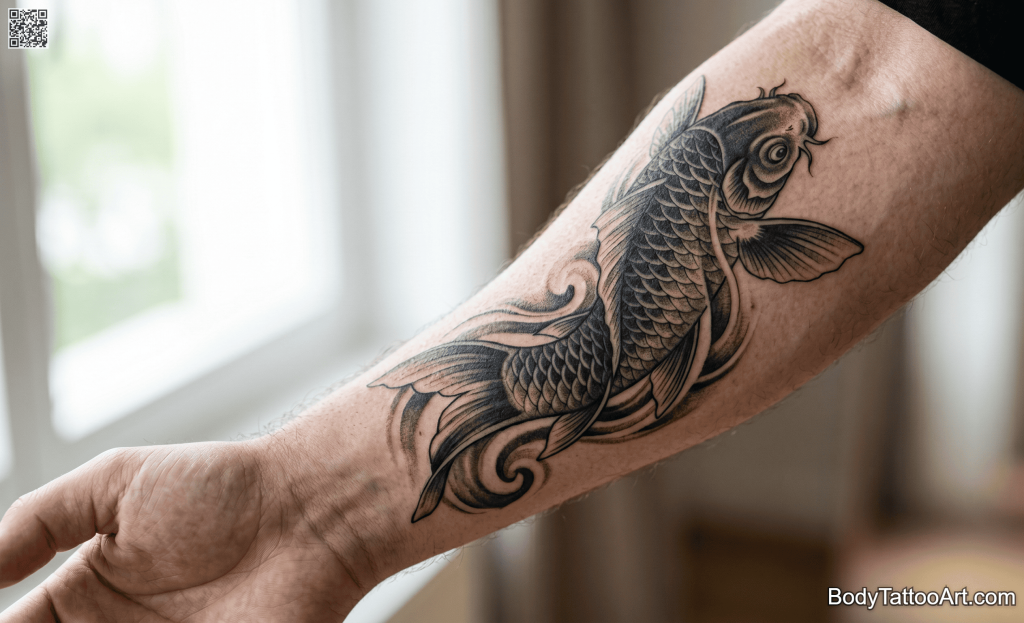
The body of this koi is filled entirely with solid black ink, except for the scales — each one is left as bare skin, creating a negative space pattern across the fish’s body. The contrast between the dense black fill and the skin-coloured scale shapes is dramatic and graphic.
Placement: Outer forearm
Style: Blackwork with negative space Koi Fish Tattoos
Why it stands out: Negative space work requires exceptional planning and precision. When done well, it reads as incredibly sophisticated — and this execution delivers.
Ideal for: Fans of bold blackwork, people who want high visual impact without colour.
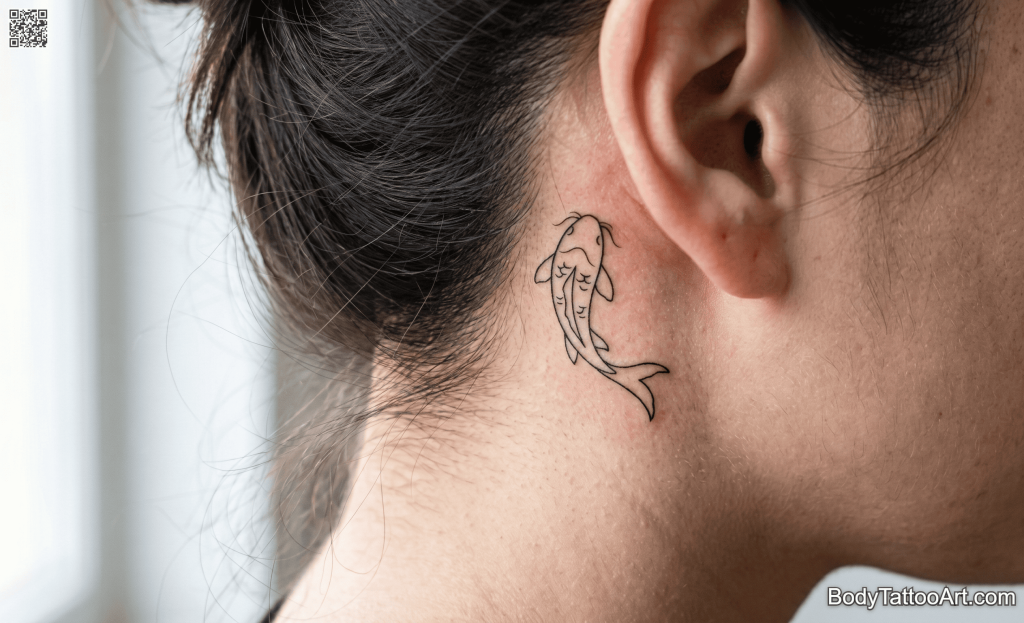
Small, precise, and quietly striking — this tiny koi sits just behind the ear, the tail following the curve of the skull. The design is pared back to its essentials: clean outline, a few scale lines, minimal fin detail. At this size, the placement does the heavy lifting.
Placement: Behind the ear
Style: Fine line / micro tattoo Koi Fish Tattoos
Why it stands out: Placement is everything here. The way the tail follows the curve of the skull makes the tattoo feel like it was designed for exactly this spot.
Ideal for: Micro tattoo fans, people who want something personal and discreet, those adding small details to a larger body of work.
The koi itself is drawn in a naturalistic style with smooth shading, but the water around it is represented through repeating geometric tessellations — interlocking shapes that suggest movement and flow without depicting literal water. The contrast between the organic fish and the mathematical background creates an interesting visual tension.
Placement: Chest / pectoral area
Style: Mixed — realism and geometric Koi Fish Tattoos
Why it stands out: The style contrast between the organic koi and the structured background makes this composition feel genuinely original. It’s a meeting point between two tattoo traditions.
Ideal for: Design-focused tattoo enthusiasts, those who want a piece that plays with concept as much as aesthetics.

Rendered entirely in white ink on darker skin, this koi is subtle and ghostly. The design only becomes fully visible at certain angles and in certain lighting, creating a tattoo that reveals itself gradually. The fine linework and scale texture catch the light and create a shimmer effect.
Placement: Inner bicep
Style: White ink Koi Fish Tattoos
Why it stands out: White ink tattoos are a commitment to subtlety. This design leans into that — it’s intentionally understated, meant for the wearer more than the audience.
Ideal for: People who want private, understated tattoos, those with medium to deeper skin tones who want the white ink contrast to read.

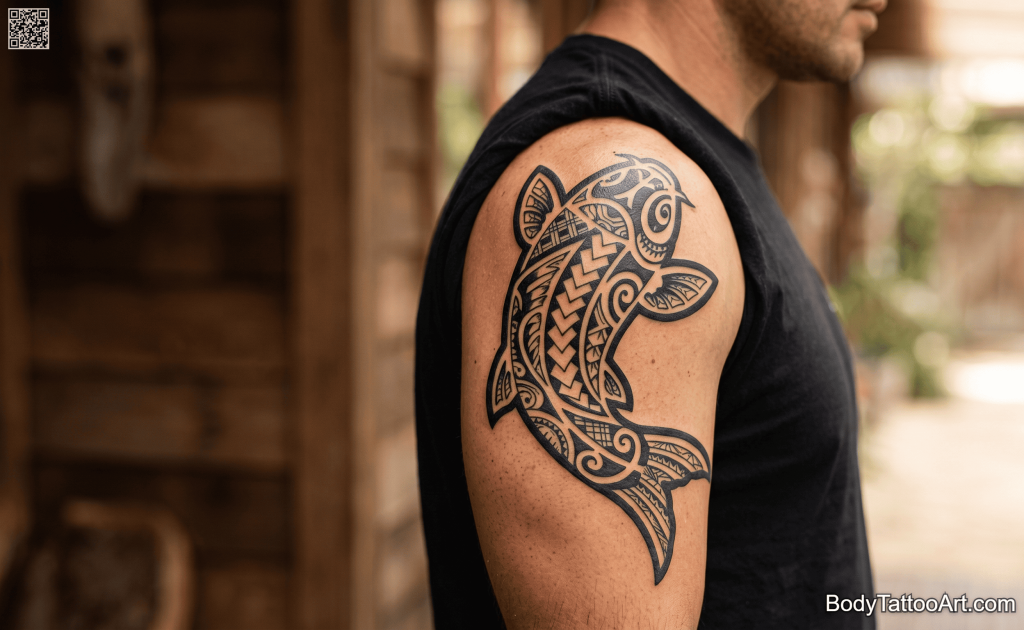
The koi’s body is composed entirely of traditional Polynesian tattoo patterns — koru spirals, chevrons, and geometric fill shapes. The fish silhouette is clearly defined by a bold outer edge, but everything inside follows the logic of Polynesian tribal design rather than representational scale drawing.
Placement: Shoulder and upper arm
Style: Polynesian tribal Koi Fish Tattoos
Why it stands out: This design honours two distinct tattoo traditions simultaneously. The koi form is universally recognised, and the Polynesian interior patterning carries its own independent cultural depth.
Ideal for: People with connections to Pacific Islander heritage, those who want bold blackwork with cultural resonance.
Bold outlines, flat colour panels, and a dynamic pose — this koi looks like it jumped off the page of a graphic novel. The shading is done with flat halftone dots rather than gradient blending, and the composition has real motion to it, with the fish caught mid-leap.
Anyone who loves illustrative tattooing will find equally dynamic designs in these eagle tattoo ideas — bold, powerful compositions that share the same graphic energy.
Placement: Outer thigh
Style: Illustrative / comic book Koi Fish Tattoos
Why it stands out: The flat halftone shading technique makes this look genuinely different from every other koi tattoo approach. It’s playful, graphic, and unmistakably modern.
Ideal for: Pop art fans, comic book enthusiasts, people who want something with personality and energy.
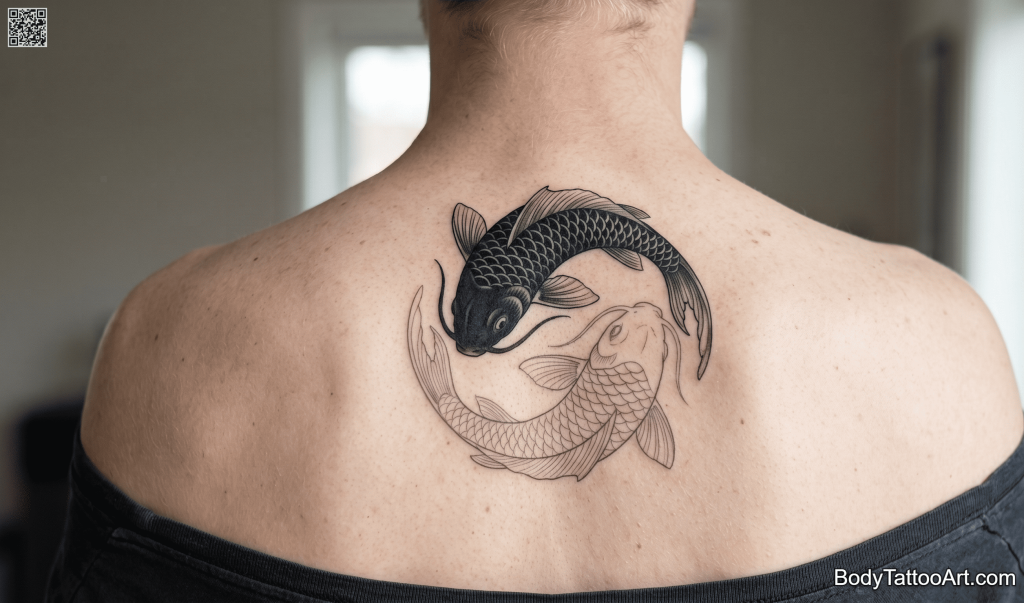
Two koi fish curl around each other in the classic yin-yang arrangement — one black, one rendered in fine grey linework. The fish don’t just mirror each other; their bodies define the negative and positive space of the design. The circular composition sits perfectly on rounded body areas.
Placement: Back of the neck / upper back
Style: Blackwork and fine line combined Koi Fish Tattoos
Why it stands out: The yin-yang arrangement is a well-known concept, but executing it purely through fish bodies — without the standard circular border — gives it a fresh and organic feel.
Ideal for: Those drawn to concepts of balance, people who want a symmetrical tattoo with visual sophistication.
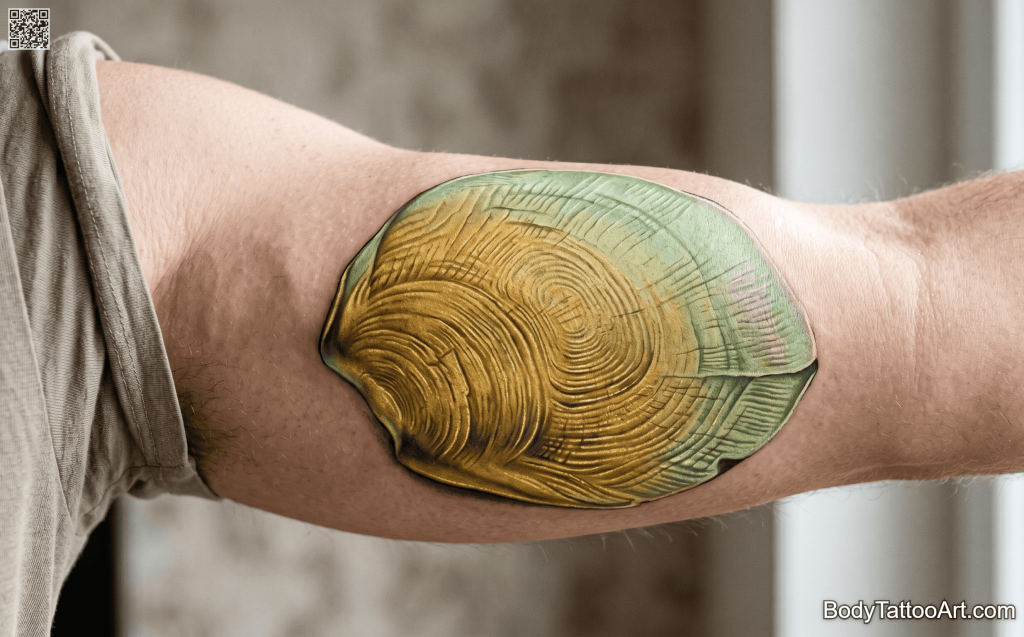
Rather than tattooing the whole fish, this design zooms in on a single oversized koi scale — rendered in incredible detail with gradient shading, visible texture lines, and a subtle iridescent colour shift from gold to green. It’s conceptual and unusual, and it works precisely because of its unexpected framing.
Placement: Bicep / upper arm
Style: Hyper-realism Koi Fish Tattoos
Why it stands out: The concept of isolating a single element of a koi and making that the entire tattoo is genuinely unusual. The hyper-realistic rendering makes it even more striking.
Ideal for: Collectors looking for conversation pieces, artists and designers drawn to abstracted close-up imagery.
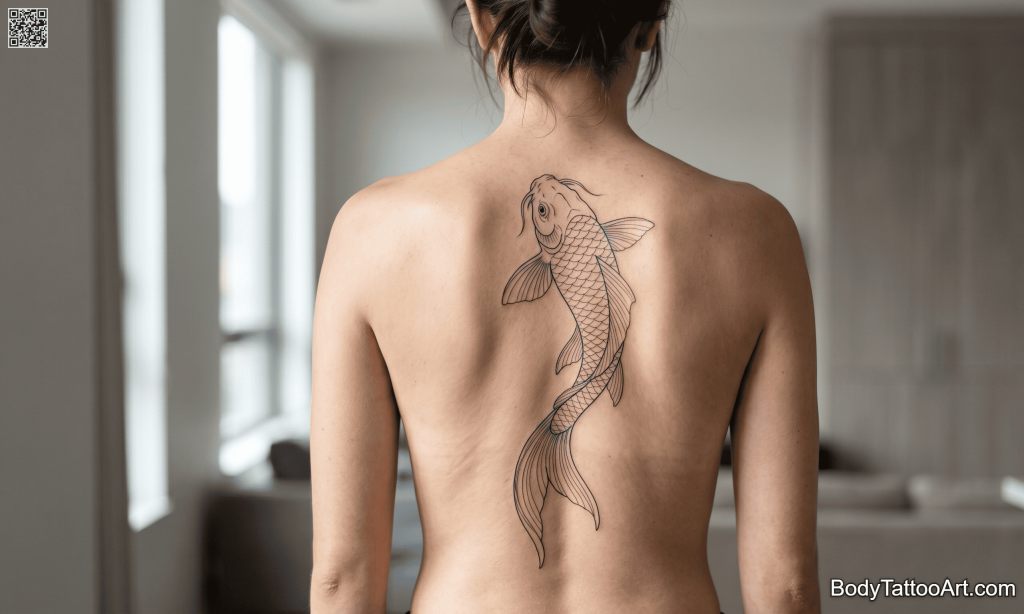
A single koi fish is oriented vertically, swimming upward along the spine. The body follows the natural column of the back, with the tail resting at the base and the head reaching toward the neck. Fine linework, no background — just the long, elegant form of the fish aligned perfectly with the body’s central axis.
Placement: Spine / centre back
Style: Fine line Koi Fish Tattoos
Why it stands out: Spine tattoos work best when the design echoes the line of the body, and a koi fish is one of the most natural fits for this placement. The vertical composition is clean and architecturally satisfying.
Ideal for: People who love placement-driven tattoos, those looking for a large-scale piece that feels sleek rather than heavy.
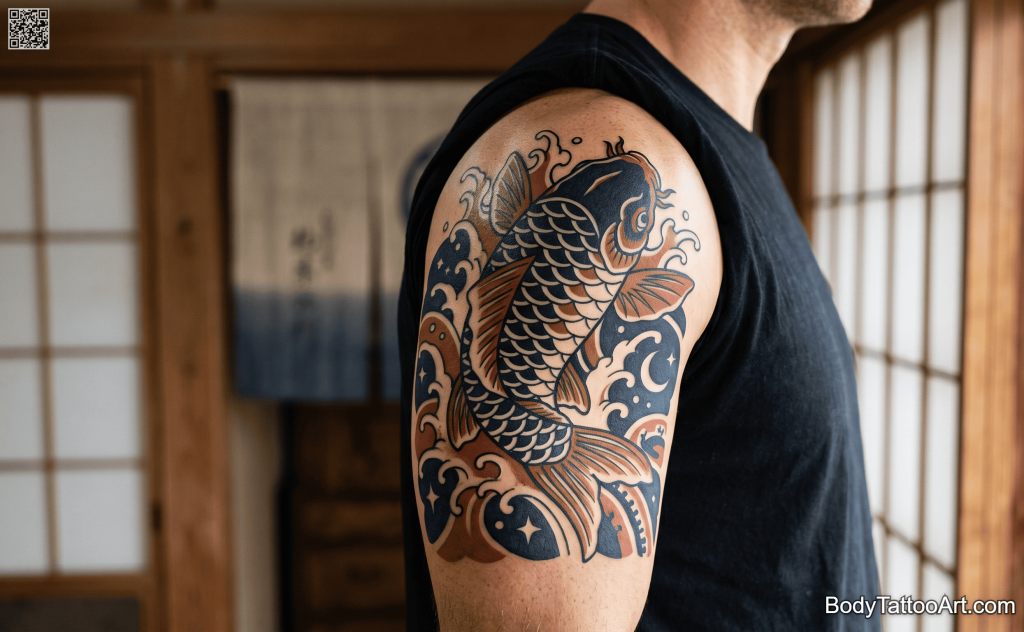
Inspired by traditional Japanese woodblock prints — think Hokusai — this koi is rendered in flat colour blocks separated by bold outlines. The colour palette is deliberately limited: deep navy, rust orange, and cream. The scale pattern is stylised and geometric, each row of scales a flat crescent shape.
For anyone drawn to traditional East Asian art aesthetics in tattoo form, these snake tattoo designs cover similar Ukiyo-e-inspired compositions with equally refined visual storytelling.
Placement: Upper arm / shoulder
Style: Japanese woodblock / Ukiyo-e inspired Koi Fish Tattoos
Why it stands out: The restricted colour palette and flat graphic style give this piece an art historical quality. It looks deliberate and culturally considered rather than decorative.
Ideal for: Art history enthusiasts, Japan-culture aficionados, collectors building an East Asian-themed body of work.
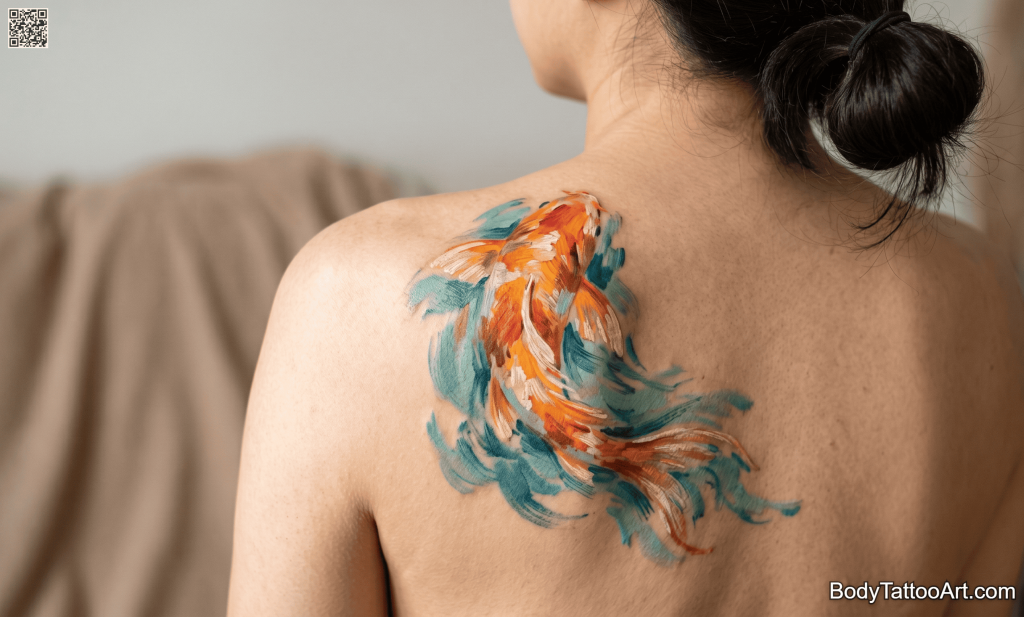
Loose, directional colour strokes build the form of this koi the way Monet might have approached water lilies — the fish is visible but rendered through layered colour rather than clean outlines. Short, choppy strokes of orange, gold, and white create the body, while cool blues and greens suggest surrounding water.
Placement: Upper back / shoulder blade
Style: Impressionist colour Koi Fish Tattoos
Why it stands out: This approach treats the skin like a canvas. The fish is secondary to the overall colour experience, which makes it feel more like wearable painting than conventional tattooing.
Ideal for: Colour tattoo enthusiasts, people with an appreciation for post-impressionist painting aesthetics.
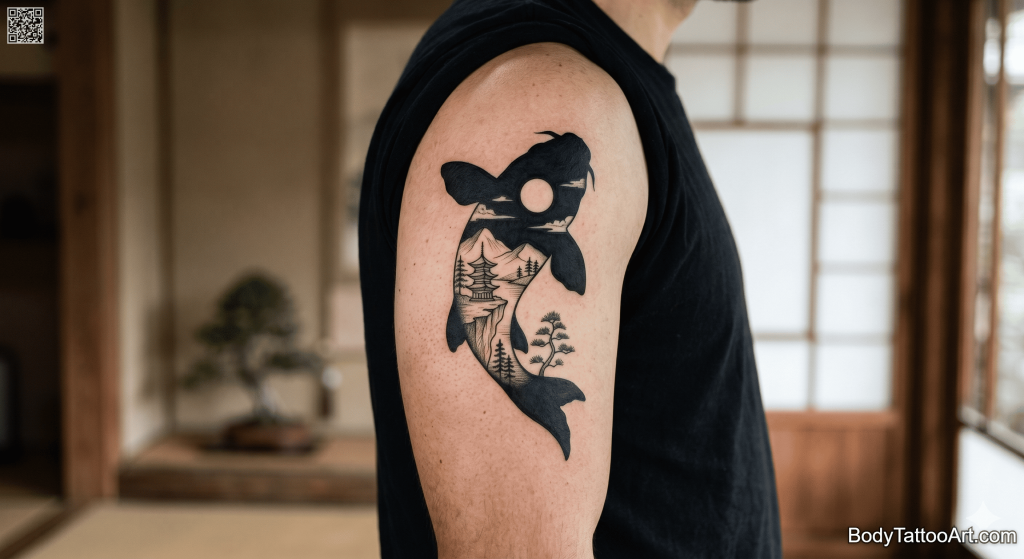
The outer shape of a koi fish acts as a window into a miniature landscape — inside the silhouette, a tiny Japanese scene unfolds: a moon, mountains, pine trees. The interior scene is rendered in fine linework while the outer silhouette is a solid bold edge. The contrast between interior detail and exterior simplicity is striking.
Placement: Upper arm
Style: Illustrative blackwork Koi Fish Tattoos
Why it stands out: The window-within-a-shape technique is visually inventive. It transforms the koi from a fish into a frame, which gives the design a narrative quality most animal tattoos don’t have.
Ideal for: Storytelling tattoo lovers, people who want depth of concept alongside visual beauty.
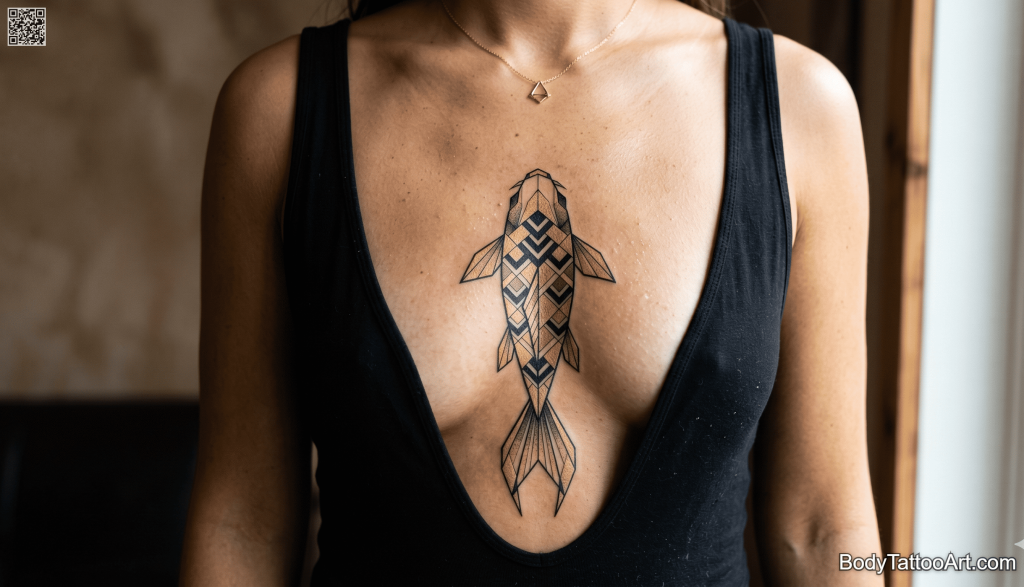
Sharp angles, gold and black geometry, and an elongated art deco sensibility transform this koi into something architectural. The fish’s body is stylised into streamlined shapes, the scales replaced with repeating chevrons and diamonds. It looks like it could be a panel from a 1920s luxury poster.
Placement: Sternum / centre chest
Style: Art deco / graphic Koi Fish Tattoos
Why it stands out: Art deco tattooing is rare, and applying it to a koi fish is genuinely original. The result is glamorous and bold without relying on conventional tattoo aesthetics.
Ideal for: Design-minded collectors, fans of 1920s visual culture, people who want something that doesn’t look like anyone else’s tattoo.
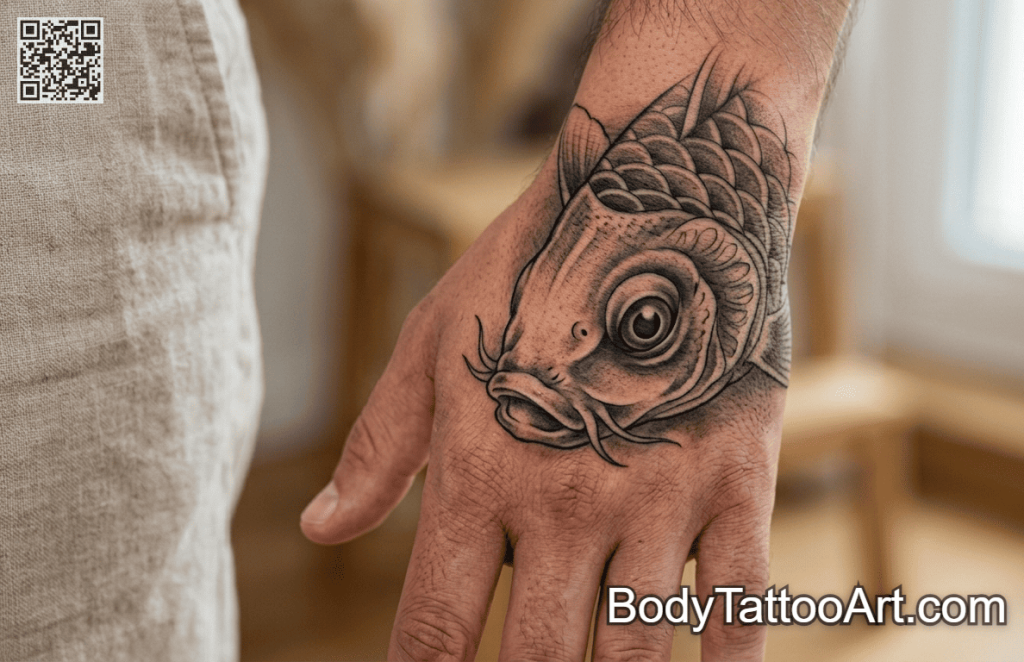
Just the face and upper body of a koi, cropped close — large expressive eye, whiskers, open mouth, and the beginning of the scale pattern. Rendered in hyper-realistic grey wash, with soft shading around the eye and fine linework on each individual scale near the head. It’s confrontational, direct, and visually powerful.
Placement: Back of hand / top of hand
Style: Hyper-realistic grey wash Koi Fish Tattoos
Why it stands out: Most koi tattoos show the full fish. Cropping to just the head gives it a portrait quality and an unusual sense of personality. The eye becomes the focal point.
Ideal for: Experienced collectors, those interested in animal portrait tattooing, people who want something unexpected for a visible placement.
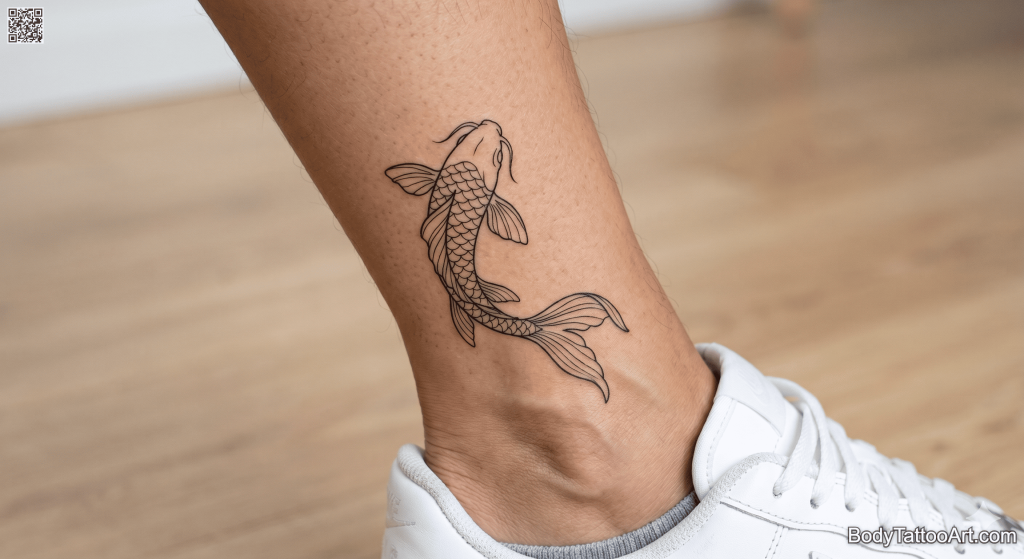
Just the outline. No fill, no shading, no colour — a precise single-line contour of a koi fish, drawn in one continuous stroke that captures the fish’s shape, scale pattern, fin detail, and tail in clean black linework. The result is graphic, minimal, and elegant.
The appeal of outline-only tattoos crosses into many different subject areas — similar restrained compositions appear in these owl tattoo ideas where the linework alone does all the heavy lifting.
Placement: Ankle / inner ankle
Style: Single-line outline / minimalist Koi Fish Tattoos
Why it stands out: Restraint is the skill here. Every line has to work twice as hard when there’s no shading to create depth. The precision of the outline is what makes or breaks a tattoo like this.
Ideal for: True minimalists, people who want something light and understated, those adding a small accent to an existing collection.
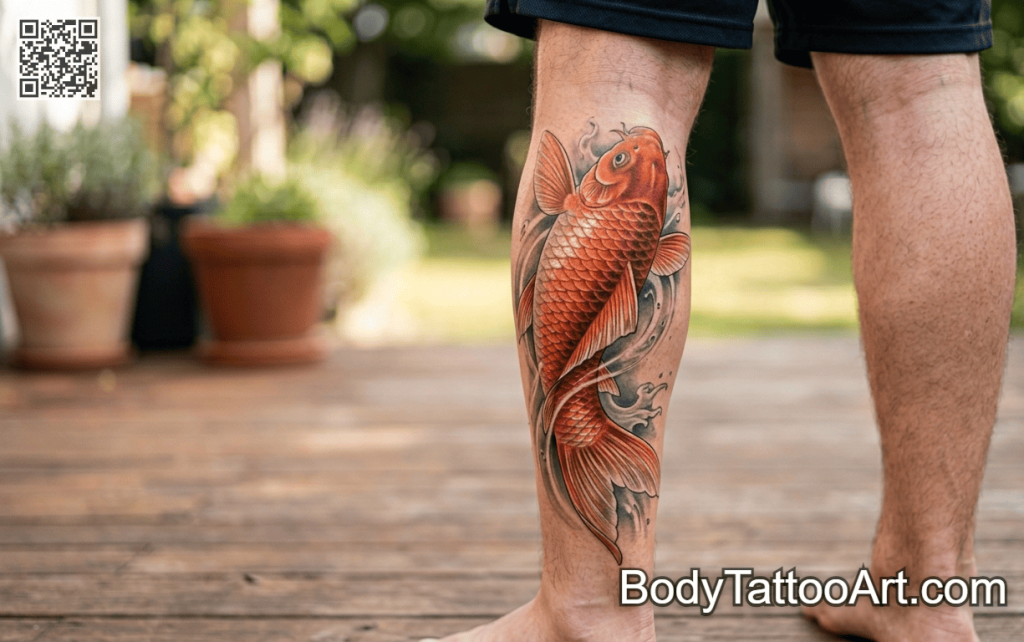
Full-colour realism — this koi looks as if it could swim off the skin. Vibrant orange scales with white highlights and deep shadow tones, transparent-looking fins with visible fin rays, and a textured underbelly. The colours shift naturally across the body, mimicking the way light hits a real koi fish in water.
Placement: Full calf
Style: Colour realism Koi Fish Tattoos
Why it stands out: Colour realism demands exceptional technique, and when executed well it’s one of the most jaw-dropping styles in tattooing. This design exists purely to showcase what’s possible when artist and client commit to full colour.
Ideal for: Tattoo enthusiasts who want a showpiece, collectors interested in high-end colour work, those with experience in the chair ready for a complex piece.
This koi exists in a surrealist dreamscape of its own body — parts of the fish transition into architectural elements, the tail becomes a staircase, a scale flips open to reveal a door. The surrealism is rendered in precise fine linework, giving the impossible elements a technical credibility that makes the whole piece more unsettling and captivating.
Placement: Full sleeve section / upper arm to elbow
Style: Surrealist fine line Koi Fish Tattoos
Why it stands out: Concept-driven tattoos like this one are rare because they require both creative vision and technical control. This design succeeds by taking the surrealism seriously rather than treating it as a novelty.
Ideal for: Art enthusiasts, people who want their tattoo to feel like a statement piece with intellectual depth.

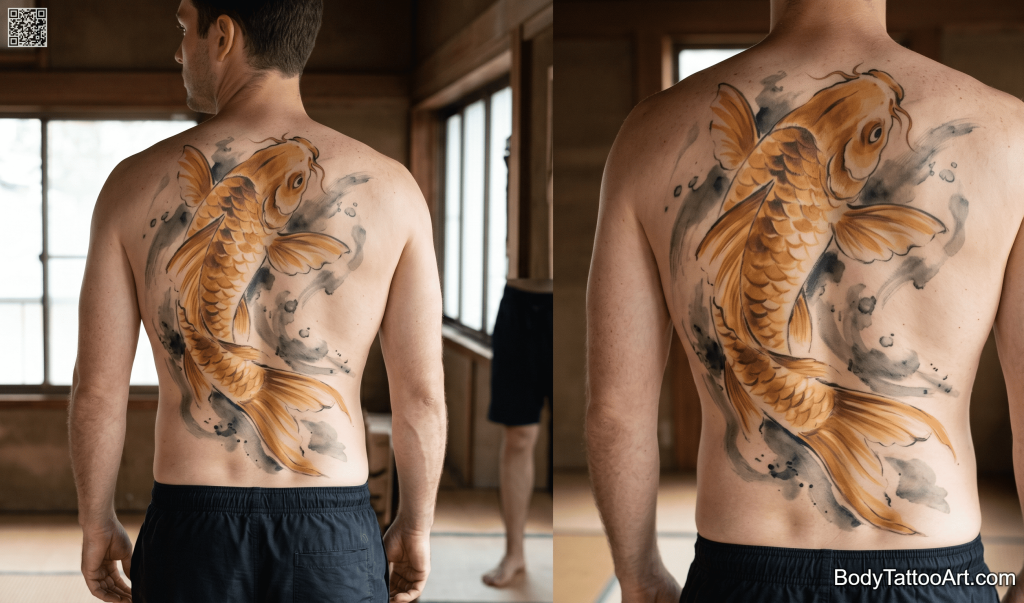
A single gold koi rendered in warm ochre and amber tones, using the controlled ink-wash technique of traditional sumi painting. The background is a loose wash of diluted black ink suggesting water, and the fish itself is painted in a single graceful sweep from head to tail. The brushwork is confident and unhurried.
Placement: Full back
Style: Sumi-e colour wash Koi Fish Tattoos
Why it stands out: Gold koi tattoos typically go the hyper-realistic or traditional Japanese route. This sumi-e approach strips everything back to the essentials of the painting tradition it draws from — and the result is quietly breathtaking.
Ideal for: Collectors ready for a large statement piece, people who want Eastern art traditions represented with genuine artistic fidelity.
Koi fish tattoos cover remarkable ground — from bold traditional Japanese compositions to hyper-minimal outlines, from colour realism masterpieces to conceptual surrealist work. What holds all 27 of these koi fish tattoo ideas together is the fish itself: a form so naturally suited to the human body that it’s been chosen by tattoo enthusiasts across continents and centuries. As with Koi fish tattoos creative dolphin ink ideas for ocean enthusiasts offer a fresh perspective on body art, celebrating the grace and beauty of marine life. Each design serves as a testament to the deep connection that many feel with the ocean, inspiring unique expressions of individuality. Embracing such themes not only showcases artistic talent but also fosters a greater appreciation for the underwater world we strive to protect.
The best koi fish tattoo is always the one that fits the person wearing it — their aesthetic, their placement preference, their relationship to the craft. Whether that’s a tiny fine-line koi behind the ear or a full-back sumi-e painting, koi fish tattoos have a version for every kind of wearer.
Anyone exploring larger tattoo collections will also find relevant inspiration in these wolf tattoo designs and these lotus flower tattoo ideas — both of which share the same balance of natural beauty and personal symbolism that makes koi tattoos so enduring.