Physical Address
304 North Cardinal St.
Dorchester Center, MA 02124
Physical Address
304 North Cardinal St.
Dorchester Center, MA 02124

There’s something quietly compelling about clover tattoos. They’re small, structured, and carry a kind of natural precision that works on just about any body part. Whether it’s a delicate single stem or a dense blackwork cluster, clover tattoos have been gaining real traction in the tattoo world — and it’s easy to see why.
Clover tattoos can be bold or whisper-soft depending on the style. They sit beautifully on small canvases like the wrist or ankle, and they scale up effortlessly for the back or thigh. This collection brings together 26 genuinely different clover tattoo ideas — different in style, composition, and mood — so there’s something here for every kind of ink lover.
The clover has been a symbol of luck, nature, and quiet resilience across cultures for centuries. The three-leaf clover is closely tied to Celtic tradition, often representing the triquetra — mind, body, and spirit. The four-leaf clover, of course, carries the universally recognised association with luck and fortune, though it also symbolises faith, hope, love, and luck in Irish folklore.
Beyond luck, clover tattoos carry a sense of rootedness — a reminder that good things can be found in ordinary places. They’re humble little plants, but they punch above their weight symbolically.
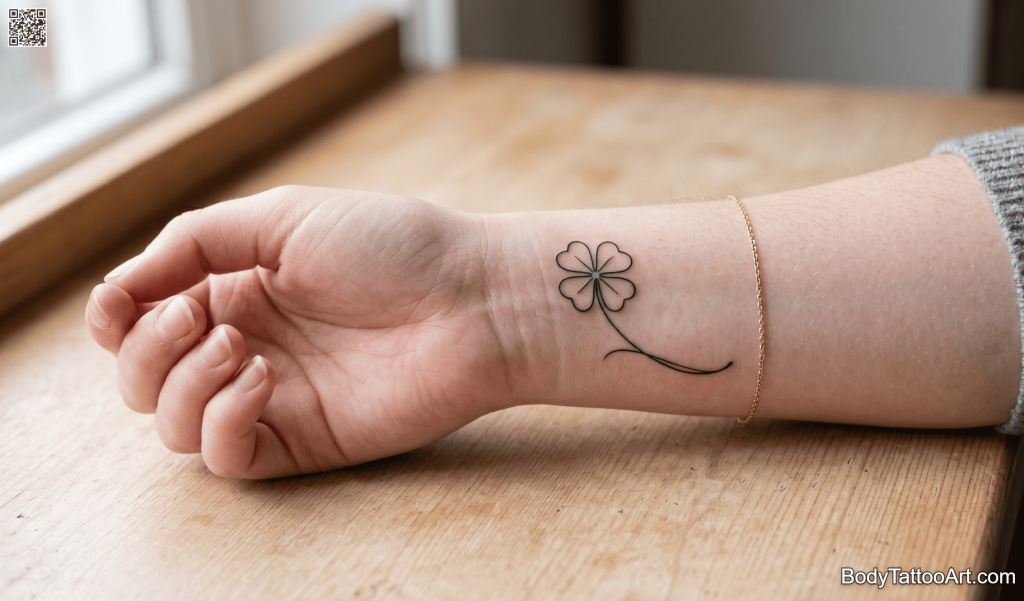
A single four-leaf clover rendered in ultra-fine linework, with clean, even outlines and no shading. Each leaf is slightly rounded at the tip, giving it a soft, botanical illustration feel. The stem is long and slightly curved — adding elegance to what could otherwise feel too simple.
Placement: Inner wrist
Style: Fine line Clover Tattoos
Why it stands out: The restraint here is the whole point. No filler, no shading — just the clean outline doing the work. It reads like something from a botanical field journal.
Ideal for: First-timers, minimalists, and people who want something that ages gracefully.
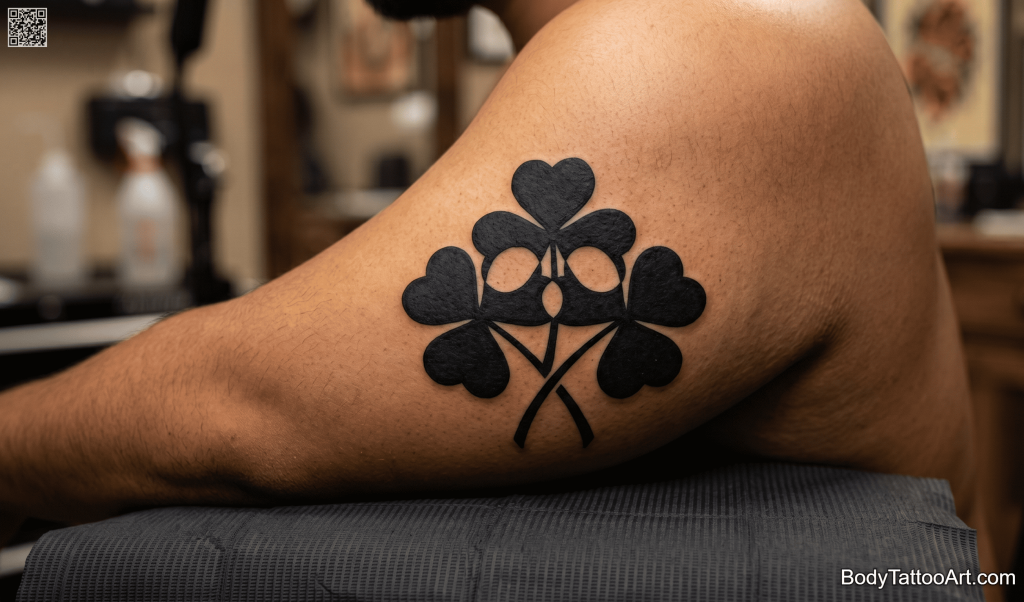
Three overlapping three-leaf clovers arranged in a dense cluster, all filled solid black. The leaves overlap slightly, creating interesting negative-space gaps between them. The stems are short and cross at the base.
Placement: Back of the upper arm
Style: Blackwork Clover Tattoos
Why it stands out: The bold contrast between the solid black and skin is striking. The overlapping composition creates depth without any shading tricks.
Ideal for: Bold style fans, blackwork collectors, people who prefer graphic over delicate.
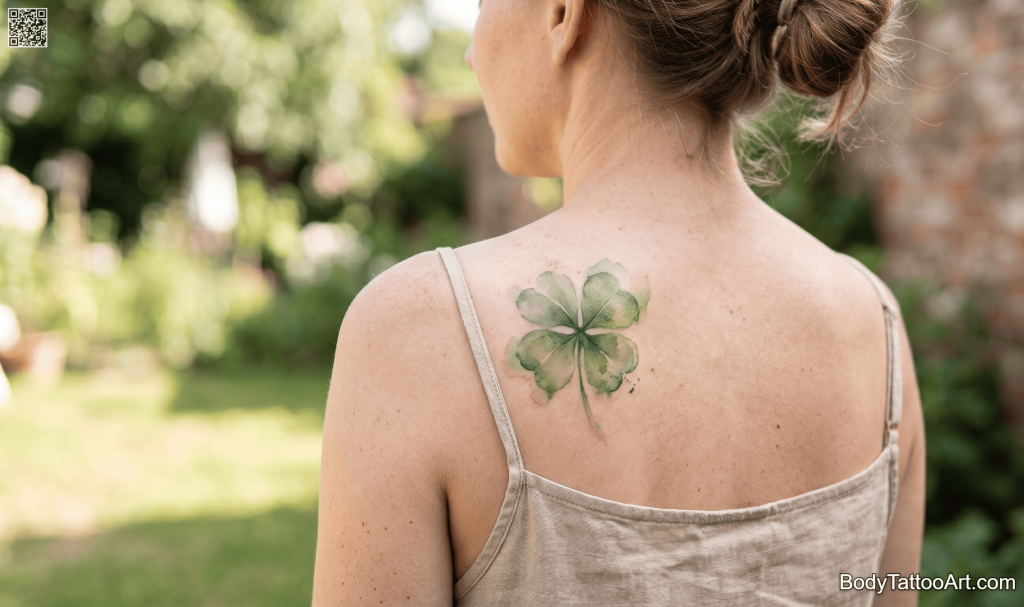
A four-leaf clover where each leaf holds a wash of soft green watercolour, bleeding slightly beyond the leaf edges. The outline is absent — the shape is defined entirely by the colour wash, which fades toward the tips.
Placement: Shoulder blade
Style: Watercolour Clover Tattoos
Why it stands out: Without any linework to anchor it, the design looks genuinely painterly. The bleeding edges make it feel like ink dropped on wet paper.
Ideal for: Art lovers, people who want colour without a traditional look, creative types.
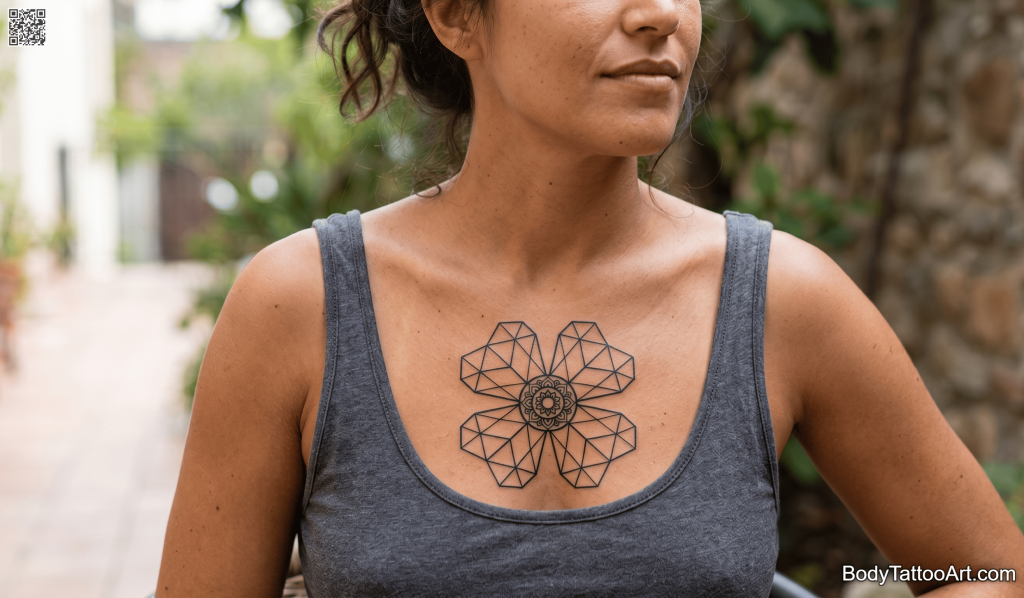
A four-leaf clover where each leaf is constructed from geometric shapes — triangles and trapezoids — meeting at a small circular mandala in the centre. The lines are perfectly straight and mechanical.
Placement: Sternum / chest centre
Style: Geometric blackwork Clover Tattoos
Why it stands out: The contrast between the organic clover silhouette and the rigid geometric interior creates an unexpected tension that makes this design feel architectural.
Ideal for: Sacred geometry fans, people who love structured, symmetrical designs.
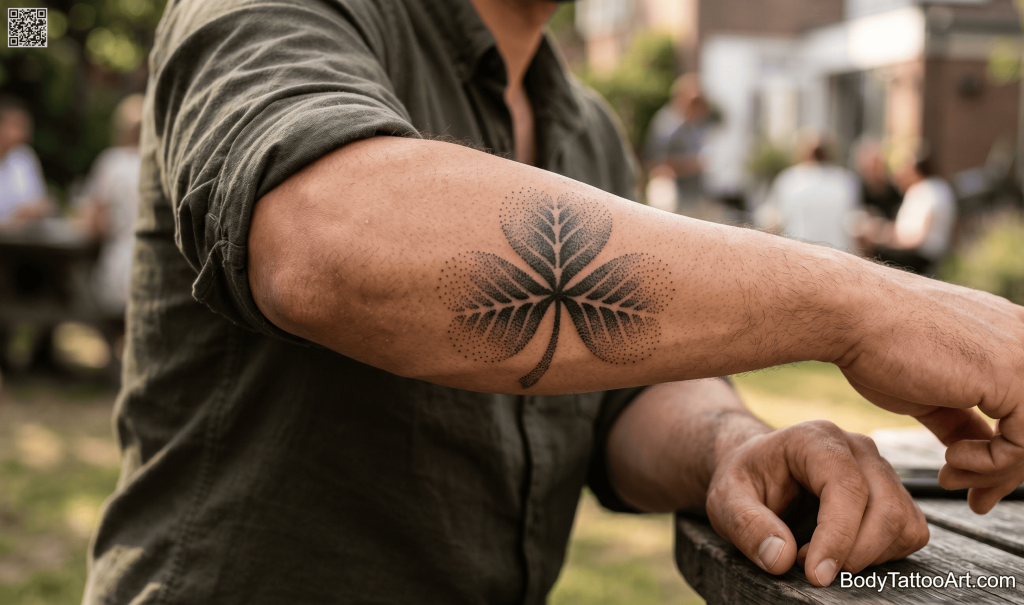
A three-leaf clover where the shading is built entirely from stippled dots. The densest dotting sits near the centre and veins of each leaf, gradually dispersing toward the edges to create a gradient effect.
Placement: Forearm
Style: Dotwork Clover Tattoos
Why it stands out: Up close, it reads as a pattern of dots. From a distance, it reads as a fully shaded botanical illustration. That duality is what makes dotwork so satisfying.
Ideal for: Detail lovers, people drawn to intricate hand-poked aesthetics.
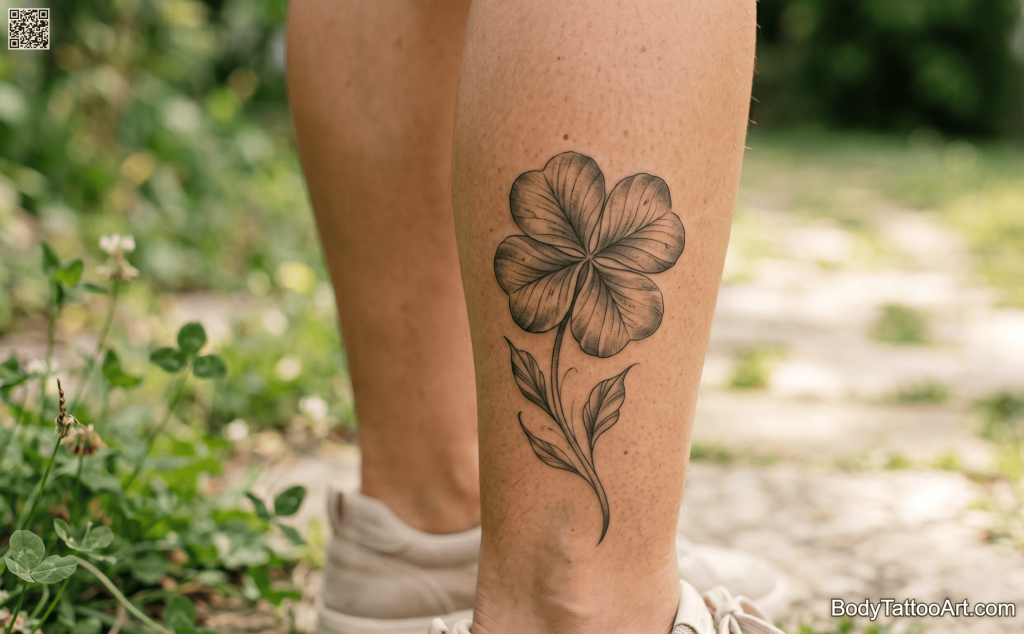
A large, illustrative-style four-leaf clover where each leaf is shaded with visible veining — thin lines radiating from the centre stem through each lobe. Light grey wash fills the leaves, making the veins pop.
Placement: Calf
Style: Illustrative / Grey wash Clover Tattoos
Why it stands out: The veining detail gives it a botanical accuracy that most clover tattoos skip. It looks like it belongs in a nature encyclopedia.
Ideal for: Nature lovers, people who appreciate scientific illustration aesthetics.
Looking for more botanical tattoo inspiration? Explore this collection of lotus tattoo designs for designs that pair beautifully with clover motifs.
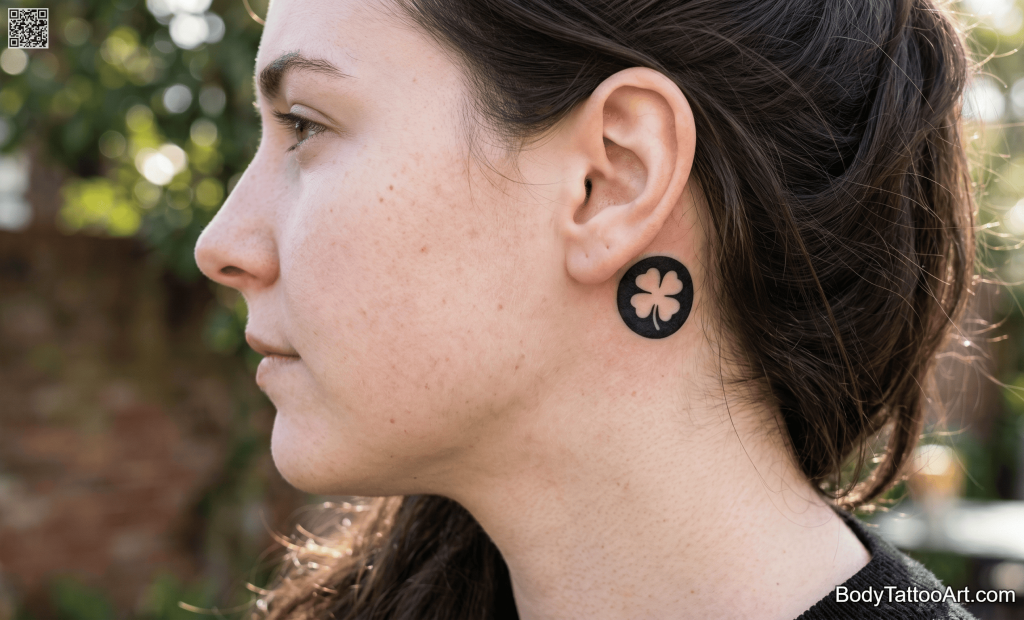
A solid black filled circle with a four-leaf clover cut out of it in negative space — the clover shape is defined by the surrounding ink rather than its own fill.
Placement: Behind the ear
Style: Blackwork / Negative space Clover Tattoos
Why it stands out: The reversal of expectation — the clover isn’t inked, the world around it is — creates a clever visual trick that looks stunning at a small scale.
Ideal for: Minimalists who want something clever, people who like optical illusion elements.
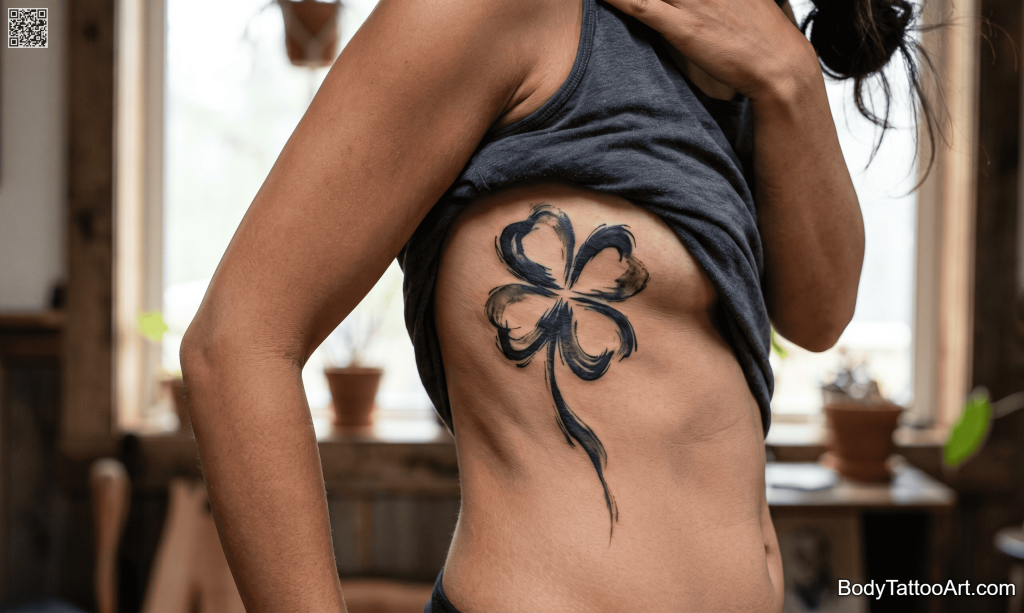
A four-leaf clover rendered in loose, expressive brushstrokes — the leaves aren’t perfectly symmetrical, and the edges are rough and imprecise, mimicking a traditional ink brush.
Placement: Ribcage
Style: Abstract brushwork Clover Tattoos
Why it stands out: The imperfect lines give it an energy that neat, symmetrical designs don’t have. It looks spontaneous, like someone captured the clover in a single breath.
Ideal for: People who love Japanese sumi-e aesthetics, bold free-spirited styles.
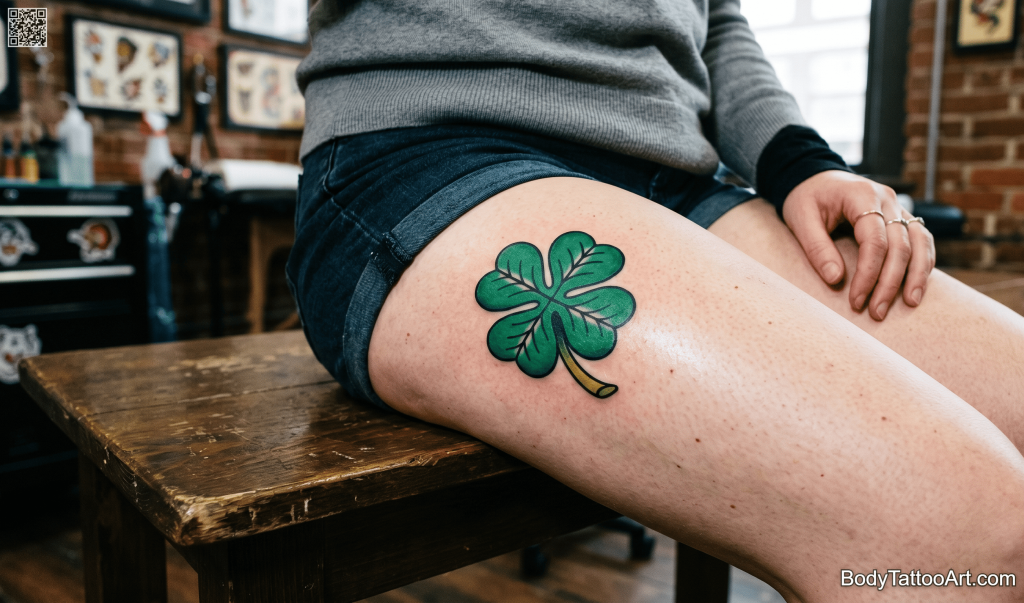
A chunky four-leaf clover in classic traditional American style — thick black outlines, flat green and yellow fills, and a bold, uncomplicated silhouette.
Placement: Upper thigh
Style: Traditional American Clover Tattoos
Why it stands out: Traditional styling turns a simple plant into something with serious character. The thick outlines ensure it holds up for decades.
Ideal for: Traditional tattoo fans, people who want saturated colour that lasts.
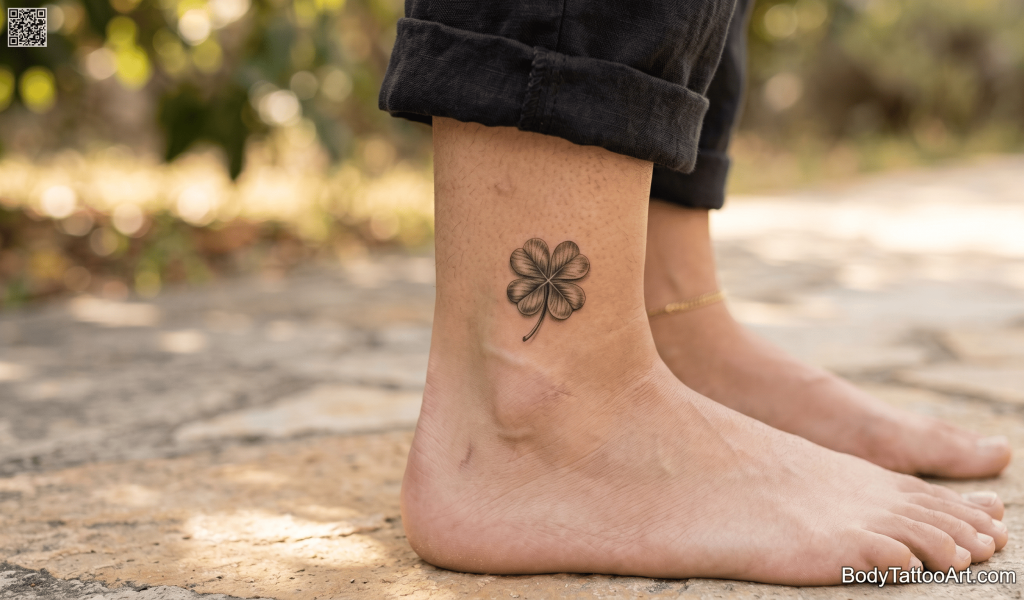
A tiny but incredibly detailed clover rendered in micro-realism — each leaf has subtle depth, texture, and shadow that makes it look almost three-dimensional despite being no larger than a coin.
Placement: Inner ankle
Style: Micro realism Clover Tattoos
Why it stands out: The contrast between the tiny scale and the level of detail is jaw-dropping. It rewards close inspection in a way most small tattoos never do.
Ideal for: People who want something subtle but technically impressive.
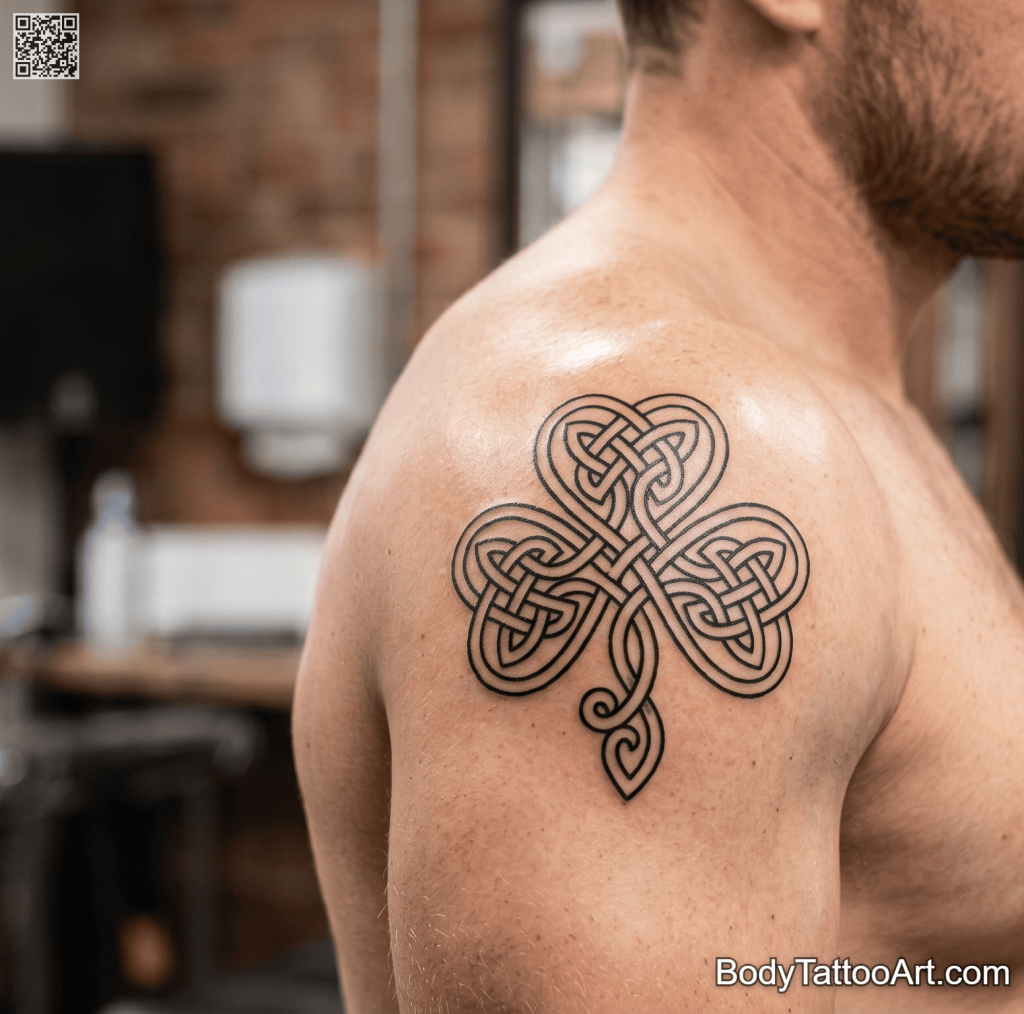
A three-leaf clover where each leaf is formed from interwoven Celtic knot lines that loop and cross without beginning or end. The stem connects to the knotwork naturally.
Placement: Shoulder cap
Style: Celtic linework Clover Tattoos
Why it stands out: The knotwork interior turns an everyday clover into something deeply rooted in heritage. The continuous looping line creates a hypnotic visual rhythm.
Ideal for: People with Celtic heritage, fans of intricate linework, heritage-focused tattoo seekers.
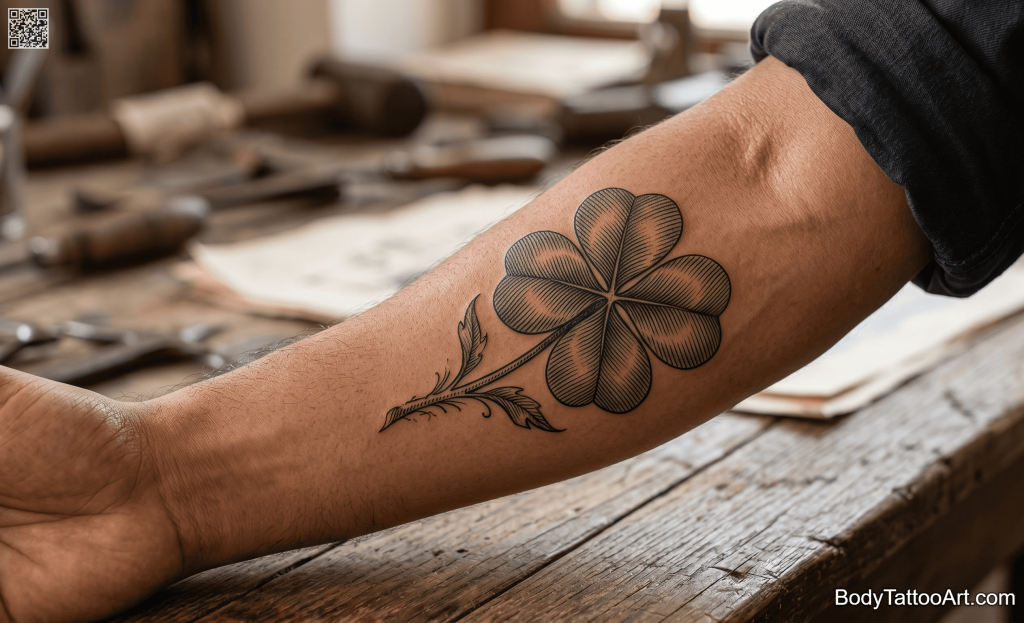
A four-leaf clover rendered in engraving style — each leaf is filled with fine parallel hatching lines that curve to follow the leaf’s contour, creating a cross-hatched gradient effect.
Placement: Outer forearm
Style: Engraving / Etching Clover Tattoos
Why it stands out: The hatching lines give it an antique, woodcut quality. It looks like it was lifted straight off a 19th-century botanical print.
Ideal for: Vintage aesthetics fans, people who love old-school illustration styles.
If botanical linework is your thing, check out this roundup of fern and leaf tattoo ideas that pair naturally with clover designs.
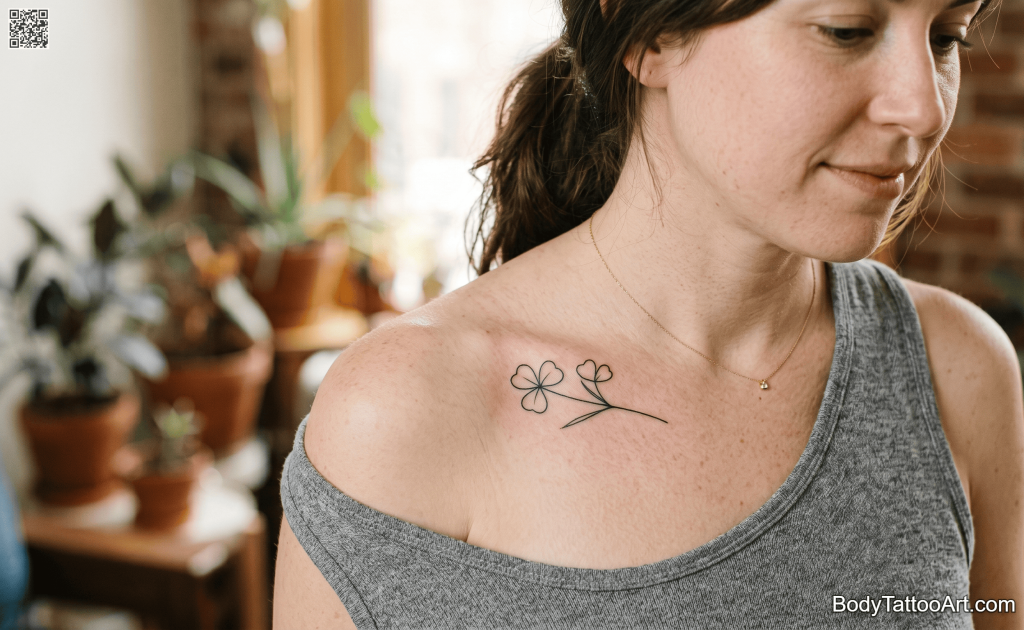
Three simple rounded leaf shapes on a single angled stem, placed horizontally along the collarbone. No detail, no shading — just clean, smooth outlines.
Placement: Collarbone
Style: Minimalist fine line Clover Tattoos
Why it stands out: The horizontal placement along the collarbone lets the design follow the body’s natural line. It looks intentional and elegant rather than placed at random.
Ideal for: People who want visible but understated ink, fans of clean modern design.
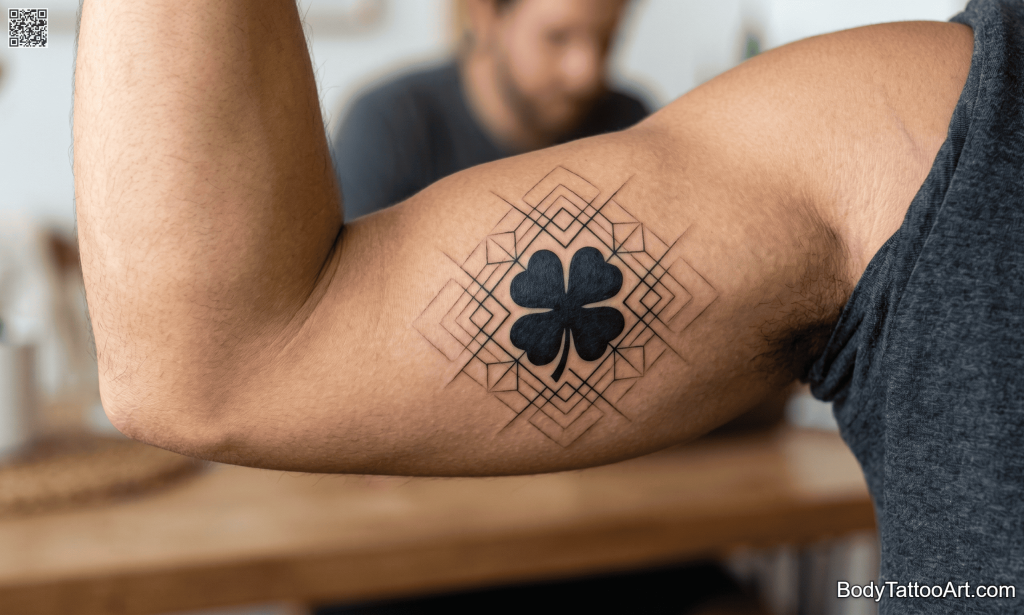
A single four-leaf clover in solid black, set against a background of fine geometric grid lines — like graph paper — that fade out around the edges of the design.
Placement: Inner upper arm
Style: Blackwork with geometric detail Clover Tattoos
Why it stands out: The grid gives it a technical, almost architectural feel. The contrast between the organic clover silhouette and the rigid background creates visual interest without complexity.
Ideal for: Fans of structured, graphic design-influenced tattoos.
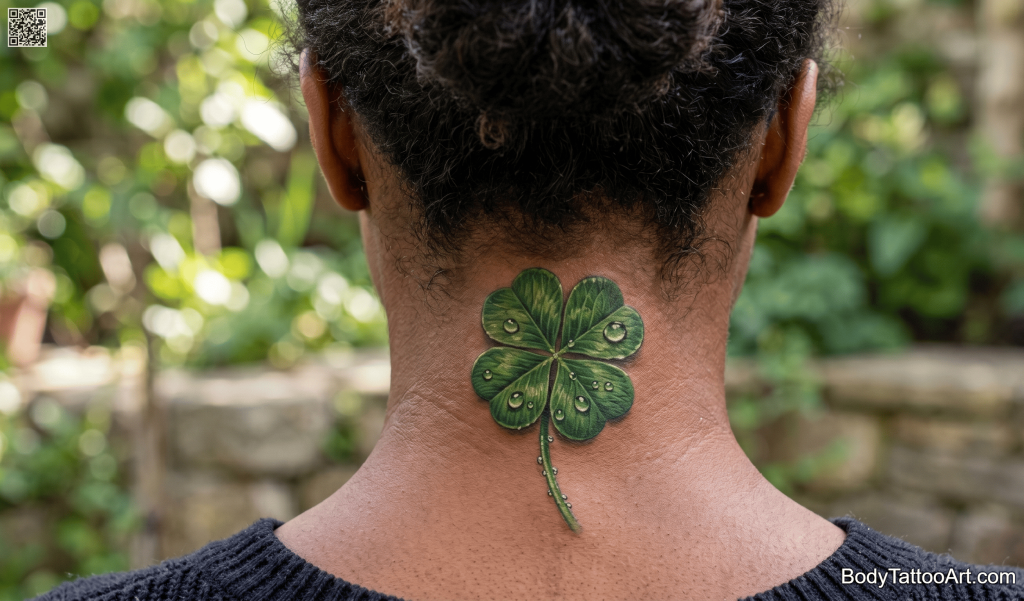
A realistic green clover where each leaf has one or two small round dew drops sitting on the surface, rendered with highlight and shadow to look three-dimensional.
Placement: Back of the neck
Style: Illustrative colour realism Clover Tattoos
Why it stands out: The dew drops are the element that elevates this from a standard botanical design to something genuinely alive-looking. The light reflection detail on each drop is the star of the show.
Ideal for: People who want colour realism, nature photography lovers.
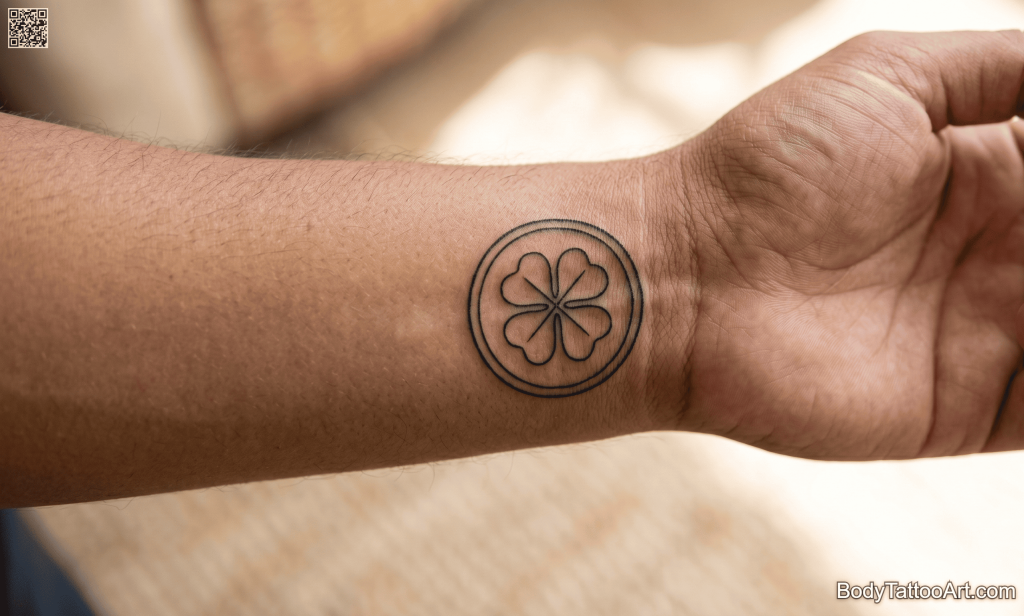
A four-leaf clover centred inside a circular border with a thin double-ring outline, designed to resemble a wax seal or postage stamp.
Placement: Wrist
Style: Blackwork / Stamp art Clover Tattoos
Why it stands out: The framing circle gives the clover a sense of ceremony. It looks like something official — a personal emblem rather than just a tattoo.
Ideal for: People who love vintage aesthetics, those who want a self-contained, framed design.
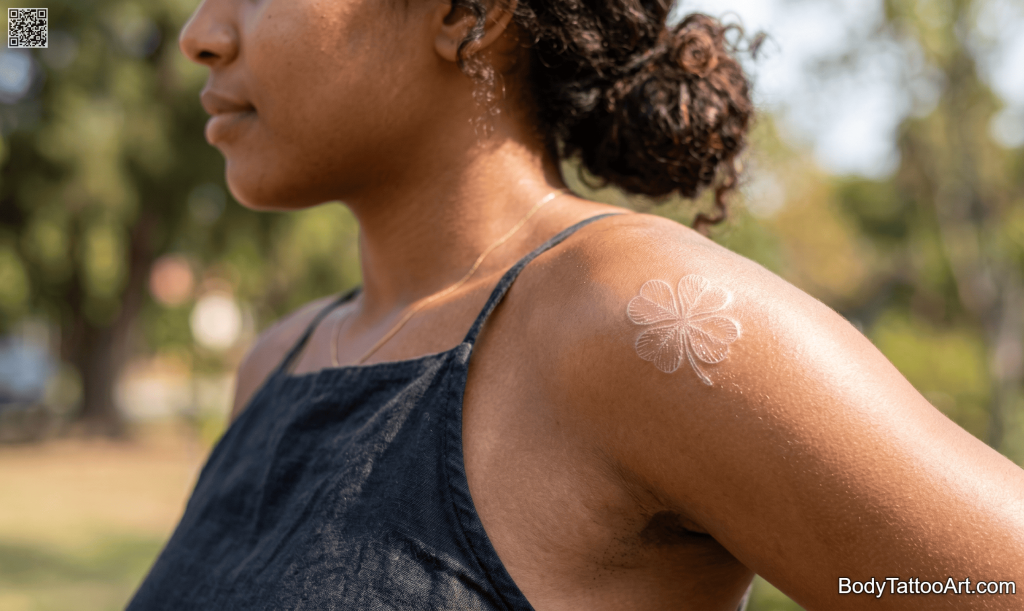
A four-leaf clover tattooed entirely in white ink, sitting subtly on the skin. The outline and inner detail are only visible when the light catches it at the right angle.
Placement: Shoulder
Style: White ink Clover Tattoos
Why it stands out: The near-invisibility is the statement. It’s a tattoo for the person wearing it, not the room. In direct light it shimmers; in normal conditions it almost disappears.
Ideal for: People who want completely private, understated ink.
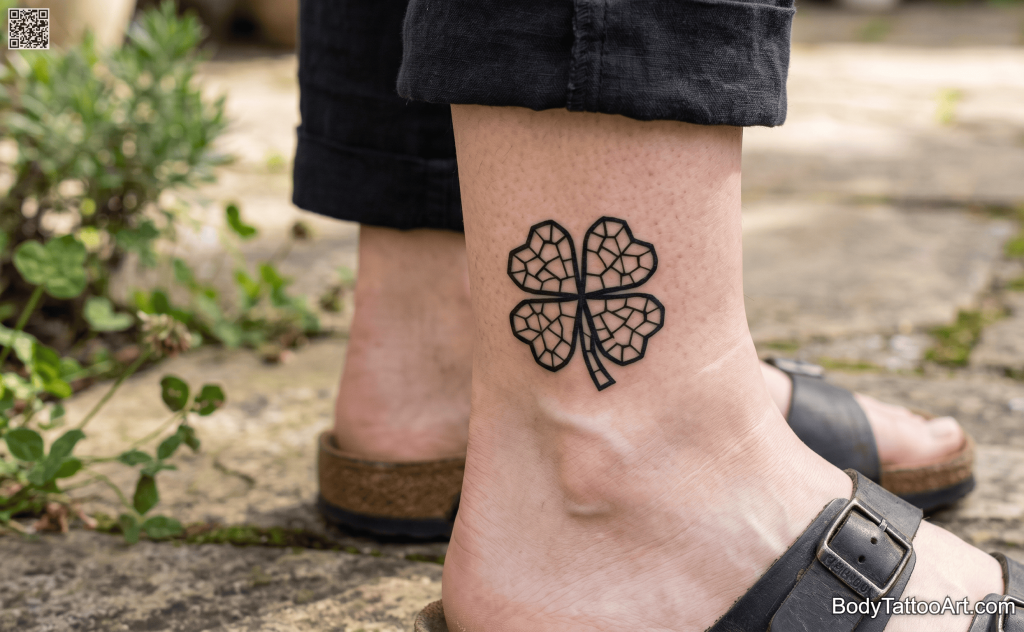
A four-leaf clover where each leaf is divided into irregular mosaic tile segments with thin black gaps between them — like a stained glass or ceramic tile design.
Placement: Ankle
Style: Mosaic / Stained glass blackwork Clover Tattoos
Why it stands out: The segmented fill turns each leaf into its own small composition. The black gaps between segments give it a structured, jewel-like quality.
Ideal for: People drawn to art nouveau and decorative art aesthetics
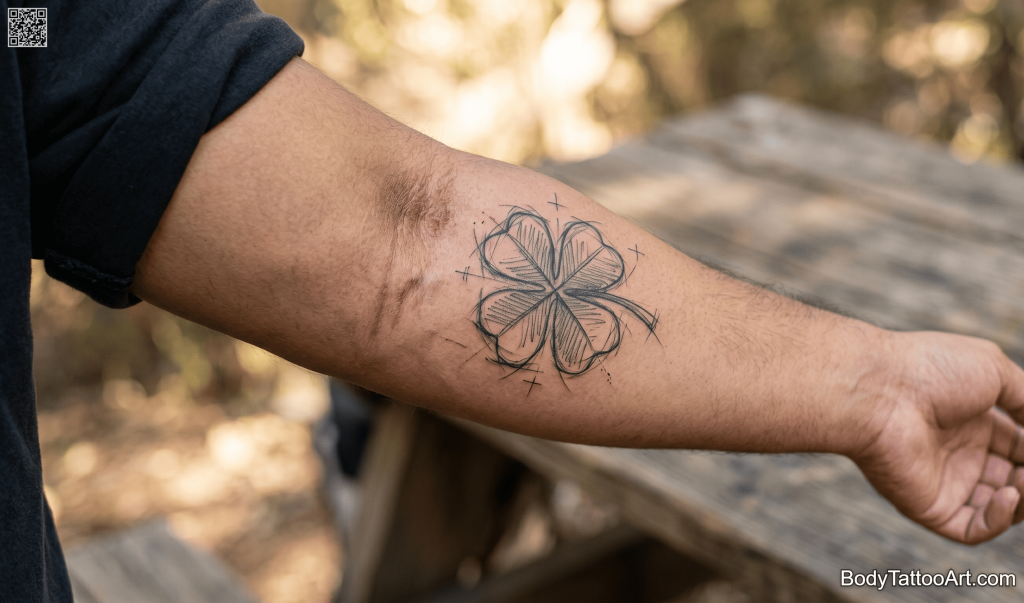
A four-leaf clover that looks like it was drawn quickly with a pencil — overlapping lines at the edges, uneven fill hatching, and visible construction marks left intentionally.
Placement: Inner elbow
Style: Sketch / pencil work Clover Tattoos
Why it stands out: The visible “mistakes” are the design choice. It looks like a doodle that somehow ended up permanent — which is charming in the best possible way.
Ideal for: Creative types, people who love unconventional approaches to traditional subjects.
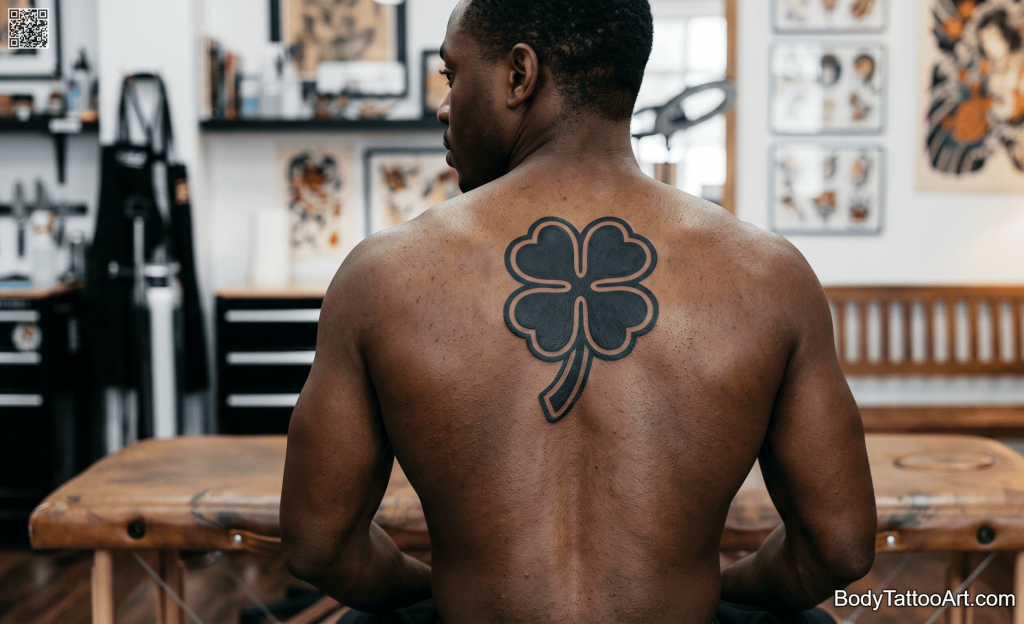
A bold, graphic four-leaf clover with strong black outlines and flat black fill inspired by the bold line aesthetic of Japanese tattooing — not traditional Japanese imagery, just the graphic weight and confidence.
Placement: Upper back / shoulder blade area
Style: Bold line graphic Clover Tattoos
Why it stands out: The sheer weight of the lines makes it powerful and unambiguous. No nuance, no gradient — just strong, certain mark-making.
Ideal for: People who like graphic, high-contrast work that reads from across a room.
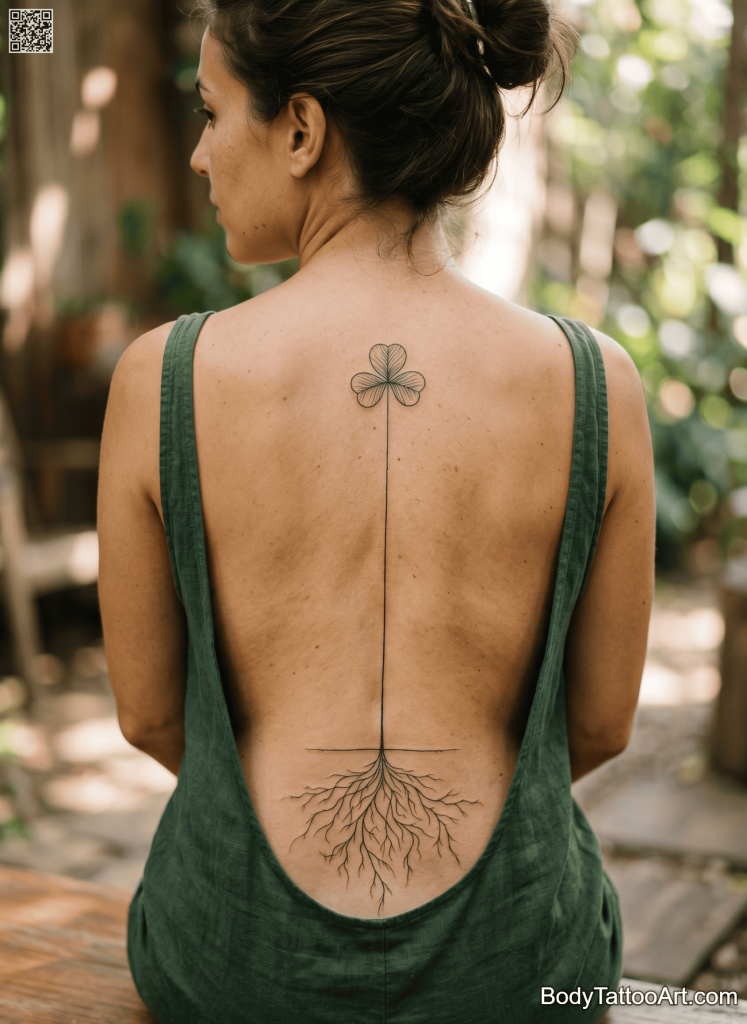
A three-leaf clover shown with its full root system below the soil line — the stem rises up to the three leaves, while below, an intricate root network spreads downward.
Placement: Spine / lower back
Style: Fine line illustrative Clover Tattoos
Why it stands out: Showing the underground element of the plant completely changes the conversation. The roots add a sense of depth — literal and metaphorical — without requiring any text or symbols.
Ideal for: People who love botanical illustration details and quiet conceptual depth.
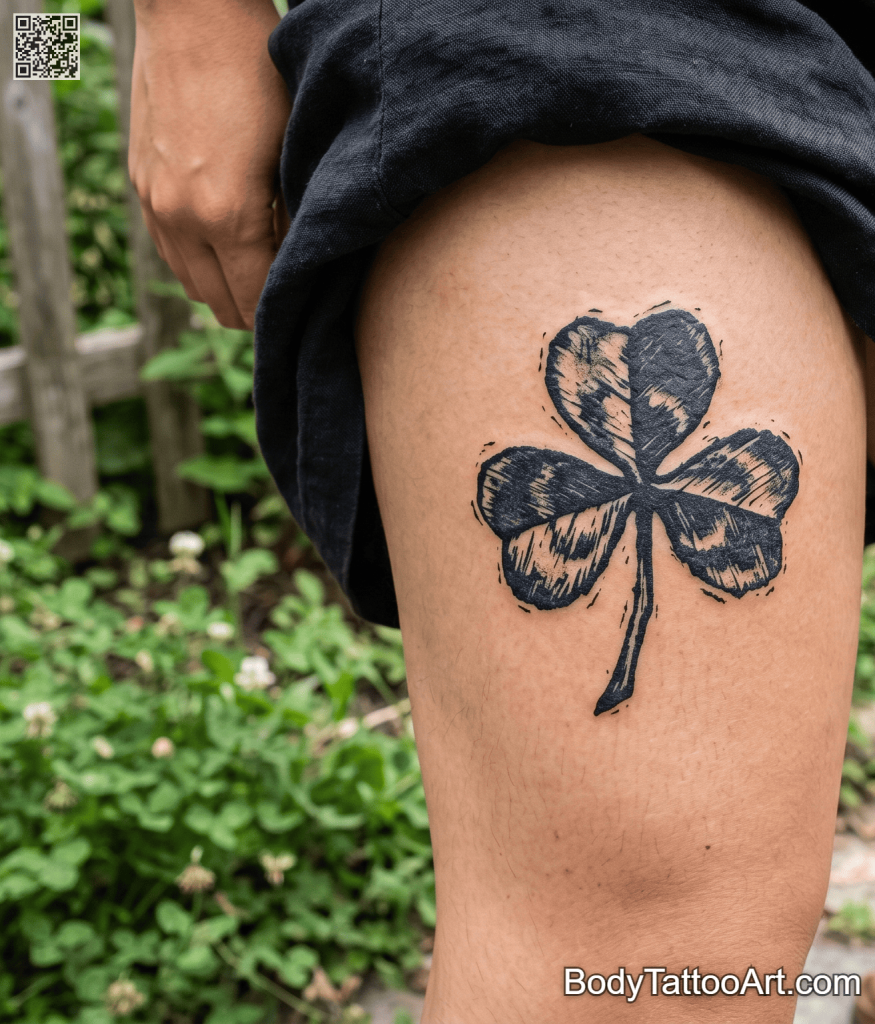
A three-leaf clover with the rough, textured quality of a traditional woodblock print — uneven ink distribution, slight edge roughness, and visible grain marks across the leaves.
Placement: Outer thigh
Style: Woodblock / Risograph-inspired Clover Tattoos
Why it stands out: The intentional imperfection mimics the texture of physical printmaking. It looks handcrafted in a way that perfect linework simply can’t replicate.
Ideal for: Printmaking and graphic arts lovers, people who appreciate textured or handmade aesthetics.
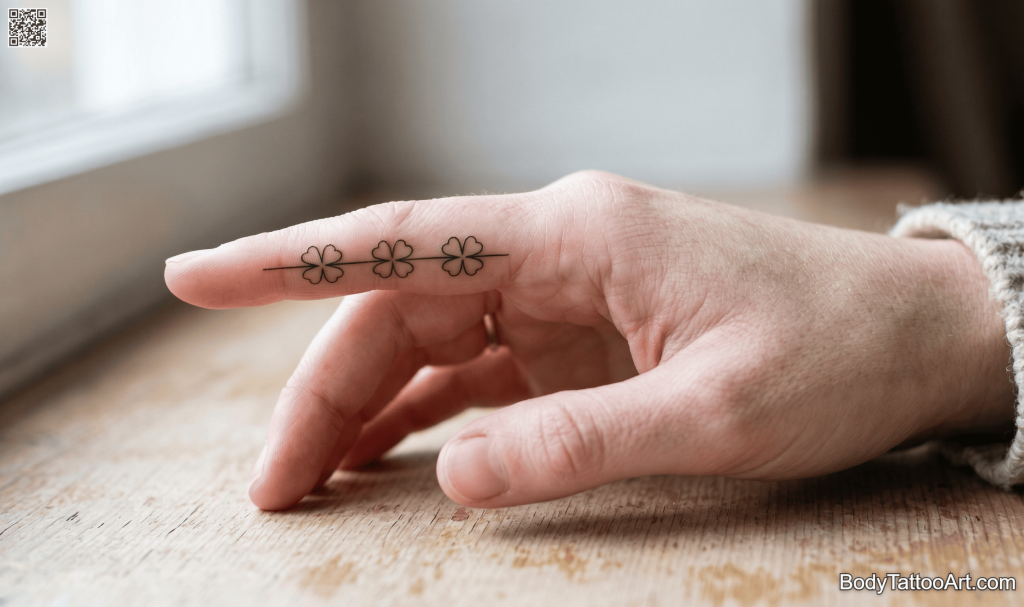
Four small identical four-leaf clovers stacked vertically along a single straight stem, creating a totem-pole style repeating pattern.
Placement: Side of the finger
Style: Minimalist fine line Clover Tattoos
Why it stands out: Finger placement demands simplicity, and this delivers. The repetition creates a visual rhythm that’s satisfying to look at but never overwhelming.
Ideal for: People who like delicate finger tattoos, fans of pattern and repetition.
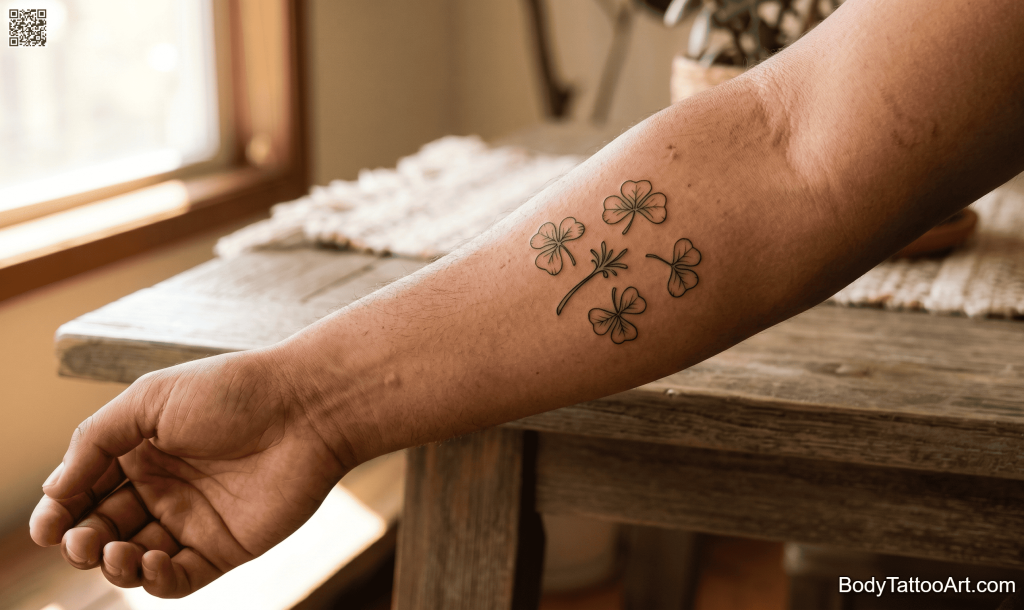
A four-leaf clover where the four leaves appear to be mid-fall — each leaf is separated and rotated slightly, as if the clover has just been scattered by wind.
Placement: Forearm
Style: Abstract fine line Clover Tattoos
Why it stands out: The fragmentation turns a static symbol into something kinetic. It looks like the clover is in the middle of something — a rare feeling for a botanical design.
Ideal for: People who want abstract takes on classic subjects.
A four-leaf clover rendered to look like a technical architectural blueprint — thin blue lines on a white background with measurement annotations, dimension lines, and a title block corner.
Placement: Upper arm
Style: Blueprint / technical illustration Clover Tattoos
Why it stands out: The unexpected framing — applying engineering drawing conventions to a natural object — is genuinely witty. It looks like someone filed a patent for luck.
Ideal for: Designers, engineers, architects, people who love concept-driven tattoos.

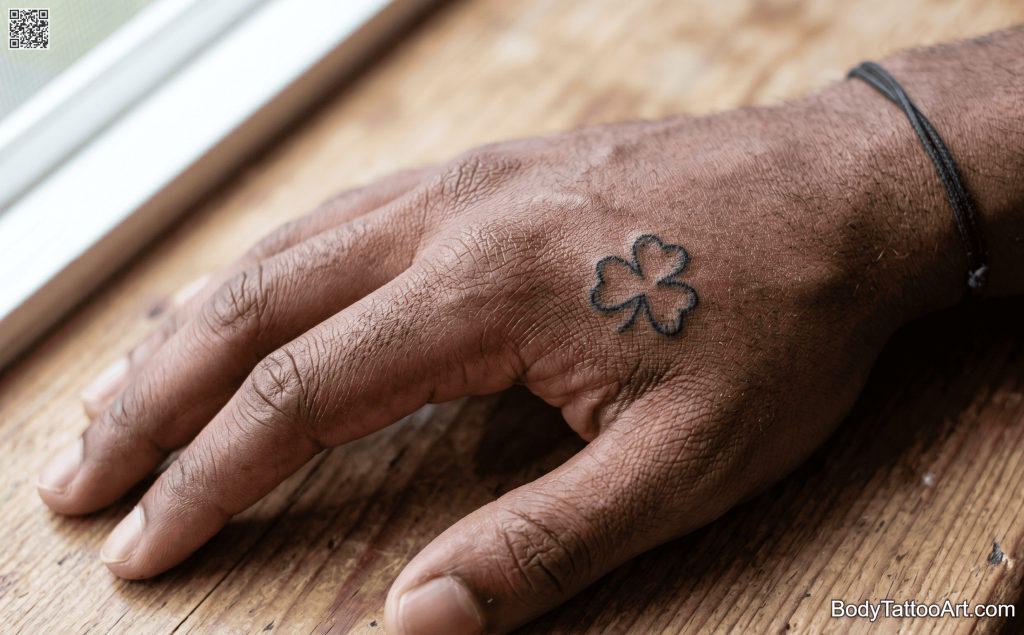
A three-leaf clover created with the hand-poke method — slightly irregular dot-based lines and a faintly uneven outline that carries the unmistakable texture of non-machine work.
Placement: Back of the hand
Style: Hand-poke / stick-and-poke Clover Tattoos
Why it stands out: Hand-poke work has a warmth to it that machine work sometimes lacks. The slight irregularity isn’t a flaw — it’s the fingerprint of the process.
Ideal for: People who love lo-fi, handcrafted aesthetics and want something that tells the story of how it was made.
Clover tattoos prove that small, simple subjects can carry a lot of range. From clean fine-line wrist placements to bold blackwork clusters and fragmented abstractions, these 26 designs show how differently the same plant can read depending on the hand holding the needle.
Whether the pull is toward the Irish-luck symbolism, a Celtic heritage connection, or simply the clean visual appeal of a four-lobed leaf — clover tattoos offer an entry point that suits almost every taste. The key is finding the style that matches not just the symbol, but the personality behind it.
For more tattoo ideas in the botanical space, explore the Rose, Orchids, Hibiscus tattoo designs to build a collection that feels cohesive and personal.