Physical Address
304 North Cardinal St.
Dorchester Center, MA 02124
Physical Address
304 North Cardinal St.
Dorchester Center, MA 02124

There’s something about marigold tattoos that just works. The flower itself is layered, textured, and full of movement — which makes it one of the most rewarding subjects for tattoo artists across every style. Fine line, blackwork, watercolour, geometric — marigold tattoos translate beautifully into all of them. And yet, compared to roses or peonies, the marigold still feels like a slightly unexpected choice. Which is exactly why it stands out.
Marigold tattoos are designs built around the marigold flower — a dense, multi-layered bloom with dozens of small petals arranged in tight concentric rings. That layered structure is what makes marigold tattoos so visually rich. There’s always something to look at, whether the design is tiny or takes up a full thigh. The flower’s naturally round, full shape also means it works well as a standalone piece without needing additional elements to fill the composition.
Marigold tattoos carry weight in several different cultural contexts. In Mexican tradition, marigolds are the flowers of Día de los Muertos — used to guide spirits home and honour the dead. In Indian culture, marigold garlands appear at weddings, festivals, and religious ceremonies, making the flower deeply tied to celebration and devotion. In Victorian flower language, marigolds were associated with grief and remembrance. In tattoo culture today, people choose marigold tattoos for all of these reasons — and sometimes for none of them, simply because the flower is stunning and complex enough to wear forever.
This marigold tattoo is drawn from slightly above, looking down into the bloom. The petals radiate outward in tight concentric rings, getting gradually wider toward the outer edge. Fine grey shading gives each ring of petals a slight shadow underneath, creating real depth. The result looks less like a flower and more like a small sun sitting on the skin.
Placement: Upper chest / back of the hand
Style: Fine line realism
Why it stands out: The top-down angle is unusual for marigold tattoos. Most designs show the flower from the front or side. This perspective turns the bloom into an almost geometric, radial composition that looks bold even at small sizes.
Ideal for: Fine line fans, people who love unusual perspectives, those wanting a piece that reads as both floral and geometric.
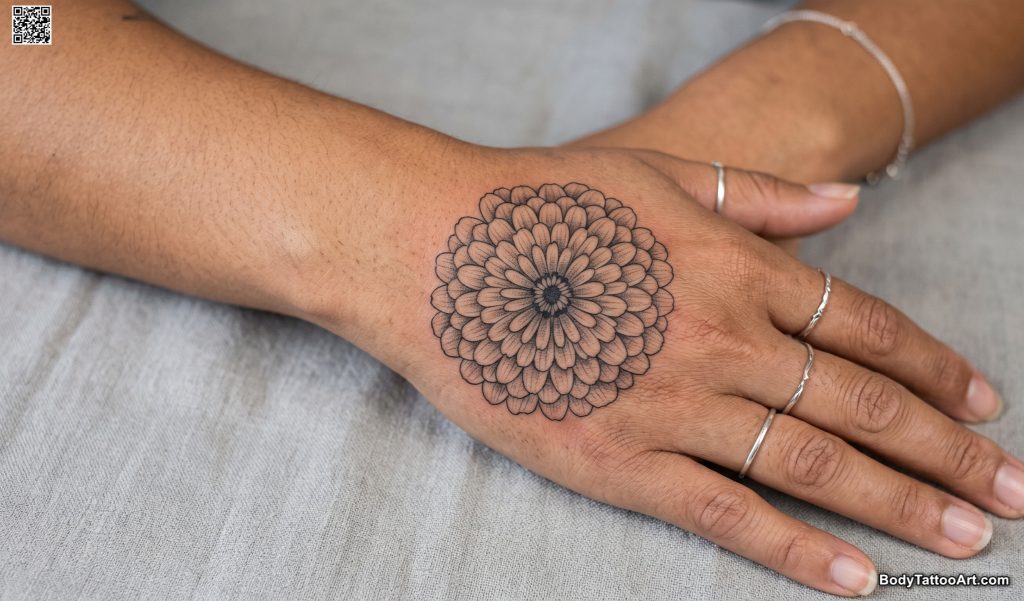
Every petal is outlined in thick confident lines and filled with solid black. The densely packed petals create a pattern of black shapes and thin untattooed gaps between them — those pale slivers of skin between each petal are what give the piece its structure. From a distance, the whole thing reads as a solid dark circle. Up close, the individual petals reveal themselves.
Placement: Upper arm / outer thigh
Style: Blackwork
Why it stands out: The contrast between solid black-filled petals and the thin skin gaps between them does all the visual work. It’s a bold marigold tattoo that rewards close inspection without needing fine details to hold interest.
Ideal for: Blackwork collectors, people who love high-contrast designs, those building a dark-ink sleeve.

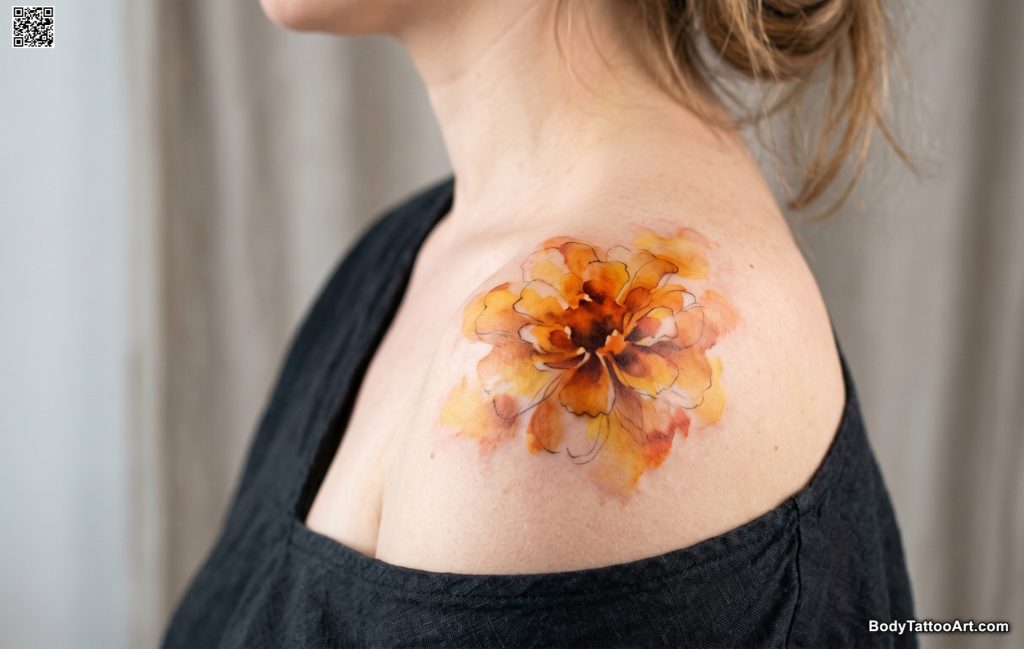
Washes of warm amber and deep saffron bleed into each other across the petals, with a darker burnt orange pooling toward the centre of the bloom. The colour extends slightly beyond the petal edges in soft diffused patches. There are no hard outlines — the whole design floats in washes of warm colour. A few thin lines suggest petal shapes within the colour fields.
Placement: Shoulder / rib cage
Style: Watercolour
Why it stands out: Marigold tattoos in watercolour style benefit from the flower’s naturally warm palette — amber, orange, saffron, gold all work together without any colour clash. The result feels sun-drenched and painterly.
Ideal for: Colour tattoo lovers, people drawn to fine art aesthetics, those wanting something that looks hand-painted
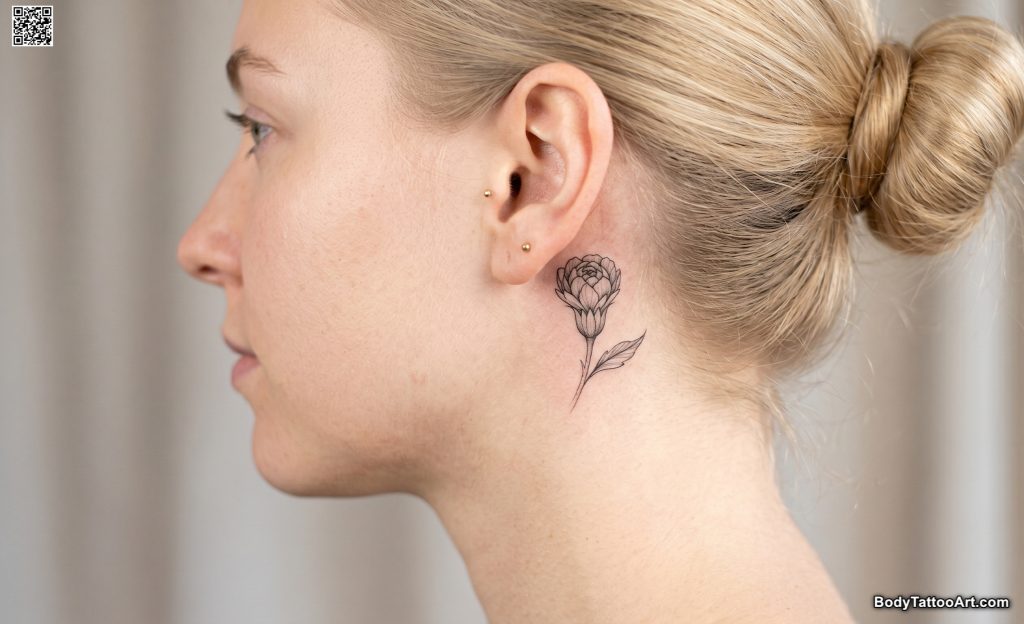
Just the bud — petals still tightly wrapped, not yet open. At this tiny scale, the design is all about the neat overlapping layers of outer petals and the pointed tip at the top. Hairline-thin strokes suggest the texture inside each petal fold. The stem ends cleanly below with one small leaf curving off to the side.
Placement: Behind the ear / finger / inner wrist
Style: Micro fine line
Why it stands out: Choosing a closed bud for a micro marigold tattoo is smart — there’s less detail to compress into a small space, which means what’s there reads clearly. The tight petal layers of the bud actually look more precise at small scale than a fully open bloom would.
Ideal for: First-timers, micro tattoo collectors, minimalists who want botanical detail in a tiny format.
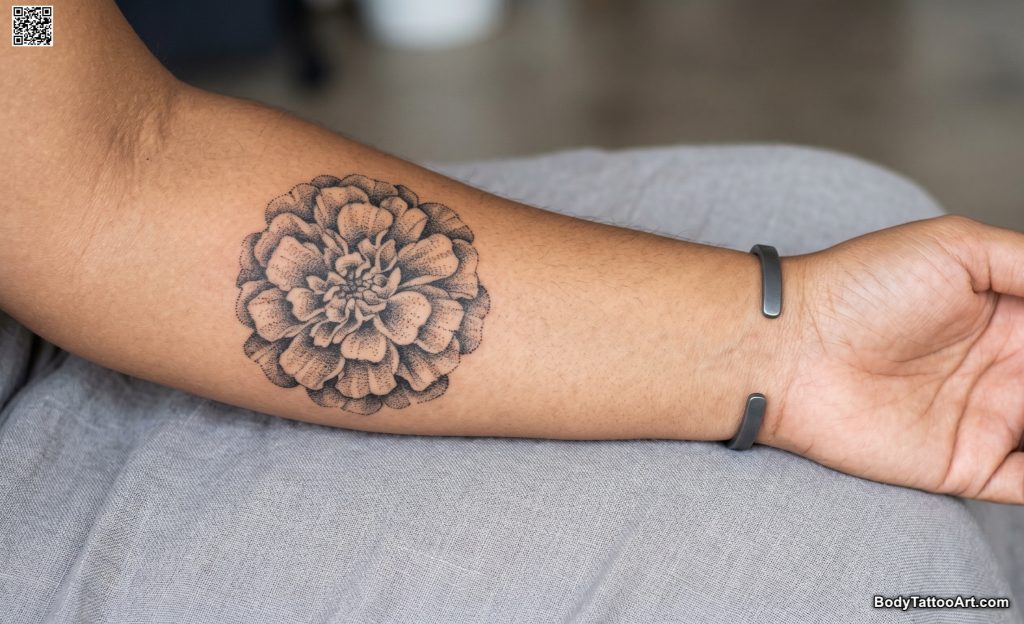
The marigold is built entirely from stippled dots — no outlines, no solid fills. The densest dot clusters sit in the shadowed areas between petal layers, and the dots gradually thin out toward the lighter petal surfaces. From across the room, the flower reads as a soft, full bloom. Up close, it dissolves into thousands of individual ink points.
Placement: Inner forearm / sternum
Style: Dotwork stippling
Why it stands out: Removing outlines from a marigold tattoo forces the stippling to carry the entire shape — which works particularly well here because the flower’s layered structure creates natural shadow zones for the heaviest dot concentration. The result looks almost like a charcoal drawing.
Ideal for: Detail lovers, dotwork collectors, people who want tattoos that look different at different distances.
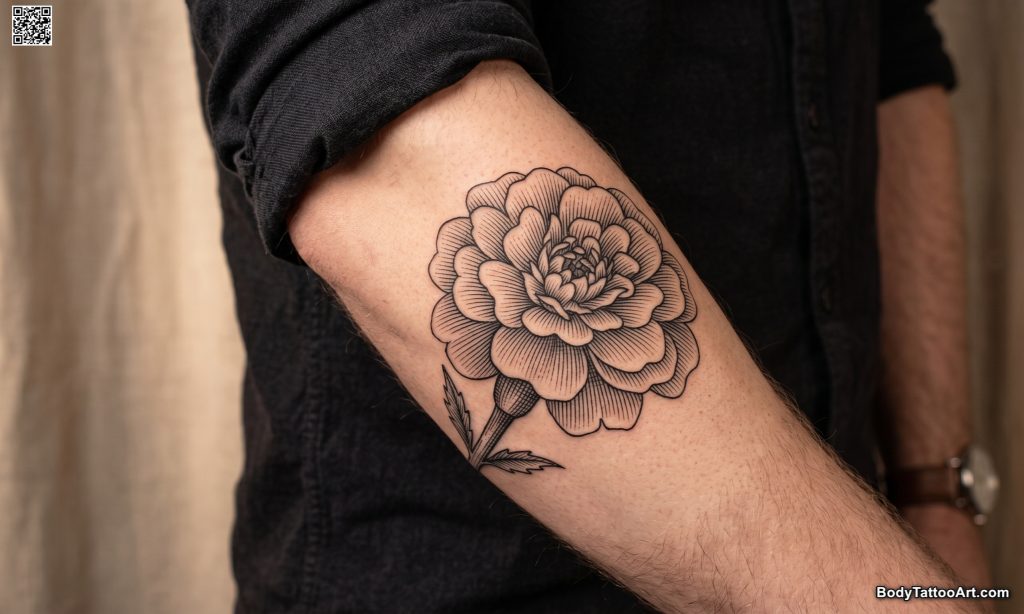
Fine parallel hatching lines follow the curves of each petal, turning the bloom into something that looks like it was lifted from an old botanical print. The direction of the hatching shifts subtly as the petals curve, reinforcing the three-dimensional form. Cross-hatching sits in the deeper shadow zones between petal layers. Every line is deliberate and precise.
Placement: Outer forearm / calf
Style: Engraving / etching
Why it stands out: Marigold tattoos in engraving style look particularly striking because the flower has so many layered petals — every layer becomes an opportunity for hatching direction changes, which adds tremendous textural complexity without needing any colour.
Ideal for: People who love historical botanical illustration, collectors of unusual technical styles, art history enthusiasts.
The petals have been pulled slightly apart from each other — not scattered, just gapped. Small spaces between each petal group break the continuous ring pattern. Some petals tilt at slightly different angles, as if the bloom is rotating slowly. The linework is precise and clean, but the composition itself is deliberately off-balance in a way that feels intentional.
Placement: Upper arm / thigh
Style: Abstract / contemporary
Why it stands out: Most marigold tattoos celebrate the flower’s dense, packed fullness. This design does the opposite — it introduces space and interruption into the pattern, which creates visual tension that a conventionally arranged bloom wouldn’t have.
Ideal for: Conceptual tattoo fans, people who want florals that don’t look like every other floral, collectors who appreciate compositional risk.
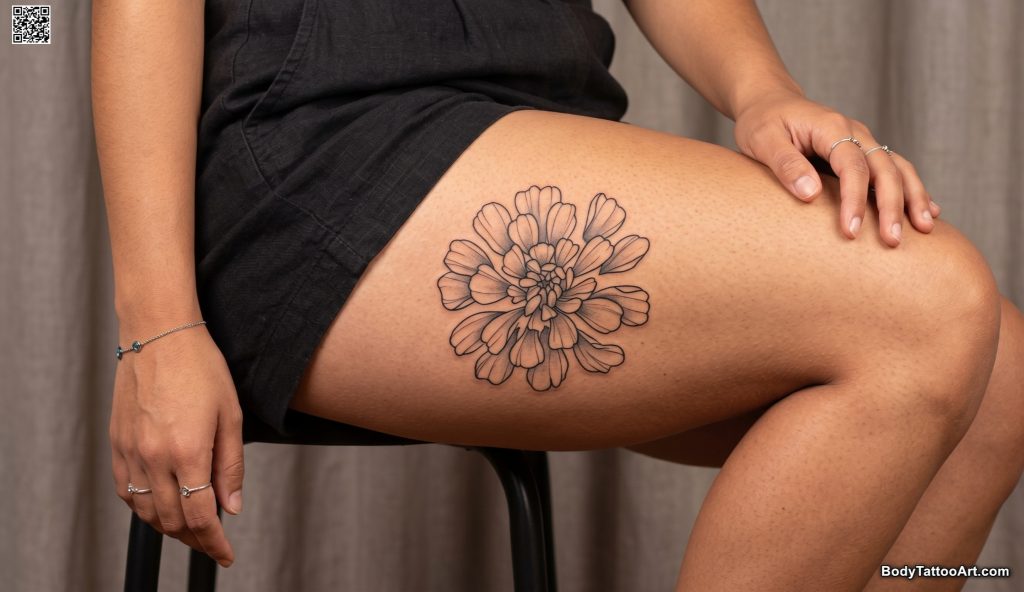
Loose overlapping pencil-style lines form the petals — not perfectly aligned, not fully closed at every edge. The shading is done through quick directional hatching, the kind a draughtsman might use when sketching fast. Some outer petals have an extra line doubling their edge, suggesting speed and confidence. The whole thing looks like it was drawn in two minutes by someone who really knows what they’re doing.
Placement: Collarbone / outer forearm
Style: Sketch / illustrative
Why it stands out: Marigold tattoos in sketch style work because the flower’s complex petal layers actually benefit from the loose, overlapping line quality — it suits the organic nature of the bloom better than rigidly clean lines might.
Ideal for: Illustration lovers, people who appreciate imperfection as craft, those wanting tattoos that look handmade.
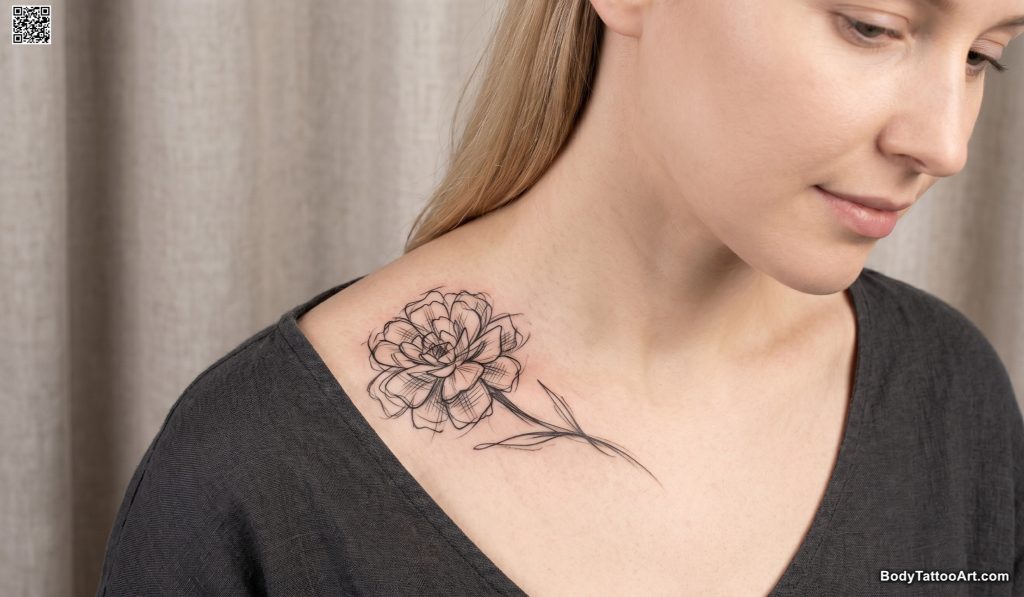
Thick black outlines, flat colour fills, and a strong graphic quality define this marigold tattoo. The petals are filled with a rich golden-amber that transitions to a deeper burnt orange toward the centre. A band of thick black separates the outer petal ring from the inner layer, creating a strong visual boundary. Two large dark green leaves frame the bloom below.
Placement: Bicep / outer calf
Style: Neo-traditional
Why it stands out: Neo-traditional marigold tattoos particularly suit this flower because the concentric petal layers translate naturally into the layered flat-colour approach the style uses. The warm colour palette feels at home in a bold outlined format.
Ideal for: Traditional tattoo fans who want updated colour work, people building matching neo-traditional collections, those who love rich saturated colour.

Instead of rendering every layer of the marigold, this design shows just one ring of petals around a small circular centre — like a simplified, flattened version of the bloom. Each petal is a clean oval shape, evenly spaced. Fine inner lines suggest petal texture. Soft grey shading fills each petal, darker at the base near the centre and fading lighter toward the tip.
Placement: Wrist / ankle / back of the neck
Style: Fine line minimalist
Why it stands out: This simplified approach strips the marigold down to its most essential visual element — the radiating ring of petals — and makes that single layer work hard. It reads instantly as a flower while being much less detailed than a full bloom, which suits small placements perfectly.
Ideal for: Minimalists, first-timers, people who want something small and recognisable without heavy detail.
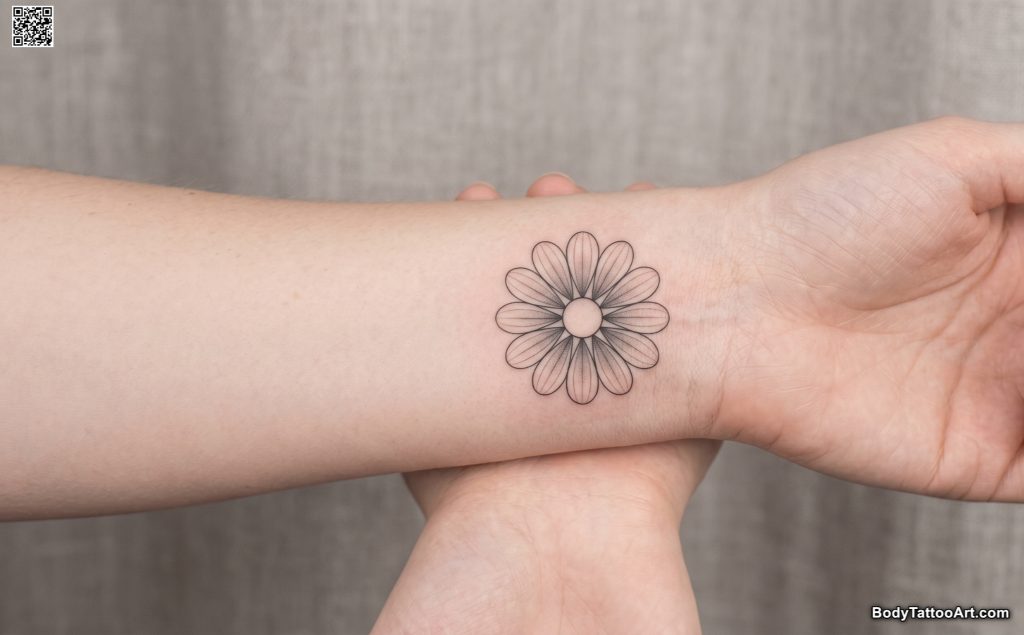
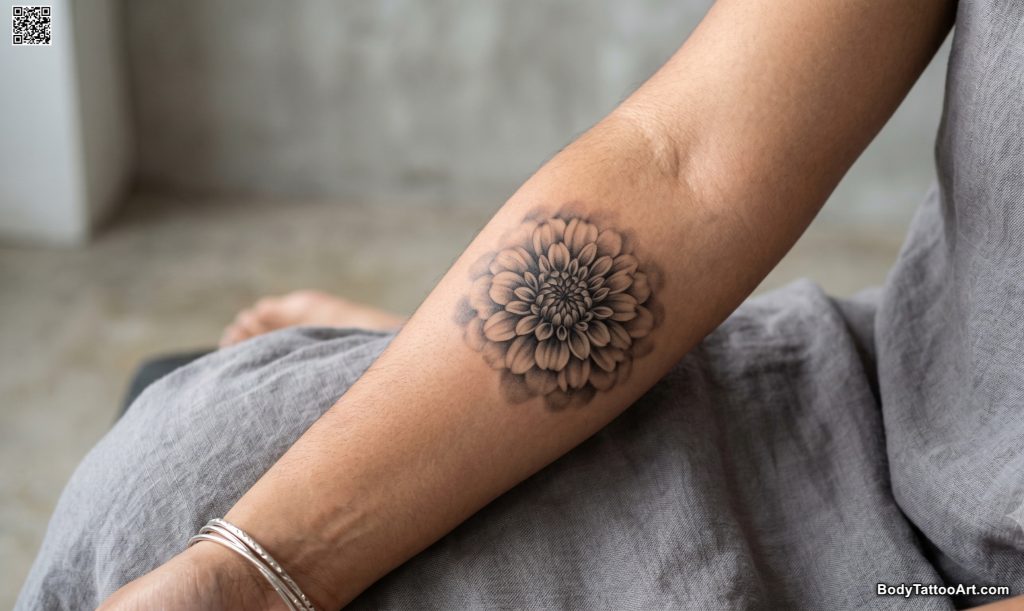
Every petal layer is visible, each one casting a slight shadow on the layer beneath it. The shading moves from almost white on the most exposed petal surfaces to deep charcoal in the recessed areas near the centre. The transition between light and shadow across each petal is gradual and smooth, giving the bloom a three-dimensionality that makes it look almost touchable.
Placement: Shoulder blade / upper arm
Style: Grey-wash realism
Why it stands out: Marigold tattoos in grey-wash realism benefit enormously from the flower’s layered structure — each petal layer creates a new shading opportunity, which is why this style suits the marigold particularly well. The depth is exceptional.
Ideal for: Realism tattoo collectors, people who love botanical detail, those wanting a showpiece piece.
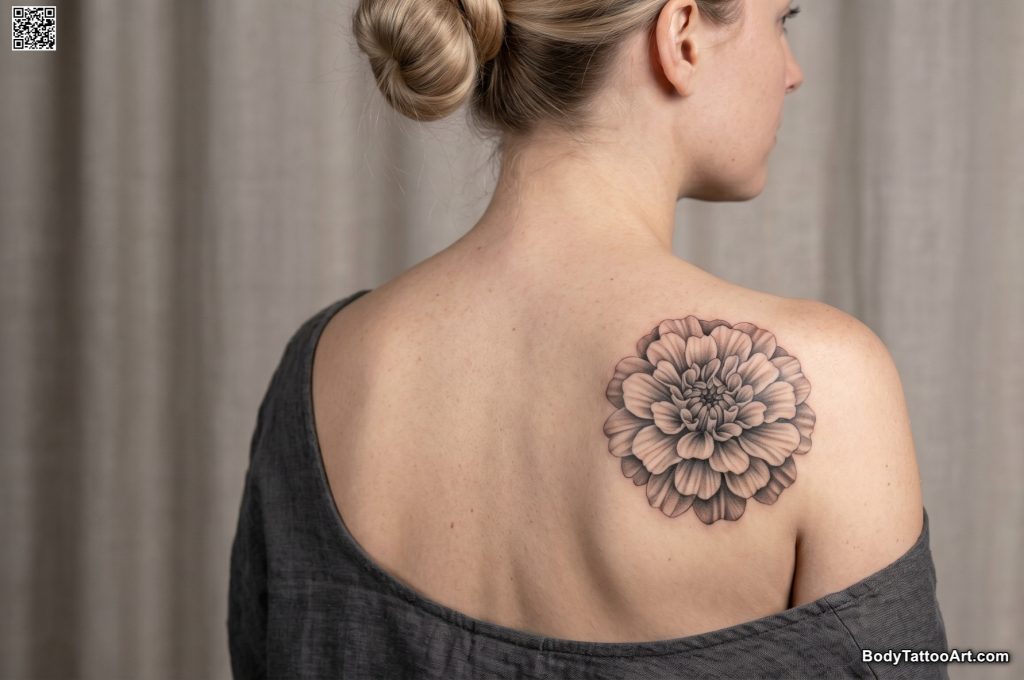
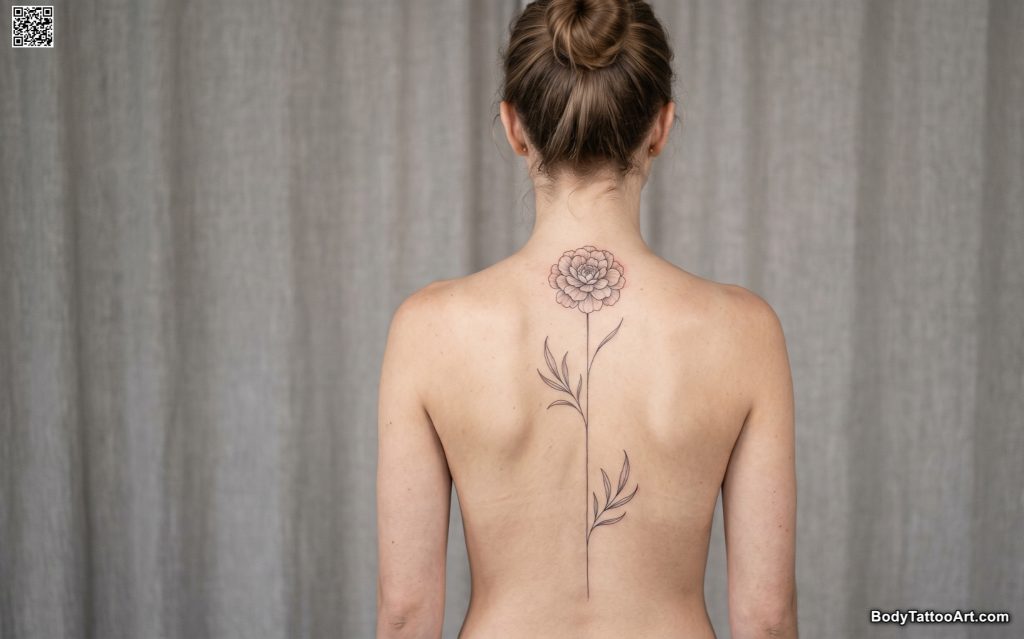
The stem is drawn long and elegant, running vertically down the spine with the full bloom sitting at the top. Two pairs of leaves branch outward at intervals along the stem — narrow and slightly curving. The bloom itself is done in fine line with light grey shading. The whole design is narrow and vertical, built to follow the body’s natural centre line.
Placement: Spine
Style: Fine line botanical
Why it stands out: The marigold’s round bloom makes a natural visual anchor at the top of a long vertical composition. The leafy stem running down the spine creates beautiful body-conscious flow that feels designed for the placement rather than placed onto it.
Ideal for: People who love spine tattoos, those who want elongated botanical pieces, collectors who think about how tattoos interact with the body’s shape.
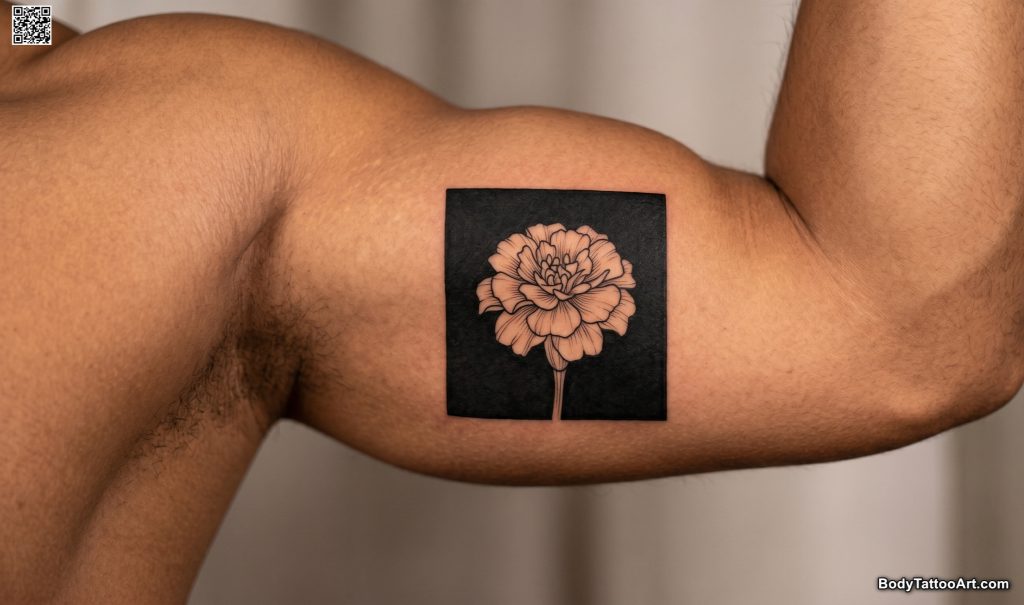
A solid black square sits on the skin, and inside it, the marigold’s silhouette is left completely untattooed. The flower exists as bare skin surrounded by black ink. Fine lines run across the negative-space petals to give them texture and definition. The square frame makes the design feel like a printed stamp or a woodblock print.
Placement: Upper arm / shoulder
Style: Negative space blackwork
Why it stands out: The square framing device transforms the marigold tattoo from a botanical illustration into something more graphic and designed. The skin-as-flower concept is visually striking, especially because the marigold’s round shape contrasts strongly with the square container.
Ideal for: Graphic design lovers, blackwork collectors, people who want florals that feel conceptual.
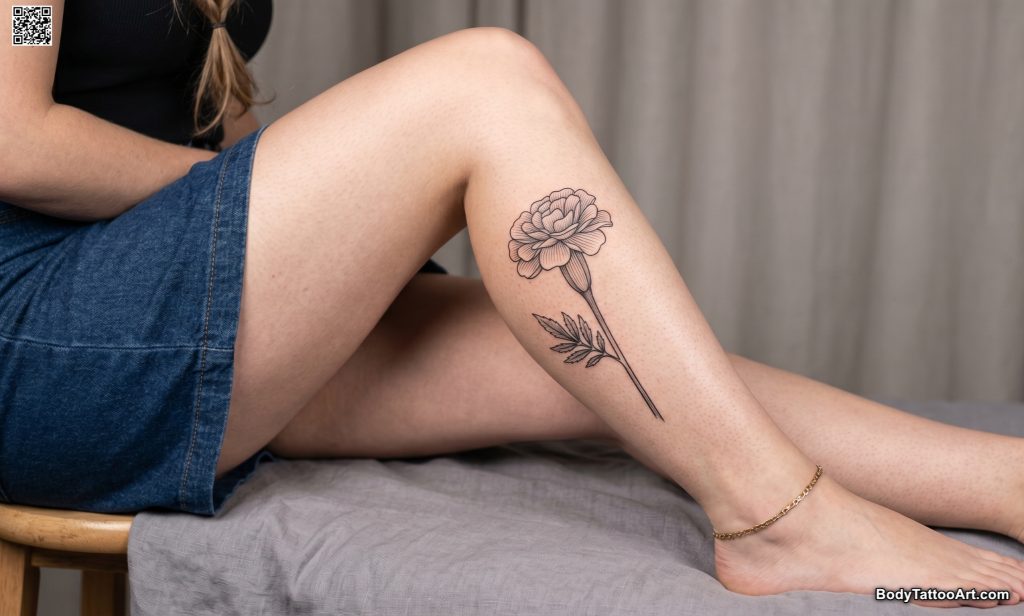
This design shows the marigold from a pure side angle — the layered petals visible as overlapping curves stacked from top to bottom, the stem rising straight upward into the base of the bloom. From this angle, the flower’s structure becomes almost architectural. Fine line shading with parallel strokes gives each visible petal a sense of depth.
Placement: Side of the forearm / shin
Style: Fine line illustrative
Why it stands out: The profile view of a marigold reveals the flower’s structure in a completely different way from the standard front-facing angle. The stacked petal layers read like a cross-section, giving the design an almost scientific quality that most marigold tattoos don’t have.
Ideal for: People who want unusual perspectives, botanical illustration fans, those wanting something that prompts a double-take.
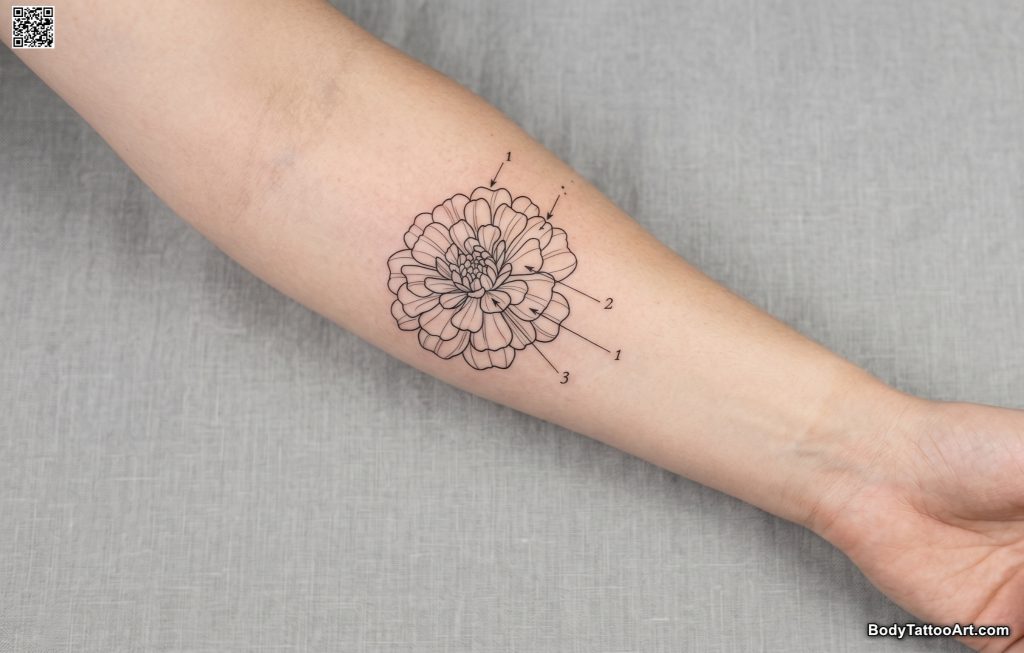
The petals are drawn with clean outlines and labelled with small numbers — 1, 2, 3 — pointing to different petal layers, like a botanical diagram. The numbers are tiny and in a simple serif font. No shading, no fills. Just the clean outlines of the bloom and its structural annotations. It looks like something from a botanical textbook.
Placement: Inner arm / forearm
Style: Illustrative / conceptual
Why it stands out: The diagram annotation detail turns a straightforward marigold tattoo into something wry and intellectual. The absence of shading keeps it clean and text-forward, and the numbers add a layer of visual interest that makes people lean in for a closer look.
Ideal for: Academics, science and nature lovers, people who want tattoos with a quiet sense of humour.
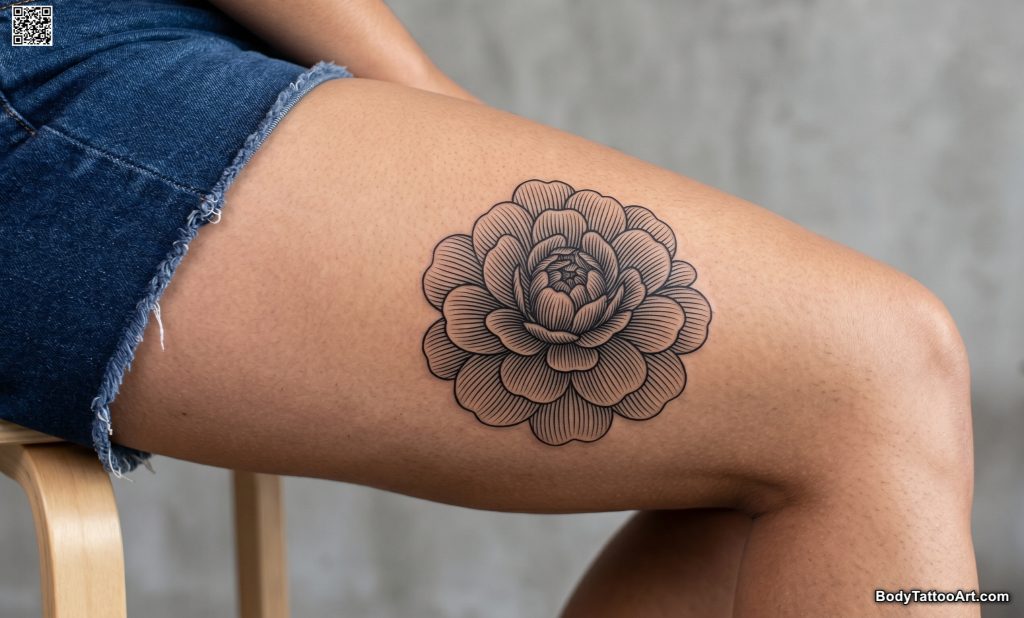
This marigold tattoo is all about the lines. Hundreds of short, curved parallel lines fill every petal, drawn close together and following the petal’s shape from base to tip. No grey wash, no dots — just line after line after line creating the illusion of texture and volume through repetition and density alone. The outer petals are slightly longer and more widely spaced; the inner petals are shorter and packed tight.
Placement: Outer thigh / upper back
Style: Linework / illustrative
Why it stands out: Using pure line density to create the impression of shading and texture is technically demanding and visually distinctive. The difference in line spacing between inner and outer petals creates a natural sense of depth without any tonal variation.
Ideal for: Collectors who appreciate technical linework, people who love deeply textured designs, those wanting something that reveals more the longer you look.
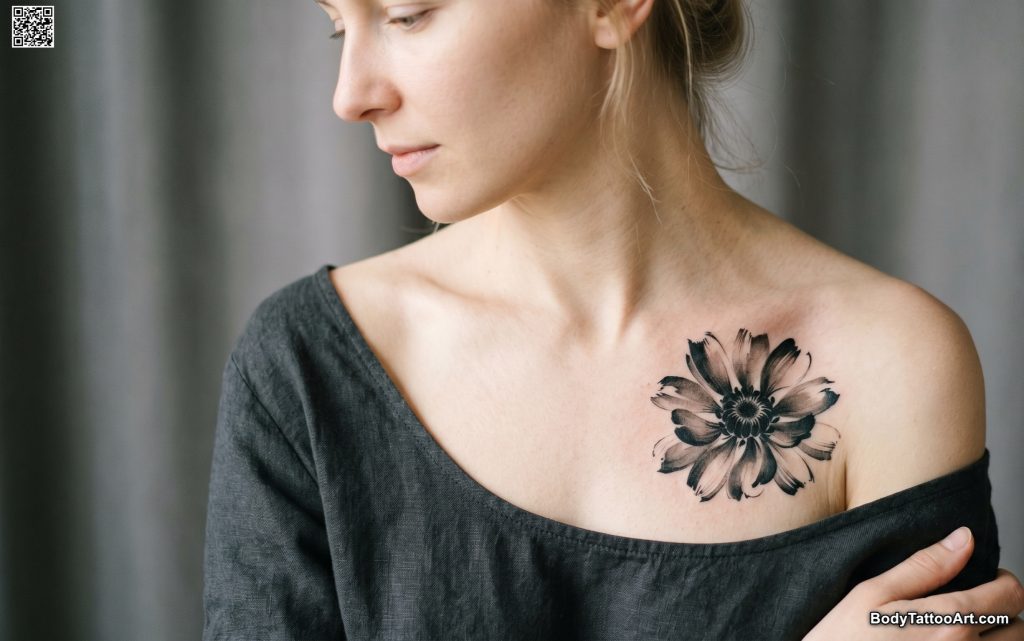
Each petal is one single sweeping brushstroke — wide at the petal base, tapering and slightly fraying at the tip. The ink is uneven in density, heavier at the stroke’s start and lighter where the brush lifted. The petals overlap loosely, with brushstroke edges visible where one petal crosses over another. The centre is a dense circular cluster of shorter strokes.
Placement: Upper chest / side of the neck
Style: Brush stroke / sumi-e inspired
Why it stands out: The marigold’s densely packed petals, when done as individual brushstrokes, create a texture that is simultaneously wild and structured. The natural fraying at each stroke tip suits the flower’s slightly spiky petal ends better than any other technique.
Ideal for: East Asian art enthusiasts, people who love expressive mark-making, those who want florals that feel energetic rather than static.
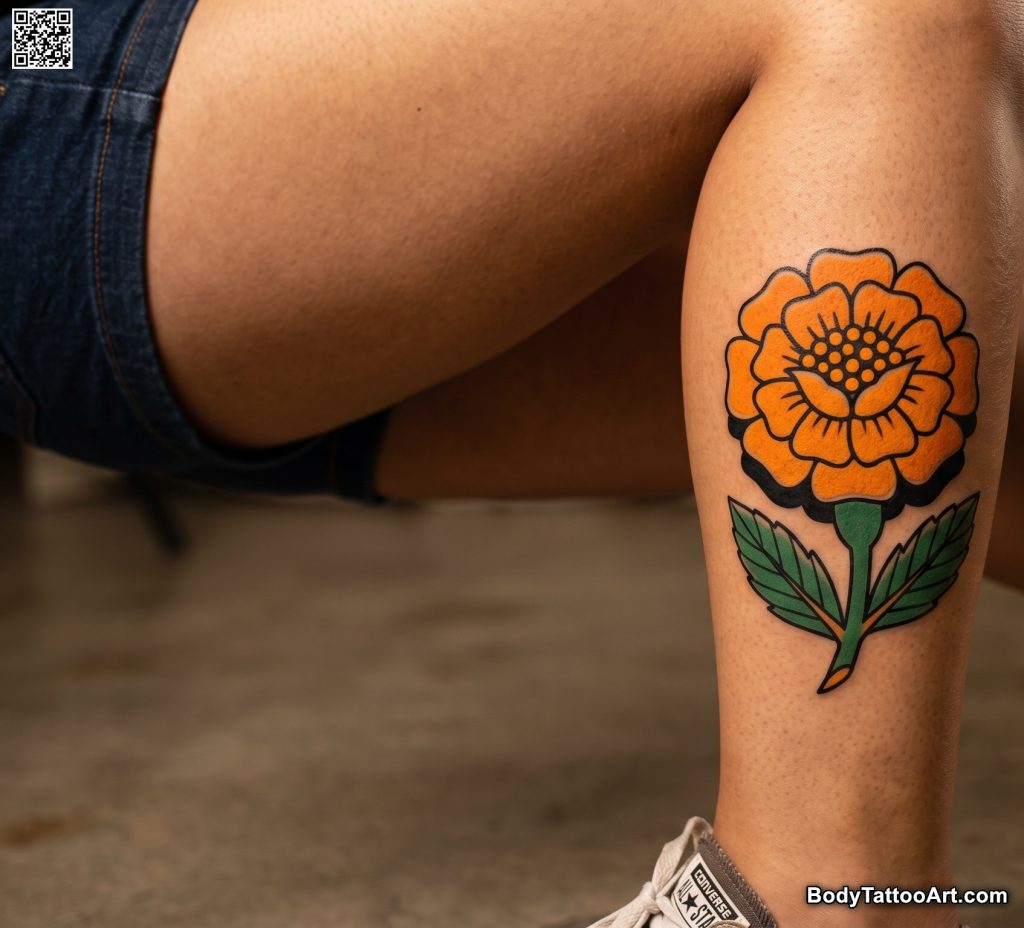
Deep orange petals outlined in thick black lines, filled with flat saturated colour. A strong black shadow sits at the base of the outer petal ring. The stem is short and sturdy, flanked by two wide flat leaves in forest green. The whole design reads like classic mid-century tattoo flash — bold, clean, unpretentious.
Placement: Shoulder / outer calf
Style: Traditional American
Why it stands out: Marigold tattoos are relatively uncommon in traditional American flash, which makes this choice feel like a fresh take on a classic format. The flower’s naturally warm orange palette suits the style’s saturated colour approach perfectly.
Ideal for: Traditional American tattoo collectors, people who love vintage aesthetics, those wanting a timeless design with a slightly unexpected flower choice.
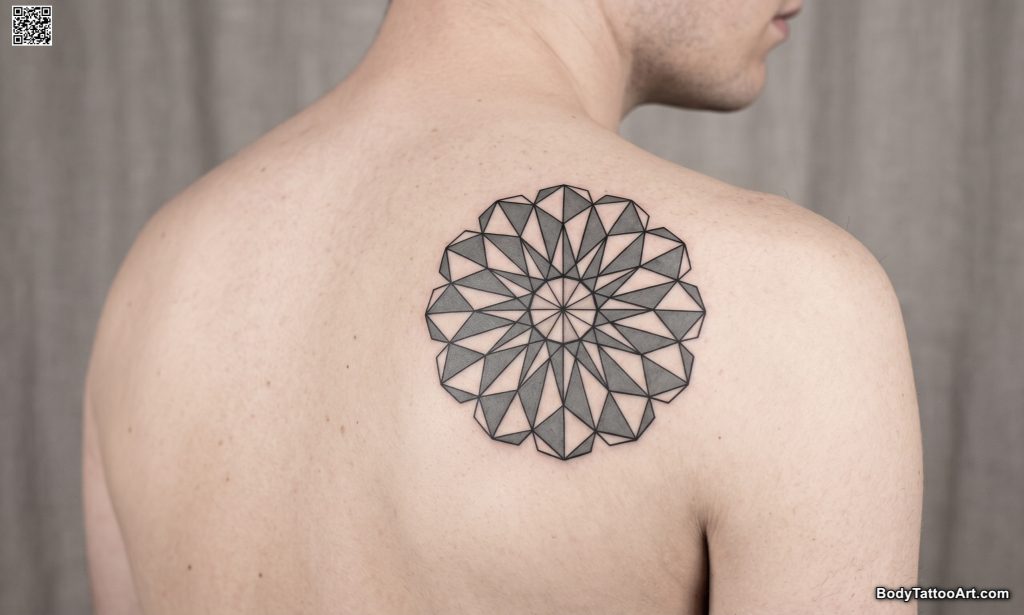
The petals are divided into triangular facets by thin straight lines, turning the round, soft flower into something angular and crystalline. Some triangular sections are shaded a medium grey while adjacent sections are left unshaded, creating a high-contrast geometric pattern across the entire bloom. The centre is a small hexagonal arrangement of similarly faceted shapes.
Placement: Upper arm / back of the shoulder
Style: Geometric blackwork
Why it stands out: The geometric treatment of the marigold creates a push-pull effect between the familiar round flower shape and the hard angular geometry imposed on it. The contrast of shaded and unshaded triangular sections adds optical energy.
Ideal for: Sacred geometry enthusiasts, people who want florals with a strong graphic design quality, blackwork collectors.
The entire bloom is slightly blurred at the edges — not out of poor execution, but deliberately. The petal edges are soft and diffused, as if the flower is being viewed through frosted glass or slightly wet tracing paper. Inside that soft boundary, fine lines still define individual petals. The centre of the bloom is the sharpest point, and everything gets progressively softer toward the outer edge.
Placement: Inner forearm / hip
Style: Soft realism / atmospheric
Why it stands out: The frosted-edge technique is rare in floral tattoo work. The contrast between the sharp centre and the blurred outer petals creates a focal depth effect that makes the tattoo look almost like a macro photograph.
Ideal for: People drawn to dreamy, soft aesthetics, photographers, those who want something that feels slightly surreal.
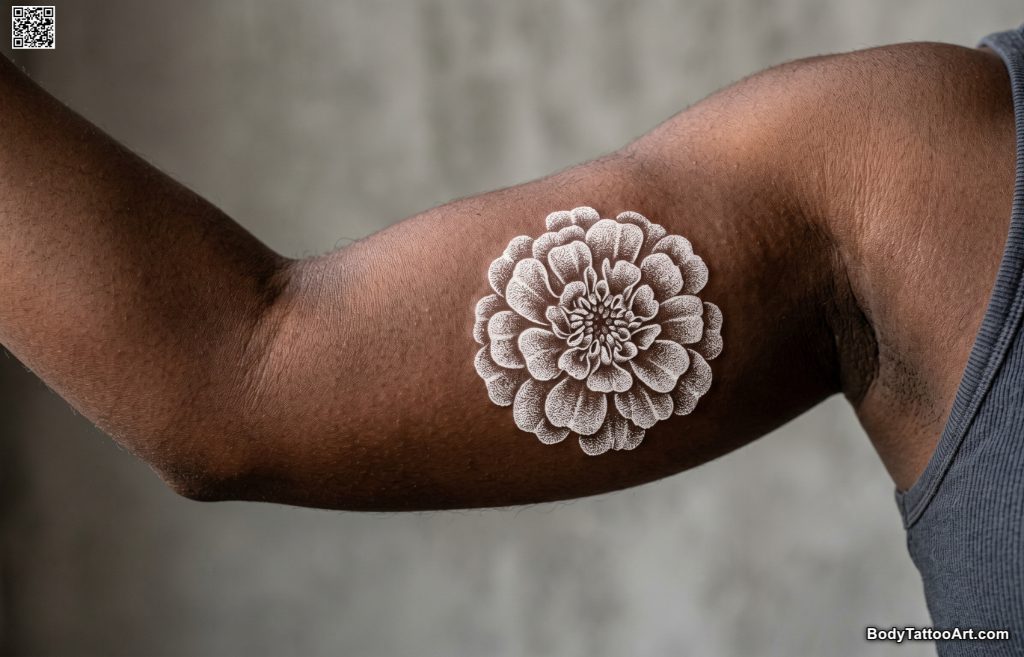
The design uses only white ink stippling — tiny white dots on dark skin, building the bloom’s form through concentrated white marks on a skin-tone background. The densest white dots cluster on the most highlighted areas of each petal. Shadow areas are simply left as bare skin, darker than the white dot clusters. No black ink used anywhere.
Placement: Shoulder / upper arm
Style: White ink dotwork
Why it stands out: White ink dotwork marigold tattoos on dark skin create an entirely different visual logic than standard black ink designs — the skin itself acts as the shadow, which inverts the normal relationship between ink and skin in tattoo composition.
Ideal for: Darker skin tone individuals looking for something that works with their skin, people who want truly unique design approaches, collectors who want to try white ink work.
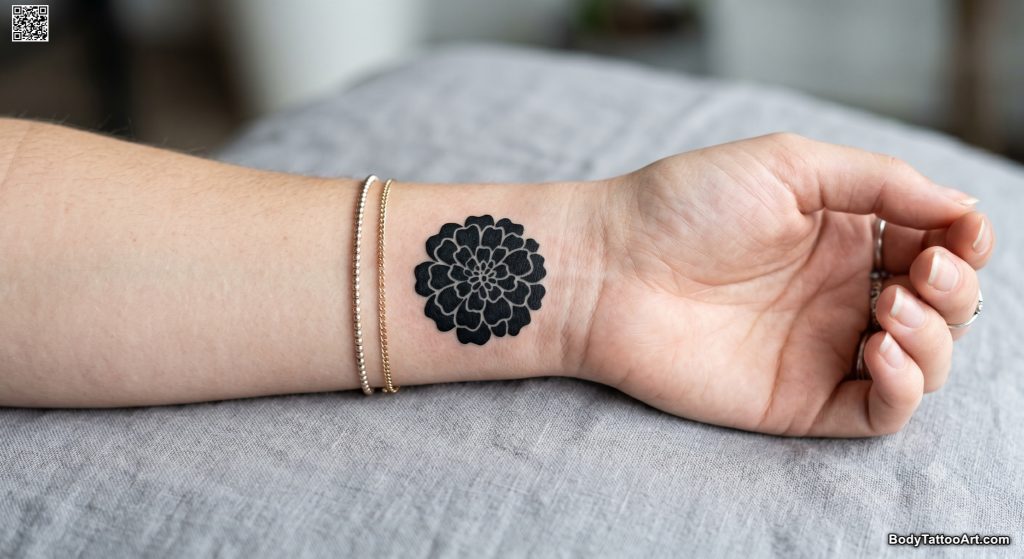
This is the most stripped-back version of marigold tattoos possible — just the overall outer silhouette of the bloom, filled in completely with solid black. No internal petal detail, no linework inside the shape. Just a clean, solid black marigold silhouette. The shape of the flower is iconic enough to read immediately without any interior detail.
Placement: Wrist / behind the ear / ankle
Style: Silhouette blackwork
Why it stands out: Testing whether a flower is recognisable as a pure silhouette is a real design challenge. The marigold passes because its dense round petal fringe creates a distinctive profile. The result is the boldest possible minimalist marigold tattoo.
Ideal for: Extreme minimalists, those wanting something small and high-contrast, people who appreciate reduction as a design concept.
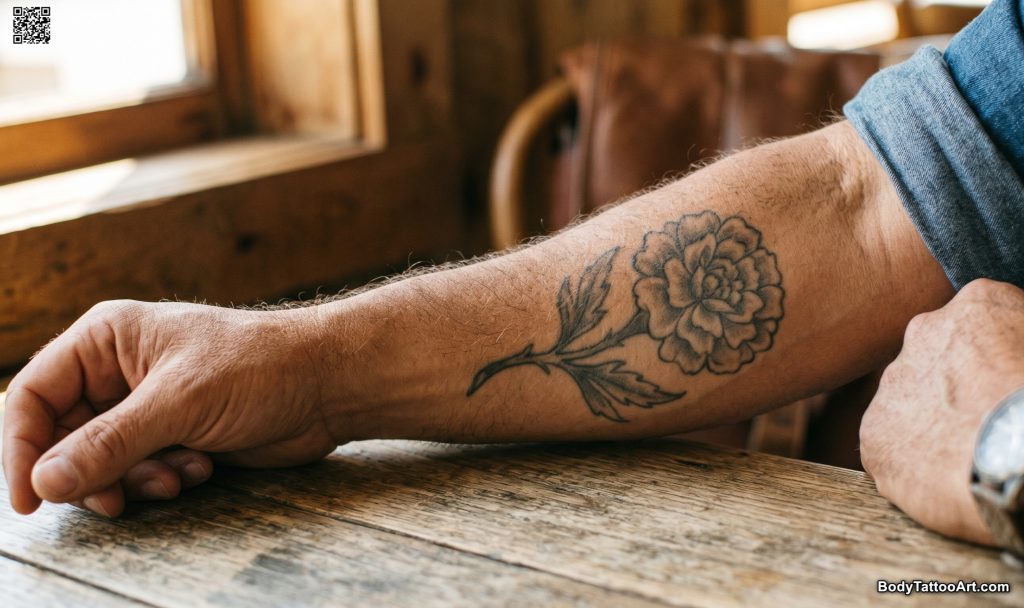
Deliberately muted tones and softened edges make this marigold tattoo look like it has already lived through several decades. The ink is grey-black rather than deep black. Lines are slightly diffused at their edges. The petal shading is soft and uneven, the way old tattoos look when they’ve faded unevenly with time. It looks nostalgic before it even heals.
Placement: Outer forearm / upper arm
Style: Vintage / faded
Why it stands out: An intentionally aged marigold tattoo asks the artist to hold back — to resist the urge to make lines crisp and fills even. That restraint produces something that feels warm, lived-in, and deeply personal in a way that a brand-new-looking tattoo sometimes doesn’t.
Ideal for: Old soul types, people who love vintage and antique aesthetics, collectors who want marigold tattoos that feel like inherited heirlooms.
Marigold tattoos deserve far more attention than they typically get in mainstream tattoo conversations. The flower’s layered, complex structure makes it a dream subject for almost every tattoo style — and the range of approaches across these 23 designs makes that clear. From a tiny micro bud behind the ear to a bold neo-traditional bicep piece, marigold tattoos prove that staying with one subject doesn’t mean limiting creative range.
For anyone considering a marigold tattoo, the most important step is finding an artist whose style genuinely suits the approach — a dotwork specialist for stippled pieces, a realism artist for grey-wash work, a traditional artist for flat-colour designs. Marigold tattoos done well are genuinely stunning. Done in the wrong hands for the chosen style, even great reference falls flat.