Physical Address
304 North Cardinal St.
Dorchester Center, MA 02124
Physical Address
304 North Cardinal St.
Dorchester Center, MA 02124

There’s a reason peony tattoos, alongside rose and sunflowers, keep showing up on every tattoo inspiration board, studio wall, and Pinterest deep-dive. The flower is just built for ink. All those layered petals, that full rounded shape, the way the whole bloom seems to be on the verge of opening further — it translates to skin in a way that very few flowers do.
Peony tattoos work because the flower has real visual weight. It’s not a delicate, single-petal situation. A peony has structure, depth, and drama — and whether that’s rendered in fine hairline strokes or bold blackwork blocks, it always reads as something substantial. This blog covers 22 different ways to wear a peony tattoo, each one genuinely different from the last.
Peony tattoos are designs built around the peony flower — a large, full bloom with tightly packed layers of petals that unfurl outward from a dense center. The flower is native to Asia and Southern Europe and has been a fixture in art, textile design, and tattooing for centuries.
In tattooing specifically, the peony is one of the most technically interesting flowers to work with. The layered petal structure gives artists real room to play with shading, depth, and light. A well-executed peony tattoo has visible foreground and background petals, believable shadow and highlight, and a sense of actual three-dimensional form. That’s why peony tattoos tend to attract skilled artists — it’s a flower that rewards serious technique.
In Chinese culture, the peony has been called the “king of flowers” for over a thousand years. It appears in imperial art, silk embroidery, and ceramic painting as a symbol of prosperity and high status. The association isn’t with delicacy — it’s with abundance, confidence, and a certain unapologetic fullness.
In Japanese tattooing, the peony — known as botan — is one of the classic traditional motifs, often paired with imagery of strength to balance or contrast its softness. It carries ideas of good fortune and bravery, and in the irezumi tradition it’s one of the four flowers that represent the seasons, standing in for summer.
In Western contexts, the peony is more broadly associated with romance and luxury — the flower you see in high-end floristry, bridal arrangements, and editorial photography. As a tattoo, it carries that same sense of something generous and beautiful.
But as with most tattoo subjects, plenty of people simply love how a peony looks. The meaning becomes personal. What matters first is the design.
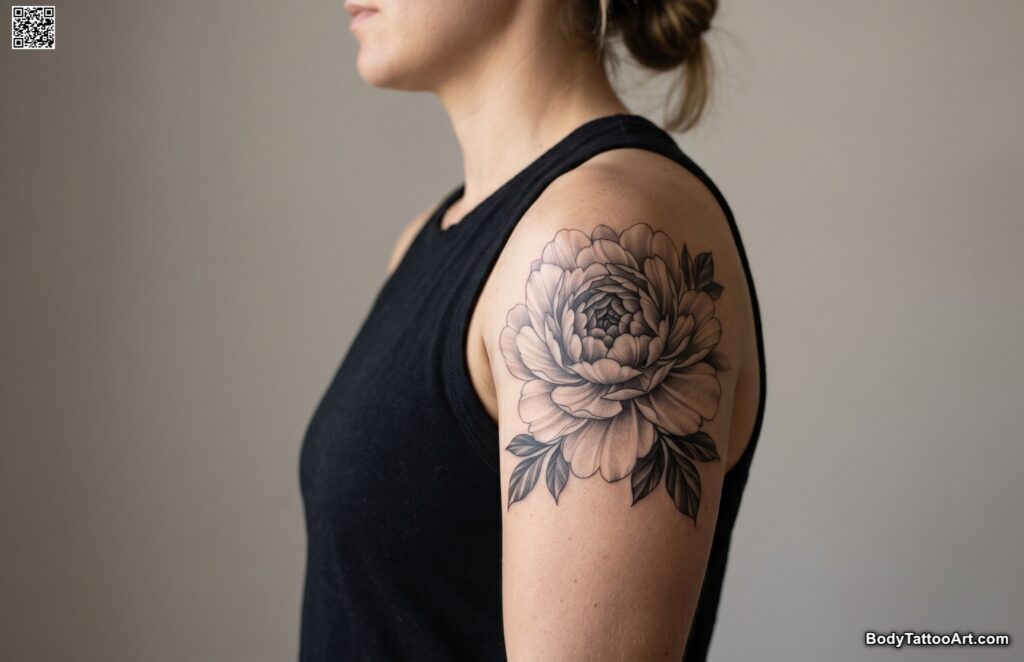
A single large peony, fully open, centered on the upper arm like a portrait. Every petal layer is individually shaded — the outer petals catching light, the inner ones falling into shadow. The center is a tight cluster of smaller curled petals that adds a beautiful density to the middle of the composition. No background, no filler.
Placement: Upper arm
Style: Grey-wash realism Peony Tattoos
Why it stands out: Single-subject realism lives or dies by the quality of the shading, and this one commits fully. The tonal range from bright highlight to deep shadow gives the flower genuine volume.
Ideal for: Realism fans, people wanting a bold single-image arm piece, collectors who appreciate technical precision.
Loose sketch-style linework gives this peony the feeling of something drawn fast in a sketchbook — doubled lines, visible petal construction strokes, slightly rough edges on the outer petals. It shouldn’t work as well as it does. The informality of it makes it feel incredibly alive.
Placement: Forearm
Style: Sketch / illustrative
Why it stands out: The raw, unfinished quality is deceptive — every “imperfect” line is deliberate. Sketch tattoos require a confident hand and a good eye for controlled chaos.
Ideal for: Illustrators, people who love hand-drawn aesthetics, those wanting something that feels personal and unconventional.

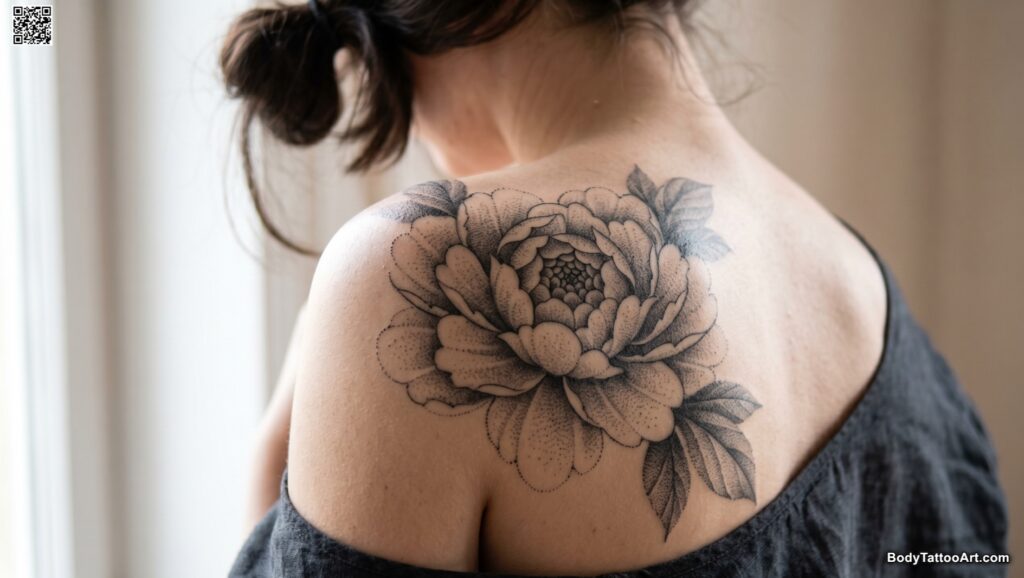
Built entirely from stippled dots — no lines, no solid fills, just thousands of tiny ink points that accumulate into petals, shadow, and form. The shading transitions from densely packed dots at the shadowed petal bases to single isolated dots at the outer edges. Up close it’s texture. From arm’s length, it becomes a flower.
Placement: Shoulder blade
Style: Dotwork Peony Tattoos
Why it stands out: The patience this requires — both from the artist and the person getting tattooed — is visible in the result. The soft, grainy texture is something flat linework simply cannot replicate.
Ideal for: Detail lovers, people drawn to textured and tactile-looking tattoos, those wanting something genuinely uncommon.
Thick, heavy outlines and flat colour fills in the style of American traditional tattooing — deep red petals with a solid dark outline, yellow stamens at the center, minimal internal shading. The design is simple, intentional, and built to last. This is tattooing at its most confident.
Placement: Calf
Style: American traditional
Why it stands out: Traditional tattoos age better than almost any other style, and the bold line-plus-flat-colour approach gives this a graphic punch that detailed realism can’t match at a glance.
Ideal for: Traditional tattoo fans, people who want bold long-lasting designs, those drawn to classic Americana aesthetics.

A watercolor peony where the outer petals bleed into soft washes of blush and rose, but the center of the flower deepens into a rich, almost burgundy tone with no visible outlines. The colour transitions are seamless — the whole thing reads like pigment dropped into water and coaxed into flower shape.
Placement: Shoulder / upper chest
Style: Watercolor Peony Tattoos
Why it stands out: The colour gradient from pale edge to deep center mirrors how real peonies actually look — lighter at the tips, richer at the base. That botanical accuracy inside a loose watercolor style is a strong combination.
Ideal for: Colour tattoo lovers, people wanting something soft and painterly, those drawn to feminine and artistic designs.

A large peony rendered purely in black ink with aggressive contrast — the lightest petals left almost white, the shadows filled to a near-solid black. No grey wash softens the transitions. The result is high-contrast, graphic, and striking. It’s a flower with a boldness that has nothing to do with colour.
Placement: Thigh
Style: Blackwork high-contrast
Why it stands out: Most peony tattoos lean into softness. This one leans the other way entirely. The aggressive tonal contrast gives the design a drama that feels completely different from the usual approach to this motif.
Ideal for: Blackwork lovers, people who want a bold statement piece, those drawn to high-contrast graphic tattooing.

The entire peony is drawn in a single continuous fine line — one unbroken stroke tracing the silhouette of every petal layer. No shading, no fill, no variation in line weight. The empty space inside the outline is raw skin. It’s architectural. It’s minimal. It’s harder to do than it looks.
Placement: Wrist
Style: Single-line / fine line
Why it stands out: Taking a subject this complex and reducing it to a single unbroken outline requires a very clear understanding of the flower’s structure. The restraint is what makes it interesting.
Ideal for: Minimalists, people wanting small delicate tattoos, fine line enthusiasts and first-timers.

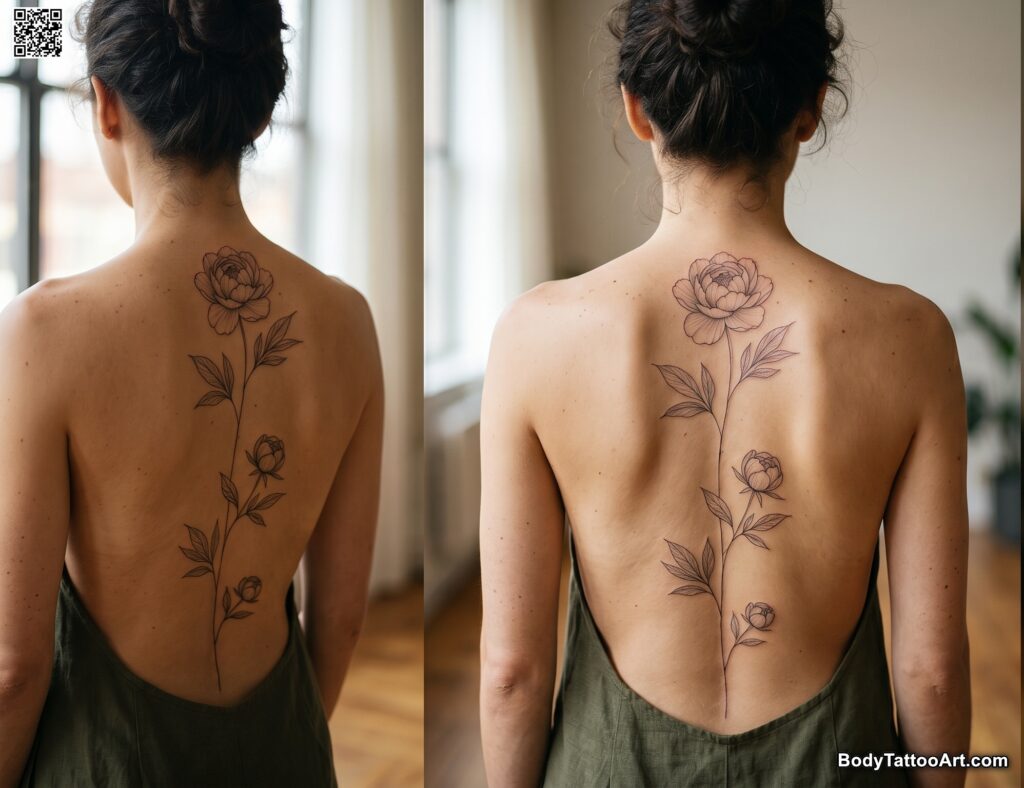
A vertical peony stem with one large open bloom at the top and two smaller buds lower down, running the full length of the spine. The stem has fine-line leaf detail and a natural slight curve that mirrors the body’s own line. From across the room it reads as a botanical illustration. Up close, the linework is extraordinary.
Placement: Full spine
Style: Fine line botanical
Why it stands out: The vertical composition uses the spine as the natural axis of the design, which means the tattoo and the body feel designed for each other. That harmony is rare.
Ideal for: People wanting long elegant back tattoos, botanical illustration lovers, fine line collectors.
A peony caught mid-bloom — not fully open, not a bud. The outer petals have unfurled but the inner layers are still dense and folded. This stage of the flower has more visual tension than a full bloom, and the shading leans into that — the closed center casting genuine shadow over the petals beneath it.
Placement: Inner bicep
Style: Grey-wash realism
Why it stands out: Most peony tattoos depict the fully open bloom. Choosing the mid-bloom stage is an artistic decision that immediately makes this feel less generic and more considered.
Ideal for: Realism collectors, people who like subtle conceptual choices in their tattoos, detail-oriented tattoo fans.

A peony in new school Japanese style — slightly cartoonish proportions, vivid flat colours, bold outlines with decorative fill patterns inside individual petals. The petals have clean colour separations rather than gradients. The overall silhouette is strong and readable. It sits somewhere between traditional and illustrative.
Placement: Upper back
Style: New school Japanese
Why it stands out: The flat colour separations inside individual petals create a stained-glass quality that’s unlike anything in the realism or fine line world. It’s graphic and fun and unafraid.
Ideal for: Colour tattoo fans, people who love Japanese aesthetics, those wanting something bold and decorative.

A full peony bloom rendered entirely in white ink on fair skin — subtle, barely-there, like a flower that exists just below the surface. The petal layers are defined by slight shading differences within the white ink itself. From certain angles it almost disappears. From others, it catches the light and glows.
Placement: Collarbone
Style: White ink
Why it stands out: White ink tattoos exist in a constant dialogue with the skin — they reveal themselves differently depending on light, angle, and season. That changeability gives the design a quality that coloured tattoos simply don’t have.
Ideal for: People wanting subtle and unusual tattoos, fair-skinned individuals, those drawn to barely-there aesthetics.

Solid black ink fills every space around the peony — the background, the spaces between petals, even some petal-tip shadows — and the flower itself is defined by what’s left unpainted. The raw skin becomes the petals. The design reads as a peony only because of the precise shapes carved out of the surrounding black.
Placement: Outer forearm
Style: Blackwork / negative space
Why it stands out: This inverts the usual tattooing logic entirely. Instead of drawing the flower, the artist draws everything except the flower. The conceptual flip makes this visually arresting.
Ideal for: Blackwork lovers, people who like dark and dramatic pieces, those wanting genuinely original designs.

The outer petals of the peony are rendered in soft, naturalistic linework — curved, organic, slightly irregular. But the center of the flower is a perfect geometric polygon, all sharp angles and straight-line precision. The two visual languages collide at the point where the petal layers meet the geometric core. That collision is the whole design.
Placement: Sternum
Style: Geometric / fine line hybrid
Why it stands out: The contrast between organic and geometric in a single flower is conceptually interesting and visually unusual. The design rewards close inspection more than most.
Ideal for: People who like conceptual tattoos, design thinkers, those wanting something structured but still soft.

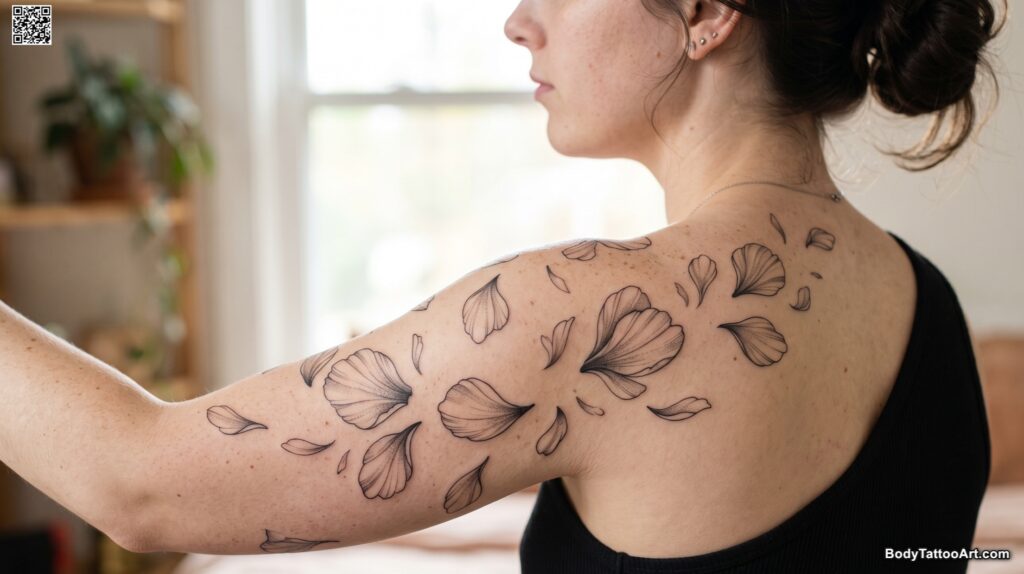
No full flower — just individual peony petals scattered across the shoulder and upper arm as if the bloom fell apart mid-air. Some petals are large and detailed with visible veining, others are smaller and simpler. They’re spread across the skin with intentional spacing, and the gaps between them are part of the design.
Placement: Shoulder / upper arm
Style: Fine line with shading
Why it stands out: Removing the whole flower and keeping only the petals is a bold compositional choice. It creates a design that’s immediately recognizable as peony but completely avoids the expected format.
Ideal for: People who want something different from a standard flower tattoo, free-spirited design lovers, those who love airy open compositions.
A large peony stem with an open bloom curves naturally along the ribcage, following the body’s own contour lines. The flower sits at the front of the ribs and the stem curves back and around. Fine leaf detail fills the spaces between the stem bends. The whole design disappears and reappears as the body moves.
Placement: Ribcage
Style: Fine line botanical
Why it stands out: Ribcage tattoos are intimate by nature — mostly hidden, revealed selectively. A design that follows the rib curve rather than fighting it has an elegance that flat-composition designs lack.
Ideal for: People who love placement-conscious tattoos, botanical illustration fans, those wanting something intimate and personal.

The peony is taken apart and rebuilt in an abstract expressionist style — petal shapes that are barely petals, ink marks that suggest a flower without representing one, layered strokes in black and grey that accumulate into something that reads as “peony” through feeling rather than accuracy.
Placement: Upper back / shoulder blade area
Style: Abstract / neo-expressionist
Why it stands out: This is the furthest from a literal flower tattoo that the subject can go while still being identifiable. The ambiguity makes it endlessly interesting — different people will see different things in it.
Ideal for: Art collectors, people who love experimental tattoos, those wanting something entirely original.

A peony centered directly on the kneecap — petals radiating outward from the center of the joint so the flower’s natural structure mirrors the shape of the knee itself. The shading on the petals follows the curved surface beneath them, which makes the whole design appear to wrap around the joint rather than sitting flat on it.
Placement: Knee
Style: Grey-wash realism
Why it stands out: Knee tattoos are notoriously difficult to execute because the curved surface distorts flat designs. Choosing a radial composition that works with the roundness of the joint is genuinely clever.
Ideal for: Experienced tattoo collectors, bold placement choices fans, people who love how unconventional placements look.

An entire peony in flat solid black silhouette — stem, leaves, and full bloom in a single flat graphic shape with zero interior detail. The shape is the design. The recognizability of the peony silhouette does all the work.
Placement: Ankle
Style: Blackwork / silhouette
Why it stands out: Pure silhouette tattooing strips everything away and asks whether the shape alone is enough. For a peony, the answer is yes — the bloom shape is so distinctive that it reads immediately even with no internal detail.
Ideal for: Minimalists who still want visual impact, graphic design lovers, people wanting small and bold ankle pieces.

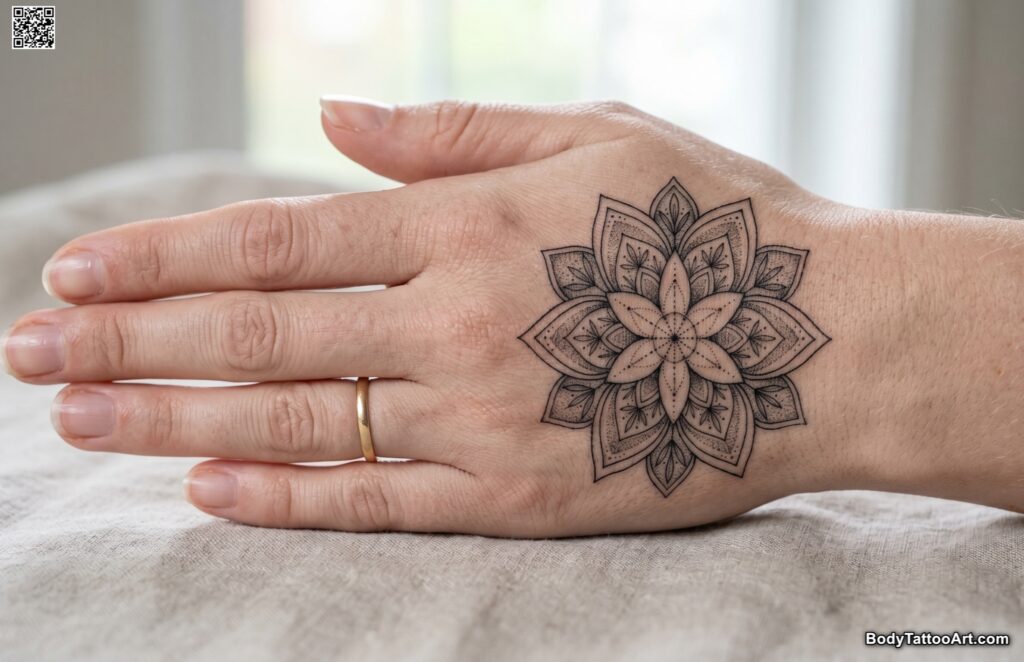
Peony petals arranged in a perfect mandala — eight blooms radiating from a central point, each petal pair mirrored. The result is simultaneously a mandala and a peony, and the two structures reinforce each other. Fine inner linework adds detail inside each petal without cluttering the overall circular geometry.
Placement: Back of the hand
Style: Geometric mandala / fine line
Why it stands out: The dual reading — mandala and flower — makes this intellectually interesting in a way that most flower tattoos aren’t. The symmetry is hypnotic and the botanical detail rewards close inspection.
Ideal for: Geometry fans, people who love intricate detailed designs, those wanting hand tattoos with strong visual presence.
A peony small enough to fit inside a coin — tucked behind the ear or on the inside of the wrist, rendered in the finest possible linework. Every petal layer is present and correct, just executed at a scale that requires a magnifying glass to fully appreciate. The miniaturization is its own form of art.
Placement: Behind the ear
Style: Micro fine line
Why it stands out: Getting full botanical accuracy into a design this small is an extraordinary technical achievement. The tinier the tattoo, the less room there is for error.
Ideal for: People wanting discreet tattoos, first-timers, those who love the hidden and intimate placement of behind-the-ear designs.

Ink applied with the same energy as a Chinese ink brush painting — the petals are single confident strokes, some with visible dry-brush texture at the edges. There’s no going back, no correcting. Each mark stays exactly as it landed. The whole piece has the spontaneity and deliberateness that only brush-style work produces.
Placement: Upper arm / shoulder
Style: Sumi-e / brush-painted
Why it stands out: The permanence of brush-style tattooing — where every mark is final — gives this a confidence that careful fine line work doesn’t have. It’s tattooing as performance.
Ideal for: East Asian art lovers, people who appreciate the sumi-e tradition, those wanting something expressive and gestural.

A full arm sleeve built from peonies alone — blooms at different stages from bud to fully open, filling every section of the arm from shoulder to wrist. The arrangement isn’t random: larger blooms anchor the shoulder and wrist, mid-sized flowers fill the forearm, and delicate buds with fine stem detail fill the transitions. The whole arm becomes a peony garden in motion.
Placement: Full arm sleeve
Style: Japanese traditional / irezumi-inspired
Why it stands out: Building a full sleeve from a single flower type is a commitment to composition over variety — and it pays off. The different bloom stages keep the eye moving, and the overall effect is overwhelming in the best way.
Ideal for: Serious collectors, people ready for large-scale commitment pieces, Japanese aesthetic lovers.
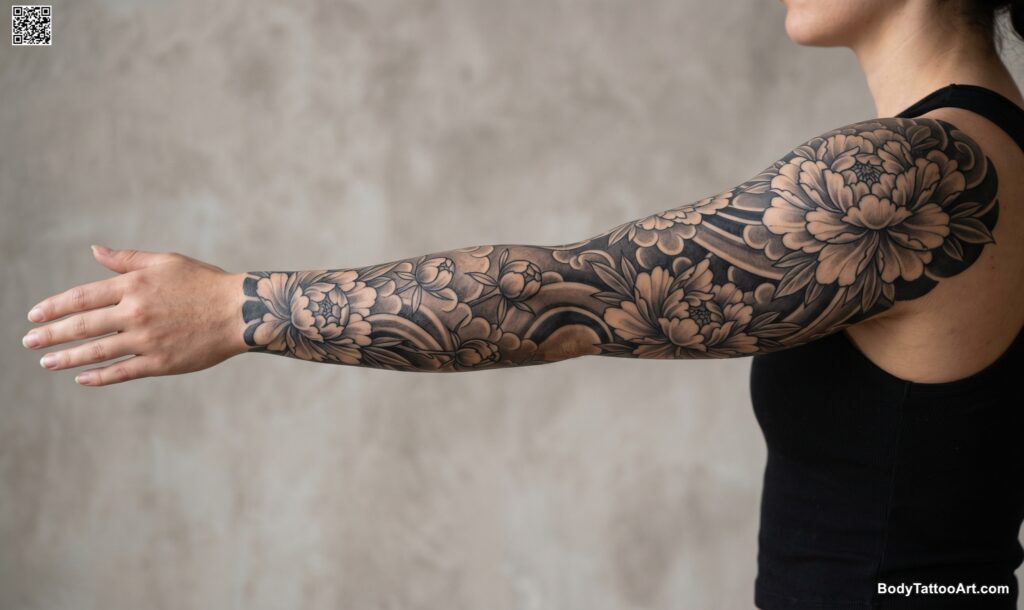
Peony tattoos are one of those subjects that tattoo artists actually love to work on — because the flower demands real technique and rewards it visibly. The layered petal structure, the tonal range from shadowed center to highlighted edge, the way the whole bloom has a clear sense of volume and weight — all of that gives a skilled artist something genuine to work with.
What the 22 designs in this blog show is how much range exists within a single subject. The same flower can become a minimalist wrist piece or a full arm statement. It can be brush-painted or geometrically precise, high-contrast black or soft watercolor blush. The peony accommodates all of it.
Anyone drawn to peony tattoos should think carefully about placement and style before anything else — because getting those two things right is what turns a good tattoo into a great one. Take the image prompt that resonates most, find an artist whose portfolio is already in that style, and let them make it theirs. That’s when peony tattoos go from beautiful to unforgettable.
If you are looking for more floral inspo, do check out, Iris, Orchids, Vines, Lotuses, Lavenders, Hibiscus and more varieties.