Physical Address
304 North Cardinal St.
Dorchester Center, MA 02124
Physical Address
304 North Cardinal St.
Dorchester Center, MA 02124

There’s something about a poppy that just works as a tattoo. The petals are thin but bold. The shape is simple but never boring. And no matter which style a tattoo artist works in — fine line, blackwork, watercolor — a poppy tattoo always manages to feel both delicate and dramatic at the same time.
Poppy tattoos have been growing in popularity for years, along with wildflowers and tulips, and it’s easy to see why. They sit beautifully on almost every placement. They scale down to tiny and still look clean. They scale up to large and still feel balanced. Whether someone wants something soft and quiet or dark and striking, there’s a poppy tattoo for every kind of taste.
Poppy tattoos have been around for decades, but the variety of styles available today makes them feel completely fresh. Artists are experimenting with geometric structures, negative space, abstract ink washes, and micro-detail work — all using the poppy as the starting point.
The flower itself has a lot going for it visually. The rounded seed pod at the center creates a strong focal point. The crinkled, tissue-thin petals create beautiful opportunities for shading. The long curved stem adds natural flow. Put all that together and it’s the kind of design that can fill a large space or sit quietly on a wrist.
Poppy tattoos carry a lot of quiet weight. Across different cultures, the poppy has been linked to remembrance, rest, dreams, and the passage of time. In many Western countries, the red poppy is deeply tied to honouring war veterans and fallen soldiers. In Eastern traditions, the poppy has long been associated with sleep, peace, and the subconscious.
But here’s the thing — most people who get poppy tattoos aren’t walking around needing to explain a deep meaning. A lot of the time, it simply feels right. The shape is beautiful, the symbolism is layered without being heavy, and poppy tattoos age incredibly well on skin.
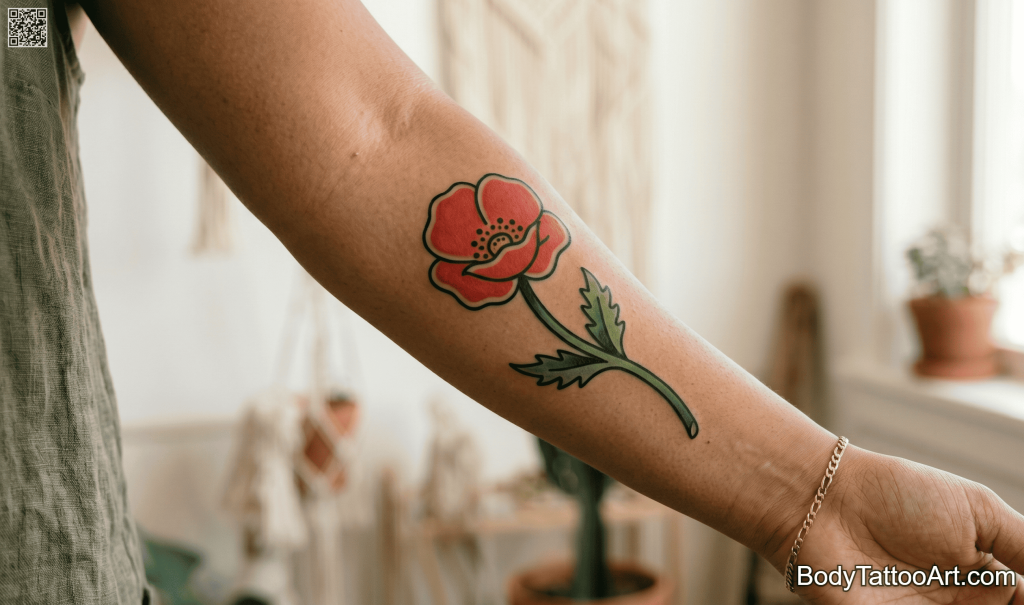
One poppy. Full colour. No fuss. This tattoo features a single red poppy in traditional tattoo style — bold black outlines, flat red fill, and a slightly curved stem with one small leaf. The design doesn’t try to do too much. That restraint is exactly what makes it pop. The black outline is thick enough to read clearly from a distance, and the red sits rich and saturated inside it.
Placement: Inner forearm / wrist
Style: American Traditional Poppy Tattoos
Why it stands out: Traditional poppy tattoos like this one age beautifully. The bold lines hold their shape for years and the minimal colour palette never muddles. It’s one of those designs that looks good the moment it heals and keeps looking good a decade later.
Ideal for: First-timers, fans of classic tattoo aesthetics, people who want something instantly recognisable.
This one is all restraint. A single poppy rendered in hairline-thin strokes, no shading, no fill — just the outline of the petals and a long elegant stem. The linework is so precise it almost looks like a pencil sketch pressed into skin. The petals are drawn with just enough variation to feel natural rather than stiff.
Placement: Back of the neck / collarbone
Style: Fine line Poppy Tattoos
Why it stands out: The minimalism here is the whole point. There’s no clutter, no filler — just one clean shape against skin. It’s the kind of tattoo that surprises people up close because the detail is finer than expected.
Ideal for: Minimalists, people who prefer subtle tattoos, those getting their first fine line piece.

The entire tattoo is built from dots. Thousands of tiny stippled marks come together to create a poppy that has incredible depth without using a single solid line. The centre of the flower is dense and almost black, and the dots gradually spread and lighten toward the petal edges, creating a natural fade that looks almost three-dimensional.
Placement: Upper arm / shoulder
Style: Dotwork / Stippling Poppy Tattoos
Why it stands out: The tonal range achieved purely through dot density is impressive. This poppy tattoo rewards close inspection — the closer you look, the more texture there is. From a distance it reads as bold. Up close it’s incredibly intricate.
Ideal for: Collectors, people who appreciate technical tattooing, fans of black and grey work.

This poppy has been broken into geometric segments — each petal divided by clean straight lines that create a mosaic-like effect. The overall shape of the flower is still recognisable, but the interior is structured and angular. Some segments are filled solid black, others left open. The contrast between filled and empty sections creates a bold graphic pattern.
Placement: Forearm / sternum
Style: Geometric blackwork Poppy Tattoos
Why it stands out: It sits right at the intersection of botanical and graphic design. The geometric structure gives it an almost architectural quality that most floral tattoos don’t have.
Ideal for: Design-minded people, fans of bold geometric work, those who want a floral tattoo that doesn’t feel soft.

Loose, free, and almost painterly. This poppy tattoo skips the outlines entirely and leads with colour — a wash of soft orange bleeding into hot pink, with ink that pools slightly at the petal edges and fades to nothing at the tips. The centre is a deep violet smudge. The whole design looks like someone held a wet brush to paper and let it do what it wanted.
Placement: Ribcage / shoulder blade
Style: Watercolour Poppy Tattoos
Why it stands out: The total absence of black outlines is rare and striking. The colours bleed into each other rather than staying contained, which gives this poppy tattoo an organic spontaneity that’s hard to replicate.
Ideal for: Art lovers, bold colour fans, people who want something that feels expressive rather than precise.

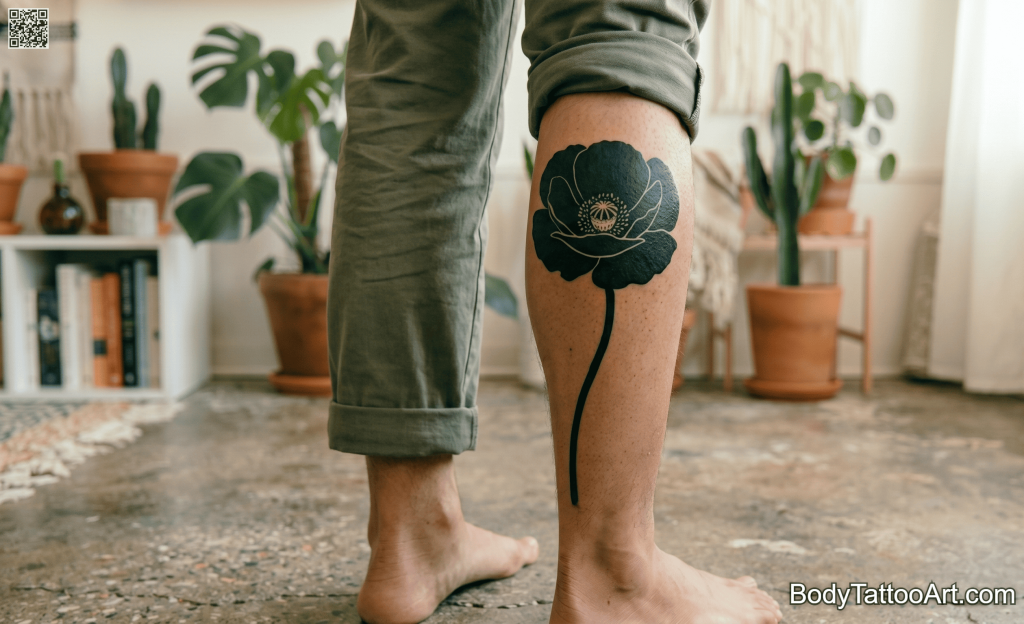
Every petal is filled completely solid black. The seed pod at the centre has a small cluster of fine white dot details scratched in, and the stem is rendered in a single thick confident line. The result is a tattoo that looks almost like a block print — flat, heavy, and completely intentional.
Placement: Calf / outer thigh
Style: Blackwork Poppy Tattoos
Why it stands out: There’s no hesitation in this design. Full black fill takes commitment from both the client and the artist. The white negative space details in the seed pod stop it from feeling too heavy and give the eye somewhere to rest.
Ideal for: Bold tattoo lovers, collectors building blackwork sleeves, people who want maximum visual impact.
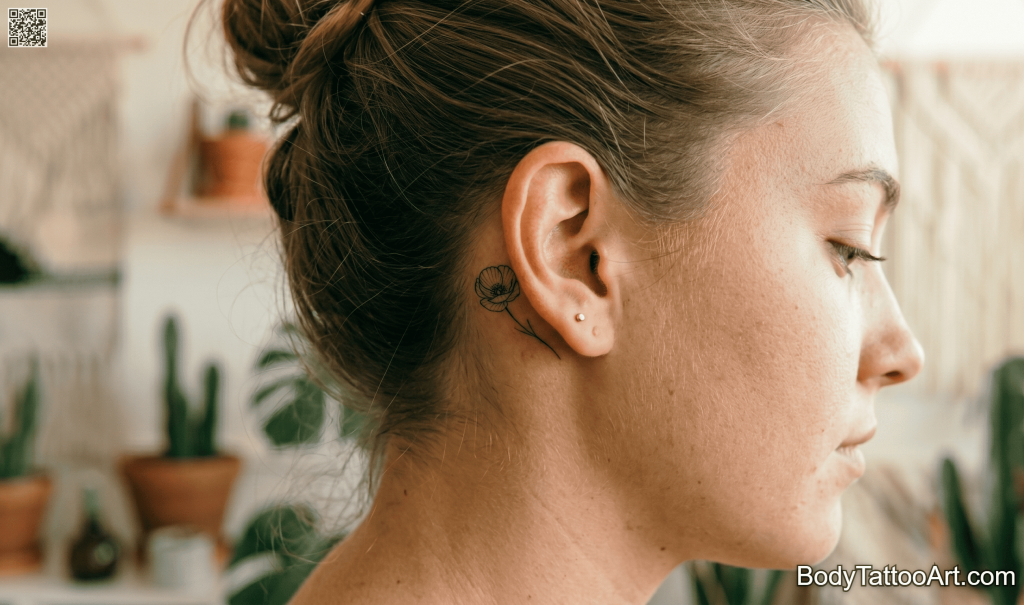
Tiny, precise, and perfectly placed. This micro poppy tattoo fits entirely within the space behind the ear — just the flower head and a short stem, drawn in fine lines so small they look almost printed. The petals have minimal interior linework, just enough to suggest form without overcrowding the small scale.
Placement: Behind the ear
Style: Micro fine line Poppy Tattoos
Why it stands out: Scale and placement are everything here. The behind-ear space is curved and tight, and a design that fits it perfectly without looking cramped takes real planning. This one sits beautifully.
Ideal for: First-timers, people wanting something discreet, minimalism fans.
This poppy looks like it was drawn with a fast, confident hand — loose strokes, visible line variation, some lines that don’t quite close, and a few expressive hatched marks for shading. It has the energy of a quick artist’s sketch, but the composition is actually carefully balanced.
Placement: Upper arm / hip
Style: Sketch / illustrative Poppy Tattoos
Why it stands out: The intentional imperfection is what makes it work. Most tattoos aim for clean symmetry. This one embraces visible gesture and movement, which gives it a lot of personality.
Ideal for: Art students, creatives, people who want a tattoo that feels hand-drawn and personal.

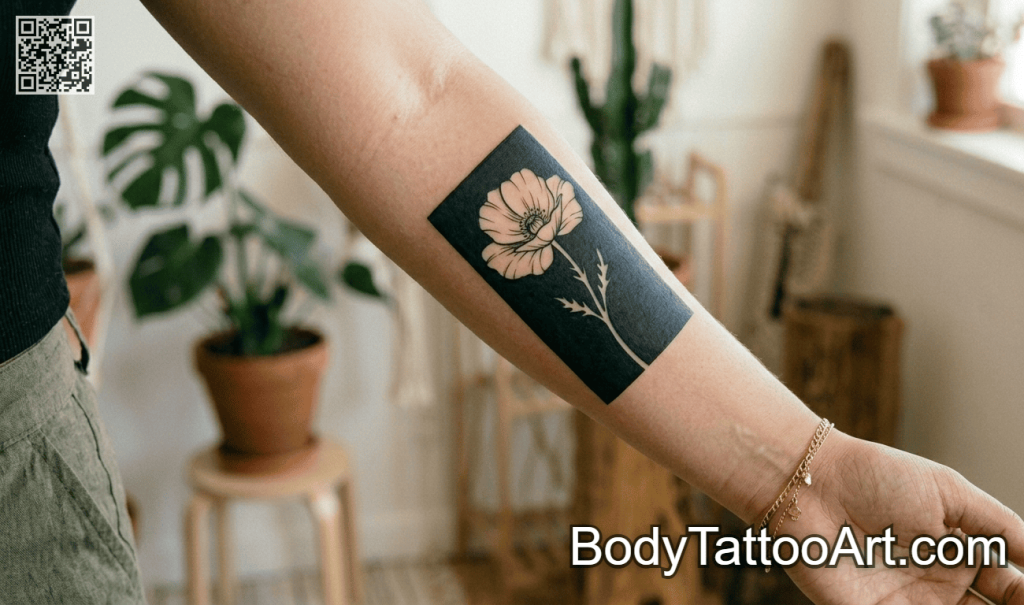
The background is filled solid black. The poppy is formed entirely by the white skin left unpainted — the petals exist as skin, not ink. The technique flips the usual approach: instead of tattooing the flower, the artist has tattooed everything around it.
Placement: Inner arm / outer forearm
Style: Negative space blackwork Poppy Tattoos
Why it stands out: Negative space designs require precise planning because the design lives in what isn’t there. Done well, the effect is genuinely arresting — the eye has to work a moment to read the form.
Ideal for: Collectors interested in experimental techniques, blackwork enthusiasts, people who want something truly different.
Soft, quiet, and genuinely beautiful. This poppy tattoo is done entirely in grey wash — no harsh lines, just smooth tonal shifts from near-white petal edges to a deep grey centre. The petals have a fine crinkled texture rendered through carefully layered shading, and the seed pod has a subtle rounded shadow that gives it real dimensionality.
Placement: Inner forearm / ankle
Style: Grey wash realism Poppy Tattoos
Why it stands out: The petal texture here is the star. Really good grey wash work on a poppy captures the way real petals catch light — thin, slightly translucent, with natural folds. This design does exactly that.
Ideal for: People who love realism, those wanting something elegant and timeless, grey tattoo fans.

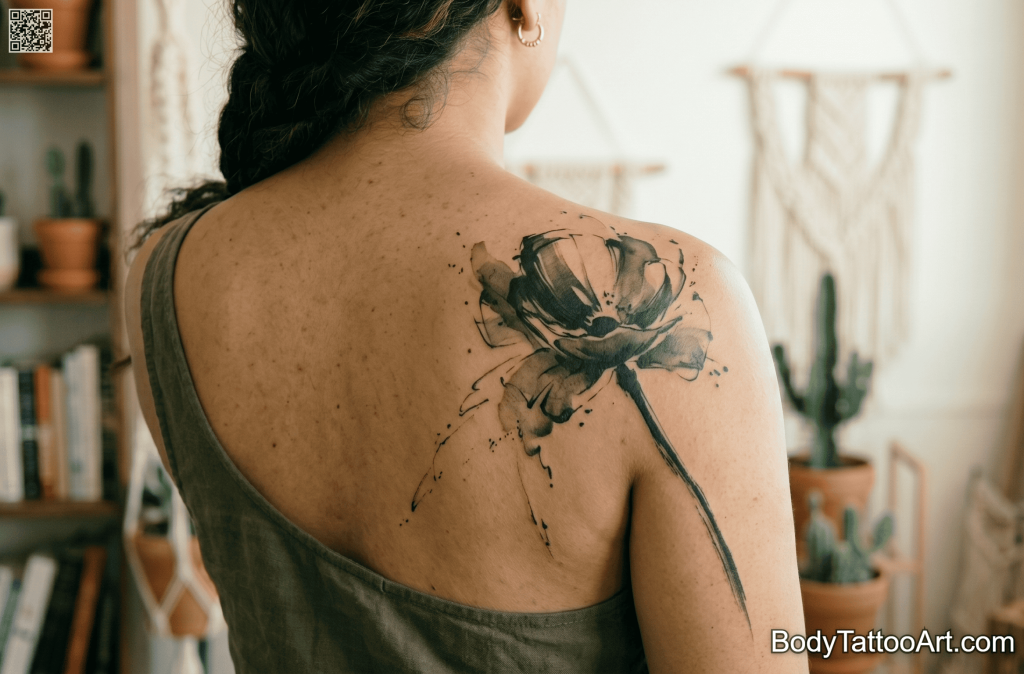
This isn’t a literal poppy — it’s a suggestion of one. Loose, expressive ink wash strokes form the rough shape of petals, with some marks bleeding outward, some dissolving before they finish, and one long brushstroke serving as the stem. The composition is asymmetrical and open-ended.
Placement: Shoulder blade / ribcage
Style: Abstract ink wash Poppy Tattoos
Why it stands out: Abstract poppy tattoos are uncommon, which is precisely why this one is worth noticing. It requires the viewer to meet the design halfway, which creates a more personal connection to the tattoo.
Ideal for: Art-forward collectors, people with existing abstract tattoos, those who want something that sparks conversation.
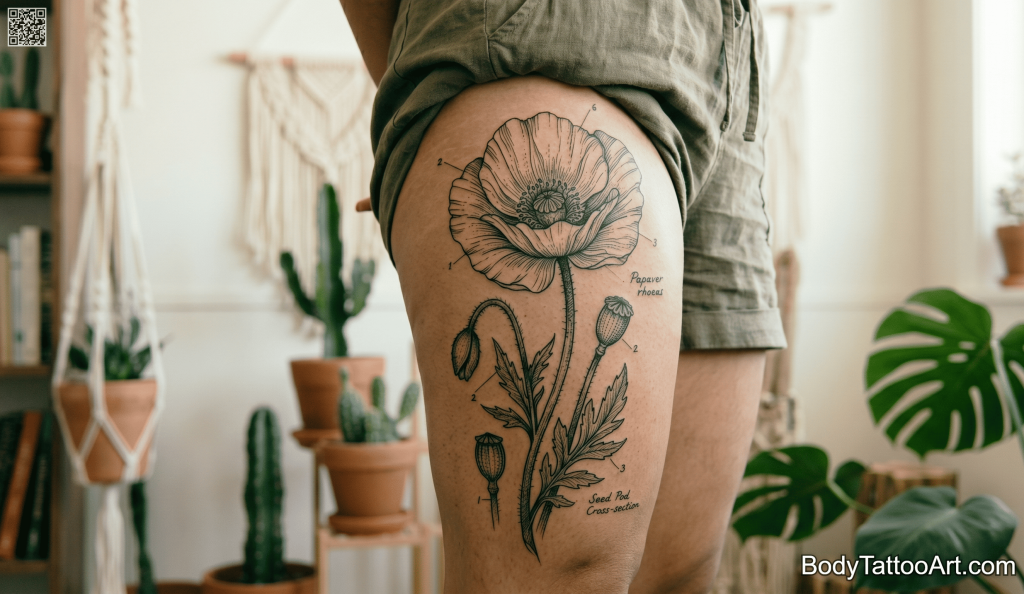
This one looks pulled straight from a 19th-century nature journal. The poppy is drawn in fine illustrative lines with careful cross-hatch shading on the stem, a detailed seed pod with texture marks, and petals that show every natural wrinkle and fold. There’s a slightly scientific precision to it — the kind of detail that rewards close looking.
Placement: Thigh / upper arm
Style: Botanical illustration / fine line Poppy Tattoos
Why it stands out: Botanical illustration tattooing is a very specific aesthetic that’s having a real moment right now. This design brings that vintage naturalist quality into a permanent format beautifully.
Ideal for: Book lovers, nature enthusiasts, people who are drawn to detailed vintage illustration styles.
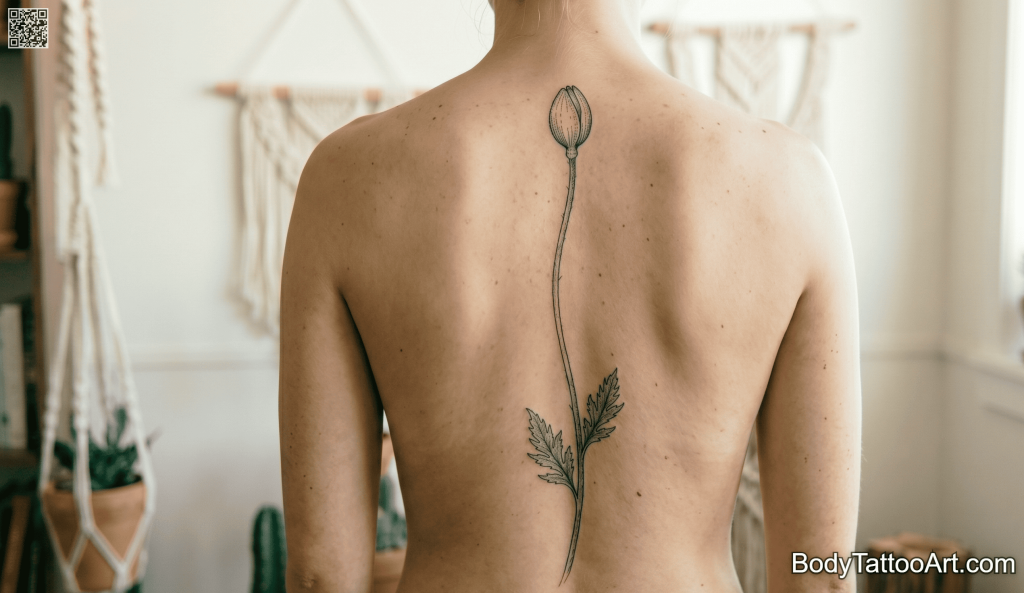
Not the flower — the bud. This tattoo captures the poppy just before it opens: the elongated teardrop shape of a still-closed bud, with finely etched surface texture showing the sepals pulling apart, and a long curved stem with two small hairy leaves. There’s a sense of quiet anticipation in the design.
Placement: Spine / inner wrist
Style: Fine line botanical Poppy Tattoos
Why it stands out: Almost every poppy tattoo shows the open flower. Choosing the bud is a compositional choice that immediately reads as considered and distinctive. The closed form also sits particularly well on narrow placements like the spine.
Ideal for: Minimalists, people who like meaningful details, those who want something that feels personal and non-generic.
The lines are bold and deliberate. The petals are rendered with flat colour fills — a deep crimson with subtle tonal variation, and a clean white highlight line along each petal edge. The composition has the structured elegance of traditional Japanese woodblock printing: strong outline, flat tone, controlled negative space.
Placement: Outer thigh / upper back
Style: Japanese / woodblock illustrative Poppy Tattoos
Why it stands out: The visual language of woodblock printing translates strikingly well into tattooing. The flat fills and bold outlines mean the design reads cleanly from a distance while still rewarding closer inspection.
Ideal for: Fans of Japanese art, collectors building traditional-influenced pieces, those who want a poppy tattoo with real graphic presence.
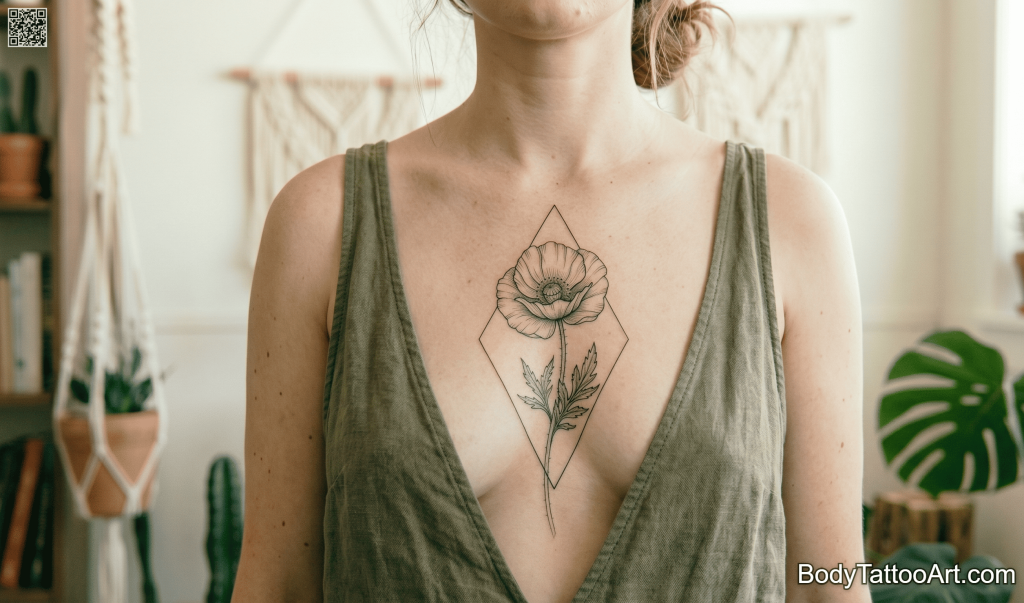
The poppy sits centred inside a thin geometric frame — a diamond or hexagonal border made from single linework. The flower itself is drawn in fine lines with minimal shading, and the contrast between the organic softness of the petals and the rigid geometry of the frame is what makes the whole composition work.
Placement: Sternum / back of hand
Style: Fine line geometric Poppy Tattoos
Why it stands out: The frame creates an almost medallion-like quality — like a pressed botanical specimen displayed behind glass. The pairing of organic and geometric elements without either overpowering the other requires careful balance.
Ideal for: Design-minded tattoo collectors, people who love the combination of soft and structured, geometric tattoo fans.
This poppy is rendered in black ink using dense hatching rather than solid fill or smooth grey wash. The shading is built from many thin parallel and cross-hatched lines that become denser toward the shadow areas. The effect is like an old engraving — highly textured, graphic, and full of visual depth.
Placement: Forearm / shin
Style: Engraving / illustrative blackwork Poppy Tattoos
Why it stands out: Hatching as a shading technique gives the tattoo a distinctly printmaking quality that smooth grey wash doesn’t. Each line is visible, and the cumulative effect is a design that’s both bold and technically rich.
Ideal for: Collectors who appreciate technical linework, fans of vintage engraving aesthetics, people who want detailed black ink work.

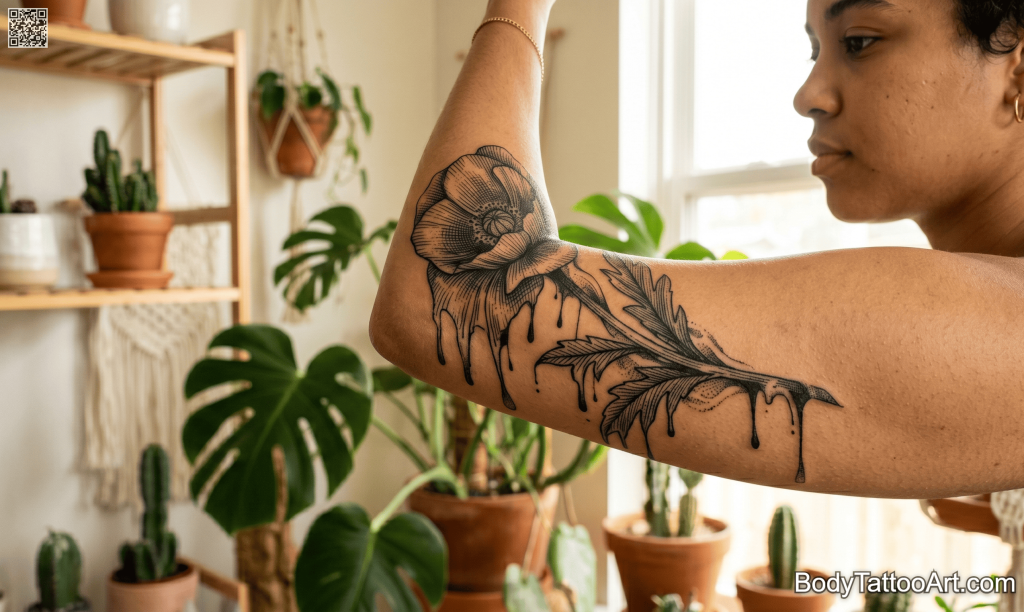
The petals appear to be melting downward, their edges dissolving into long drips that taper to fine points. The overall shape of the poppy is still recognisable from the top, but from the base of the petals down, everything is flowing and gravity-pulled. It’s strange, striking, and completely original.
Placement: Upper arm / calf
Style: Surrealist / illustrative blackwork Poppy Tattoos
Why it stands out: Surrealist treatments of botanical subjects are rare in tattooing, which gives this design a real novelty. The tension between the familiar flower shape at the top and the melting abstraction below creates genuine visual interest.
Ideal for: Creative collectors, fans of unusual tattoo concepts, people who want a poppy tattoo that doesn’t look like anyone else’s.
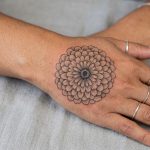
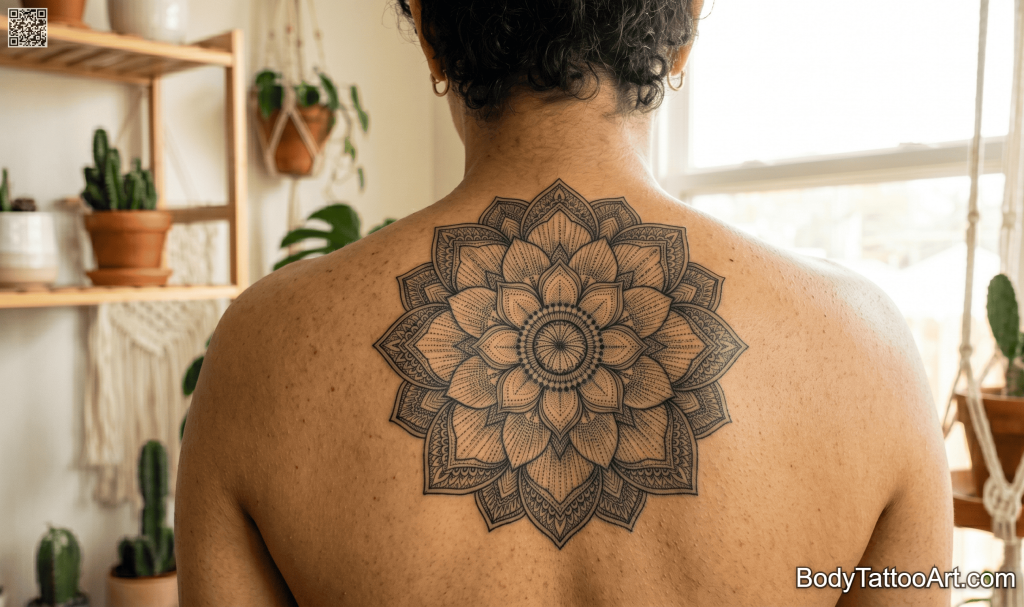
The petals radiate outward from the seed pod centre in perfect symmetry, and each petal is filled with fine mandala-style interior patterning — tiny geometric lines, dots, and repeated shapes that fill the petal space like mosaic tiles. The overall effect is circular and meditative.
Placement: Back of hand / upper back / chest
Style: Mandala / ornamental blackwork Poppy Tattoos
Why it stands out: Applying mandala patterning to a recognisable flower shape is more complex than it looks — the organic petal contours have to contain geometric interior elements without losing the poppy’s identity. This balance is the design’s real achievement.
Ideal for: Fans of ornamental tattooing, those who love intricate geometric detail, mandala tattoo collectors.
One poppy. Two to three thick, deliberate brushstroke-style marks make up each petal — the kind of strokes that show velocity and direction. The ink is deep red, heavy and saturated at the stroke origin and thinning toward the edges. The stem is a single decisive line. Nothing is outlined. Everything is gesture.
Placement: Shoulder / collarbone
Style: Brushstroke / painterly Poppy Tattoos
Why it stands out: This poppy tattoo has calligraphic energy — each stroke feels like it was made in one committed motion. The result is raw and confident, closer to sumi-e painting than traditional tattooing.
Ideal for: People who love expressive mark-making, fans of East Asian art traditions, those who want colour without the expected colour-tattoo aesthetic.

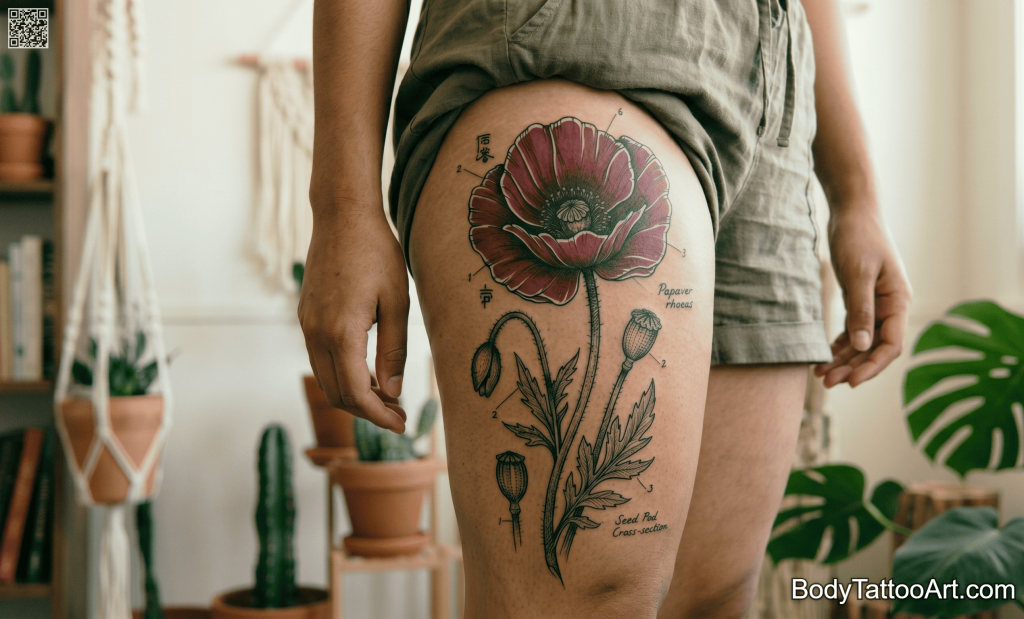
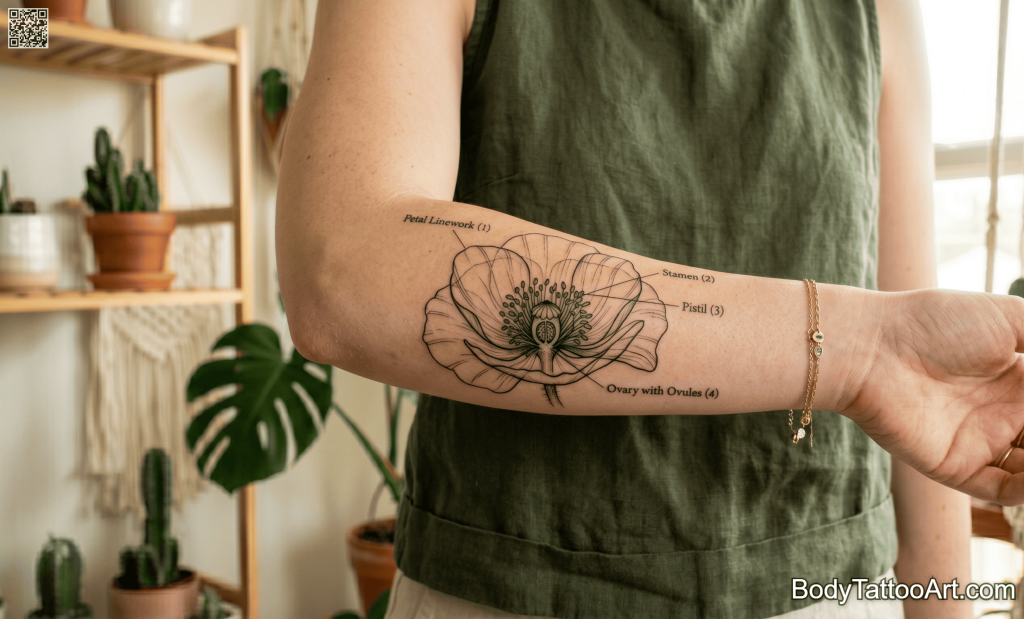
The outside of this poppy is rendered in fine illustrative lines, but the interior of each petal is shown as transparent — revealing the anatomical cross-section structures inside: the stamen, pistil, and ovary, drawn in detailed scientific illustration style. It looks like the petals are made of glass.
Placement: Inner arm / thigh
Style: Scientific illustration / fine line Poppy Tattoos
Why it stands out: This design takes the poppy into genuinely unexpected territory. The botanical science inside the decorative exterior creates a conversation between art and nature that gives the tattoo real intellectual depth.
Ideal for: Science and biology enthusiasts, those who like educational aesthetics in tattoo art, collectors looking for concept-driven designs.
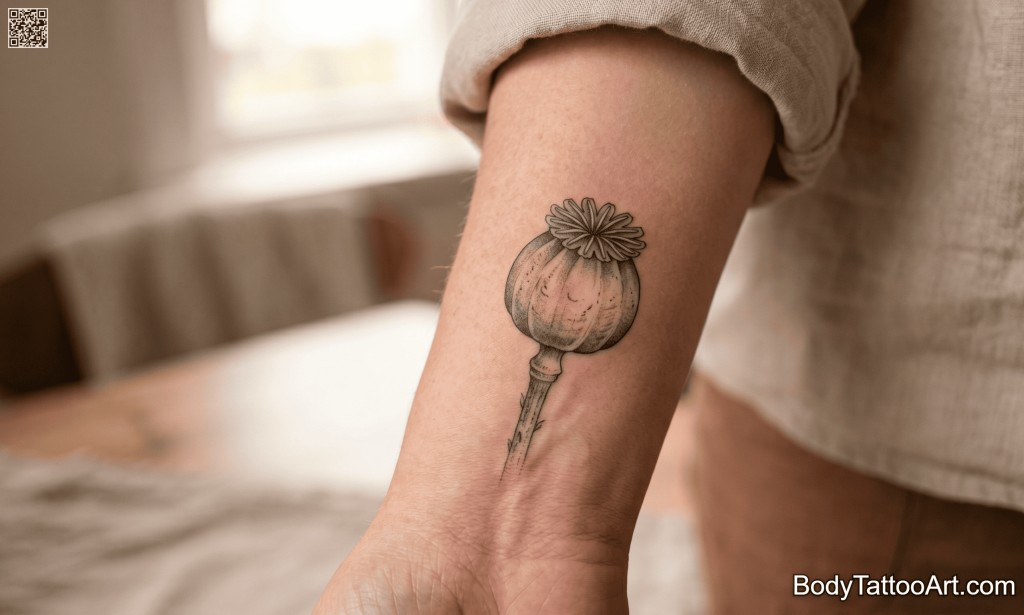
Just the pod. This tattoo focuses entirely on the poppy seed pod — the distinctive rounded capsule at the top of the stem, with its crown of radial ribs fanning outward from the top. The pod is rendered in grey wash with careful attention to its globular form, and the stem has fine surface texture marks. No petals, no leaves, just the raw architectural beauty of the pod itself.
Placement: Inner wrist / behind the ear / ankle
Style: Grey wash botanical Poppy Tattoos
Why it stands out: Seed pods are almost always background elements in poppy tattoos — here, they’re the subject. The poppy pod has a striking geometric quality that’s genuinely underused as a standalone design.
Ideal for: Minimalists who still want something with visual substance, people who like botanical tattooing, those wanting something truly unexpected.
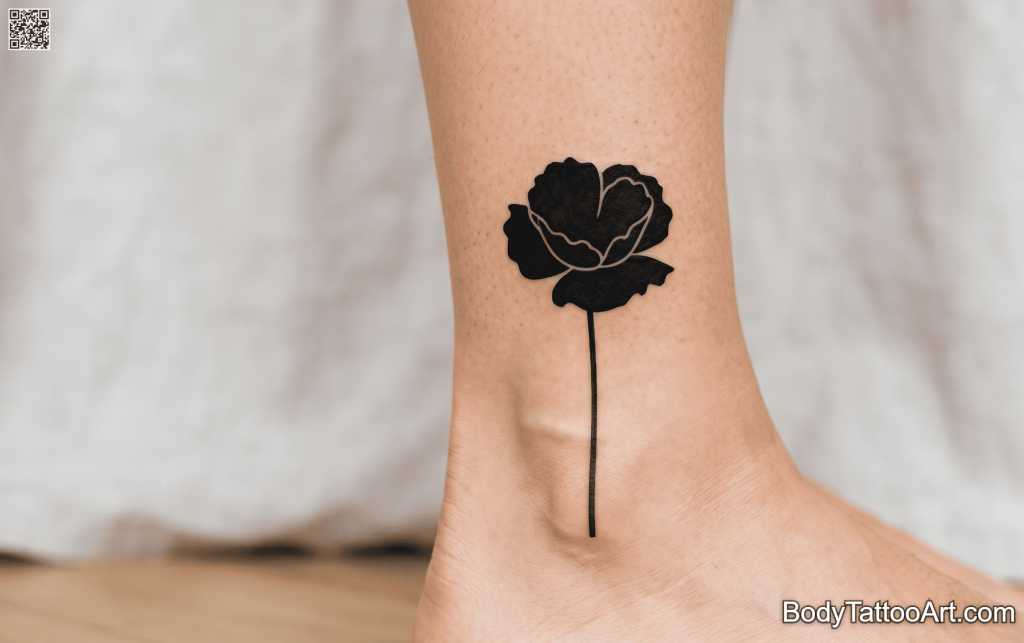
The tattoo looks like a paper cut-out — a completely flat black silhouette of a poppy in full bloom, with every petal edge crisp and sharp. No interior detail, no shading, no linework inside the form. Just the perfect, clean outline of the flower as a filled black shape.
Placement: Ankle / behind knee / wrist
Style: Silhouette / blackwork Poppy Tattoos
Why it stands out: Silhouette designs seem simple but demand careful shape design. Every petal edge matters when there’s nothing inside the form to distract from it. This poppy tattoo has to be beautiful as a pure shape — and it is.
Ideal for: Minimalists who want impact without complexity, people new to blackwork, those who want something clean and permanent.
The poppy is shown mid-scatter — the petals are separate from the flower, floating around a still-intact seed pod and stem. Some petals are fully rendered, others are caught mid-fall with motion blur marks. The composition spreads across a larger skin area, using the space between elements deliberately.
Placement: Shoulder to upper arm / ribs
Style: Fine line illustrative Poppy Tattoos
Why it stands out: The scattered composition gives the tattoo a sense of time and movement. It’s not just a flower — it’s a moment. That narrative quality in a non-figurative tattoo is genuinely hard to achieve.
Ideal for: Collectors who think carefully about composition, people who want a flowing placement-specific design, fans of storytelling through visual design.

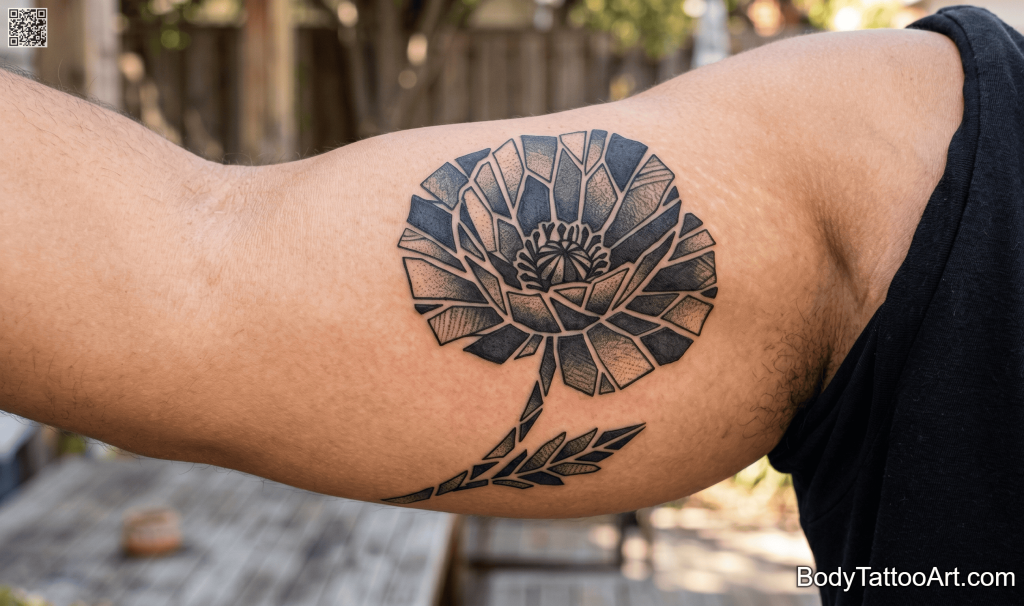
The poppy has been broken into irregular mosaic-like fragments — like a smashed ceramic tile reassembled with thin black grout lines separating each piece. Within each fragment, the shading direction changes slightly, giving the whole design a fractured three-dimensional quality. The result is bold, graphic, and completely unlike any other poppy tattoo on this list.
Placement: Upper arm / chest panel / thigh
Style: Mosaic / graphic blackwork Poppy Tattoos
Why it stands out: The mosaic fragmentation gives a familiar subject a completely unfamiliar structure. Each piece of the design contains its own micro-composition, and together they rebuild the poppy from the ground up in the most unexpected way.
Ideal for: Bold tattoo collectors, fans of graphic art and design, people looking for a statement piece that genuinely turns heads.
Poppy tattoos have earned their place as one of the most versatile floral tattoos out there. After 24 designs — each one taking a completely different approach to the same flower — it becomes clear that the poppy is one of those subjects that can keep giving. Change the style, change the composition, change the scale, and it becomes something new every time.
Whether it’s a tiny micro poppy behind the ear or a full graphic blackwork piece on the thigh, poppy tattoos carry a quiet beauty that feels personal without being overdone. The ones that last — the ones people never regret — are usually the ones where the design was chosen slowly and thoughtfully.