Physical Address
304 North Cardinal St.
Dorchester Center, MA 02124
Physical Address
304 North Cardinal St.
Dorchester Center, MA 02124

Bulls have always stood for something bigger than strength. They carry weight, history, and a kind of stubborn confidence that translates beautifully onto skin.
Whether someone wants a massive back piece or a small, quiet symbol on the wrist, a bull tattoo can be shaped into almost any visual language — bold blackwork, soft realism, sharp geometry, or old-school flash. Unlike a lot of animal tattoos that get boxed into one style, the bull moves easily between traditions. It works in a temple carving, a rodeo poster, a stock market lobby, and a tattoo sleeve, all without losing its core meaning.
This list breaks down 27 completely different bull tattoo concepts, each with its own composition, shading style, and mood. Some are massive full-back pieces meant to be seen from across a room. Others are small, private symbols meant only for the person wearing them. Anyone hunting for ideas beyond the usual bull head with horns will find plenty to work with here, whether the goal is something loud and graphic or quiet and detailed.
For those exploring other animal-inspired designs, this collection pairs well with a guide on tiger tattoos for bold linework lovers, a piece on wolf tattoos for pack-and-loyalty symbolism, and a roundup of eagle tattoos for anyone drawn to freedom-themed ink.
Across cultures, the bull represents raw physical power, fertility, and stubborn will. In ancient Mediterranean mythology, bulls were tied to strength and sacrifice, most famously in the story of the Minotaur and in Mithraic imagery, where the bull-slaying scene became a central symbol of cosmic order. In Hindu tradition, Nandi the bull serves as the loyal mount of Lord Shiva, symbolizing devotion, patience, and steady strength rather than aggression. In Western culture, particularly in American and Spanish traditions, the bull is linked to grit, confrontation, and unshakable determination — something visible in everything from rodeo culture to Wall Street’s Charging Bull statue, which has become a shorthand for ambition and financial confidence worldwide.
Because the symbolism spans so many cultures, a bull tattoo rarely means just one thing. It can represent financial ambition, physical resilience, family loyalty, zodiac pride for those born under Taurus, or simply a love for bold animal imagery. That range is part of why the design lends itself to so many visual treatments, and why two people can get very different bull tattoos for very different reasons. For a deeper dive into how bulls have been represented across mythology and religion, this Wikipedia entry on the bull in mythology offers solid background reading.
Below are 27 bull tattoo ideas, each built around a distinct style and composition, with an image prompt placed right under each one.
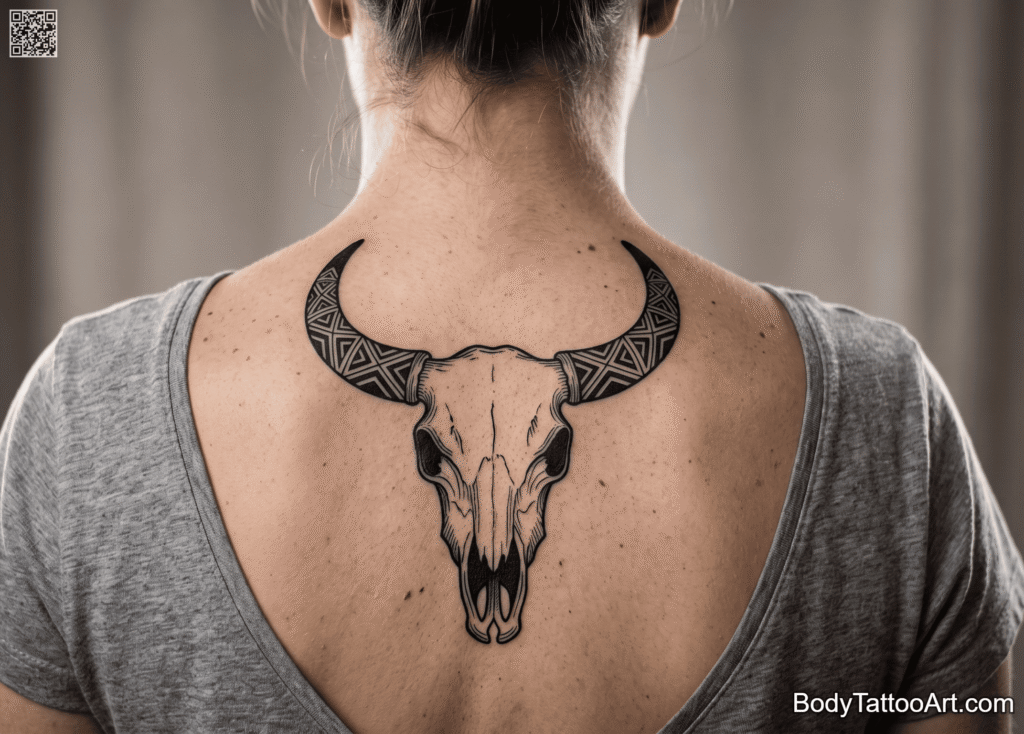
A bull skull rendered in heavy blackwork, its horns replaced with sharp geometric lines that fan outward like a crown. The eye sockets are left hollow and deep black, while thin triangular patterns run along the jawline, each one slightly different in size to avoid looking mechanical. The contrast between solid black fill and negative space gives it a striking, almost architectural feel, like something carved rather than drawn.
Placement: Upper back or chest
Style: Blackwork Bull Tattoos
Why it stands out: The geometric horns turn a classic skull motif into something that feels modern and structured rather than purely gothic. It reads as intentional design work, not just a dark symbol.
Ideal for: Bold ink fans, minimalist-blackwork lovers, first-time large piece wearers.
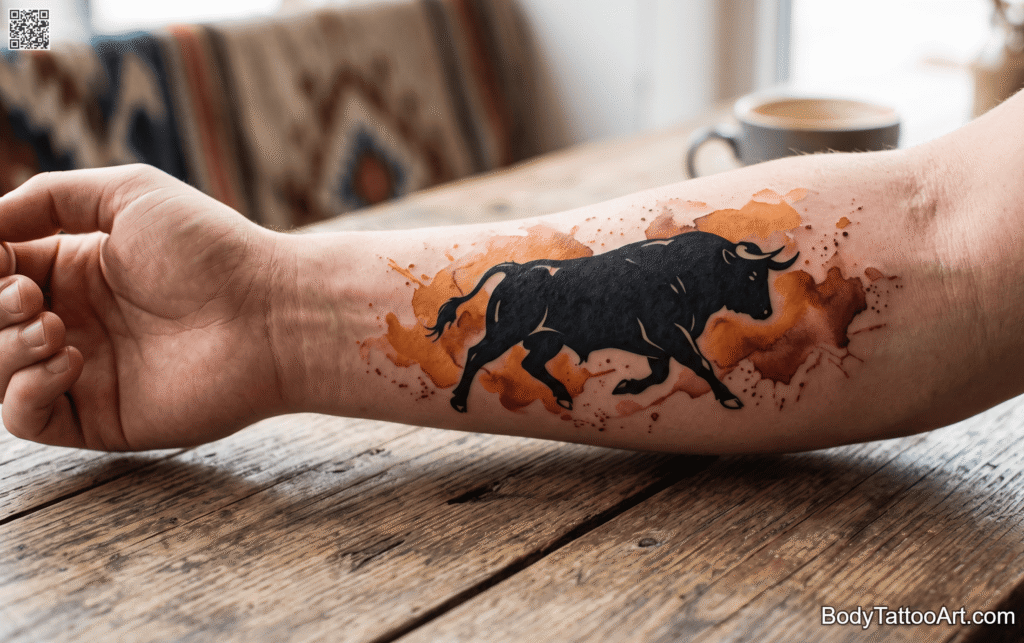
A solid black bull silhouette standing mid-stride, surrounded by loose watercolor splashes in deep amber and rust tones that bleed outward like spilled paint. The silhouette stays clean and sharp while the background color feels wild and unplanned, creating nice tension between control and chaos. A few thin drips trail down from the color blocks, adding to the sense of movement without cluttering the actual bull shape.
Placement: Forearm or shoulder
Style: Watercolor Bull Tattoos
Why it stands out: The clash between the crisp silhouette and loose color gives the piece movement without needing any extra detail in the bull itself.
Ideal for: People who want color without heavy shading, watercolor tattoo fans.
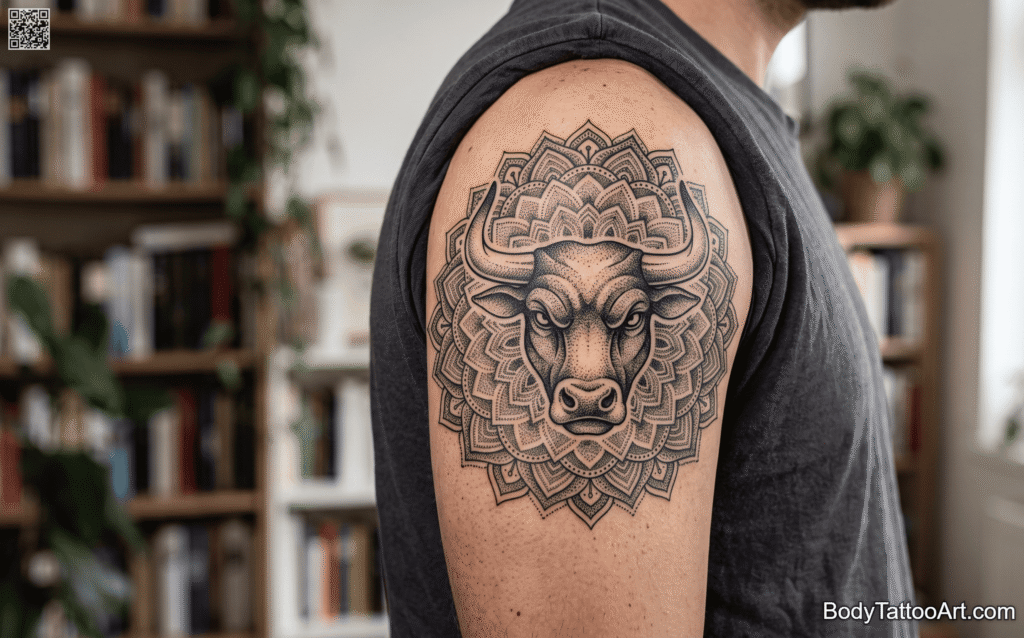
A bull’s face built entirely from tiny dots, arranged so the muzzle and horns sit inside a circular mandala frame. The dot density is heaviest around the eyes and nostrils, fading out toward the mandala’s edges, giving the whole piece a soft, almost meditative texture. Thin dotted rings extend outward from the central face, each ring slightly more spaced than the last.
Placement: Upper arm or back of shoulder
Style: Dotwork Bull Tattoos
Why it stands out: The circular framing turns an aggressive animal into something calm and symmetrical, which is a nice contrast most bull tattoos don’t attempt.
Ideal for: Dotwork enthusiasts, people who like spiritual or symmetrical designs.
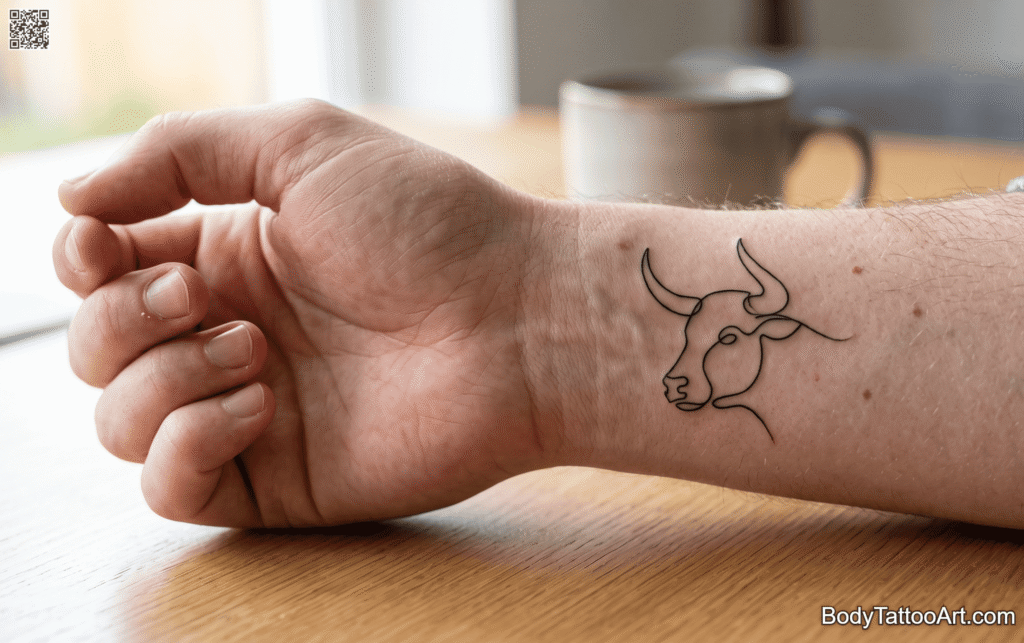
One continuous thin line traces the outline of a bull’s head and horns without ever lifting, creating a clean, unbroken silhouette. No shading, no filler details — just a single confident stroke that captures the shape. The line occasionally doubles back on itself at the horn tips, giving just enough structure without breaking the one-line rule.
Placement: Wrist or behind the ear
Style: Fine line, single-line Bull Tattoos
Why it stands out: The restraint is the whole appeal. It proves a bull tattoo doesn’t need to be big or heavy to make an impact.
Ideal for: Minimalist lovers, first-timers, anyone wanting a subtle piece.
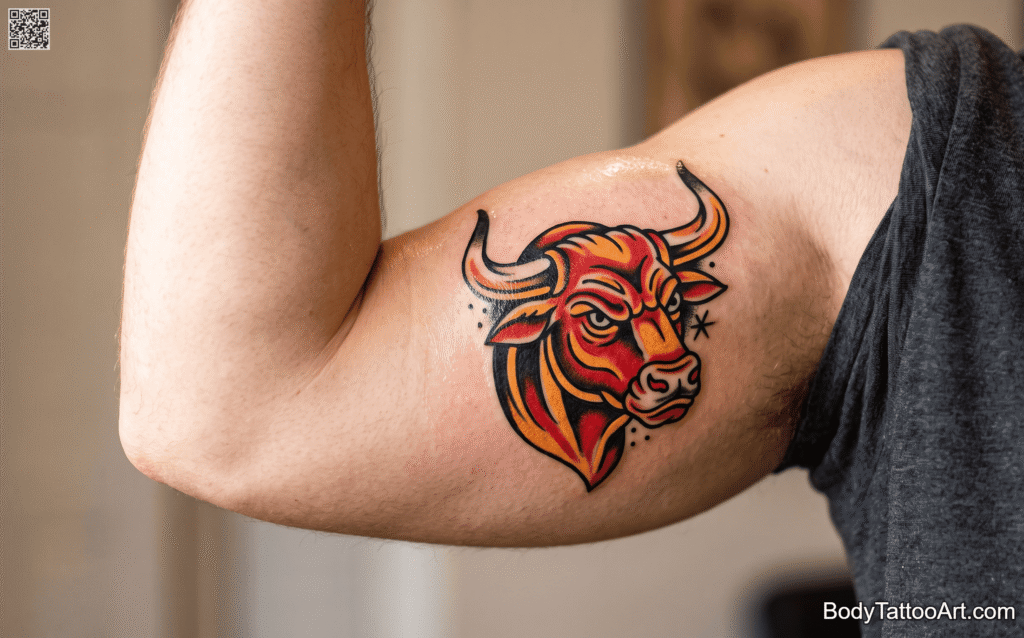
A bold, classic bull head done in traditional American flash style — thick black outlines, solid red and yellow shading, and a slightly angry expression with flared nostrils. The linework is deliberately simple, leaning on bold color blocks rather than fine detail, the way old flash sheets were built to survive decades without blurring.
Placement: Bicep or calf
Style: Traditional American Bull Tattoos
Why it stands out: The thick lines and saturated colors age well and give off a timeless, tattoo-shop-classic energy.
Ideal for: Old-school tattoo fans, bold color lovers.
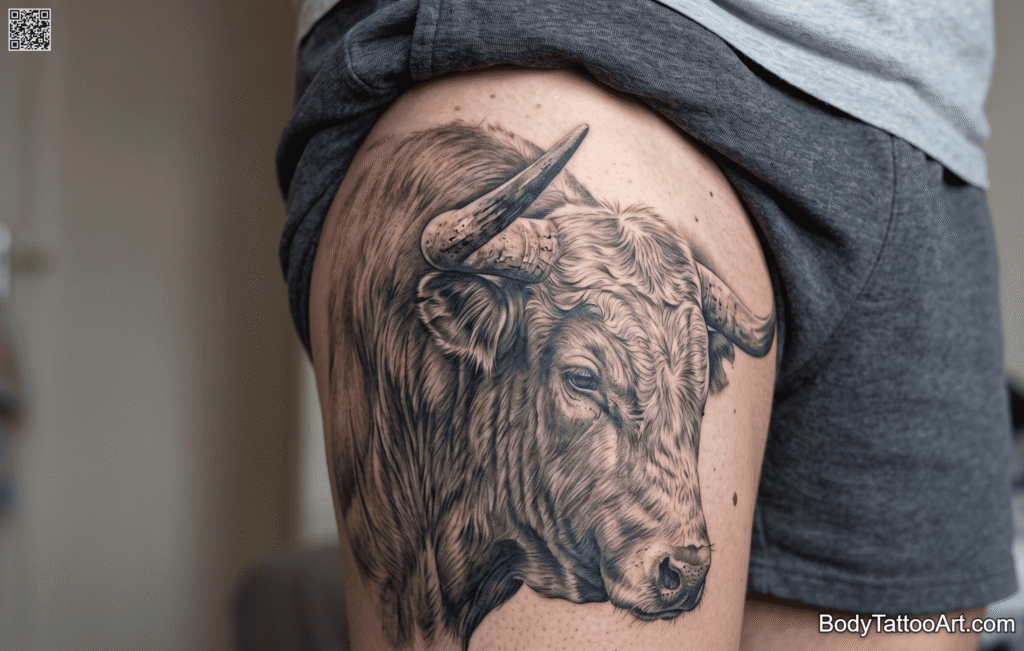
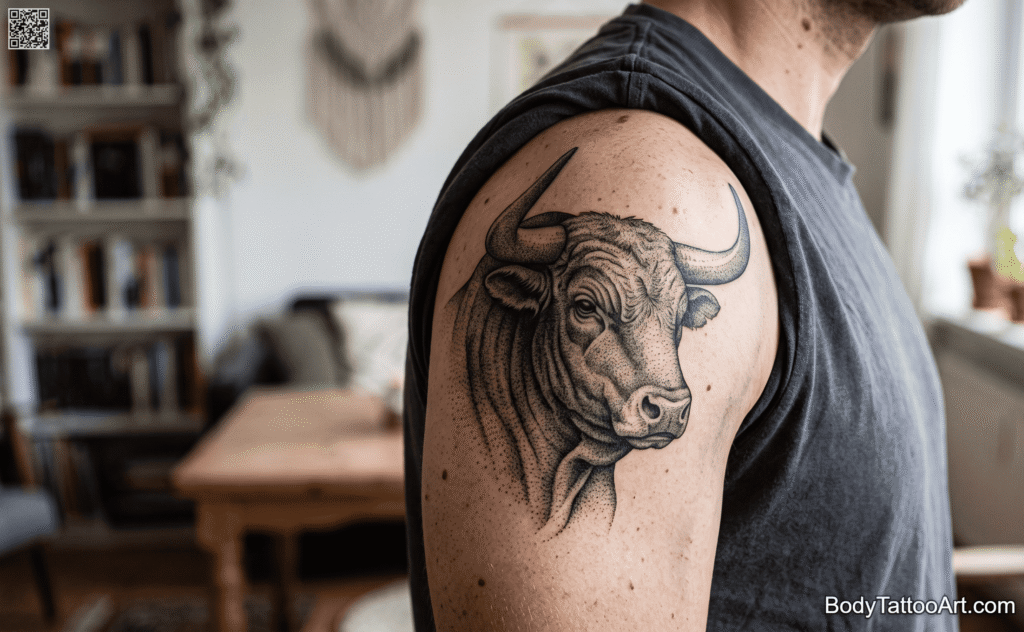
A photorealistic bull face rendered entirely in grey-wash shading, capturing every wrinkle of skin around the nose and the texture of coarse fur near the horns. The eyes carry a soft reflective highlight that makes the whole piece look almost photographic, and faint stray hairs are visible along the jawline where the shading fades into skin.
Placement: Thigh or full back
Style: Grey-wash realism Bull Tattoos
Why it stands out: The level of texture detail makes the bull feel alive rather than decorative, which realism fans always look for.
Ideal for: Wildlife tattoo collectors, detail-lovers, larger canvas pieces.
Anyone drawn to this kind of texture-heavy realism might also like a guide on lion tattoos, which covers similar grey-wash portrait techniques.
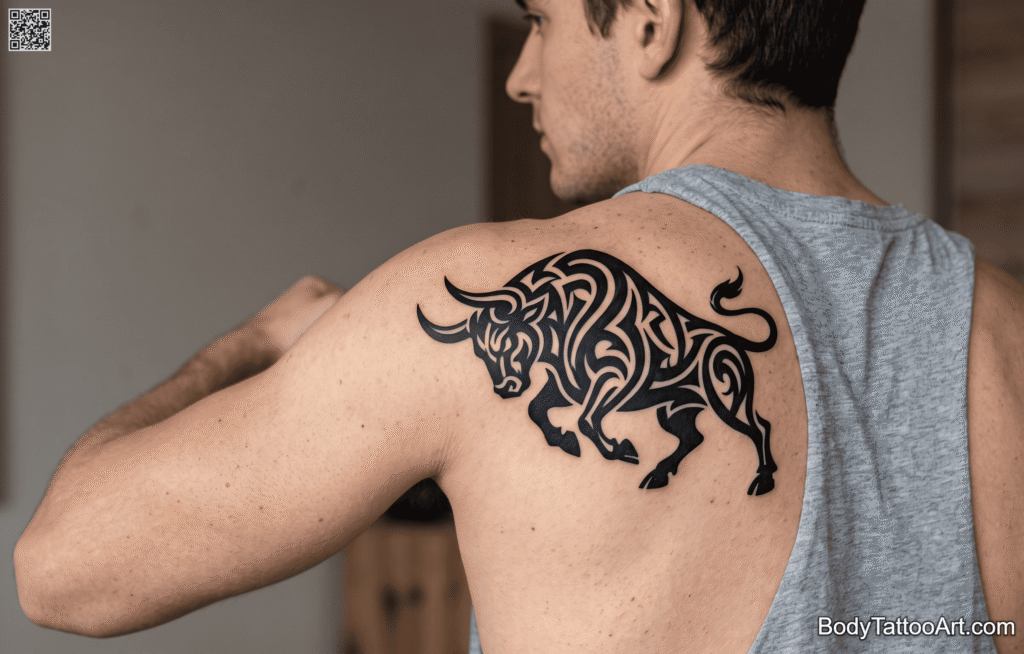
A bull’s silhouette built from bold, curving tribal linework — thick black shapes that flow like flames along the back and horns. There’s no shading at all, just sharp negative-space cuts that give the design rhythm and movement, with the thickest shapes concentrated near the shoulder of the bull and thinning out toward the legs.
Placement: Shoulder blade or forearm
Style: Tribal Bull Tattoos
Why it stands out: The flowing tribal lines give a static animal shape a real sense of motion.
Ideal for: Bold tribal-style fans, people who like high-contrast blackwork.
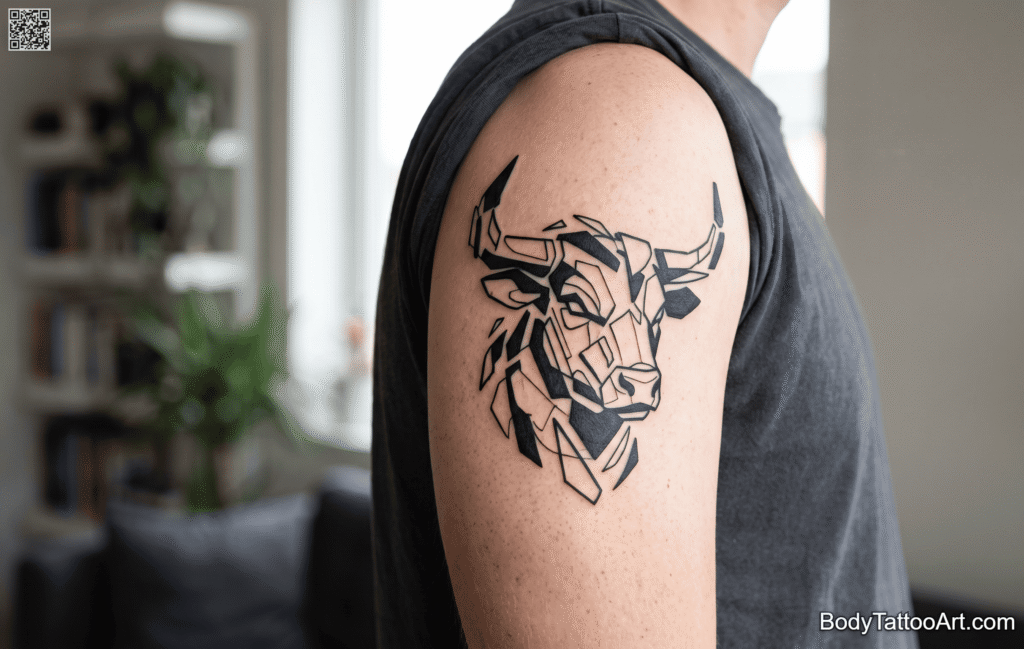
The bull’s head is broken into angular, disconnected fragments, almost like a shattered mirror reassembled slightly off-center. Some fragments are solid black, others left as thin outlines, giving the piece a fractured, modern art feel. A couple of small fragments sit slightly detached from the main cluster, as if drifting away from the rest of the face.
Placement: Upper arm or side ribs
Style: Abstract Bull Tattoos
Why it stands out: The fragmentation makes the viewer’s eye piece the bull together, which is a far more interesting visual puzzle than a straightforward portrait.
Ideal for: Abstract art lovers, people wanting something unconventional.
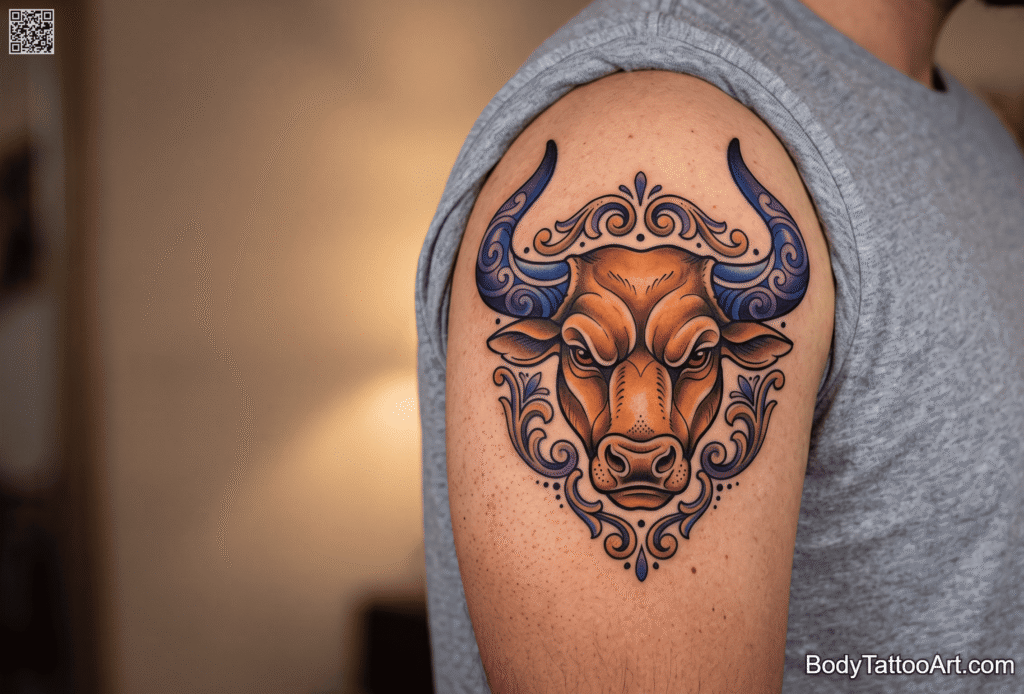
A bull head rendered with neo-traditional shading — deep jewel-tone blues and purples along the horns, with warm ochre across the face. The line weight varies dramatically, thick on the outline and delicate around the eyes, giving it a painterly quality traditional flash doesn’t usually have. Small dotted highlights sit along the horn tips to catch the light.
Placement: Upper arm or chest
Style: Neo-traditional Bull Tattoos
Why it stands out: The unexpected color palette moves the design away from the usual red-and-black bull cliché.
Ideal for: Color tattoo lovers, neo-traditional collectors.
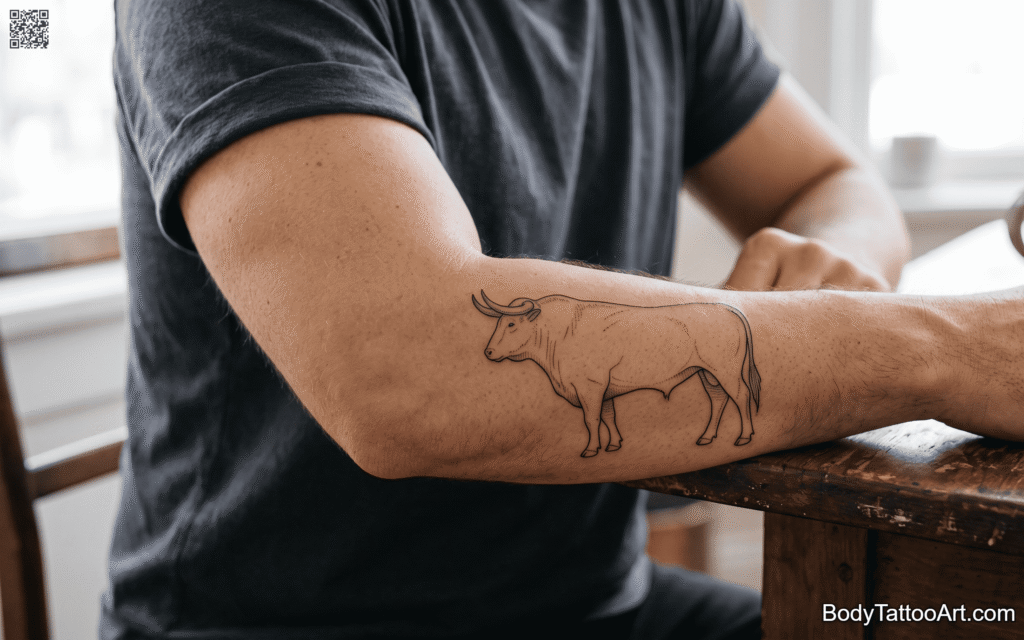
A delicate, thin-line bull standing in profile, drawn with barely-there shading just under the belly and along the horn base. Every line stays consistent in width, giving the design a clean, almost illustrative quality, like something lifted straight from a nature sketchbook rather than a tattoo flash sheet.
Placement: Forearm or ankle
Style: Fine line Bull Tattoos
Why it stands out: The simplicity keeps the focus on posture and silhouette rather than detail, which suits people who want something quiet but recognizable.
Ideal for: Subtle tattoo lovers, first-time clients.
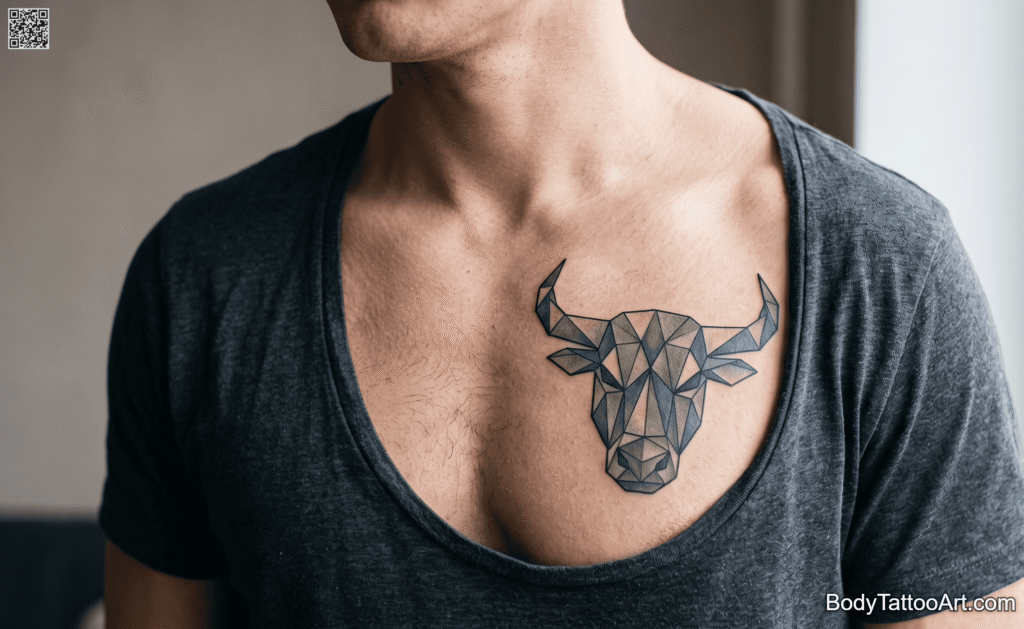
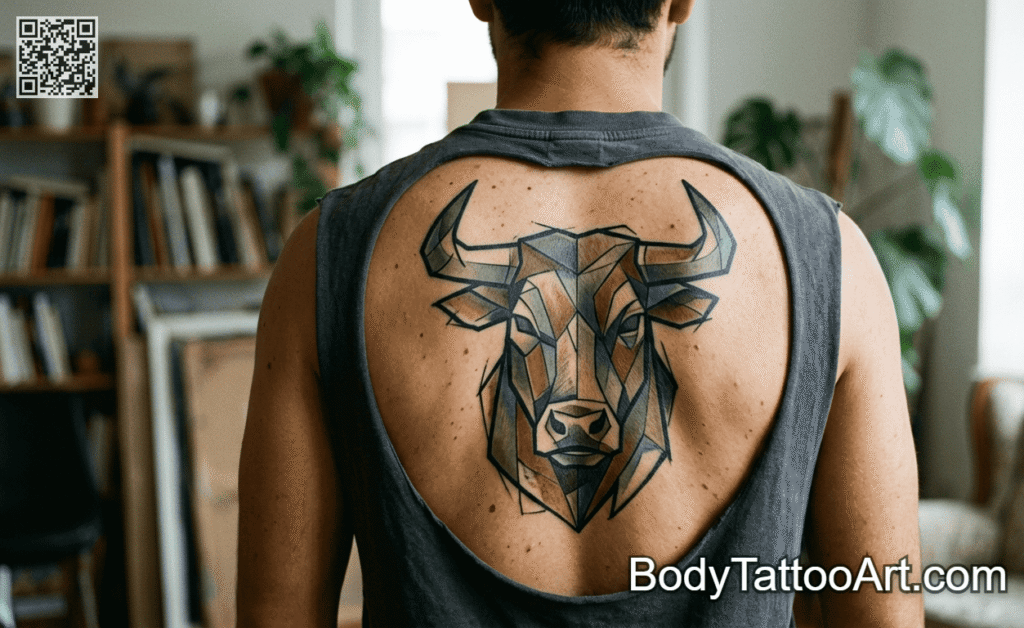
A bull’s head built entirely from angular polygon facets, similar to low-poly digital art. Each triangle carries a slightly different shade of grey, creating natural-looking depth without a single curved line anywhere in the piece. The facets are smallest near the eyes and grow larger toward the edges of the horns.
Placement: Chest or upper back
Style: Geometric Bull Tattoos
Why it stands out: The polygon technique turns an organic animal into a striking, almost digital-looking artwork.
Ideal for: Geometric tattoo fans, modern design lovers.
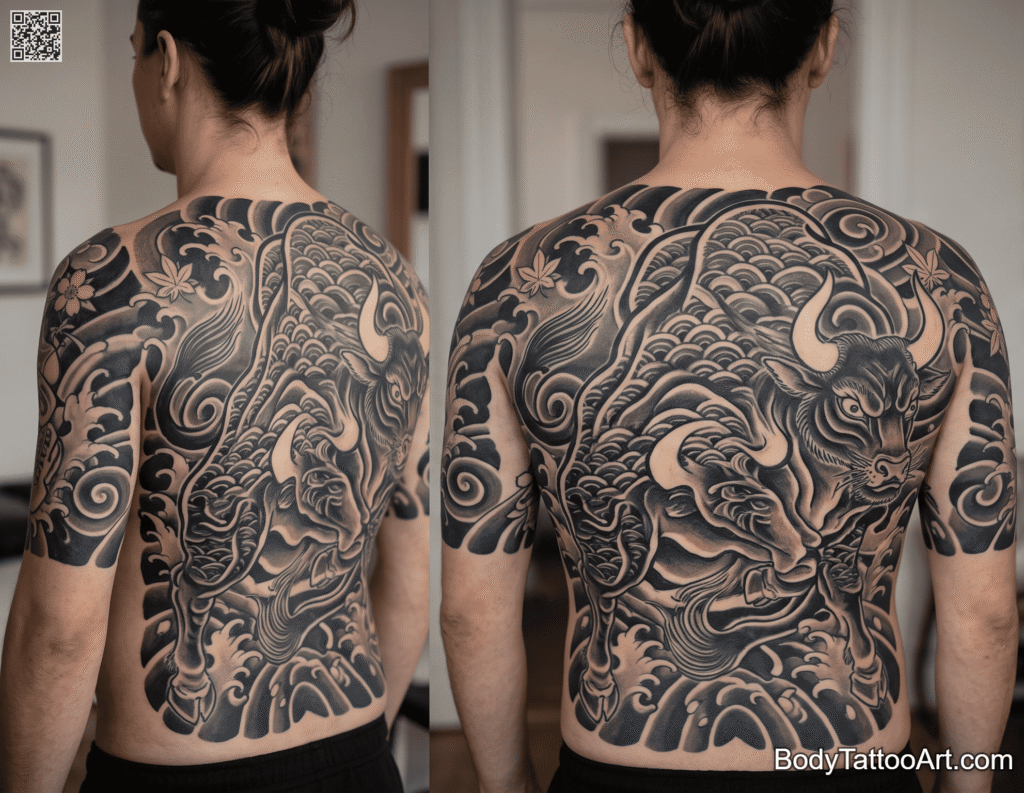
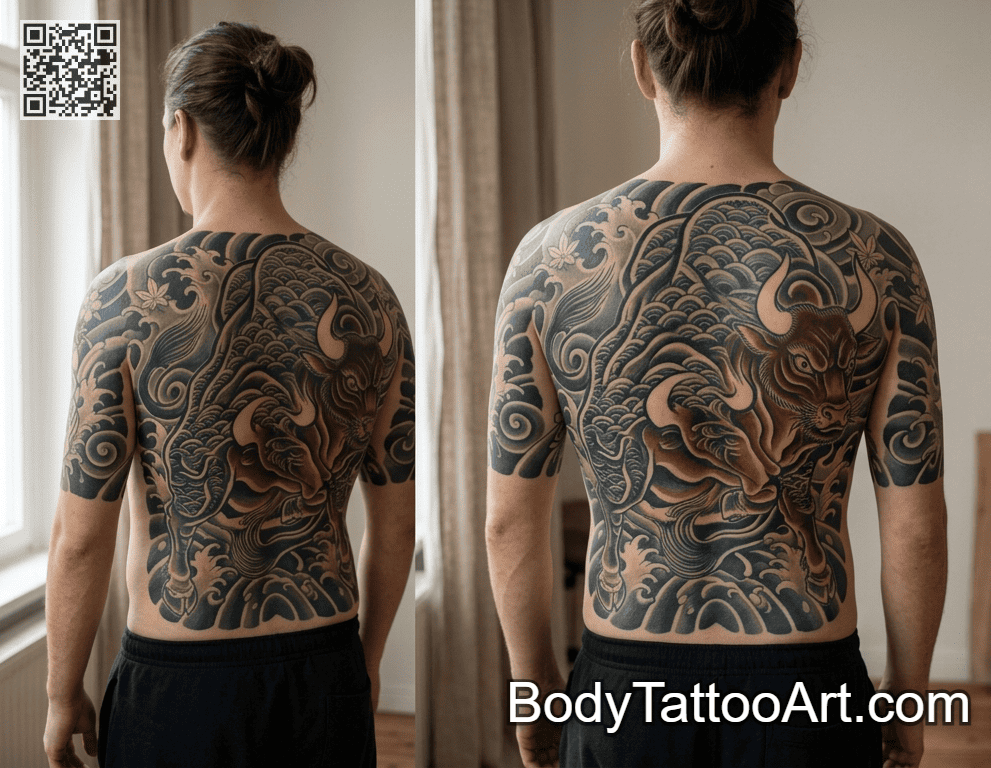
A bull rendered in traditional Japanese Irezumi style, with bold black outlines, wave-like shading patterns along the muscles, and a deep, almost sculptural sense of form. The composition leaves generous negative space, following the flow of the body it’s tattooed on, with the wave pattern curling around the shoulder and trailing down toward the lower back.
Placement: Full back or thigh
Style: Irezumi / Japanese traditional Bull Tattoos
Why it stands out: The wave-pattern shading gives the bull a mythic, storybook quality rarely seen in Western bull designs.
Ideal for: Japanese tattoo style fans, large-piece collectors.
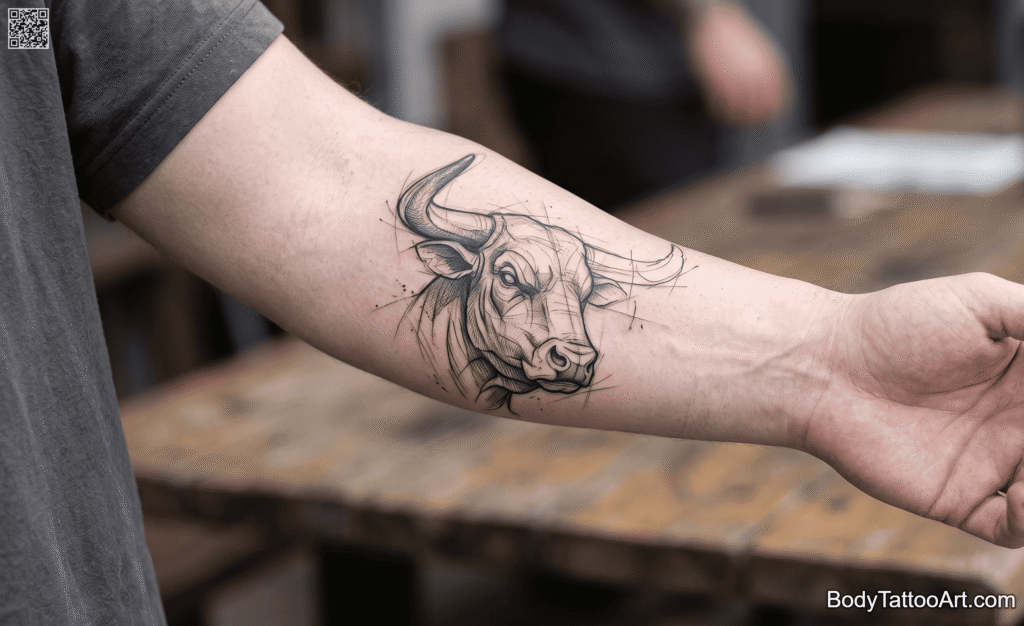
A bull head drawn like an unfinished pencil sketch — visible construction lines, a few deliberate smudges, and one horn left only half-outlined. It looks intentionally rough, like a page pulled straight from an artist’s sketchbook, with faint cross-hatch marks scattered around the edges as if the artist was still working out the proportions.
Placement: Forearm or calf
Style: Sketch style Bull Tattoos
Why it stands out: The “unfinished” look feels raw and artistic instead of sloppy, which is a hard balance to strike well.
Ideal for: Artistic tattoo lovers, people who like sketch-style ink.
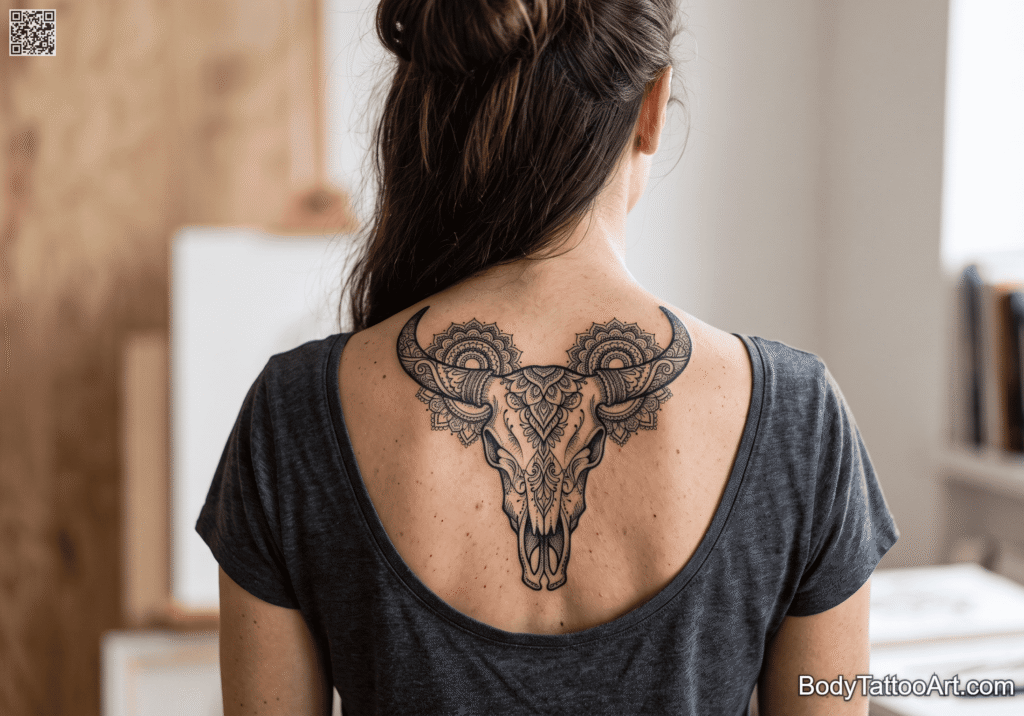
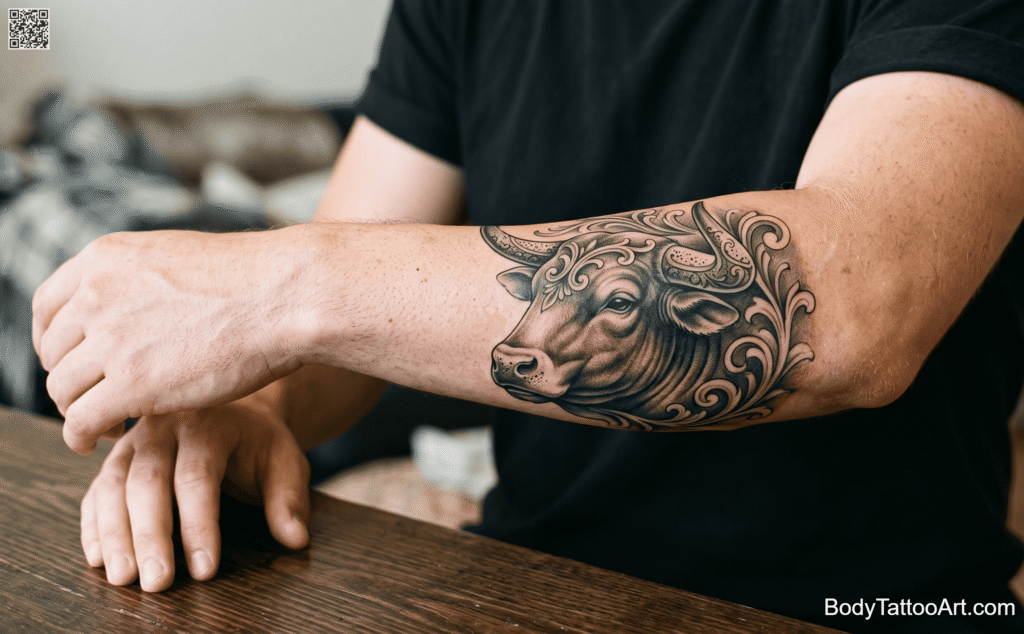
A bull skull covered in intricate ornamental patterns — lace-like linework running down the snout, small mandala circles at the base of each horn. Every inch of the skull carries some kind of pattern, but the overall shape stays clean and readable, with the densest patterning saved for the center of the forehead.
Placement: Upper back or sternum
Style: Ornamental blackwork Bull Tattoos
Why it stands out: The density of pattern work rewards a closer look without overwhelming the bull’s basic silhouette.
Ideal for: Detail lovers, ornamental blackwork collectors.
A bull head done in classic Chicano black-and-grey style, with soft smoky shading and sharp fine-line detailing around the eyes. The expression is calm rather than aggressive, giving the piece a dignified, almost portrait-like presence, with a subtle vignette of shading fading out toward the edges of the design.
Placement: Forearm or shoulder
Style: Chicano black and grey Bull Tattoos
Why it stands out: The calm expression sets it apart from the usual snorting, aggressive bull tattoos.
Ideal for: Black and grey style fans, Chicano art lovers.
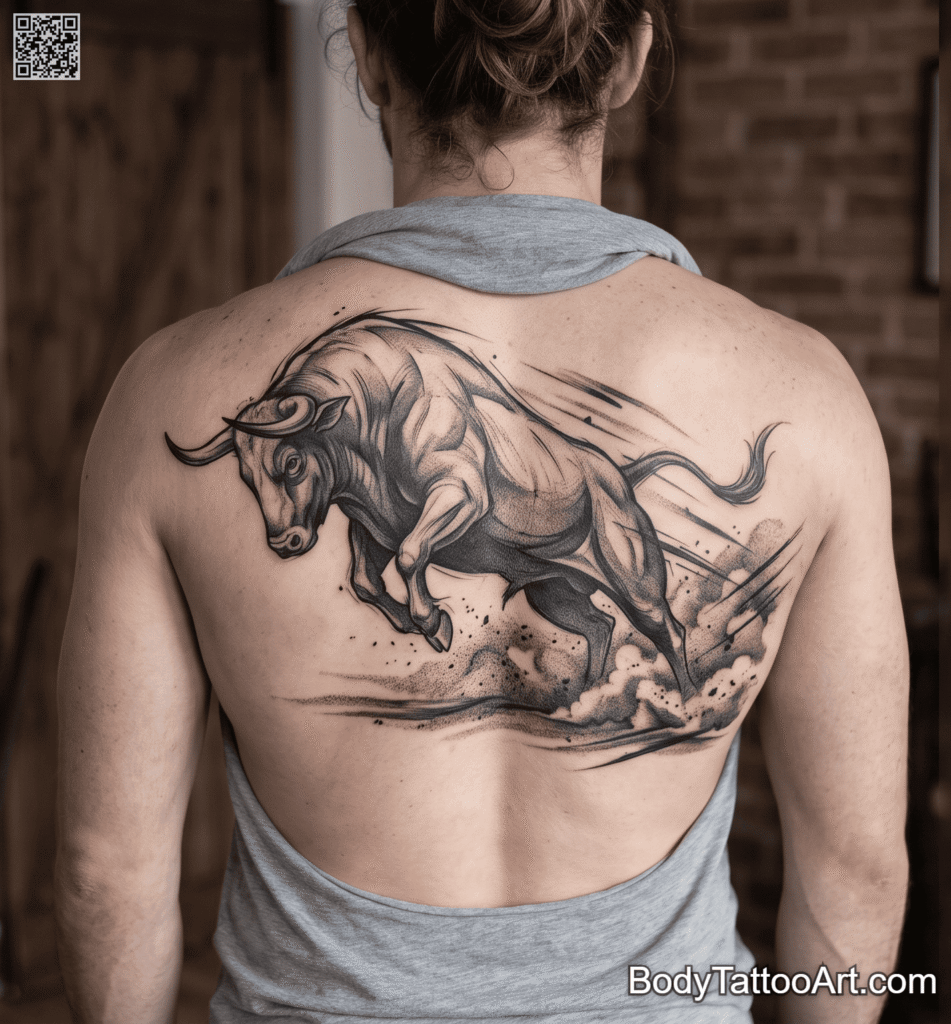
A bull captured mid-charge, dust kicked up around its hooves rendered as loose, energetic linework. The body is stretched into a dynamic diagonal pose, with speed lines trailing behind to emphasize motion, and the head lowered slightly as if about to make contact with something just out of frame.
Placement: Full back or side ribs
Style: Illustrative linework Bull Tattoos
Why it stands out: Most bull tattoos are static portraits — this one captures actual movement and energy.
Ideal for: Dynamic composition lovers, larger piece collectors.
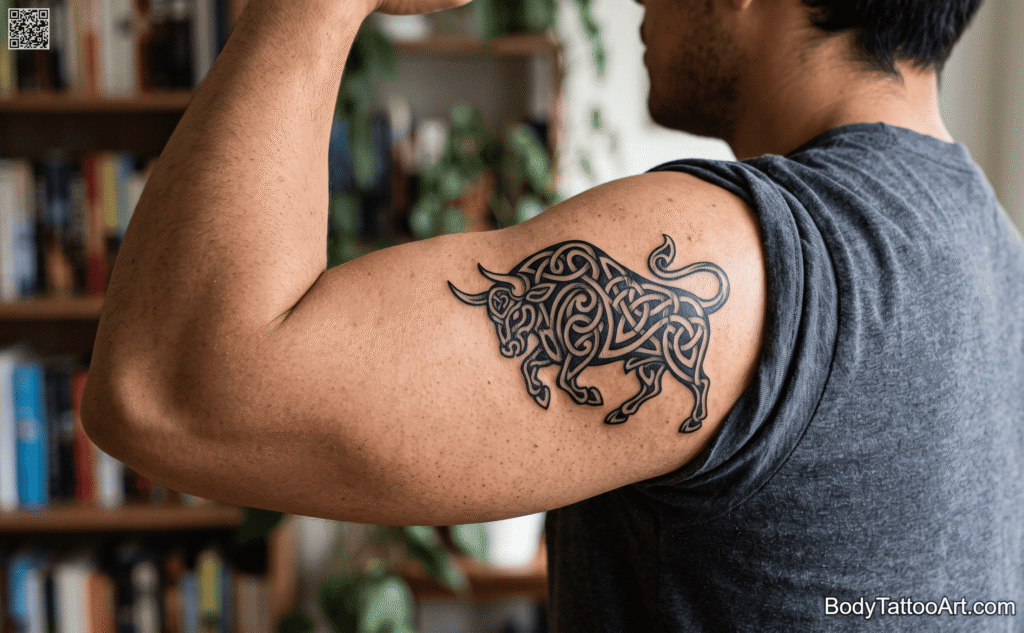
A bull silhouette filled entirely with interlocking Celtic knot patterns, the lines weaving in and out to form the shape of the horns and body without a single gap. The knotwork stays consistent in width throughout, creating a hypnotic, continuous flow that never breaks even at the tightest curves of the horns.
Placement: Upper arm or back
Style: Celtic knotwork Bull Tattoos
Why it stands out: Turning knotwork into the bull’s actual form, rather than just a border, makes the design feel genuinely integrated.
Ideal for: Celtic art fans, pattern-lovers.
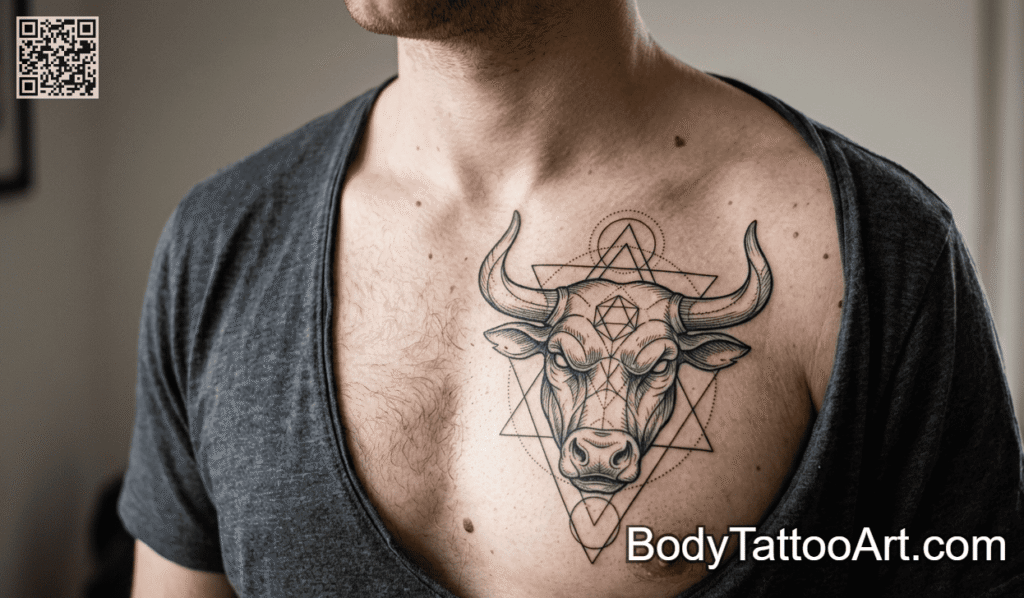
A bull’s head outlined simply, with sacred geometry lines — a subtle triangle and circle grid — worked directly into the linework of the face itself rather than sitting behind it. The geometry follows natural contours like the brow and jaw, so the pattern feels like part of the anatomy instead of an overlay.
Placement: Chest or forearm
Style: Sacred geometry linework Bull Tattoos
Why it stands out: The geometry feels structural, not decorative, since it follows the bull’s actual anatomy.
Ideal for: Sacred geometry fans, symmetry lovers.
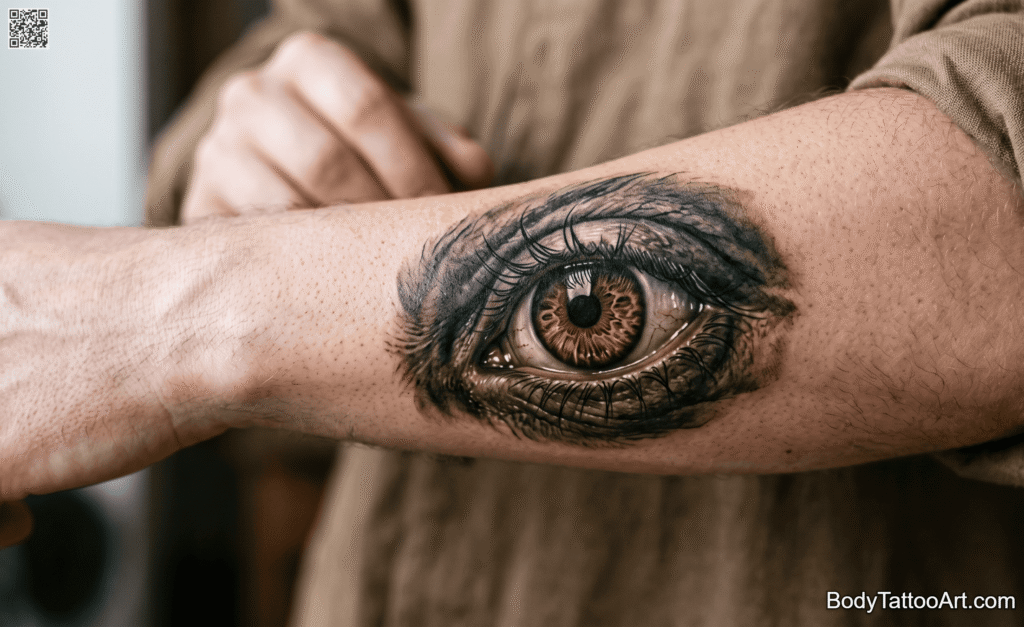
An extreme close-up of just one bull’s eye, rendered in hyper-realistic detail — every fleck of color in the iris, the wet shine of the eye, and a few coarse hairs along the lash line. Nothing else from the bull is shown, letting the eye itself carry the entire emotional weight of the piece.
Placement: Inner forearm or calf
Style: Hyper-realism, macro detail Bull Tattoos
Why it stands out: Zooming into just the eye creates an intense, almost uncomfortable intimacy that a full portrait can’t achieve.
Ideal for: Realism lovers, people who want something unconventional and striking.
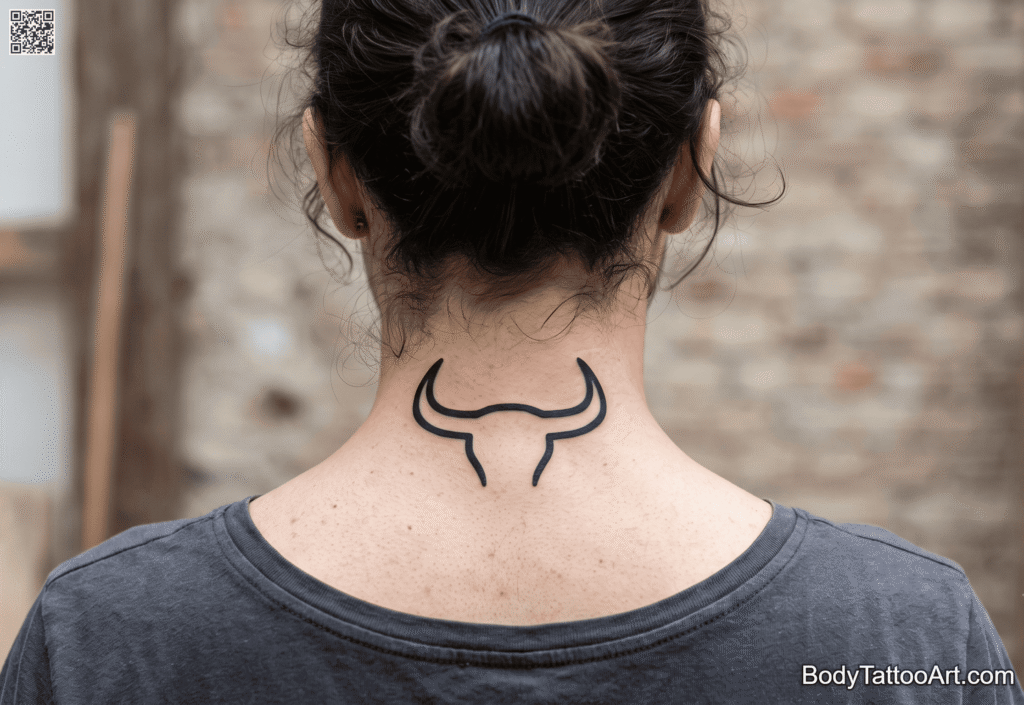
Just the horns and top of the head, drawn in simple thick linework with no face or body included. The negative space does most of the work, letting the horns alone represent the whole animal, with the tips left slightly rounded rather than sharp to soften the overall look.
Placement: Back of neck or ankle
Style: Minimalist Bull Tattoos
Why it stands out: Reducing the bull to just its horns is a confident, less-is-more approach.
Ideal for: Minimalist lovers, small tattoo fans.
Fans of this reduced, symbol-only approach might enjoy browsing a piece on deer tattoos, which uses a similar antler-only technique.
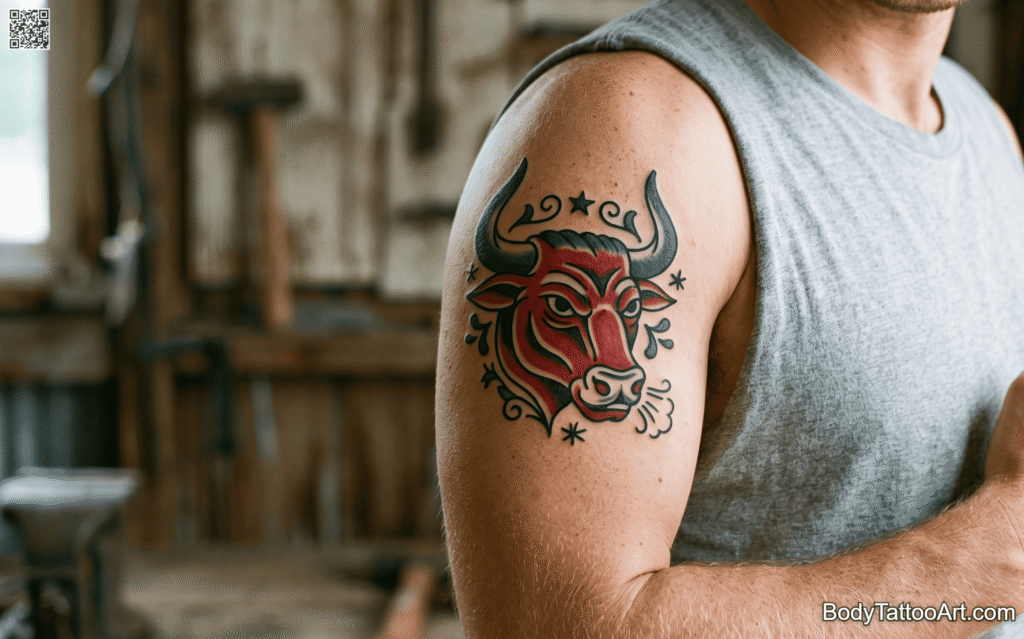
A bold, cartoon-ish bull head in classic Sailor Jerry flash style — thick black outlines, flat red and green shading, and an exaggerated, almost comic expression. The style leans heavily into nostalgia rather than realism, with the nostrils drawn slightly oversized for that classic old-flash exaggeration.
Placement: Bicep or forearm
Style: Old school / Sailor Jerry Bull Tattoos
Why it stands out: The playful exaggeration makes it feel fun rather than fierce, a nice break from the usual serious bull tattoo.
Ideal for: Old-school flash collectors, vintage tattoo lovers.
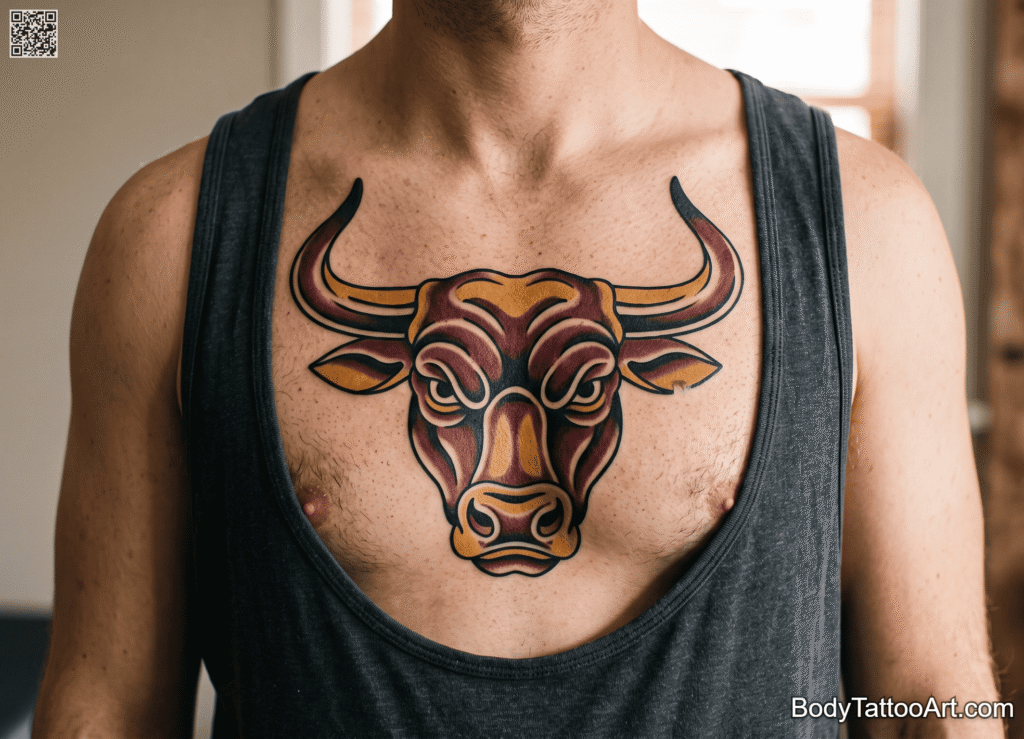
A straightforward American traditional bull head, front-facing, with thick black outlines and bold solid shading in classic maroon and mustard tones. The design keeps everything symmetrical and graphic, built to hold up over decades, with a slightly weathered look to the outlines that mimics aged flash art.
Placement: Chest or upper arm
Style: American traditional Bull Tattoos
Why it stands out: The symmetry and bold color blocking make it instantly readable from a distance.
Ideal for: Traditional tattoo purists, bold statement piece lovers.
A bull rendered in the style of Japanese Ukiyo-e woodblock prints, with flat color fields, strong outlines, and a stylized wave pattern in the background reminiscent of old print art. The linework has that slightly imperfect, hand-carved quality typical of woodblock prints, with a faint texture running through the flat color areas.
Placement: Full back or thigh
Style: Ukiyo-e / woodblock illustrative Bull Tattoos
Why it stands out: The woodblock aesthetic gives it a storytelling quality, like it’s lifted straight from a classic print.
Ideal for: Japanese art lovers, people wanting something with an old-world illustrated feel.
A bull’s face reconstructed in a cubist style, with the eyes, horns, and snout rearranged into overlapping angular planes, similar to Picasso’s bull studies. Bold black lines separate each plane, with only a few areas lightly shaded, keeping most of the visual weight in the linework itself.
Placement: Upper back or ribs
Style: Cubist abstract Bull Tattoos
Why it stands out: The rearranged features turn a familiar animal into a genuine art piece rather than a straightforward portrait.
Ideal for: Fine art tattoo fans, abstract style lovers.
A full bull portrait built entirely from stippling — thousands of tiny dots creating gradual shifts from deep black to soft grey across the face and horns. The texture feels almost like fabric up close, but reads as a clean portrait from a distance, with the darkest dot clusters concentrated around the nostrils and eyes.
Placement: Shoulder or thigh
Style: Stipple dotwork Bull Tattoos
Why it stands out: The dot-only technique gives incredible texture depth without a single solid line anywhere in the piece.
Ideal for: Dotwork purists, texture-detail lovers.
A pair of bull horns drawn using negative space — the horns exist only as the gap between two solid black shapes rather than being outlined directly. It’s a visual trick that takes a second look to fully register, since the eye initially reads the black shapes before noticing the horn shape hiding between them.
Placement: Forearm or shoulder blade
Style: Negative space blackwork Bull Tattoos
Why it stands out: The optical-illusion element makes it far more interesting than a straightforward horn outline.
Ideal for: Blackwork fans, people who like tattoos with a visual trick built in.
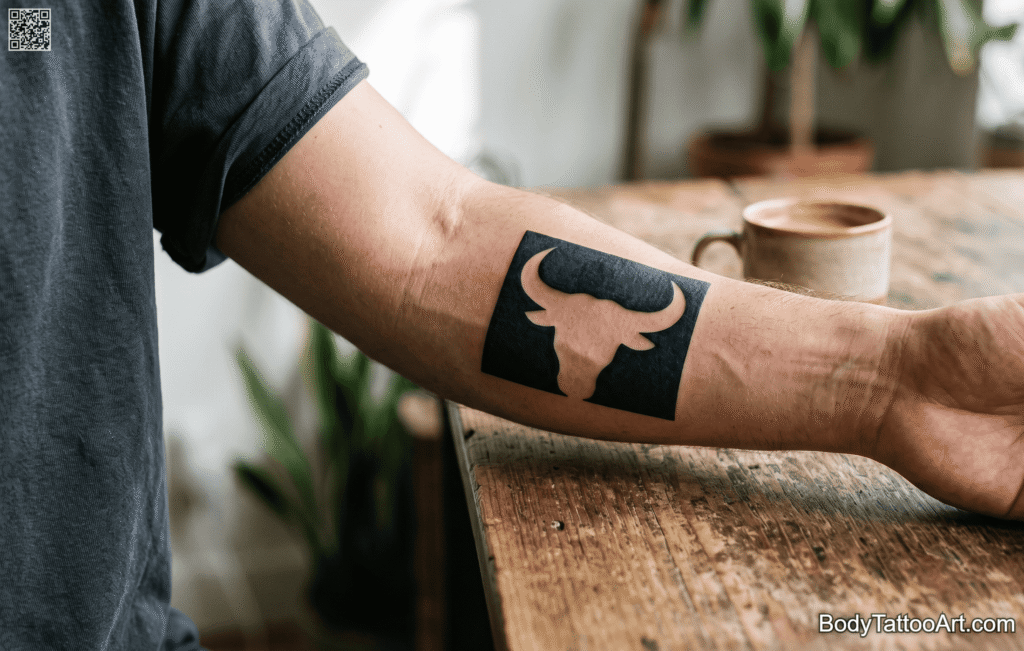
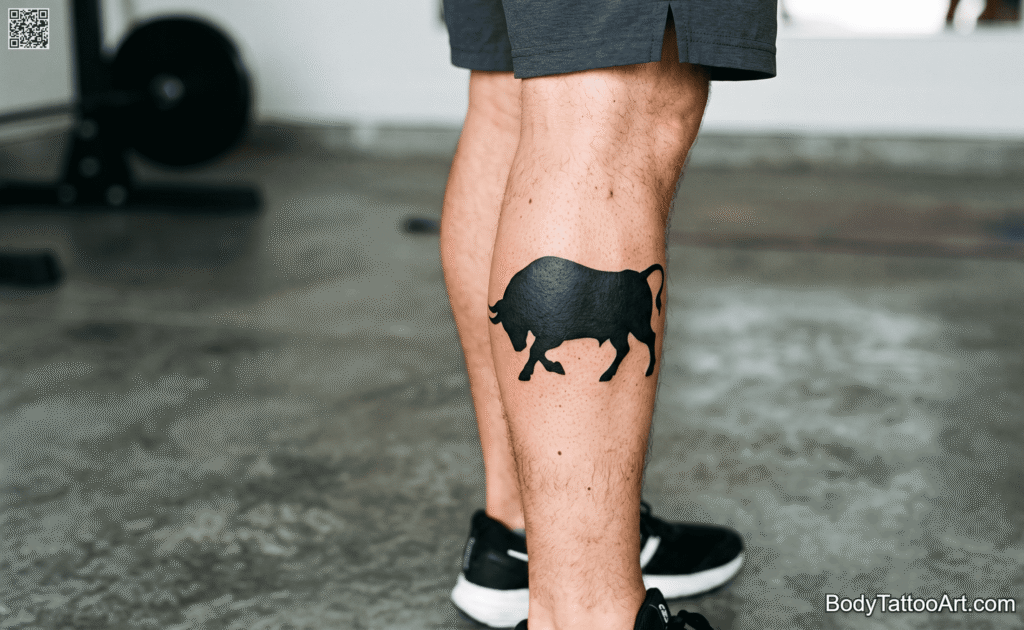
A completely solid black bull silhouette, standing still in profile, with zero internal linework or shading of any kind. The strength of the piece comes purely from the shape and how it sits against skin, relying entirely on clean edges and confident proportions to read well from a distance.
Placement: Calf or side ribs
Style: Blackout Bull Tattoos
Why it stands out: Stripping away every detail forces the design to succeed purely on silhouette and placement, which takes real confidence to pull off.
Ideal for: Bold blackwork fans, people wanting a graphic, high-contrast piece.
Bull Tattoos carry weight in almost every culture that has depicted them, which is exactly why the design holds up across so many different tattoo styles. From delicate single-line minimalism to full-back Irezumi pieces, there’s room for a bull tattoo in nearly any collection.
Anyone deciding between these should think less about which style is trending and more about which composition actually matches their existing tattoos and the energy they want on their skin. A quiet fine-line piece on the wrist sends a completely different message than a full-back blackout silhouette, even though both are technically “bull tattoos” — and that range is exactly what makes this animal such a rich subject to design around.