Physical Address
304 North Cardinal St.
Dorchester Center, MA 02124
Physical Address
304 North Cardinal St.
Dorchester Center, MA 02124

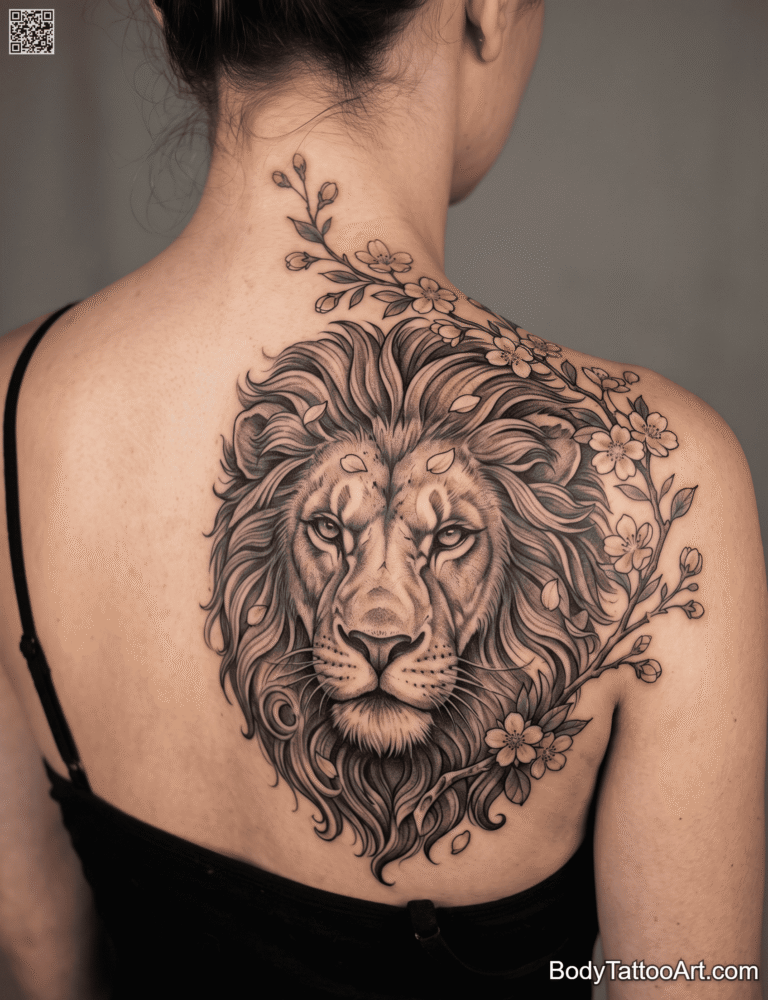
A lion brings weight and presence to a tattoo the moment it shows up, and pairing it with a peony gives that strength something to sit against instead of standing alone. The peony’s big, layered petals soften the composition just enough, so the lion doesn’t read as purely aggressive, and the flower doesn’t get lost either, since peonies are already one of the fuller, more dramatic blooms used in tattoo work.
This combination also gives artists a lot of room to decide how the two subjects relate to each other. Some designs let the lion take up most of the space with the peony tucked into a corner, while others build the flower first and let the lion’s face or mane emerge through the petals, closer to how the tiger sits inside the lotus in some of the more layered floral-animal pieces seen in earlier work. Readers who liked the lily with tiger tattoo ideas will recognize that same emerging technique used again here with a different flower and a different animal entirely.
This roundup covers ten different versions of the peony and lion pairing, from a small lion silhouette resting beside one bloom to a full sleeve built around a roaring lion surrounded by peonies in every stage of bloom. Some lean bold and traditional, others go quiet and minimal, and a few mix in geometric or abstract touches for something less expected.
Every entry below includes the visual breakdown, the tattoo style, a placement suggestion, and a detailed image prompt for building out reference art.
A peony with lion tattoo pairs a peony bloom, often shown fully open with its layered, ruffled petals, with a lion shown as a full body, a head and mane, or sometimes just a partial face peeking through the flower itself. The lion can dominate the piece as the main subject, or it can sit smaller and closer to the peony, depending on how the artist wants to balance the two elements.
What makes this pairing interesting visually is the contrast between soft and structured. A peony’s petals curve and layer in a way that feels loose and organic, while a lion’s mane, especially in bold or traditional styles, tends to get broken into distinct, almost architectural sections of fur. Putting those two textures side by side gives an artist a lot to work with in terms of shading and flow, since the eye naturally moves between the softness of the flower and the density of the mane.
The number of peonies included also changes how the piece reads. A single large bloom next to the lion’s face tends to feel deliberate and balanced, while scattering several smaller blooms around the mane or body can soften a bold subject even further, especially in designs that lean into color or watercolor techniques.
Anyone who enjoyed the cherry blossom with bee tattoo roundup covered earlier will notice a real shift in scale and mood here, since a lion asks for a very different kind of composition than a small insect ever would.
That difference also shows up in how the two subjects are usually shaded. A bee or a butterfly can get away with thin, uniform linework across the whole design, but a lion’s mane almost always needs some kind of layered shading, whether that’s dotwork, grey-wash, or color gradients, just to keep the texture from looking flat. The peony ends up adapting to whatever technique the mane is using, rather than the other way around, which is a bit of a role reversal compared to smaller floral-animal pairings.
Peonies are often associated with prosperity and honor, particularly in East Asian art and design traditions where the flower has held a significant place for centuries. The layered, full-bloom shape of the flower is part of what gives it that sense of richness in visual work. For more on the flower’s history and its many cultivated varieties, the Wikipedia entry on peonies covers the plant family in detail.
Lions carry associations with courage, strength, and leadership across a wide range of cultures, largely tied to their position at the top of the food chain and their social structure within prides. Their prominent mane and commanding presence have made them a recurring symbol in art, heraldry, and design for a very long time. The Wikipedia page on lions goes into more depth on the species, their behavior, and their natural habitat for anyone curious about the animal itself.
Put together, the pairing tends to suggest something powerful softened by something rich and layered, though the rest of this post focuses mainly on how each individual design looks and holds together rather than repeating that idea under every entry.
It’s also worth noting that both subjects are already considered fairly high-status choices on their own, before they’re even combined into one piece. Peonies have long been treated as a flower associated with wealth and rank in East Asian art, and lions have carried a similar association with authority and rank across a completely different set of traditions, from European heraldry to depictions of royalty. Pairing the two together in one tattoo isn’t a common accident, it tends to be a deliberate choice by people who want a piece that reads as bold from a distance and detailed up close.
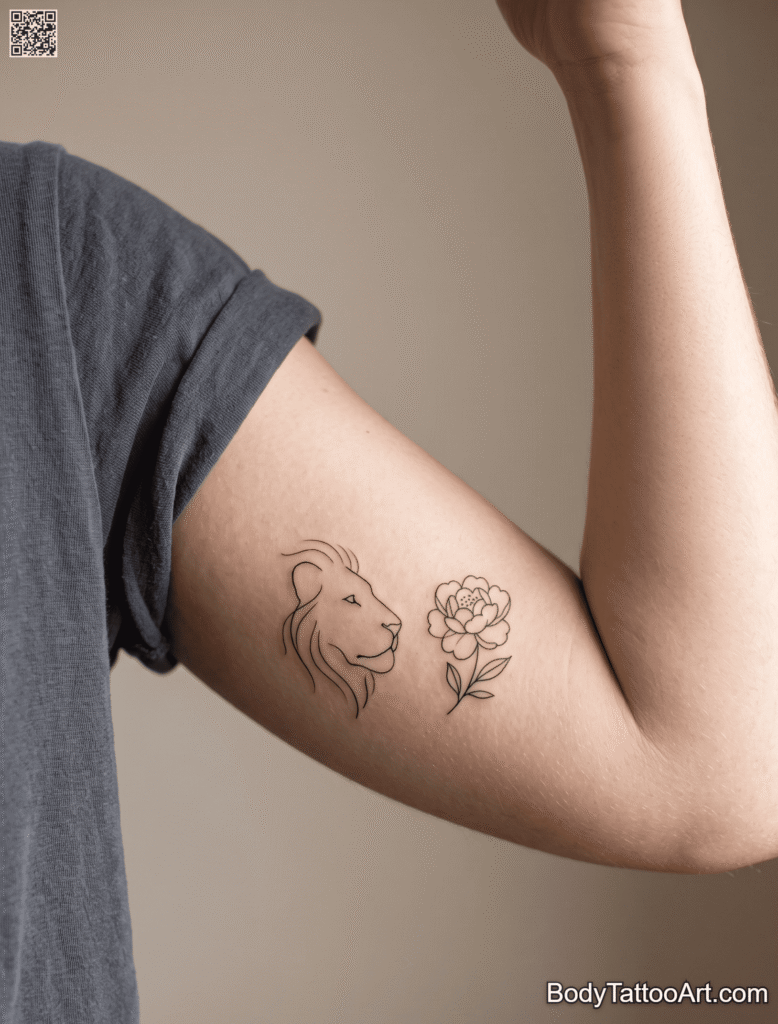
A small peony sits beside a lion’s face drawn only in profile, just the outline of the nose, brow, and a hint of mane suggested with a few curved lines. No shading fills either shape, keeping the whole piece down to clean, even linework. The peony’s petals are simplified into soft, rounded loops rather than fully detailed layers, matching the same restraint used on the lion.
Placement – Inner bicep Peony With Lion Tattoos
Style – Fine line Peony With Lion Tattoos
Why it stands out – Reducing the lion to a profile instead of a full face keeps the design from feeling heavy, which is unusual for a subject that’s often drawn much bolder and more detailed. The soft curve of the peony beside it balances the sharper lines of the mane, so neither shape competes for attention.
Ideal for – First-timers and minimalist lovers who still want a recognizable animal subject.
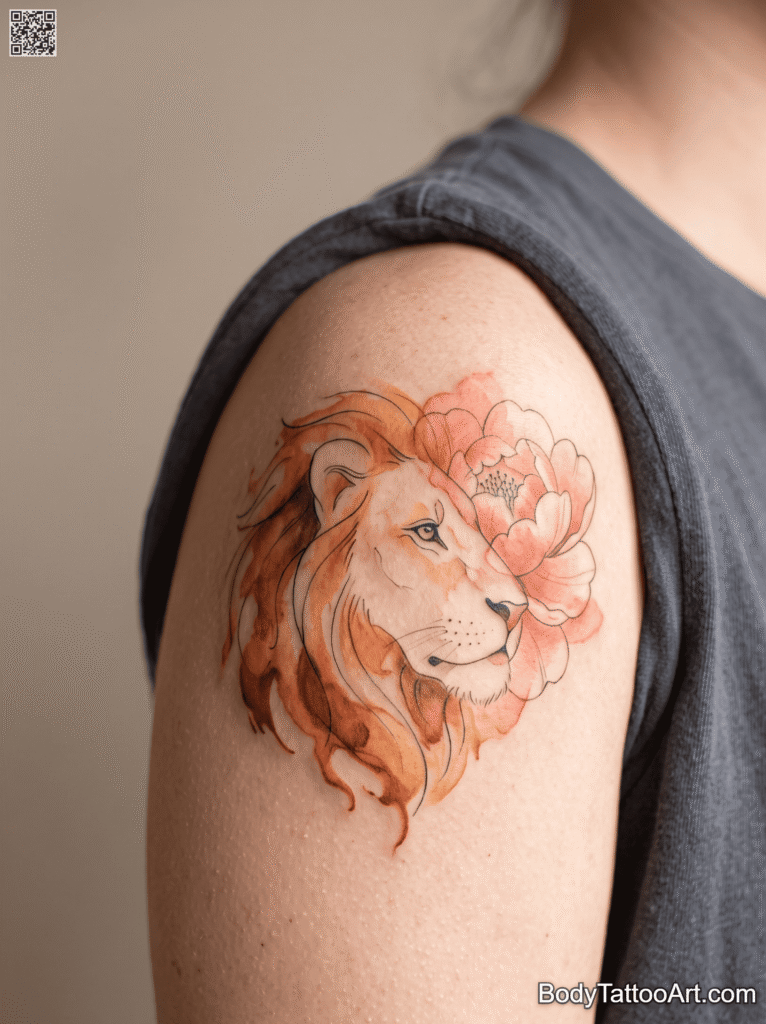
A lion’s mane spreads across the shoulder in loose watercolor washes of amber and burnt orange, blending directly into a large peony bloom painted in soft coral and blush pink, so the two subjects share the same color bleed instead of staying visually separate. The lion’s face sits mostly hidden within the color, just the eyes and a suggestion of the nose visible through the wash.
Placement – Shoulder Peony With Lion Tattoos
Style – Watercolor Peony With Lion Tattoos
Why it stands out – Letting the mane and the petals share the same color palette turns the lion and the flower into one continuous shape instead of two subjects placed next to each other, which is a harder effect to pull off than it looks. The soft edges also mean the piece changes slightly depending on the light it’s seen in.
Ideal for – Fans of painterly, art-inspired tattoos who want color without sharp outlines.
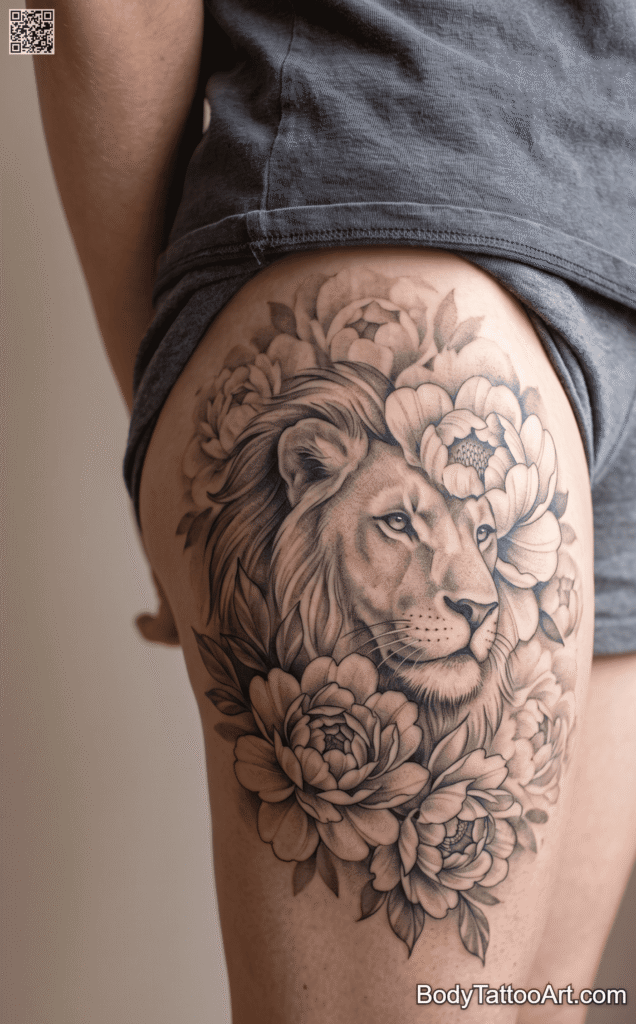
A full lion’s face slowly emerges through layers of blooming peonies on the thigh, with petals overlapping parts of the mane and cheek in a way that makes it hard to tell where the flower ends and the fur begins. Some blooms sit sharp and detailed in the foreground while others fade softer into the background, giving the whole piece real depth. Soft grey shading on the lion contrasts against slightly warmer tones on the petals.
Placement – Outer thigh / full back Peony With Lion Tattoos
Style – Grey-wash realism Peony With Lion Tattoos
Why it stands out – The lion feels like it belongs inside the flowers rather than sitting on top of them as a separate element, and that blending makes the whole composition feel like one connected scene rather than two subjects stitched together. The size of the piece also gives the shading room to build real depth without feeling rushed.
Ideal for – Wildlife tattoo lovers and collectors who want an immersive, large-scale piece.
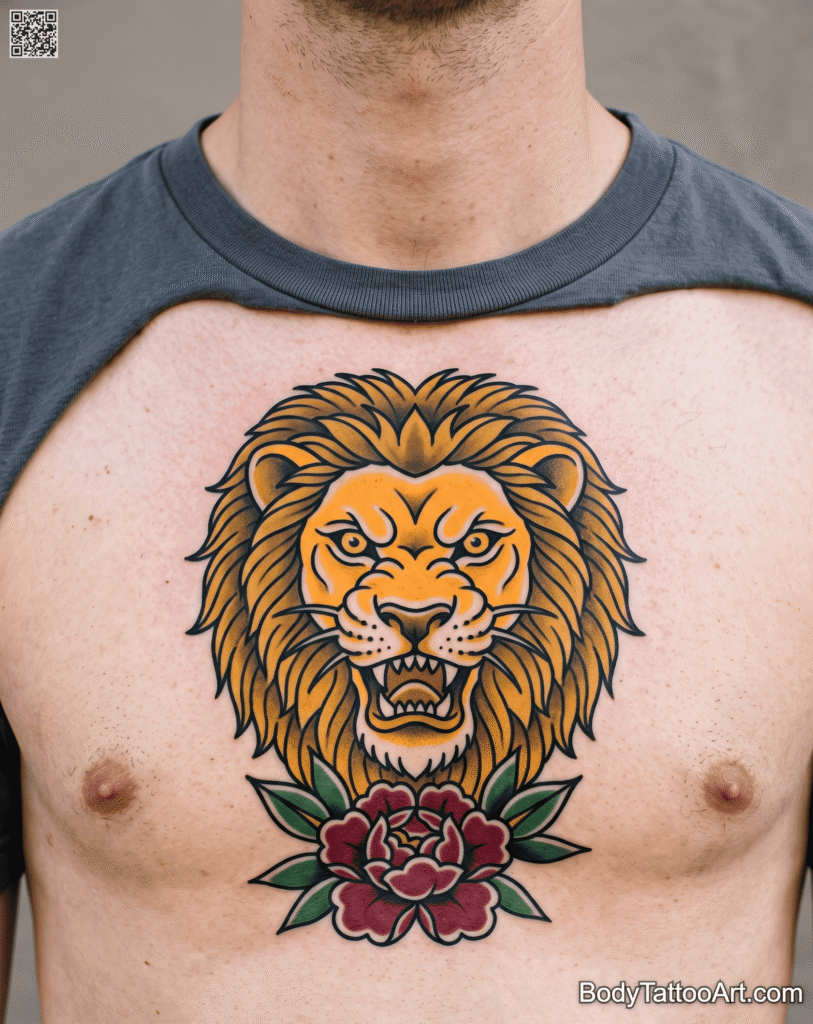
A lion’s head sits front and center on the chest, drawn with thick black outlines and flat, solid color fill in classic traditional style, a deep golden mane surrounding a confident, forward-facing expression. A single peony in rich red sits just below the chin, its petals built from the same bold outline weight as the mane so the two elements feel like they belong to the same visual family.
Placement – Chest Peony With Lion Tattoos
Style – American traditional Peony With Lion Tattoos
Why it stands out – Matching the outline weight across both the lion and the flower keeps the piece from feeling split into two separate tattoos, which happens often when a bold animal gets paired with a softer floral element. The centered placement also gives it a strong, symmetrical anchor point on the chest.
Ideal for – Fans of classic tattoo styles and anyone who wants a design that reads clearly from a distance.
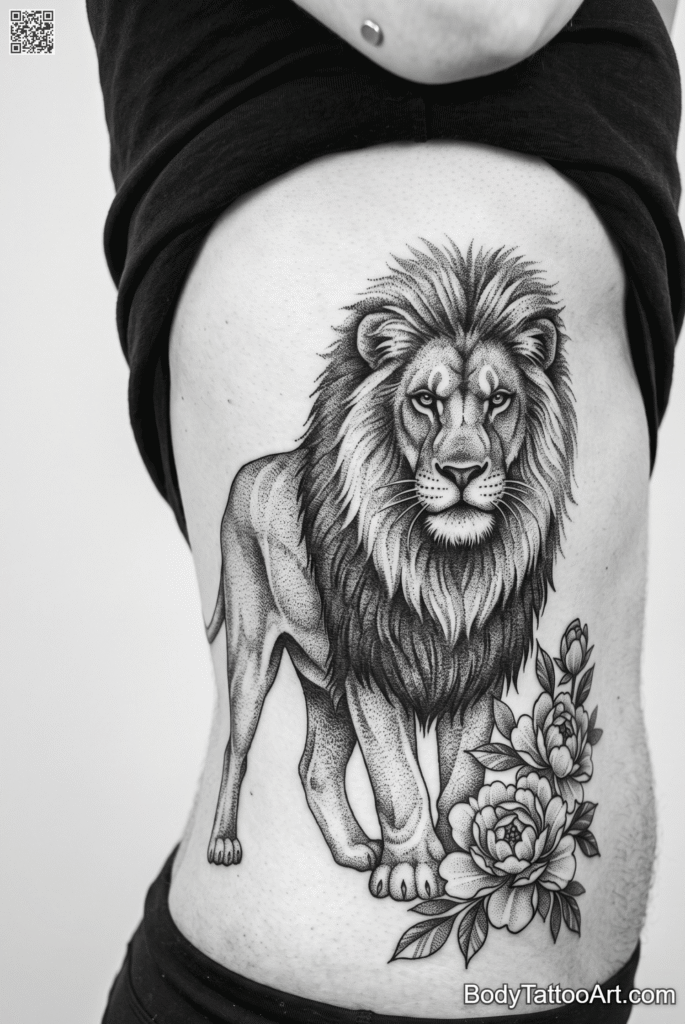
A lion’s full body rests along the ribcage and hip, built entirely from black dotwork shading with no solid fill anywhere in the piece. The mane is rendered through varying dot density, thick and dark near the face and thinning out toward the edges. A cluster of peonies grows near the lion’s front paws, shaded in the same dot technique, so the whole piece stays visually consistent from top to bottom.
Placement – Ribcage and hip Peony With Lion Tattoos
Style – Blackwork with dotwork shading Peony With Lion Tattoos
Why it stands out – Keeping the shading technique identical across both the lion and the flowers ties the whole piece together, even though the subjects themselves are structurally very different from each other. The dot density around the paws also gives the peonies a slightly rougher texture that fits the wildlife theme better than smooth shading would.
Ideal for – Bold style fans and collectors who want a large piece with heavy, detailed shading.
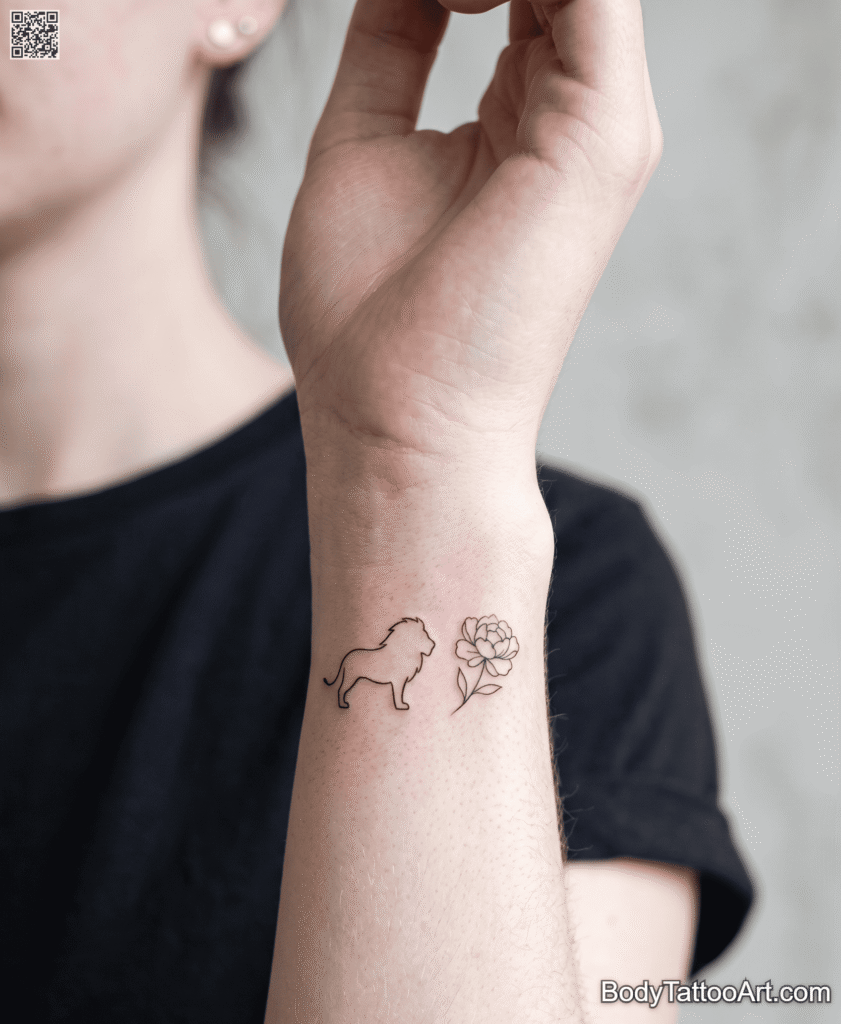
A tiny lion silhouette, just a simple side profile with a short mane outline, sits beside a single small peony drawn with a handful of curved lines. No shading, no color, just the barest suggestion of both shapes small enough to be covered by a watch strap.
Placement – Wrist Peony With Lion Tattoos
Style – Minimalist linework Peony With Lion Tattoos
Why it stands out – Reducing a subject as bold as a lion down to a tiny, quiet silhouette is a fun contrast, since the design keeps the animal’s strength as an idea without needing any of the usual bold detail to back it up. It also sits easily next to other small wrist pieces without competing for space.
Ideal for – Minimalist lovers and anyone wanting a small, easy-to-hide first tattoo.
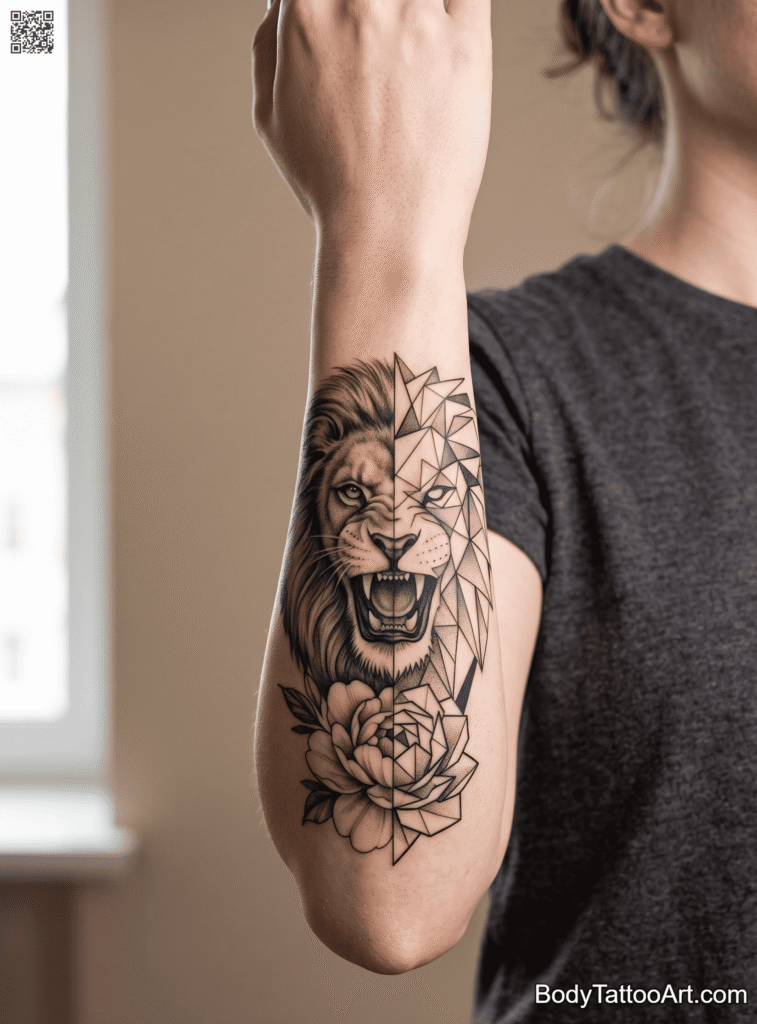
A lion mid-roar takes up most of the forearm, its mane split between realistic shading on one side and sharp geometric triangles on the other, as if the animal exists in two different visual styles at once. A peony sits just beneath the jaw, half rendered with soft, natural petal curves and half rebuilt from the same angular shapes used in the mane.
Placement – Forearm Peony With Lion Tattoos
Style – Abstract geometric fusion Peony With Lion Tattoos
Why it stands out – Splitting both the lion and the flower down the same visual line creates a strong sense of tension in the piece, and it keeps the eye moving between the realistic and geometric halves instead of settling in one spot. The forearm’s flat surface also gives the split line room to run in a clean, uninterrupted path.
Ideal for – People drawn to modern or abstract tattoo work who want something outside the usual wildlife template.
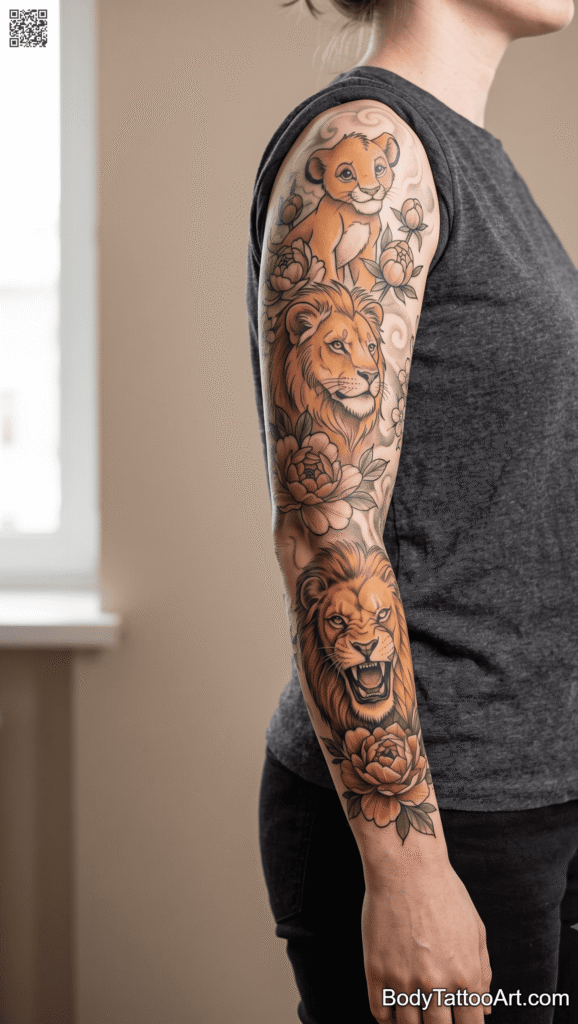
A full sleeve running from shoulder to wrist tells a bigger story, starting with a young lion cub near the shoulder that grows into a full adult lion by the forearm, with peonies in different stages of bloom marking the transition, tight buds near the shoulder opening into full flowers near the wrist. Bold black outlines and warm color washes carry the piece in a Japanese-inspired style, with faint clouds filling the gaps between the main figures.
Placement – Full sleeve Peony With Lion Tattoos
Style – Japanese-inspired traditional Peony With Lion Tattoos
Why it stands out – Using the peony’s bloom stages to track the lion’s growth across the sleeve gives the whole piece a sense of time passing, which turns a simple animal-and-flower pairing into something closer to a visual story. It also gives the sleeve a clear beginning and end point instead of feeling like one repeated pattern.
Ideal for – Collectors planning a full sleeve and anyone who wants a design built for multiple sessions.
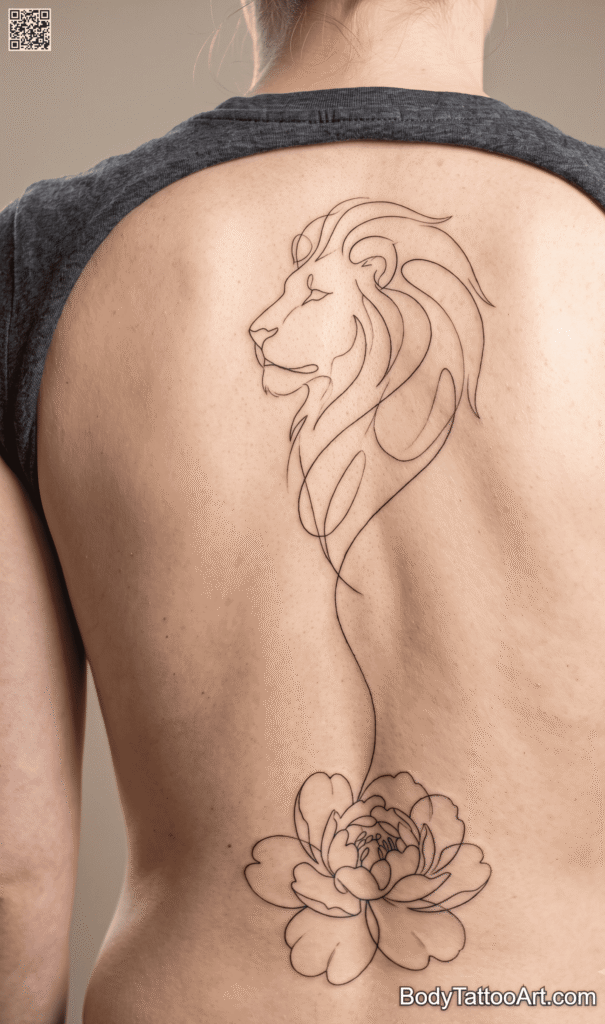
A thin, almost invisible outline of a lion’s mane traces along the spine, using negative space so heavily that most of the fur texture is only implied by the curve of the line rather than filled in. A single peony sits at the base, drawn the same way, with a few petals only suggested by gaps rather than closed shapes.
Placement – Spine Peony With Lion Tattoos
Style – Delicate linework with negative space Peony With Lion Tattoos
Why it stands out – Letting the skin carry most of the visual weight turns a naturally bold subject into something quiet and almost ghost-like, which is a rare take on a lion tattoo. The narrow shape of the spine also suits this kind of thin, traced linework better than a wider, flatter area would.
Ideal for – Minimalist lovers and anyone wanting a subtle piece that still reads as a lion on close inspection.
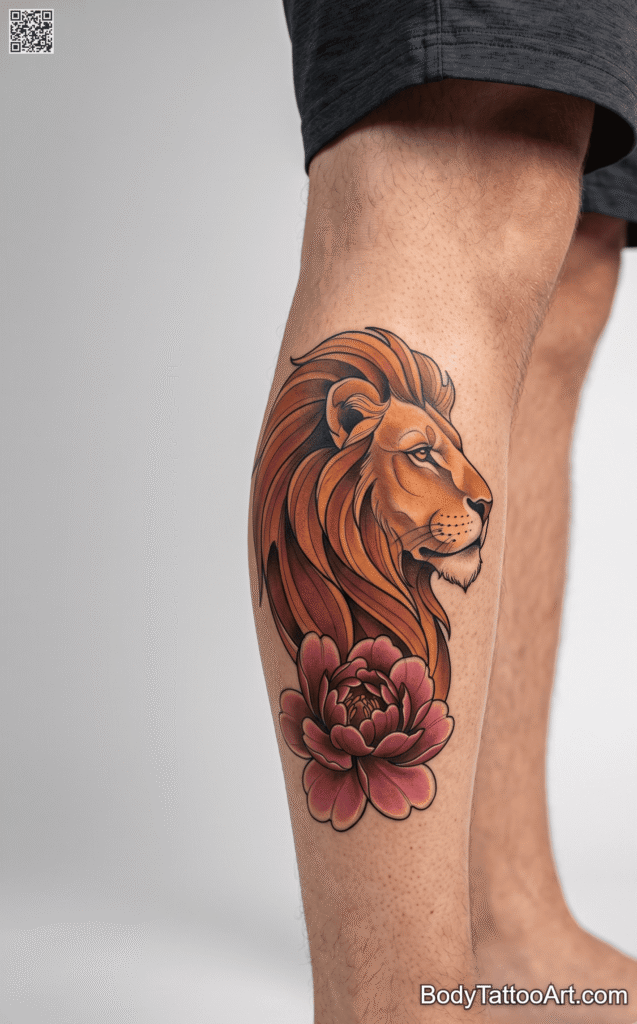
A bold lion’s head takes up most of the calf, mane rendered in rich amber and rust tones shaded with smooth gradients rather than flat color blocks. A peony in deep magenta blooms just beside the jaw, its petals catching the same warm light as the mane so the two subjects feel like they’re lit from the same source.
Placement – Calf Peony With Lion Tattoos
Style – Neo-traditional Peony With Lion Tattoos
Why it stands out – The gradient shading gives the mane a richer, almost glowing look compared to flat traditional fill, and matching the lighting across both subjects makes the whole piece feel like one cohesive scene instead of two separate elements. The calf’s natural curve also helps the mane wrap convincingly around the leg.
Ideal for – Bold style fans who want strong color and a striking design that wraps naturally around the leg.
A lion asks for more consideration than most floral pairings, mostly because the animal’s detail tends to shrink or expand depending on how much space it’s given. A full mane with individual strands of fur needs real room to breathe, which is why so many of the larger, more detailed designs above end up on the back, thigh, or full sleeve rather than smaller areas like the wrist or forearm.
For anyone drawn to a bolder design but working with limited space, simplifying the lion down to a profile, a silhouette, or just the face rather than the full body is usually the better move. Several of the smaller pieces above lean on that approach, and it keeps the design from feeling cramped or losing detail once it heals and settles into the skin.
Color also plays a bigger role with this pairing than it might with a quieter flower-and-insect combination. A golden or amber mane tends to hold up well over time in neo-traditional or traditional styles, while black and grey versions age a bit more evenly and need less touch-up work down the line. It’s worth discussing both options with an artist based on how long the color is expected to stay vibrant.
Body shape and natural contour matter more with a lion than with most floral subjects, too. A mane wraps and curves in a fairly specific way, so placements that already follow a natural curve, like the shoulder, calf, or ribcage, tend to let the design sit more comfortably than a flat area would. Artists who work often with wildlife pieces usually have strong opinions about which placements let a mane read most convincingly, so it’s worth asking directly during a consultation.
A pairing this varied benefits from walking into a consultation with more than just one fixed idea. Since the lion and peony combination works across so many different techniques, from soft watercolor to heavy dotwork, an artist can often pull the shading approach from one reference and the layout from another to land on something that fits a specific placement better than any single design would on its own.
It also helps to be upfront about how much detail actually matters going in. Some people care most about the lion looking as realistic as possible, while others are more interested in the overall shape and composition working well on the body, even if that means simplifying the mane or the petals. Being clear about that priority early on saves a lot of back and forth once the stencil stage begins.
Sizing is another detail worth nailing down before the first session. A lion that looks perfectly detailed in a small reference photo often needs to grow significantly once it’s actually placed on skin, especially if the mane is meant to carry any real texture. Bringing a rough sense of the intended size, not just the intended design, tends to make that first conversation with an artist much smoother.
Ten different versions of the peony and lion pairing show just how much range there is in combining a soft, layered flower with an animal known mostly for strength and presence. A tiny wrist silhouette and a full sleeve pride scene come from the same basic idea, yet they ask for completely different levels of commitment and completely different amounts of skin.
Anyone comparing this pairing against other floral-animal combinations, including the cherry blossom with hummingbird tattoo roundup and the cherry blossom with butterfly tattoo ideas covered earlier, will notice how much the size and personality of the animal changes the whole feel of the design. A lion carries a very different weight than a hummingbird or a bee, and that difference shapes everything from placement to shading choices.
For readers who want to see how a similar big-cat pairing looks with a different flower entirely, the lily with lion tattoo ideas post covers that ground from a slightly different angle, and the broader floral tattoo design collection has plenty of standalone peony options for anyone who decides they’d rather skip the added animal altogether.
Whichever version ends up feeling right, the range across these ten designs shows there’s no single correct way to pair a lion with a peony. Scale, color, and technique all shift the mood dramatically, and that flexibility is really the strongest argument for this combination over a lot of other floral-animal pairings.
Does a lion tattoo take longer to complete than a smaller animal pairing?
Usually, yes, especially for larger, more detailed pieces. The mane alone can take significant time to shade properly, whether through dotwork, grey-wash, or color gradients, so a full lion and peony piece often needs more than one session compared to a smaller insect or bird pairing.
Is it possible to get a smaller, simplified lion tattoo without losing the design’s impact?
Definitely. Several designs above, like the wrist silhouette and the quiet profile piece, prove that reducing the lion down to a simple outline or profile still reads clearly, as long as the linework stays clean and the peony doesn’t overcrowd the smaller shape.
Which style holds up best over time for a large peony and lion piece?
Bold outlines with dotwork or solid black shading, like the blackwork pride design, tend to age a bit more evenly than heavy color work, since black ink generally holds its edges longer than color gradients as skin changes over the years.
Can the lion and peony be added to an existing tattoo instead of starting fresh?
Often, yes, particularly with sleeve or back pieces that leave open space for expansion. An experienced artist can usually work a lion and peony combination around existing linework, though the exact approach depends heavily on what’s already there.
Does this pairing work well for both bold, colorful tattoos and quieter black and grey pieces?
Yes, and that flexibility is part of why it works at almost any scale. The designs above range from vivid neo-traditional color to soft grey-wash realism and negative-space linework, so the same basic pairing adapts easily to whichever mood or style someone prefers.
Is a peony necessary, or can a different flower work just as well with a lion?
A peony isn’t required, but its layered, full-bloom shape tends to complement a lion’s mane better than flatter or smaller flowers, since both subjects already share a sense of fullness and texture. That said, the same basic composition ideas covered above can usually be adapted to a different flower if a peony doesn’t fit someone’s personal preference.
How much should someone budget in terms of sessions for a large peony and lion piece?
It depends heavily on size and detail, but pieces like the sleeve pride scene or the grey-wash thigh design typically need more than one sitting, especially once shading is factored in. Smaller versions, like the wrist silhouette or the quiet profile piece, can usually be finished in a single, shorter session.