Physical Address
304 North Cardinal St.
Dorchester Center, MA 02124
Physical Address
304 North Cardinal St.
Dorchester Center, MA 02124

There’s something about lavender that just works as a tattoo. Maybe it’s the tall, slender stems. Maybe it’s the way the tiny florets stack up like a little purple tower. Or maybe it’s just that lavender tattoos look incredibly good on skin — delicate without being forgettable, simple without being boring.
Lavender tattoos have been showing up everywhere lately — on wrists, ribs, ankles, collarbones, and behind ears. And the best part? Lavender tattoos can go ultra-minimal or deeply detailed. They can be soft and watercolour-dreamy or bold and graphic.
Lavender tattoos are tattoo designs featuring the lavender plant — typically its signature long stems, clustered purple florets, and sometimes narrow green leaves. The most common compositions show one or a few sprigs in various states of bloom. The design can be rendered in everything from hairline fine line work to bold traditional outlines to abstract brushstroke styles.
What makes lavender tattoos so popular is how naturally the plant translates to skin. The vertical stem gives a clean directional flow, the tiny florets add texture without needing much space, and the overall silhouette is immediately recognisable even at a small scale.
Lavender has been associated with calm, healing, and quiet grace across different cultures for centuries. It’s been used in everything from ancient Roman baths to French perfumeries to aromatherapy practices today. As a tattoo, it tends to carry personal meaning for the wearer — often connected to peace, a love for nature, a particular memory, or simply an aesthetic preference. Similar to Lotus Tattoos, lavender tattoos are hot among nature lovers too.
Lavender tattoos don’t need to carry heavy meaning to earn their place. A lot of people simply love how they look, and that’s reason enough. The design’s natural elegance does the rest.
One perfectly upright lavender sprig, with a single straight stem and tightly packed florets rendered in the thinnest possible lines. No shading, no background — just the outline doing all the work. The simplicity makes it look more intentional, not less.
Placement Inner wrist / ankle
Style Fine line Lavender Tattoos
Why it stands out The restraint is everything here. One line, one stem, one statement. It doesn’t try to be more than it is, and that’s exactly what makes it work.
Ideal for Minimalists, first-timers, people who want something small and meaningful.

Three lavender sprigs grouped loosely together, each at a slightly different height and angle, like they were just picked from a garden and haven’t been arranged yet. The stems are thin but confident, and the florets have a bit more texture — small dashes and dots giving them body without going overboard.
Placement Forearm / outer ankle
Style Fine line with minimal texture Lavender Tattoos
Why it stands out The slight variation in stem height gives the whole piece natural movement. It looks less designed and more found.
Ideal for Nature lovers, people who like organic-feeling tattoos, those wanting something soft but not too precious.

A single lavender stem done in full blackwork — thick, solid florets stacked tightly along the upper spike, with dark fills and clean edges. The leaves at the base are minimal, more suggestion than detail. The whole piece has strong contrast and a graphic quality that feels modern.
Placement Upper arm / calf
Style Blackwork Lavender Tattoos
Why it stands out Most lavender tattoos play soft. This one goes bold. The solid black fills turn a delicate plant into something with real visual weight.
Ideal for People who prefer bold tattoos, blackwork collectors, those wanting something that reads from a distance

A lavender sprig built entirely from dots — the stem formed by tight rows of stippling, the florets created by clusters of dots that grow denser at the centre and fade outward. The result is a soft, almost powdery texture that looks completely different from anything linework can achieve.
Placement Shoulder blade / side of neck
Style Dotwork Lavender Tattoos
Why it stands out The dotwork technique gives lavender a velvety, almost photographic quality. The gradient from dense to sparse creates natural depth without a single line.
Ideal for Texture lovers, dotwork enthusiasts, people who want fine detail work.

A fine line lavender sprig sits over a soft wash of purple and blue watercolour that bleeds slightly beyond the outline. The linework is precise and dark — the colour behind it is loose and imprecise. The contrast between the two creates a layered, dreamy quality.
Placement Collarbone / upper back
Style Fine line with watercolour Lavender Tattoos
Why it stands out The controlled line drawing and the freeform colour wash pull in opposite directions and somehow make each other better. The design feels like a botanical sketch brought to life.
Ideal for Colour tattoo lovers, art and illustration fans, people wanting something painterly.

A lavender sprig sits inside a sharp geometric diamond outline. The plant is rendered in fine line with light stipple shading on the florets, and the diamond frame is clean and angular. The softness of the organic plant against the rigid geometry creates an interesting tension.
Placement Sternum / upper chest
Style Fine line geometric Lavender Tattoos
Why it stands out The framing device turns a botanical tattoo into something more structured. The diamond anchors the plant without flattening it.
Ideal for People who like structured compositions, geometry fans, those wanting a centrepiece tattoo.

A single lavender stem hangs vertically downward — florets at the bottom, stem at the top — like it’s been tied to dry. The lines are thin and delicate, with tiny leaves curving outward from the stem. The inverted orientation gives the tattoo an unusual, slightly melancholic composition.
Placement Behind the ear / back of the neck
Style Fine line Lavender Tattoos
Why it stands out The downward hang is unexpected. It breaks from the typical upright botanical pose and creates a more intimate, personal feel — like something pressed and saved.
Ideal for People wanting something unusual, small tattoo lovers, those who like hidden or subtle placements.

The lavender form is abstracted into gestural brushstroke shapes — quick, fluid marks suggest the stem and florets without literally depicting them. The strokes vary in thickness and pressure, some thin and trailing, some broader and dark. It reads as lavender clearly but has a loose, painted energy.
Placement Shoulder / upper arm
Style Abstract / brushwork Lavender Tattoos
Why it stands out It captures the essence of lavender without being illustrative. The confidence of each stroke makes the whole piece feel alive.
Ideal for Abstract art fans, people who want tattoos that feel expressive rather than decorative, bold style enthusiasts.

A detailed single lavender sprig rendered in grey-wash realism — soft gradients of grey create depth in each tiny floret, and the stem has subtle shadow work along one side. It looks like a scientific botanical illustration translated to skin.
Placement Inner forearm / thigh
Style Grey-wash realism Lavender Tattoos
Why it stands out The grey-wash technique gives lavender an unexpected photographic quality. Each floret has its own light and shadow, which makes the whole piece surprisingly dimensional.
Ideal for Detail lovers, people who appreciate realistic art styles, those building a botanical tattoo collection.

A patch of solid black ink covers a rectangular section of skin, with the lavender sprig left completely untattooed — the skin itself becomes the plant, surrounded by darkness. The florets and stem exist as pale skin shapes cut out of black.
Placement Forearm / calf
Style Blackwork negative space Lavender Tattoos
Why it stands out The concept flips the usual logic. The tattoo is technically the background, not the subject. The lavender appears without a single stroke drawn on top of it.
Ideal for Conceptual tattoo fans, blackwork collectors, those wanting something visually unusual.

A miniature lavender stem runs along the side of a finger — florets climbing toward the knuckle, stem stopping just before the base joint. The lines are as fine as possible, the scale is tiny, and the whole tattoo is just a few centimetres long.
Placement Side of finger
Style Fine line micro Lavender Tattoos
Why it stands out Scale transforms familiar things. At this size, even one or two misplaced lines would ruin it, which means when it’s done right, it’s remarkable.
Ideal for Micro tattoo lovers, people wanting discreet ink, those who already have hand tattoos.

The lines aren’t perfectly clean — this lavender looks hand-sketched, with a slightly scratchy quality and visible stroke variation. Some lines double back on themselves slightly. The florets are quick oval marks. The intentional imperfection gives it personality.
Placement Ribs / outer forearm
Style Sketch / illustrative Lavender Tattoos
Why it stands out The imperfection is the point. It has the energy of something drawn in a notebook — spontaneous and personal rather than polished and decorative.
Ideal for People who love illustration and art, those wanting something that feels handmade, creative types.

Multiple lavender stems of varying heights are arranged in a vertical column along the spine — each stem slightly different in tilt and size, creating an organic, gently swaying composition. The florets are rendered in fine line with delicate texturing.
Placement Spine / centre back
Style Fine line Lavender Tattoos
Why it stands out The vertical placement along the spine lets the stems breathe naturally. The spacing between them mirrors how lavender grows in a field — together but not crowded.
Ideal for Back tattoo lovers, those wanting elongated vertical compositions, people who love botanical tattoo arrangements.

Thick black outlines, flat purple fill, and that classic traditional tattoo look. The lavender stem is sturdy and graphic, the florets are bold oval shapes filled with a solid purple tone, and the leaves have simple dark green fills with classic shine marks.
Placement Upper arm / calf
Style Traditional / American traditional Lavender Tattoos
Why it stands out Traditional lavender tattoos are rarer than you’d expect. The bold outline and flat fill turn something delicate into something punchy and timeless.
Ideal for Traditional tattoo collectors, people wanting colour tattoos, fans of vintage tattoo aesthetics.

A fine line lavender sprig with all its shading done exclusively through stippling — thousands of tiny dots creating shadow and depth rather than gradient washes. Up close, it looks like a texture study. From a distance, it reads as a clean, dimensional botanical.
Placement Inner arm / side of neck
Style Fine line with stipple shading Lavender Tattoos
Why it stands out The stipple shading creates a completely different tactile quality than wash shading. The dots add a meditative attention to detail that rewards a closer look.
Ideal for Detail-obsessed tattoo fans, people who love textured work, those wanting something that improves on inspection.

A single long lavender stem curves around the wrist like a bracelet — florets visible on the outer wrist, bare stem wrapping underneath. The lines are thin and the overall effect is like a botanical wristband.
Placement Wrist wrap / wrist circumference
Style Fine line Lavender Tattoos
Why it stands out Placement-driven tattoos are inherently interesting because the body becomes part of the composition. The wrap-around creates continuity that a flat tattoo can’t replicate.
Ideal for People who love placement-specific tattoos, those wanting something that goes all the way around, bracelet tattoo fans

A lavender sprig with bold black outlines, but instead of solid black fills, the interior of each floret and the stem body are filled with dense dotwork patterns — hundreds of tiny dots packed tightly to create near-black tones with a rough, organic texture.
Placement Calf / upper arm
Style Blackwork with dotwork Lavender Tattoos
Why it stands out The dotwork fill inside bold outlines creates a hybrid aesthetic — bold from afar, intricate up close. It’s one of those tattoos that changes completely depending on how close you are to it.
Ideal for Blackwork collectors, people who love layered techniques, those wanting large-scale detailed tattoos

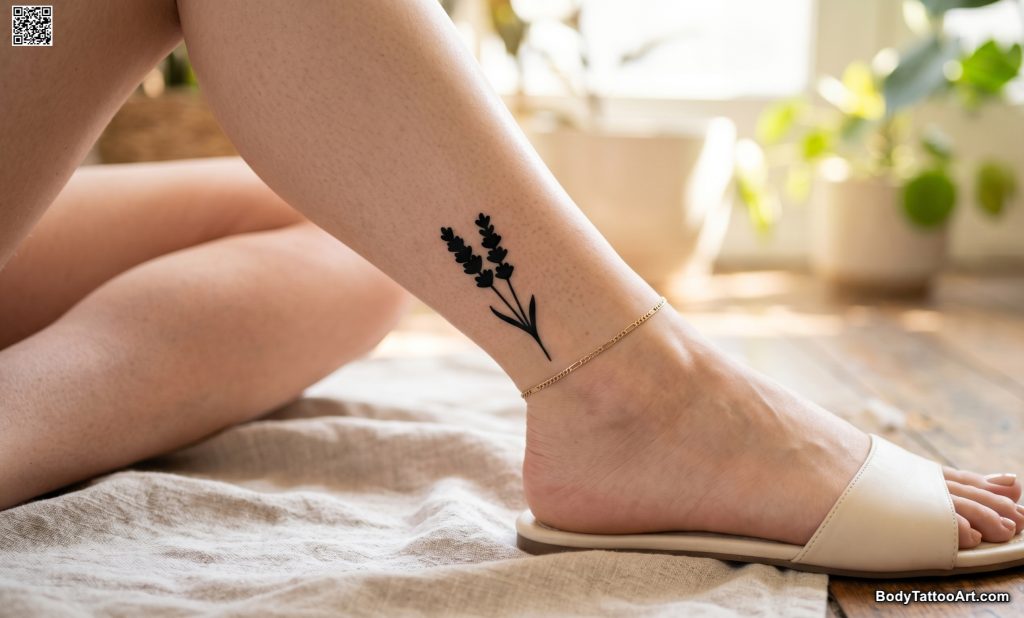
Just the outer silhouette of a lavender sprig — filled solid black with no interior detail whatsoever. No floret texture, no stem lines inside, no shading. Pure shape. It reads immediately as lavender through form alone.
Placement Ankle / wrist
Style Minimalist blackwork Lavender Tattoos
Why it stands out Reducing the plant to pure silhouette is a design choice that takes confidence. Nothing is hidden, nothing is supplemented — it’s all form.
Ideal for Minimalist design lovers, people wanting something clean and permanent, those who prefer bold shapes over delicate lines.
A detailed fine line lavender sprig anchored in place, with a burst of ink splatter radiating outward from the base — loose black drops and splashes that contrast with the controlled botanical drawing above.
Placement Inner forearm / shoulder
Style Illustrative with splatter Lavender Tattoos
Why it stands out The tension between the precise drawing and the chaotic splatter makes the whole piece dynamic. It feels like it just landed on the skin and scattered on impact.
Ideal for People who love artistic and expressive tattoos, those wanting something that doesn’t look traditionally decorative.

The lavender is rendered in a cross-hatching and parallel line technique that references old botanical engravings — the kind you’d find in a 19th-century plant atlas. Dense parallel lines build shadow, and fine hatching creates texture throughout.
Placement Ribcage / inner bicep
Style Engraving / etching Lavender Tattoos
Why it stands out The etching style is rare in tattoo work, which makes it immediately distinctive. It has a historical, archival quality that modern botanical tattoos rarely achieve.
Ideal for Art history lovers, people wanting unique and reference-rich designs, those who appreciate old-world illustration aesthetics.

A lavender sprig at the end of its bloom — florets partially gone, small rounded seed pods beginning to form along the stem. The composition feels like a snapshot of a plant mid-season, not at its peak. Fine line with delicate stipple shading throughout.
Placement Shoulder / upper back
Style Fine line illustrative Lavender Tattoos
Why it stands out Most lavender tattoos show the plant in full bloom. This one captures something more honest and transient — the moment after the peak, which has its own quiet beauty.
Ideal for People drawn to botanical accuracy, those who love subtle and thoughtful designs, nature enthusiasts.

A lavender stem is precisely centred inside a hexagon geometric frame — both rendered in the same fine line weight. The frame and plant share the same visual language, making the geometric container feel like it belongs to the plant.
Placement Inner wrist / behind ear
Style Fine line geometric Lavender Tattoos
Why it stands out Using a hexagon connects lavender to ideas of symmetry and natural structure — honeycombs, crystal formations. The framing elevates the design without overwhelming it.
Ideal for People who love geometry in tattoo design, minimalists who want a bit more structure, those wanting a unique small tattoo.

No black lines at all — this lavender tattoo is built entirely from soft purple and green watercolour washes. The florets are hazy purple smudges, the stem is a thin green stroke, and the whole thing has a light, translucent quality as if painted wet-on-wet.
Placement Outer ankle / shoulder blade
Style Watercolour (no outline) Lavender Tattoos
Why it stands out Removing outlines entirely is a bold choice that makes the design look genuinely painted, not tattooed. The whole composition floats rather than sitting heavy on the skin.
Ideal for People who want soft colour tattoos, watercolour art fans, those who want something that looks handpainted.

A tiny lavender sprig rendered with surprising photographic detail — each small floret has individually shaded petals, the stem shows texture and highlights, and the whole piece achieves a miniature realism that is technically difficult to execute at small scale.
Placement Behind the ear / inner wrist
Style Micro realism Lavender Tattoos
Why it stands out Micro realism at this scale is a technical feat. The amount of detail packed into a small footprint is what makes the viewer lean in and look twice.
Ideal for Collectors who appreciate technical skill, people wanting small but high-detail tattoos, those looking for a conversation-starter piece.

Instead of a single sprig, this design shows a row of lavender stems — varying slightly in height — arranged horizontally like a cropped view of a lavender field. The stems are bold blackwork, the florets dense and dark, the overall composition wide and cinematic.
Placement Forearm band / upper thigh band
Style Blackwork Lavender Tattoos
Why it stands out Shifting from a single sprig to a row changes the whole emotional register of the design. It becomes a landscape reference rather than a botanical one — more immersive, more environmental.
Ideal for People wanting band-style tattoos, bold tattoo fans, those who want lavender tattoos with an unusual compositional angle.

Lavender tattoos have a lot more range than they’re given credit for. This list alone covers micro realism, bold blackwork, watercolour washes, negative space, geometric frames, and everything in between — all using the same plant. That kind of versatility is exactly why lavender tattoos keep trending without feeling tired.
Whether the goal is something tiny and discreet or large and technically detailed, there’s a version of lavender tattoos that fits. The key is finding the right artist for the right style and letting the design work with the placement rather than against it.
You Might Also Like To Read –
29 Sunflower Tattoos Ideas Suitable For Everyone