Physical Address
304 North Cardinal St.
Dorchester Center, MA 02124
Physical Address
304 North Cardinal St.
Dorchester Center, MA 02124

There’s something quietly striking about a camellia tattoo. It doesn’t shout like roses. It doesn’t overdo it like sunflowers. The bloom has clean, symmetrical petals, a strong round structure, and a natural elegance that translates beautifully onto skin — whether it’s a single flower in fine line or a full blackwork piece.
Camellia tattoos have been growing in popularity across all tattoo styles, and for good reason. The flower holds its shape well in both small and large formats. It works in realism, it works in illustrative style, and it works as a standalone piece without needing any extra elements to feel complete.
This blog covers 26 different camellia tattoos designs — each one distinct in composition, style, and visual feel.
The camellia (Camellia japonica) is a flowering plant native to East and Southeast Asia. It belongs to the family Theaceae and has been cultivated for centuries in China, Japan, and Korea. The flower typically has overlapping rounded petals arranged in a near-perfect circular form, making it a strong visual subject for art and tattoo design.
Camellia flowers come in shades of red, pink, white, and even yellow, though in tattoo form, the structure and shading do most of the work.
In Japanese culture, the camellia (tsubaki) has been associated with deep admiration and devotion. In Chinese tradition, it symbolises the union of two people — the petals and leaves staying together even after the flower falls. In Korean culture, the camellia represents longing and steadfastness.
Across Western traditions, the red camellia has historically been associated with passion and desire, while white camellias carry associations with purity. The pink camellia is linked to longing and remembrance.
For more on the cultural and historical significance of this flower, visit the Wikipedia page on Camellia
That said, most people who get camellia tattoos aren’t getting them for a single fixed meaning. The bloom is just visually strong on its own.
A single camellia drawn in ultra-thin lines with no fill, no shading — just the outline of each petal in clean, precise detail. The petals spiral inward toward a small, tight centre, and the entire design sits almost like a botanical sketch. Negative space does all the work here.
Placement: Inner wrist / collarbone
Style: Fine line Camellia Tattoos
Why it stands out: The restraint is the whole point. Nothing is filled in, nothing is exaggerated — the structure of the camellia carries the design entirely.
Ideal for: Minimalist tattoo fans, first-timers, people who prefer subtle ink.

A fully filled blackwork camellia where each petal is solid black with sharp white edges left as contrast. The flower looks graphic and bold, like a woodblock print. A single leaf sits beneath, also filled, casting the composition in dramatic contrast.
Placement: Upper arm / shoulder blade
Style: Blackwork Camellia Tattoos
Why it stands out: The graphic quality is intense. The white edges between the filled petals give the design its definition — without them, it would collapse into one black mass, but with them, the structure is razor sharp.
Ideal for: Bold tattoo collectors, fans of graphic art aesthetics, people going for high-contrast body art.

A realistic camellia rendered entirely in grey wash with smooth gradient shading across each petal. The petals closest to the viewer are fully detailed, while the ones behind fade into softer grey. The centre of the bloom has tight, delicate detailing that gives the whole piece a three-dimensional quality.
Placement: Forearm / ribcage
Style: Grey-wash realism Camellia Tattoos
Why it stands out: The depth is remarkable for a single flower design. The layering of darker outer petals against the lighter inner ones gives the tattoo a natural, almost photographic quality.
Ideal for: Realism tattoo collectors, people wanting a detailed statement piece.

The camellia petals are mapped within a geometric framework — each petal shaped into a precise, angular form, and the overall flower fits inside an implied hexagonal boundary. Thin lines divide sections of each petal, giving the design a structured, architectural look.
Placement: Sternum / back of hand
Style: Geometric Camellia Tattoos
Why it stands out: It takes a naturally soft, rounded flower and strips it of softness without losing its identity. The contrast between organic subject and rigid geometry makes this visually interesting.
Ideal for: People who like structure in their tattoo design, fans of sacred geometry work.

The entire camellia is built through thousands of tiny dots rather than lines or fills. The density of dots increases toward the centre of each petal and in the shadowed areas, while the highlighted edges remain almost dot-free. The resulting texture feels like a fine stipple drawing.
Placement: Shoulder / calf
Style: Dotwork Camellia Tattoos
Why it stands out: The texture created purely by dot density is hypnotic up close. At a distance, it reads as a clean shaded flower — but up close, it reveals its construction.
Ideal for: Tattoo enthusiasts who appreciate craftsmanship, people who like unusual textures.

Loose, translucent washes of ink bleed softly beyond the petal outlines, creating the impression of watercolour paint on skin. The linework is minimal — just a light sketch of the bloom’s structure — while the colour bleeding does most of the expressive work.
Placement: Upper back / ankle
Style: Watercolour Camellia Tattoos
Why it stands out: The controlled looseness is hard to pull off. The camellia reads as solid in structure but soft in execution, which creates a genuinely painterly effect.
Ideal for: People who love art-inspired tattoos, those wanting colour without heavy saturation.

Inspired by traditional Japanese hand-poke technique, this camellia has smooth, consistent ink saturation with a slightly matte quality. The petals are rounded and clean, with subtle gradient shading done in a classic Japanese style, and the composition includes a single curved stem.
Placement: Bicep / ankle
Style: Japanese traditional Camellia Tattoos
Why it stands out: The matte finish and clean rounded petals give it a timeless quality. It reads as both classic and contemporary depending on placement.
Ideal for: Traditional tattoo fans, people who appreciate Japanese tattoo heritage.

The petals are deconstructed — some are present as full shapes, others as partial fragments, and a few dissolve into abstract brushstroke forms. The composition feels intentionally incomplete, as if the flower is mid-motion, either forming or falling apart.
Placement: Rib / upper arm
Style: Abstract / illustrative Camellia Tattoos
Why it stands out: The tension between recognisable flower and abstract form is what makes it work. The eye naturally tries to complete the missing parts, which keeps the design visually active.
Ideal for: People who want something unconventional, art lovers, those drawn to expressive styles.

A tiny, perfectly detailed camellia no bigger than a coin. Despite the scale, the petal overlaps are visible, the centre has a small star of detail, and the proportions hold. The size makes it feel delicate and almost secret.
Placement: Behind the ear / finger / wrist
Style: Fine line micro Camellia Tattoos
Why it stands out: The precision required at this scale is impressive. Nothing is compromised even at a small size — it’s a complete composition.
Ideal for: People wanting discreet ink, minimalists, first-timers

The camellia is formed by leaving skin-coloured negative space while the surrounding areas and inner petal veins are filled in black. The bloom appears as the absence of ink rather than its presence — a reversal of the usual approach.
Placement: Forearm / calf
Style: Blackwork negative space Camellia Tattoos
Why it stands out: The inversion creates a genuinely surprising effect. From a distance it reads as a filled design, but up close it becomes clear that the flower itself is untattooed skin.
Ideal for: People who like conceptual tattoo design, those who want blackwork without heavy ink density on the bloom itself.

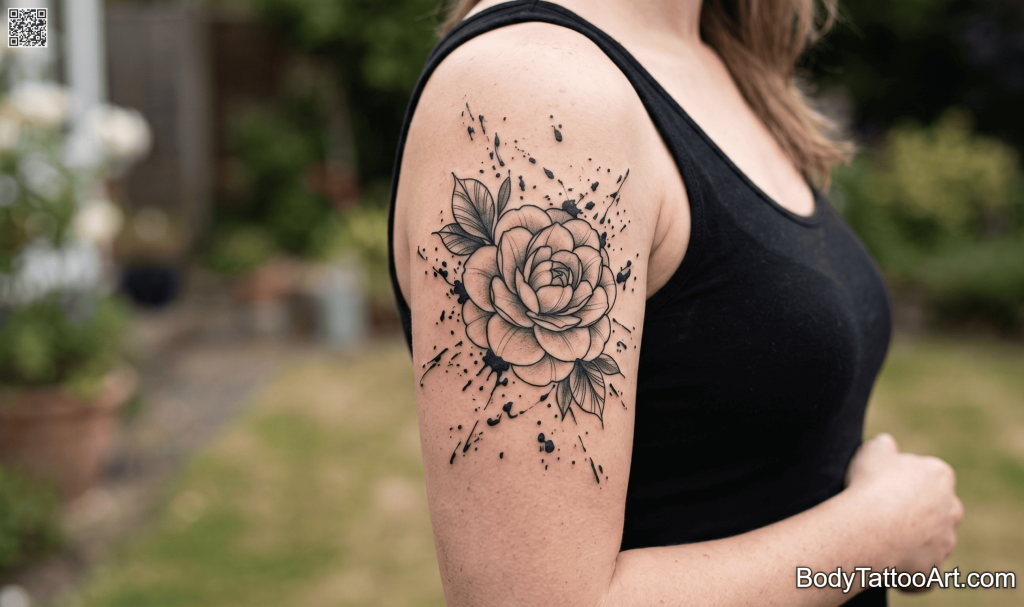
The camellia is drawn in a clean illustrative style, but ink splatter marks radiate from around the bloom — not overlapping the flower, but framing it loosely. The splatter suggests spontaneity against the controlled linework of the flower.
Placement: Upper arm / shoulder
Style: Illustrative / neo-traditional Camellia Tattoos
Why it stands out: The contrast between the composed flower and the loose splatter creates an energetic tension. It gives a clean camellia design some visual movement without complicating the subject.
Ideal for: People who want something edgy without going fully abstract, creative types.
The outer petals use clean linework, while the inner petal faces transition into stipple shading. The combination creates a two-texture effect — structured at the edge, grainy and textured toward the centre.
Placement: Inner arm / side ribcage
Style: Stipple and line hybrid Camellia Tattoos
Why it stands out: The mid-transition between techniques is the most interesting zone of the tattoo. It’s technically demanding and visually distinctive.
Ideal for: Tattoo collectors who want something craft-forward, people drawn to mixed-technique work.

The camellia is rendered entirely in parallel hatching lines — finer lines in the light areas, denser crosshatching in the shadow zones. The overall effect looks like a copper plate engraving, with no fill and no dots, just directional lines.
Placement: Chest / calf
Style: Etching / engraving Camellia Tattoos
Why it stands out: The directional line shading gives the flower a sculptural, almost metallic quality. It’s unusually formal for a floral tattoo.
Ideal for: People interested in art history aesthetics, those who appreciate highly technical linework.

The tattoo shows the underside and back of a camellia bloom — the sepal leaves radiating outward from the base, the petal backs visible as rounded shapes, and the stem curving slightly. It’s a perspective that’s rarely used and gives the design an unexpected angle.
Placement: Back of neck / ankle
Style: Botanical fine line Camellia Tattoos
Why it stands out: The reverse perspective turns a familiar flower into something almost unrecognisable at first glance, which creates a quiet visual intrigue.
Ideal for: Botanical tattoo lovers, people who want something uncommon.

Instead of depicting the full bloom, the tattoo zooms in on one dramatically large petal with detailed vein lines, gentle gradient shading from base to tip, and soft curved edges. The scale makes the design feel like a macro photograph.
Placement: Thigh / upper back
Style: Botanical realism Camellia Tattoos
Why it stands out: Cropping a familiar flower into one oversized element is a bold compositional choice. The detail work on a single petal can be richer than on a full flower at the same size.
Ideal for: People wanting large-scale botanical work, those who appreciate close-up composition.

Two camellia blooms stacked vertically — one fully open at the top, one in a tighter bud form below — connected by a short stem. The contrast between the open and closed stages of the flower gives the composition natural rhythm.
Placement: Spine / shin
Style: Fine line illustrative Camellia Tattoos
Why it stands out: The interplay between the open bloom and the closed bud creates movement along a vertical axis. It’s a simple composition but one that works extremely well in long, narrow placements.
Ideal for: People wanting spine or shin placements, those who like vertical designs.

The petals look like folded paper — flat planes with sharp crease lines and angular shadows rather than organic curves. The design mimics the look of paper cutting or origami, with clean, hard-edged petal folds.
Placement: Wrist / forearm
Style: Geometric illustrative Camellia Tattoos
Why it stands out: The paper-fold aesthetic gives a tactile quality to the design — it looks like it could be lifted off the skin. The hard edges contrast beautifully with the usual softness of floral tattoos.
Ideal for: Design enthusiasts, people interested in paper arts, those wanting geometric floral work.

The skin appears to peel back in a triangular tear, revealing a camellia bloom beneath — as though the flower exists in a layer under the surface. The torn edges are shaded to look three-dimensional, while the camellia below has a flatter, illustrative quality.
Placement: Bicep / shoulder
Style: 3D realism / trompe l’oeil Camellia Tattoos
Why it stands out: The juxtaposition between the hyper-realistic torn skin and the illustrative bloom creates a surreal layered effect. It’s technically ambitious and visually striking.
Ideal for: Tattoo collectors who love optical illusion work, 3D realism fans.

A full camellia design executed entirely in white ink on medium or darker skin, creating a ghosted, embossed effect. The petals show subtle shading through white tonal variation, and the design reads almost like a relief carving.
Placement: Inner wrist / collarbone
Style: White ink Camellia Tattoos
Why it stands out: White ink camellias have a visibility that shifts with lighting — vivid under direct light, subtler in low light. The tactile quality reads almost like scarification or embossing.
Ideal for: People wanting unconventional ink, those who prefer very discreet tattoos.

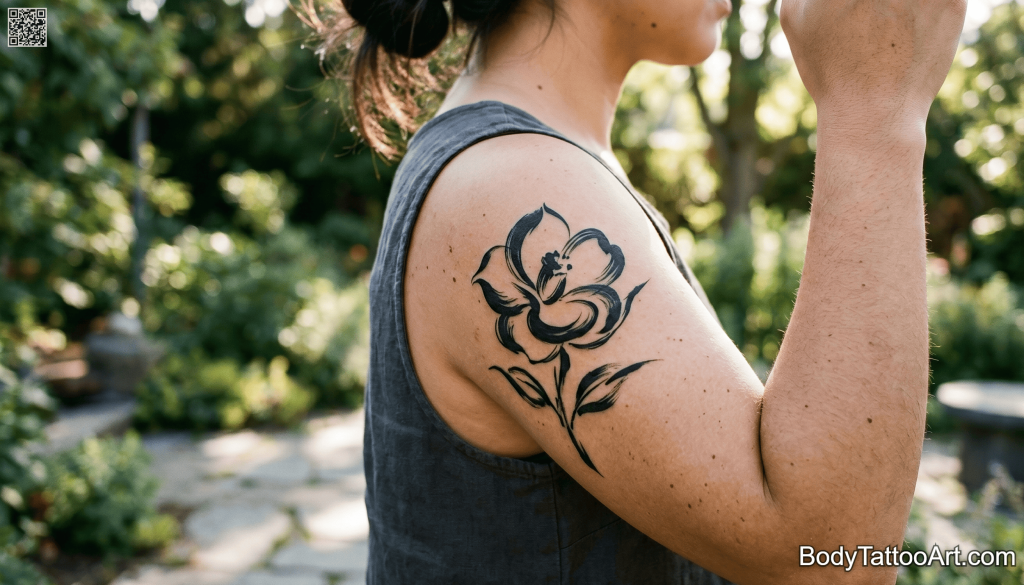
The petals are drawn with thick-to-thin brush strokes that taper dramatically from wide bases to fine pointed tips. The overall composition looks like calligraphy ink brush work — each stroke confident and singular, with no corrections.
Placement: Forearm / upper arm
Style: Brush stroke / sumi-e inspired Camellia Tattoos
Why it stands out: The gestural confidence of each stroke makes the design feel executed rather than drawn. It has the energy of East Asian ink painting translated directly onto skin.
Ideal for: People drawn to calligraphic aesthetics, those who appreciate ink painting traditions.
The entire flower is filled as a solid black silhouette — no internal petal detail, no shading, just the clean profile shape of a camellia bloom. The silhouette reads clearly because the outline is precise and the profile of the flower is distinct.
Placement: Ankle / behind ear / wrist
Style: Blackwork silhouette Camellia Tattoos
Why it stands out: Maximum simplicity, maximum impact. The design relies entirely on a clean outline and the instantly recognisable camellia profile.
Ideal for: Minimalists, people wanting small discrete blackwork, first-timers.

The camellia looks like a pencil sketch — loose, confident lines that don’t always meet, some petal shapes only partially drawn, and visible sketch marks around the composition as if the artist stopped mid-process. The deliberately unfinished quality is intentional.
Placement: Ribs / upper thigh
Style: Sketch style Camellia Tattoos
Why it stands out: The “unfinished” aesthetic creates a softness and spontaneity that polished tattoos can’t replicate. It looks personal and handmade rather than professional and technical.
Ideal for: People who love art journal or sketchbook aesthetics, those wanting a laid-back design.

Instead of gradient shading, the interior of each petal is filled with even, parallel horizontal lines spaced at consistent intervals. Closer to shadow zones, the lines appear slightly thicker; in highlight zones, they’re finer. The overall effect is graphic and mechanical.
Placement: Shin / outer calf
Style: Graphic linework Camellia Tattoos
Why it stands out: The graphic line fill technique makes the flower look like a technical illustration or print design. It’s structured and repeatable in a way that organic shading isn’t.
Ideal for: Graphic design lovers, people drawn to print-style aesthetics.

A camellia tattoo in just two colours — deep red ink for the petals and black for the linework and shading. No gradients, no additional colours. The red is saturated and flat within the petal shapes, and the black linework defines every edge.
Placement: Upper arm / calf
Style: Limited palette colour Camellia Tattoos
Why it stands out: The discipline of using only two colours forces graphic clarity. The saturated red against the black lines gives the design a bold, almost icon-like quality.
Ideal for: People who want colour without a complex palette, fans of traditional colour work.

A large blackwork camellia spans the entire shoulder cap — petals radiating outward toward the top of the arm, with thick black fills and deliberate white spacing between each petal. The scale makes it dramatic and structural.
Placement: Shoulder cap / top of arm
Style: Large-scale blackwork Camellia Tattoos
Why it stands out: At this size and placement, the camellia becomes architectural. The flower’s naturally circular structure maps perfectly onto the shoulder cap, fitting the anatomy rather than fighting it.
Ideal for: Blackwork collectors, people building sleeve work, those wanting bold statement pieces.

A camellia outline done in UV-reactive ink, which appears invisible in daylight and glows under blacklight. Only the outline is UV — the design is essentially hidden ink that reveals itself under the right conditions.
Placement: Inner wrist / collarbone
Style: UV / invisible ink Camellia Tattoos
Why it stands out: The concept of a tattoo that hides and reveals itself completely changes the relationship between the design and its wearer. The camellia is there — just not always visible.
Ideal for: People who want truly discreet ink, those drawn to unconventional tattoo experiences.

Camellia tattoos are one of those designs that keep surprising. They work in almost every tattoo style — from the most minimal fine line to the most dramatic blackwork — and the flower’s clean structure means it holds up well across sizes and placements.
What makes camellia tattoos genuinely interesting is how different the same subject can look depending on the technique, scale, and placement approach. A micro fine-line camellia on the wrist and an oversized blackwork camellia on the shoulder are technically the same flower but completely different tattoo experiences.
If there’s a version in this list that resonates, it’s worth saving the image prompt and taking it directly to a trusted tattoo artist. Every tattoo here can be adjusted — the size, the style, the placement — to fit individual anatomy and preference.
The camellia holds up. It always has.