Physical Address
304 North Cardinal St.
Dorchester Center, MA 02124
Physical Address
304 North Cardinal St.
Dorchester Center, MA 02124

There’s something about a bouquet that a single flower can’t quite do. It’s the layering, the mix of textures, the way stems cross and petals overlap — all of it together creates something that feels more alive than any one bloom on its own. That’s what makes flower bouquet tattoos so endlessly appealing.
Flower Bouquet tattoos have been a staple of the tattoo world for years, but the range of what’s possible within the concept is far wider than most people realise. A bouquet can be a tight, wrapped bundle with a ribbon at the base. It can be a loose, scattered arrangement that spills across the skin. It can be hyper-realistic and botanical or flat and graphic and completely abstract. The subject stays the same — a grouping of flowers — but the creative directions are nearly limitless.
Flower bouquet tattoos are designs featuring a collection of multiple flowers — usually three or more — arranged together into a single composition. Unlike scattered floral tattoos or single-stem designs, bouquet tattoos treat the group of flowers as one unified subject.
The bouquet format works across every tattoo style. In realism, it can look like a photograph of fresh-cut flowers. In traditional style, it becomes bold and graphic. In fine line, it turns delicate and almost fragile. The arrangement itself — how the flowers are grouped, what stems and leaves support them, whether they’re wrapped or loose — is where most of the compositional decisions happen.
Part of what makes Flower Bouquet tattoos particularly versatile is placement. A tall vertical bouquet works beautifully on the thigh, shin, or upper arm. A horizontal arrangement fits the ribcage or collarbone. A round, compact cluster sits perfectly on the shoulder or calf.
Bouquets have carried meaning across cultures for centuries. The practice of gifting flowers — each species chosen for its symbolic weight — goes back to ancient Greece, Rome, and Egypt, and reached its most elaborate form during the Victorian era with the language of flowers, known as floriography.
In tattoo form, a Flower Bouquet tattoos often represents a collection of things that matter: people, memories, relationships, or values. Because different flowers carry different meanings — roses for love, lilies for renewal, sunflowers for loyalty, lavender for devotion — a bouquet tattoo can be as personally coded as a coat of arms.
For a deeper read on the history and cultural significance of flowers as symbols, the Wikipedia entry on the language of flowers covers the subject thoroughly.
A simple hand-tied bouquet — roses, ranunculus, and eucalyptus stems — wrapped loosely in paper and bound with a thin ribbon. The paper is suggested by just a few angled lines at the base. Everything is rendered in fine line, with no shading or fills. The whole piece is clean and editorial.
Placement: Inner forearm / upper arm
Style: Fine line Flower Bouquet Tattoos
Why it stands out: The paper wrap grounds the composition and gives it a real-world context. It looks like someone set a fresh market bouquet down on the skin.
Ideal for: Minimalists, people who want something that feels personal and everyday, fine line tattoo lovers.

A tightly packed bouquet of peonies, dahlias, and large leaves rendered entirely in solid black ink. No grey, no colour — just flat black shapes and clean outlines. The flowers are identifiable by their silhouette and petal structure alone. The result is bold and graphic, almost like a linocut print.
Placement: Thigh / upper back
Style: Blackwork Flower Bouquet Tattoos
Why it stands out: Floral blackwork at this density creates a striking mass of ink that reads from a distance as pure shape and up close as detailed botanical form.
Ideal for: Bold tattoo collectors, people who love graphic design aesthetics, those building a high-contrast sleeve or body piece.

Soft watercolour washes in blush pink, pale yellow, and muted violet build up into a loose, impressionistic bouquet. There are no hard outlines — just colour bleeding into colour, with flowers suggested by shape and tonal contrast rather than linework. The edges dissolve into the skin.
Placement: Shoulder blade / ribcage
Style: Watercolour Flower Bouquet Tattoos
Why it stands out: The lack of outlines is technically demanding and visually striking. The whole piece looks painted directly onto the skin rather than tattooed.
Ideal for: People who love painterly, expressive art, colour tattoo enthusiasts, those wanting something soft and romantic in aesthetic.

A compact, round bouquet built entirely from dotwork stippling — no lines, only dots of varying density. The flowers take shape through gradients of dots: dense clusters at the centres, sparse stippling at the petal edges. The stems are single rows of dots. The overall effect is soft and textured, like a charcoal drawing.
Placement: Forearm / shin
Style: Dotwork Flower Bouquet Tattoos
Why it stands out: Building a recognisable bouquet using only dot placement — no outlines to define shapes — is a real technical achievement. The soft gradient quality is unlike any other rendering style.
Ideal for: Detail-obsessed tattoo fans, people drawn to meditative or labour-intensive art styles, dotwork collectors.
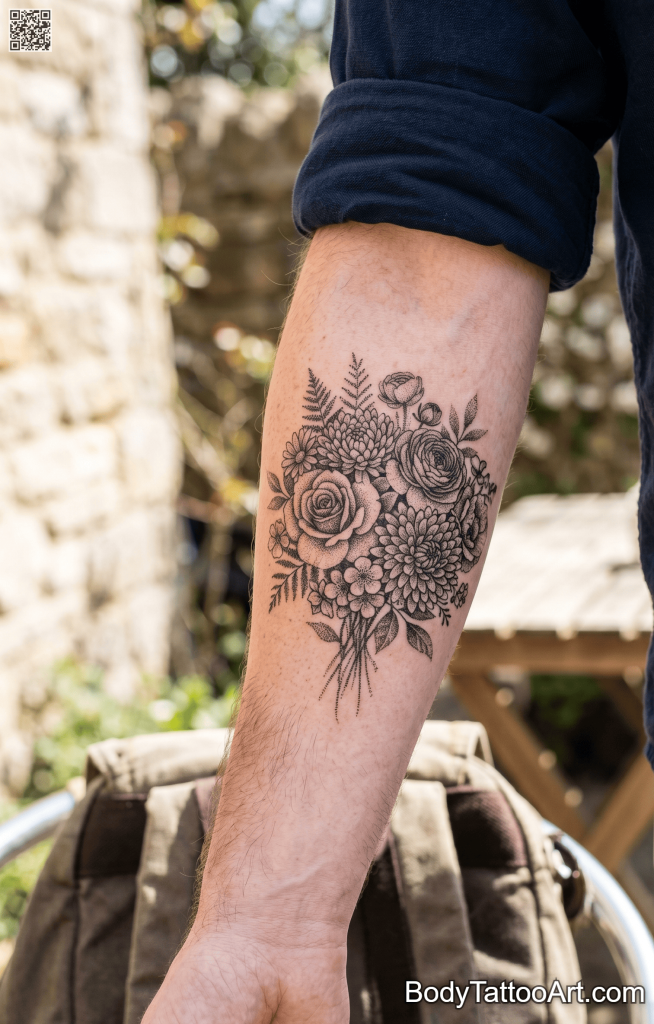
A bouquet of roses, tulips, and sprigs of baby’s breath arranged in the style of 18th-century botanical illustration — precise, measured, and slightly stiff in the best way. Thin, controlled linework defines every petal edge. Delicate cross-hatching creates shadow. The result looks like it was lifted from a rare plant encyclopedia.
Placement: Thigh / upper arm
Style: Illustrative / botanical realism Flower Bouquet Tattoos
Why it stands out: The vintage illustration aesthetic gives the bouquet a sense of history and craft that modern floral tattoos often skip. Every line has intention. Beautiful gardenia tattoo designs capture the intricate detail and elegance that many seek in body art. These tattoos often symbolize love and purity, making them a popular choice among floral enthusiasts. With their soft curves and delicate petals, gardenias create a stunning visual impact on the skin.
Ideal for: Book lovers, people with an interest in natural history, those who want something that feels cultured and considered.

For those who love the detailed botanical illustration look, the Hibiscus Tattoos Ideas explores similar styles across single-stem and scattered wildflower designs worth considering alongside bouquet compositions.
The bouquet is flipped — stems pointing upward, blooms facing down — as if it’s been hung to dry. Lavender, chamomile, and small dried roses hang in a loose bundle, tied at the top with twine. The flowers are rendered in fine line with subtle grey shading that gives them a dried, papery quality.
Placement: Inner bicep / sternum
Style: Fine line with grey wash Flower Bouquet Tattoos
Why it stands out: The upside-down orientation is immediately unusual and gives the composition a vertical structure that works especially well on the inner bicep. The dried-flower aesthetic adds a quiet, nostalgic quality.
Ideal for: People who appreciate unconventional compositions, those drawn to the aesthetic of dried botanicals, fine line tattoo lovers.

A classic American traditional bouquet: bold black outlines, flat colour fills in deep red, yellow, and forest green, and a thick ribbon tying the stems. The flowers are simplified and iconic — roses, a daisy, and a tulip. Nothing subtle, nothing minimal. Just clean, confident, traditional tattooing.
Placement: Calf / forearm
Style: American traditional Flower Bouquet Tattoos
Why it stands out: Traditional bouquet tattoos have a timeless quality that more fashionable styles don’t. The deliberate simplification of the flowers — reducing them to their most recognisable shapes — is a skill in itself.
Ideal for: Traditional tattoo collectors, people who value longevity and readability in their ink, those drawn to the roots of Western tattoo culture.

A tiny but precise bouquet of four flowers — a mini rose, a tulip, a small daisy, and a sprig of lavender — grouped tightly together on the inner wrist. The flowers are drawn at a scale where every line counts. Despite the small size, the distinct shape of each flower is fully legible.
Placement: Inner wrist
Style: Fine line micro Flower Bouquet Tattoos
Why it stands out: The challenge and appeal of micro tattoos is the discipline of working small. Four genuinely distinct flower types packed into a composition under 4 cm requires real precision.
Ideal for: People wanting a discreet personal piece, first-timers, those building a wrist or hand tattoo collection.

Three large peonies and trailing leaves, rendered in detailed grey wash realism. The petals have dozens of layers, shaded from near-white at the tips to deep grey at the base of each bloom. No colour, no black fills — just the full tonal range of grey ink working together to build volume and softness.
Placement: Thigh / upper back
Style: Grey wash realism Flower Bouquet Tattoos
Why it stands out: Peonies, with their layered petals, are one of the most rewarding subjects for grey wash because the shading has so much to work with. A well-executed grey wash peony bouquet is genuinely hard to pull off.
Ideal for: People who love large, detailed realism pieces, collectors working toward a sleeve, those who prefer monochrome over colour.
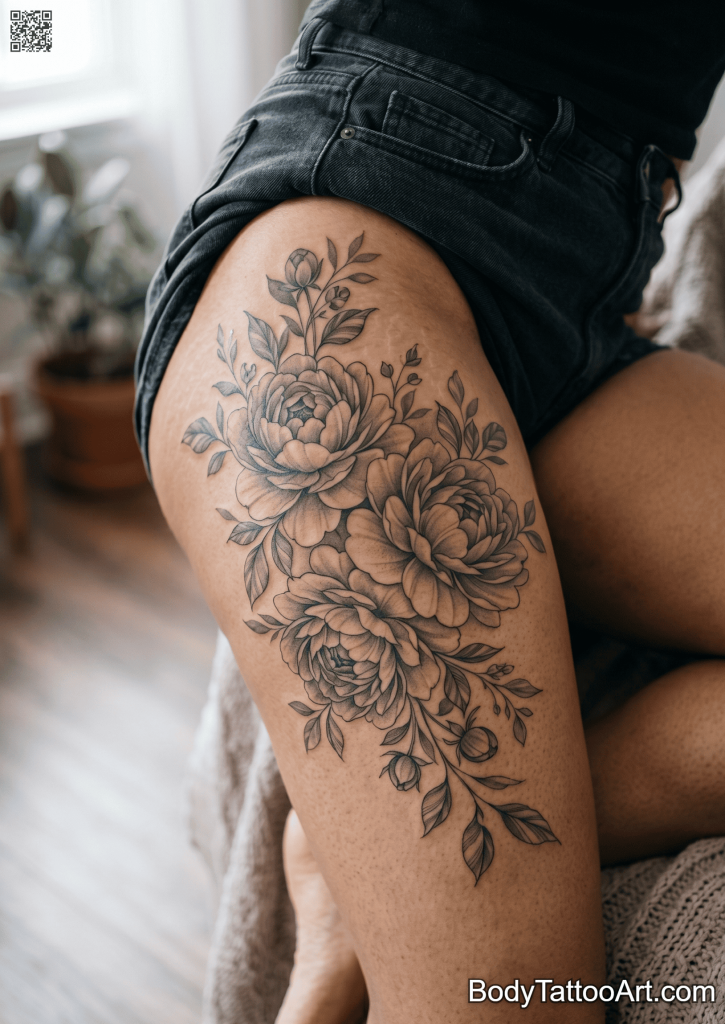
A tight bouquet of roses and lily stems sits inside the lower half of a diamond shape, with the top half open. Clean geometric lines form the frame while the flowers themselves are drawn in naturalistic fine line detail. The stems and lower leaves fill the geometric shape; the upper blooms break free above it.
Placement: Upper arm / calf
Style: Geometric fine line Flower Bouquet Tattoos
Why it stands out: The contrast between rigid geometric structure and organic floral shapes creates visual tension. The flowers escaping the top of the frame give the composition energy and movement.
Ideal for: Design-minded tattoo enthusiasts, people who like structure in their compositions, those balancing natural and architectural aesthetics.

A bouquet of chrysanthemums arranged in the style of Japanese traditional tattooing — strong outlines, bold tonal contrast, and a warm palette of gold, red, and black. The petals radiate outward with architectural precision. Leaves curve with deliberate grace. The whole composition has weight and formality.
Placement: Outer thigh / upper arm
Style: Japanese traditional (Irezumi-influenced) Flower Bouquet Tattoos
Why it stands out: Most bouquet tattoos lean Western in their aesthetic. Bringing chrysanthemum bouquets into a Japanese traditional style gives the subject a completely different cultural and visual register.
Ideal for: Japanese tattoo style enthusiasts, people wanting a large, bold colour piece, collectors building toward a Japanese-style sleeve.

A bouquet that looks like it was drawn in five minutes in a sketchbook — loose, gestural linework, slightly uneven petal shapes, a few stray marks from where the hand moved quickly. Roses, tulips, and a stem of eucalyptus, all tied at the base with a rough ribbon. It looks intentionally unfinished.
Placement: Inner bicep / outer calf
Style: Sketch / illustrative Flower Bouquet Tattoos
Why it stands out: The looseness is entirely intentional — and it takes real skill to sketch freely without losing legibility. This style has personality that controlled, precise tattoos often lack.
Ideal for: Illustrators, people who prefer handmade aesthetics over polished ones, those who want their tattoo to feel personal and alive.

The bouquet exists as bare skin inside a field of dense black ink. The silhouettes of flowers — roses, tulips, leaves — are carved out of a black background rather than drawn onto a light one. The stems and ribbon are bare skin lines running through the black fill.
Placement: Forearm / shin
Style: Negative space blackwork Flower Bouquet Tattoos
Why it stands out: Flipping the logic of how a tattoo works — using the skin as the drawing and the ink as the background — makes for an immediately striking and unusual composition.
Ideal for: Experimental tattoo collectors, people who’ve thought carefully about something original, those who want high visual impact.
For those drawn to high-contrast blackwork compositions, the snake with lotus tattoo blog explores similarly bold, graphic approaches to combining natural subjects with strong design structures.
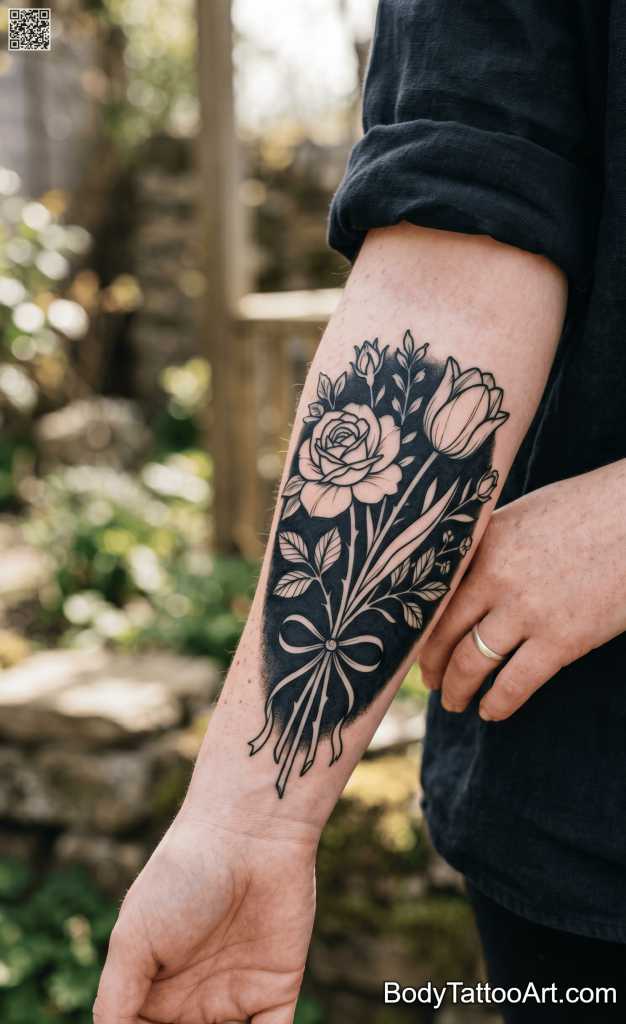
A soft, horizontal spread of small flowers — forget-me-nots, ranunculus, and tiny bell blooms — arranged loosely along one collarbone. The flowers are drawn in fine detail with very light grey shading. Some stems cross slightly. The composition follows the natural curve of the bone without feeling forced.
Placement: Collarbone
Style: Fine line botanical Flower Bouquet Tattoos
Why it stands out: The horizontal spread format mirrors the natural line of the body rather than working against it. The mix of small, varied flowers keeps it from looking like a single repeated motif.
Ideal for: People wanting a placement-conscious piece, those drawn to elegant, body-aware compositions, anyone considering a collarbone tattoo.

This is a bouquet in concept only — the flowers have been broken into abstract shapes. Petals become curved planes of flat black ink. Stems become angled lines. The overall composition is still readable as a grouped arrangement of flowers, but every element has been reduced to its most essential geometric form.
Placement: Upper arm / shoulder blade
Style: Abstract / contemporary blackwork Flower Bouquet Tattoos
Why it stands out: The discipline of simplifying a complex organic subject into purely abstract forms while keeping it recognisable is genuinely rare in tattoo design.
Ideal for: Design-focused tattoo collectors, people who appreciate conceptual art, anyone looking for something completely outside the mainstream.

A richly detailed, full-colour bouquet featuring garden roses in deep coral, blue irises, white anemones with black centres, and dark green foliage. The rendering is photorealistic — petals have translucency, leaves have visible veining, the whole composition is lit as if the bouquet is sitting in natural window light.
Placement: Thigh / full upper arm
Style: Photorealism, full colour Flower Bouquet Tattoos
Why it stands out: Full-colour realism at this level of detail is a serious commitment — both in chair time and in finding the right artist. But the result is a tattoo that genuinely looks like a photograph of real flowers.
Ideal for: Serious tattoo collectors, people who want the most technically impressive option, those drawn to colour realism.

A miniature five-flower bouquet — two rosebuds, two daisies, and one tiny leaf — sits on the side of the index finger. The design is stripped to its most essential lines. Everything is under 2 cm. It’s barely-there, but unmistakably a bouquet.
Placement: Side of finger
Style: Fine line micro Flower Bouquet Tattoos
Why it stands out: Finger tattoos demand ruthless simplification. Getting five distinct flowers to read clearly in under 2 cm of height is a technical challenge that makes this deceptively small piece genuinely impressive.
Ideal for: People who love barely-there tattoos, those building a ring or finger tattoo collection, minimalists who still want recognisable imagery.

A long vertical bouquet runs down the spine — starting with the largest blooms at the top (garden roses and magnolia) and tapering to single small flowers and bare stems near the lower back. The composition narrows as it descends, using the spine’s natural line as the design’s central axis.
Placement: Spine / back centerline
Style: Fine line botanical Flower Bouquet Tattoos
Why it stands out: Few designs use the spine as well as a tapering vertical bouquet. The way it naturally widens at the top and narrows at the base mirrors the shape of the torso itself.
Ideal for: People planning a back piece, those who want a long placement-conscious design, spine tattoo enthusiasts.

A bouquet of dried flowers — preserved roses, dried lavender, and seed pods — rendered in warm sepia-toned grey wash. The flowers look papery and faded, with a nostalgic quality. Petals are slightly curled, stems are slightly bent. The whole piece has the warmth of an old photograph.
Placement: Inner forearm / upper arm
Style: Grey wash / sepia tone Flower Bouquet Tattoos
Why it stands out: Most bouquet tattoos feature fresh flowers. The dried flower aesthetic is far less common, and the curled, faded quality of preserved blooms creates a distinctly different visual mood.
Ideal for: People drawn to vintage aesthetics, those who want something melancholic and beautiful, grey wash tattoo enthusiasts.

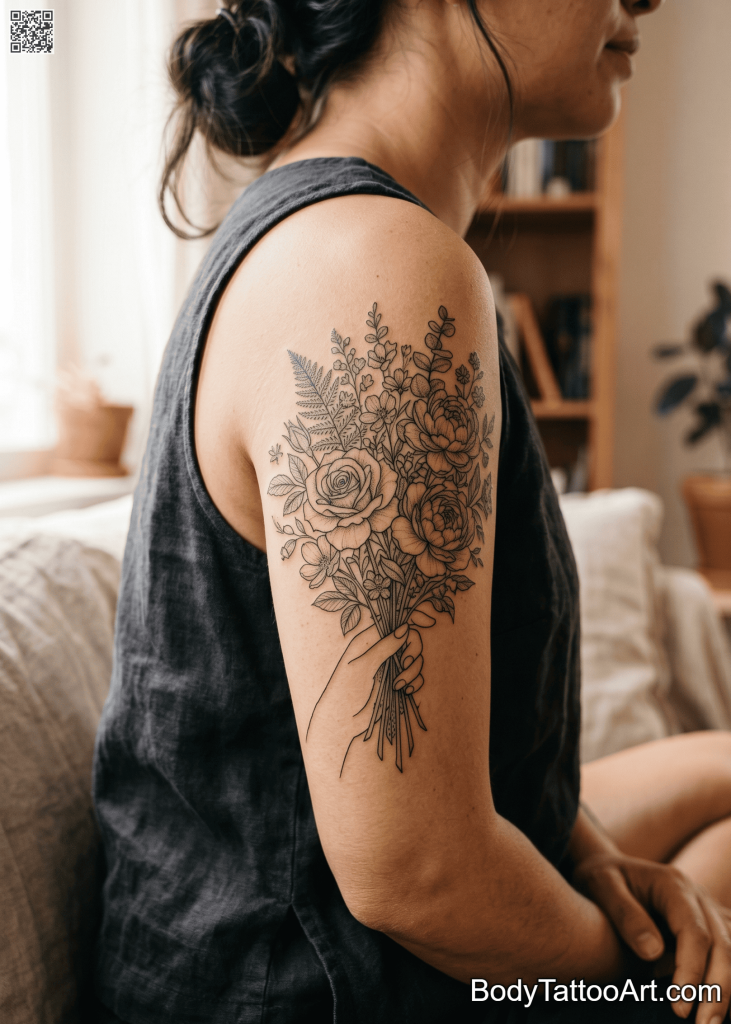
The composition shows a hand holding the bouquet from below — just the bottom portion of a fist, fingers wrapped around the stems, and the flowers rising above. The hand is rendered in basic outline only while the bouquet above it is the detailed focal point.
Placement: Upper arm / thigh
Style: Fine line illustrative Flower Bouquet Tattoos
Why it stands out: Adding a hand to the composition gives the tattoo a human context and a sense of scale. The contrast between the simplified hand and the detailed flowers directs attention exactly where it should go.
Ideal for: People who want something narrative and compositionally interesting, those who like their tattoos to tell a small story.
A bouquet in neo-traditional style — strong outlines but with lush, saturated colour blending. Deep burgundy roses, forest green leaves, and pale cream gardenias fill the composition. The shading is smooth and dimensional, pushing the palette toward jewel tones without going fully realistic.
Placement: Outer calf / upper sleeve
Style: Neo-traditional Flower Bouquet Tattoos
Why it stands out: Neo-traditional sits between traditional and realism in the best way — the bold structure of one with the dimensional colour of the other. Jewel-toned bouquets in this style have a richness that neither pure style achieves alone.
Ideal for: Colour tattoo lovers, collectors who want bold but not quite traditional, people building a sleeve with visual depth.

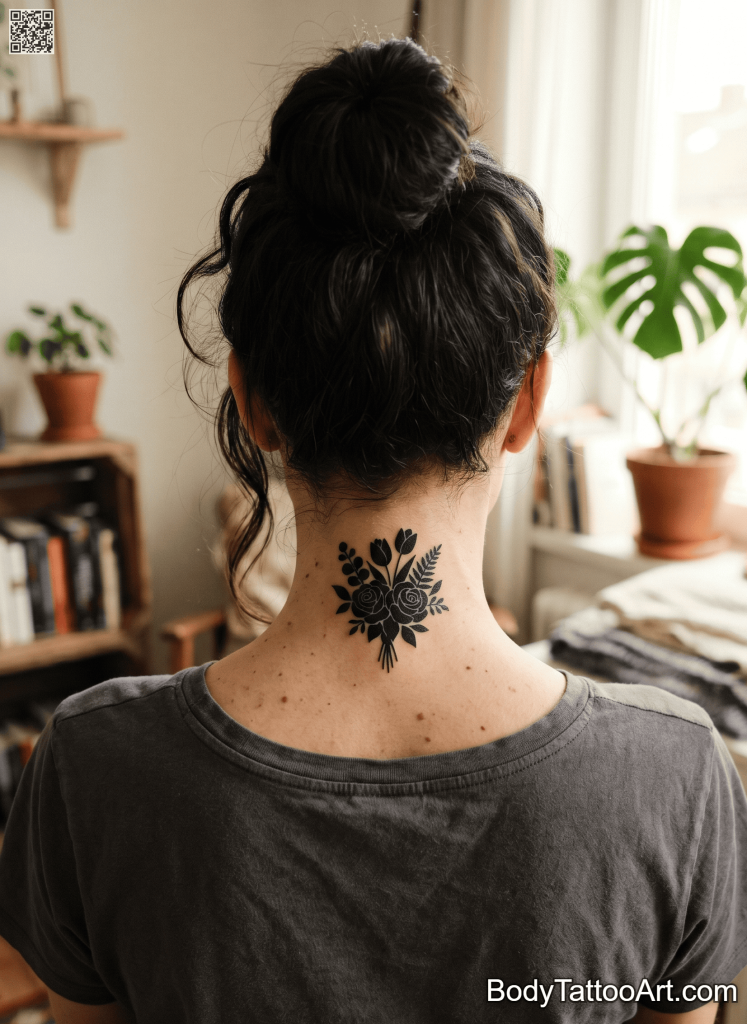
A compact, round bouquet reduced entirely to a single black silhouette. No interior details — just the outer shape of the flowers and leaves reading as one solid form. The silhouette is carefully chosen so the individual flower heads are identifiable by their outline alone.
Placement: Back of neck / inner ankle
Style: Blackwork silhouette Flower Bouquet Tattoos
Why it stands out: The design lives or dies entirely on the quality of its silhouette, which means every flower in the bouquet has to have a distinctive enough profile shape to read clearly. Done well, it has a graphic power that more detailed versions don’t.
Ideal for: Minimalists who want impact, people wanting a small but bold piece, those drawn to clean graphic shapes.
A small glass mason jar sits at the base of the design, holding a loose arrangement of wildflowers — daisies, poppies, cornflowers, and long grasses. The jar is drawn in fine line with light shading to suggest glass. The flowers spill casually over the rim. The whole thing has a domestic, still-life quality.
Placement: Inner arm / calf
Style: Fine line illustrative Flower Bouquet Tattoos
Why it stands out: The jar grounds the bouquet in a real-world context — it’s not floating or abstract. The suggestion of transparency in the glass drawing adds technical interest, and the casual overflow of the flowers keeps it from feeling stiff.
Ideal for: People drawn to still-life aesthetics, cottage-core and nature enthusiasts, those wanting something homey and personal.

A garland-style bouquet wraps around the upper arm like a band — flowers on one side, stems and trailing leaves completing the circle on the other. The flowers are clustered on the outer face of the arm, with the wrap visible all the way around. Rendered in fine line with minimal shading.
Placement: Upper arm wrap
Style: Fine line botanical Flower Bouquet Tattoos
Why it stands out: Wrap-around tattoos that use flowers as their subject need to balance the cluster and the negative space carefully. Putting the blooms at the front and letting stems trail around naturally is the smart compositional choice.
Ideal for: People planning a sleeve, those who want something visible from every angle, armband tattoo enthusiasts.

The entire bouquet — stems, petals, leaves, and a simple bow — is drawn as a single continuous line that never crosses itself and never lifts from the skin. The line varies slightly in weight through the petals but remains one unbroken stroke. The result is minimal and visually fascinating.
Placement: Wrist / ankle
Style: Monoline / single line Flower Bouquet Tattoos
Why it stands out: Single-line tattoos of complex subjects like bouquets are a niche art form within tattooing. The constraint — one unbroken line — forces creative problem-solving that produces genuinely unusual compositions.
Ideal for: Conceptual art lovers, people who want something conversation-starting and technically interesting, minimalists with an experimental streak.

A large, lush bouquet takes up most of the outer thigh — garden roses, peonies, dahlias, and trailing jasmine, all rendered in fine line realism with detailed grey wash shading. The composition is dense at the top and opens up at the bottom as stems and trailing vines extend downward toward the knee. It’s a serious piece that uses the thigh canvas to its full advantage.
Placement: Outer thigh
Style: Fine line realism with grey wash Flower Bouquet Tattoos
Why it stands out: The thigh is one of the best canvases for large botanical work because it has scale, natural curvature, and visibility. Using all of that space intentionally — densest at the hip, trailing toward the knee — makes this feel designed rather than placed.
Ideal for: Serious collectors ready to commit to a statement piece, people building a leg sleeve, those who want something genuinely impressive in scale and detail.

Flower bouquet tattoos offer more range than almost any other tattoo subject. From a three-centimetre wrist micro piece to a full thigh statement, from stark blackwork to full photorealism, the bouquet format adapts to nearly every style, scale, and placement without losing what makes it compelling.
Before booking, it’s worth collecting a handful of reference images and spending time with a trusted artist to talk through what will actually translate well at the chosen size and placement. The designs in this list are a starting point — the right one becomes real when it’s designed for the specific person wearing it.