Physical Address
304 North Cardinal St.
Dorchester Center, MA 02124
Physical Address
304 North Cardinal St.
Dorchester Center, MA 02124

Tulip tattoos have been quietly taking over tattoo studio walls and Pinterest boards, alongside Daisies and Wildflowers — and honestly, it makes complete sense. The tulip is one of those flowers that works in literally any style. Fine line, bold blackwork, abstract, geometric — it holds its shape and its drama no matter what. Unlike roses, which feel a little overused, tulip tattoos still feel fresh and personal.
Tulip tattoos are designs centered on the tulip flower — known for its smooth, cup-shaped petals and clean silhouette. Because of how structured the tulip naturally is, it translates beautifully into tattoo art. The flower’s simple shape gives artists room to experiment — with shading, with negative space, with linework — while still being instantly recognisable.
Tulip tattoos carry different meanings across cultures. In Persian and Ottoman art, tulips were symbols of paradise and divine love. In Dutch history, they represented prosperity and rarity. In tattoo culture today, people wear tulip tattoos for everything from honouring a loved one to simply loving the way the flower looks. Some choose tulip tattoos for their connection to spring and renewal. Others just think it’s a beautiful shape. Both reasons are completely valid.
What makes tulip tattoos especially interesting is that they don’t come with the same heavy symbolic baggage as, say, a skull or an anchor. They leave room for personal interpretation — which is part of why so many people are drawn to them.
Now, here are 24 tulip tattoo ideas worth bookmarking.
A lone tulip sits upright, rendered in clean fine-line ink with almost no fill — just the outline of the petals and a long, slightly curved stem with one small leaf. The emptiness inside the petals is part of the design. It feels airy and intentional, like a quick sketch that somehow looks deeply considered.
Placement: Inner wrist / side of finger
Style: Fine line minimalist Tulip Tattoos
Why it stands out: Most tulip tattoos try to fill every inch of space. This one doesn’t. The negative space inside the outline makes the whole thing feel lighter and more modern than most floral pieces.
Ideal for: First-timers, minimalist fans, people who want something small but not forgettable.

The tulip head hangs low on its stem — not broken, just heavy. The petals droop forward, and the grey wash shading gives the whole piece a soft, almost photographic quality. The darker shading pools at the base of the petals and fades lighter toward the tips, which makes the bloom look full and three-dimensional.
Placement: Forearm / back of the neck
Style: Grey-wash realism Tulip Tattoos
Why it stands out: The drooping angle is unusual — most flower tattoos face upward. This one leans forward like it’s nodding, which gives it a quiet kind of mood that a straight-stemmed tulip just doesn’t have.
Ideal for: People drawn to soft, emotional imagery; fans of realistic botanical illustration

This one doesn’t whisper — it announces itself. The tulip is drawn with bold, thick outlines and the petals are filled in completely with solid black ink. The contrast between the jet-black fill and bare skin is sharp and striking. No shading gradients, no grey midtones — just pure black shapes arranged into a flower.
Placement: Upper arm / calf
Style: Blackwork Tulip Tattoos
Why it stands out: The weight of the solid black fill turns a delicate flower into something that feels almost graphic, like a woodcut print. It’s confident in a way that lighter floral tattoos often aren’t.
Ideal for: Bold style lovers, people who lean toward graphic design aesthetics, those building a blackwork sleeve.

The tulip here is built entirely out of tiny dots. The densest clusters sit in the shadowed areas — under the petal curves and deep inside the bloom — and gradually thin out toward the highlights. From a distance it reads like a perfectly shaded drawing. Up close, it’s thousands of individual dots doing precise work.
Placement: Shoulder blade / sternum
Style: Blackwork dotwork Tulip Tattoos
Why it stands out: Dotwork shading has a texture that regular ink wash doesn’t. It gives this tulip tattoo a kind of handmade quality — it looks like it was drawn with a very fine-tipped pen rather than tattooed at all.
Ideal for: Detail-obsessed tattoo collectors, fans of geometric or stippled work, people who love to look closely at their tattoos.

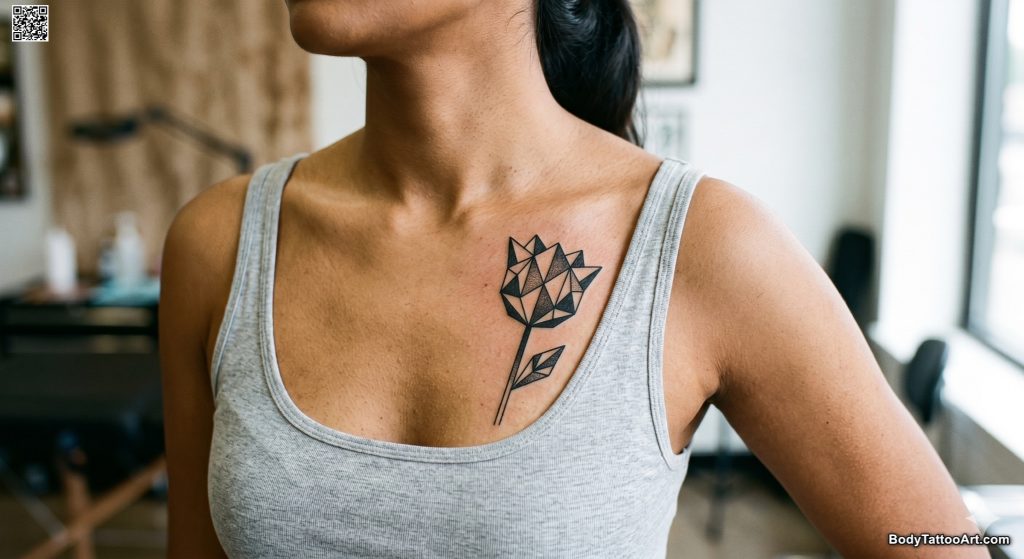
The petals of this tulip have been redrawn with angular edges and triangular sections, turning the soft flower into something almost architectural. Thin straight lines divide each petal into geometric facets, and some sections are shaded while others are left blank, creating a stained-glass kind of pattern across the bloom.
Placement: Upper chest / behind the ear
Style: Geometric blackwork Tulip Tattoos
Why it stands out: Most floral tattoos lean into softness and curves. This design deliberately breaks the flower’s natural shape into hard angles, which creates a fascinating tension between something organic and something structural.
Ideal for: Fans of sacred geometry tattoos, people who want florals with an edge, those who like designs that make you look twice.
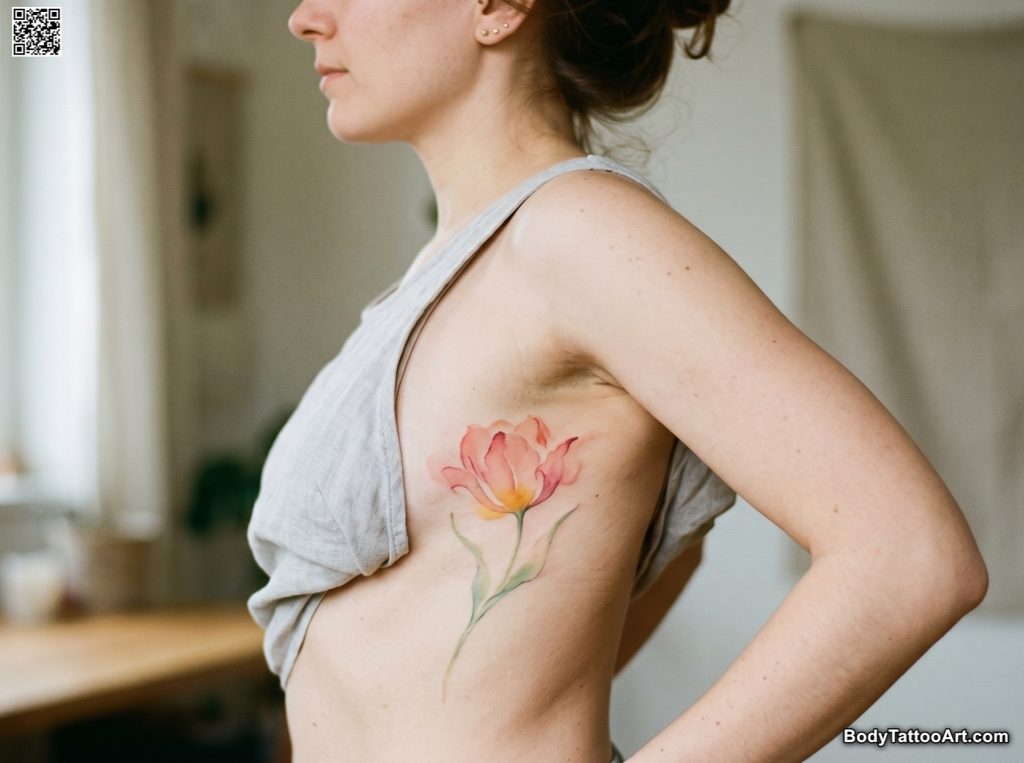
This tulip is surrounded by loose washes of colour that bleed beyond the petal edges — soft peach at the tips, a deeper rose pink toward the centre, and a small burst of yellow at the base. There are no strict outlines holding the colour in. Everything flows freely, giving the tattoo a painted, spontaneous look.
Placement: Rib cage / shoulder
Style: Watercolour Tulip Tattoos
Why it stands out: The colour washes outside the lines of the petals without becoming messy. It looks like someone painted it with actual watercolour paint, then decided the slight bleeding was perfect as is.
Ideal for: Colour tattoo enthusiasts, people who love fine art aesthetics, those wanting something that looks hand-painted.
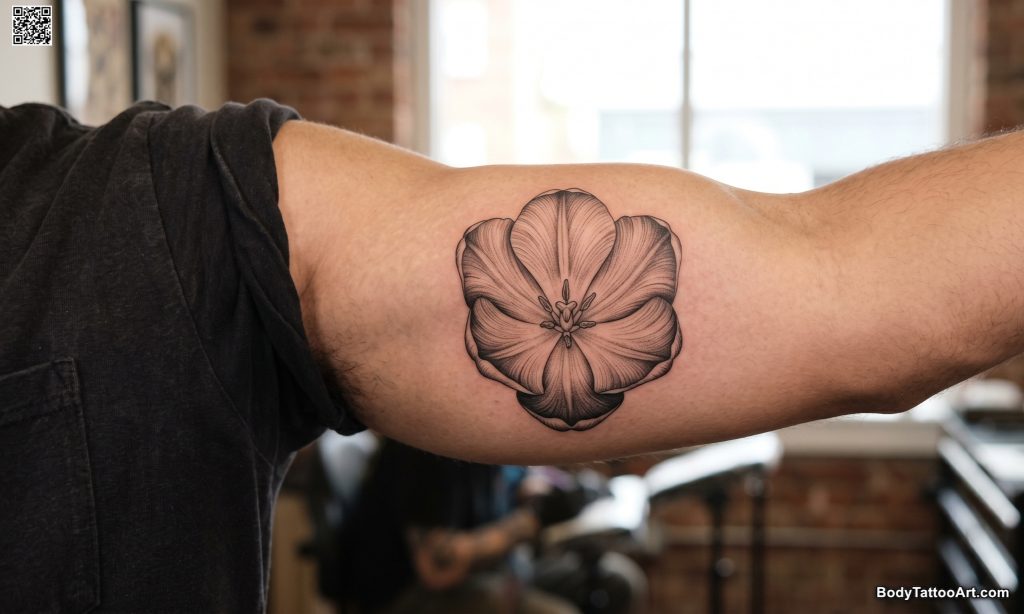
The perspective here is unusual — the tulip is drawn as if someone is looking up into it from directly below. The inside of the petals spread wide open above, with the stamens visible at the centre. The outer petal surface shades darker while the inner surface catches more light, creating a convincing sense of depth and angle.
Placement: Inner upper arm / back of the hand
Style: Fine line realism Tulip Tattoos
Why it stands out: Almost every flower tattoo shows the bloom from the front or side. This upward-looking angle is genuinely rare and creates an immersive, slightly theatrical quality that feels different from every other tulip tattoo in the room.
Ideal for: Collectors who love unusual perspectives, people looking for conversation-starting placements, fine line fans.
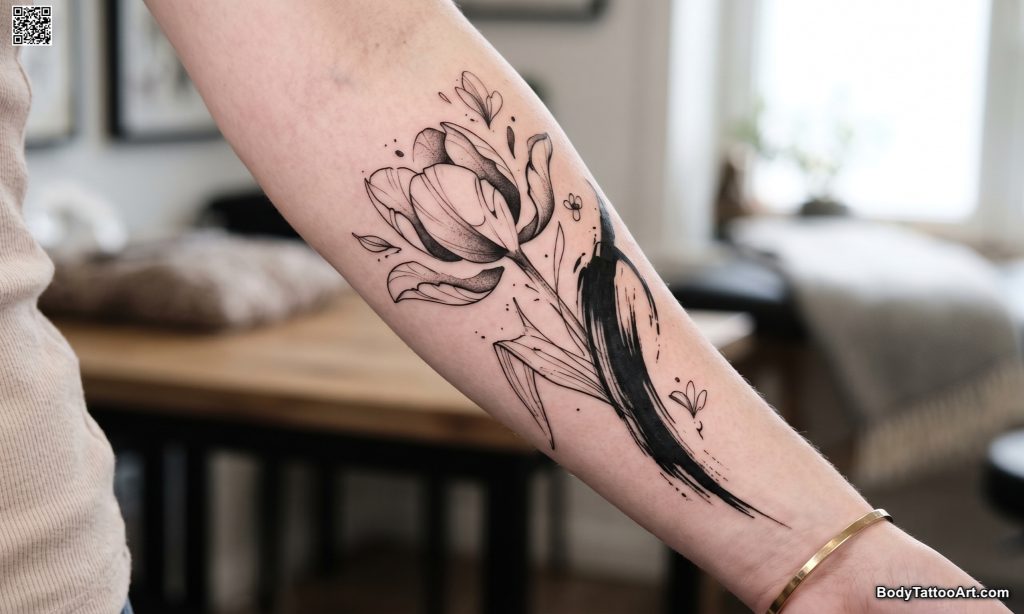
This tulip has been pulled apart and put back together differently. Some petals float slightly separated from the main bloom. Lines that should be continuous break off suddenly. Parts of the stem are missing, replaced by a single thick brushstroke. The result is a recognisable tulip — but fractured, like a reflection in moving water.
Placement: Thigh / forearm
Style: Abstract / contemporary Tulip Tattoos
Why it stands out: Deconstructed flower tattoos are tricky to get right — they can easily look unfinished. This one hits the balance perfectly. Every “broken” element feels deliberate, and the negative space between parts makes the composition feel spacious rather than incomplete.
Ideal for: Art school types, collectors who want designs that break conventions, people drawn to conceptual tattoo work.
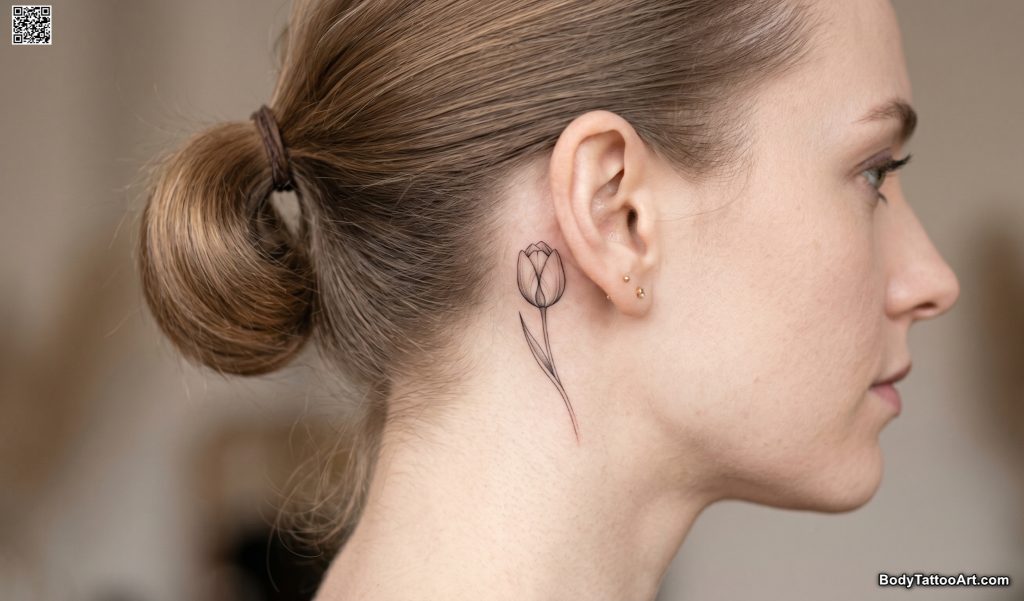
This tiny tulip bud hasn’t opened yet — the petals are still tightly wrapped around each other, forming a neat pointed oval shape. At this small scale, every line is incredibly precise. A tiny stem with one even tinier leaf extends below the bud, and the shading inside the petal folds is done with hairline strokes that are almost invisible until you’re right next to the skin.
Placement: Behind the ear / finger / ankle
Style: Micro fine line Tulip Tattoos
Why it stands out: Choosing a closed bud instead of a full bloom is a compositional decision that pays off at this small scale — there’s less detail to compress, which means the tiny shading that does exist reads beautifully. It looks delicate and deliberate.
Ideal for: People who love small tattoos, minimalists, those adding to a collection of tiny pieces.
This tulip looks like it was drawn with a real pencil — quick confident strokes, a few overlapping outlines, hatching used for shadow instead of smooth shading. The slightly rough quality of the lines is part of the appeal. It looks spontaneous, like something captured quickly in a sketchbook rather than planned on a grid.
Placement: Outer forearm / collarbone area
Style: Sketch / illustrative Tulip Tattoos
Why it stands out: The deliberate imperfection of sketch-style tattooing is harder to execute than it looks — keeping it loose without making it look sloppy is genuinely skilled work. The hatching on this one sits in exactly the right places to give the flower form without overworking it.
Ideal for: Illustration lovers, people who appreciate tattoos that look handmade, those who want something that looks like wearable art.

Just lines. The entire tulip is constructed from nothing but varying-weight outlines — slightly thicker where shadows would fall, thinner on the petal tips. There’s no shading, no fill, no colour. The elegance is entirely in how the lines curve and meet each other, and where they stop just before the eye expects them to.
Placement: Spine / side of the neck
Style: Pure linework Tulip Tattoos
Why it stands out: Removing all shading forces the linework to do everything on its own, which is a high-risk approach. When it works — and this one does — it looks quietly stunning. Every line feels considered because nothing is hidden behind fill or gradient.
Ideal for: Minimalists who appreciate restraint, people wanting clean and timeless designs, those with a preference for black-only tattoos.

The petals are outlined in thick bold lines and filled with deep, saturated ink — a rich burgundy-red that gradually shifts to a burnt orange near the petal tips. Thick black outlines define the edges and create strong separation between petal layers. A single large leaf sits at the base, filled with a deep forest green. The whole thing is bold, graphic, and instantly legible from across the room.
Placement: Bicep / outer thigh
Style: Neo-traditional Tulip Tattoos
Why it stands out: Neo-traditional florals often look cluttered, but this one is restrained — one bloom, one leaf, nothing competing for attention. The colour shift inside the petals adds the visual interest that makes it feel painterly rather than flat.
Ideal for: Fans of vintage tattoo aesthetics with a modern update, people who love colour but want structure, bold style collectors.

This design uses the tulip’s naturally vertical shape to create something that runs long and narrow along the spine. The stem is exaggerated in length, with the bloom sitting at the top and two long curved leaves branching outward at the midpoint. The linework is extremely fine and precise, with soft grey shading inside the petals.
Placement: Spine / sternum
Style: Fine line with soft shading
Why it stands out: The elongated format takes full advantage of the body’s natural line. Most floral tattoos work horizontally or at angles — this one commits entirely to vertical flow, making the placement itself part of the design.
Ideal for: People who love spine placement, those who want something elegant and body-conscious, collectors who think about how tattoos move with the body.

This one looks like it was lifted from a 17th-century botanical plate. The shading is done entirely through fine parallel hatching lines, just like old engraving prints. The direction of the lines follows the curves of the petals, reinforcing the flower’s shape. It’s detailed without being photorealistic — it looks printed rather than photographed.
Placement: Outer forearm / calf
Style: Engraving / etching
Why it stands out: Engraving-style tattoos are genuinely technically demanding — the hatching lines have to flow consistently in one direction and change angle as the surface curves. When it’s done well, it looks like the skin itself has been turned into old parchment.
Ideal for: History and art buffs, people drawn to antique aesthetics, collectors of unusual technical styles.

A single tulip bloom sits inside a perfect thin circle, stem cut off at the bottom of the frame. The circle isn’t decorative — it functions more like a window or a lens, containing just the top section of the flower. Inside the circle, the petals are shaded realistically. Outside the circle, there’s nothing.
Placement: Upper arm / back of the shoulder
Style: Fine line geometric framing
Why it stands out: Framing a flower inside a circle is an old device, but cutting the stem off inside the frame — showing just the bloom with no base — is a less obvious compositional choice. It makes the tulip feel like it’s being observed rather than displayed.
Ideal for: People who like clean, composed designs, those who appreciate geometric structure alongside organic imagery.

The bottom of the tulip stem ends not in soil or a clean cut but in a few slow ink drips, as if the flower itself is made of liquid. The drips are thick and rounded, each one a slightly different length. The rest of the design — the stem, leaves, and bloom — is clean and precise fine line work, which makes the drips at the bottom feel unexpected.
Placement: Upper arm / shin
Style: Illustrative / conceptual fine line
Why it stands out: The drip detail is an old trick in tattoo art, but adding it at the base of a botanical design reframes the whole piece. The tulip looks almost like it’s melting into the skin, which adds a surreal quality to what would otherwise be a straightforward floral.
Ideal for: Conceptual tattoo fans, people who like tattoos with a twist, those who want florals that don’t take themselves too seriously.

Three tulips grouped together, stems crossing loosely at the base, each bloom at a slightly different height. The tallest one in the centre faces forward, the one on the left turns slightly away, and the one on the right is still a bud. Fine line shading with light grey tones gives each bloom dimension without heaviness.
Placement: Hip / back of the shoulder
Style: Fine line botanical
Why it stands out: The variation in heights and the one-bud-one-open-bloom combination gives this cluster a sense of time — as if three tulips are in three different stages simultaneously. The crossing stems make the group feel like they grew together rather than being placed next to each other.
Ideal for: People who love botanical illustration aesthetics, those wanting slightly larger pieces with room to breathe, collectors who appreciate compositional thought.

The tulip exists where the ink isn’t. The background — a rough square of dark ink — is filled in around the tulip’s outline, leaving the flower’s shape as bare skin. The petals, stem, and one leaf are all untattooed skin surrounded by black. A few fine lines run across the negative space areas to suggest petal texture.
Placement: Upper arm / forearm
Style: Negative space blackwork
Why it stands out: Negative space designs require the artist to think about the design in reverse — to draw with absence rather than presence. This one is particularly effective because the thin lines across the negative-space petals keep the flower from looking flat or empty.
Ideal for: Conceptual tattoo lovers, blackwork collectors, people drawn to optical illusions or counterintuitive design approaches.

The petals here look like they were painted with a wide brush in a few bold strokes — each petal is one sweeping movement of ink, thick at the base and feathering out at the tip. The imperfection is the whole point: the slightly rough petal edges, the uneven ink density, the way the brush strokes don’t quite line up perfectly. It looks like calligraphy crossed with a flower.
Placement: Side of the forearm / collarbone
Style: Brush stroke / sumi-e inspired
Why it stands out: The brushstroke aesthetic applied to a tulip specifically works because the tulip’s petal shape — wide at the base, narrowing at the tip — mirrors the natural movement of a single brushstroke. The flower and the technique feel made for each other.
Ideal for: Fans of East Asian art and calligraphy aesthetics, people who love expressive mark-making, those who want florals that feel alive rather than static.

Thick bold outlines, flat colour fill, clear black shadows at the petal base — this is a traditional American tattoo through and through. The red is fully saturated, the green of the stem and leaves is solid, and the black outlines are confident and unwavering. Simple, direct, and timeless in that specific way that only traditional American tattooing manages.
Placement: Shoulder / calf
Style: Traditional American
Why it stands out: Tulips don’t appear in traditional American tattoo flash as often as roses or pansies, which makes this choice feel slightly unexpected within a very familiar style. The clean execution makes it look like it could have come off a mid-century flash sheet.
Ideal for: Traditional tattoo fans, those building a matching American traditional collection, people who appreciate tried-and-true aesthetics.

There are no outlines here — the tulip is built purely from tightly stippled dots that form the shape on their own. The heaviest dot density marks the outer edges of the petals, creating a soft implied boundary rather than a hard line. The interior of the bloom fades out gradually, giving the whole piece an almost blurred, glowing quality.
Placement: Shoulder blade / inner forearm
Style: Stippling / dotwork
Why it stands out: Eliminating the outline entirely in a stipple piece is bold because the shape has to hold itself together through dot density alone. The result is softer and more ethereal than any outlined version — it looks like the tulip is dissolving gently into the skin.
Ideal for: People who love texture-heavy work, dotwork collectors, those drawn to tattoos that look different depending on how close you stand.

The tulip is mid-disintegration — the main bloom is still largely intact but two or three petals have separated and are floating upward to the right, each one rotating slightly as it drifts. Fine linework with soft shading gives the remaining bloom and scattered petals real volume. The empty spaces where the petals broke away are part of the composition.
Placement: Upper back / upper arm
Style: Fine line illustrative
Why it stands out: Showing a flower in the act of coming apart — not wilted, not dead, just releasing — creates genuine visual movement. The floating petals draw the eye upward and outward, which makes the tattoo feel dynamic on the skin rather than static.
Ideal for: Dreamers, people who gravitate toward poetic or layered visuals, those who want florals that feel like they’re telling a story.

This design shows the tulip cut in half from top to bottom — a cross-section view revealing the interior structure. The stamens and pistil run down the centre, the inner surface of the petals lines the sides, and the cut stem shows its internal layers at the bottom. Fine linework with precise hatching renders every internal detail like a scientific illustration.
Placement: Forearm / shin
Style: Scientific illustration / fine line
Why it stands out: Almost no tulip tattoo shows the inside of the flower. This cross-section view turns a familiar subject into something suddenly unfamiliar — and the scientific illustration treatment makes it feel genuinely intellectual without being cold or sterile.
Ideal for: Botanists, scientists, people who love natural history aesthetics, those who want their tattoos to prompt questions rather than just compliments.

This tulip tattoo is designed to look like it’s been there for decades — deliberately faded, with slightly blurred edges and intentionally uneven ink density. The lines aren’t crisp; they have that soft, diffused edge that old tattoos get after years of sun and time. The muted grey-black tones add to the aged quality. It looks lived-in on purpose.
Placement: Outer forearm / upper arm
Style: Vintage / faded blackwork
Why it stands out: Getting a tattoo that intentionally looks old is a counterintuitive but increasingly requested approach. The skill here is in knowing exactly how much blur to add and where — too much and it looks like a mistake, too little and the effect doesn’t land. This one gets the calibration right.
Ideal for: Old soul types, people who love vintage aesthetics, collectors who want something that feels like it has history even on day one.

Tulip tattoos are genuinely one of the most versatile floral tattoos someone can choose. The flower’s structure works equally well in tiny micro-scale pieces and large bold blackwork placements. It holds its identity across styles — realistic, abstract, traditional, sketch — without ever disappearing into generic flower territory.
Whether going for something quietly minimal or boldly graphic, tulip tattoos offer more creative range than most people expect when they first consider them. The 24 designs above are proof that staying within a single subject — one flower — doesn’t have to mean repeating yourself. Every one of these tulip tattoos is doing something different with the same raw material.
One flower looks amazing for sure, but have you ever considered a flower bouquet? Here’s a thought for something varied and unique!