Physical Address
304 North Cardinal St.
Dorchester Center, MA 02124
Physical Address
304 North Cardinal St.
Dorchester Center, MA 02124

Dragons have never gone out of style. Whether someone wants something bold and brutal or quiet and elegant, dragon tattoos deliver every single time. The sheer range of what a dragon tattoo can look like is what keeps people coming back to the design — a coiled serpent wrapped around a forearm reads completely differently from a geometric dragon carved in dotwork on a chest. Each one is its own world.
Dragon tattoos show up across cultures and centuries — in East Asian art, Norse mythology, Celtic manuscripts, and modern fantasy. That kind of cultural depth gives the design serious staying power. It’s not a trend. It’s a tradition that keeps evolving.
This list covers 27 dragon tattoo ideas — each one built around a different visual concept, style, and placement. No two are alike. Whether someone’s getting their first tattoo or adding to a sleeve, there’s a design here worth looking at twice.
Dragon tattoos carry layered meaning depending on the culture and the design. In East Asian traditions, dragons represent wisdom, protection, and cosmic power — they’re guardians, not monsters. In Western mythology, dragons are creatures of raw strength and danger. In Norse and Celtic traditions, they appear as world-defining beings like Jörmungandr.
Across the board, dragon tattoos tend to represent transformation, protection, power, and primal energy. They’re often chosen during turning points — after overcoming something hard, or to mark the start of something new.
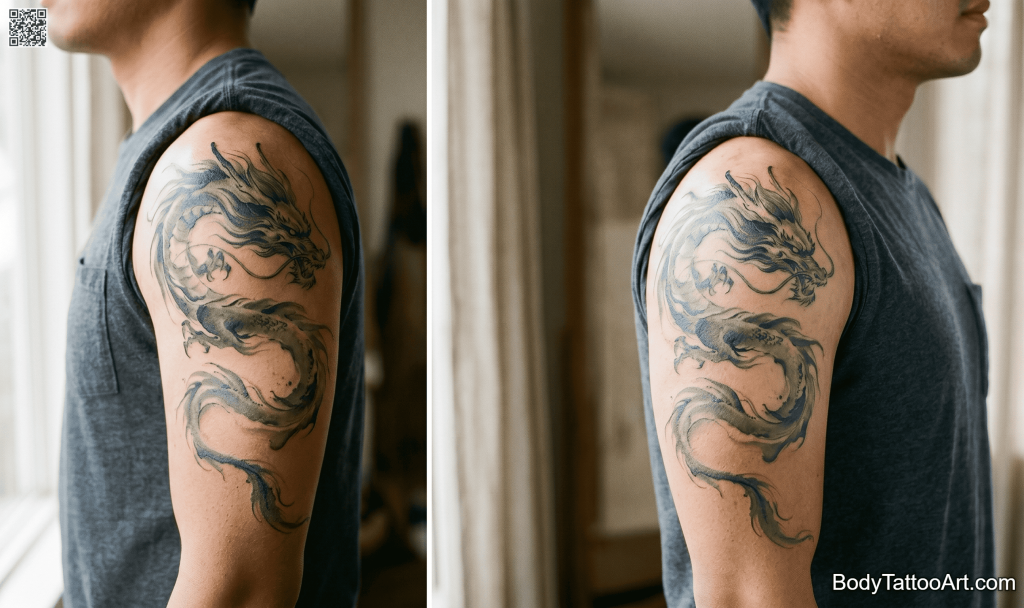
A dragon rendered entirely in ink wash style — dark, fluid brushstrokes that bleed into lighter washes of grey. The body twists loosely across the skin, disappearing and reappearing like it’s moving through clouds. The edges are intentionally soft. No hard outlines. Just movement.
Placement: Shoulder to upper arm
Style: Ink wash / Sumi-e inspired Dragon Tattoos
Why it stands out: The design mimics traditional East Asian brush painting, which is rare in tattoo form. The lack of clean outlines makes it feel alive and fluid instead of rigid.
Ideal for: Art lovers, people drawn to Japanese or Chinese aesthetics, collectors who want something that looks painted.
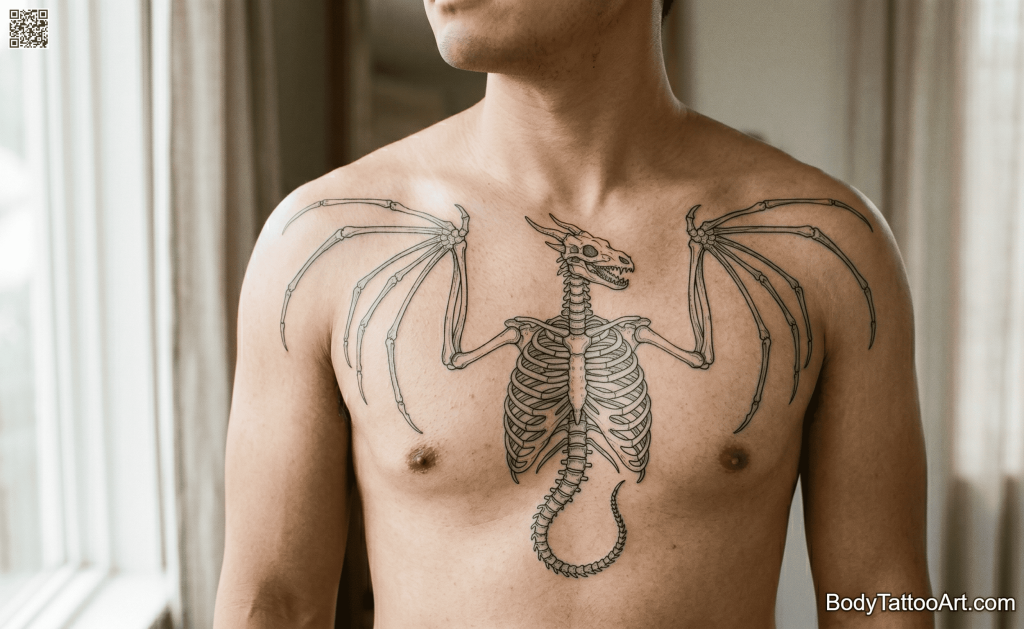
A dragon stripped down to its skeleton — ribcage, spine, wing bones, and skull all rendered in clean black linework. The design is anatomically considered, like something from a natural history illustration. Every bone is drawn with precision.
Placement: Sternum and upper chest
Style: Blackwork linework Dragon Tattoos
Why it stands out: Skeletal dragon tattoos are rare. Most go for the full creature. This one leans into the structure beneath — creating something that feels both scientific and eerie.
Ideal for: People who love anatomy art, dark minimalists, anyone who wants something unusual.
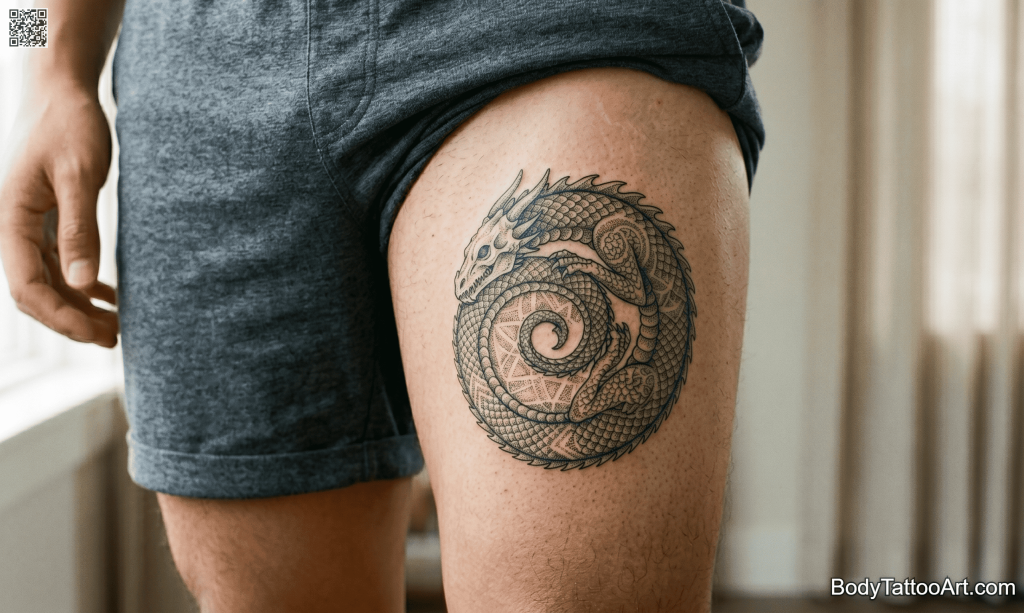
A tightly coiled dragon curled into itself, head resting near its own tail. The entire body is filled with fine dotwork — thousands of tiny dots building up shadow and depth without a single brushstroke. The pattern inside the scales is geometric.
Placement: Upper thigh
Style: Dotwork / geometric Dragon Tattoos
Why it stands out: The sheer patience visible in dotwork shading gives this kind of tattoo an almost meditative quality. Up close, it’s dots. From a distance, it reads as a fully shaded creature.
Ideal for: Dotwork fans, people who appreciate fine detail, those wanting a large thigh piece.
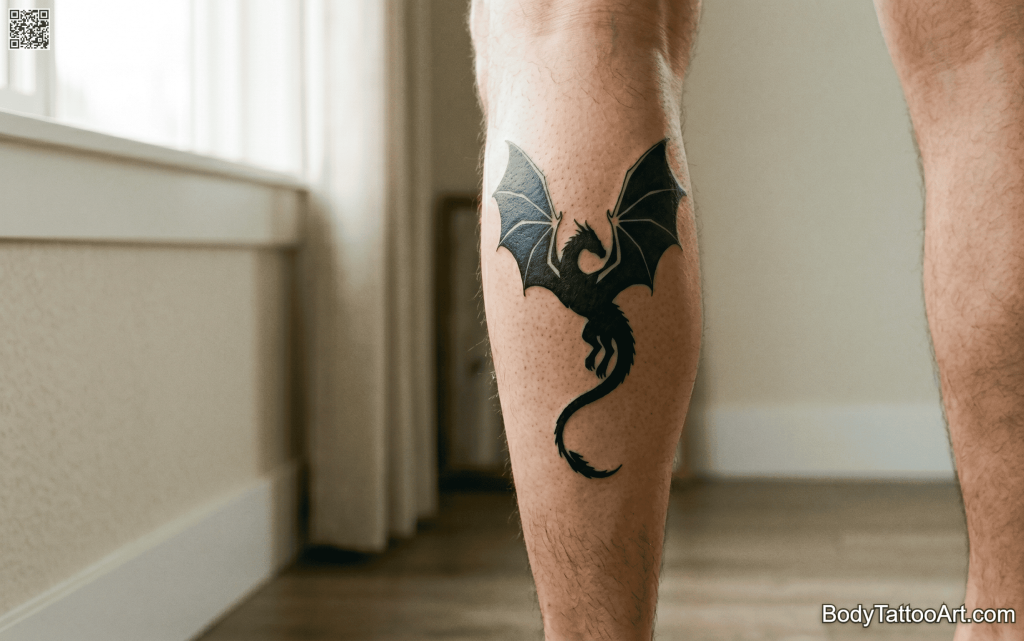
Just the outline. A solid black silhouette of a dragon mid-flight — wings spread, neck arched, tail trailing. No interior detail at all. Pure shape against skin.
Placement: Calf
Style: Solid blackwork / silhouette Dragon Tattoos
Why it stands out: This design trusts the shape entirely. The dragon’s form has to be strong enough to carry the whole tattoo, and a well-drawn silhouette does exactly that — clean, bold, unforgettable.
Ideal for: Minimalists who still want impact, people who like bold graphic tattoos, first-timers.
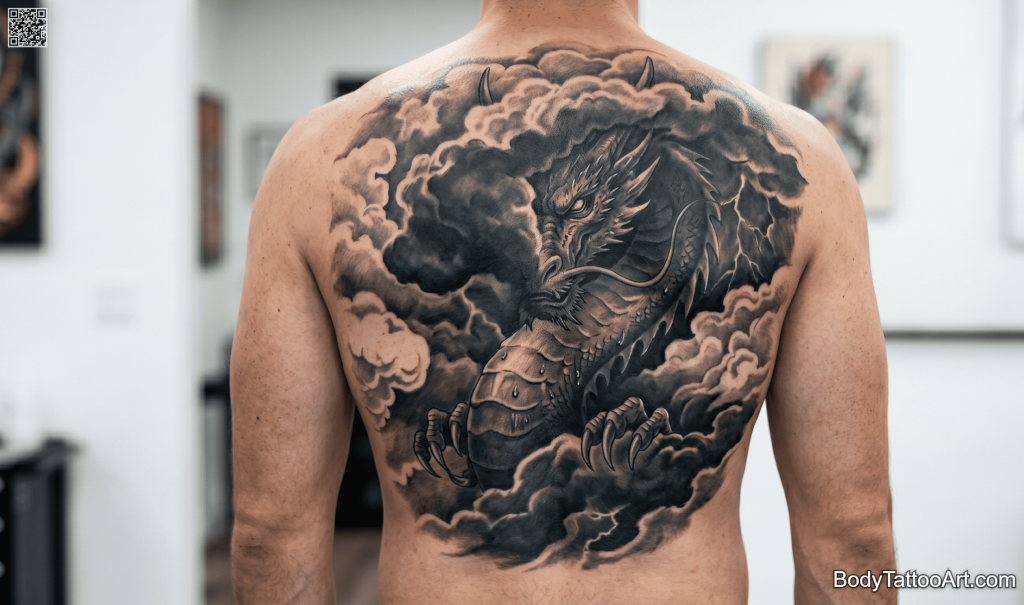
A dragon partially visible through a swirling field of storm clouds — its claws extended downward, face half-covered, body disappearing into dark cumulus forms. The clouds are the scene. The dragon is the secret inside it.
Placement: Full back
Style: Grey-wash realism Dragon Tattoos
Why it stands out: Most dragon back tattoos show the full creature. This one makes the dragon feel like something you’re discovering — partially hidden, partially revealed. The tension between seen and unseen is the whole design.
Ideal for: People who want large-scale storytelling tattoos, realism collectors, those planning a full back piece.
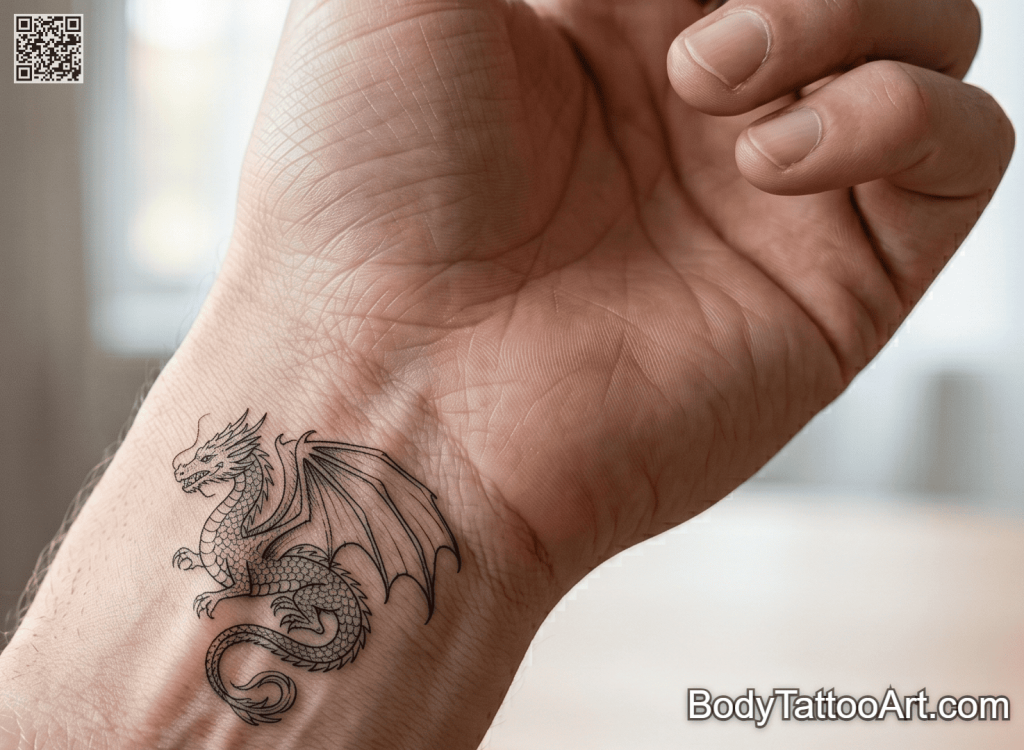
A tiny dragon, no longer than a few centimeters, drawn with hair-thin lines. Every scale is present. Wings folded. Tail curled. An entire creature in miniature form.
Placement: Inner wrist
Style: Fine line micro realism Dragon Tattoos
Why it stands out: The challenge of fitting this much detail into such a small space is enormous. When it’s done right, a micro dragon has the same presence as a much larger tattoo — just condensed.
Ideal for: Fine line lovers, people who prefer subtle tattoos, those wanting something discreet.
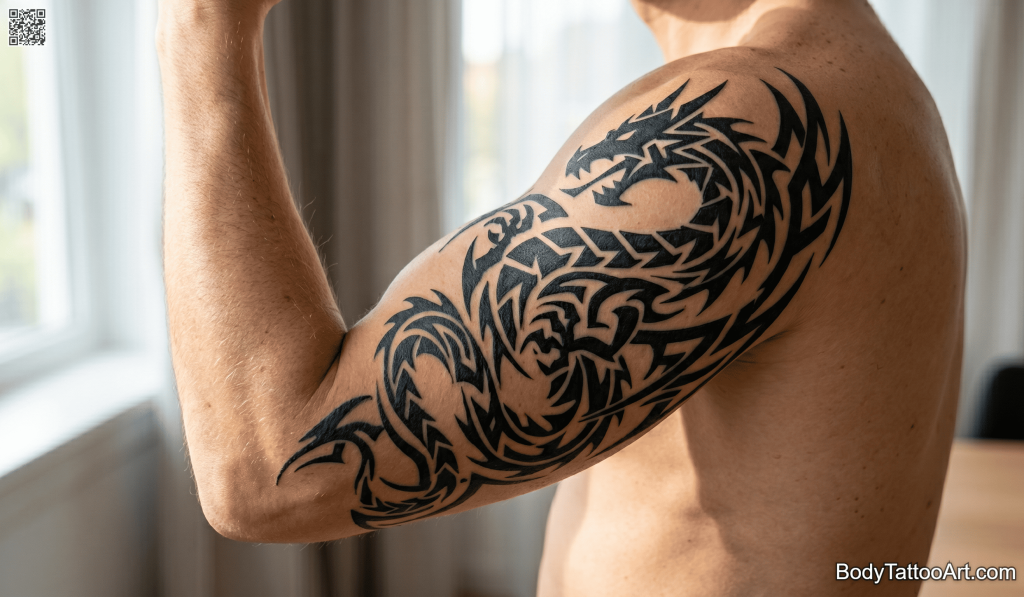
Sharp angular forms, thick black lines, interlocking shapes that build the dragon’s body out of purely tribal geometry. No realism, no softness — just pattern and power.
Placement: Upper arm / bicep wrap
Style: Tribal blackwork Dragon Tattoos
Why it stands out: Tribal dragon tattoos fell out of fashion and are now circling back — but the modern versions are far more considered. When the geometry is tight and the proportions are right, this style hits harder than almost anything.
Ideal for: Bold tattoo fans, those with Polynesian or Māori aesthetic influences, people building a full sleeve.
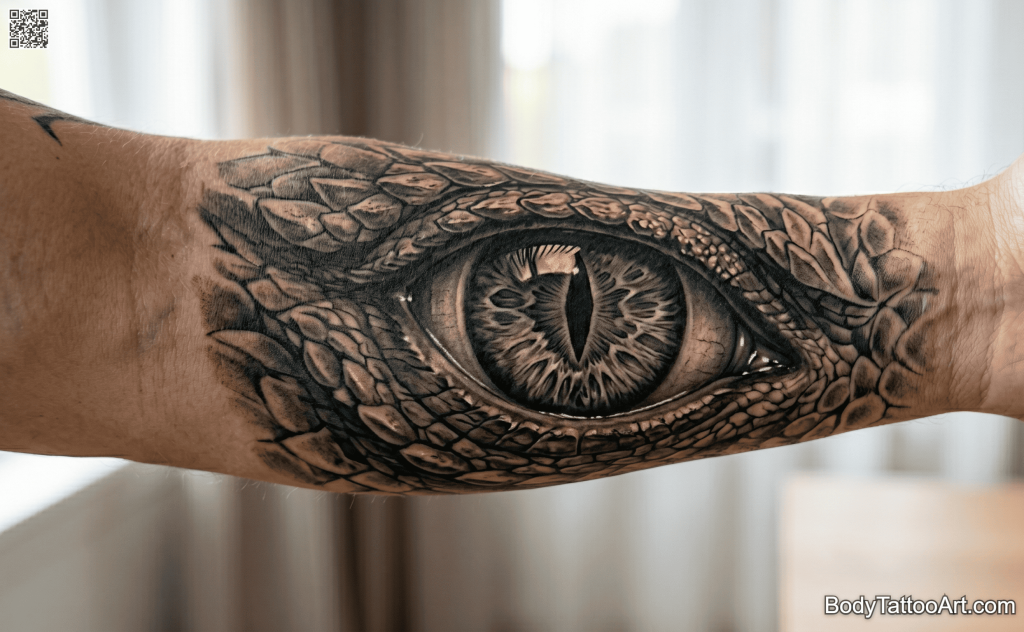
Not the whole dragon — just the eye. A single enormous dragon eye covering the entire forearm. The iris is slit and reptilian. Scales radiate outward from the eye socket. The pupil is deep black with detailed highlights.
Placement: Forearm (full coverage)
Style: Realism / blackwork Dragon Tattoos
Why it stands out: Pulling one element from the creature and blowing it up creates a completely different kind of dragon tattoo. The eye holds as much power as the whole body — maybe more.
Ideal for: People who’ve already done animal or creature tattoos and want something conceptually different, realism fans.
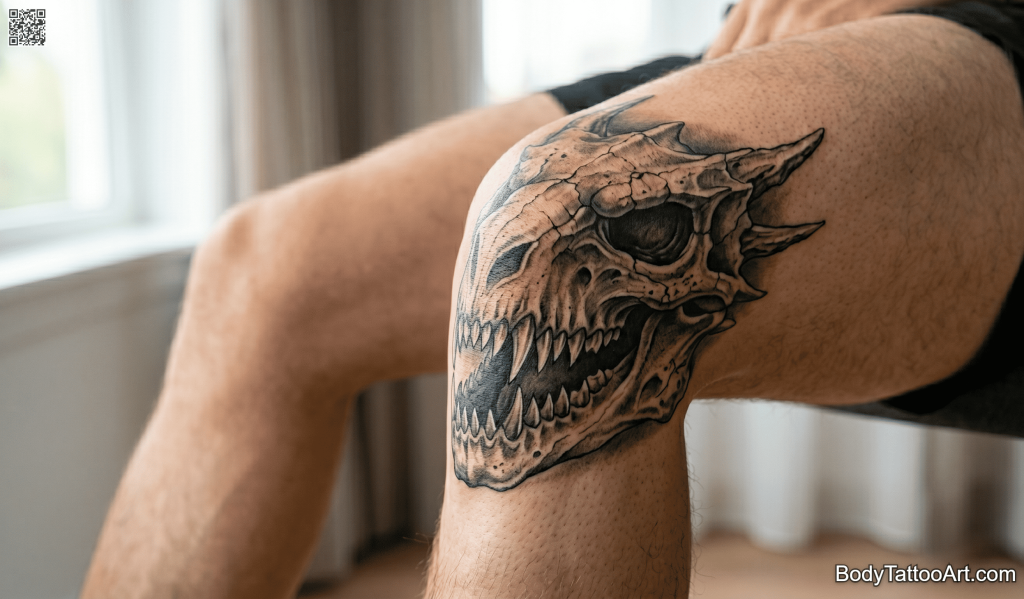
A dragon skull — no body, no wings — drawn in detailed black and grey. The bone structure is wide, the teeth are long, and the eye sockets are hollow and shadowed. Cracks run through the skull.
Placement: Knee cap and lower thigh
Style: Black and grey realism Dragon Tattoos
Why it stands out: The kneecap is one of the more daring placements — painful and very visible. A dragon skull there reads like armor. The cracked bone detail adds age and narrative to the design.
Ideal for: Collectors who take their placement seriously, fans of dark or gothic aesthetics.
A dragon mapped out like a star constellation — small dots connected by fine single lines, forming the shape of a dragon across the skin. It’s sparse. More space than design. The dots vary slightly in size.
Placement: Ribcage
Style: Fine line / constellation Dragon Tattoos
Why it stands out: The emptiness is the point. The design trusts the viewer to fill in the gaps. It feels more like a map than a tattoo, and that restraint is rare.
Ideal for: Minimalists, astronomy or mythology lovers, those who want something that looks almost accidental.
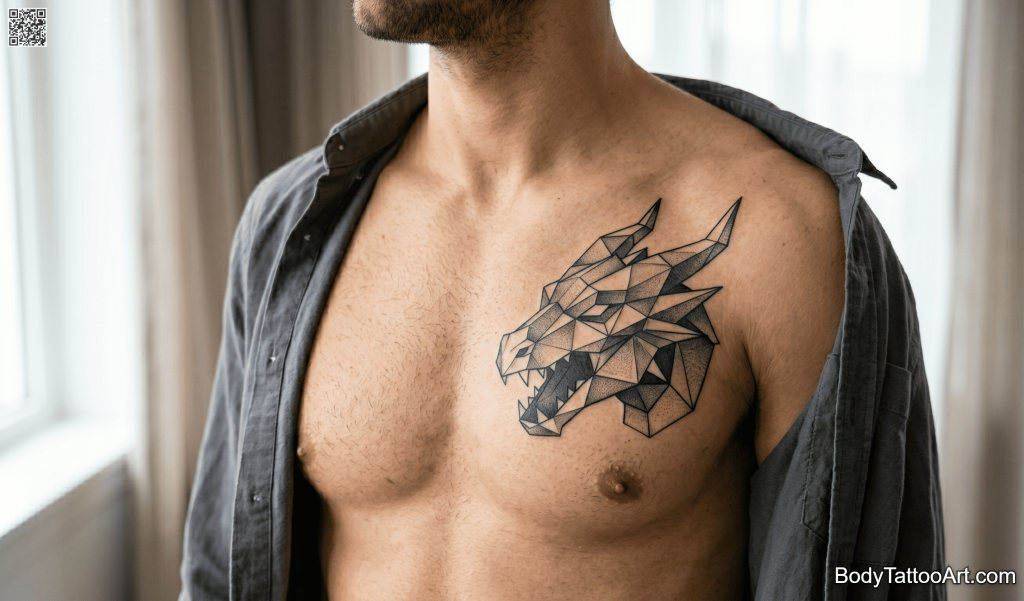
A dragon’s head broken into geometric planes — like a low-polygon 3D model rendered in clean linework. Each facet of the face is defined by sharp angles. The shading inside each plane shifts from dark to light.
Placement: Chest (off-center, one side)
Style: Geometric blackwork Dragon Tattoos
Why it stands out: The low-poly approach makes a mythical creature feel modern and architectural. It’s still clearly a dragon but reimagined as something more structural.
Ideal for: Design-minded people, fans of geometric tattoos wanting to branch into creature subjects.
A long, sinuous Eastern dragon running the full length of the spine — head at the base of the neck, body following the vertebrae down to the tailbone. No legs depicted. Just the serpentine body, mane, and horns.
Placement: Full spine
Style: Fine line black Dragon Tattoos
Why it stands out: The placement is everything here. The dragon literally follows the spine’s anatomy. The alignment between subject and body part makes the tattoo feel intentional in a way that’s hard to fake.
Ideal for: People who want a single cohesive spine piece, minimalists who still want drama.
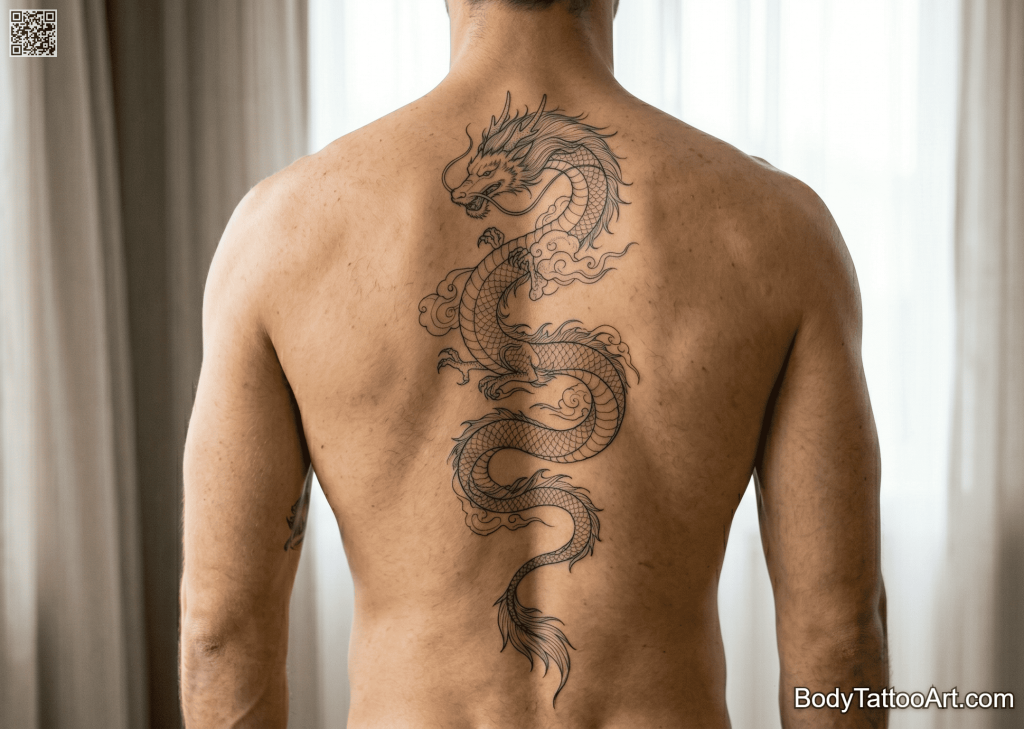
A dragon designed to look exactly like a Japanese woodblock print — flat color fields, bold outlines, visible “grain” texture in the background, and a traditional compositional style.
Placement: Upper arm
Style: Japanese / neo-traditional Dragon Tattoos
Why it stands out: The woodblock aesthetic is instantly recognizable but rarely applied this faithfully in tattoo form. It feels more like wearable art history than a standard neo-Japanese tattoo.
Ideal for: Japanese art fans, collectors who appreciate historical aesthetic references.
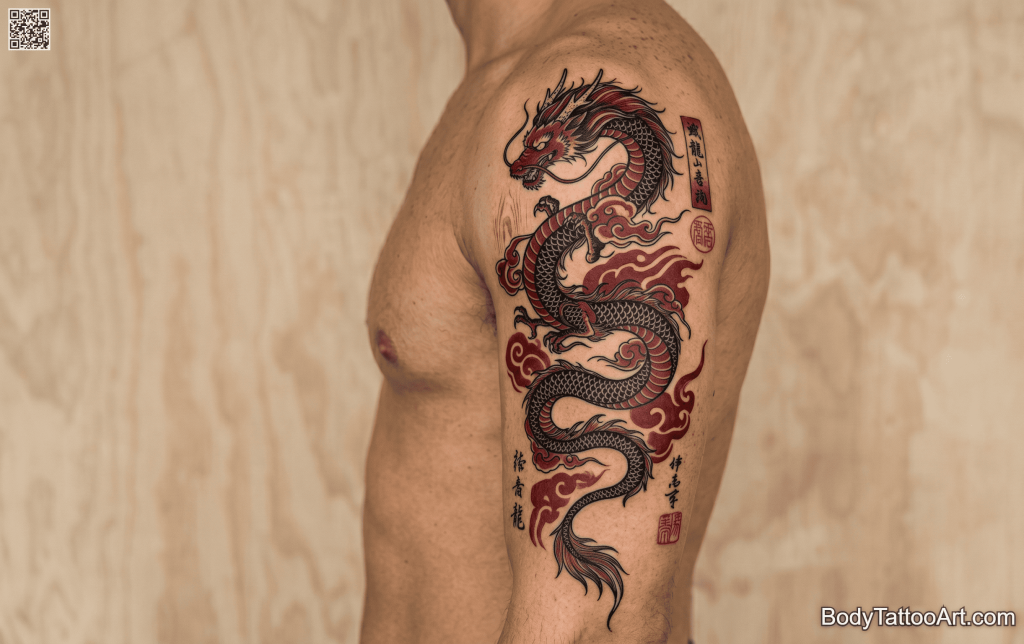
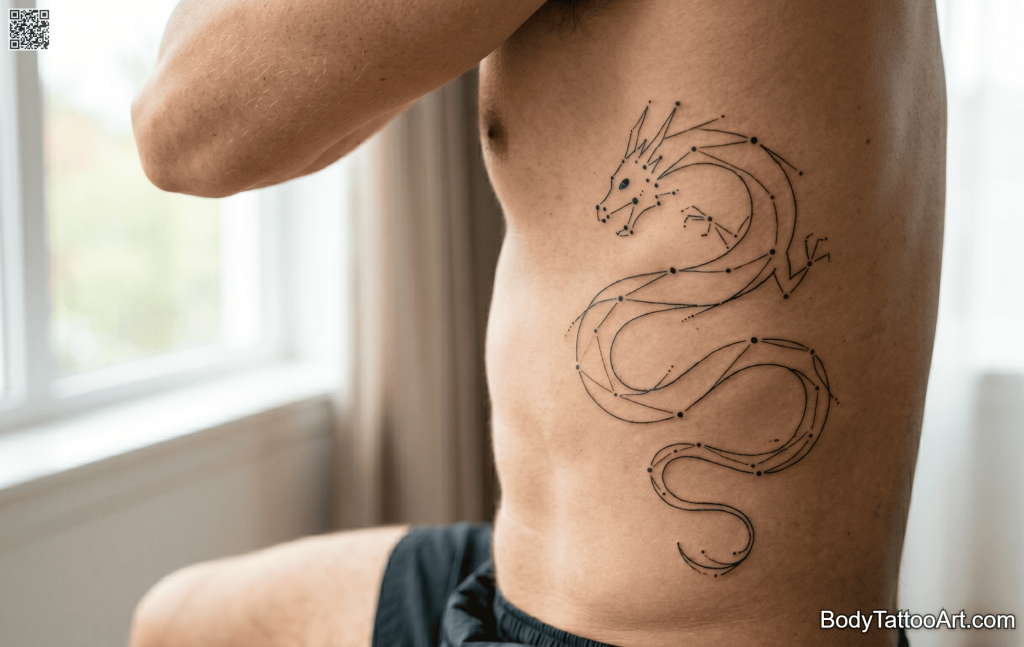
A full dragon — body, wings, claws, face — drawn only in clean single-line outlines. Not a single area filled. The lines vary in weight to suggest form and volume.
Placement: Side ribcage
Style: Fine line outline only Dragon Tattoos
Why it stands out: Refusing to fill a dragon tattoo is a bold artistic choice. The varied line weight does all the work of suggesting depth without a drop of shading. It’s technically demanding to pull off well.
Ideal for: Fine line purists, people who want something light and airy rather than bold and heavy.
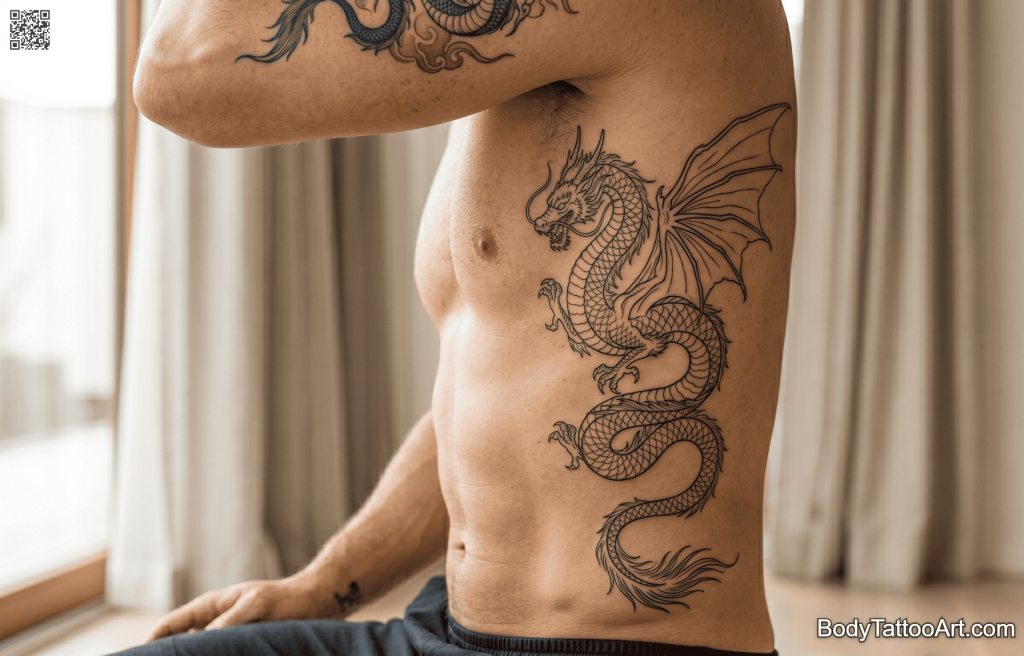
A dragon interpreted through Cubist principles — the body is visible from multiple angles simultaneously, overlapping planes and fragmented forms. Inspired by Picasso-era deconstruction.
Placement: Forearm
Style: Abstract / neo-expressionist Dragon Tattoos
Why it stands out: A Cubist approach to a dragon is genuinely rare. The creature’s form is broken, reassembled, and viewed from six angles at once. It’s challenging to read and impossible to ignore.
Ideal for: Art history lovers, people who want tattoos that start conversations, collectors who think conceptually.
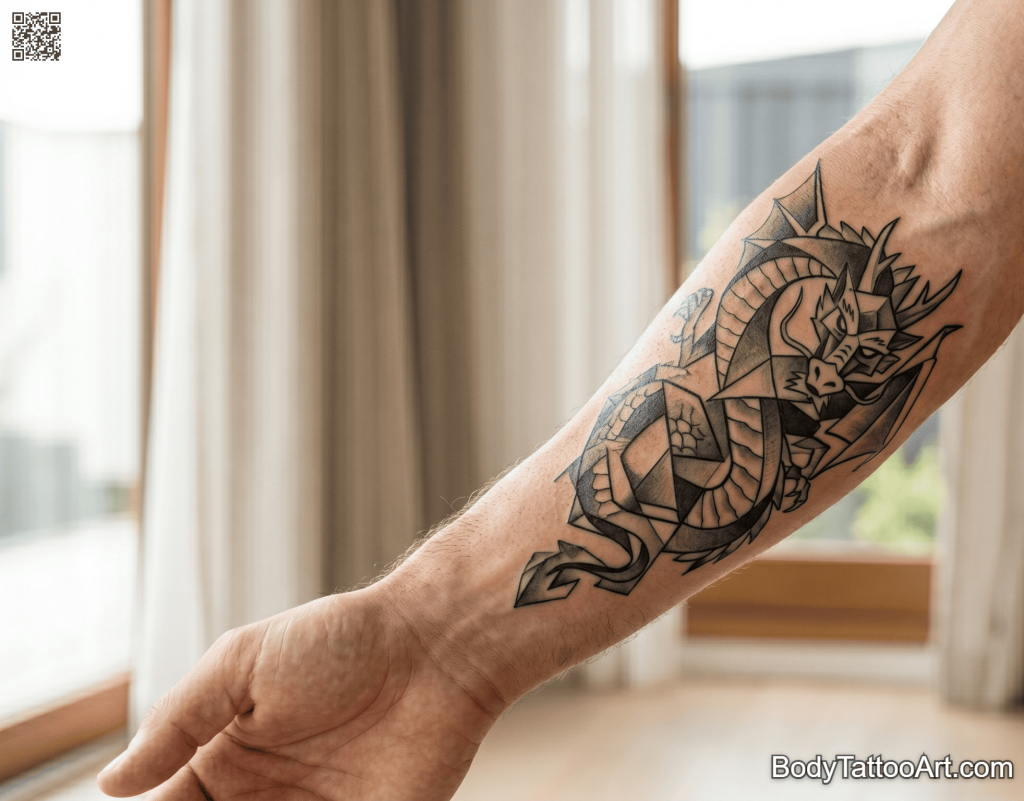
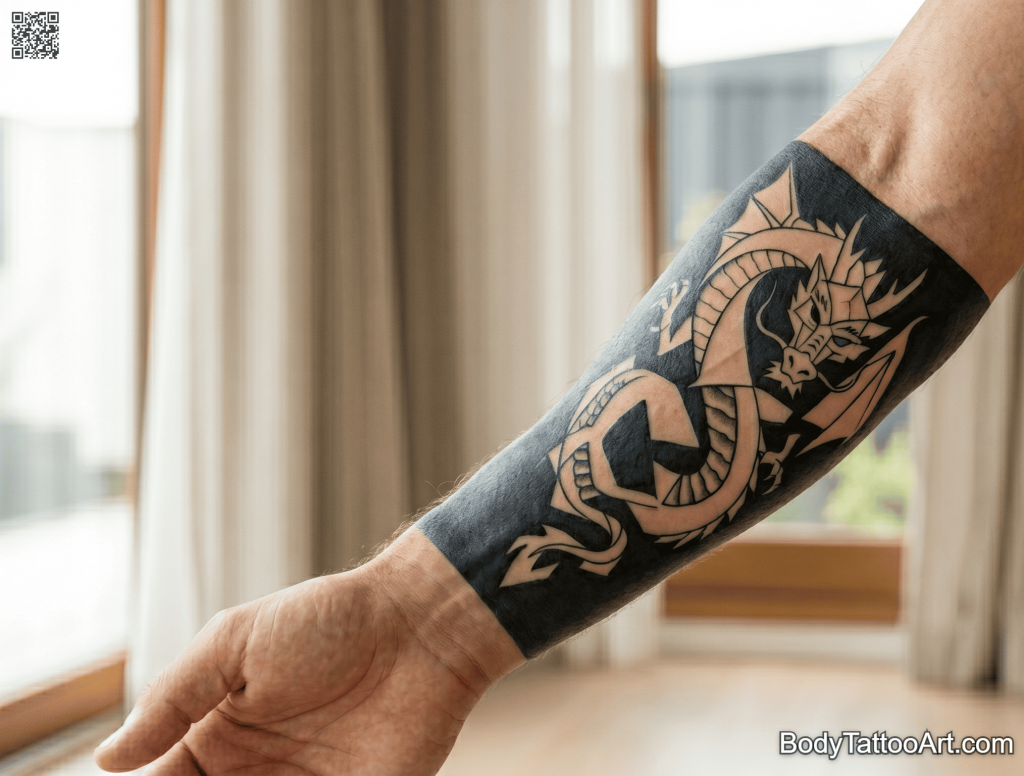
A dragon created entirely through negative space — the skin itself forms the dragon’s body, while the surrounding area is filled solid black. The dragon is made of nothing. The absence is the design.
Placement: Outer forearm
Style: Negative space blackwork Dragon Tattoos
Why it stands out: Negative space tattoos flip the usual logic. Here the dragon isn’t drawn — it’s revealed. The skill is in designing the filled areas so that what’s left behind reads perfectly as a dragon.
Ideal for: People who love clever visual concepts, fans of blackwork, those who want something that takes a second to see.
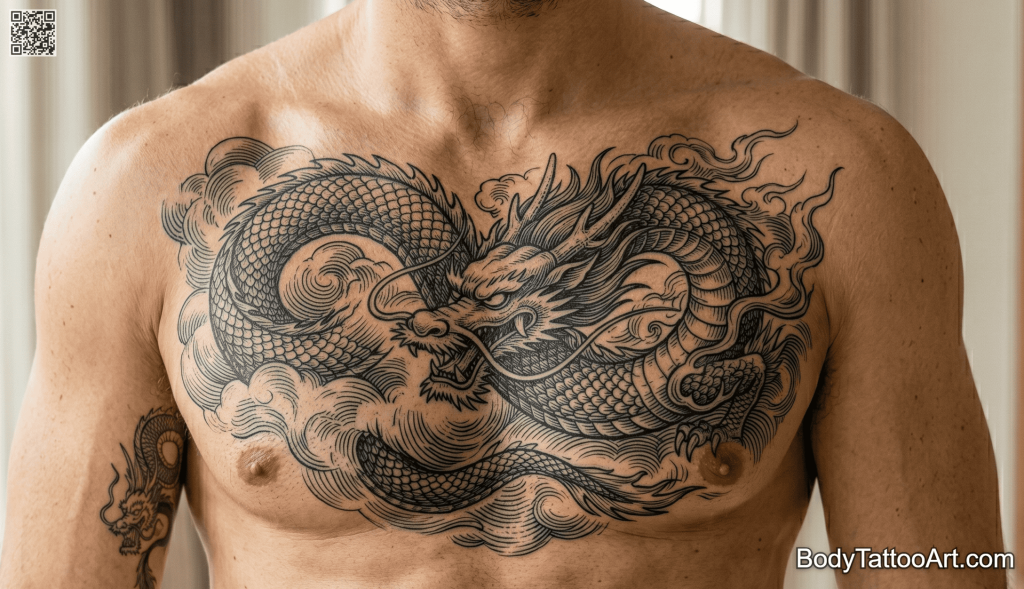
A dragon rendered in the style of a 16th-century copper engraving — crosshatched shading, fine parallel lines, and that distinctly aged, pressed-ink look.
Placement: Chest
Style: Engraving / etching style Dragon Tattoos
Why it stands out: Engraving tattoos look like they were printed from a woodcut press onto skin. The aesthetic is unmistakable and the level of linework discipline required is extraordinary.
Ideal for: Lovers of historical illustration, book lovers, people who want tattoos with an antique quality.
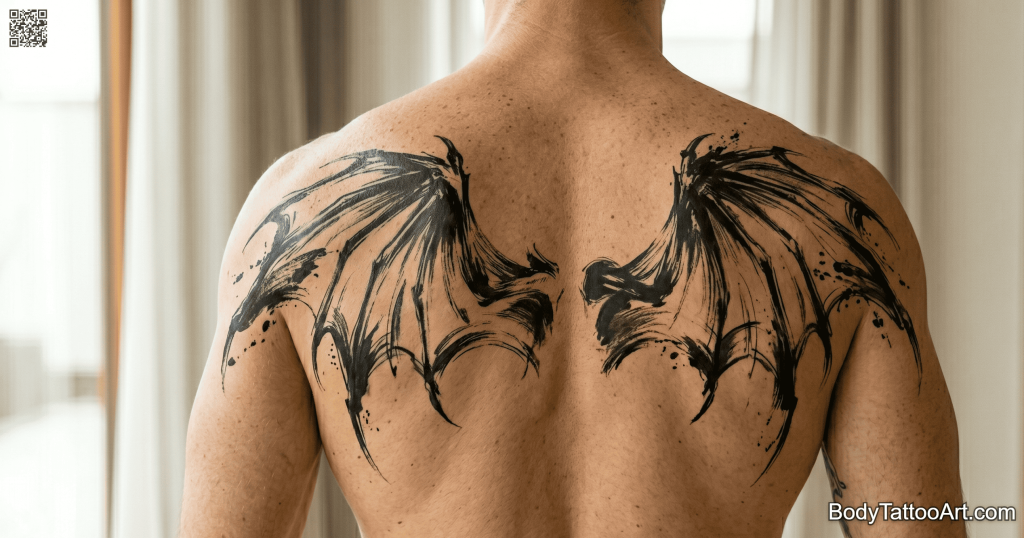
Just the wings of a dragon — two large wings rendered in loose, expressive brushstroke style, spreading across both shoulder blades. The body and head are absent. Only the wings.
Placement: Upper back / shoulder blades
Style: Brushstroke / expressive black Dragon Tattoos
Why it stands out: Removing the creature and leaving just the wings creates a wearable image of flight. The brushstroke execution makes the wings feel mid-beat — caught in motion.
Ideal for: People who want a large back piece without committing to the full creature, those who love expressive brushwork.
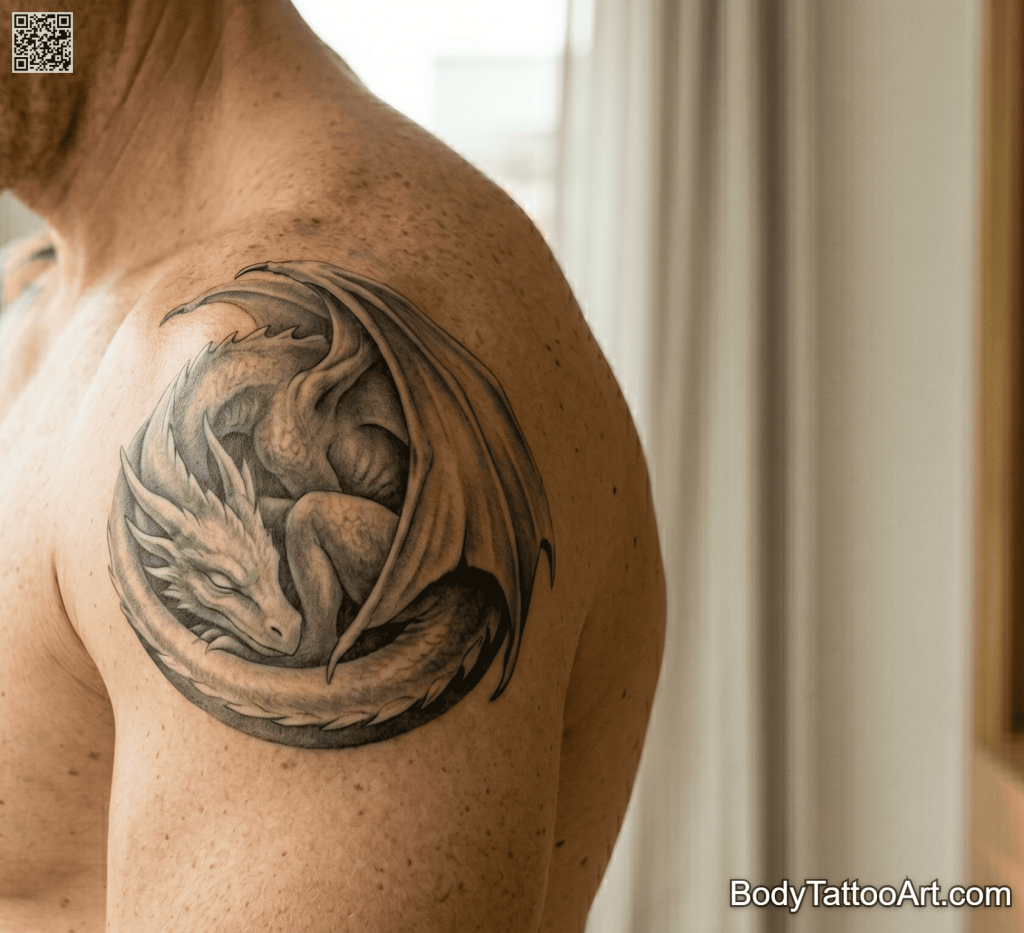
A dragon curled tight and sleeping — eyes closed, wings folded flat, tail wrapped around its own body. The expression is peaceful. This isn’t a creature mid-action. It’s at rest.
Placement: Shoulder cap
Style: Grey-wash realism Dragon Tattoos
Why it stands out: Almost every dragon tattoo shows the creature in battle or flight. A sleeping dragon is quieter and stranger. The mood contrast makes it memorable.
Ideal for: People who want a dragon tattoo without the aggression, grey-wash realism fans.
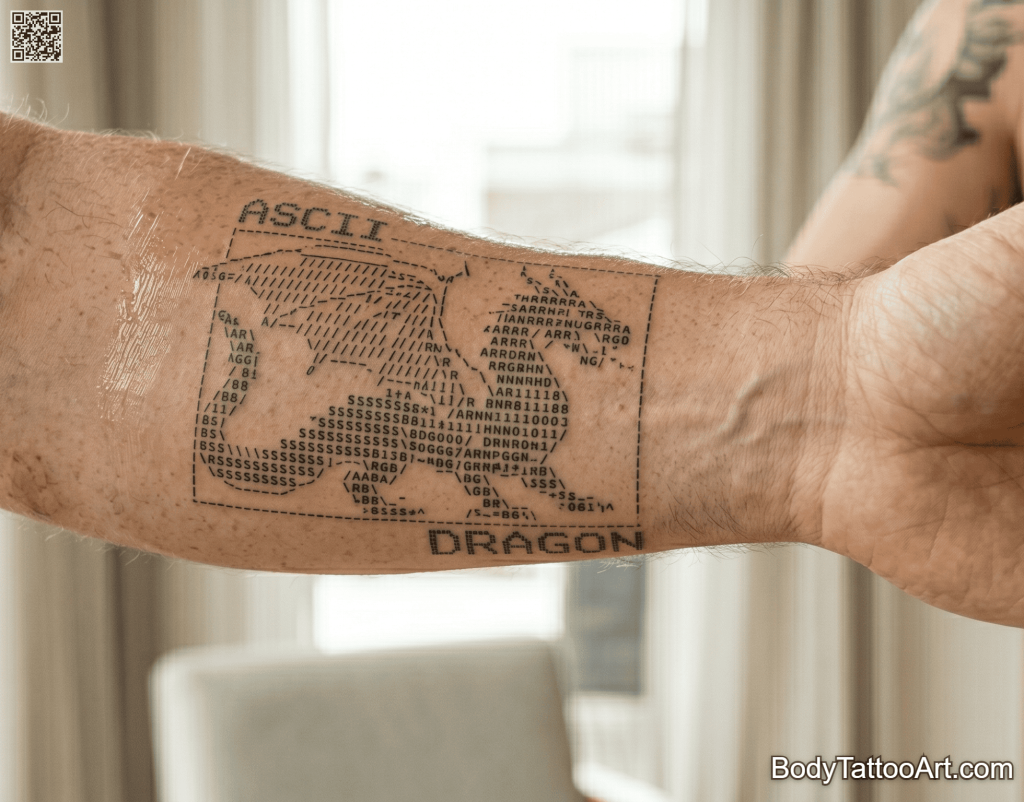
A dragon built entirely out of typographic characters — letters, numbers, and symbols arranged into the shape of a dragon in a fixed-width grid pattern. Inspired by ASCII art.
Placement: Inner forearm
Style: Typographic / conceptual Dragon Tattoos
Why it stands out: A dragon made of text is genuinely unusual in tattoo form. The idea that language can construct an image — and be permanently inked — is a concept-forward design that rewards close inspection.
Ideal for: Programmers, writers, designers, people who love conceptual art.
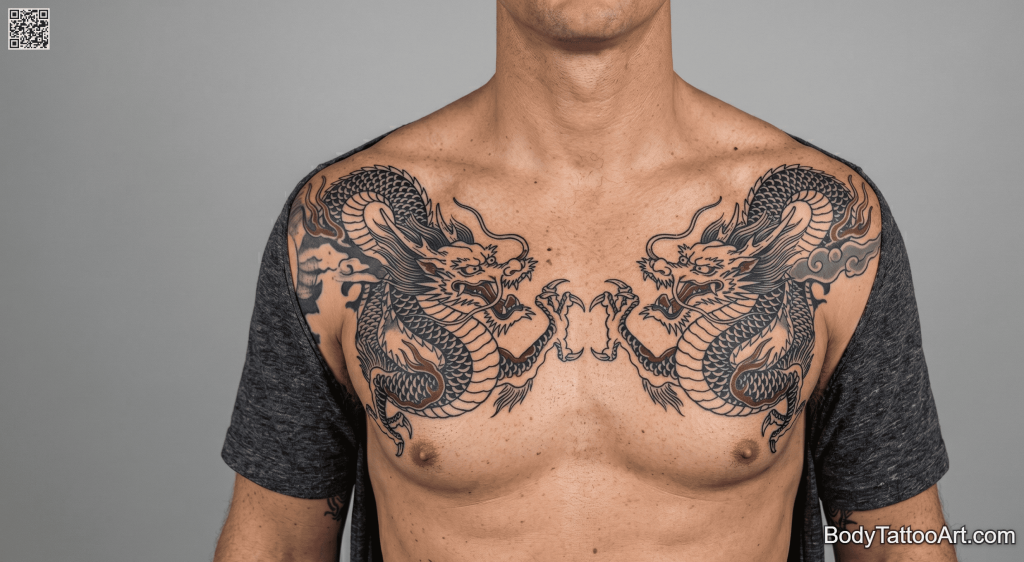
Two identical dragons facing each other in perfect mirror symmetry — chests forward, claws raised, tails curling outward symmetrically. The space between them is empty. The design is its own frame.
Placement: Chest / collarbones
Style: Japanese traditional / neo-trad Dragon Tattoos
Why it stands out: Symmetrical chest placements have natural visual pull. Two dragons in direct confrontation — or communion — across the sternum creates a composition that’s been used in heraldry, mythology, and ceremony across cultures.
Ideal for: People who want bold chest work, those drawn to ceremonial or heraldic aesthetics.
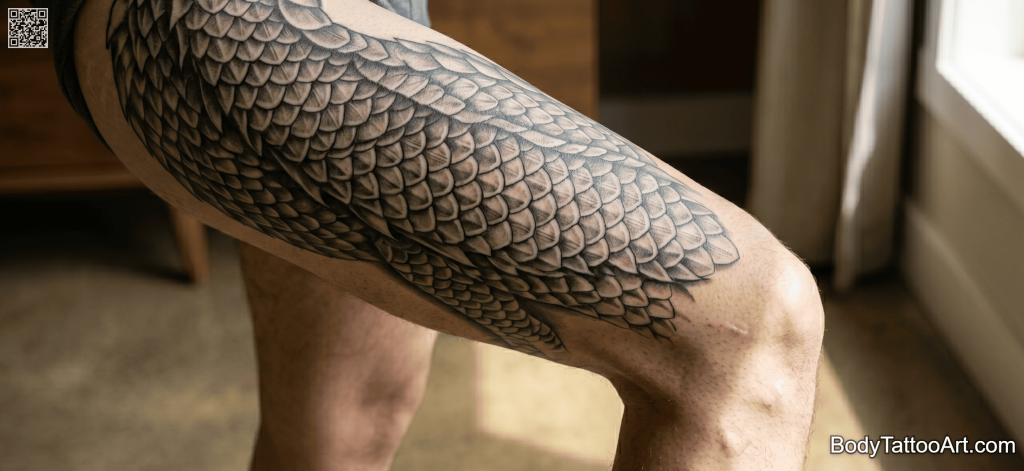
A dragon where the entire visual interest is in its scales — overlapping plates, each one individually shaded with gradients from dark to light. The body itself is minimal; the scales are the art.
Placement: Knee to lower thigh
Style: Detailed realism / scale study Dragon Tattoos
Why it stands out: Scale detail in dragon tattoos is usually supporting texture. Here it’s the headline. The entire tattoo is a study in how individual scales catch light.
Ideal for: Detail-obsessed collectors, people who appreciate craft-focused tattooing.
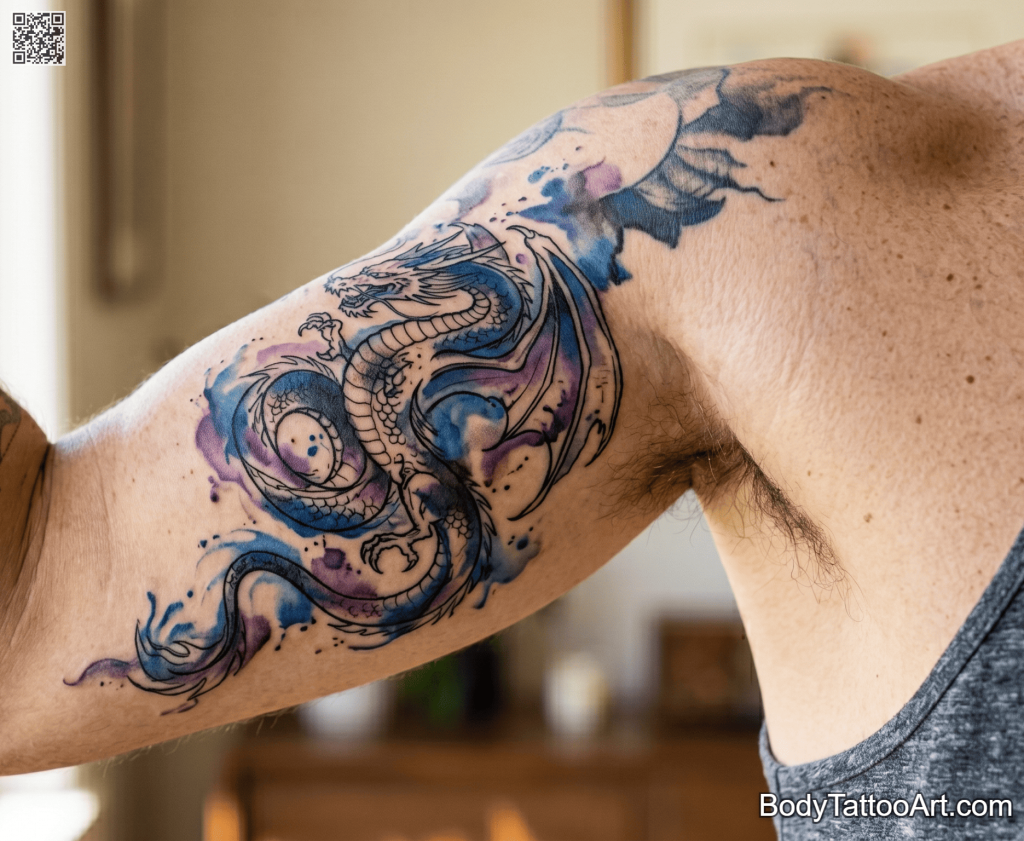
A dragon with bold linework underneath and loose watercolor-style washes of ink spreading beyond the lines — blues, purples, and blacks bleeding outward like wet paint. The color doesn’t stay inside the lines on purpose.
Placement: Outer bicep and shoulder
Style: Watercolor blackwork Dragon Tattoos
Why it stands out: The tension between the clean linework structure and the loose wash around it creates a design that looks like it’s mid-process — like an illustration being painted live on skin.
Ideal for: Creative types, people who love color tattoos with an artistic edge, painters or illustrators.
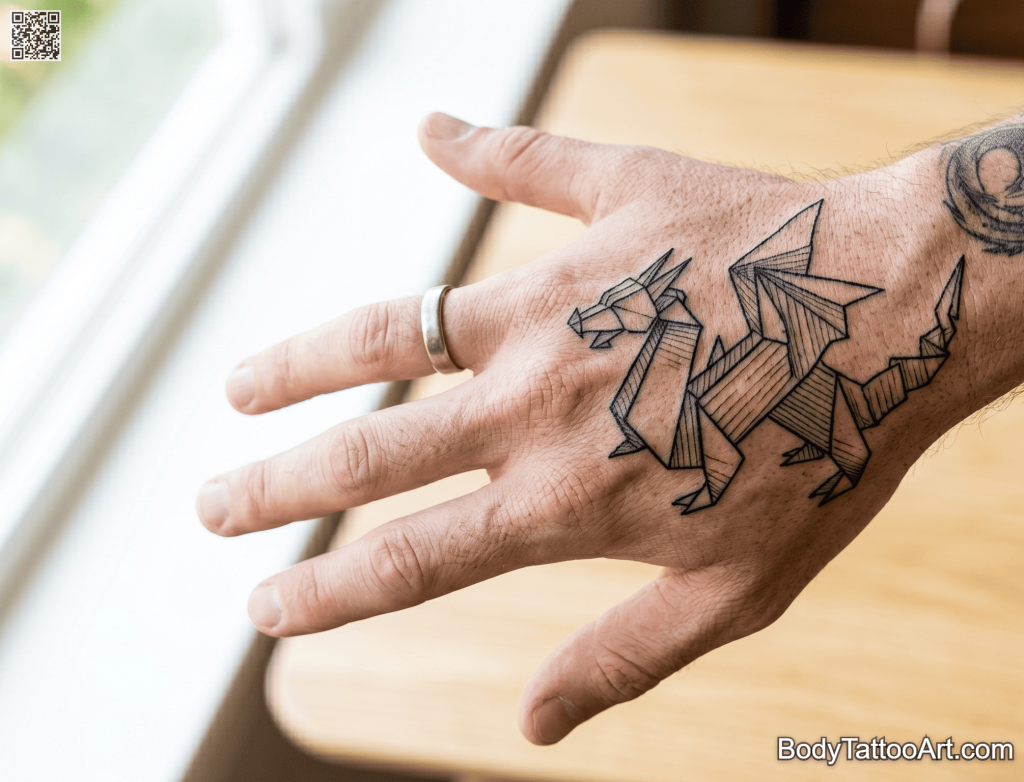
A dragon that looks like it’s been folded from paper — flat geometric planes, sharp fold lines, and the aesthetic of an origami figure translated into tattoo form.
Placement: Back of the hand
Style: Geometric linework Dragon Tattoos
Why it stands out: Origami aesthetics in tattoo form are rare. The dragon becomes a paper construction — simultaneously delicate and geometric. The back of the hand placement makes it constantly visible.
Ideal for: People who love design, Japanese craft traditions, or geometric tattoo styles.
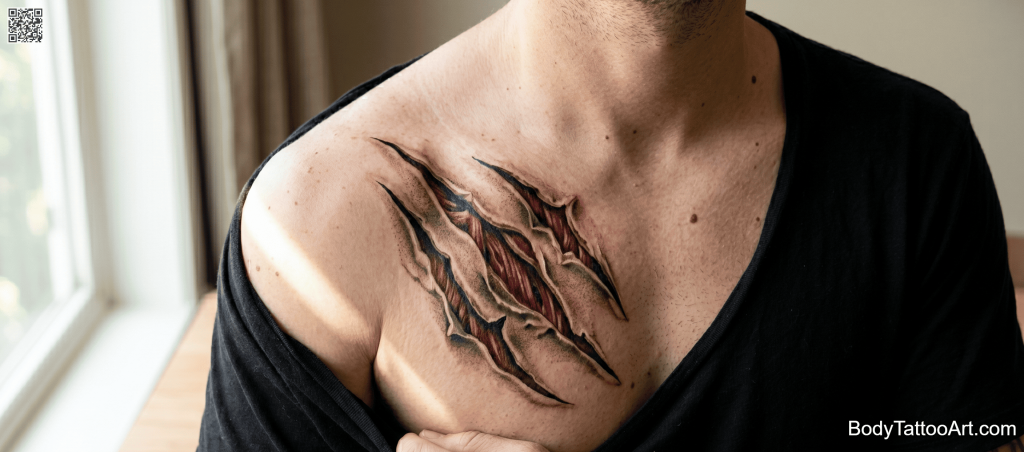
Not the dragon — just the claw print it left behind. Three to four deep claw marks raking across skin, as if the dragon just passed by. The scratches are drawn as deep gashes with lifted skin edges in 3D effect.
Placement: Collarbone and upper chest
Style: Hyper-realism / 3D illusion Dragon Tattoos
Why it stands out: The implied presence of the dragon is more visceral than showing it directly. A claw mark tattoo that looks like real damaged skin is one of the most effective 3D illusion concepts in tattooing.
Ideal for: Fans of 3D tattoos, people who love conceptual storytelling through tattoo, those who want something shocking at first glance.
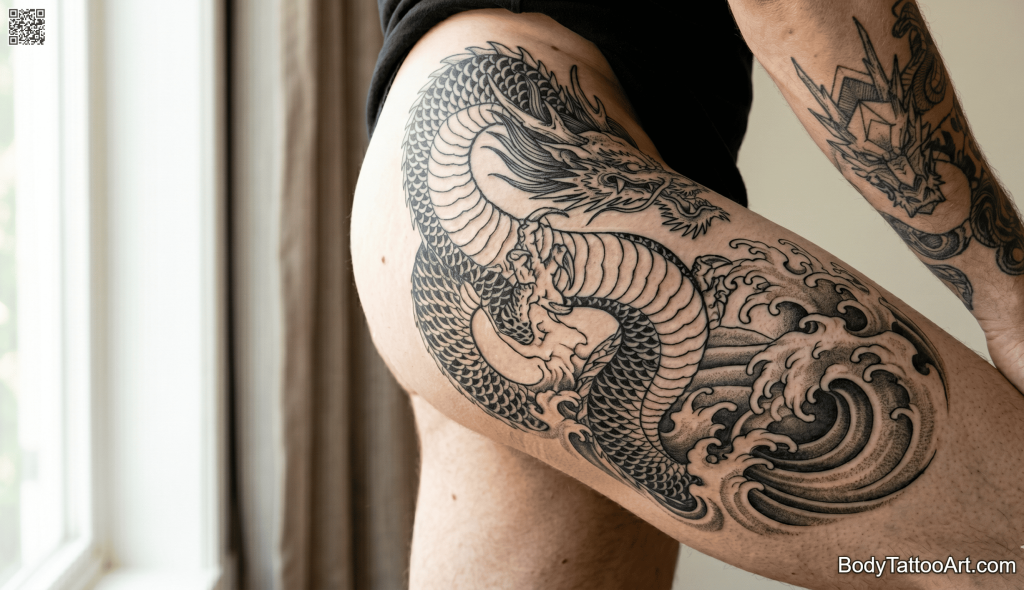
A dragon whose body blends seamlessly into ocean waves — its scales become water, its movement becomes the tide. The dragon and sea are one continuous form.
Placement: Outer thigh to hip
Style: Japanese blackwork Dragon Tattoos
Why it stands out: This isn’t a dragon near water — it’s a dragon becoming water. The visual merge between creature and element is a concept rooted in Japanese tattooing but rarely executed this fully.
Ideal for: Fans of Japanese tattoo aesthetics, people who want large flowing thigh or hip pieces, collectors building full leg coverage.
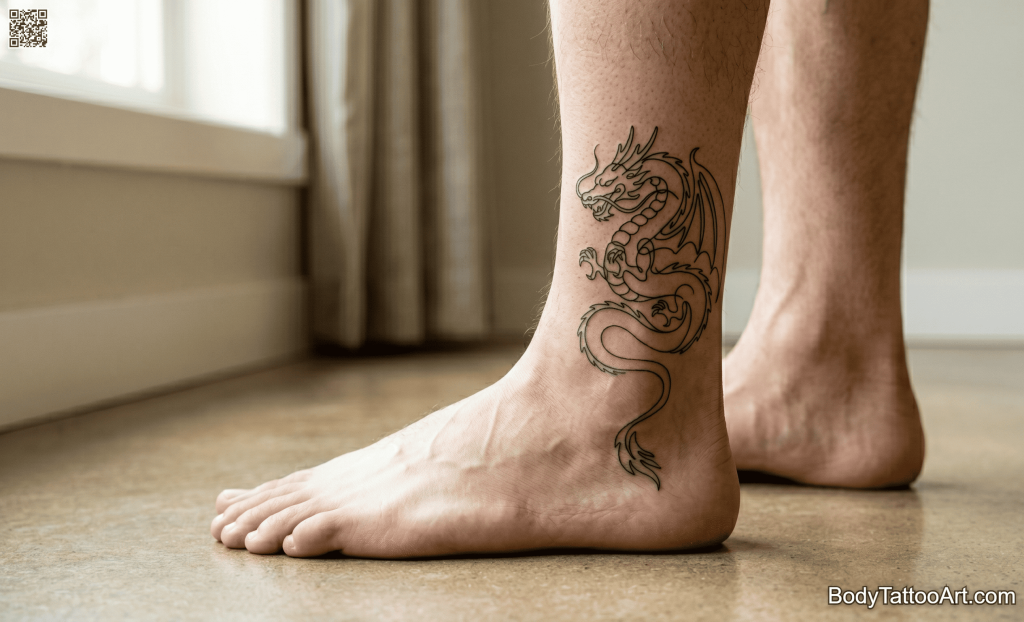
A complete dragon — head, body, wings, tail — drawn in a single unbroken line. The line loops and curves to suggest all the creature’s features without ever lifting from the skin.
Placement: Ankle to lower calf
Style: Single line / continuous line Dragon Tattoos
Why it stands out: Single-line tattoos are a contemporary art discipline borrowed into tattooing. Drawing a full dragon without the line ever breaking requires compositional planning that’s close to drawing calligraphy. The result looks effortless but isn’t.
Ideal for: Minimalist tattoo lovers, people who love concept-driven art, first-timers wanting something small but meaningful.
Dragon tattoos work because they’re never finished evolving. From a sleeping dragon on a shoulder cap to a skeletal dragon carved into the sternum, the range is almost infinite. The 27 designs above are each built on a different visual idea — different lines, different moods, different ways of using the body as a canvas.
Anyone serious about getting a dragon tattoo should spend time looking at different styles before committing. The design matters as much as the creature itself — and the right artist will know exactly how to make it land.
Interested in more creature-based designs? Browse tiger tattoos, wolf tattoos, eagle tattoos, snake tattoos, and owl tattoos for more ideas across the same bold, nature-inspired category.