Physical Address
304 North Cardinal St.
Dorchester Center, MA 02124
Physical Address
304 North Cardinal St.
Dorchester Center, MA 02124

Oak leaf tattoos have been quietly gaining popularity, and it’s easy to see why. There’s something grounded and timeless about this design — it never looks trendy, and it never really goes out of style either., it is always timeless like Roses and Daisies. Whether someone wants something small and delicate or bold and detailed, oak leaf tattoos have a way of fitting the brief every single time.
This blog covers 27 oak leaf tattoo ideas that are genuinely different from each other. Different styles, different placements, different moods — no two are the same.
Oak leaf tattoos are exactly what they sound like — tattoos that feature the distinctive lobed silhouette of the oak tree leaf. The shape itself is instantly recognizable: wide, with deep rounded lobes running along both sides. This unique form makes it one of the most visually interesting leaves to tattoo.
What makes oak leaf tattoos especially versatile is how well the leaf’s shape translates into different tattoo styles. The strong outline lends itself to bold blackwork and traditional tattooing. The delicate veining inside the leaf is perfect for fine line work. The overall shape has a natural symmetry that works beautifully in geometric and dotwork interpretations too.
The oak tree has been a symbol of strength, endurance, and wisdom across many cultures for thousands of years. The oak leaf, as an extension of that symbolism, carries meanings of resilience, knowledge, and rootedness — the idea that someone has weathered hard times and come out steadier on the other side.
In ancient Celtic traditions, the oak was considered the most sacred tree. It was associated with the god of thunder in Norse and Roman mythology. In many European cultures, wearing oak leaves was a mark of honor — Roman generals were crowned with wreaths made of oak leaves after significant victories.
Beyond mythology, the oak leaf represents longevity, patience, and quiet power — qualities that resonate with a wide range of people. It’s not a flashy symbol; it’s a deeply personal one.
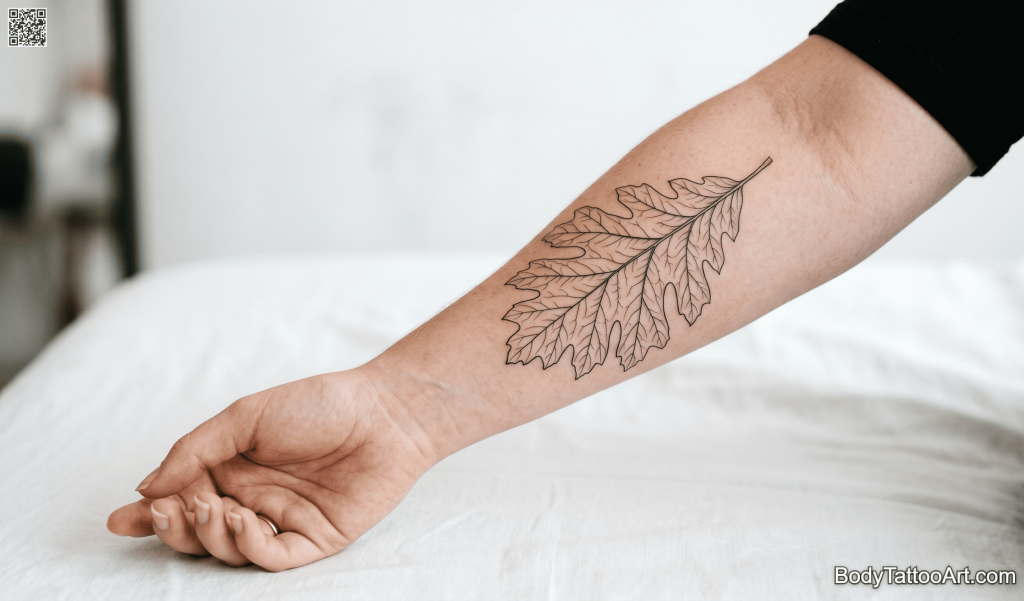
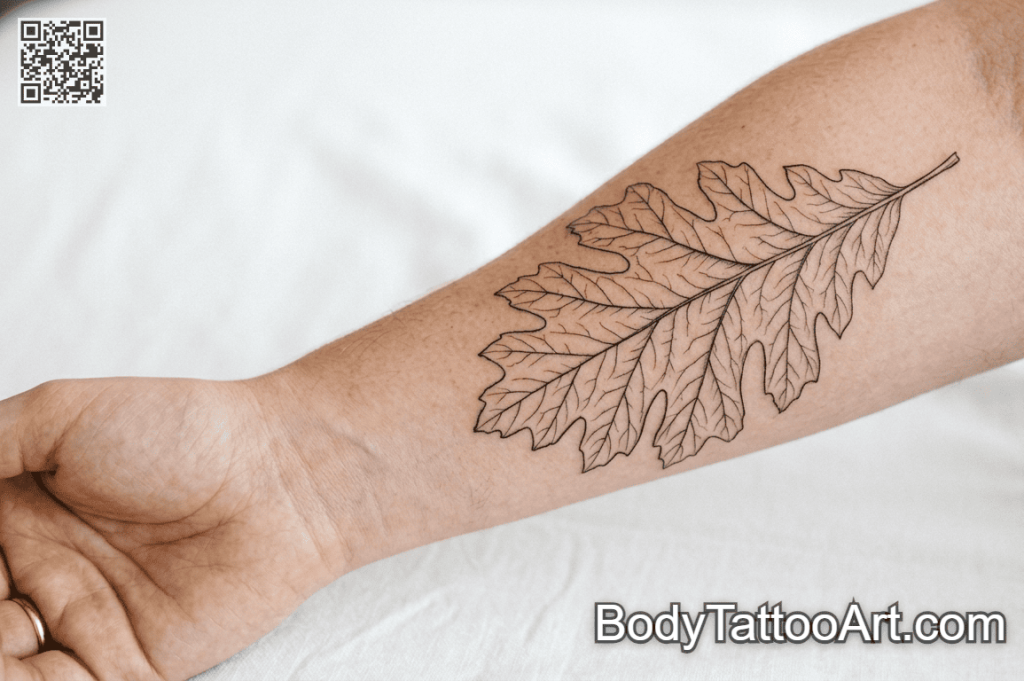
A single oversized oak leaf fills the entire canvas with intricate vein work running from the midrib out to every lobe tip. The veins are rendered in ultra-thin lines, almost like a botanical illustration. The contrast between the empty lobes and the detailed veining creates a surprisingly striking result even without any shading.
Placement: Forearm
Style: Fine line Oak Leaf Tattoos
Why it stands out: The hyperdetailed veining makes something simple look like art. It reads clean from a distance and rewards close-up viewing.
Ideal for: Fine line tattoo fans, minimalist collectors, and anyone drawn to botanical illustration aesthetics.
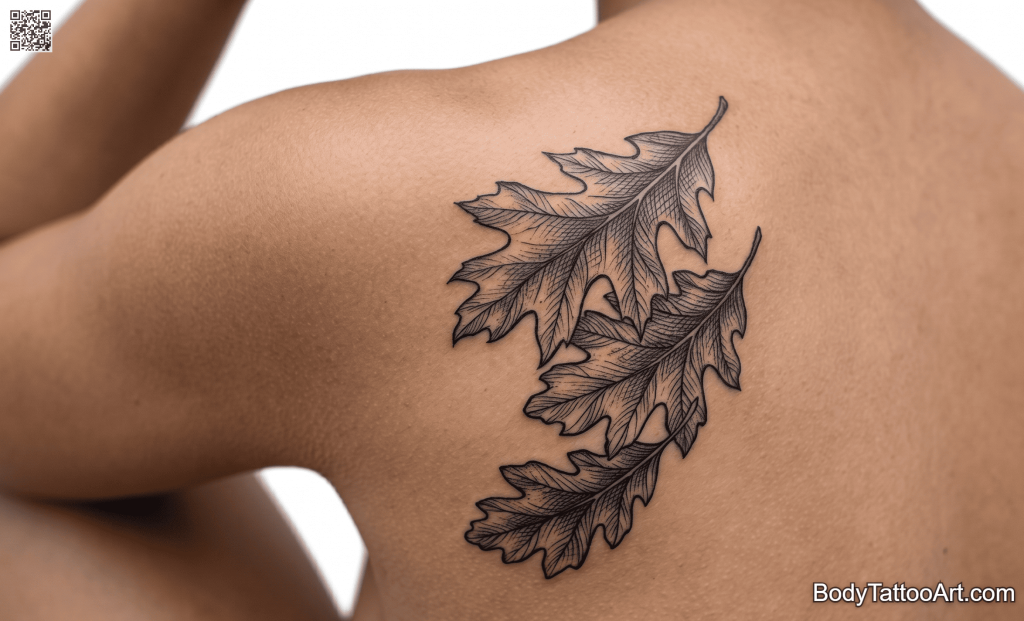
Three oak leaves in slightly different sizes are arranged as if mid-fall — each tilted at a different angle. One faces upward, one is sideways, one faces slightly down. The overlapping creates natural depth without needing heavy shading. Light cross-hatching fills the leaves unevenly, giving the piece texture and movement.
Placement: Shoulder blade
Style: Illustrative blackwork Oak Leaf Tattoos
Why it stands out: The off-axis arrangement and uneven hatching make this feel like a freeze-frame moment rather than a static design.
Ideal for: People who want something dynamic, blackwork enthusiasts, and those looking for a medium-sized shoulder piece.
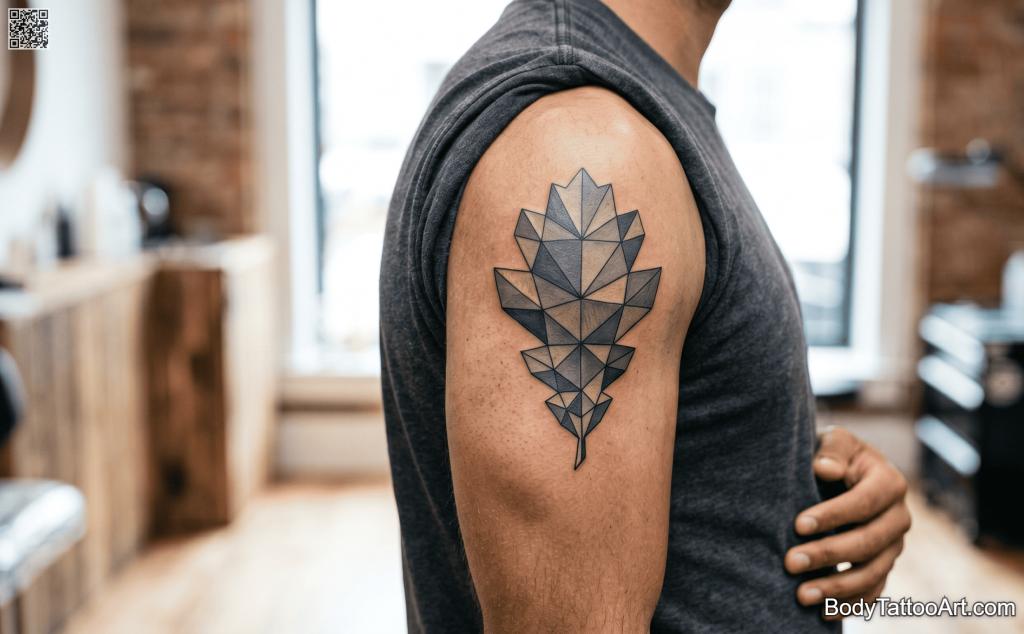
The oak leaf shape is broken down into sharp triangular planes, like a low-polygon 3D render of a leaf. Each geometric facet is filled with a slightly different shade of black or grey, giving the illusion of light hitting different surfaces. The outline is clean and angular.
Placement: Upper arm
Style: Geometric / neo-geo Oak Leaf Tattoos
Why it stands out: It turns an organic shape into something architectural. The sharp angles contrast sharply with the natural subject.
Ideal for: Geometry tattoo lovers, men’s arm tattoos, and people who want something modern and structured.
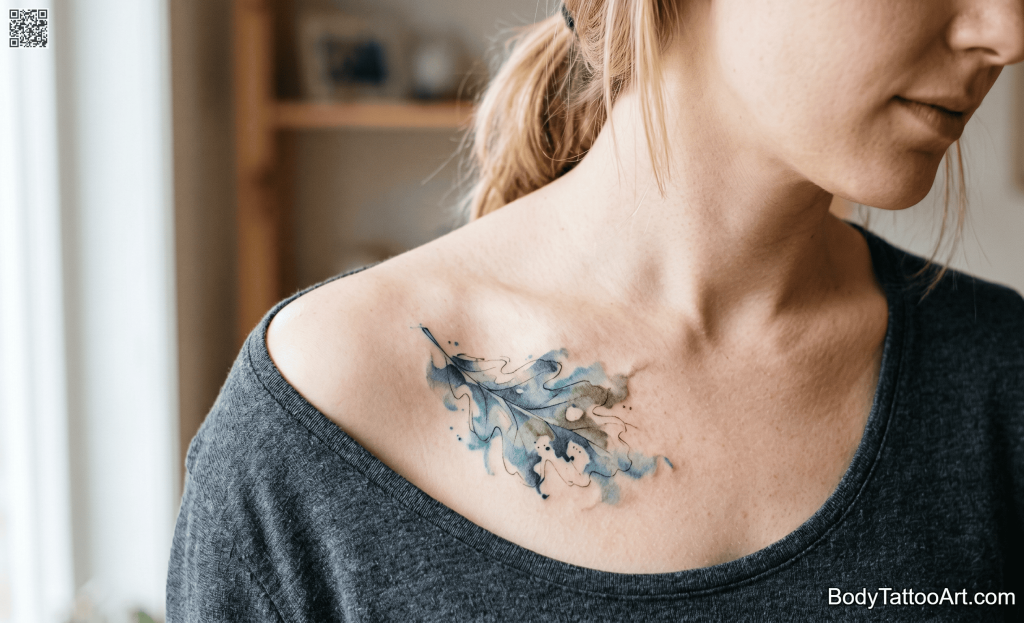
The leaf outline is barely there — just a faint suggestion of the shape — while loose washes of ink bleed beyond its edges in blue, teal, and muted olive. The internal structure is almost absent. The whole piece looks like a watercolor brushstroke study.
Placement: Collarbone / upper chest
Style: Watercolor Oak Leaf Tattoos
Why it stands out: The color bleed and loose handling create an almost painterly mood. It looks different from every other oak leaf tattoo out there.
Ideal for: Color tattoo fans, people who want something soft and artistic, and those who like a less “defined” aesthetic.
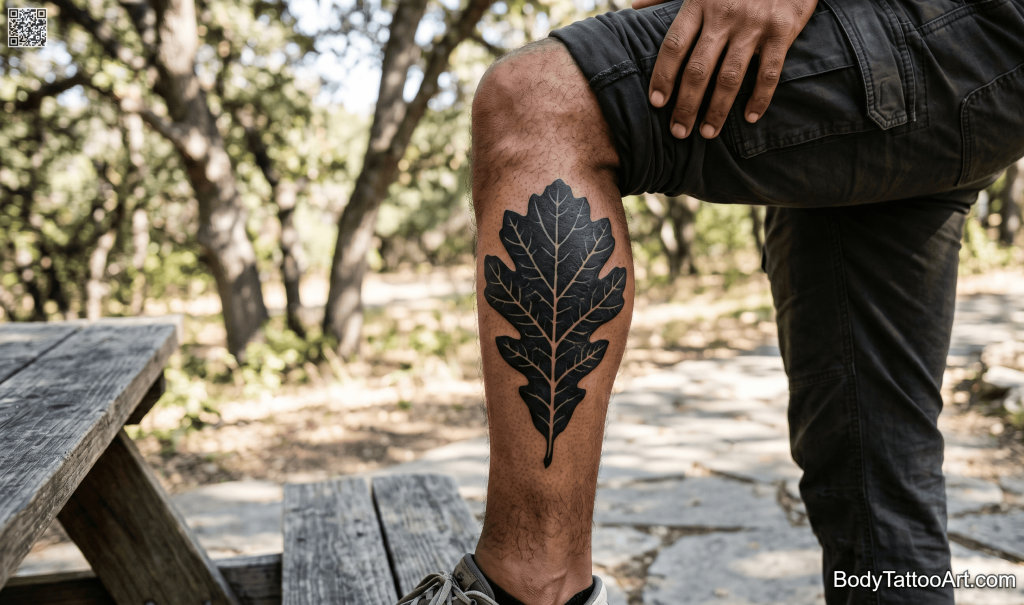
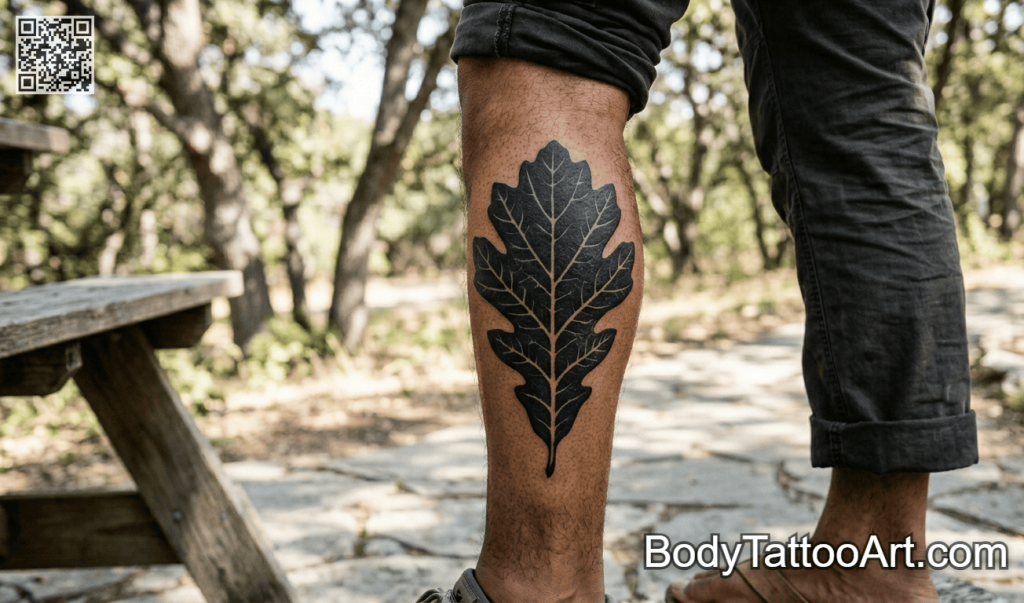
A bold, oversized oak leaf rendered entirely in solid black — except for the vein lines, which are left as negative space (unpainted skin). The contrast between the black fill and the white vein lines creates a dramatic, graphic quality.
Placement: Calf
Style: Blackwork with negative space Oak Leaf Tattoos
Why it stands out: Letting the skin become the veins is an underused technique that makes the design feel alive and unexpected.
Ideal for: Bold tattoo lovers, blackwork collectors, and people who want a striking lower-leg piece.
The leaf is shaded entirely with dotwork — thousands of tiny dots densest at the center and lightest at the lobe edges. No lines, no solid fills. Just dots building up tone slowly. The leaf appears to glow slightly at the edges where the dotwork fades into bare skin.
Placement: Inner wrist
Style: Dotwork Oak Leaf Tattoos
Why it stands out: Pure dotwork shading on a leaf creates an almost stippled print effect — like a vintage nature sketch come to life.
Ideal for: Detail-oriented tattoo fans, dotwork collectors, and first-time tattoo seekers who want something small but impressive.

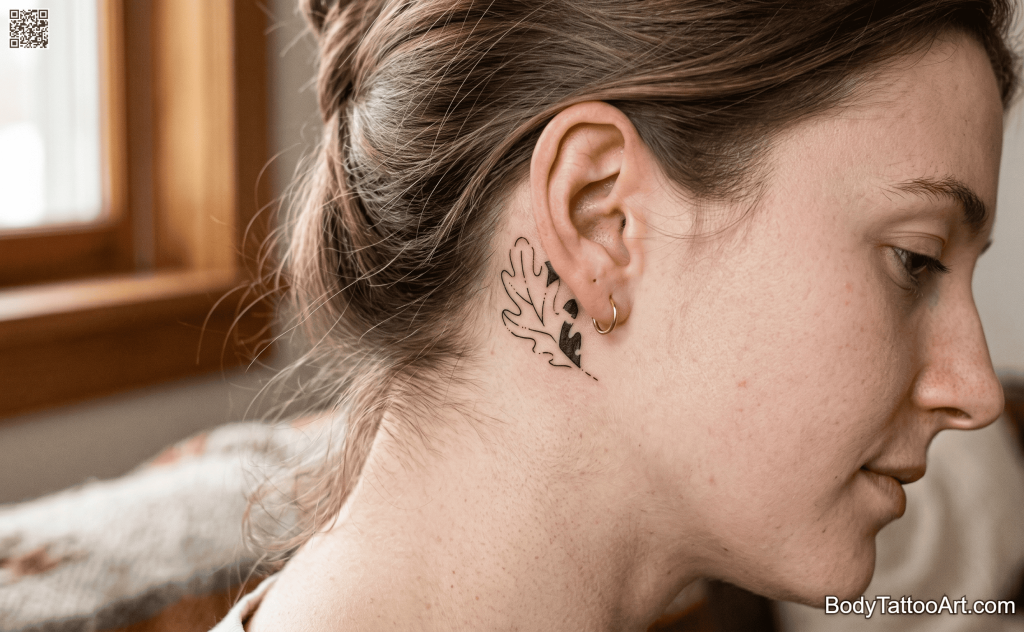
The leaf isn’t fully drawn — instead, fragments of the oak leaf shape are scattered across a small area, like pieces that haven’t assembled yet. Some fragments are just curved outlines. Others are tiny filled sections. There’s deliberate incompleteness to the composition.
Placement: Behind the ear
Style: Abstract / minimalist Oak Leaf Tattoos
Why it stands out: The intentional fragmentation makes the viewer’s eye complete the leaf mentally. It’s clever and unusual.
Ideal for: People who love abstract designs, minimalist tattoo fans, and those wanting something subtle but conversation-starting.
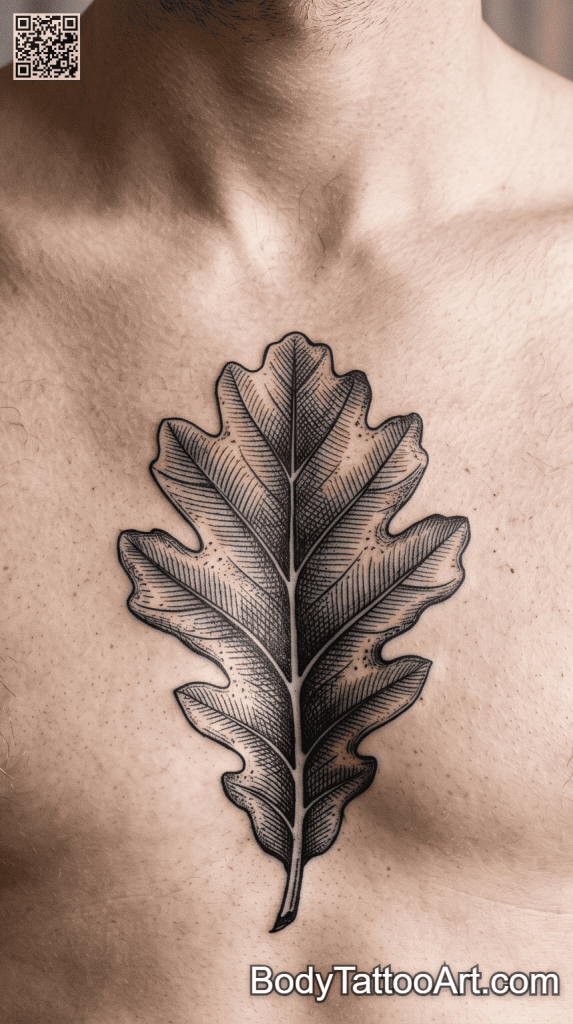
The leaf looks like it was lifted straight from a 19th-century botanical print. Parallel hatching lines fill the lobes, with cross-hatching in the darker shadow areas. The midrib is boldly defined. The overall feel is heavily illustrative — almost like an engraving.
Placement: Sternum / chest center
Style: Illustrative / vintage etching Oak Leaf Tattoos
Why it stands out: The hatching work is time-consuming and technical. Up close, the layered lines reveal incredible depth and dimension.
Ideal for: Vintage art enthusiasts, collectors who appreciate technical tattooing, and anyone who wants a museum-worthy chest piece.
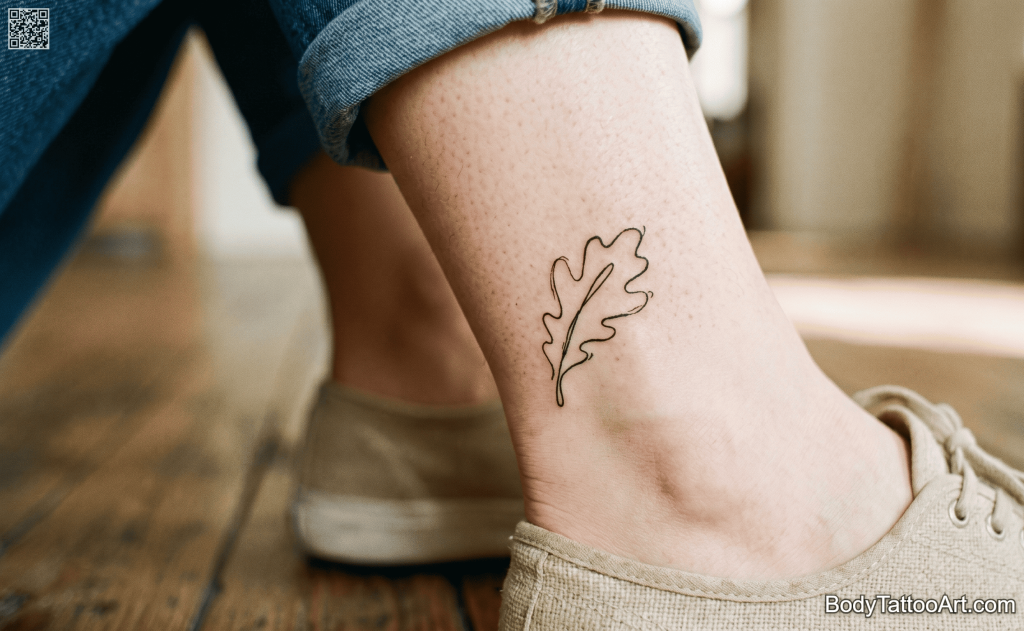
The entire oak leaf is drawn in one continuous, unbroken line — a single-stroke impression of the shape. The line varies slightly in weight but never lifts. No shading, no fill, no detail. Just the gesture of a leaf.
Placement: Ankle
Style: Single line / minimalist Oak Leaf Tattoos
Why it stands out: The restraint here is the entire point. The imperfect, flowing single line makes the tattoo feel handmade and alive.
Ideal for: Minimalists, first-time tattoo seekers, and anyone who prefers understated tattoos.
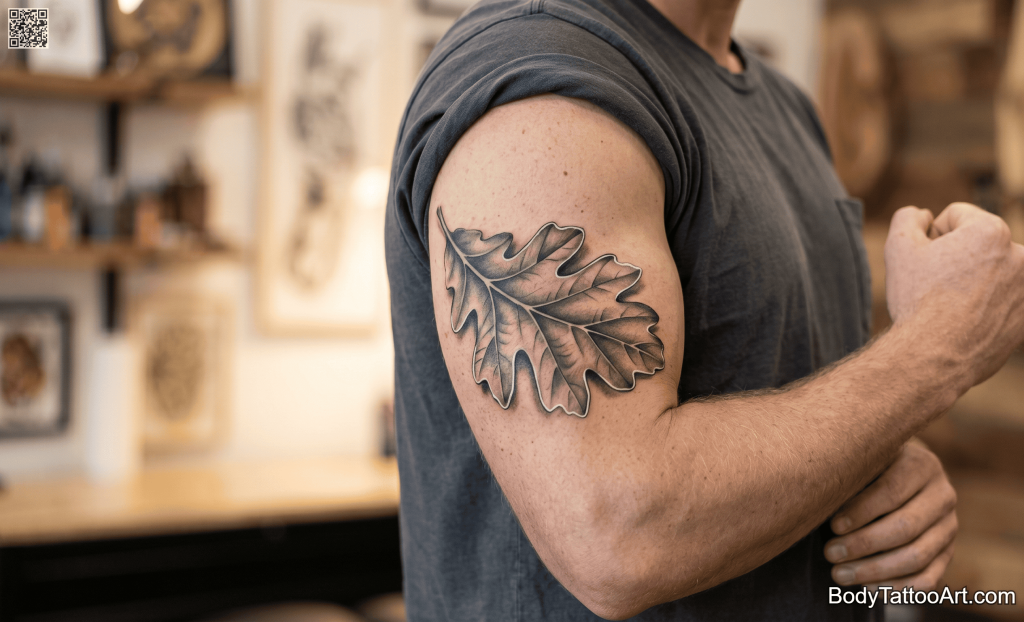
The leaf is rendered with photorealistic shading — deep black shadows in the creases between lobes, soft grey mid-tones across the surface, and clean white highlights at the edges. It looks like someone pressed a real leaf onto the skin and tattooed around it.
Placement: Bicep
Style: Grey-wash realism Oak Leaf Tattoos
Why it stands out: The tonal range is what separates this from a typical leaf tattoo. It has real volume and a three-dimensional quality.
Ideal for: Realism tattoo collectors, fans of botanical themes, and those who want something undeniably skillful.
The leaf looks like it’s been partially torn — one or two lobes have rough, jagged edges as if the paper or skin itself is ripped. The rest of the leaf is cleanly rendered in fine line. The torn section reveals bare skin beneath.
Placement: Forearm (outer)
Style: Illustrative / surreal Oak Leaf Tattoos
Why it stands out: The illusion of tearing breaks the expected structure of a leaf tattoo. It introduces texture and a slightly surreal quality without being overly conceptual.
Ideal for: People who love illusion tattoos, illustrative tattoo fans, and those wanting something with an edge.
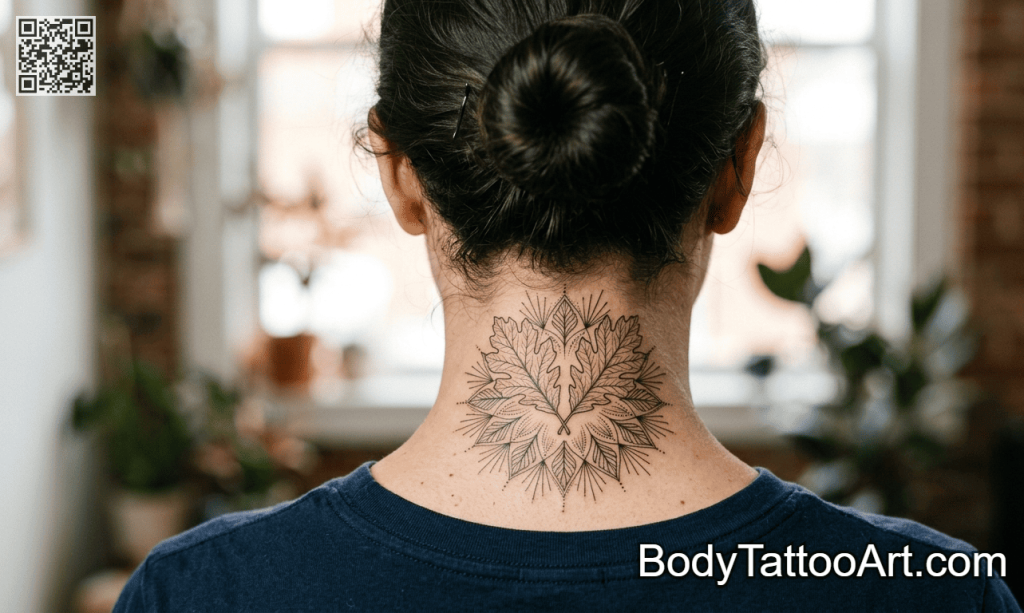
Two mirrored oak leaves face each other with their stems touching at the center, surrounded by thin radiating lines that echo the vein structure — creating an almost mandala-like circular composition. The symmetry is precise and meditative.
Placement: Nape of the neck
Style: Fine line / ornamental Oak Leaf Tattoos
Why it stands out: The mirror symmetry and radiating lines transform a leaf into an ornament. The placement at the nape makes it beautifully framed by hair.
Ideal for: People who love ornamental tattoos, nape placement fans, and those wanting something quietly elegant.
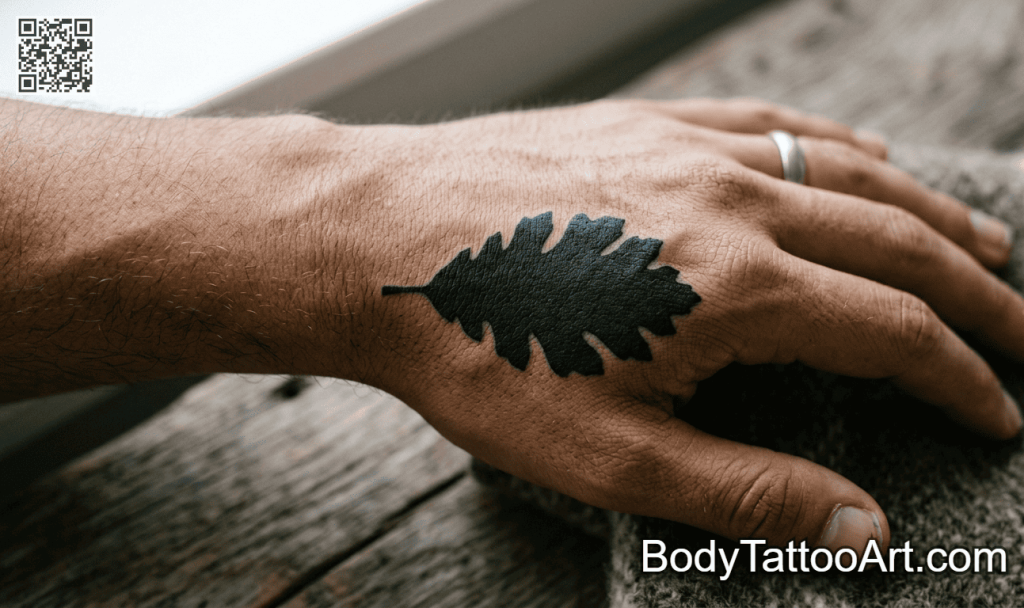
No detail, no texture, no veins — just the clean, solid black silhouette of an oak leaf. The shape does all the talking. The edges are sharp and deliberate.
Placement: Back of the hand
Style: Blackwork / silhouette Oak Leaf Tattoos
Why it stands out: Brutal simplicity. The negative space of the leaf’s lobes creates its own visual rhythm without needing any internal detail.
Ideal for: Minimalist blackwork fans, people who want a small hand tattoo, and bold tattoo lovers.
If you enjoy leaf tattoos with a more delicate feel, check out our guide to palm tattoo designs for ideas that pair beautifully with oak leaf tattoos in a sleeve or botanical arrangement.
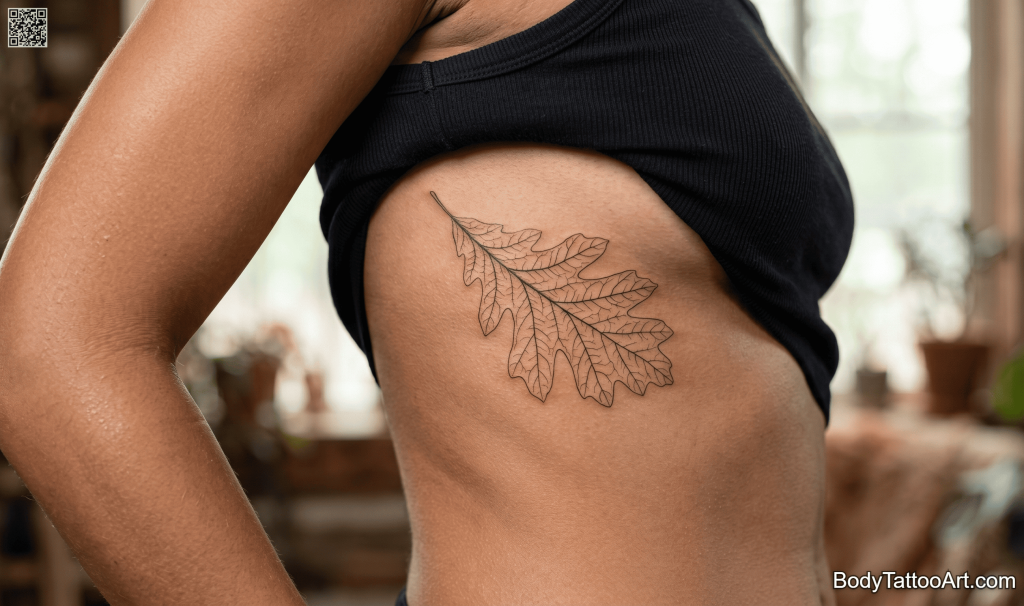
The leaf’s surface is completely absent — only the vein structure is tattooed, as if the leaf has decomposed and left only its skeleton behind. The vein lines branch out realistically from the midrib with fine, spidery secondary and tertiary veins.
Placement: Rib cage / side
Style: Fine line Oak Leaf Tattoos
Why it stands out: The vein-only approach is striking because it flips the usual tattoo logic. There’s no “leaf” — just its inner structure. It’s ghostly and beautiful.
Ideal for: Nature lovers, people who want something unusual and structural, and fine line enthusiasts.
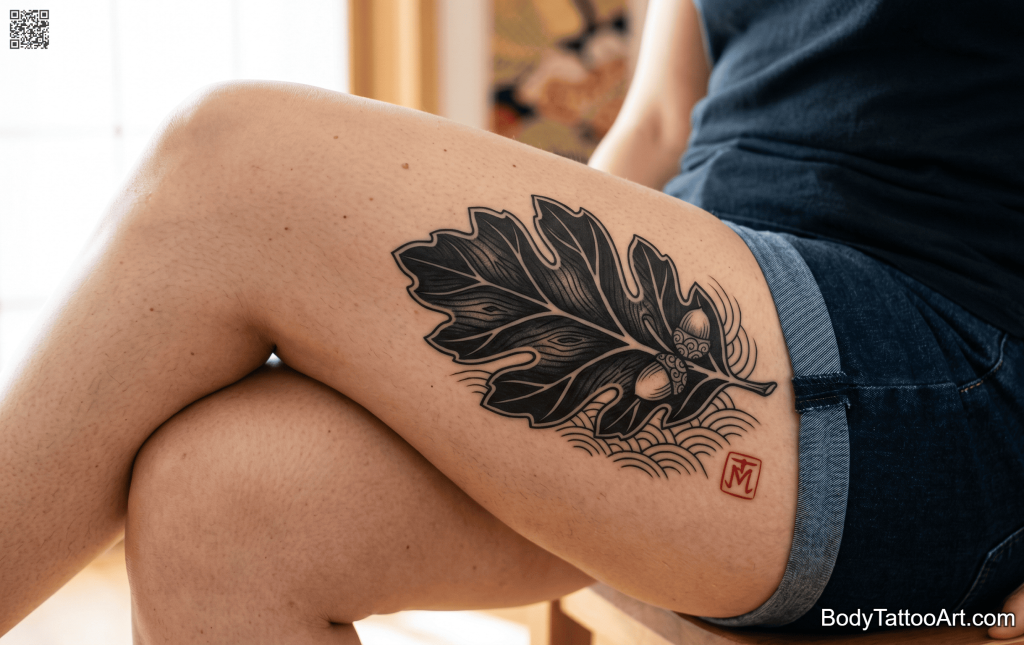
The oak leaf is rendered in a style inspired by Japanese woodblock printing — flat, bold, with clear outlines and a limited range of tones. The black areas are strong and deliberate, with very little grey. Some areas of the leaf have visible “grain lines” suggesting the texture of a print block.
Placement: Thigh
Style: Traditional / woodblock-inspired Oak Leaf Tattoos
Why it stands out: The flat, graphic quality of woodblock tattooing is rare. The grain lines inside the black areas add a handmade, printmaking energy.
Ideal for: Fans of Japanese aesthetics, bold tattoo lovers, and people wanting something with a strong graphic identity.
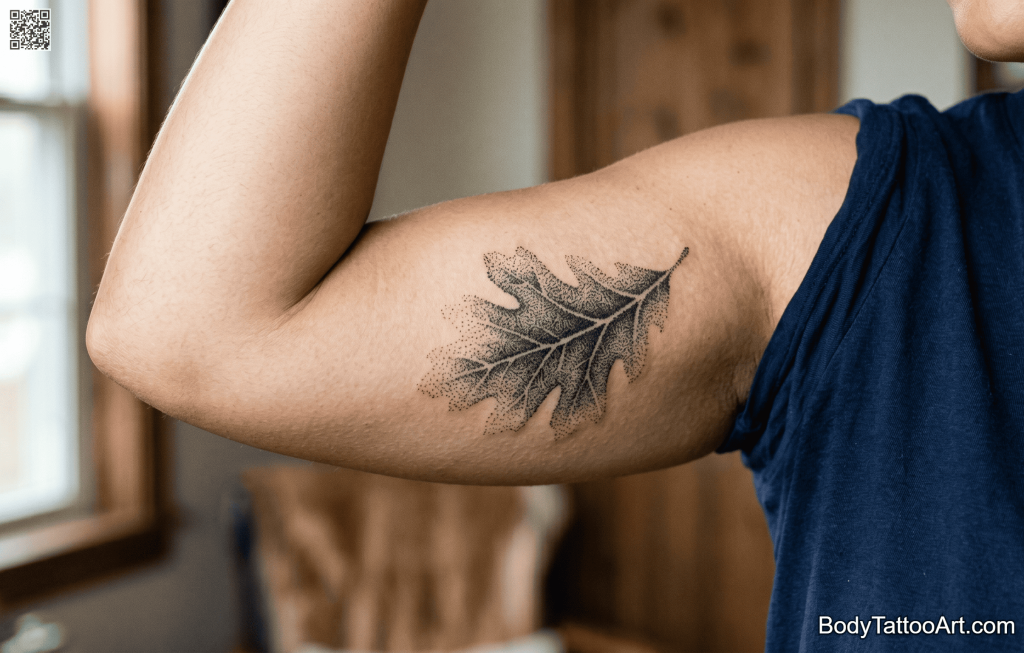
The leaf has no outline at all. The shape is formed entirely from stippling — dense dots at the center fading outward, so the leaf seems to emerge from and dissolve back into the skin. The edge of the leaf is entirely soft and undefined.
Placement: Inner upper arm
Style: Pointillist / dotwork Oak Leaf Tattoos
Why it stands out: The absence of an outline makes the leaf feel atmospheric rather than graphic. The leaf appears and disappears depending on the viewing distance.
Ideal for: Dotwork fans, people who prefer softness over sharpness, and tattoo enthusiasts looking for something meditative.
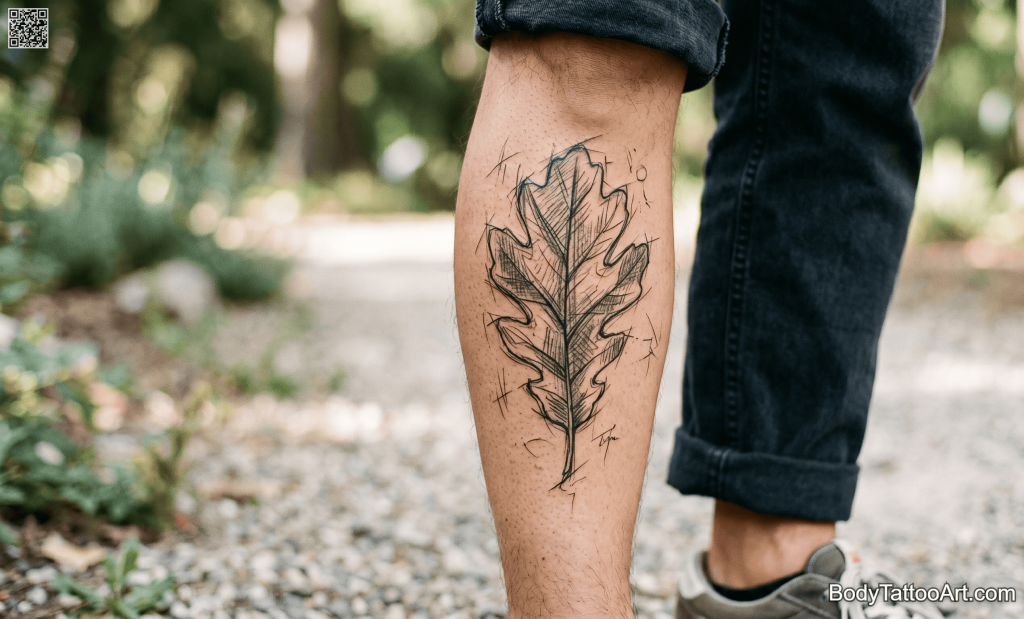
The leaf looks like it was drawn quickly in a sketchbook — rough pencil-like lines, visible sketch marks, some areas drawn twice as if the artist corrected the line. The charm is in its unfinished, handmade quality.
Placement: Shin / lower leg front
Style: Sketch / illustrative Oak Leaf Tattoos
Why it stands out: The roughness is the whole point. In a world of perfectly clean tattoos, a sketch-style piece feels refreshingly human and imperfect.
Ideal for: Art and illustration lovers, people who want something that feels personal rather than polished, and anyone who values the creative process aesthetic.
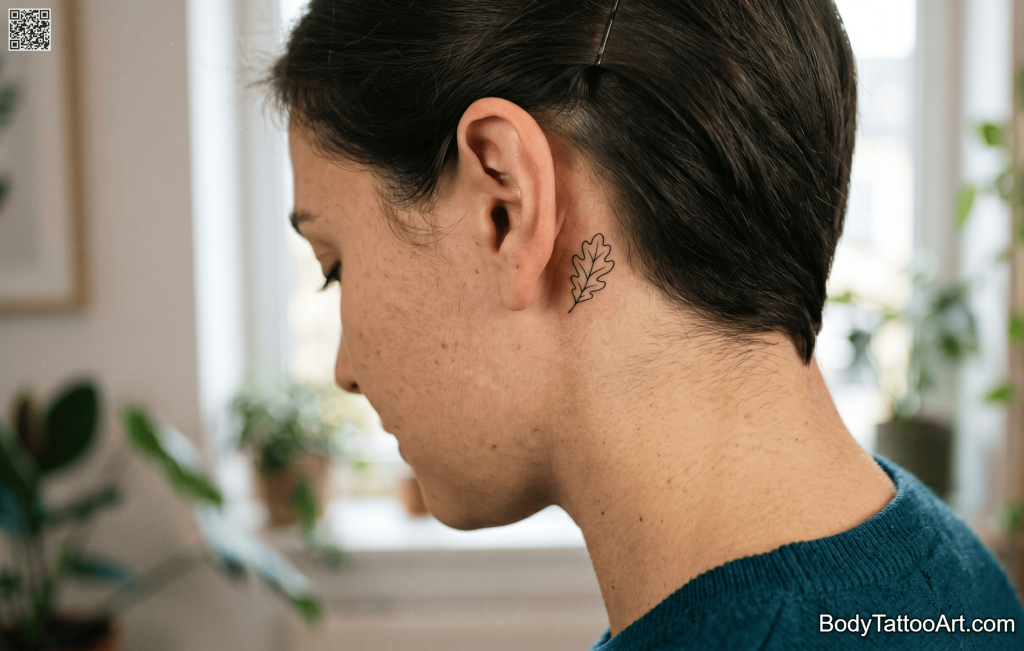
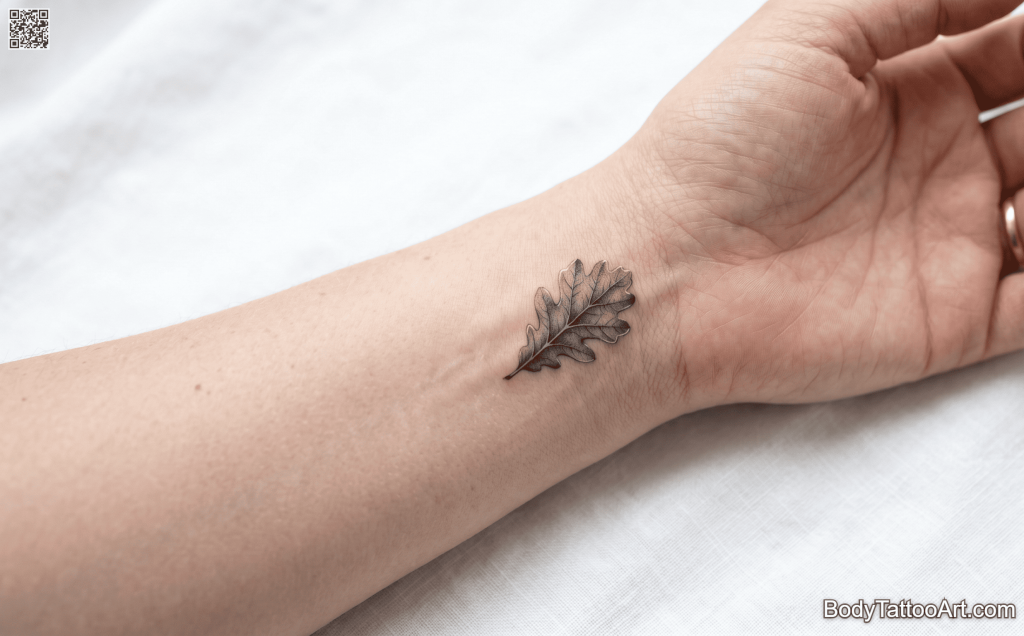
Tiny. The entire tattoo is no larger than a thumbnail. The oak leaf is rendered cleanly but at a very small scale — just enough detail to read the lobes and a hint of the midrib. Nothing more.
Placement: Behind the ear
Style: Fine line / micro Oak Leaf Tattoos
Why it stands out: The sheer restraint of a micro tattoo is its own kind of skill. The precision required to render an oak leaf at this scale is impressive.
Ideal for: First-time tattoo seekers, minimalists, and people who prefer their tattoos discreet and personal.
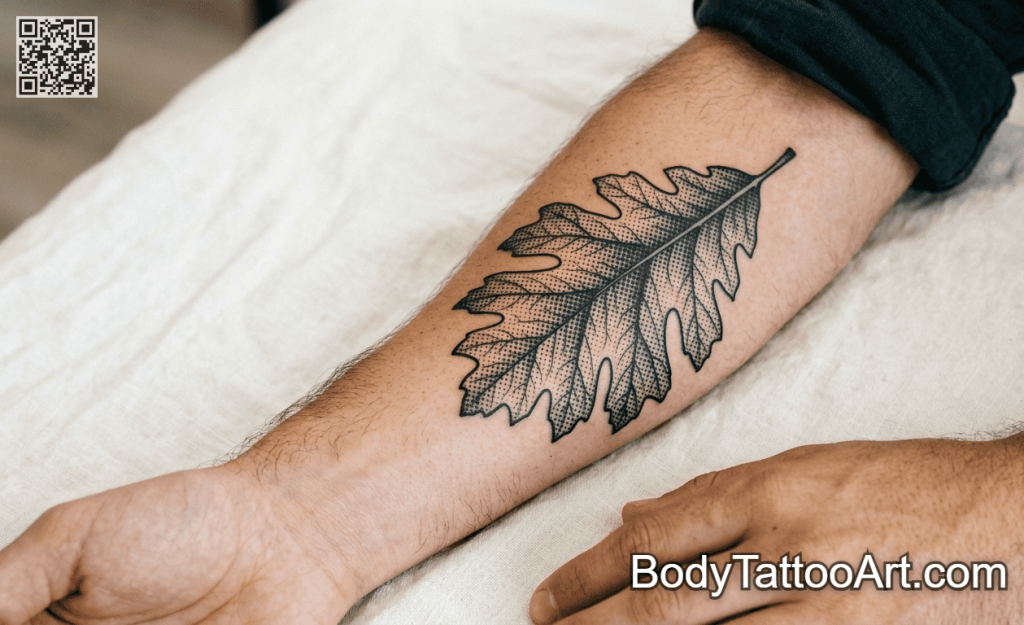
The shading in this tattoo is achieved entirely through halftone dots — circular dots of varying sizes that build up tone the way a screen-printed poster would. From a distance it looks like solid grey; up close the dots become visible.
Placement: Forearm (inner)
Style: Graphic / halftone Oak Leaf Tattoos
Why it stands out: Halftone tattooing mimics commercial printing processes. It gives the tattoo a retro graphic design quality that’s very different from organic shading.
Ideal for: Graphic design enthusiasts, tattoo collectors interested in unconventional techniques, and people who love vintage print aesthetics.
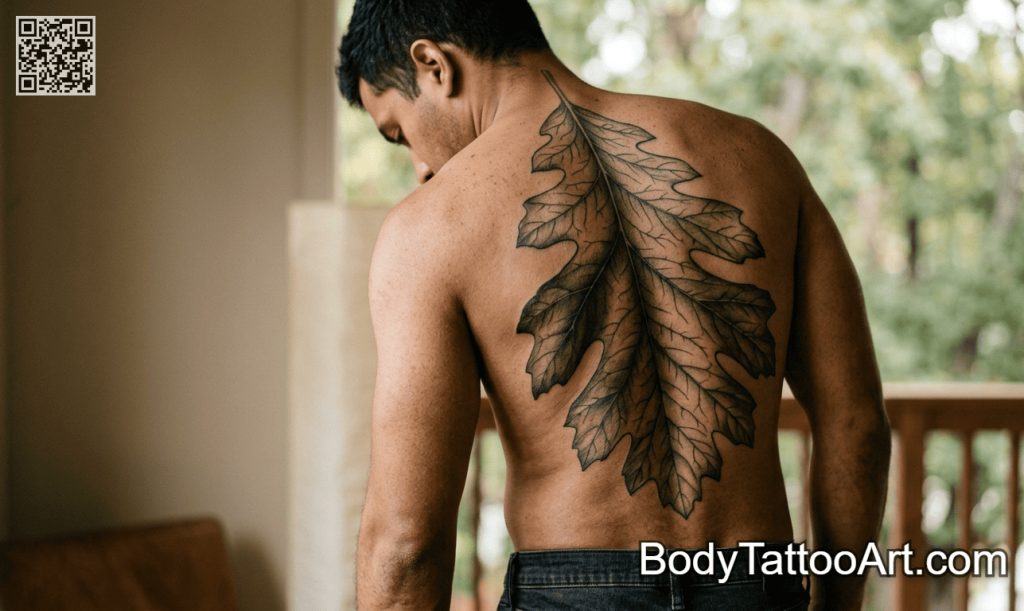
A single oversized oak leaf spans most of the upper back. The leaf is rendered with layered grey-wash shading, deep black shadow areas, and incredibly fine vein detail. The sheer scale gives it the quality of a statement piece.
Placement: Upper back
Style: Grey-wash realism / illustrative Oak Leaf Tattoos
Why it stands out: Scale alone transforms a common subject. At this size, every vein, every crease, every subtle tonal shift becomes visible — it’s a fully immersive botanical piece.
Ideal for: Collectors looking for a large statement back tattoo and people who appreciate botanical realism at scale.
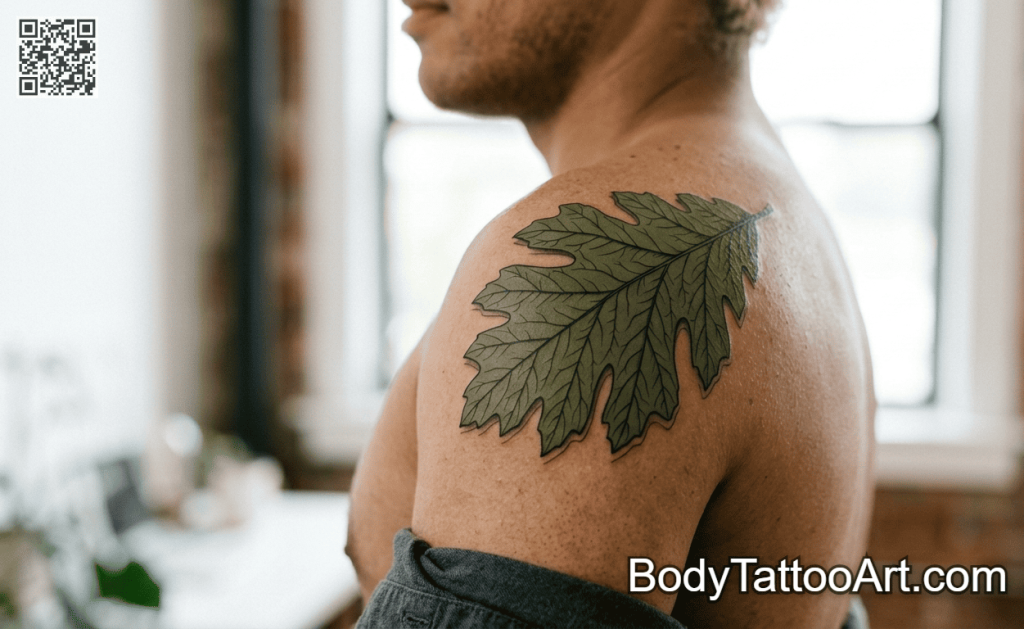
The tattoo mimics the aesthetic of paper cutting — the leaf appears layered, with shadow lines suggesting multiple cut paper layers. Thin parallel lines beneath the leaf’s outline create the illusion of depth between a paper layer and the skin.
Placement: Shoulder
Style: Illustrative / papercut Oak Leaf Tattoos
Why it stands out: The layered shadow lines create a subtle but clever three-dimensional illusion that makes the leaf look like it’s sitting above the skin.
Ideal for: Fans of illusion tattoos, people who appreciate detailed line work, and anyone interested in paper art aesthetics.
The oak leaf’s shape is reimagined using heavy tribal linework — bold black bands that follow the contours of the lobes, tapering to sharp points. There are no organic textures or natural details. The design is bold, angular, and pattern-based.
Placement: Calf / lower leg
Style: Tribal blackwork Oak Leaf Tattoos
Why it stands out: Tribal tattooing rarely incorporates leaf shapes, making this an unusual hybrid that feels both ancient and fresh.
Ideal for: Tribal tattoo enthusiasts, bold blackwork fans, and people who want something powerful and graphic.
The tattoo mimics the look of a linocut print — the surface of the leaf has visible cut marks suggesting the carving direction used in printmaking. Some areas are heavily inked while thin white cut-lines break through the black.
Placement: Upper chest / pectoral
Style: Illustrative / linocut Oak Leaf Tattoos
Why it stands out: The artificial cut-marks give the tattoo a handmade, craft quality. It looks like something transferred directly from a carved printing block.
Ideal for: Art enthusiasts, printmaking fans, and collectors who appreciate the cross-pollination of art forms and tattooing.

if you’re exploring tattoo styles that use similar bold, graphic approaches, the magnolia tattoo blog covers some stunning designs with comparable structural beauty.
Small enough to fit in the palm, but rendered with full photorealistic detail — every shadow, every vein, every surface texture. This is the most technically demanding tattoo on this list at its scale.
Placement: Inner wrist
Style: Micro-realism Oak Leaf Tattoos
Why it stands out: The contrast between the tiny size and the extreme detail level is what makes micro-realism so impressive. It challenges what people think a small tattoo can look like.
Ideal for: Collectors who appreciate technical excellence, people who want something understated but deeply impressive up close, and tattoo enthusiasts who love realism.
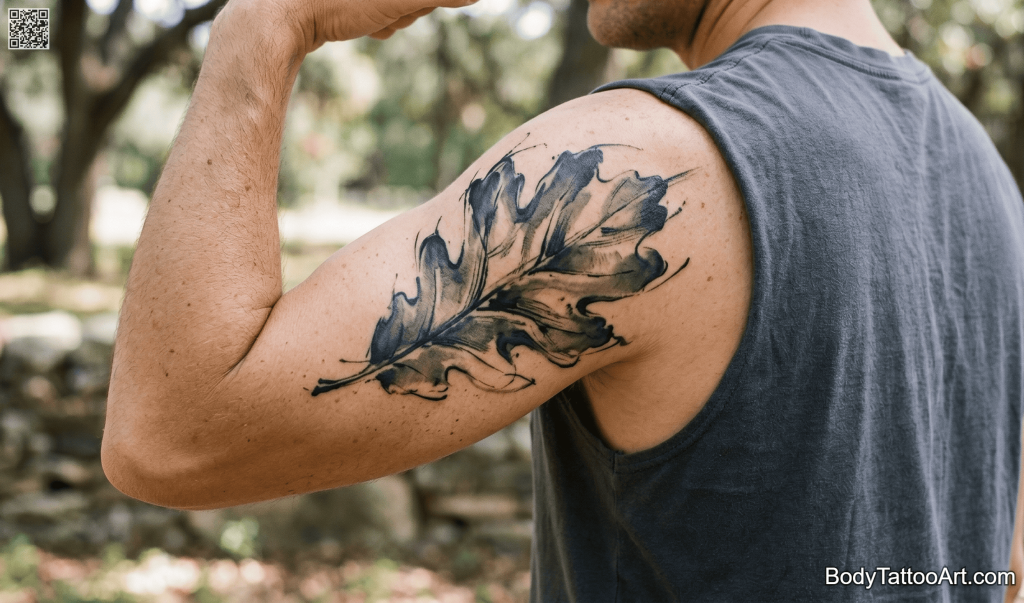
The leaf is painted rather than drawn — thick, gestural ink wash brush strokes build the form with loose, expressionistic confidence. The edges bleed and fade. Some strokes overshoot the leaf shape. The energy is bold and spontaneous.
Placement: Back of the upper arm
Style: Ink wash / sumi-e inspired Oak Leaf Tattoos
Why it stands out: The deliberate roughness and brush movement make this look like a piece of East Asian ink painting. It has energy and motion that a clean tattoo can’t replicate.
Ideal for: Fans of ink painting aesthetics, people who love expressive rather than precise tattooing, and collectors who want something with raw artistic energy.
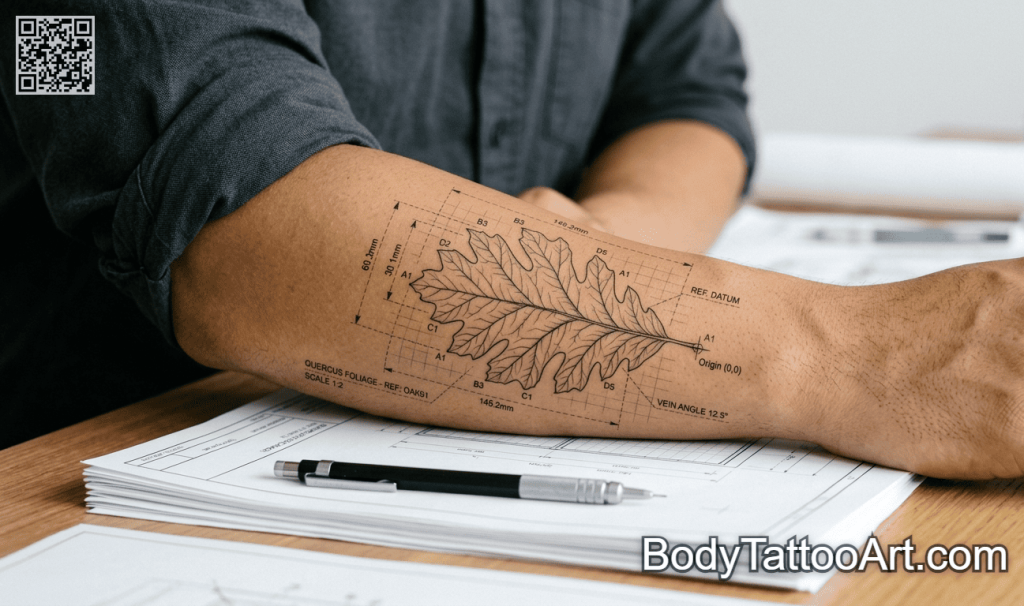
The leaf is drawn in the style of a technical or architectural drawing — dashed measurement lines, small crosshair markers at key points, thin grid lines in the background. The vein structure is labeled with tiny dashed indicator lines as if it’s a diagram.
Placement: Forearm (outer)
Style: Technical / architectural Oak Leaf Tattoos
Why it stands out: Taking an organic natural form and rendering it like an engineered diagram creates an interesting tension. It makes the viewer see the geometry in nature.
Ideal for: Engineers, architects, designers, and anyone who appreciates the crossover between technical drawing and tattooing.
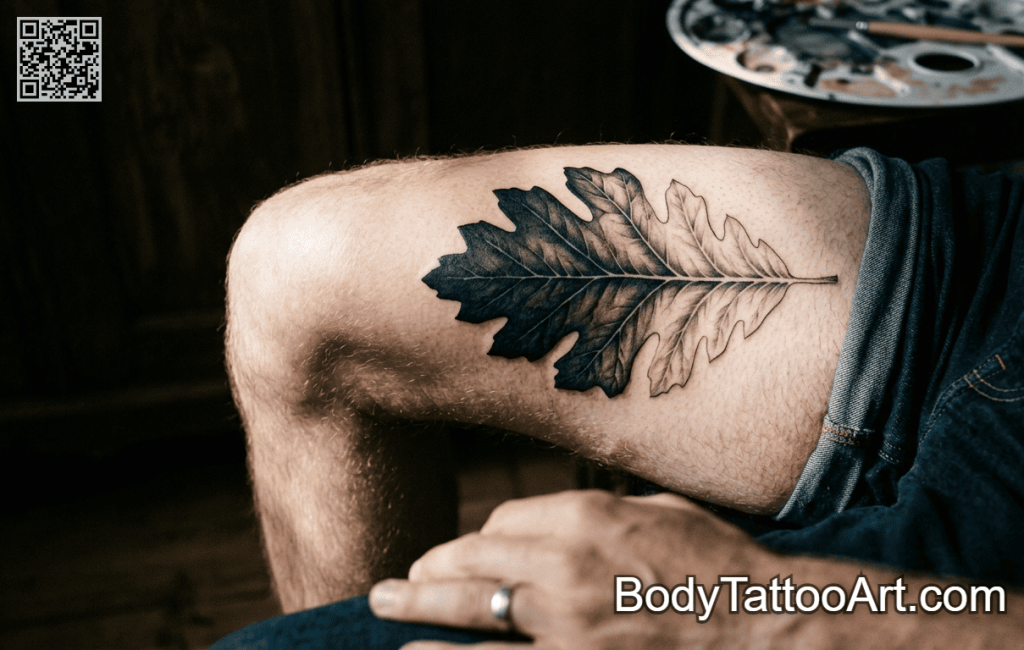
The leaf is rendered with dramatic chiaroscuro — extreme contrast between deep black shadow areas and near-white highlight zones. Half the leaf sits in deep shadow; the other half catches imaginary light. The tonal jump is stark and theatrical.
Placement: Thigh
Style: Grey-wash realism / chiaroscuro Oak Leaf Tattoos
Why it stands out: The theatrical lighting approach is rare for a leaf tattoo. It gives the design a dramatic, almost Renaissance painting quality.
Ideal for: Realism fans, people who love dramatic tattoo aesthetics, and collectors looking for something with visual impact.
Oak leaf tattoos are one of those designs that genuinely reward creativity. The shape is strong enough to hold up across every style imaginable — from a hairline-thin single-line sketch to a full back piece in grey-wash realism. The 27 oak leaf tattoo ideas covered here prove there’s no single “right” way to approach this design.
Take the time to find inspiration, build a reference folder, and trust the process. The right oak leaf tattoo will feel like it was always supposed to be there.