Physical Address
304 North Cardinal St.
Dorchester Center, MA 02124
Physical Address
304 North Cardinal St.
Dorchester Center, MA 02124

Some tattoo subjects never get old. Like Roses, Sunflowers, Lavenders in floral ideas and Palms and Ferns in botanicals. The tiger is one of them — and not just because it looks impressive. There’s something about the structure of the animal that lends itself to ink in a way most other subjects don’t. The face alone gives you stripes, deep-set eyes, layered fur, and that jaw — all of which translate into extraordinary detail work regardless of style.
But tiger tattoos aren’t just for people chasing drama. Done as a micro piece behind the ear or a quiet stippled portrait on the calf, a tiger tattoo can be just as restrained as it is fierce. The designs below cover a wide range — 26 ideas that look nothing like each other, built for different bodies, different aesthetics, and different levels of tattoo commitment.
The tiger carries weight across a lot of cultures, and it’s worth knowing what you’re working with before picking a design.
In Chinese tradition, the tiger is one of the four celestial animals — a guardian that watches over the west and wards off evil spirits. In Japanese tattooing, the tiger is traditionally paired with wind, representing the strength to endure change. In Hinduism, Goddess Durga rides a tiger, linking the animal to divine strength and protection. Across Southeast Asia, tigers appear in folk tales as protectors of the forest and symbols of untamed nature.
Beyond cultural meaning, people are drawn to tiger tattoos because they represent something more personal — independence, ferocity, resilience, or the quiet confidence of someone who doesn’t need to prove anything.
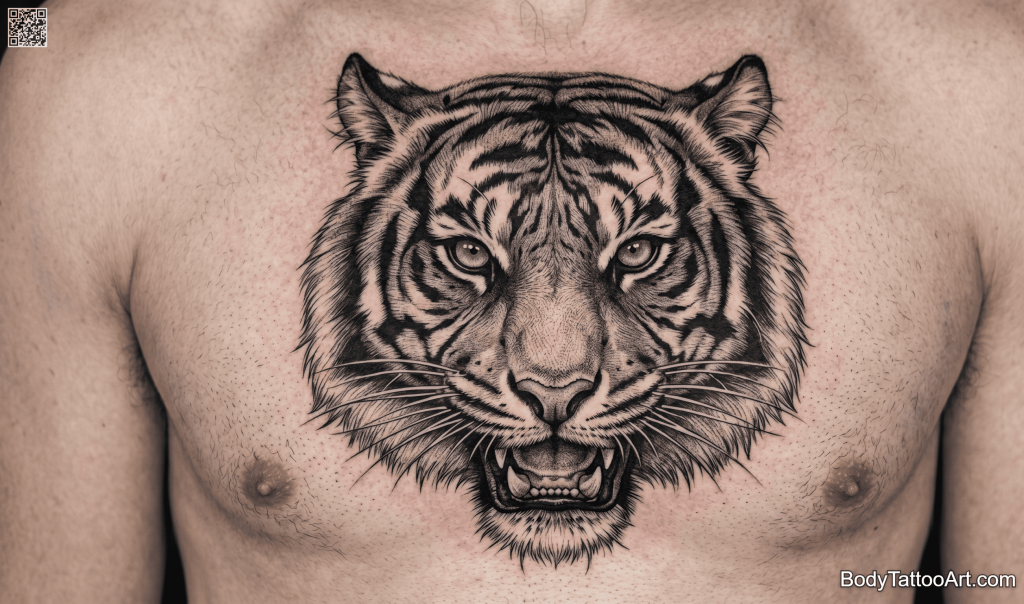
A straight-on tiger face, centered and completely symmetrical. The composition doesn’t tilt or angle — it locks eyes with whoever looks at it. The fur is built with micro-fine hatching that changes direction around the cheeks and forehead. The eyes have cornea highlights, depth in the iris, and shadow behind the pupils that makes them look wet.
Placement: Chest
Style: Black and grey realism Tiger Tattoos
Why it stands out: Symmetry is hard to pull off in realism tattooing. When it works — and this composition is built around it working — the result is genuinely arresting. The gaze doesn’t move no matter the angle.
Ideal for: People who want one statement piece with no surrounding elements. Collectors who let the subject carry all the weight.
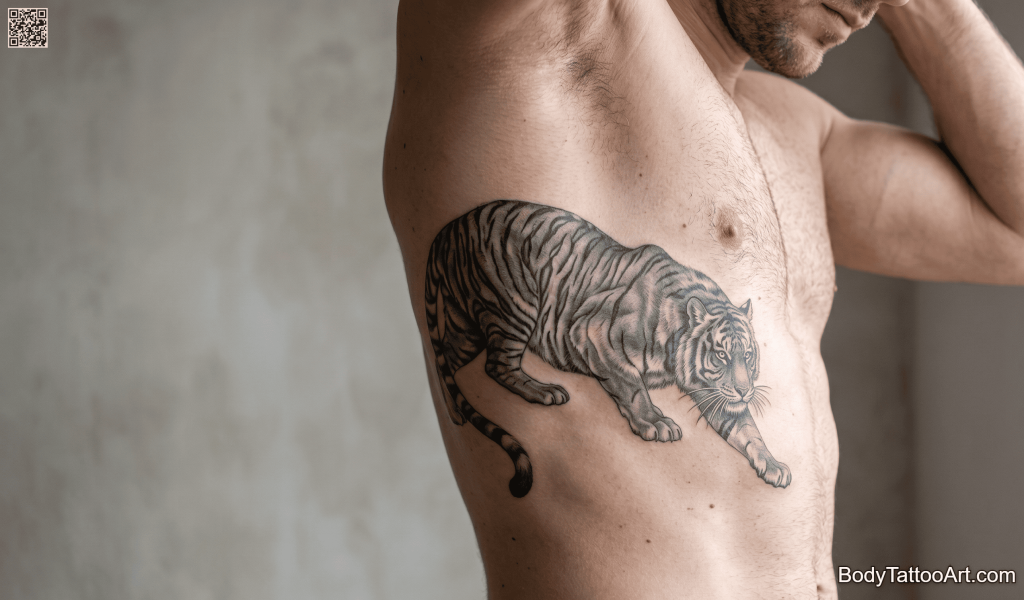
The tiger is stretched horizontally in a full prowl — belly almost grazing the floor, shoulder blades raised, neck forward. This isn’t a resting pose. It’s the moment before something happens. The muscles under the fur are visible as subtle shifts in shading, and the tail traces a long arc behind the body.
Placement: Ribcage
Style: Grey-wash realism Tiger Tattoos
Why it stands out: The horizontal stretch of the prowling body sits against the ribcage in a way that actually uses the body’s shape rather than ignoring it. The tattoo follows the natural line of the ribs.
Ideal for: People who want a full-body animal form. Anyone who appreciates placement harmony over just picking a spot.
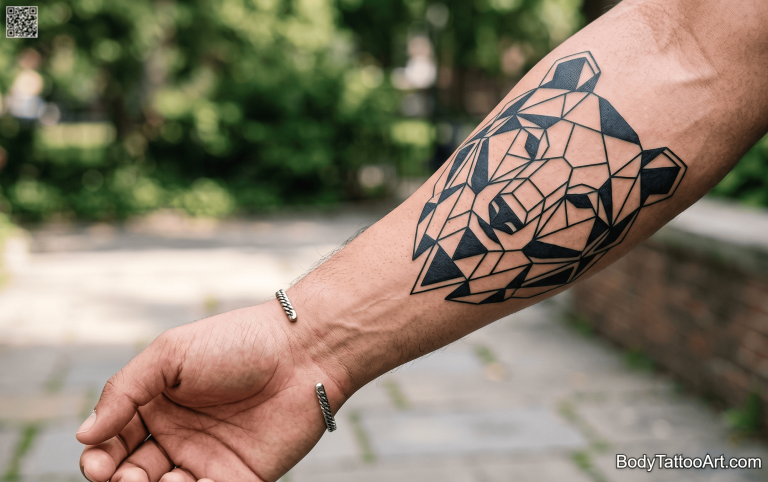
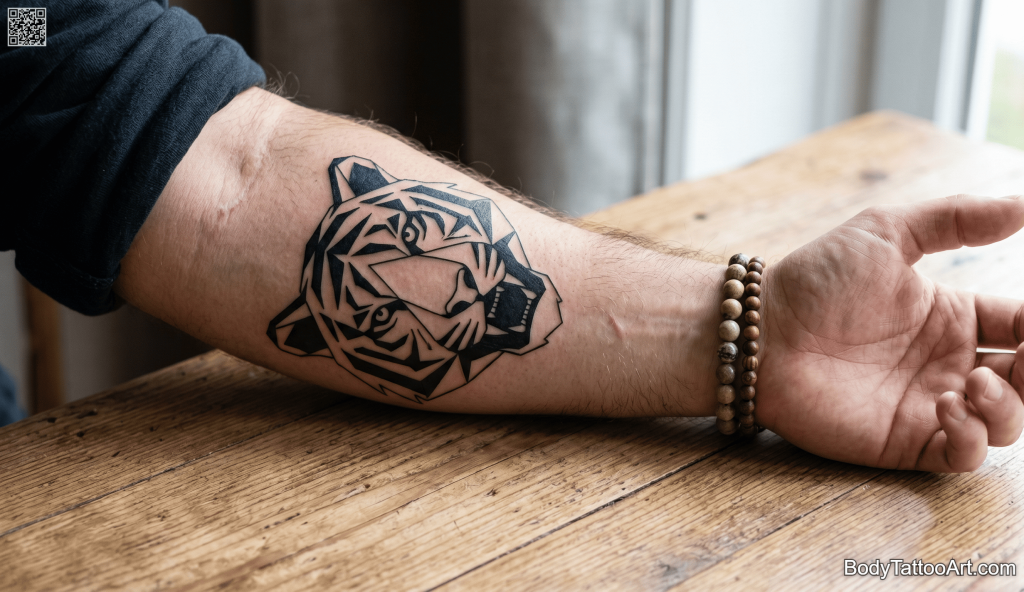
The tiger’s face has been broken into flat geometric planes — like the wireframe model of a 3D render printed in ink. Some sections are solid black, others are white space, and the contrast between them builds the form without any traditional shading. From a distance it reads as abstract. Closer up, the face becomes clear.
Placement: Forearm
Style: Geometric blackwork Tiger Tattoos
Why it stands out: It treats the tiger as a design problem rather than a portrait. The result sits somewhere between architecture and tattooing — structured, clean, and built to be read from any distance.
Ideal for: People with a graphic design sensibility. Those who want something bold that doesn’t look like anyone else’s tiger tattoo.
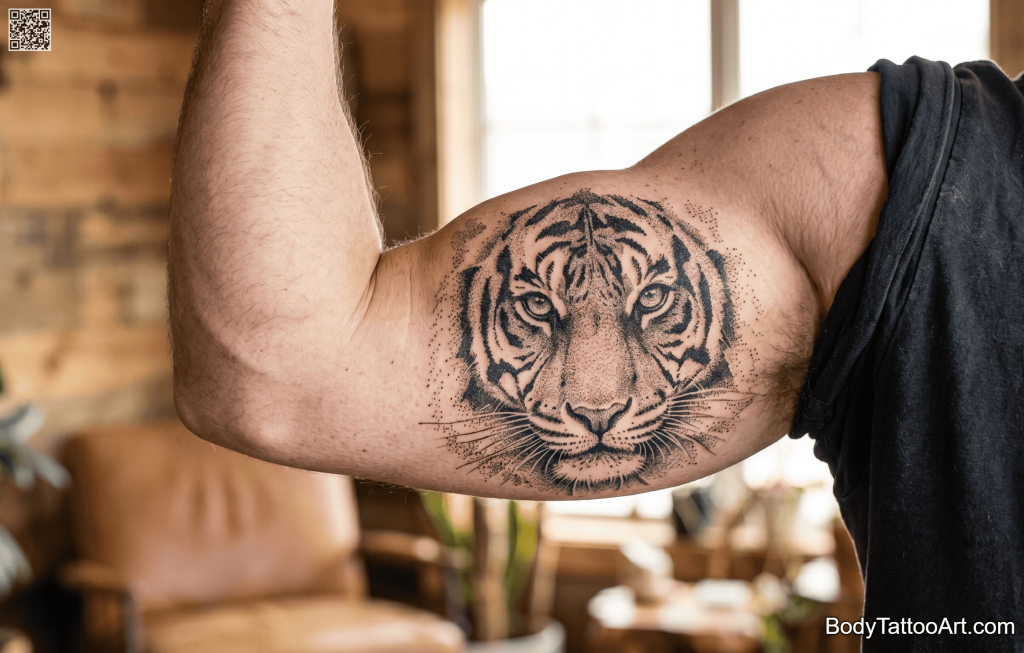
No outlines. No solid fills. Just thousands of individual dots placed with enough precision that the tiger’s face emerges from them like a developed photograph. The darkest zones — around the eye corners, along the nose bridge, where the stripes sit heaviest — are dense with dots so close they nearly touch. The edges of the design dissolve as the dots drift further apart.
Placement: Bicep
Style: Dotwork Tiger Tattoos
Why it stands out: The gradation in dotwork is unlike anything else in tattooing. The image softens at its own edges, which gives it an almost holographic quality when the light changes on it.
Ideal for: People who like to get close and look at their tattoos. Anyone who values technical process over flashy results.
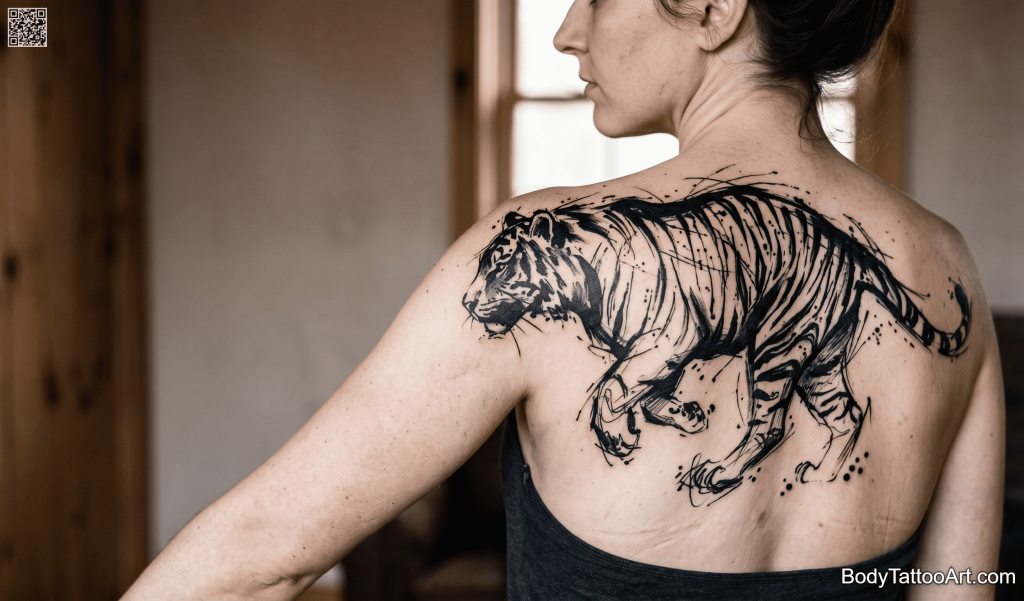
This tattoo looks like someone painted it with a wide ink brush in a single sitting and meant every mark. Thick gestural strokes form the back and haunches. A bold curve suggests the head. Thin splattered lines read as stripes. The paws are barely indicated — just a few marks. The entire design has movement and speed built into it, like the tiger was caught mid-stride and the artist kept up.
Placement: Shoulder and upper back
Style: Abstract brushwork Tiger Tattoos
Why it stands out: Most tiger tattoos try to capture the animal’s details. This one captures its energy instead. There’s no wasted mark here — every stroke is doing structural work.
Ideal for: People who appreciate sumi-e painting or gestural art. Anyone bored by hyper-rendered realism.
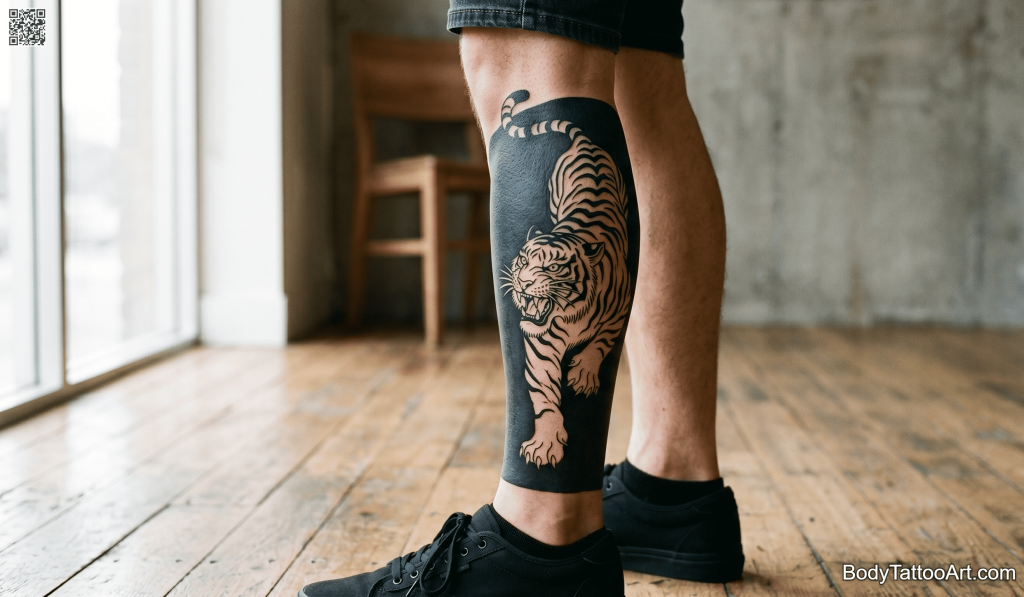
The design reverses the usual logic. The skin is the tiger. A field of solid black covers the surrounding area, and the tiger’s form — face, stripes, outline — is the untouched skin left within it. The stripes don’t need to be inked because the black around them does the job.
Placement: Calf
Style: Negative space blackwork Tiger Tattoos
Why it stands out: It takes a second to read, which is exactly what makes it work. The eye adjusts, the tiger appears, and the visual puzzle is satisfying every time.
Ideal for: People who like designs with a concept behind them. Blackwork collectors looking for something beyond solid fills.
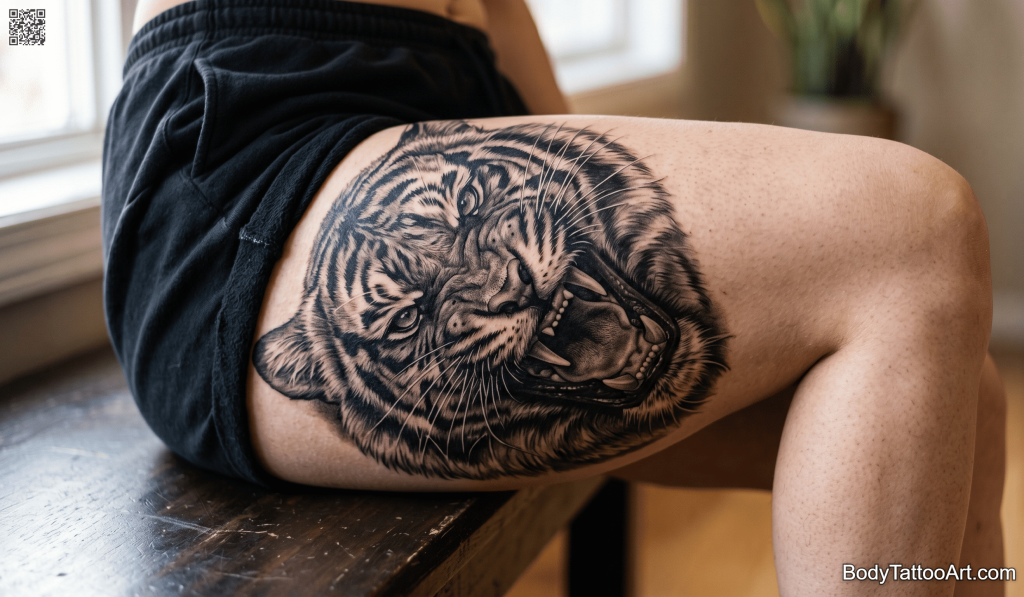
The composition is tight — just the face, zoomed in to the moment the roar is happening. The mouth is fully open, the tongue slightly visible, the teeth sharp and deeply shaded. The skin folds at the nose and around the eyes are rendered with the kind of attention usually reserved for portrait work. This is less about power as a concept and more about power as a physical event.
Placement: Thigh
Style: Black and grey realism Tiger Tattoos
Why it stands out: Still, composed tiger faces are everywhere. This one is caught in motion — mid-sound, mid-breath — which gives it a completely different energy from most tiger tattoos.
Ideal for: People who want drama without ornamentation. Collectors who like wildlife realism at its most raw.
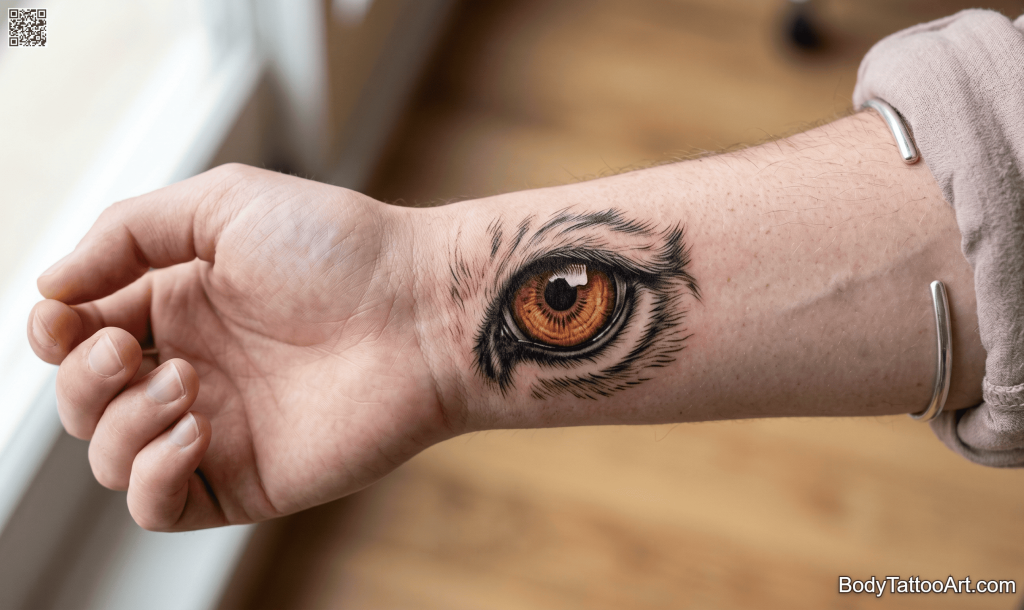
One tiger eye. That’s the whole tattoo. The iris fills with radial amber-toned lines around the pupil. A small white highlight sits on the cornea. The fur around the socket is suggested with fine, short strokes. At first glance it could almost be a human eye — but the coloring and structure give it away.
Placement: Inner wrist
Style: Fine line realism Tiger Tattoos
Why it stands out: There’s something a little unsettling about a single eye as a tattoo — in the best way. It watches. And for a small piece, the amount of information packed into it is remarkable.
Ideal for: Fine line fans. People who want something that rewards close attention. Those who prefer their tattoos to whisper rather than shout.
Looking for more animal-inspired combination tattoo ideas? Check out these related posts:, Sunflower with tiger tattoos and Lotus with tiger tattoos — all covering a similar range of styles and placements.
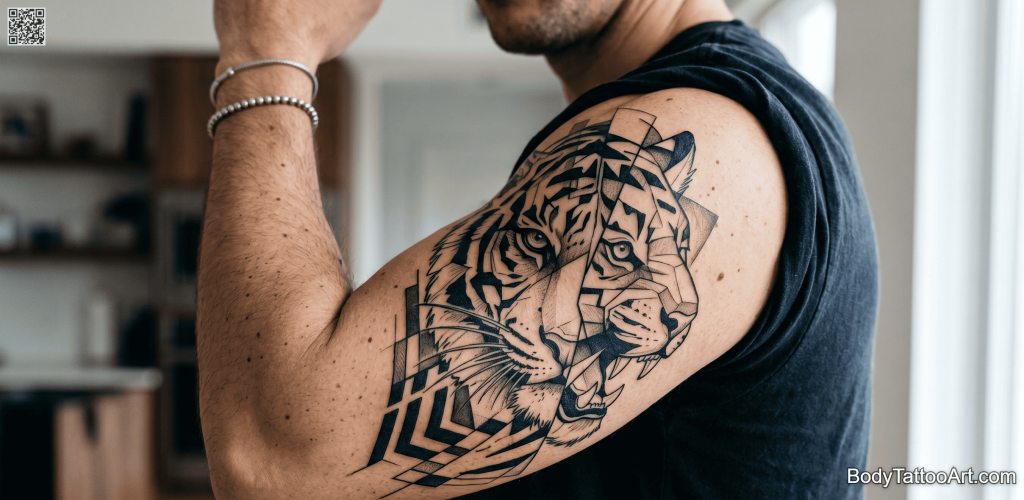
A cubism-influenced tiger face that borrows from Braque and Picasso — the same face shown from multiple perspectives simultaneously. One eye is forward-facing, the other is in profile. The nose sits flat against abstract planes. Stripes become blocks. The face is deconstructed and rebuilt into something that looks wrong and right at the same time.
Placement: Upper arm
Style: Cubist illustrative Tiger Tattoos
Why it stands out: It’s the most art-historically interesting composition on this list. No other tiger tattoo approach makes the viewer work this hard to read the subject — and the payoff is worth it.
Ideal for: People with a connection to fine art. Collectors who want their tattoo to start conversations rather than just draw looks.
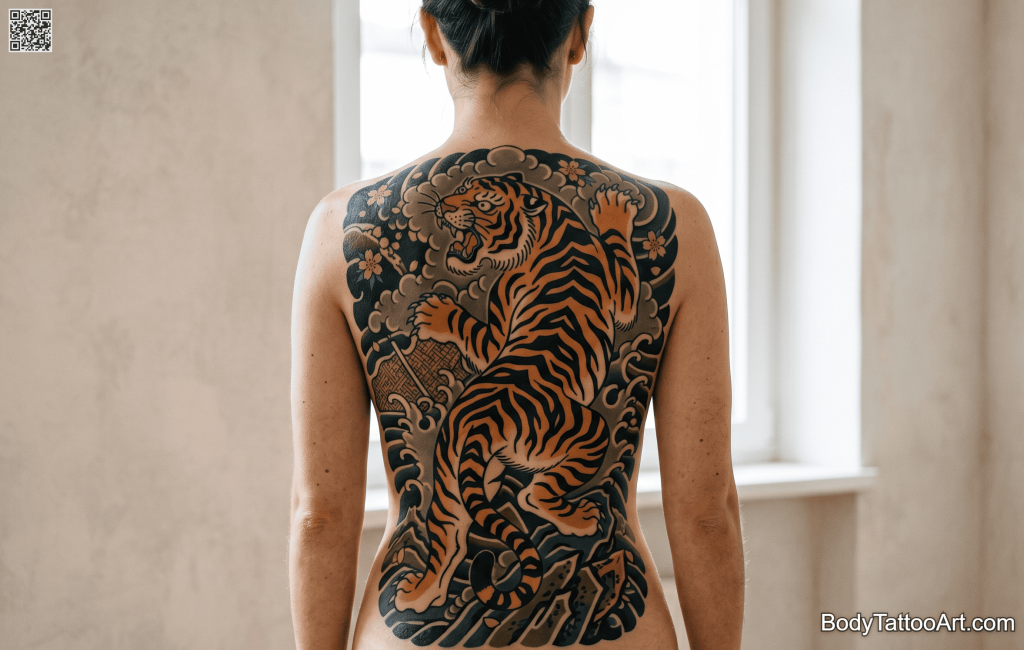
Inspired by traditional Japanese woodblock printing — flat, graphic, bold. The tiger’s outline is thick and decisive. The stripes are solid black shapes rather than drawn lines. The face features stylized proportions: slightly wide-set eyes, simplified nose. There’s no photographic shading here — only flat tones that hold up at a distance.
Placement: Full back
Style: Japanese woodblock / traditional Tiger Tattoos
Why it stands out: Flat graphic tattooing has a durability that realism often doesn’t — the design reads cleanly for decades. This style also makes the tiger feel archetypal rather than literal.
Ideal for: People building traditional-themed Japanese back pieces. Anyone who appreciates print culture and graphic design history.
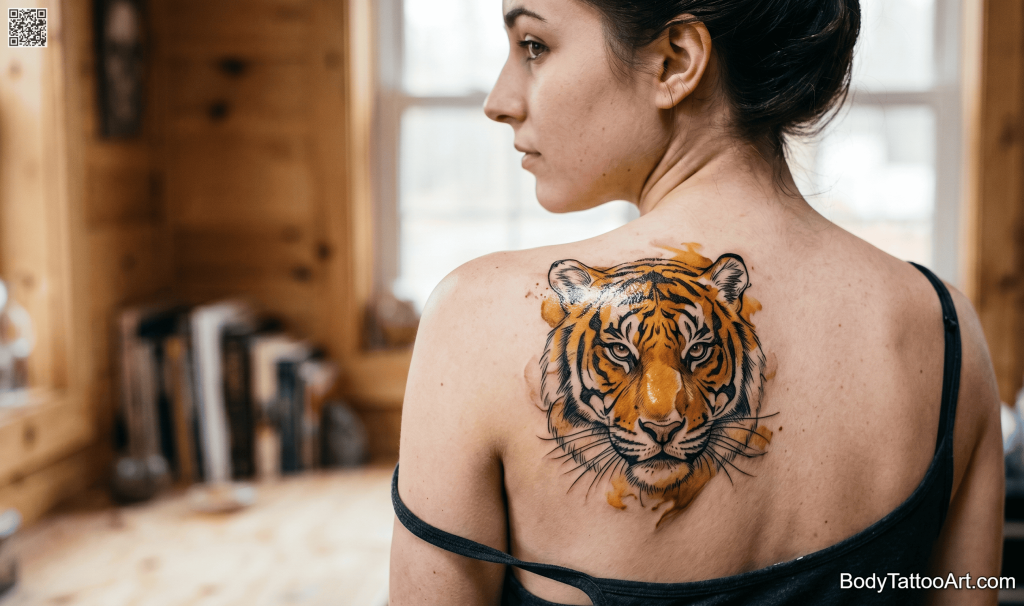
Fine black linework holds the tiger’s face together — clean, deliberate, exact. But inside those lines and beyond them, color washes of amber, burnt orange, and deep gold bleed freely. The ink doesn’t stay inside the lines. Color pools in some areas and barely touches others. The result looks like it was painted from the inside out.
Placement: Shoulder blade
Style: Watercolor Tiger Tattoos
Why it stands out: Most tiger tattoos in color use the color to fill in — this one uses color to overflow. The warmth of the palette matches the animal’s coat naturally, which makes the choice feel inevitable rather than decorative.
Ideal for: Color tattoo collectors. People who want warmth and looseness in an otherwise bold subject.
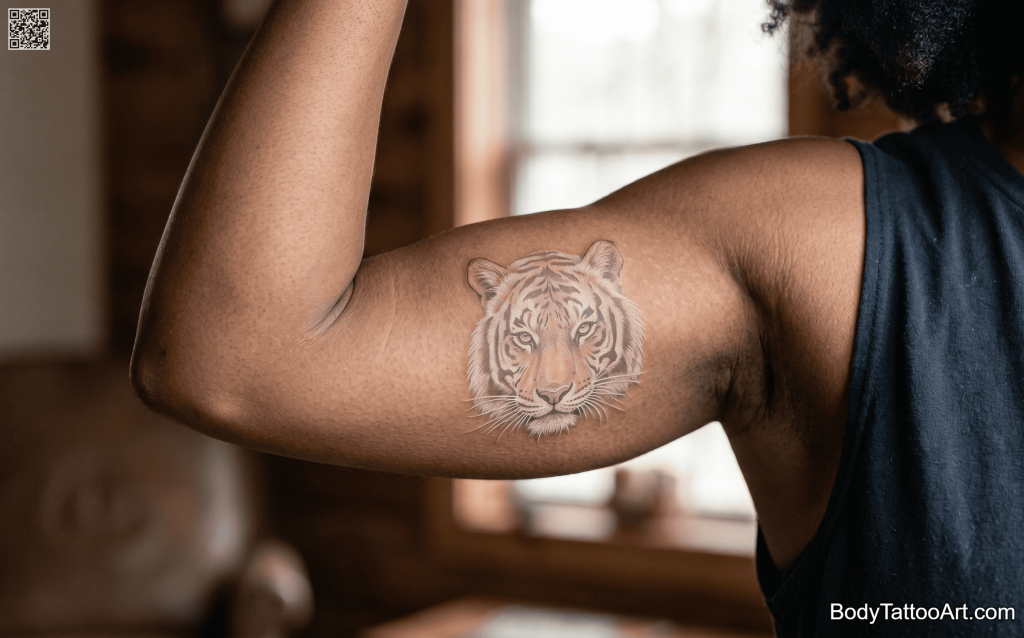
Designed with darker skin tones in mind — white ink only. The tiger’s lighter fur is formed by the white ink, and the natural pigment of the skin becomes the dark stripes. No black lines separate them. The design lives in the contrast between ink and skin, which means the body itself is part of the composition.
Placement: Inner bicep
Style: White ink Tiger Tattoos
Why it stands out: The skin isn’t just the canvas — it’s an active element of the design. That’s rare in tattooing and makes this one genuinely different from anything else on this list.
Ideal for: People with medium to deep skin tones who want something subtle. Anyone interested in tone-on-tone aesthetics.
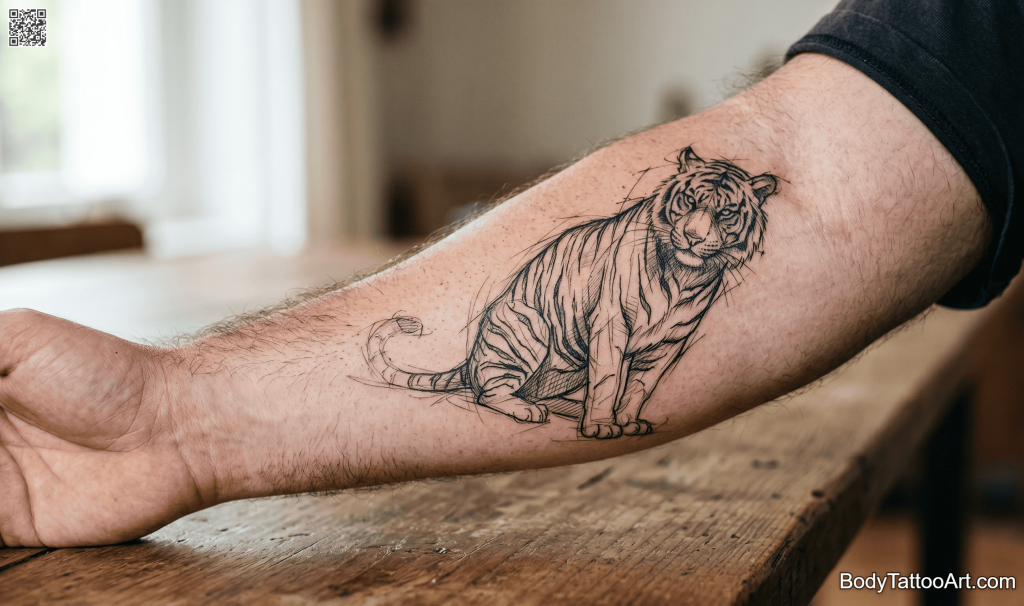
This tattoo looks like someone’s sketchbook page lifted and placed onto the arm. Loose, slightly variable pencil-style lines. Some areas reinforced with heavier strokes, others barely there. Small construction lines are visible that were never cleaned up. It’s intentionally unfinished — and that’s exactly what makes it feel personal.
Placement: Forearm
Style: Sketch linework Tiger Tattoos
Why it stands out: Polished realism is common. Deliberately rough, drawn-looking work is harder to execute convincingly and far more interesting when it lands.
Ideal for: Artists and illustrators. People who want a tattoo that feels handmade and specific to them.
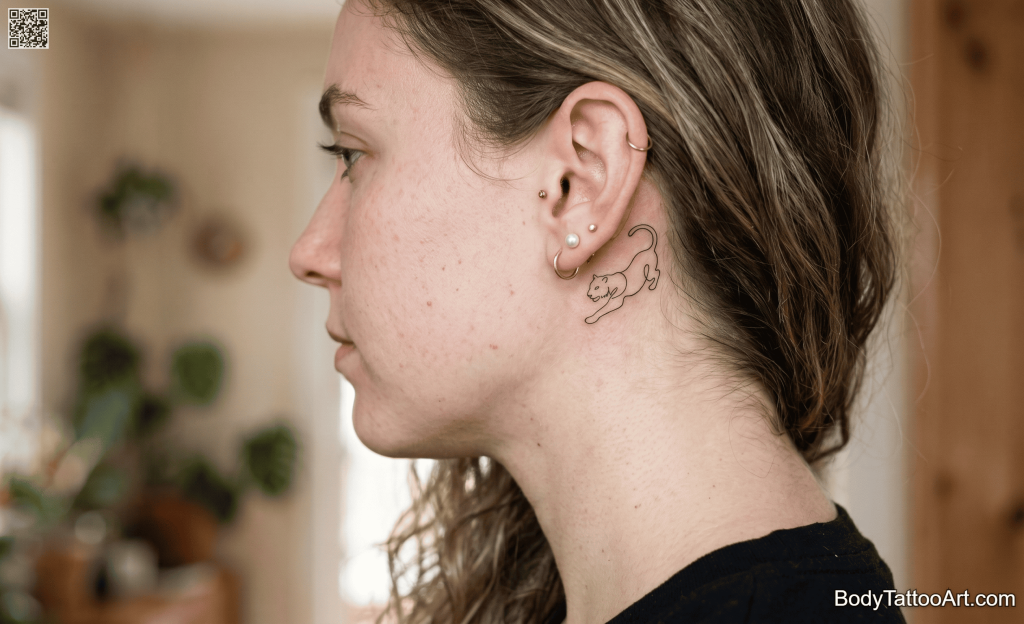
A single unbroken line traces the tiger’s crouching silhouette from nose to tail and back. No interior detail. No shading. Just the contour — clean, confident, complete. The shape is immediately readable, which proves how recognizable the tiger is as a form even at minimal resolution.
Placement: Behind the ear
Style: Minimalist fine line Tiger Tattoos
Why it stands out: The whole challenge is in what’s not there. Every unnecessary curve has been removed. What’s left is the essential tiger — nothing more, nothing less.
Ideal for: First-timers. People who prefer small precise placements. Anyone who lives by the less-is-more rule.
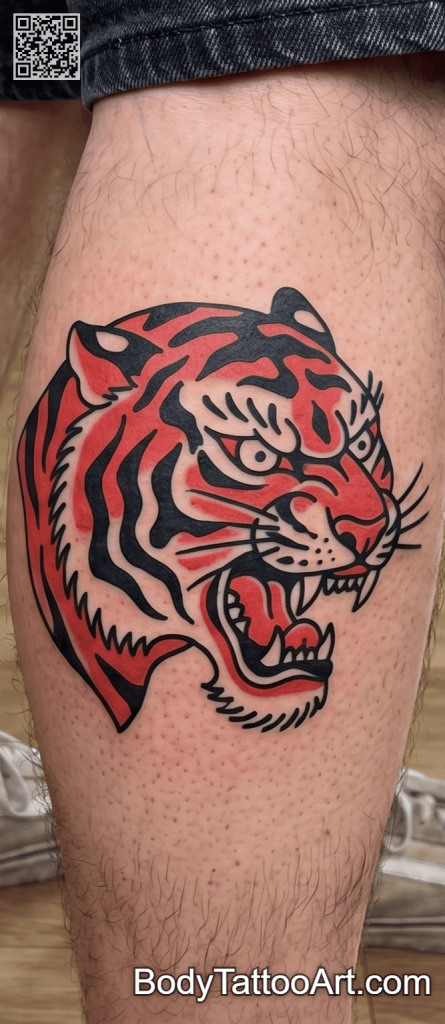
American traditional at its most committed — thick outlines, red and black palette, flat fills, zero subtlety. The tiger snarls in a three-quarter view. Stripes are solid black shapes. Red covers the cheeks, inner ears, and corners of the eyes. This is the tattoo version of a rock band patch. It’s not trying to impress anyone who doesn’t already get it.
Placement: Outer calf
Style: American traditional Tiger Tattoos
Why it stands out: Traditional tiger tattoos age differently from realism — the bold lines and flat fills hold for decades without losing the image. There’s longevity built into the style.
Ideal for: Old school collectors. People building traditional American sets or sleeves.
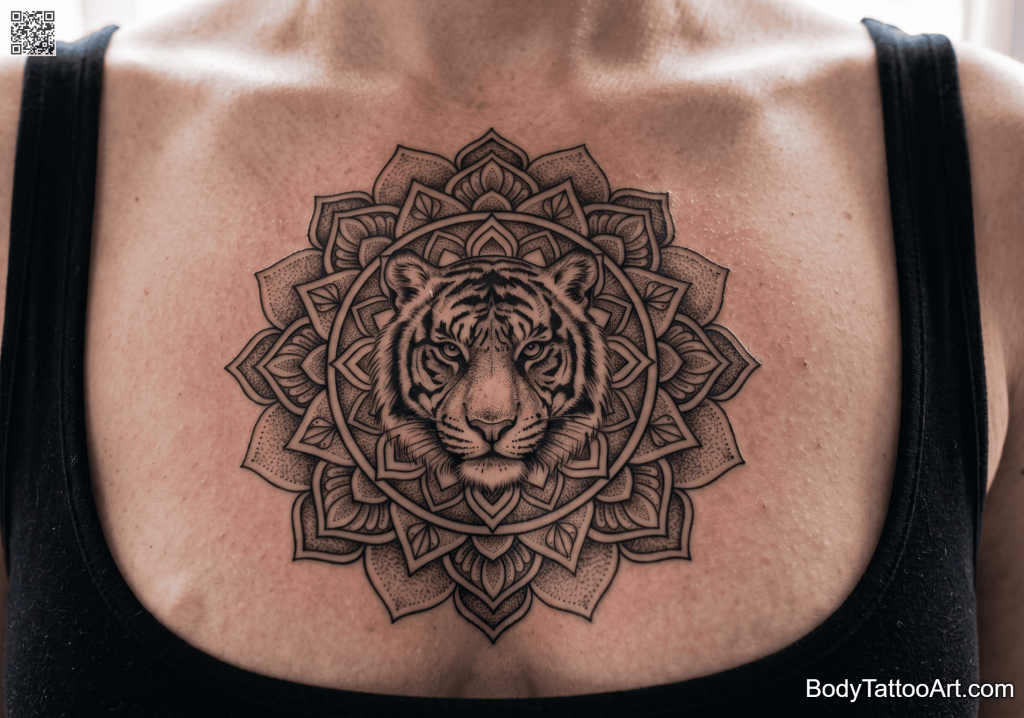
The tiger’s face sits at the center of a mandala — concentric rings of petals, fine geometric shapes, and dotwork patterns radiating from the nose outward. The mandala isn’t decorating the tiger. It’s framing it the way a setting frames a stone. The organic animal face against the structured geometry creates a tension that makes both elements stronger.
Placement: Sternum
Style: Ornamental dotwork Tiger Tattoos
Why it stands out: Standalone mandala tattoos are common. Tiger portraits are common. Combining them with this kind of compositional intention is not.
Ideal for: Ornamental tattoo fans. People who like their designs to have a clear structural logic.
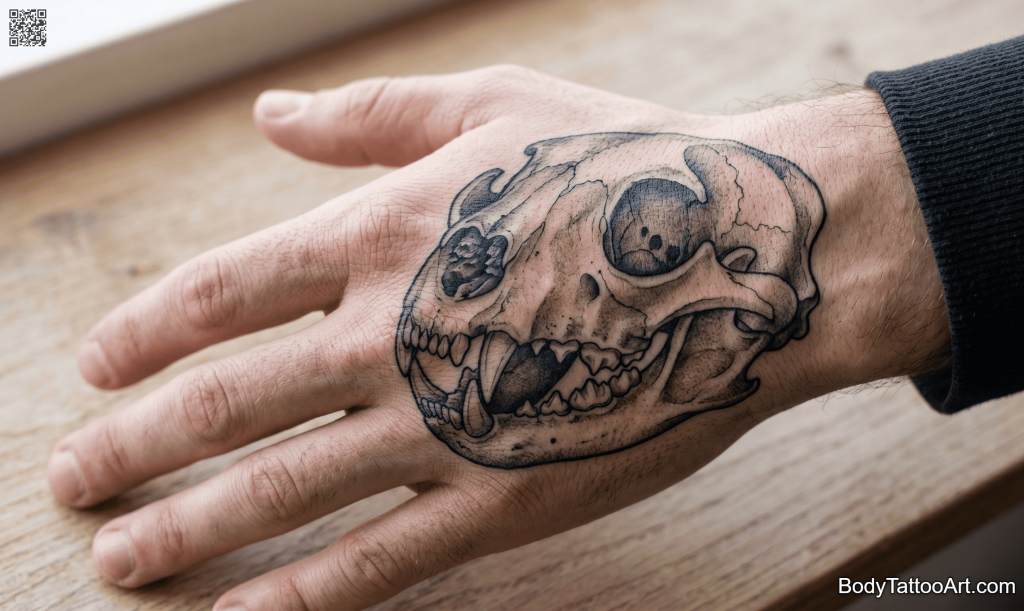
A tiger skull rendered with anatomical seriousness — not a cartoon death symbol, but a real study of bone structure. The cheekbones arch. The eye sockets are deep and well-proportioned. The teeth are still in place, and their root structure is visible where the gumline would have been. Light grey shading in the recessed areas gives the whole thing three-dimensional weight.
Placement: Back of hand
Style: Black and grey realism Tiger Tattoos
Why it stands out: There’s a version of skull tattooing that’s purely aesthetic — and then there’s this. The anatomical reference makes the skull feel like it’s making an argument about the tiger rather than just using it as a symbol.
Ideal for: Dark aesthetic collectors. People drawn to biological and anatomical art references.
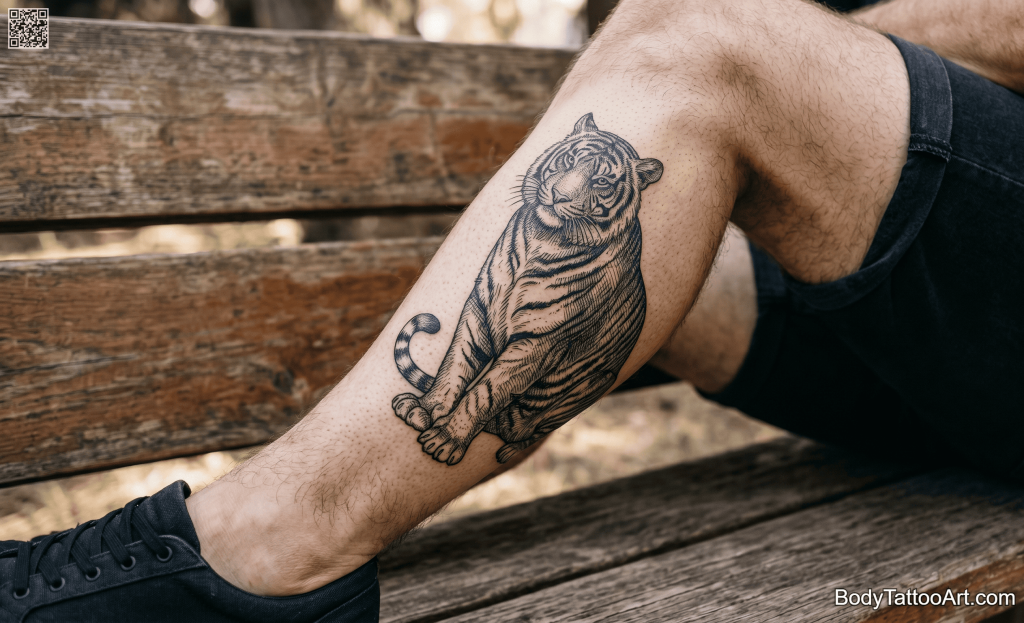
The entire tiger — full body, seated — is built from lines only. Parallel hatching describes the fur direction. Cross-hatching builds the shadows under the chin, behind the ears, between the paws. No area of the design uses a solid fill or grey wash. The darkness is created entirely by line density, the same way 17th-century engravings were made.
Placement: Shin
Style: Engraving linework Tiger Tattoos
Why it stands out: This is one of the most demanding styles in tattooing because there’s no shading to smooth over imprecision. Every line is doing work. The reference to engraving history makes it feel timeless.
Ideal for: People who appreciate technical printmaking. Collectors who want something that looks like it came out of a different century.
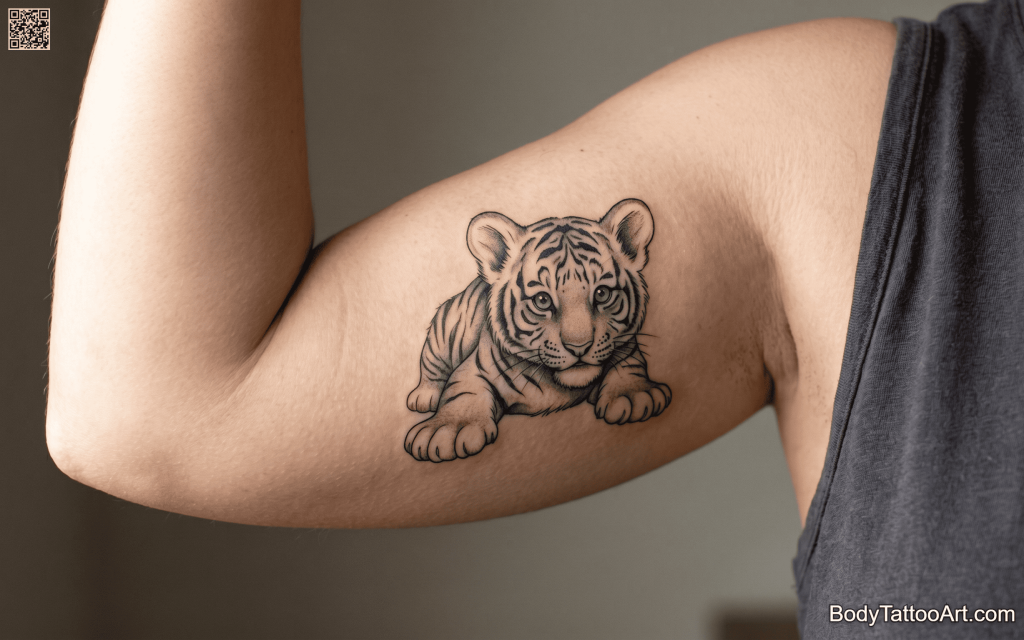
A tiger cub — head proportionally too big, paws too wide for the body, ears at full attention. The pose is a low crouch that looks more curious than threatening. The style is illustrative with soft shading and clean linework. This tattoo isn’t making any claims about power or symbolism. It’s just a very good drawing of a young tiger doing cub things.
Placement: Inner bicep
Style: Soft illustrative Tiger Tattoos
Why it stands out: Tiger tattoos overwhelmingly go for the adult animal in its most intimidating form. A cub rendered with this kind of observation and personality is a genuine counterpoint — and more visually interesting for being unexpected.
Ideal for: Wildlife art enthusiasts. People who want character and warmth rather than intensity.
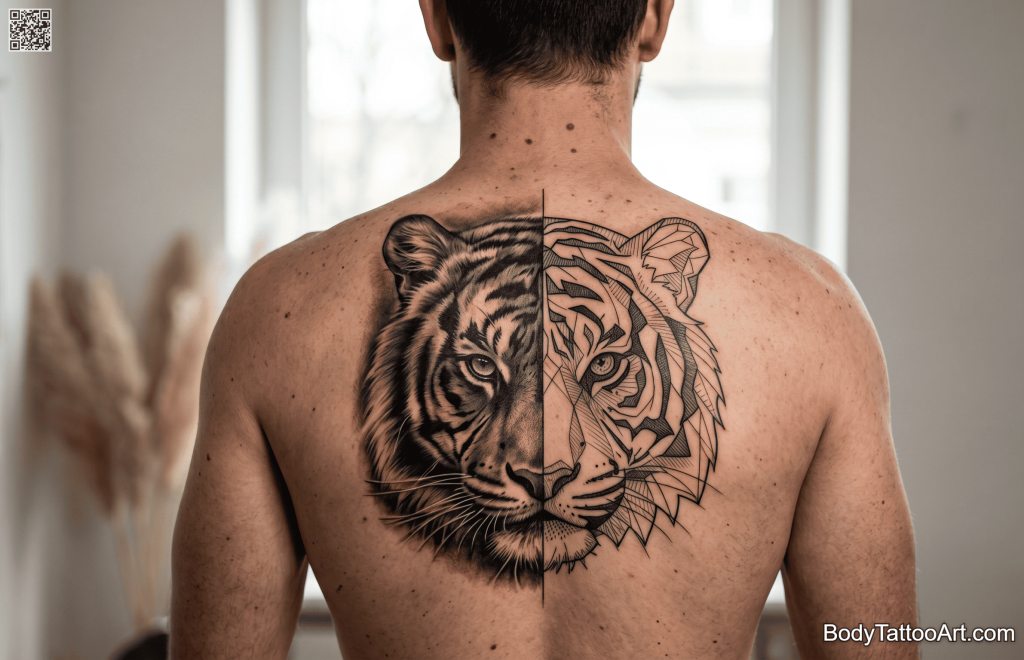
The face is split vertically down the center. The left half is photorealistic black and grey — every hair strand, every shadow, full depth. The right half is the same face in geometric linework only — planes and lines where the shading would be. Both halves align perfectly at the dividing line. The split isn’t a trick. It’s a statement about the two ways of seeing the same thing.
Placement: Upper back
Style: Split realism and geometric Tiger Tattoos
Why it stands out: Every element of this design exists in deliberate tension with the other half. The more time spent looking at it, the more the contrast becomes interesting rather than just unusual.
Ideal for: Collectors looking for something genuinely conceptual. People interested in design theory and duality themes.
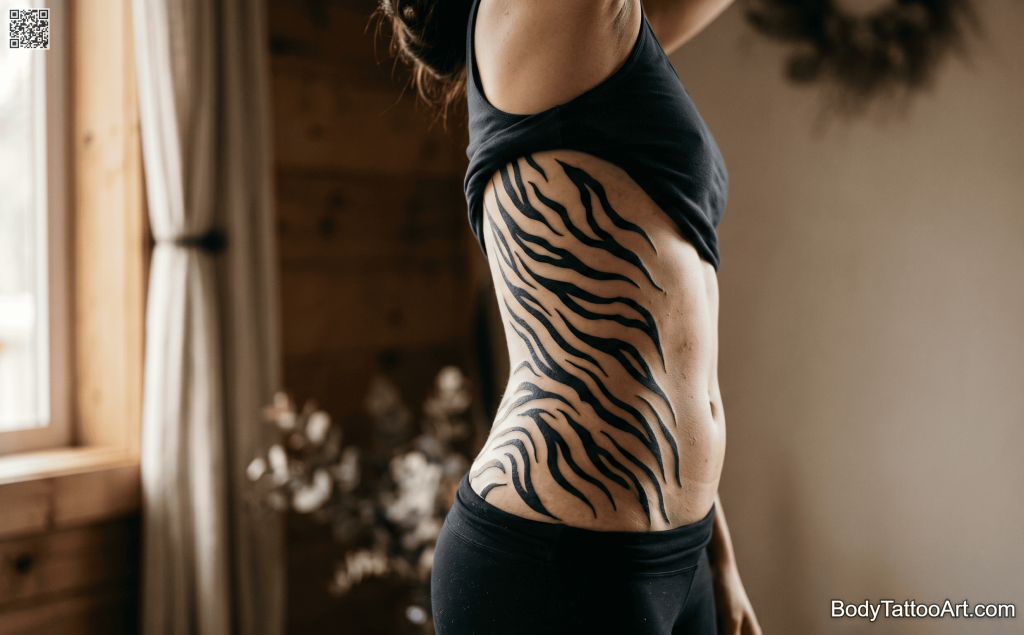
No face, no figure, no pose. Just the stripe pattern — thick, curved black marks flowing across the skin the way they actually distribute on a Bengal tiger’s flank. The stripes follow the body’s natural contours. At a glance it could almost read as intentional body marking rather than a tattoo.
Placement: Side torso and hip
Style: Pattern blackwork Tiger Tattoos
Why it stands out: It’s the most conceptually minimal interpretation of tiger tattoos possible. The animal is entirely implied — present through signature rather than image.
Ideal for: People who want to reference the tiger without depicting it. Those who prefer pattern and texture over imagery.
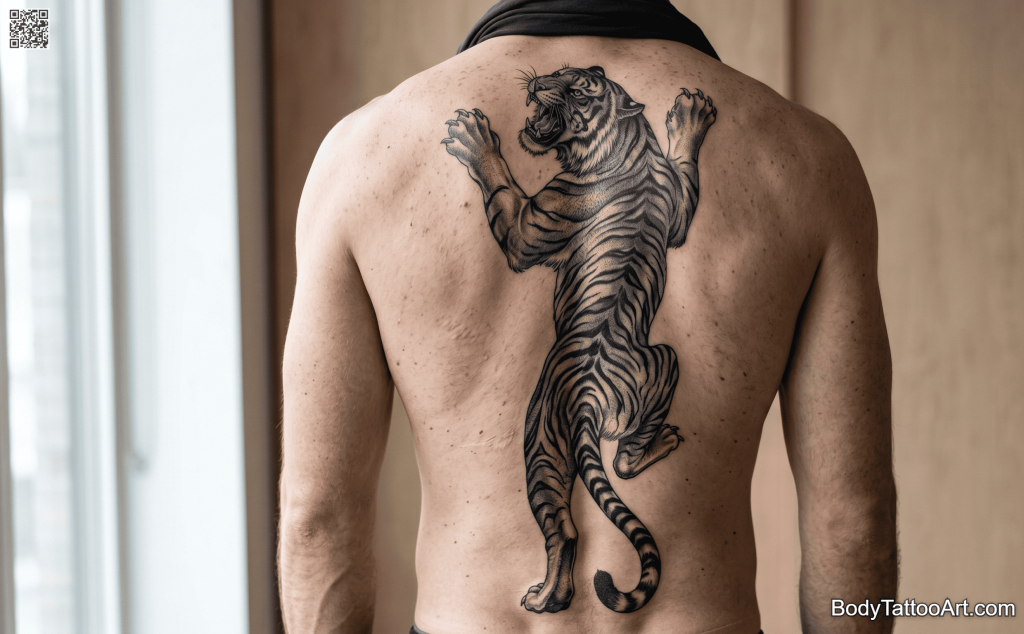
Full-body tiger, vertical composition, rearing slightly with the front paws raised and mouth open. The design runs the length of the spine from shoulder blade level to the tailbone. Every individual strand of chest fur is drawn. The tail falls to one side, curving gently at the tip. It’s a long tattoo — and the length is the point.
Placement: Spine
Style: Black and grey realism Tiger Tattoos
Why it stands out: The spine is one of the most underused placements for large-scale animal work. The rearing vertical pose is one of the few compositions that genuinely earns that length.
Ideal for: People building large back pieces. Collectors who think about how placements relate to anatomy.
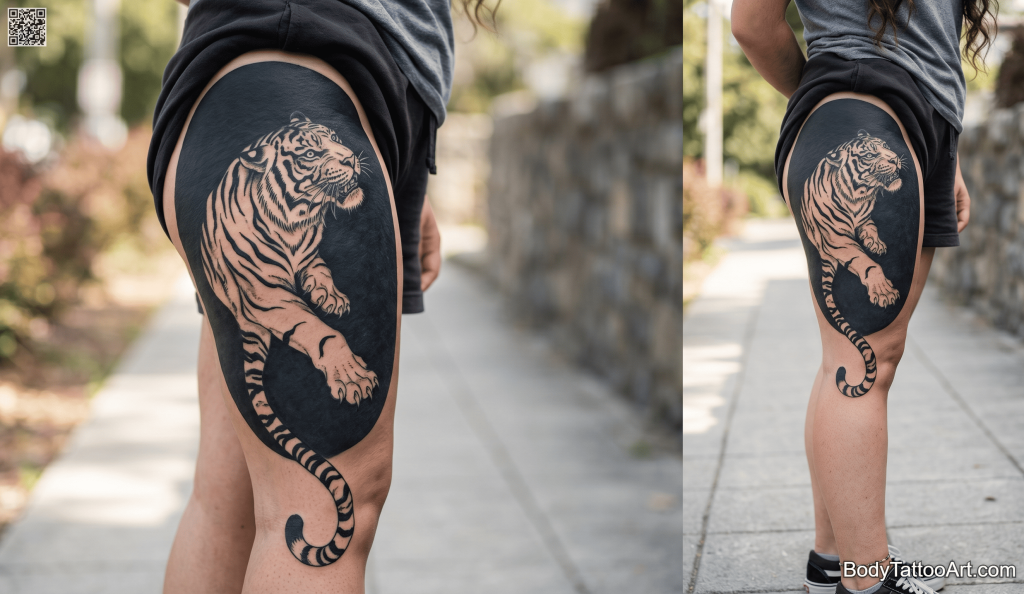
A large panel of the thigh is filled with flat solid black. Within that blackout, the tiger’s complete form — face, body, paws, tail — is preserved as bare skin. The stripes are the black itself. The fur is the skin. No lines were needed to draw the tiger — it was built by deciding what not to fill.
Placement: Outer thigh
Style: Blackout and negative space Tiger Tattoos
Why it stands out: Blackout tattooing is a serious commitment, and most people who do it aren’t using it this deliberately. The tiger emerging from the negative space rewards looking at it slowly.
Ideal for: Experienced collectors. People who want large-scale dramatic work with a strong concept.
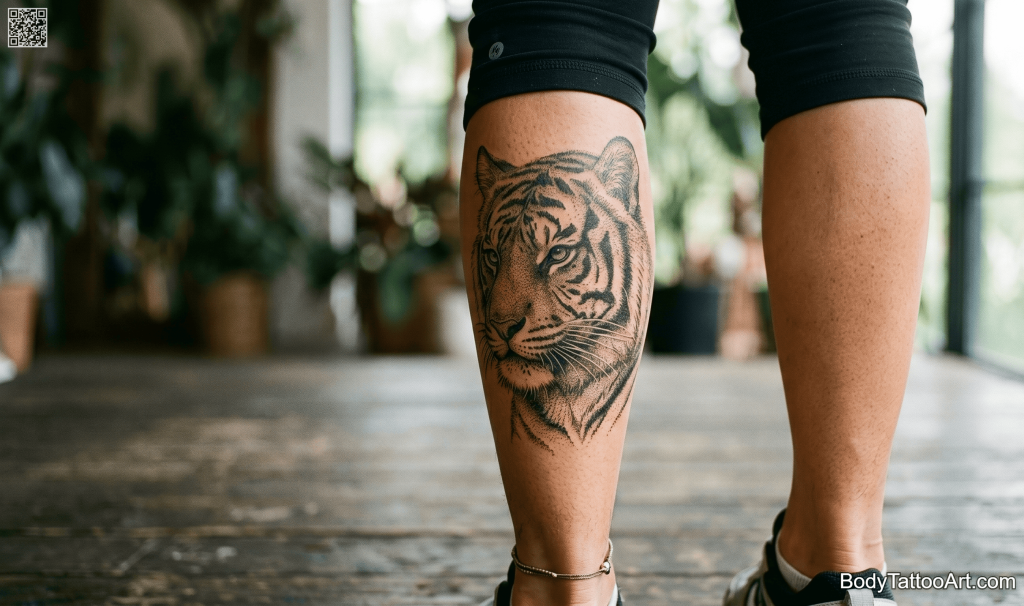
A three-quarter tiger portrait built entirely from evenly-spaced individual dots — not dotwork clusters, but true pointillist placement. The transitions between light and dark areas are slow and smooth, the way they are in a Seurat painting. The image seems to shift slightly when you look at it from different distances, which is an optical property unique to this technique.
Placement: Back of calf
Style: Stippling Tiger Tattoos
Why it stands out: This is technically one of the most demanding styles on this list. The even spacing has to be maintained across thousands of marks. The visual result — that quiet vibrating quality — can’t be replicated any other way.
Ideal for: Collectors who value technique over impact. People drawn to pointillist art and meditative processes.
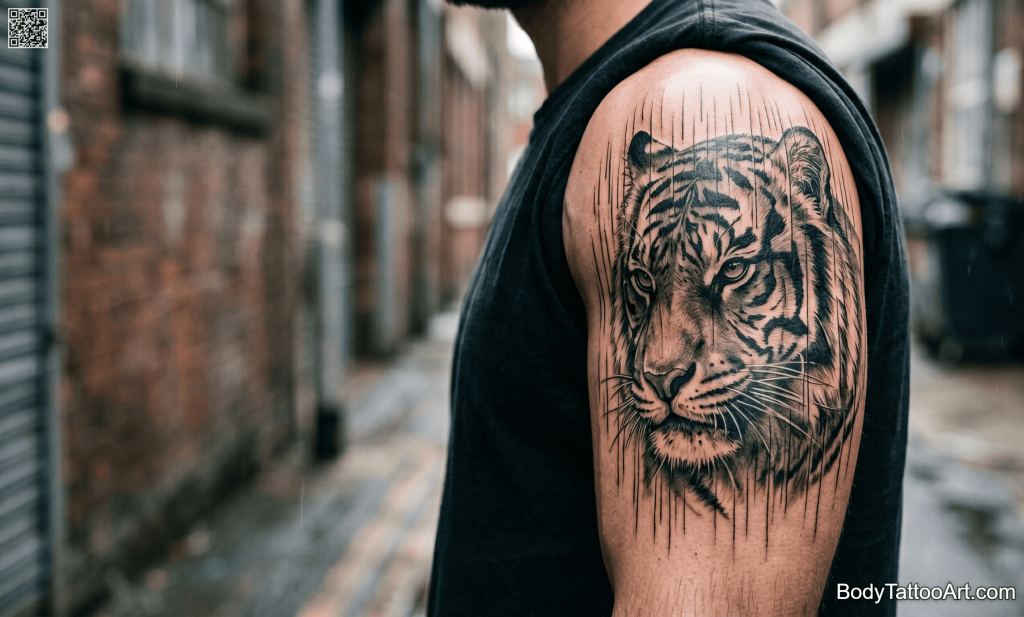
The tiger is fully rendered in black and grey — detailed, composed, realistic. But laid over the entire design is a field of fine vertical parallel lines, consistent in direction and weight, representing heavy rain falling across the scene. The rain isn’t around the tiger. It’s falling through the image. The tiger doesn’t look out from the tattoo — the viewer looks in, through weather.
Placement: Outer upper arm
Style: Realism with environmental texture Tiger Tattoos
Why it stands out: The rain texture transforms a portrait into a scene. It adds atmosphere, dimension, and a cinematic framing that’s rare in tiger tattoos — or any portrait work.
Ideal for: People who think about their tattoos as images rather than symbols. Collectors drawn to moody, atmospheric work.
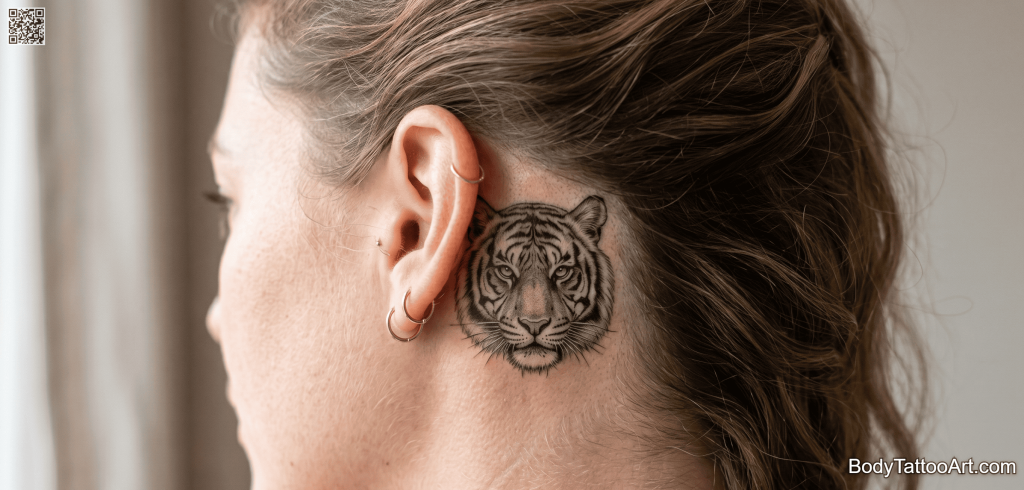
A complete, fully detailed tiger portrait — reduced to the size of a coin. The stripes are individually drawn at 2–3 centimeters of actual scale. The eyes still carry depth. The fur texture is still suggested. Nothing has been simplified to accommodate the size — the design has been compressed, which is a completely different challenge.
Placement: Behind the ear
Style: Micro realism Tiger Tattoos
Why it stands out: Micro realism is less about miniaturizing a design and more about knowing exactly what detail survives the reduction. The artists who do this well are doing something genuinely rare.
Ideal for: People who want precision in a small footprint. Fine line collectors. Those who prefer personal over visible.
The tiger as a subject has been around in tattooing for centuries, across cultures and continents, and it still hasn’t run out of directions to go in. From a single eye on the inner wrist to a full rearing body running the length of the spine, the animal translates into almost any approach. What holds all these designs together isn’t meaning — it’s structure. The stripes, the face, the body proportions — they all carry so much natural visual information that the tattoo does half the work before the artist even picks up the machine.
The best way to use this list is to let the placement decide first. Once there’s a space in mind, the right style and composition usually become obvious from there.