Physical Address
304 North Cardinal St.
Dorchester Center, MA 02124
Physical Address
304 North Cardinal St.
Dorchester Center, MA 02124

Whale tattoos have been making waves in the tattoo world — and it is easy to see why. These are some of the most visually dynamic designs out there, whether someone goes for a bold blackwork piece or a delicate fine line illustration. The sheer size of a whale as a subject gives tattoo artists so much to work with — curves, textures, depth, and movement all come naturally with this design.
What makes whale tattoos so interesting is how versatile they are. A small minimalist whale on the wrist reads very differently from a large geometric whale spread across the ribs. The same subject, dozens of different moods.
This guide covers 26 distinct whale tattoo ideas, each one different in style, composition, and placement. Whether someone is getting their first tattoo or adding to a growing collection, this list has something worth bookmarking.
Across many cultures, whales have represented wisdom, depth, and emotional strength. In Indigenous Pacific traditions, whales are considered guardians of the ocean and symbols of community. Norse mythology ties them to mystery and power. In modern symbolism, whale tattoos often speak to inner calm, intuition, and a connection with something much larger than oneself.
Whales are also associated with long journeys — both literal and emotional. Their migration patterns, spanning thousands of miles, make whale tattoos a meaningful choice for people who have been through major life transitions.
For a deeper dive into whale symbolism across world cultures, visit the Wikipedia page on whale mythology and cultural significance.
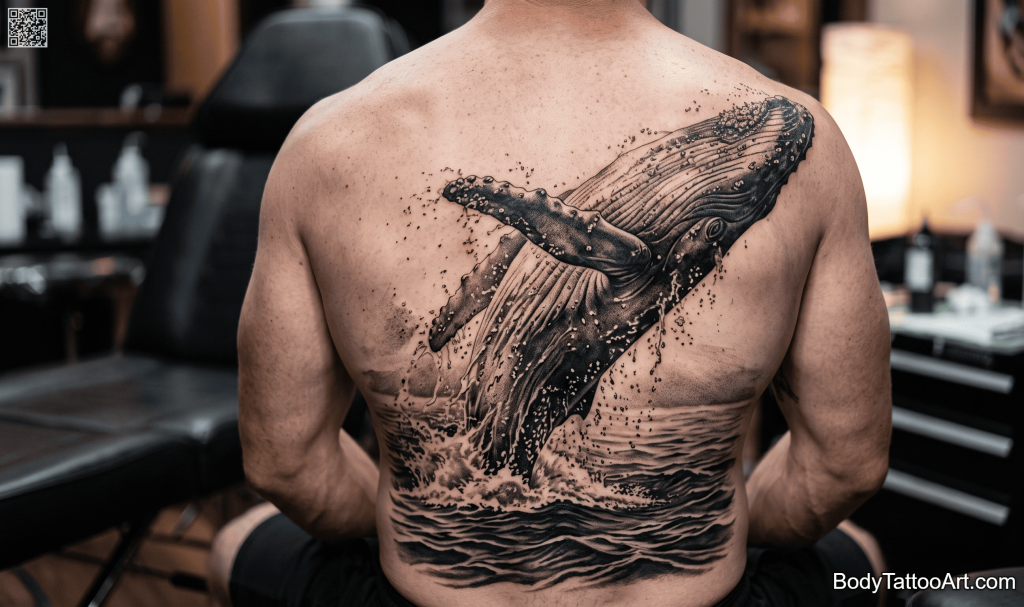
A humpback whale launches itself out of the ocean in a full breach, its body arching through the air at a dramatic diagonal. Water sprays off its fins and tail in fine, detailed droplets. The lower half fades into dark, rippling ocean waves while the upper body catches contrast against a lighter background. The motion in this piece is palpable.
Placement: Upper back / shoulder blade
Style: Black and grey realism Whale Tattoos
Why it stands out: The diagonal composition breaks the usual horizontal tattoo layout. The motion blur on the water spray gives this a cinematic quality rarely seen in whale tattoos.
Ideal for: People who want large, dramatic pieces and collectors who appreciate realistic wildlife art.
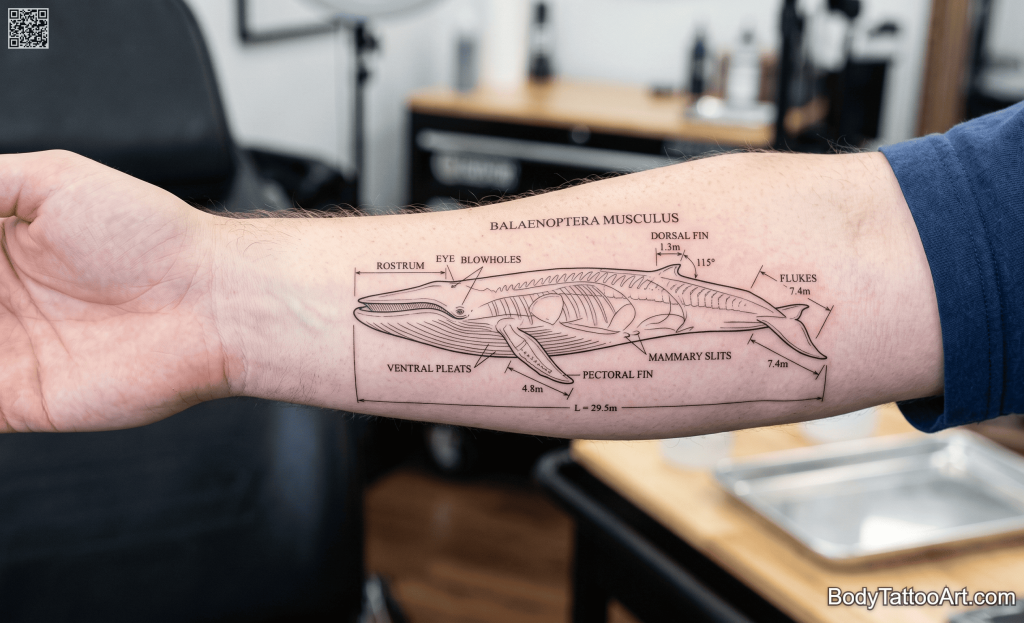
Rendered entirely in thin, precise lines, this design looks like a scientific diagram pulled from a marine biology textbook. Measurement lines extend from different parts of the whale’s body, and faint Latin-style labels are written in micro lettering beside them. The style is clean, clinical, and oddly beautiful.
Placement: Forearm / inner arm
Style: Fine line illustrative Whale Tattoos
Why it stands out: The blueprint or scientific diagram approach to whale tattoos is rarely done well. This one leans into precision over decoration — it reads like wearable research.
Ideal for: Science enthusiasts, minimalists, academics, and people who prefer intellectual aesthetics in their tattoos.
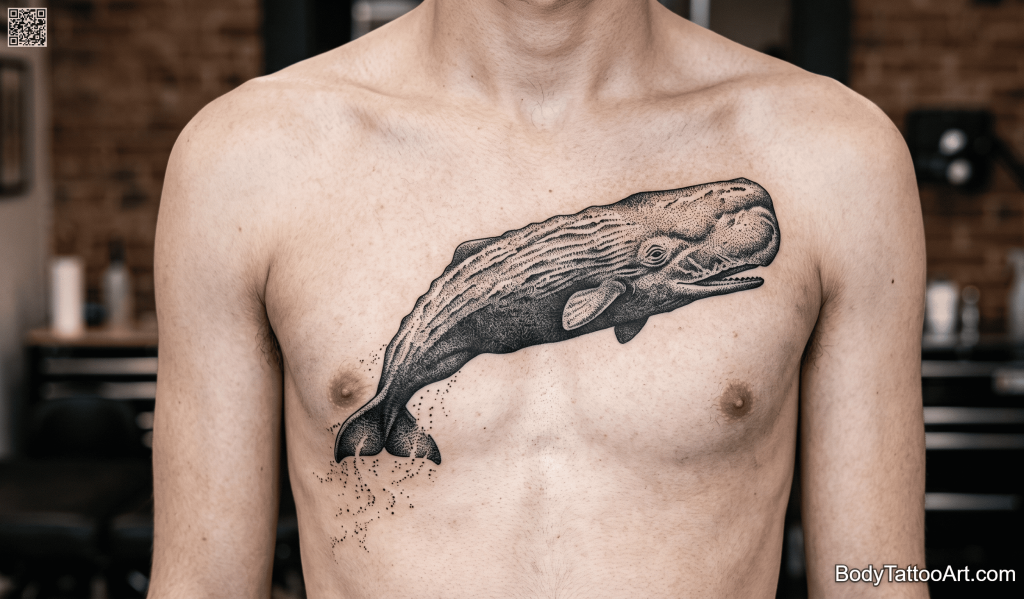
This whale tattoo is built entirely from thousands of tiny dots — no solid lines, no brushwork. The body is formed through varying densities of stippling, with the darkest dots clustered along the spine and belly, creating a rounded, three-dimensional effect. The tail dissolves into scattered dots at the edges, giving it a dissolving quality.
Placement: Sternum / chest centre
Style: Dotwork / stippling Whale Tattoos
Why it stands out: The patience and technique required for pure dotwork shading creates a texture that no other style can replicate. Up close, it looks like a constellation. From a distance, it reads as a solid, perfectly shaded whale.
Ideal for: Detail-obsessed collectors and those who appreciate slow, technique-heavy tattoo work.
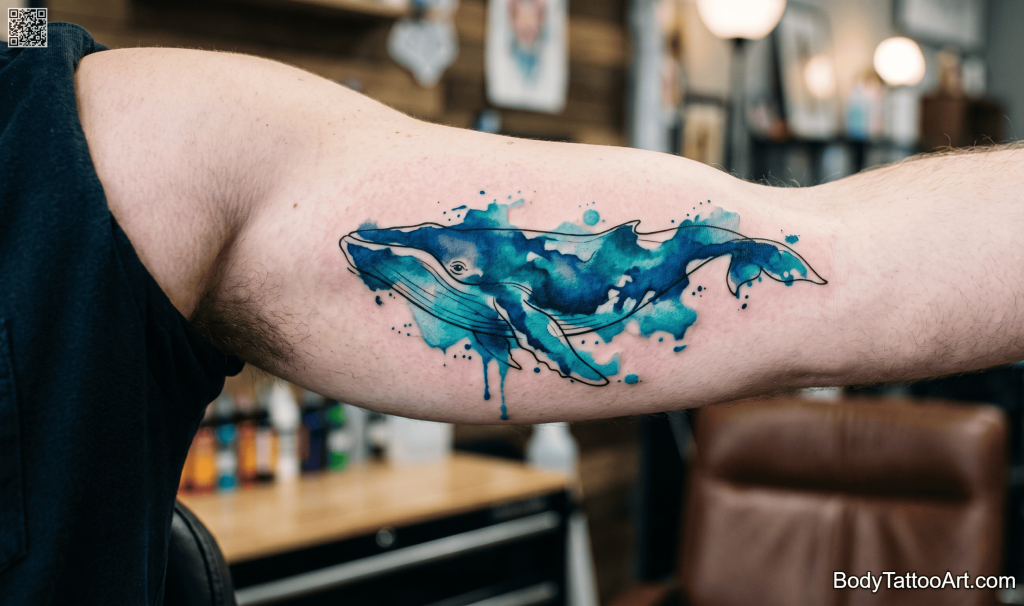
Loose, flowing patches of colour — deep navy, teal, and soft turquoise — bleed outward from the whale’s body like a watercolour painting that got too wet. The whale itself is outlined in thin black lines but the colour washes extend beyond those lines freely. The effect is impressionistic and painterly.
Placement: Shoulder / upper arm
Style: Watercolour Whale Tattoos
Why it stands out: The colour bleeds outside the outline intentionally, making the whale feel like it is melting into the skin. The contrast between the tight outline and the loose colour wash is what makes this composition work.
Ideal for: Colour tattoo lovers, creative personalities, and those who want whale tattoos that feel artistic rather than illustrative.
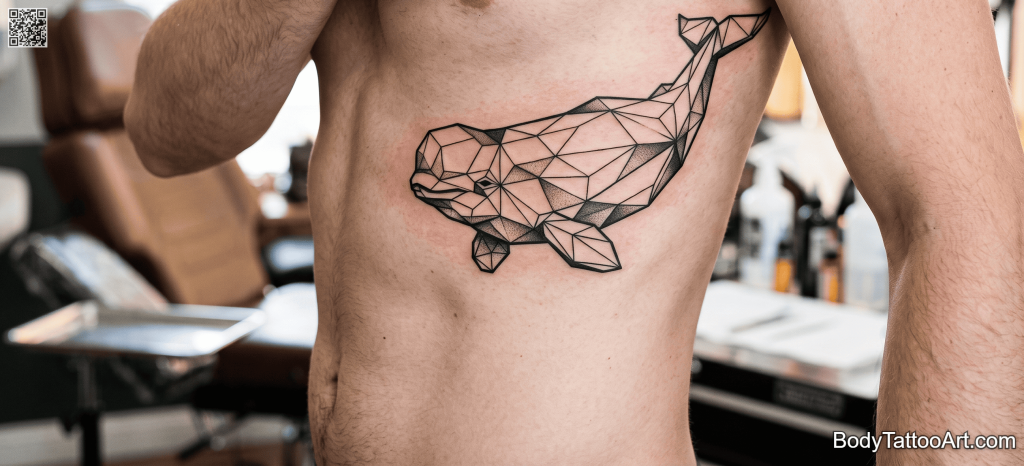
A beluga whale is reconstructed entirely from geometric shapes — triangles, hexagons, and sharp faceted planes arranged to form its body. Think origami meets wildlife illustration. The lines are precise and angular, completely stripping the design of any organic softness. No curves exist here.
Placement: Ribcage / side torso
Style: Geometric blackwork Whale Tattoos
Why it stands out: Using hard geometry to depict one of the ocean’s softest-looking creatures creates fascinating tension in the design. The angularity makes it feel architectural rather than decorative.
Ideal for: Fans of geometric art, people drawn to structured and mathematical design aesthetics.
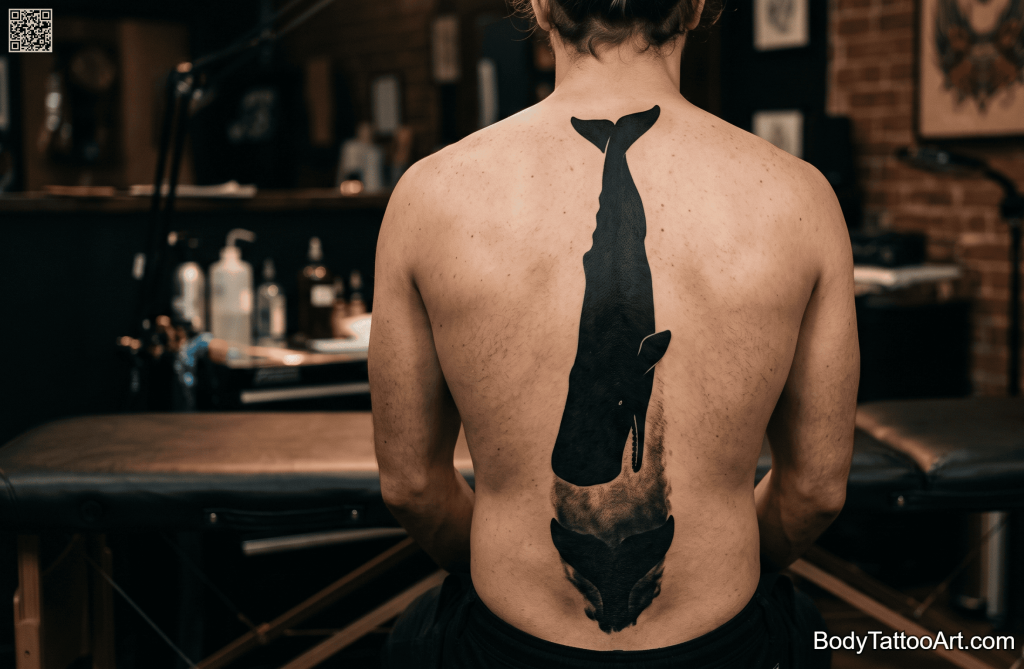
A solid black silhouette of a sperm whale hangs vertically, as if diving downward. Below it, the black ink deepens into a heavy shadow suggesting the abyss. Above the whale, the skin is left completely bare — just black on skin, no background detail. The contrast between the filled silhouette and the empty space above creates dramatic tension.
Placement: Spine / back centre
Style: Solid blackwork Whale Tattoos
Why it stands out: Placing the whale vertically along the spine mirrors the act of diving — the tattoo and the body anatomy work together. The empty space above feels like open water.
Ideal for: Minimalists who still want bold impact, and people who want spine tattoos with strong visual weight.
For those who love bold blackwork compositions like this, the wolf tattoo designs show similar power in silhouette work.
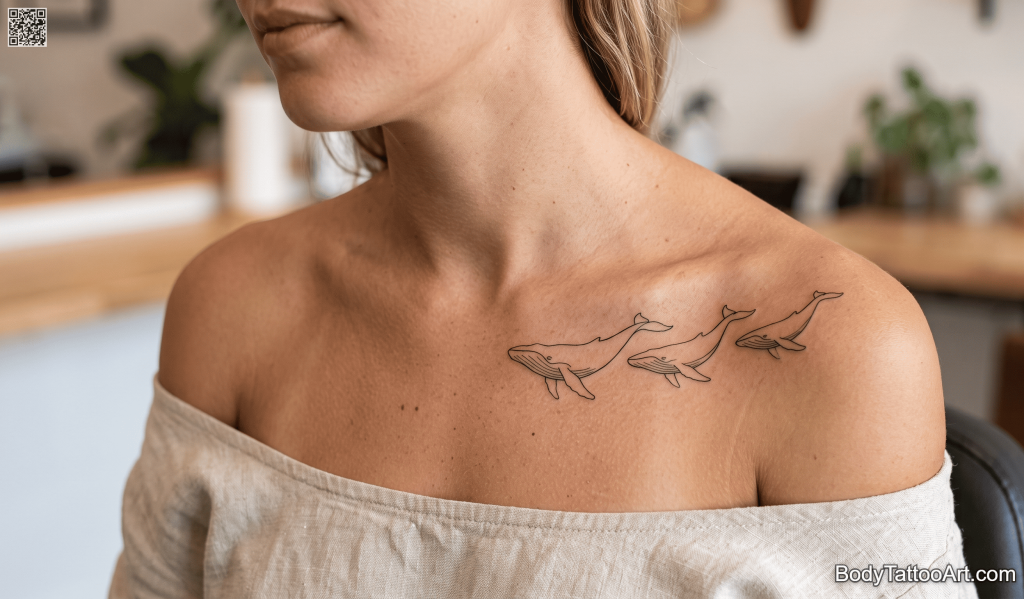
Three whales of slightly different sizes travel in loose formation across the skin, rendered in single continuous linework. No shading, no fill — just one flowing line per whale, tracing the outline and returning. The composition uses negative space to suggest movement and distance between the whales.
Placement: Collarbone / clavicle
Style: Single-needle fine line Whale Tattoos
Why it stands out: Three whales in flight formation across the collarbone creates a natural horizontal composition that mirrors the bone’s angle. The single-line technique is deceptively simple and technically demanding.
Ideal for: Minimalists, fine line lovers, and those who want delicate whale tattoos with a poetic quality.
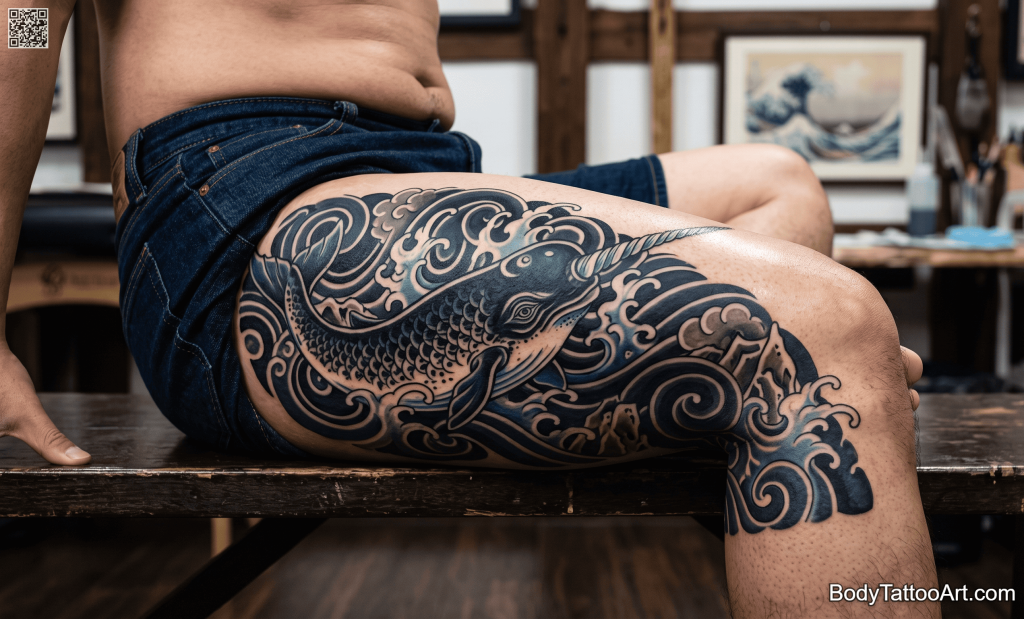
Rendered in the style of traditional Japanese ukiyo-e woodblock prints, this whale tattoo features a narwhal surrounded by stylised waves with the classic curling white foam tips. The lines are bold, the composition follows a traditional Japanese tattoo layout, and the whale’s horn adds an unusual asymmetric element to the design.
Placement: Thigh / outer leg
Style: Japanese traditional Whale Tattoos
Why it stands out: Using a narwhal — with its long spiralled horn — inside a traditional Japanese composition is unexpected. The horn breaks the symmetry and gives the piece a unique visual anchor.
Ideal for: Japanese art fans, collectors of traditional tattooing, and those who want strong black outlines and cultural depth.
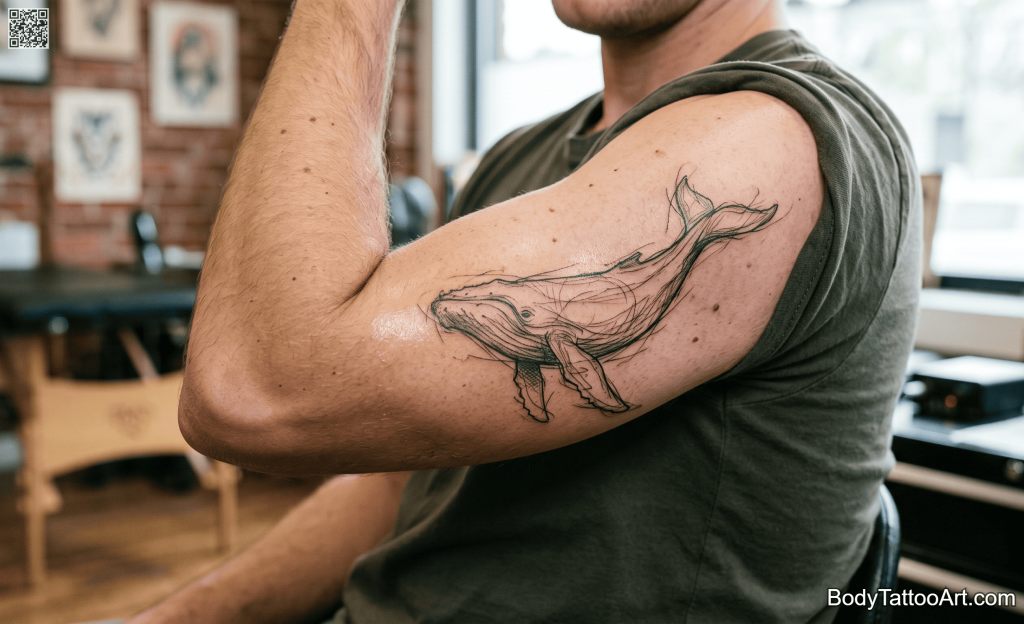
This design looks like it was pulled directly from an artist’s sketchbook. A humpback whale is drawn in loose, overlapping pencil-style strokes — some lines go slightly outside the form, others are unfinished, and the whole thing has an intentional “work in progress” quality. The roughness is the point.
Placement: Bicep / upper arm
Style: Sketch / illustrative linework Whale Tattoos
Why it stands out: Sketch-style tattoos succeed when the looseness feels intentional, not accidental. The overlapping strokes here create a visual layering that gives the whale genuine artistic weight.
Ideal for: Art lovers, people who prefer organic over polished aesthetics, and collectors looking for something that feels handcrafted.
A beluga whale is captured in a minimal white-on-skin technique — the tattoo uses negative space as the whale’s body, with surrounding dark ink creating the shape through contrast. Fine black linework traces details within the negative space, suggesting the ice-white skin of the beluga without filling it with ink.
Placement: Inner wrist / forearm
Style: Negative space fine line Whale Tattoos
Why it stands out: Using the skin itself as the “white” of the beluga is a smart technique choice — it mirrors the actual colour of the animal. The dark surrounding ink makes the unpainted skin glow.
Ideal for: Creative thinkers, people with lighter skin tones looking for unconventional whale tattoos, and minimalist collectors.
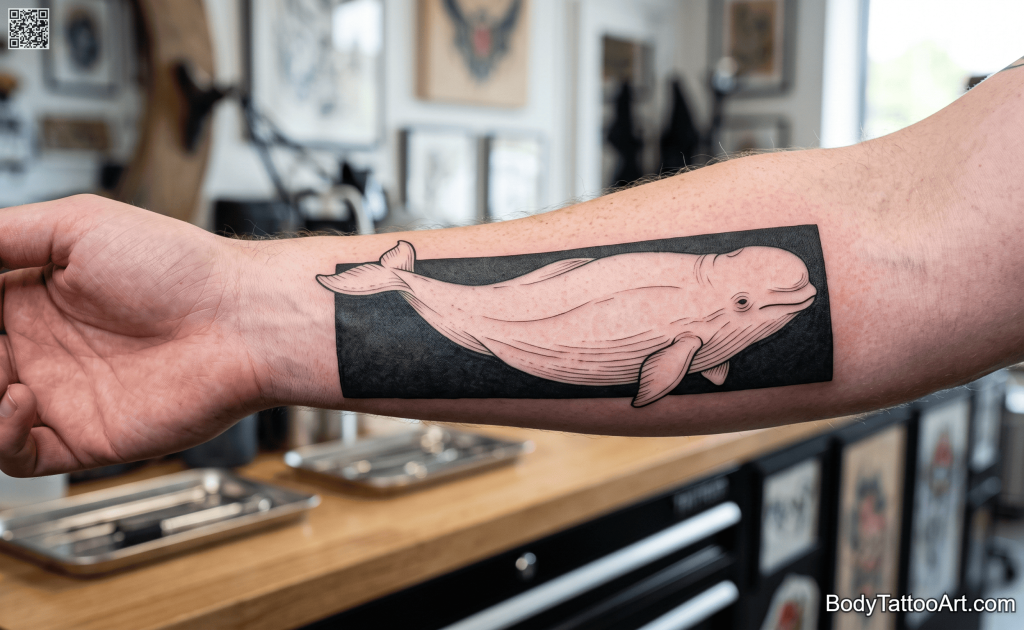
Negative space techniques appear in some of the most striking eagle tattoo designs as well — worth a look for composition ideas.
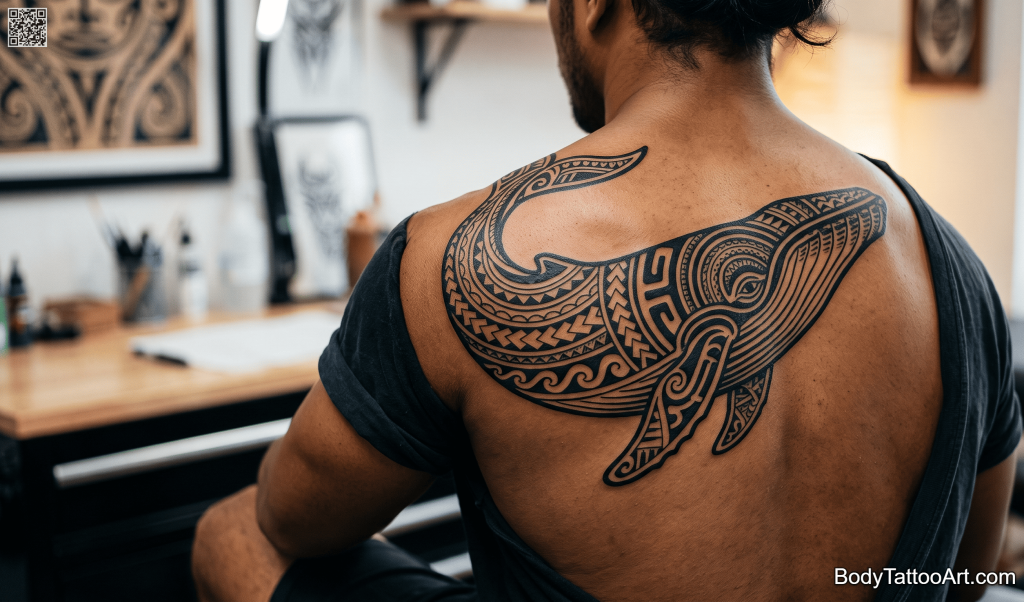
A blue whale’s silhouette is filled with bold tribal patterns — thick black lines, sharp chevrons, and repeating geometric forms fill the interior of the shape. The outer edges of the whale are clean and smooth, contrasting dramatically against the intricate tribal fill inside. There is no gradient, no shading — just pattern.
Placement: Shoulder / upper back
Style: Tribal blackwork Whale Tattoos
Why it stands out: Using the whale shape as a container for tribal patterning gives the design two levels of reading — the animal from a distance, the pattern up close. This dual-layer composition is sophisticated without being complicated.
Ideal for: Fans of Polynesian or Maori-inspired art and those who want bold, ink-heavy whale tattoos with cultural texture.
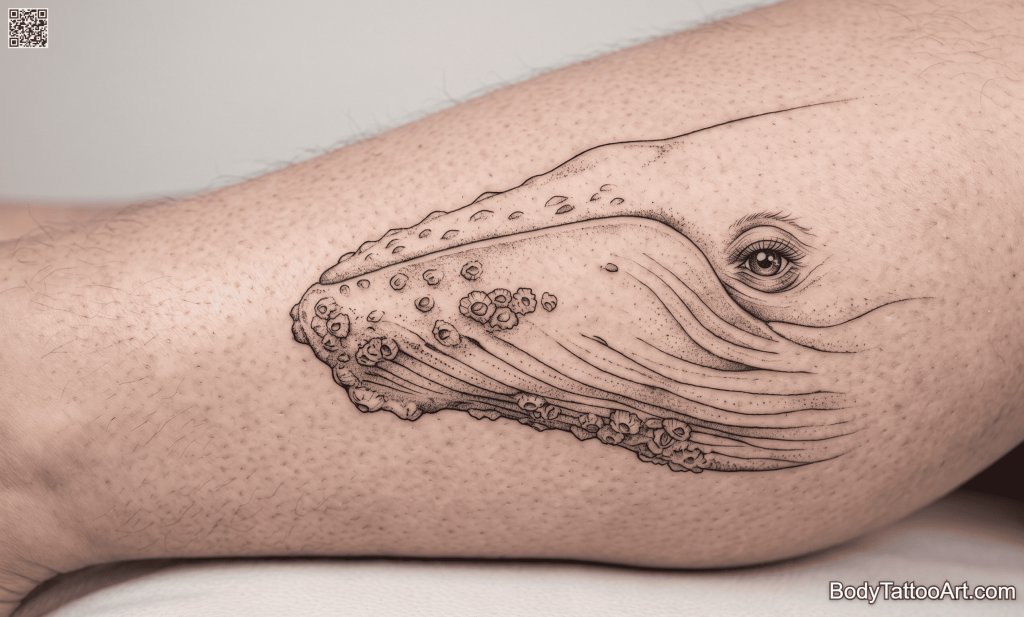
The head of a humpback whale fills the entire composition — just the face, the barnacle texture along the jaw, and the expressive eye rendered in extreme fine line detail. No body, no tail, no setting. Just the face, up close, like a portrait.
Placement: Knee / lower leg
Style: Fine line portrait Whale Tattoos
Why it stands out: Treating a whale as a portrait subject the same way artists treat human or animal faces is unusual. The close crop and the eye as the focal point give the piece emotional depth without any symbolic explanation needed.
Ideal for: Marine life enthusiasts, collectors who prefer close-up detail work, and those looking for conversation-starting whale tattoos.
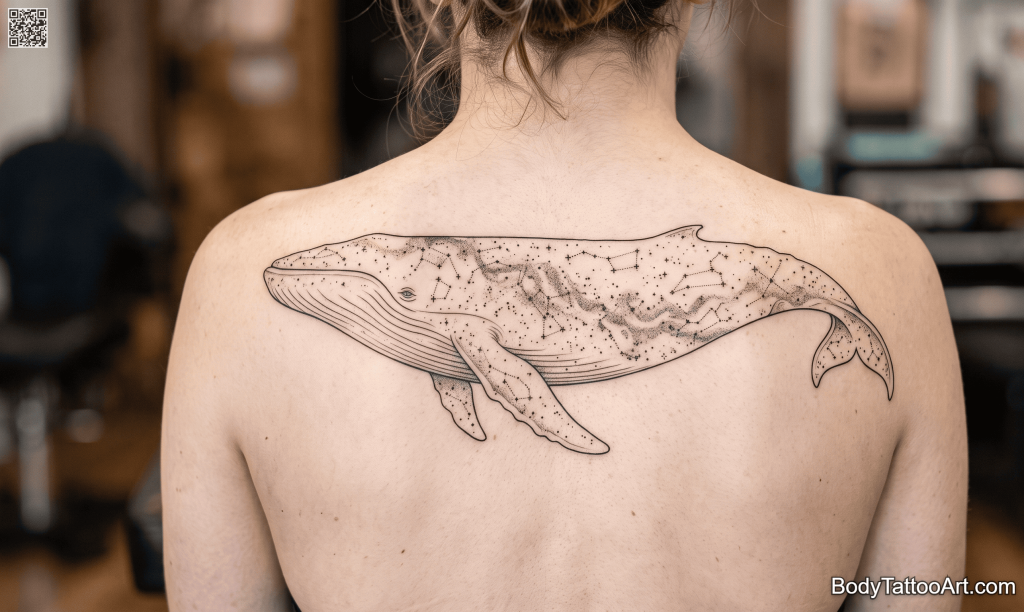
The body of a blue whale is rendered with clean linework, but its entire interior is filled with a star map — constellations, tiny dot stars, and curved lines of the Milky Way band running through the whale’s form. The skin outside the outline stays bare. The contrast between cosmic interior and clean outer line is the visual hook.
Placement: Upper back / shoulder blade
Style: Illustrative fine line with negative space fill Whale Tattoos
Why it stands out: Filling the whale’s interior with a star field turns the animal into a universe of its own. It is a conceptually rich idea executed with restraint — the outer line keeps it grounded while the interior goes cosmic.
Ideal for: Astronomy lovers, dreamers, and collectors who enjoy layered conceptual whale tattoos.
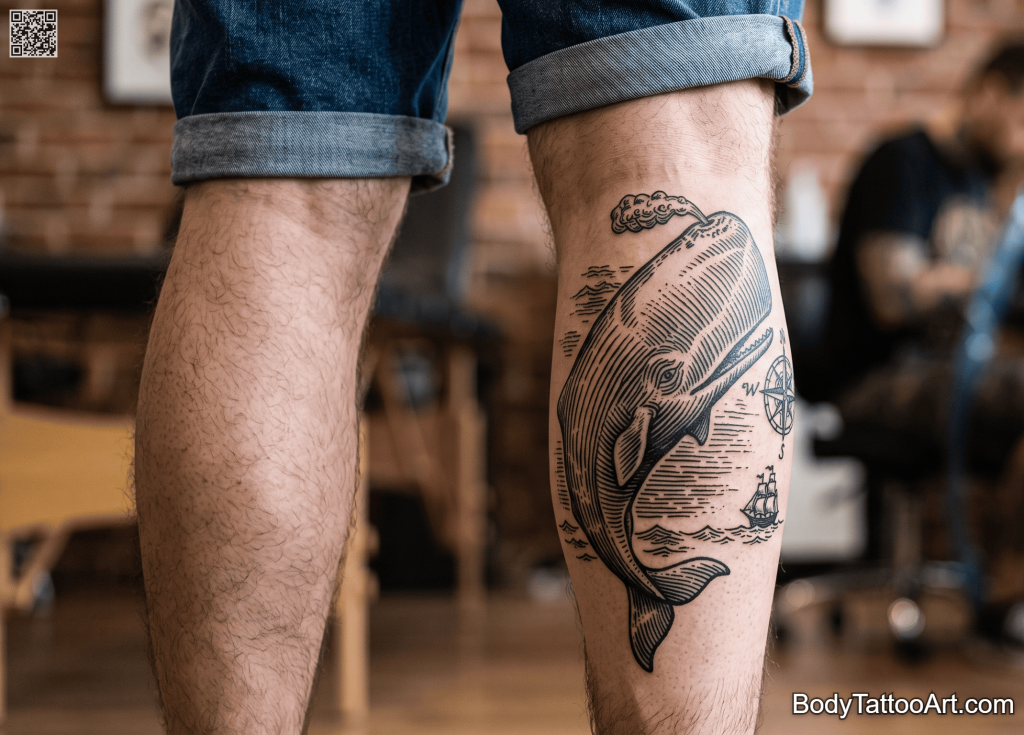
Inspired by old maritime woodcut illustrations, this design uses strong parallel hatching lines to create texture and shading across the whale’s body. The lines are deliberate and uniform, not free-flowing — they follow the curves of the whale’s anatomy and create a structured, almost engraved quality.
Placement: Calf / lower leg
Style: Woodcut / etching linework Whale Tattoos
Why it stands out: The hatching technique gives this piece a historical weight — it looks like it belongs in a 19th-century maritime encyclopedia. That vintage quality makes it stand apart from more contemporary whale tattoos.
Ideal for: History enthusiasts, fans of traditional illustration, and collectors who want their tattoos to feel timeless.
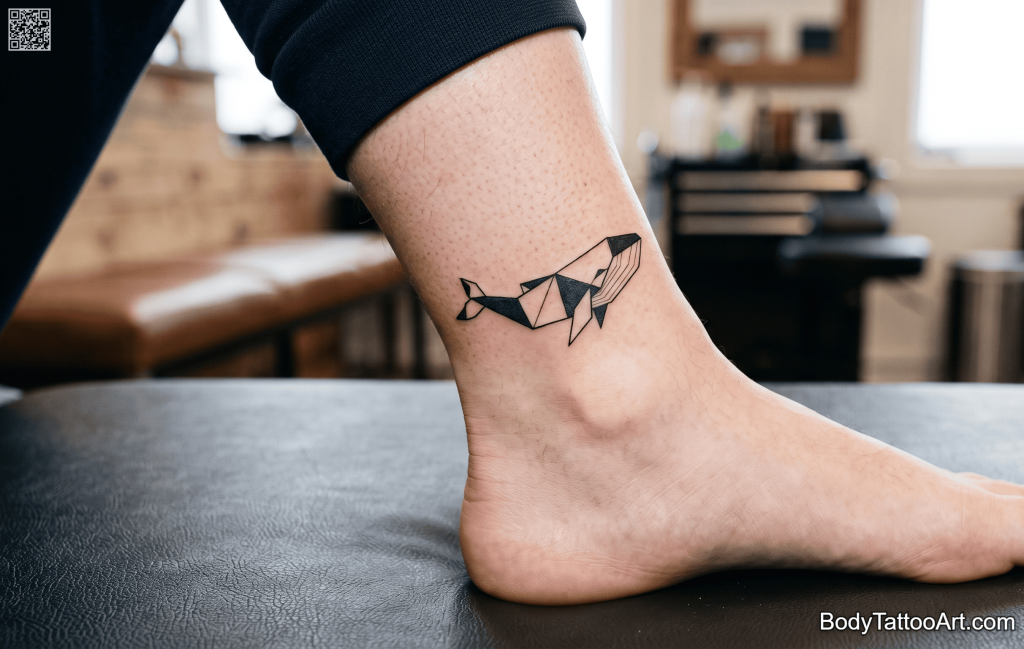
A blue whale is reimagined in origami form — flat faceted paper fold shapes create its fins, body, and tail with sharp creases and geometric fold lines. Some areas are completely white (negative space), others filled with solid black, creating a high-contrast paper art aesthetic.
Placement: Ankle / inner ankle
Style: Geometric origami illustrative Whale Tattoos
Why it stands out: Origami-inspired tattoos work best on smaller, cleaner placements where the precision of the folds can be read clearly. The ankle is perfect for this — the scale suits the delicate geometry.
Ideal for: First-timers, minimalists, and people looking for small but genuinely unique whale tattoos.
The ankle and wrist are also popular spots for daisy tattoos — great if mixing nature themes is the goal.
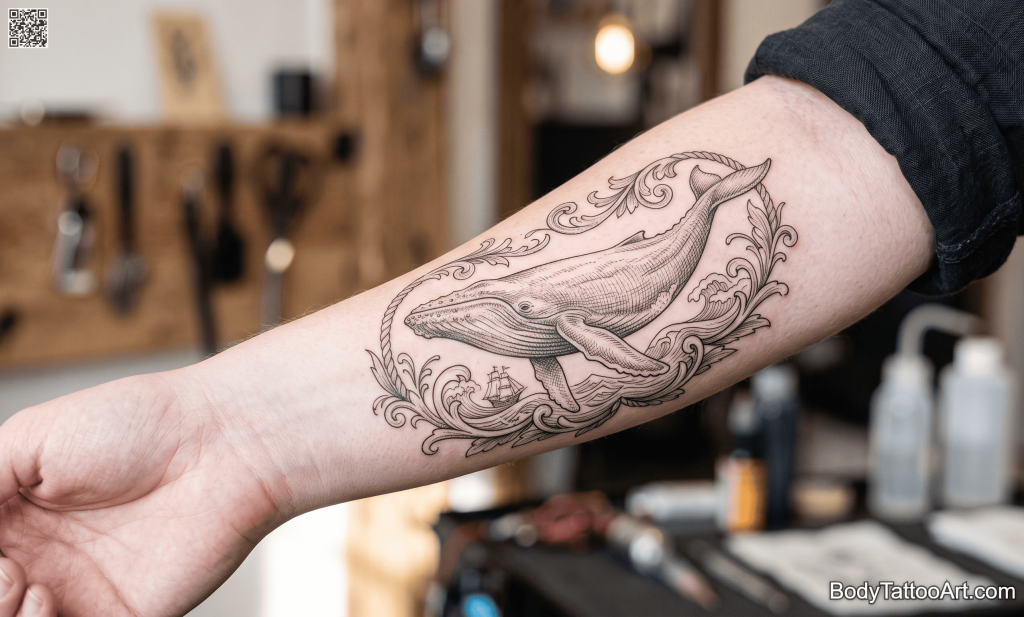
Taking inspiration from the old sailor art of scrimshaw — detailed etchings carved into whale bone — this tattoo mimics that aesthetic on skin. The whale is surrounded by thin etched borders, small decorative flourishes, and fine crosshatching that gives the whole composition an antique ivory quality.
Placement: Forearm / outer forearm
Style: Fine line scrimshaw-inspired Whale Tattoos
Why it stands out: Most whale tattoos lean into the vastness of the ocean. This one leans into maritime history and the craft of sailors who spent months at sea. It is niche, historically layered, and visually distinct.
Ideal for: History buffs, maritime enthusiasts, and collectors who want whale tattoos with a backstory built in.
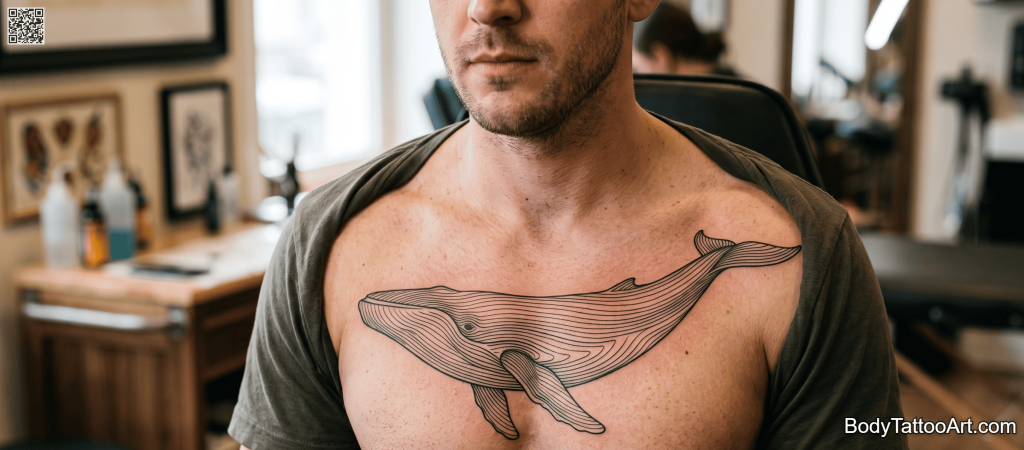
The whale is constructed entirely from wave lines — dozens of thin parallel curved lines running along its body’s length, slightly varying in spacing to create the sense of three-dimensional form. No solid fill, no dotting. Just wave-shaped lines that together read as a whale.
Placement: Chest / pectoral
Style: Line form / contour line illustrative Whale Tattoos
Why it stands out: The repetition of the wave lines creates an optical rhythm — the eye travels along the form and reads it as both the whale and the ocean simultaneously. It is conceptually tight and visually meditative.
Ideal for: Minimalists who want something with visual complexity, and fans of optical illustration.
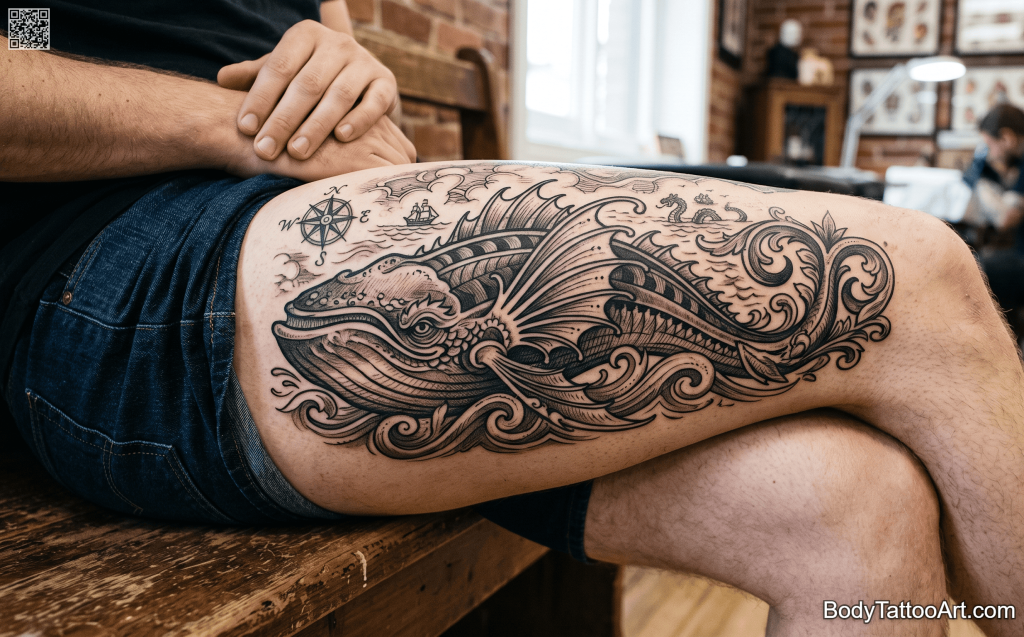
Drawn in the style of mythological sea creatures found in antique cartographic maps, this whale features decorative spines along its back, a curling tail, dramatic fanned fins, and exaggerated proportions. It looks like it would be labelled “Here Be Monsters” on an old parchment map.
Placement: Thigh / front thigh
Style: Illustrative / medieval cartographic Whale Tattoos
Why it stands out: Old map sea monsters have a drama and theatricality that modern tattoo styles rarely capture. The exaggerated fins and curling tail give this maximum movement without needing realism.
Ideal for: Mythology fans, history lovers, and people who want storytelling baked into their whale tattoos.
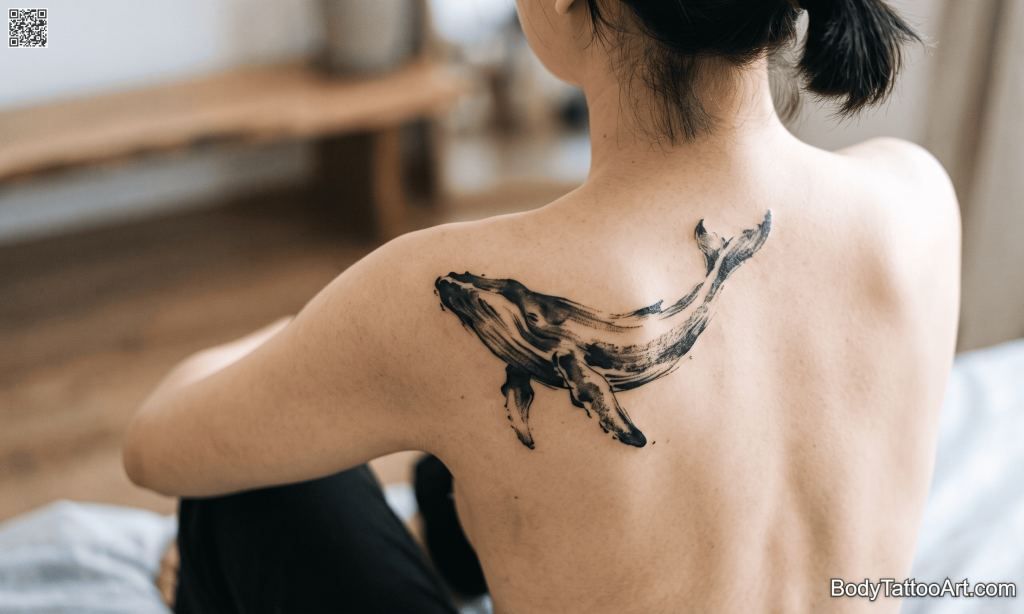
Inspired by Japanese sumi-e ink painting, this whale is captured in three or four loose, gestural brushstrokes — the kind that take decades to perfect and look deceptively simple. The ink is not uniform; it has texture and variation the way actual brush ink does when it dries on paper.
Placement: Shoulder blade / upper back
Style: Sumi-e brushwork Whale Tattoos
Why it stands out: True brushwork tattoos require an artist who can replicate the controlled chaos of ink-on-rice-paper. The variation in ink density across the strokes makes this design feel alive.
Ideal for: Fans of East Asian art, collectors who appreciate restraint, and those who want whale tattoos that feel spiritual.
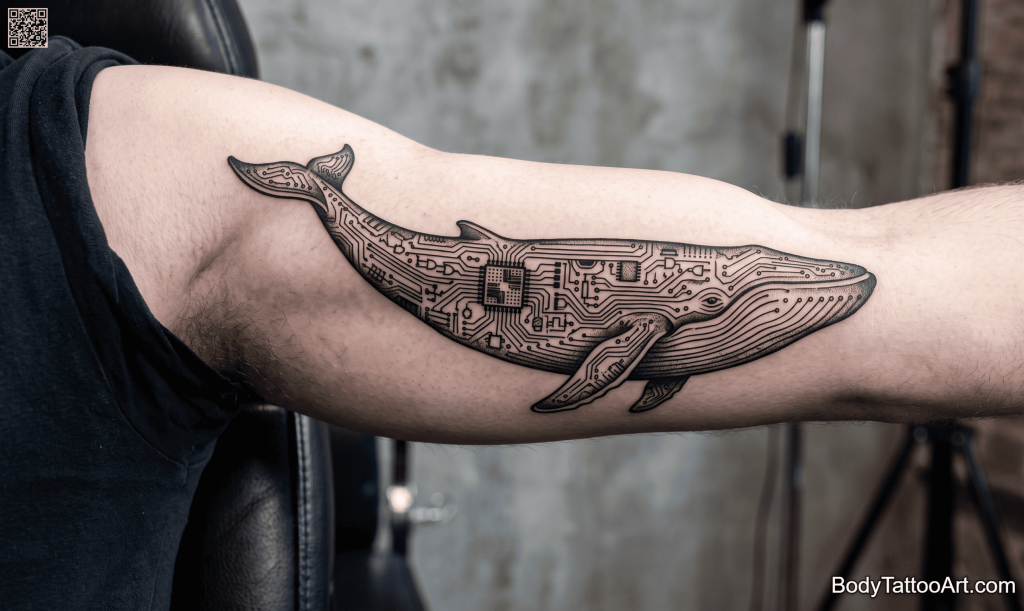
The whale’s silhouette is clean and recognisable, but its interior is filled with a detailed circuit board pattern — thin electrical traces, solder points, microchip grids, and logic pathways replacing anatomy with technology. The effect is half-wildlife, half-machine.
Placement: Upper arm / sleeve segment
Style: Blackwork cyberpunk illustrative Whale Tattoos
Why it stands out: The juxtaposition of a natural marine animal with the interior of a computer chip creates a unique visual tension. It asks an interesting question about nature and technology without spelling anything out.
Ideal for: Tech professionals, sci-fi enthusiasts, and collectors who want conceptual whale tattoos with an edge.
For more designs that mix the organic with the geometric, the dragon tattoo roundup covers similar conceptual territory.
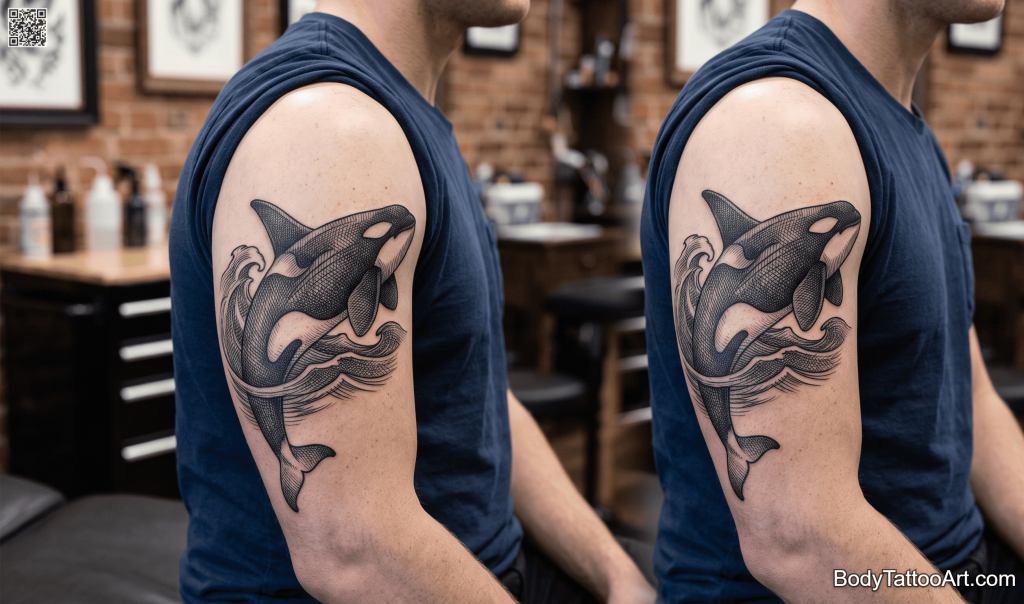
An orca is rendered using only crosshatching — no solid fills, no smooth shading. Every shadow and tonal value is built through overlapping lines at different angles and densities. The result is a textured, graphic quality reminiscent of old newspaper illustration.
Placement: Outer bicep / upper arm
Style: Crosshatch engraving Whale Tattoos
Why it stands out: Most orca tattoos lean into the dramatic black and white contrast of the animal. This one achieves that contrast through technique alone — the discipline of crosshatching across a large curved surface is genuinely impressive.
Ideal for: Collectors who want technically demanding whale tattoos and fans of graphic print-style illustration.
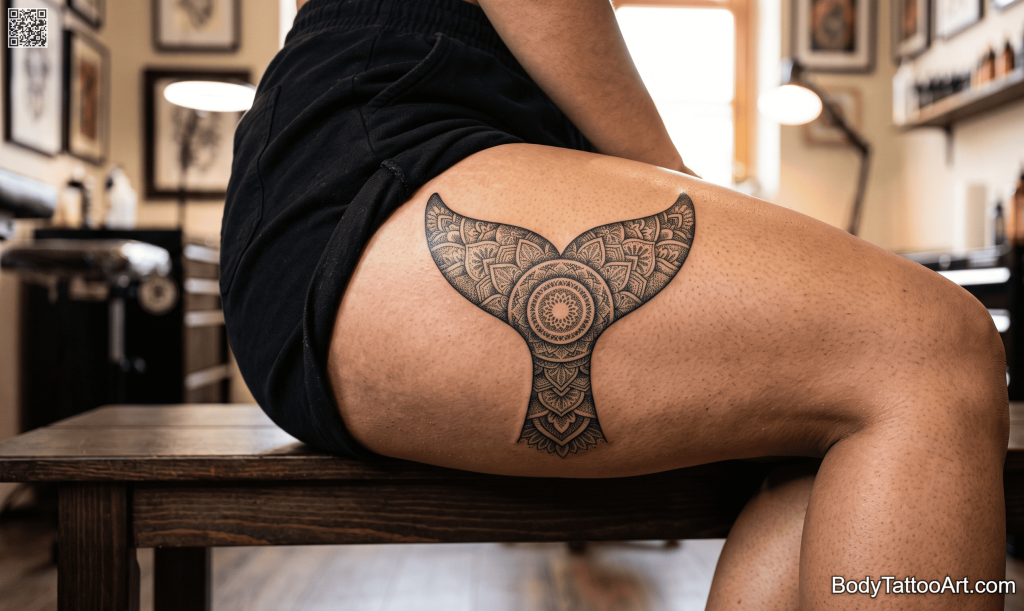
Only the tail fluke of a whale is depicted, rising out of implied water. The fluke itself is filled with intricate mandala patterning — circular geometric designs, fine dotwork centres, and repeating radiating forms. The body of the whale is not shown — the tail alone carries the entire composition.
Placement: Upper thigh / back of thigh
Style: Mandala dotwork Whale Tattoos
Why it stands out: Isolating just the tail fluke creates a strong compositional choice — it suggests the whale without showing it. The mandala fill turns the anatomical shape into a decorative object.
Ideal for: Fans of dotwork and mandala designs who want their interest in whale tattoos expressed through texture and pattern rather than full illustration.
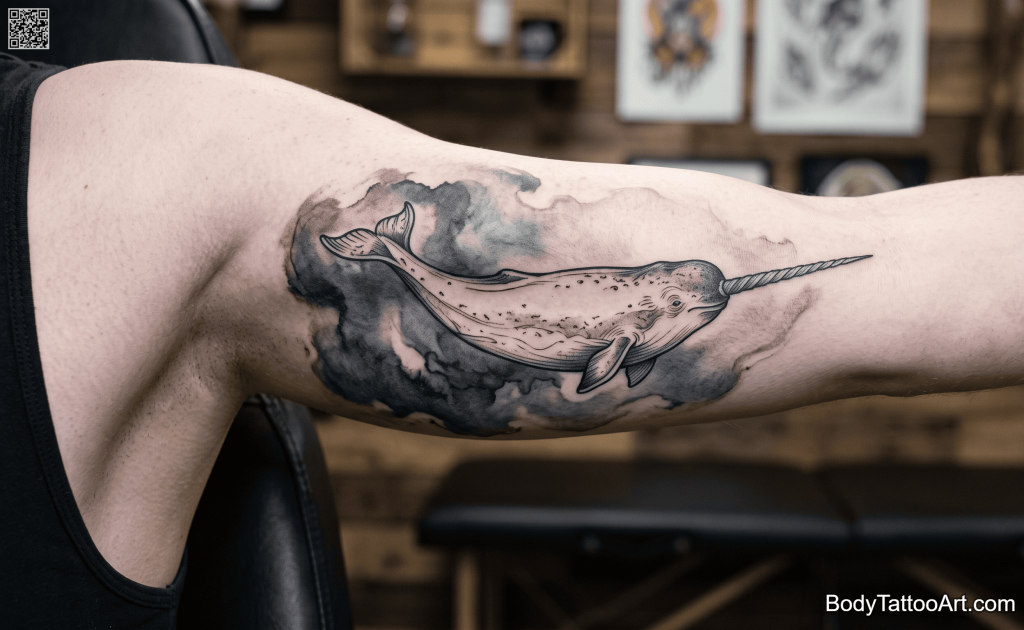
A narwhal hangs suspended in a loose grey ink wash background that fades from dark at the edges to almost nothing at the centre. The narwhal itself is drawn in clean, tight linework while the wash behind it bleeds freely in all directions, suggesting frozen Arctic water or winter fog.
Placement: Inner upper arm
Style: Grey wash illustrative Whale Tattoos
Why it stands out: The contrast between the tight controlled narwhal linework and the freely bleeding ink wash creates a push-pull composition. The fog or water effect through grey wash alone is atmospheric without being busy.
Ideal for: People who want atmospheric whale tattoos, collectors who enjoy that painterly ink-on-skin quality.
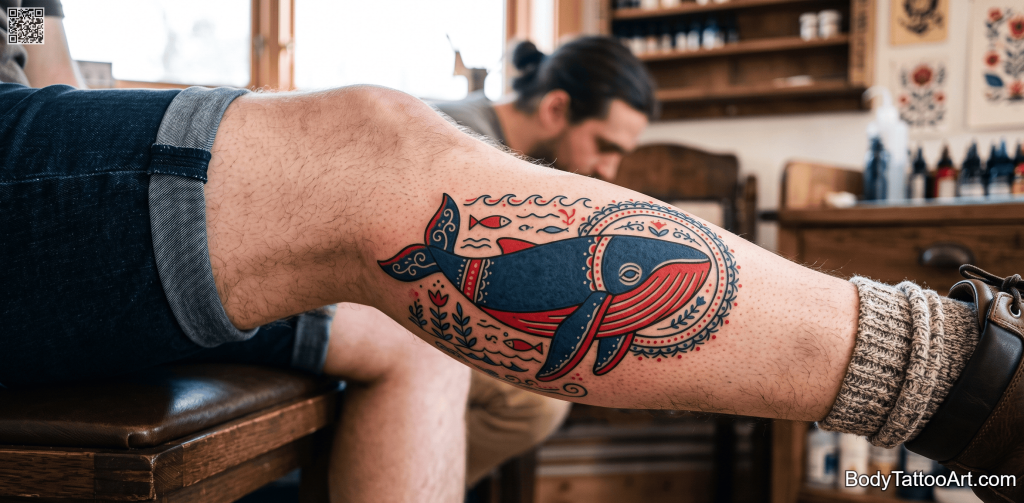
Rendered in the flat, bold style of folk art illustration — think Scandinavian or Eastern European decorative painting traditions — this blue whale features solid areas of navy and red, simple decorative borders along its fins, and a stylised eye with a circular decorative frame around it.
Placement: Calf / outer calf
Style: Folk art illustrative Whale Tattoos
Why it stands out: Folk art approaches to wildlife tattoos are genuinely rare. The flat colour, decorative borders, and stylised eye turn an anatomical subject into a decorative object — almost like a painted wooden toy come to life.
Ideal for: Fans of folk illustration, collectors wanting colourful whale tattoos that feel culturally rooted, and people drawn to decorative aesthetics.
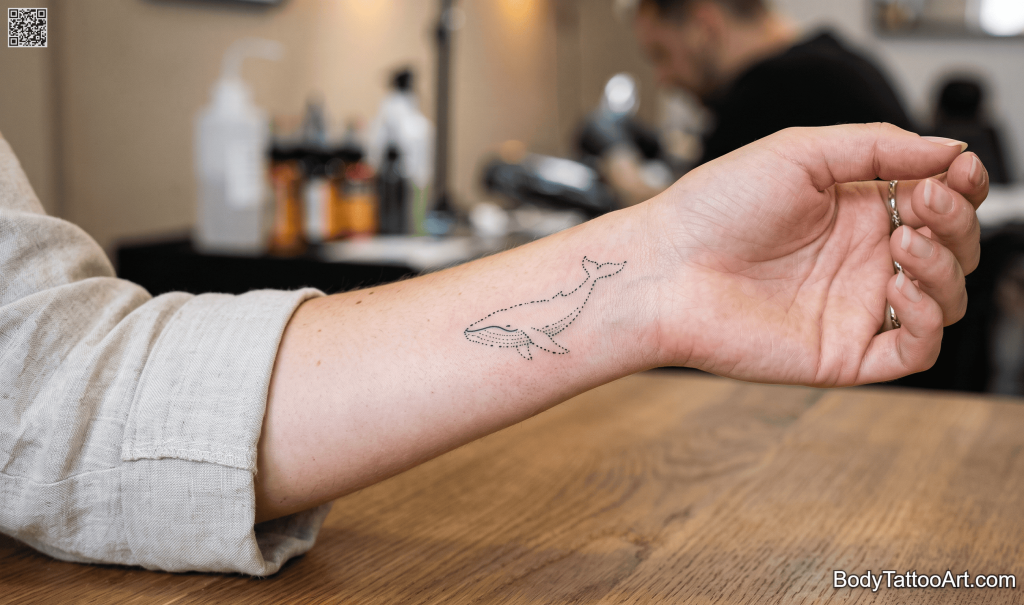
The whale tattoo uses the animal’s silhouette as a framework, but the outline itself is constructed from Morse code dots and dashes rather than a solid line. Zoom in and the outline disintegrates into a pattern of coded symbols. Zoom out and it reads perfectly as a whale.
Placement: Wrist / inner wrist
Style: Conceptual fine line Whale Tattoos
Why it stands out: This is a quiet concept tattoo — one that rewards closer inspection. The Morse code outline is only visible when someone leans in, which gives this small whale tattoo a private dimension.
Ideal for: Detail-focused collectors, people who enjoy hidden meanings in their tattoos, and minimalists who want something genuinely clever.
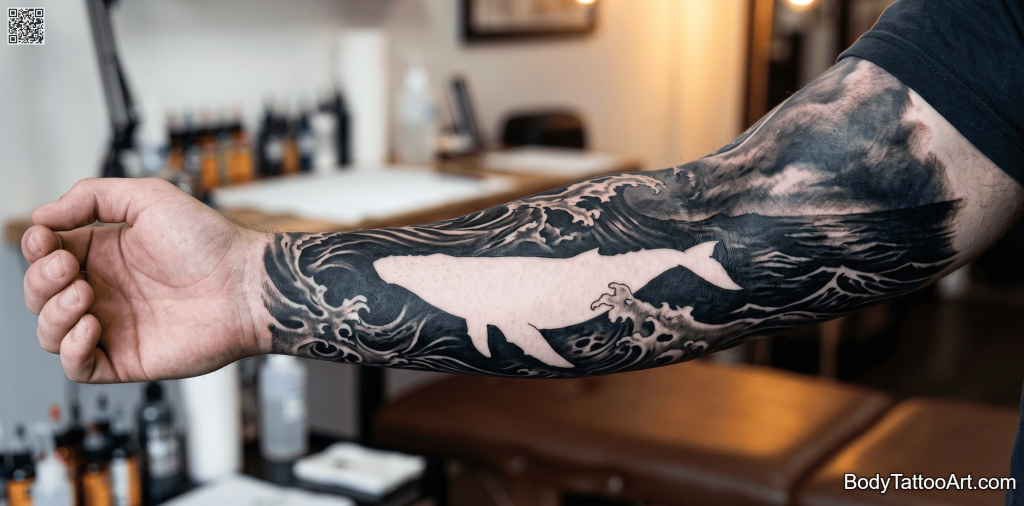
A blue whale is rendered entirely through the surrounding negative space — the ocean, waves, and sky are inked in solid black and heavy grey wash, and the whale’s form is left completely uninked. The animal appears as a white silhouette carved from a dark seascape.
Placement: Full forearm
Style: Negative space blackwork Whale Tattoos
Why it stands out: Whale tattoos usually celebrate the animal through ink ON the form. This one celebrates it through absence — the whale appears because everything around it is dark. It is a conceptually bold reversal that makes the design feel vast.
Ideal for: Bold blackwork fans, collectors who appreciate conceptual approaches, and anyone wanting dramatic whale tattoos that make an immediate visual impact.
Whale tattoos cover an enormous range of styles, moods, and aesthetics — from the delicate Morse code wrist piece to the heavy blackwork negative space forearm. What ties them all together is the subject itself: a creature that moves through depth, travels vast distances, and holds weight in nearly every culture that has ever looked out at the sea.
Whether someone wants something small and personal or a large detailed piece, whale tattoos offer visual versatility that very few other subjects can match. The key is finding the design that genuinely connects — and with 26 very different options here, that should be a strong starting point.