Physical Address
304 North Cardinal St.
Dorchester Center, MA 02124
Physical Address
304 North Cardinal St.
Dorchester Center, MA 02124

Butterfly tattoos are one of the most requested tattoo designs across every studio, and for good reason. The shape naturally works with the body, the wings give artists room to experiment with detail, and the design never feels outdated. This collection features 27 completely different butterfly tattoos, ranging from tiny stick-and-poke dots to large blackwork pieces, so there is something here for almost every taste.
Each design below focuses on a different style, composition, or shading technique. None of them repeat the same layout, so this list works as a real idea board rather than the same design shown 27 times with small changes.
For readers who enjoy nature-based tattoo themes, the lotus tattoo collection , rose with butterfly and sunflower tattoo ideas pair well with butterfly designs if a second piece is ever on the table. Those who prefer animal tattoos may also want to look at the wolf tattoo guide or koi fish tattoo ideas for comparison in linework style. Fans of soft, feminine tattoo work might enjoy the cherry blossom tattoo roundup as well, and anyone drawn to bold blackwork should check the panther tattoo designs for shading reference. Readers building a full sleeve concept can also browse the peony tattoo ideas for floral filler pieces that sit well around a butterfly centerpiece. Lily and butterfly tattoo designs offer a delicate and enchanting aesthetic for those who appreciate intricate body art. These designs can beautifully complement other floral tattoos, creating a harmonious theme that reflects a love for nature. Consider incorporating additional elements, such as stars or vines, to enhance the overall visual impact of your tattoo collection.
Butterflies go through a complete transformation before they ever take flight. They start as eggs, become caterpillars, form a chrysalis, then emerge with wings. This life cycle is the reason butterfly tattoos are so often chosen to mark a personal change, a difficult chapter that has ended, or simply a fresh start. In many cultures, the butterfly is also linked to the soul, freedom, and the idea of lightness after struggle. Ancient Greek art connected the butterfly to Psyche, the goddess of the soul, and similar symbolism appears across Japanese, Mexican, and Native American traditions. More detail on the biology and cultural history behind the insect can be found on Wikipedia’s butterfly page.
Because the meaning is personal and flexible, the design itself carries most of the weight. A soft watercolor butterfly reads very differently from a bold blackwork one, even though the symbolism behind both can be the same. That’s why style and composition matter just as much as the subject itself.
A single-line monarch butterfly drawn with thin, continuous strokes and light dot shading along the wing edges. The lines never overlap, giving the design a clean, almost sketch-like quality. Small gaps in the linework let the skin show through, keeping the piece airy instead of heavy.
Placement: Wrist / behind the ear
Style: Fine line Butterfly Tattoos
Why it stands out: The single continuous line makes it look effortless, like it was drawn in one motion.
Ideal for: First-timers, minimalist lovers, anyone wanting a subtle piece.
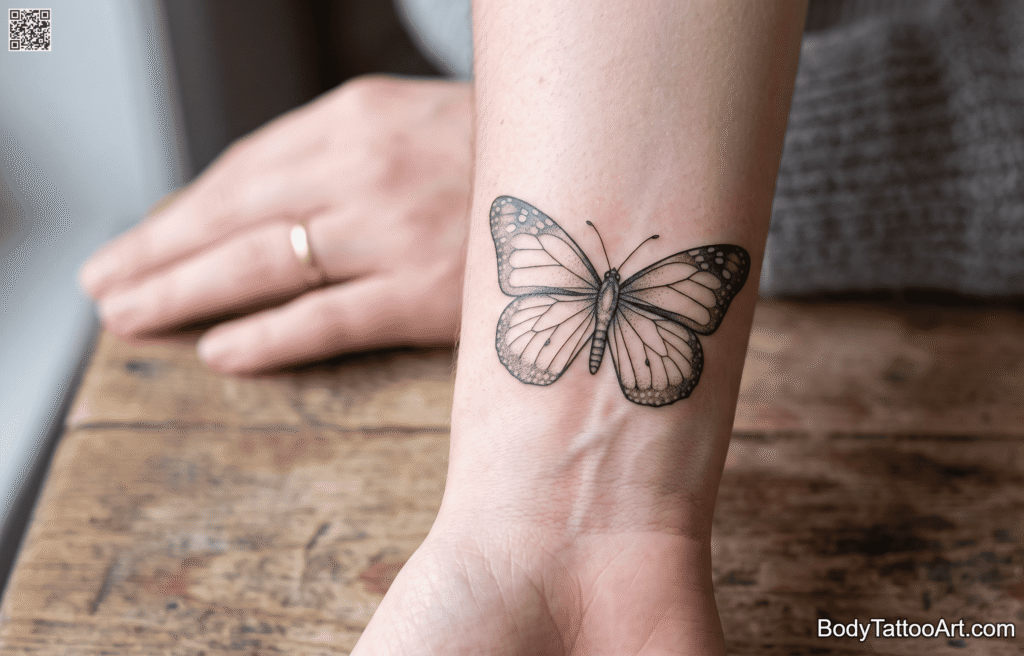
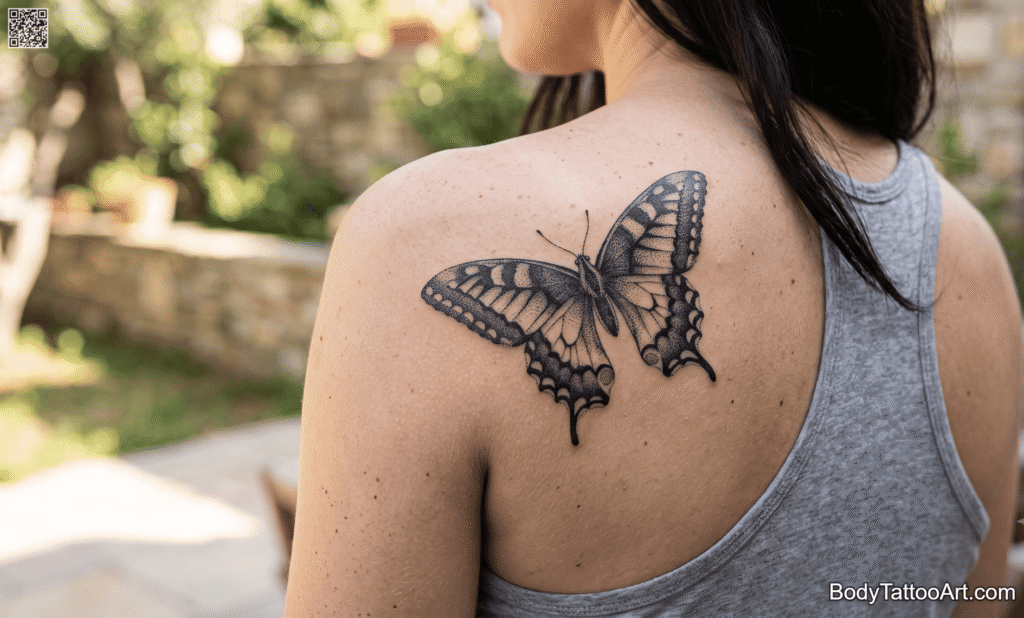
Built entirely from tiny black dots, this swallowtail design uses stippling to create shadow and depth instead of solid lines. The dots cluster tightly near the wing base and spread out toward the tips, creating a fading effect that looks almost like a mist.
Placement: Shoulder blade
Style: Dotwork / stippling Butterfly Tattoos
Why it stands out: The gradual fade from dense to sparse dots gives it a soft 3D look without any shading tool other than dots.
Ideal for: Fans of textured tattoos, people who like slow-and-detailed work.
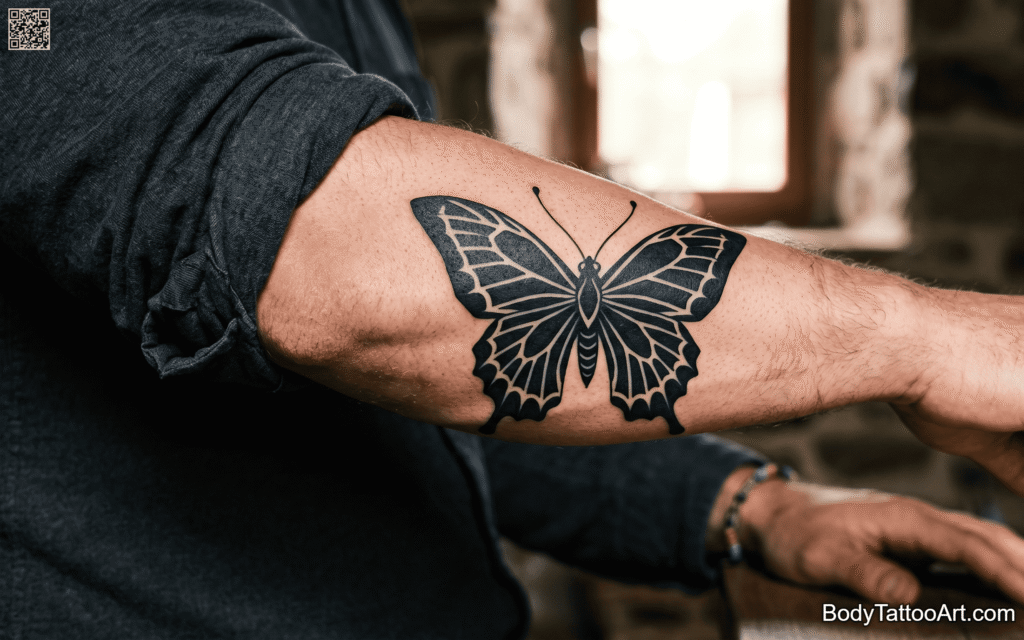
A thick, graphic butterfly filled almost entirely in solid black, with only a few negative space lines breaking up the wings. The shape is symmetrical and slightly angular, giving it a modern, poster-like feel rather than a delicate one.
Placement: Forearm
Style: Blackwork Butterfly Tattoos
Why it stands out: The heavy black fill makes it bold enough to stand alone without any additional detail.
Ideal for: Bold style fans, people who want high contrast pieces.
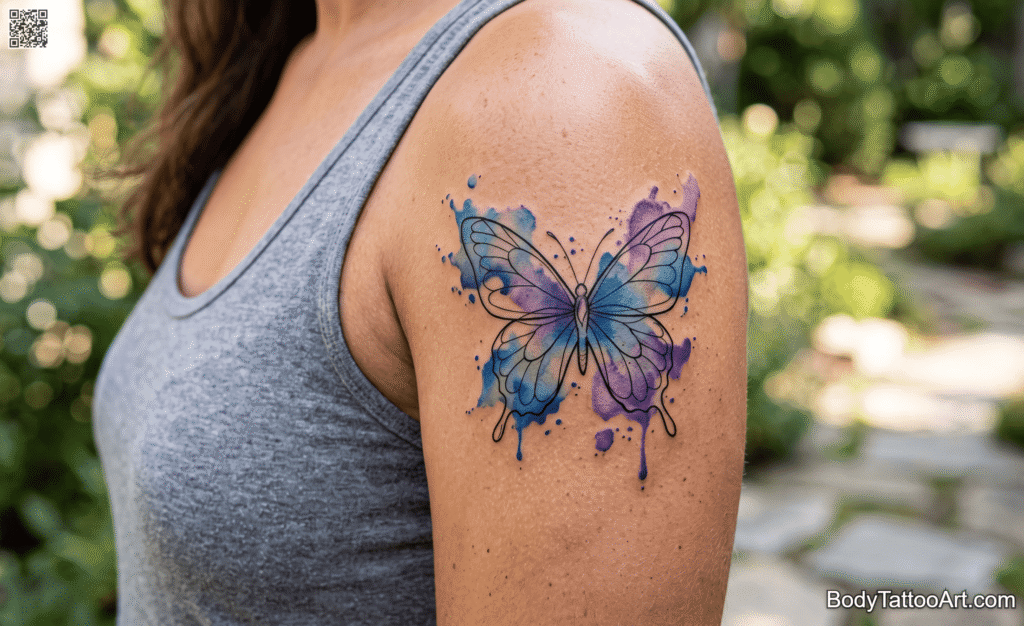
Soft washes of blue and purple bleed outside a thin black outline, giving the impression of paint spreading on wet paper. The wings themselves stay mostly outlined, while the color splash extends beyond the shape in loose, uneven blotches.
Placement: Upper arm
Style: Watercolor Butterfly Tattoos
Why it stands out: The color deliberately breaks the outline, making it feel painted rather than drawn.
Ideal for: People who want color without a fully filled-in design.
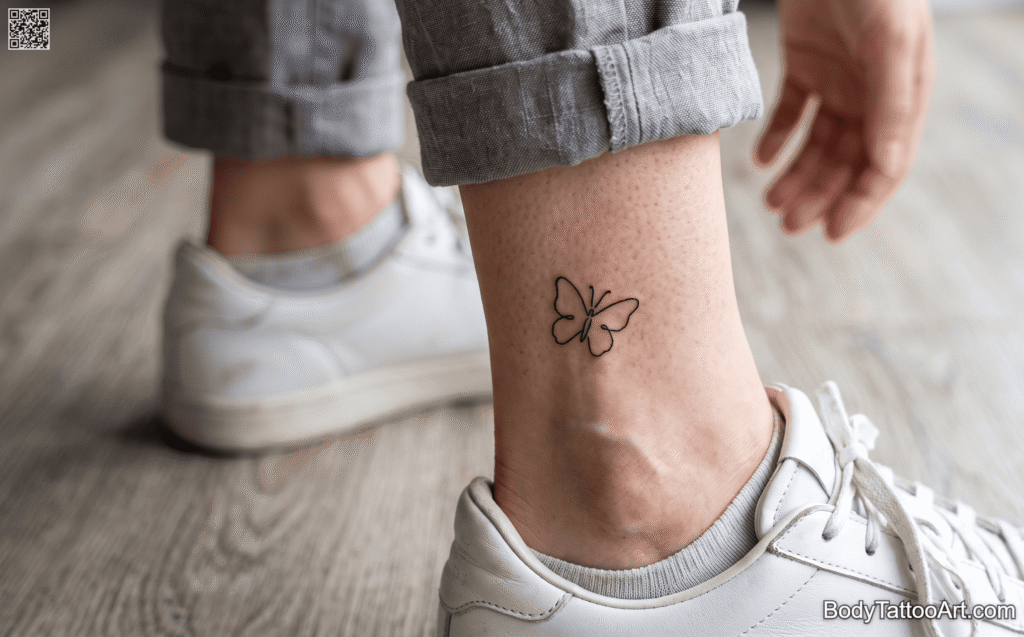
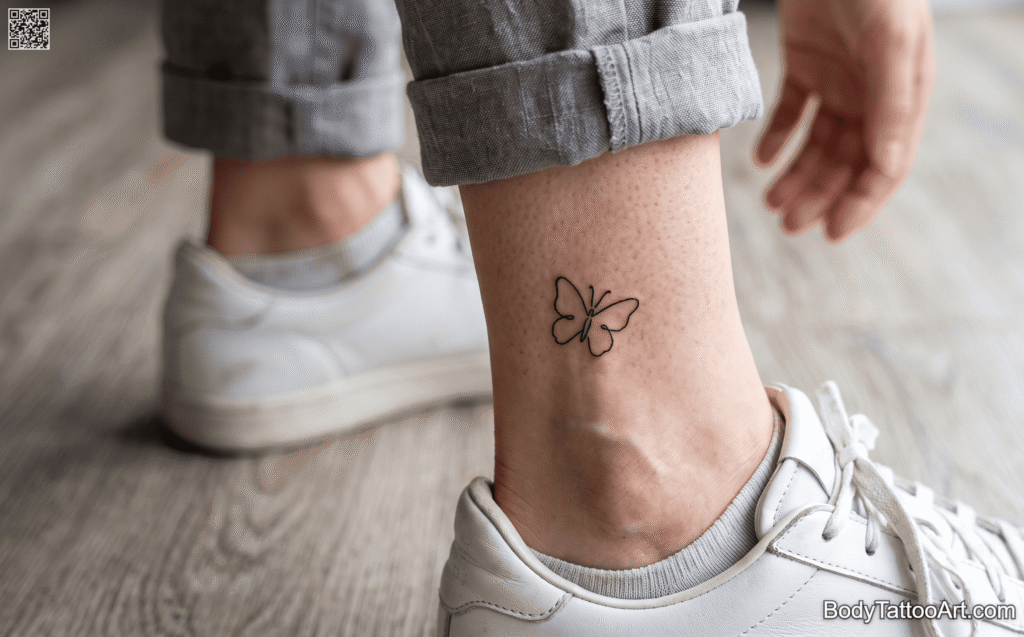
A small, simple butterfly no bigger than a coin, with basic outlines and no shading at all. The wings are slightly asymmetrical, giving it a hand-drawn, imperfect charm instead of a stiff, symmetrical look.
Placement: Ankle
Style: Simple linework Butterfly Tattoos
Why it stands out: The small size and slight asymmetry make it feel personal rather than templated.
Ideal for: People wanting a first tattoo or a quiet, everyday piece.
A rounded, cartoon-style butterfly with big soft wings and a tiny smiling face detail on the body. The lines are thick and bouncy, and the wings are filled with small pastel-colored dots instead of patterns.
Placement: Calf
Style: Kawaii / cartoon Butterfly Tattoos
Why it stands out: The playful face and pastel dots give it a cheerful, toy-like personality most butterfly tattoos don’t have.
Ideal for: Fans of cute, playful tattoo styles.
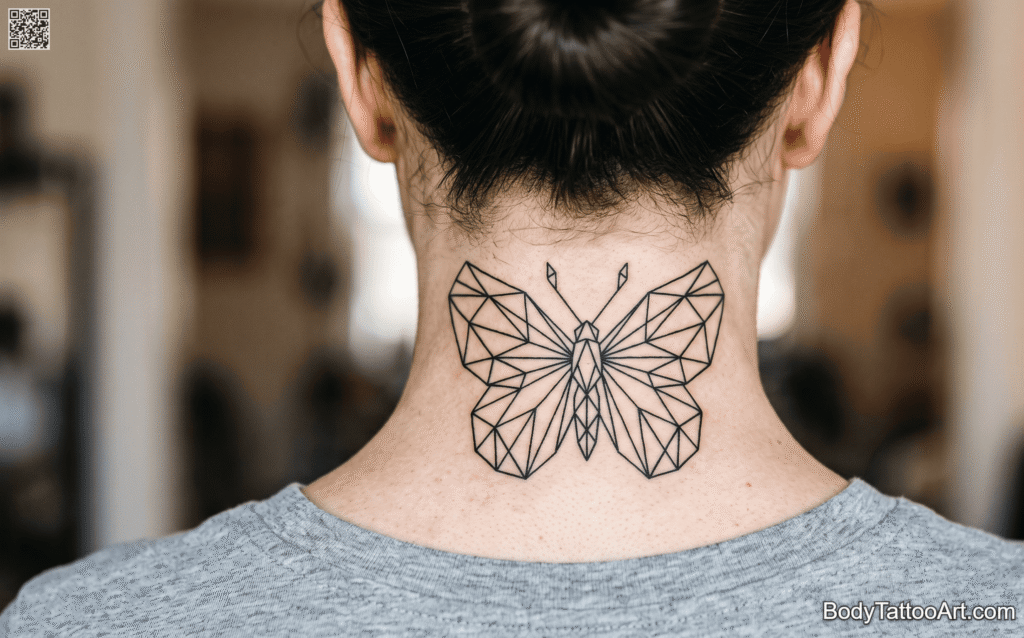
The wings are built from straight lines and triangles instead of natural curves, turning the insect into an almost crystal-like shape. A single vertical line runs down the center, keeping both sides in sharp symmetry.
Placement: Back of the neck
Style: Geometric Butterfly Tattoos
Why it stands out: Replacing natural curves with hard angles makes it feel more like a logo than a living creature.
Ideal for: People who like structured, symmetrical designs.
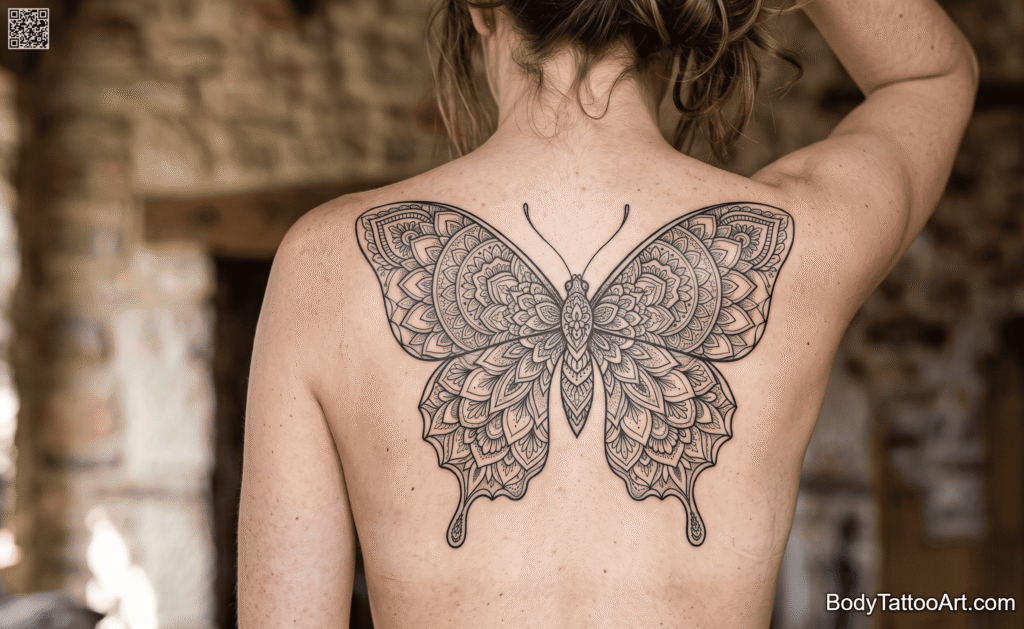
Each wing is filled with a small mandala pattern instead of natural wing texture, with tiny circles and petal shapes radiating from the body outward. The linework is thin and precise, requiring the wings to stay fairly large to hold the detail.
Placement: Mid-back
Style: Mandala / ornamental Butterfly Tattoos
Why it stands out: Turning the wings into mandalas gives the tattoo two design styles working together inside one shape.
Ideal for: People who love intricate, pattern-heavy tattoos.
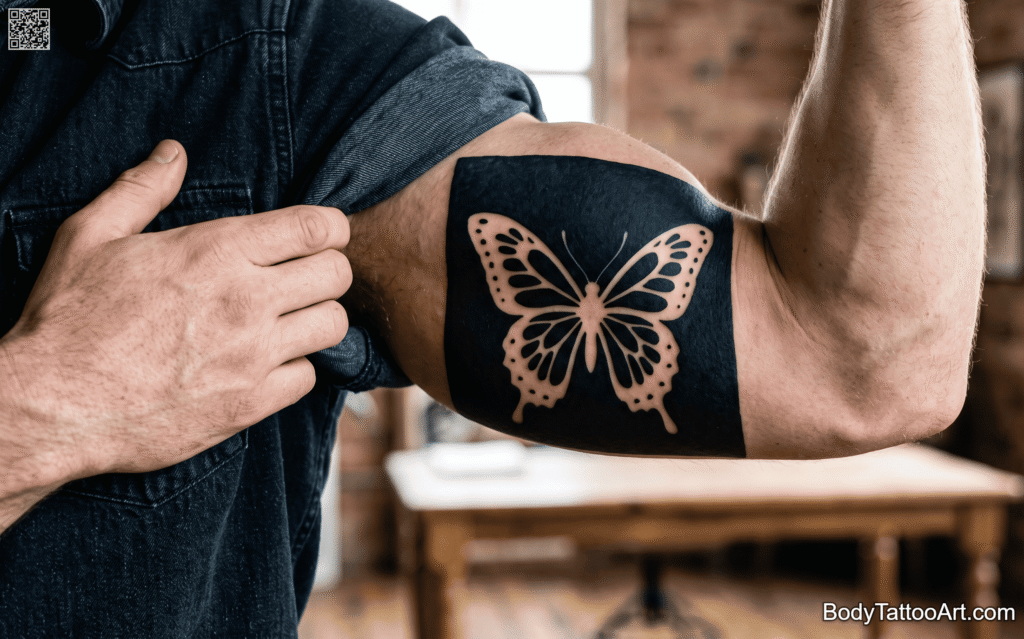
Instead of outlining the butterfly, the artist fills in the space around it with solid black, leaving the wings as untouched skin. The shape only becomes visible because of what’s missing, not what’s drawn.
Placement: Bicep
Style: Negative space blackwork Butterfly Tattoos
Why it stands out: The butterfly is defined entirely by the black around it, which is a rare technique for this subject.
Ideal for: People who want something visually unusual and conversation-starting.
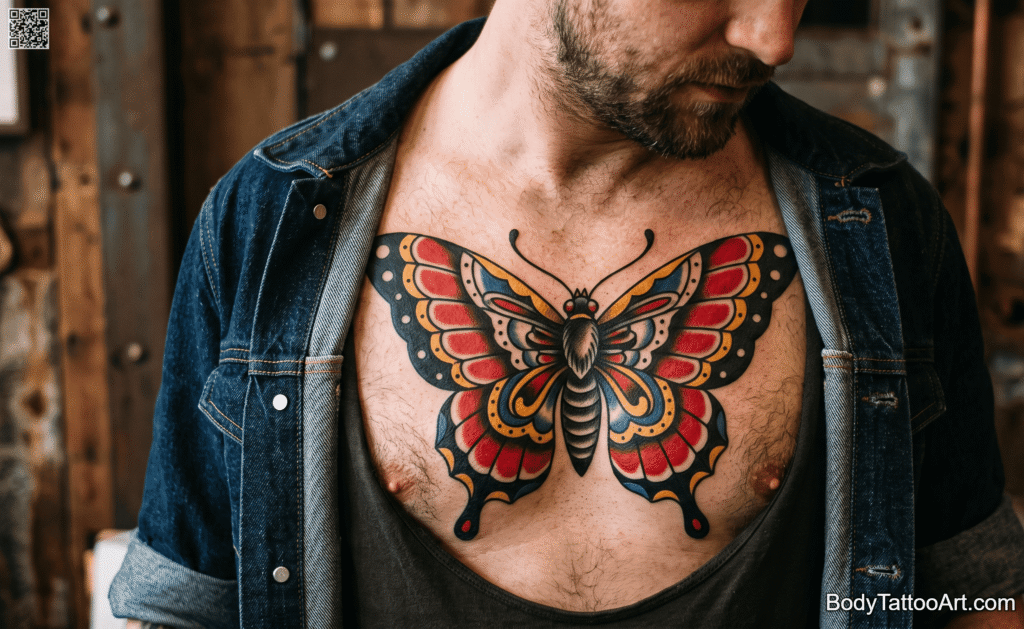
Thick black outlines, bold red and yellow fill, and heavy shading give this butterfly the classic look of vintage tattoo flash art. The wings are rounded and slightly oversized compared to the body, typical of the traditional style.
Placement: Chest
Style: American traditional Butterfly Tattoos
Why it stands out: The saturated colors and bold lines make it hold up well over time, a signature trait of the traditional style.
Ideal for: Fans of vintage tattoo flash art.
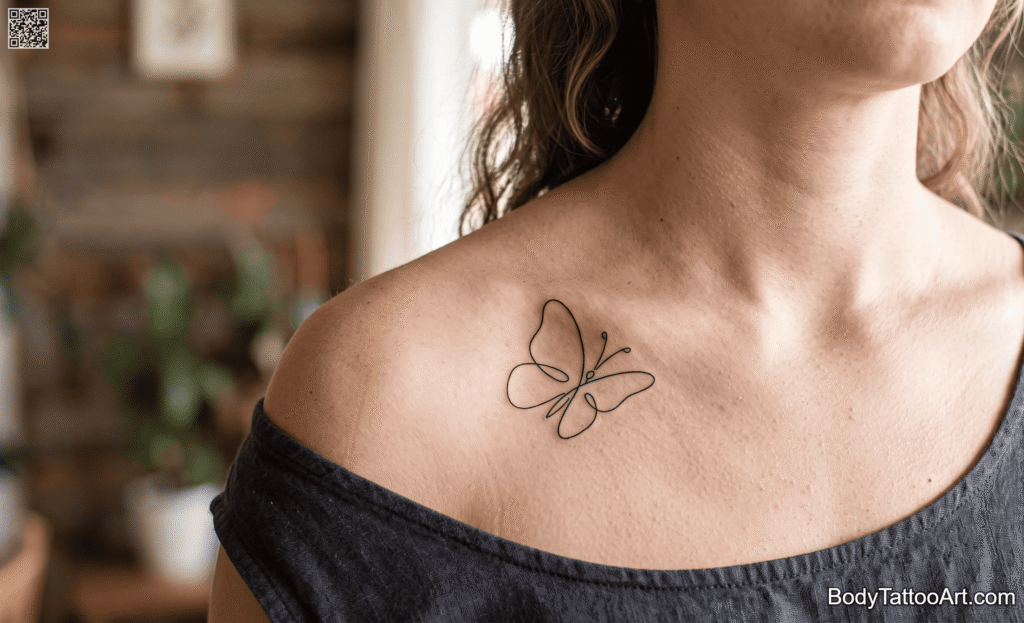
Drawn in one unbroken line from start to finish, this butterfly has no lifted pen marks anywhere in the design. The wings loop back into the body in a way that keeps the whole shape connected.
Placement: Collarbone
Style: Single line / continuous line Butterfly Tattoos
Why it stands out: The unbroken line adds a sense of motion, like the butterfly was traced mid-flight.
Ideal for: Minimalist lovers, people who want a clever technical detail.
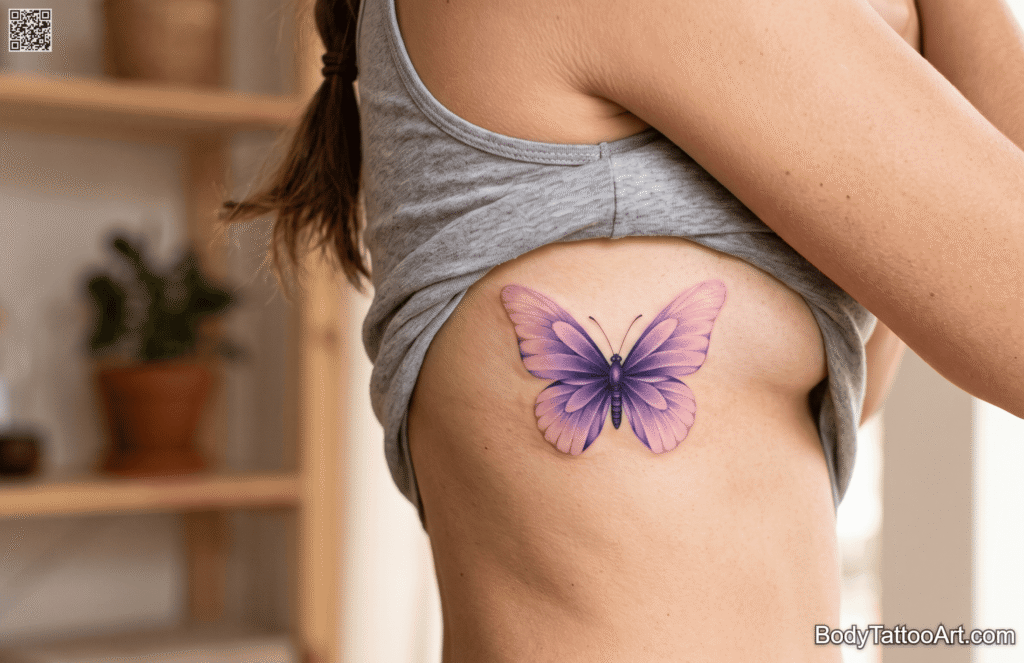
The wings transition smoothly from deep purple near the body to soft pink at the tips, with no visible line separating the colors. The blending is smooth enough that it looks airbrushed rather than tattooed with a needle.
Placement: Ribcage
Style: Color realism / ombre Butterfly Tattoos
Why it stands out: The smooth gradient is technically difficult, which makes it stand out among flat-color designs.
Ideal for: People who want color but not a bold, saturated look.
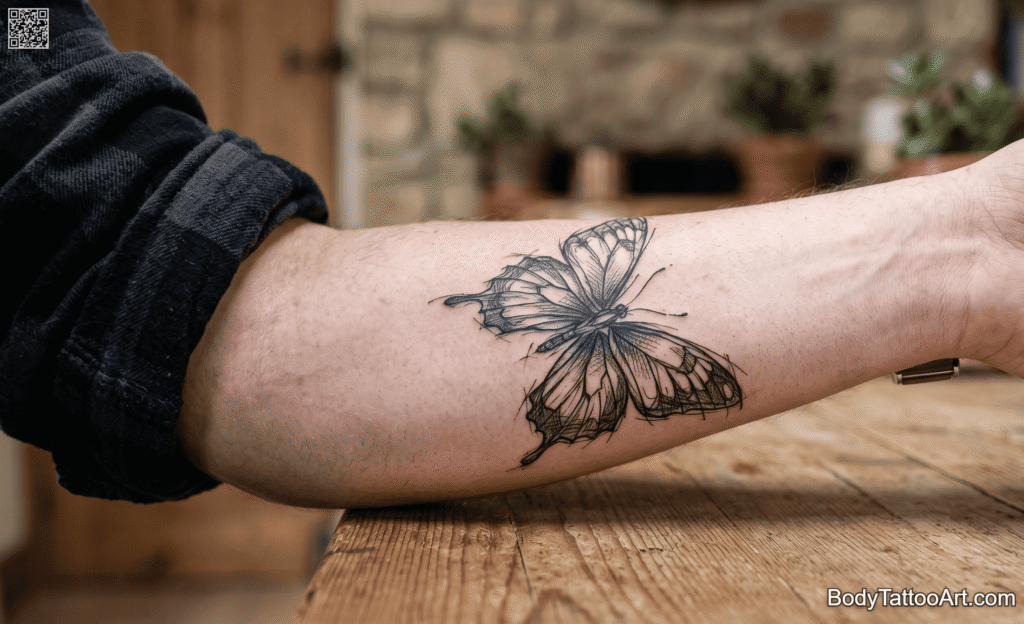
Loose, uneven pencil-like lines make up the wings, with visible cross-hatching in place of smooth shading. Some lines are left intentionally incomplete, giving the tattoo the look of an unfinished drawing rather than a polished design.
Placement: Forearm
Style: Sketch / illustrative Butterfly Tattoos
Why it stands out: The incomplete, sketchy lines make it feel like art in progress instead of a finished piece.
Ideal for: People who like an artistic, hand-drawn aesthetic.
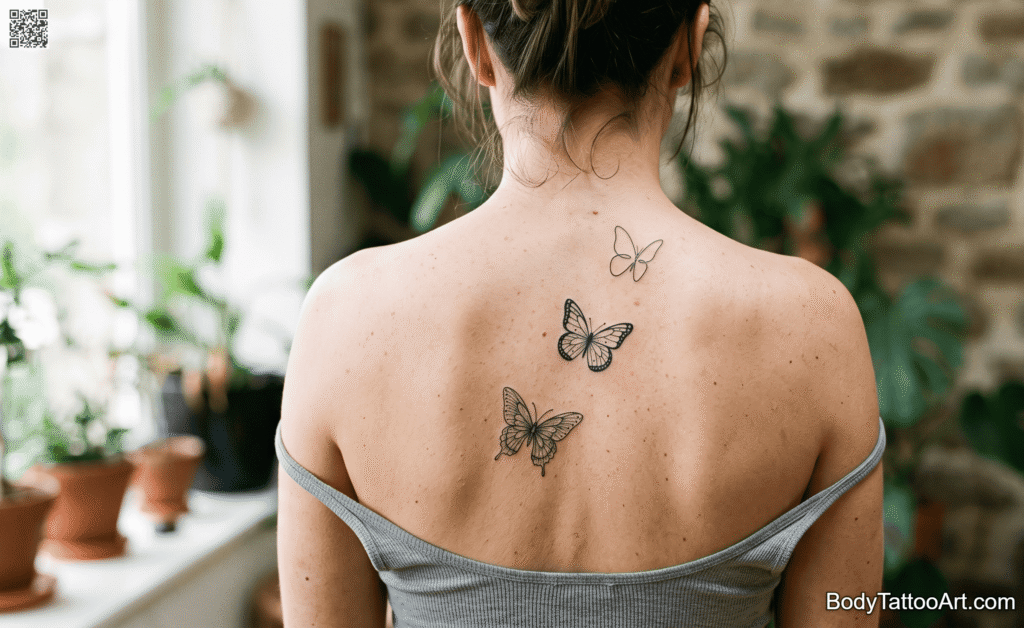
Three small butterflies of slightly different sizes are placed in a diagonal trail, each one simpler in detail than the last, as if they’re flying away from the body. No two are drawn identically.
Placement: Spine / side ribs
Style: Minimal linework, multiple pieces Butterfly Tattoos
Why it stands out: The trail formation creates a sense of movement across the body instead of one static shape.
Ideal for: People wanting a design that flows with the body’s natural lines.
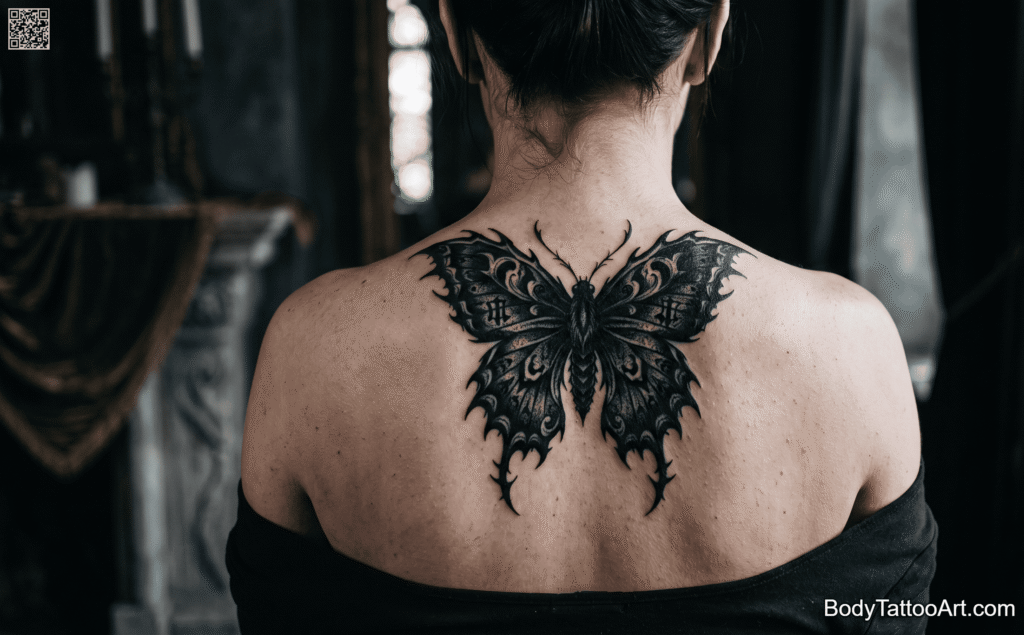
Sharp, jagged wing edges and heavy black shading give this butterfly a darker, more dramatic look than a typical design. Small thorn-like points extend from the lower wings instead of the usual rounded curves.
Placement: Upper back
Style: Gothic blackwork Butterfly Tattoos
Why it stands out: The jagged edges and heavy shadow give it an edge that softer butterfly designs don’t have.
Ideal for: Fans of darker, moodier tattoo aesthetics.
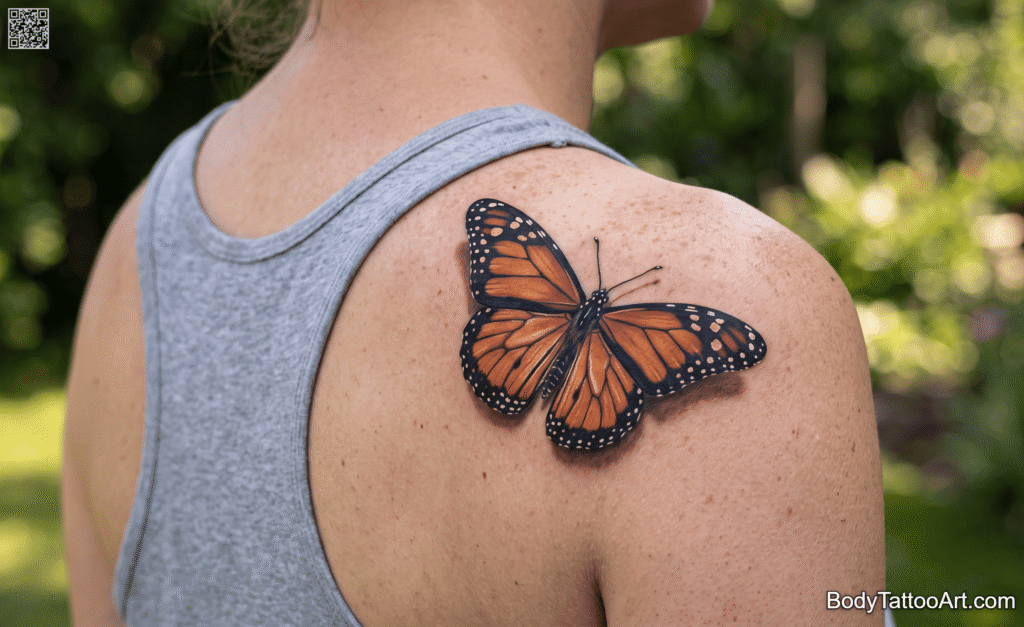
Detailed shading mimics real wing texture, including subtle vein lines and light reflections that make the wings look like they’re slightly lifted off the skin. The color palette stays close to a real monarch butterfly’s natural tones.
Placement: Shoulder
Style: Realism Butterfly Tattoos
Why it stands out: The shading creates a 3D illusion, making the tattoo look almost photographic.
Ideal for: People who want a highly detailed, lifelike design.
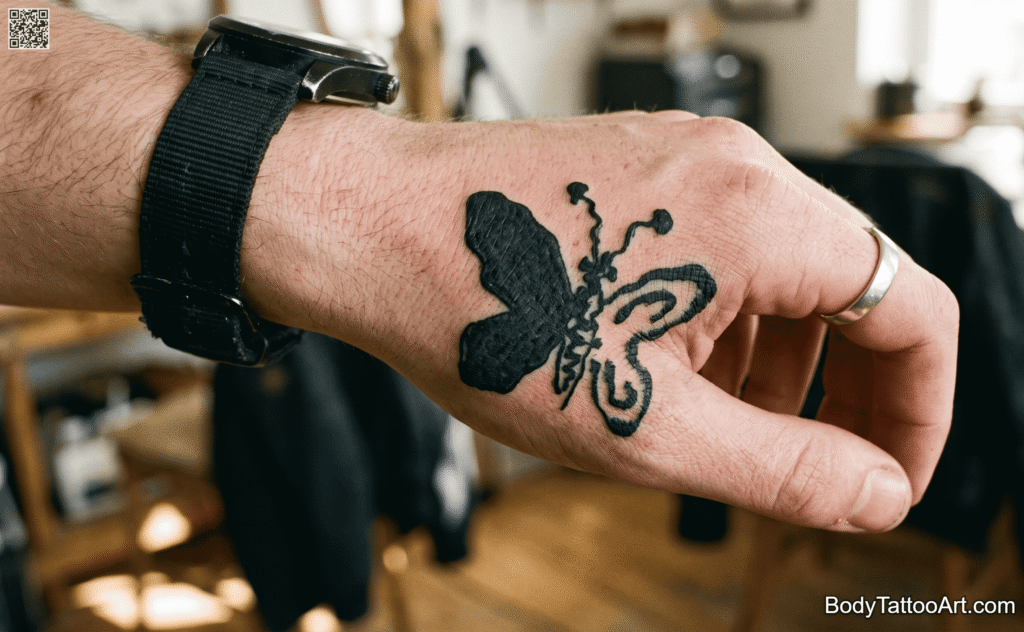
Deliberately rough, uneven linework with a childlike simplicity, drawn as if freehanded without a stencil. The wings are lopsided on purpose, and the shading is a solid flat black instead of anything gradual.
Placement: Hand
Style: Ignorant style Butterfly Tattoos
Why it stands out: The rough, imperfect look is intentional and gives it a raw, unpolished charm.
Ideal for: People who like non-traditional, rebellious tattoo styles.
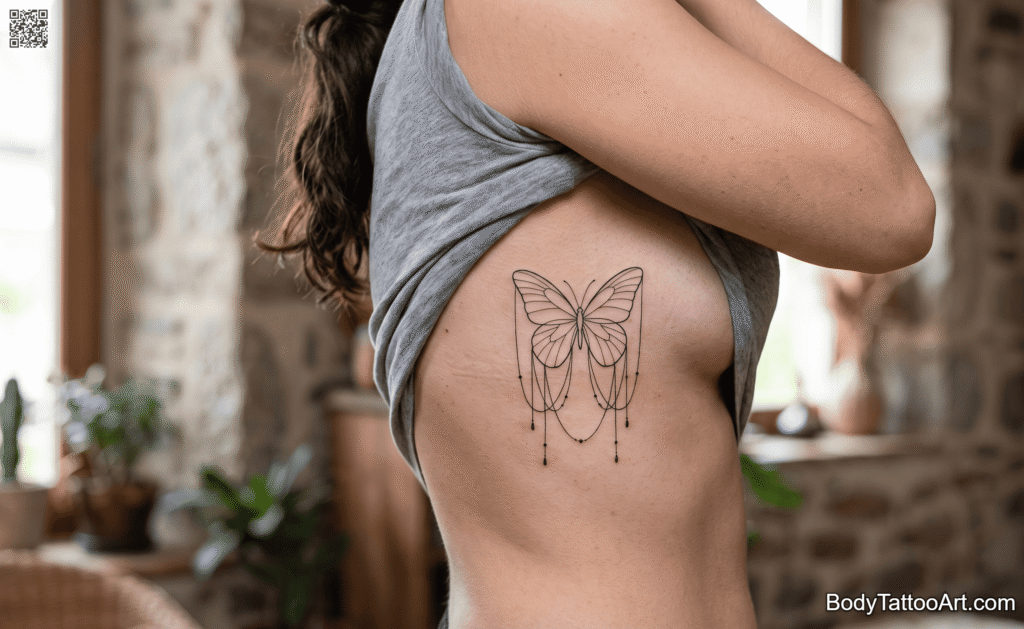
Delicate dangling lines drop from the bottom of each wing like tiny beads on a chandelier, adding movement below the main shape. The wings themselves stay simple so the dangling detail becomes the focal point.
Placement: Underarm / side of ribs
Style: Fine line with ornamental detail
Why it stands out: The dangling lines give it a jewelry-like quality most butterfly tattoos don’t attempt.
Ideal for: People who want something delicate but still detailed.
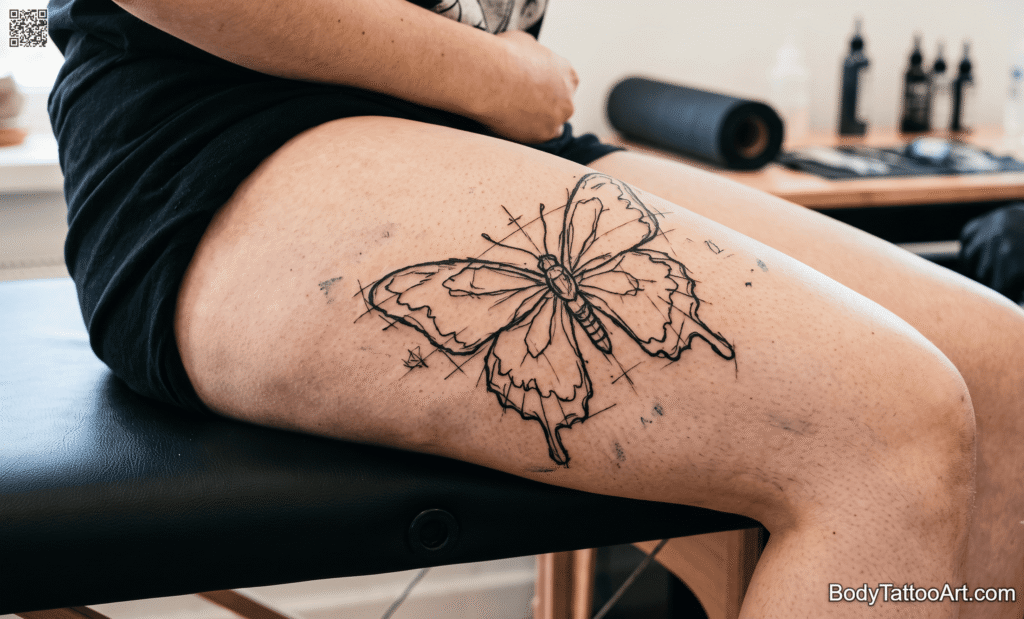
This design keeps the raw, unshaded look of a tattoo stencil, with visible construction lines left in place rather than cleaned up. The wings have a slightly rough, hand-traced edge instead of a smooth finish.
Placement: Thigh
Style: Stencil outline Butterfly Tattoos
Why it stands out: Leaving the construction lines visible turns the design process itself into part of the art.
Ideal for: People who like an unfinished, workshop-style aesthetic
Each wing is divided into small sections filled with alternating straight and curved line patterns, similar to a stained-glass window. Every section is outlined separately, keeping the overall shape crisp despite the busy detail inside.
Placement: Lower back
Style: Linework / pattern fill Butterfly Tattoos
Why it stands out: The stained-glass effect turns a simple shape into a detailed patchwork of smaller patterns.
Ideal for: People who like busy, detail-rich tattoos with a clean outer shape.
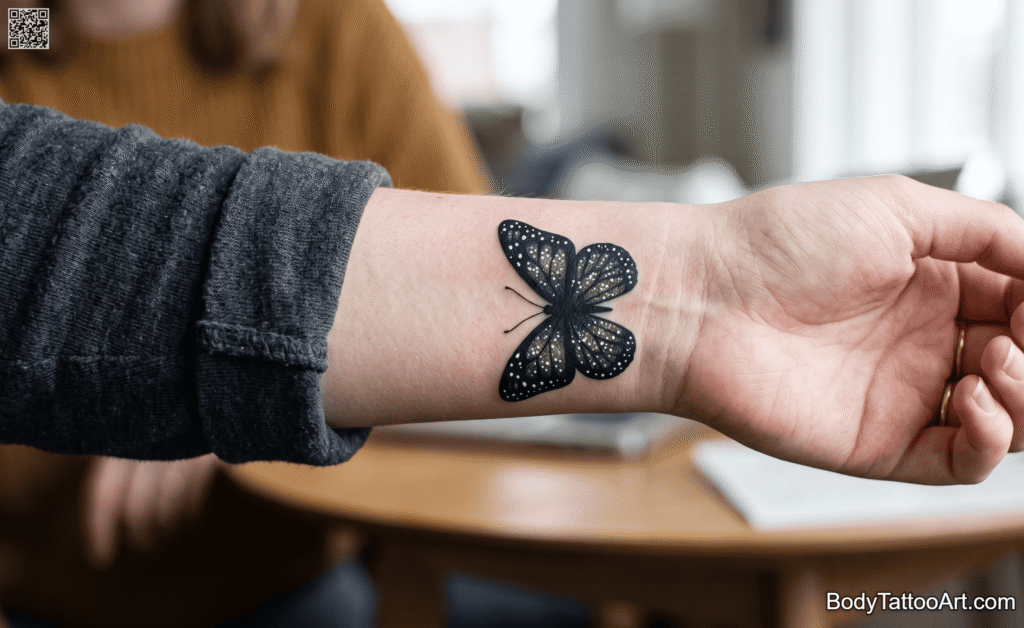
Small white highlight dots scattered across a black wing create the illusion of shimmer or sparkle catching the light. The base shape stays simple, letting the scattered highlights do most of the visual work.
Placement: Wrist
Style: Blackwork with highlight dotwork Butterfly Tattoos
Why it stands out: The scattered white highlights give the illusion of movement and shine on an otherwise still design.
Ideal for: People who want a subtle sparkle effect without actual color.
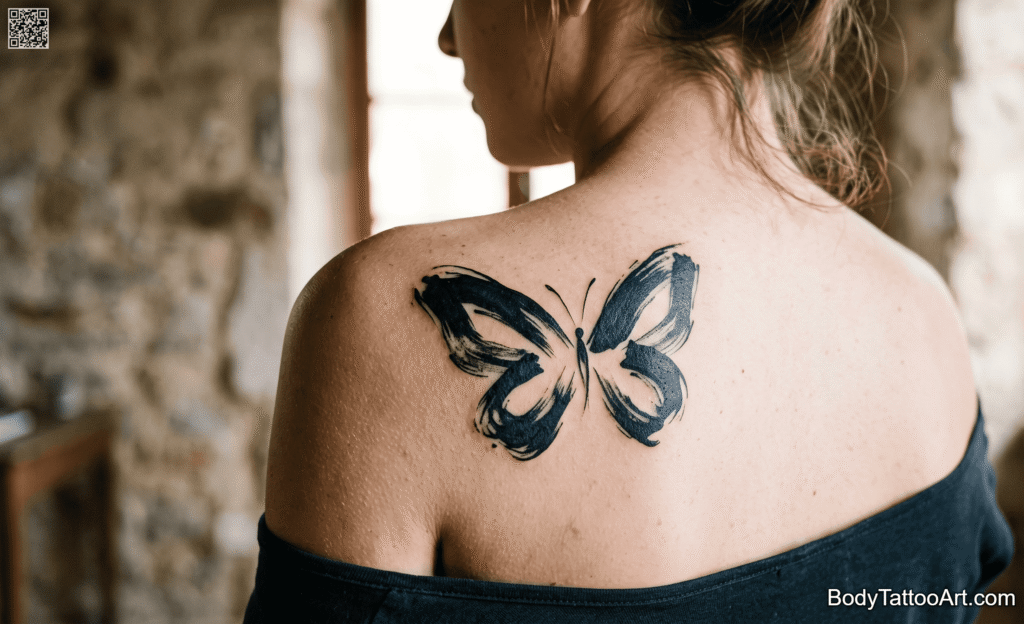
The wings are built from loose, wide brushstroke shapes instead of defined outlines, giving the design a more painterly, abstract feel. Some strokes overlap slightly, and the body of the butterfly is barely more than a thin connecting line.
Placement: Shoulder blade
Style: Abstract Butterfly Tattoos
Why it stands out: The loose brushstroke shapes make it feel more like a painting than a traditional tattoo outline.
Ideal for: People who want an artistic, non-literal interpretation of the design.
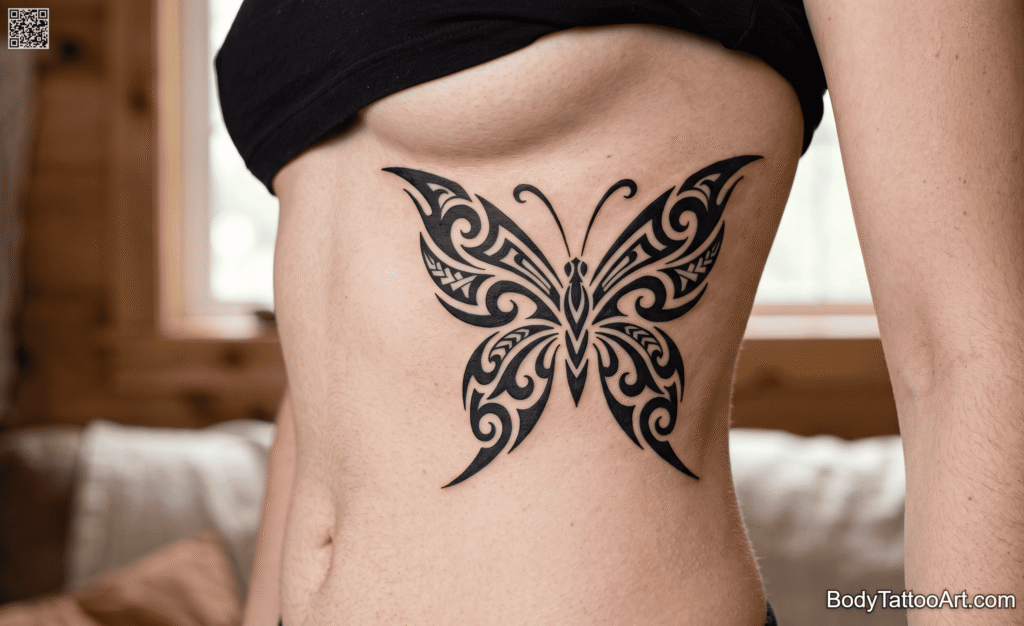
Thick, flowing black shapes curve outward from the body in a way that echoes traditional tribal tattoo linework, though the overall silhouette still reads clearly as a butterfly. The lines taper to sharp points at the wing tips.
Placement: Lower back / side torso
Style: Tribal-inspired blackwork Butterfly Tattoos
Why it stands out: The tapered flowing shapes give it a strong sense of motion compared to a static outline.
Ideal for: Fans of bold, flowing blackwork designs.
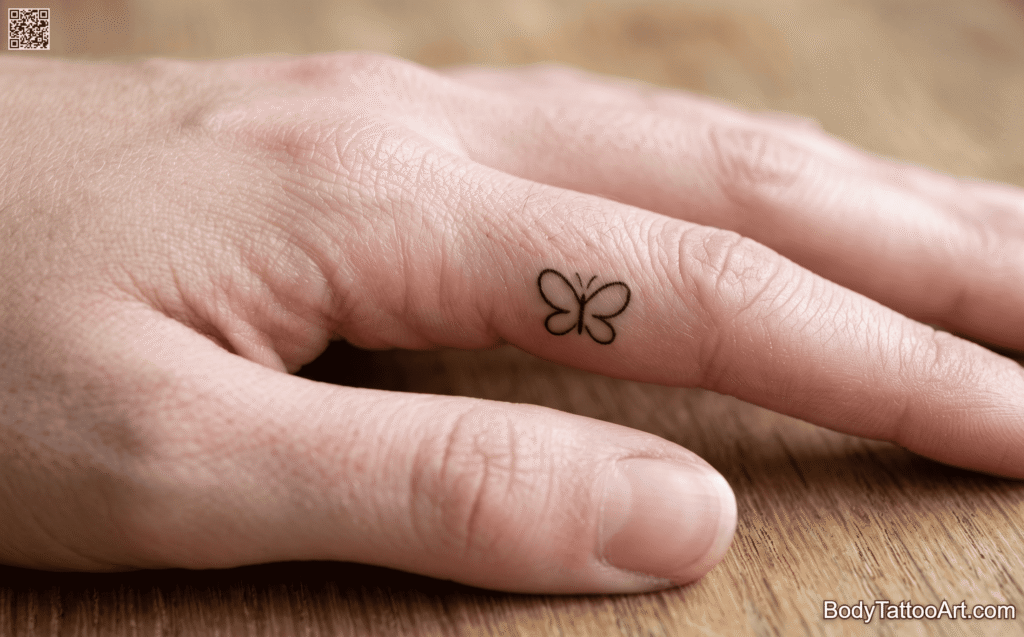
An extremely small, simplified butterfly reduced to its most basic shape, sized to fit entirely on a single finger. There’s no shading, just two small linked ovals for wings and a short line for the body.
Placement: Finger
Style: Micro tattoo Butterfly Tattoos
Why it stands out: The extreme simplicity makes it barely noticeable unless someone is looking closely.
Ideal for: People wanting a discreet, low-commitment design.
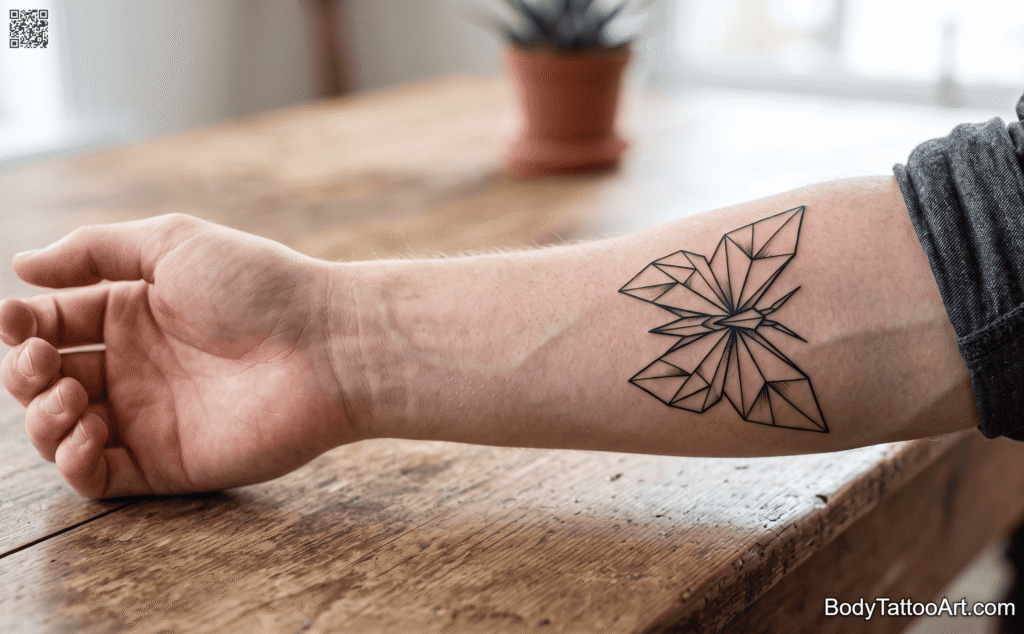
The wings are drawn with sharp, angular folds like paper origami rather than smooth natural curves, complete with visible crease lines across each fold. The effect makes the butterfly look like it was made from folded paper rather than grown in nature.
Placement: Forearm
Style: Geometric / origami-inspired Butterfly Tattoos
Why it stands out: The paper-fold illusion gives it a craft-like quality that’s rare in butterfly tattoos.
Ideal for: People who like clever, illusion-based designs.
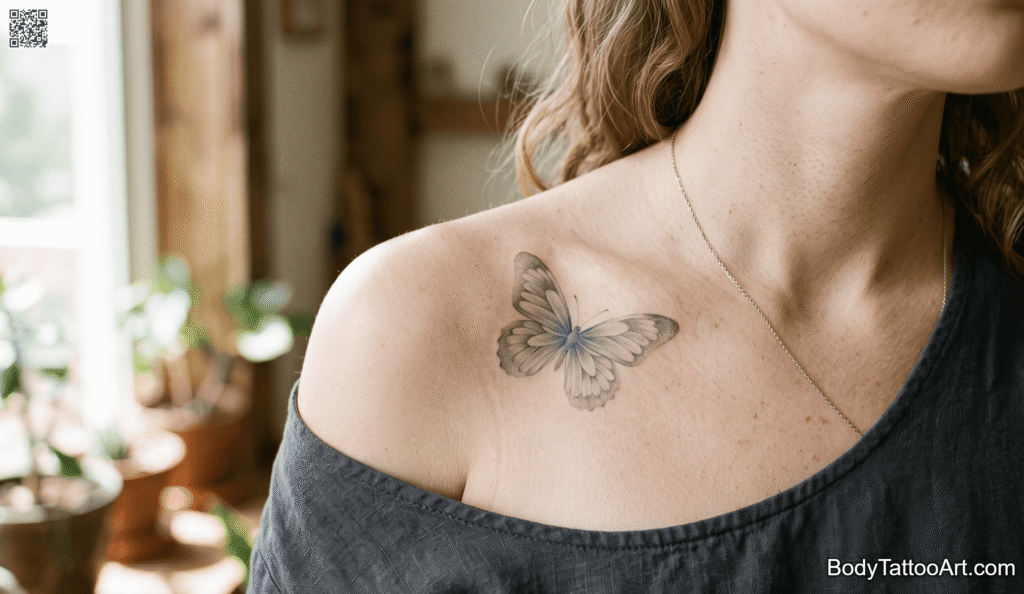
Gentle grey shading builds up the wing texture in soft layers, with no harsh black outlines anywhere in the design. The edges of the wings fade slightly into the skin instead of ending in a hard line.
Placement: Collarbone / neck
Style: Grey-wash / soft shading Butterfly Tattoos
Why it stands out: The lack of outlines makes it look like the shading itself is holding the shape together.
Ideal for: People who want a soft, quiet tattoo with no bold lines.
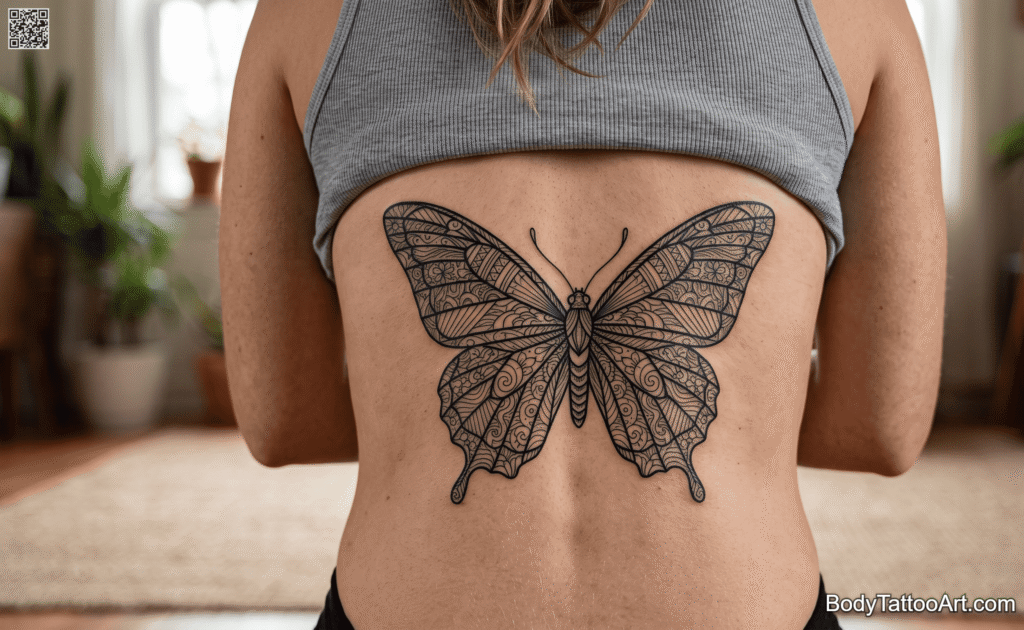
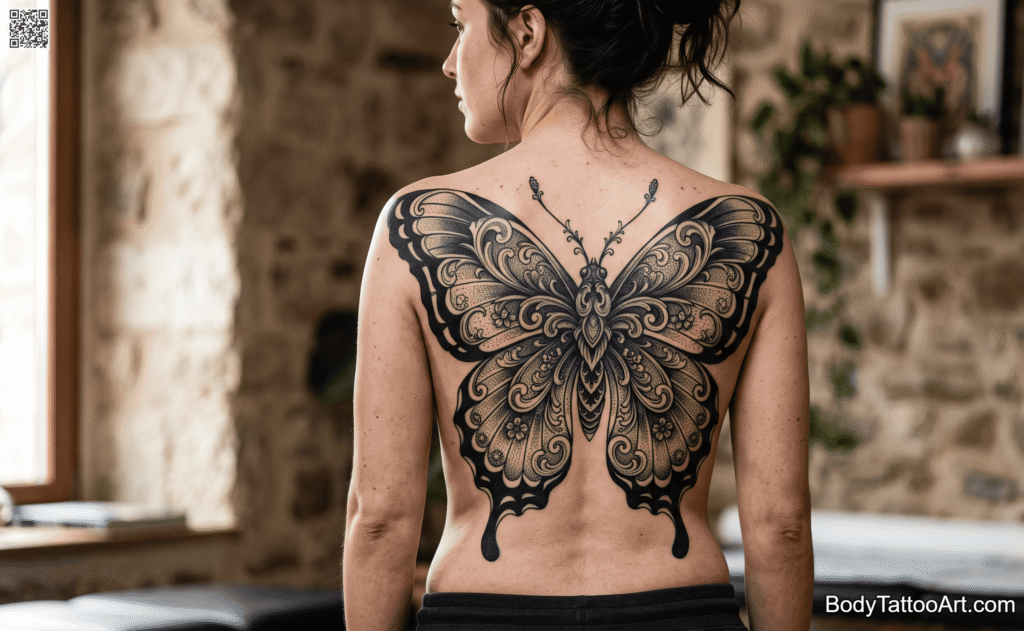
A large-scale butterfly with heavily decorated wings, filled with swirling filigree lines, small florets, and fine dotwork detailing throughout. The design spans a wide area and uses varying line weights to keep the busy pattern readable from a distance.
Placement: Full back
Style: Ornamental blackwork Butterfly Tattoos
Why it stands out: The scale allows for layers of fine detail that a smaller tattoo simply couldn’t hold.
Ideal for: Collectors of large, statement-making tattoos.
Each of these designs works on its own, but they also mix well with other nature-themed tattoos already covered, like the magnolia tattoo ideas or orchid tattoo designs, for anyone planning a larger connected piece. Butterfly tattoos hold up across almost every style because the shape itself is so flexible, which is exactly why this list leans into so many different techniques instead of repeating the same look 27 times.