Physical Address
304 North Cardinal St.
Dorchester Center, MA 02124
Physical Address
304 North Cardinal St.
Dorchester Center, MA 02124

Cat tattoos have been a steady favorite in tattoo studios for years, and it is easy to see why. Cats carry a certain mystery, independence, and charm that translates beautifully into ink. From tiny minimalist outlines to bold blackwork pieces, there is a cat tattoo style for almost every personality. This list covers 30 different cat tattoo ideas, each built around a distinct style, composition, and placement so no two entries feel repetitive. Anyone browsing for a first tattoo or planning an addition to an existing collection will find something worth saving here.
Cat tattoos also pair well with other animal-inspired ink. Readers who enjoy feline designs often gravitate toward big cat pieces too, and the tiger tattoo ideas collection covers everything from realism to bold traditional line work. Those who prefer a softer, more graceful animal might enjoy browsing lion tattoo designs for a similarly regal feel. Fans of nocturnal, mysterious creatures may also want to check out wolf tattoo inspiration, which shares a lot of the same shading techniques used in cat portraits.
For something floral instead of animal-led, the lotus tattoo ideas roundup shows how delicate linework can still make a strong visual statement. Anyone drawn to color and movement should also look at the koi tattoo collection, and those who like bold single-color designs might enjoy the leopard tattoo roundup as well.
Cats have held cultural significance across many civilizations for thousands of years. In Ancient Egypt, cats were closely tied to protection and household guardianship, while in Japanese folklore, the beckoning cat is associated with luck and good fortune. In Western superstition, cats are often linked to independence, curiosity, and even mystery, depending on the story or region.
Because of this long and varied history, a cat tattoo can mean different things to different people, ranging from personal independence to companionship to simple appreciation for the animal itself. Anyone curious about the broader cultural history of cats can read more on Wikipedia’s page on cats in culture, which outlines how the animal has been viewed across different societies and time periods.
Because meaning shifts from person to person, most people choosing a cat tattoo today lean more on the visual appeal of the design than on a fixed symbolic meaning, which is part of why style variety matters so much in this list.
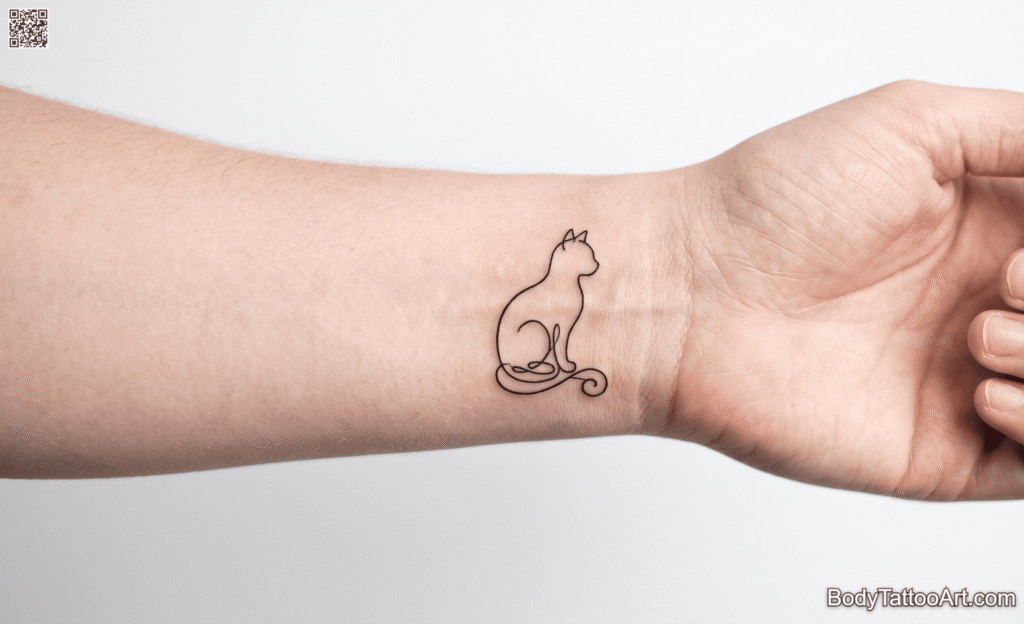
A single unbroken line curves and loops to form a cat sitting upright, tail wrapped neatly around its paws. There are no extra details, just one continuous stroke that never lifts off the skin. The simplicity is the whole point here, and the open space around the line lets it breathe instead of feeling cramped.
Placement: Wrist
Style: Single-line / fine line Cat Tattoos
Why it stands out: The design relies entirely on line confidence, so any wobble would show, which makes a clean version feel very intentional and polished.
Ideal for: First-timers and minimalist lovers who want something subtle.
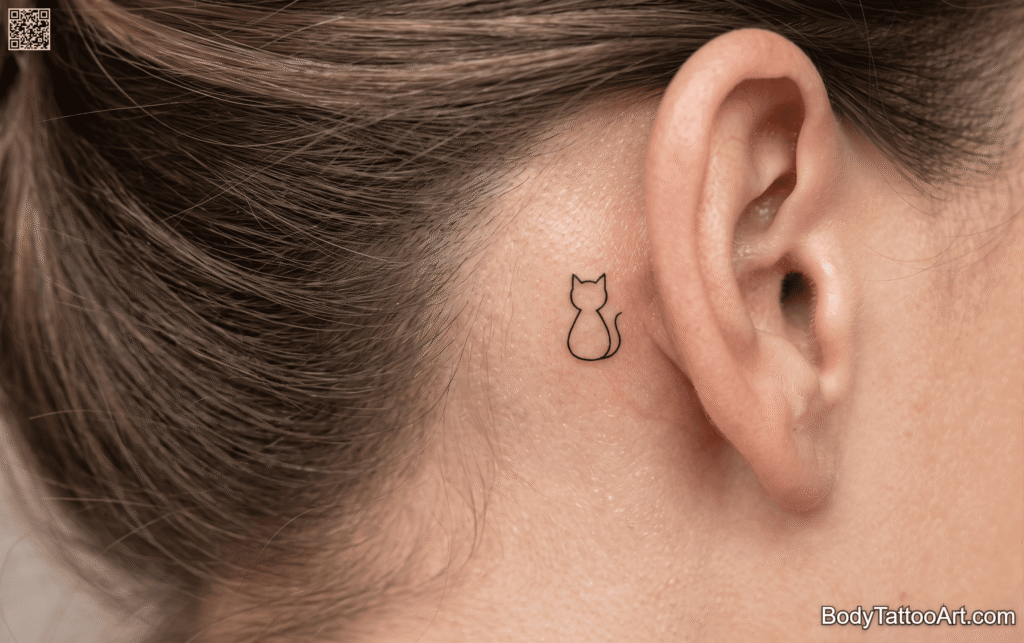
This tiny cat is barely bigger than a thumbnail, just a basic outline with pointed ears and a curved back. There is no shading at all, only the outer shape. It reads instantly as a cat even from a distance, which is impressive given how small the actual linework is.
Placement: Behind the ear
Style: Micro / tiny outline Cat Tattoos
Why it stands out: The scale forces total simplicity, and that restraint gives it a quiet, almost secret quality.
Ideal for: People who want a discreet tattoo that is easy to hide.
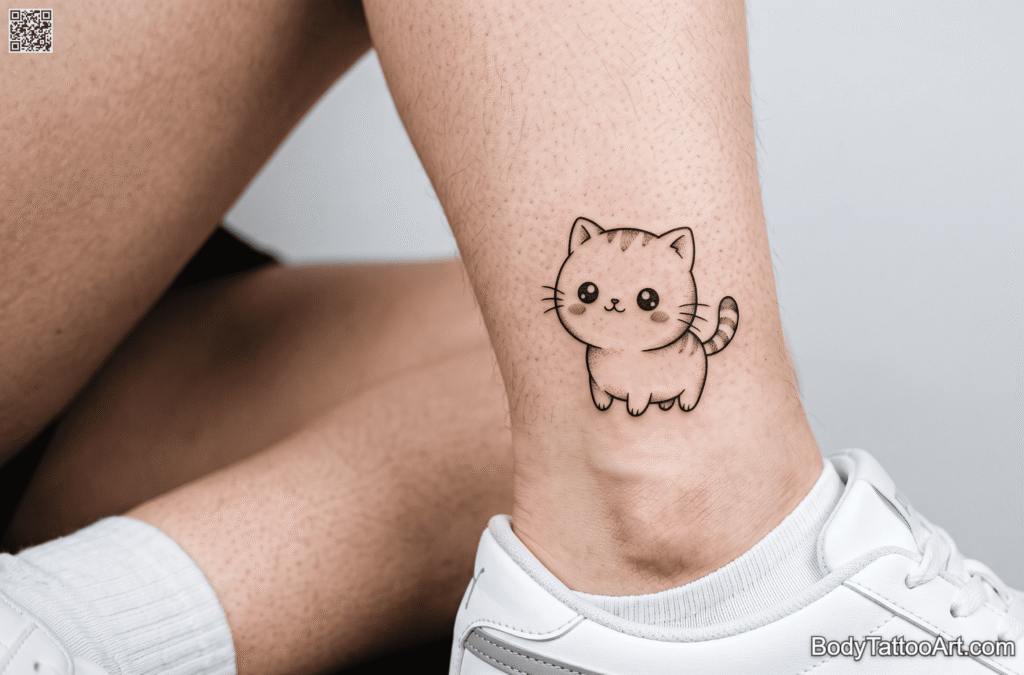
This design leans fully into cute territory, with an oversized round head, tiny triangle ears, and big dot eyes. The proportions are exaggerated on purpose, making the face take up most of the space while the body shrinks down small underneath it.
Placement: Ankle
Style: Kawaii / cute cartoon Cat Tattoos
Why it stands out: The exaggerated proportions give it personality without needing any color or shading.
Ideal for: Fans of playful, cartoon-inspired ink.
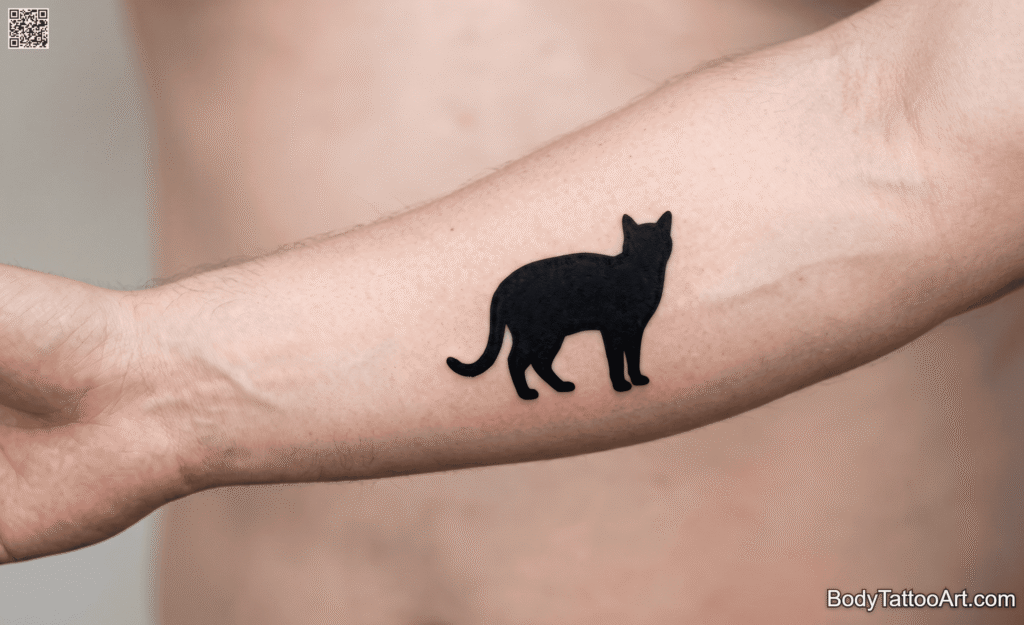
A completely solid black silhouette of a cat in a relaxed standing pose fills this design. There is no linework inside, just one flat block of ink shaped into the cat’s outline. The edges are crisp and deliberate, giving it a graphic, poster-like quality.
Placement: Outer forearm
Style: Blackwork Cat Tattoos
Why it stands out: The solid fill makes the shape do all the work, so the pose has to be strong enough to read clearly on its own.
Ideal for: Bold style fans who prefer high contrast over detail.
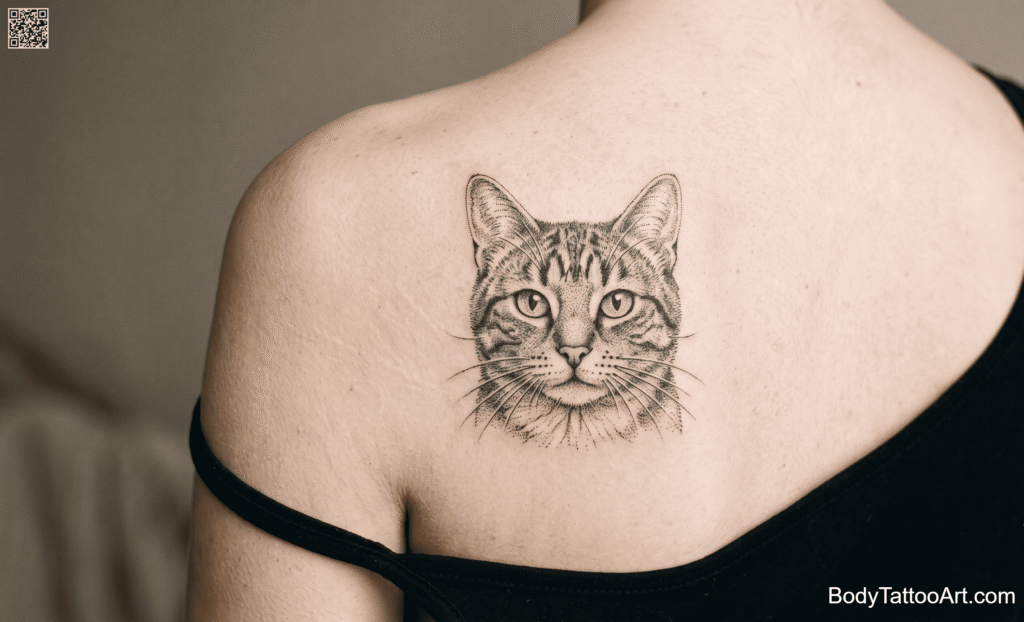
This cat’s face is built entirely from tiny dots layered close together to create depth. Darker clusters sit around the eyes and jawline, while lighter, more spaced-out dots form the softer fur areas. The result feels textured and almost powdery instead of flat.
Placement: Shoulder blade
Style: Dotwork Cat Tattoos
Why it stands out: The shading has a soft, grainy texture that regular line shading cannot really copy.
Ideal for: People who like detailed portraits without heavy black fill.
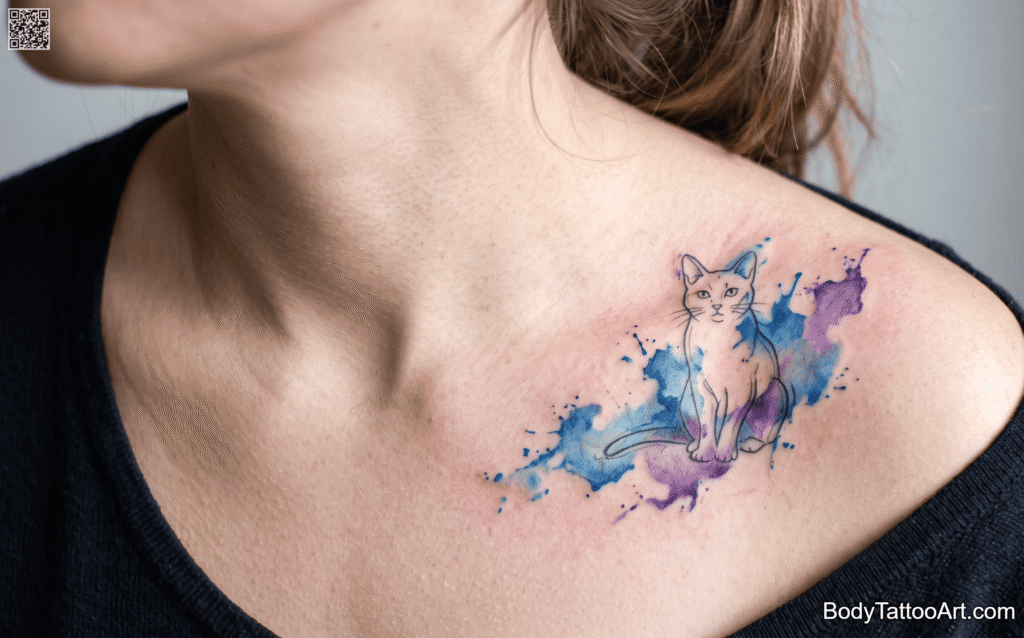
A simple black cat outline sits over a loose splash of color that spreads unevenly beyond the lines, mixing soft blues and purples. The color does not stay inside the shape on purpose, giving the whole piece a painted, slightly messy feel.
Placement: Collarbone
Style: Watercolor Cat Tattoos
Why it stands out: The color spilling past the outline gives it movement that a fully contained design would not have.
Ideal for: People who want color without a rigid, boxed-in look.
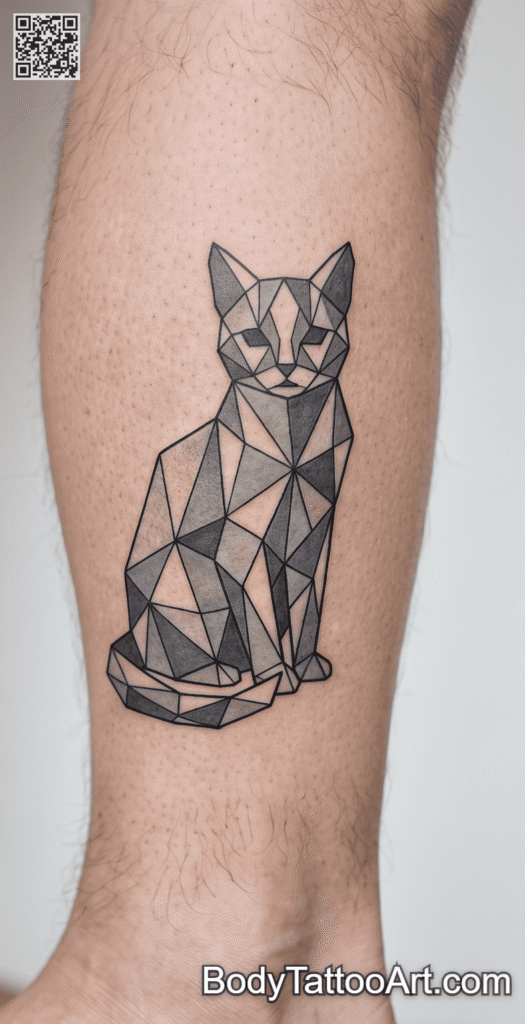
This cat is built from flat triangular facets instead of smooth curves, similar to a low-poly 3D render. Each triangle is a slightly different shade, creating light and shadow through angles rather than blending. The head faces forward while the body is angled to the side.
Placement: Calf
Style: Geometric Cat Tattoos
Why it stands out: The faceted shapes give it a modern, almost digital look that feels different from typical animal tattoos.
Ideal for: People who like structured, pattern-based designs.
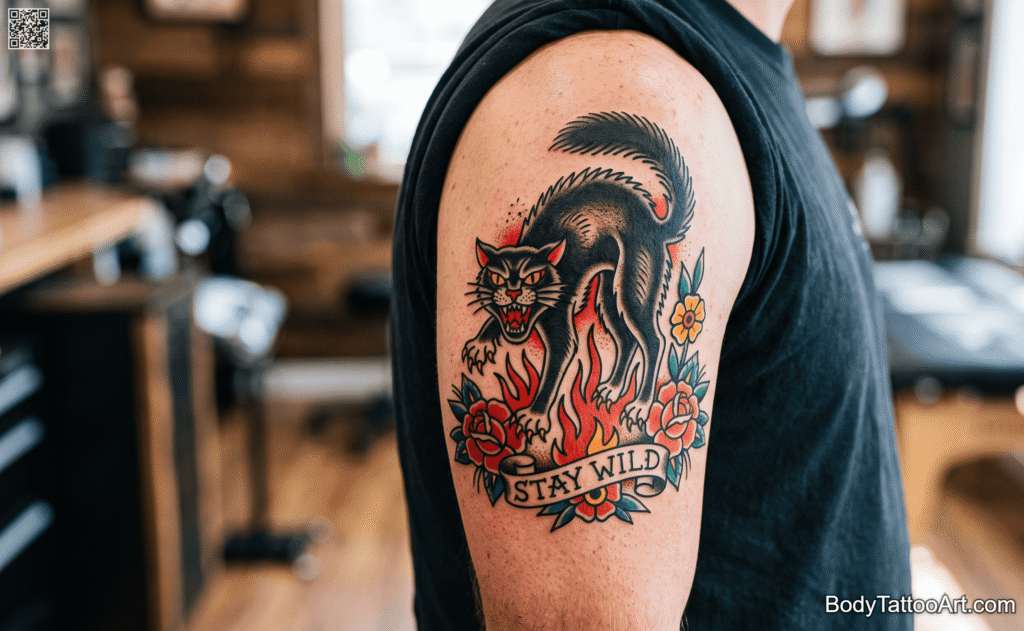
Thick black outlines and a limited color palette of red and yellow define this classic tattoo flash style cat. The cat sits with an arched back, drawn in the same chunky, confident lines seen in old tattoo parlor flash sheets.
Placement: Upper arm
Style: American traditional Cat Tattoos
Why it stands out: The heavy outlines and flat color blocks are built to age well and stay legible for decades.
Ideal for: Fans of classic tattoo flash and vintage styles.
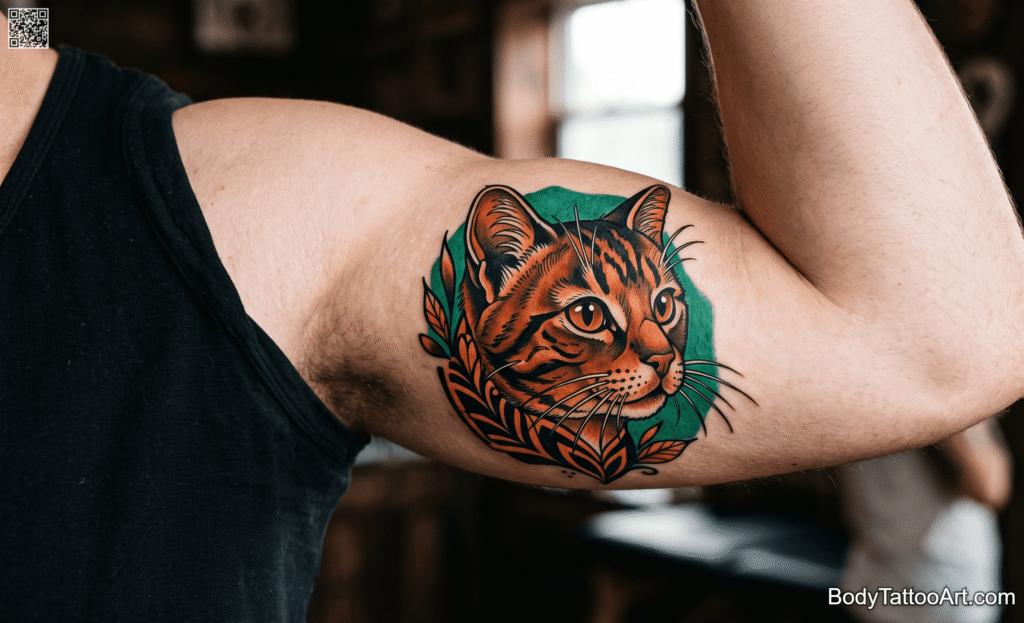
This version keeps the bold outlines of traditional work but pushes the color further, with a rich green background tone behind a orange and black cat face turned slightly sideways. The shading adds more dimension than classic traditional pieces usually have.
Placement: Inner bicep
Style: Neo-traditional Cat Tattoos
Why it stands out: The added shading and richer palette give it more depth while keeping the bold, graphic feel intact.
Ideal for: People who like traditional tattoos but want extra detail.
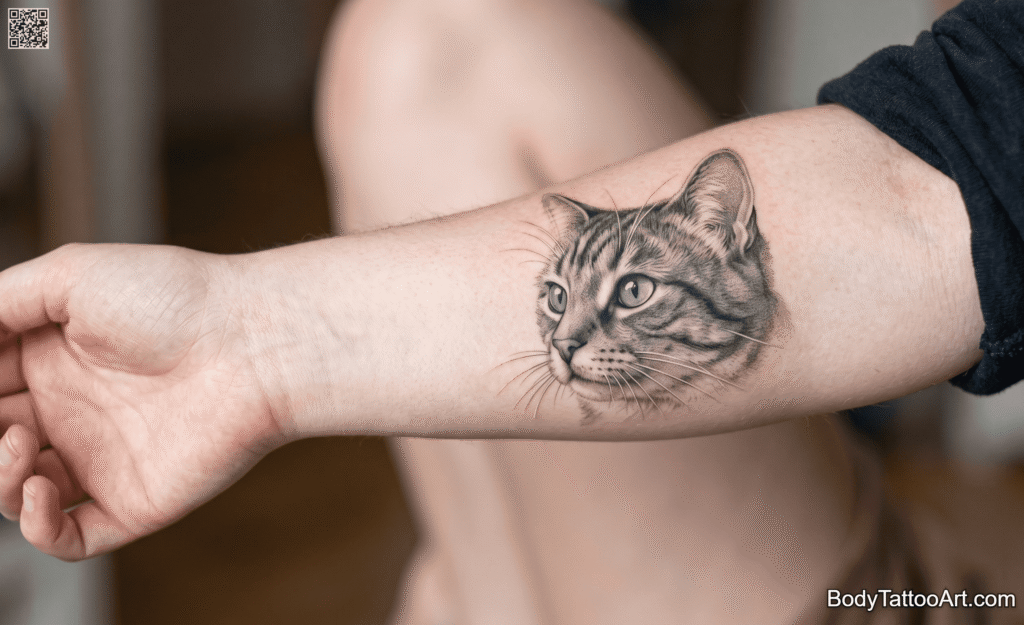
Soft grey shading builds up gradually to form a lifelike cat face, with individual fur strands visible around the cheeks and detailed catchlights in the eyes. The shading transitions smoothly from dark to light without any harsh outlines.
Placement: Inner forearm
Style: Grey-wash realism Cat Tattoos
Why it stands out: The smooth gradients and fine fur detail make it look closer to a photograph than a drawing.
Ideal for: People who want a lifelike, portrait-style tattoo.
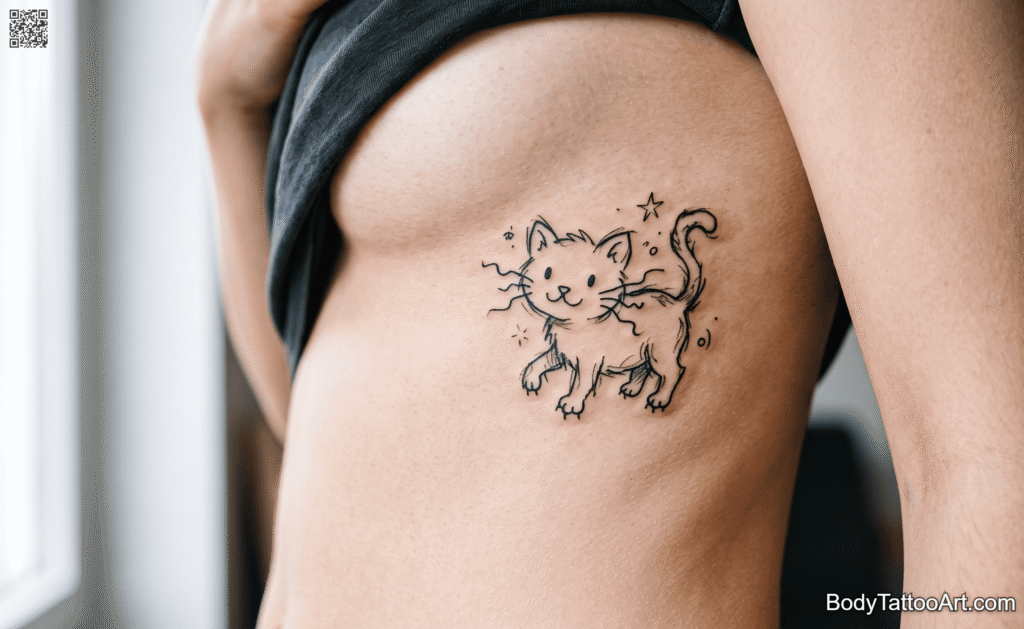
This cat looks hand-drawn straight from a notebook margin, with slightly uneven lines, a crooked whisker, and a loose, playful posture. It has an unfinished, sketchbook energy rather than a polished final illustration.
Placement: Ribcage
Style: Doodle Cat Tattoos
Why it stands out: The intentionally rough lines give it a personal, handwritten quality other styles do not have.
Ideal for: People who like casual, sketch-inspired tattoos.
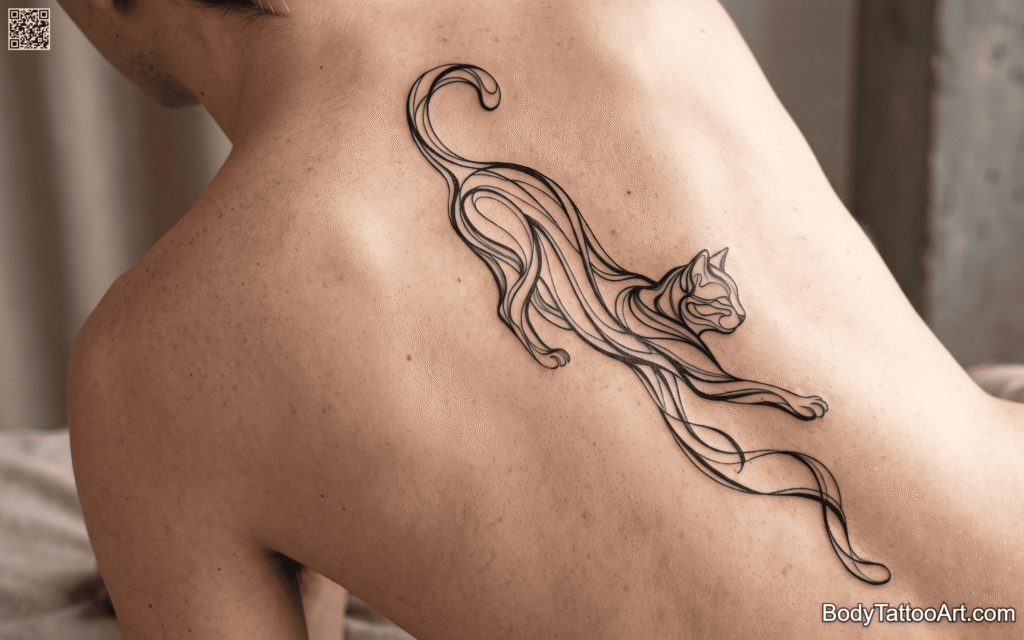
Flowing, ribbon-like lines twist and loop to suggest a cat mid-stretch, without a single solid outline holding the shape together. The lines vary in thickness, thinning out at the tips and thickening near the body’s center.
Placement: Upper spine
Style: Abstract linework Cat Tattoos
Why it stands out: The design suggests movement through line flow alone, without needing a literal, fully outlined shape.
Ideal for: People who like abstract, artistic interpretations over literal designs.
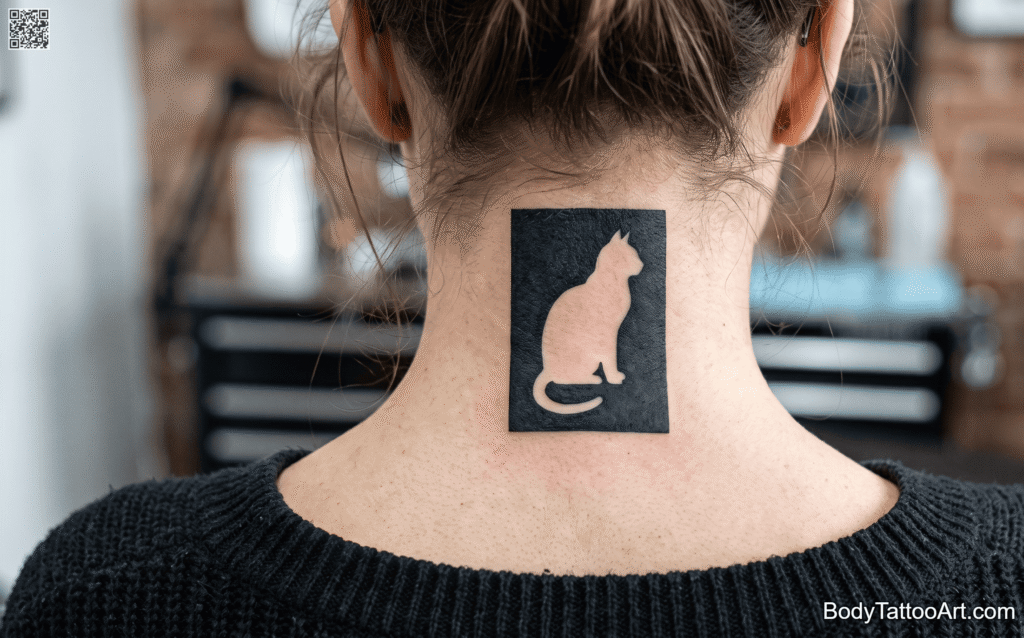
A solid black rectangle fills most of the space, with the cat’s shape cut out of it in plain skin tone. Instead of the cat being drawn in ink, the surrounding black block does the work, leaving the animal shape empty.
Placement: Nape of the neck
Style: Negative space blackwork Cat Tattoos
Why it stands out: Reversing which part holds the ink creates a striking, high-contrast effect that is instantly eye-catching.
Ideal for: Bold style fans who want something unconventional.
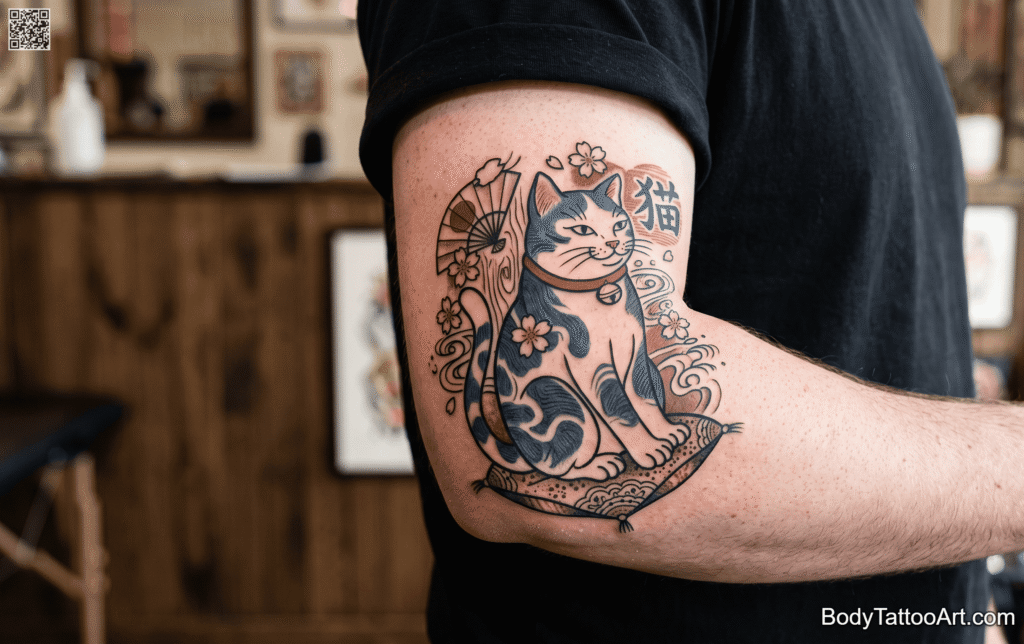
This cat is drawn in the flat, bold style of old Japanese woodblock prints, with strong black outlines and muted flat colors like faded red and indigo. The pose is calm and formal, almost like a figure from a historic print.
Placement: Outer forearm near the elbow
Style: Ukiyo-e inspired Cat Tattoos
Why it stands out: The flat color blocks and heavy outlines borrow directly from a centuries-old print tradition, giving it a distinct historic feel.
Ideal for: Fans of Japanese art styles and vintage print aesthetics.
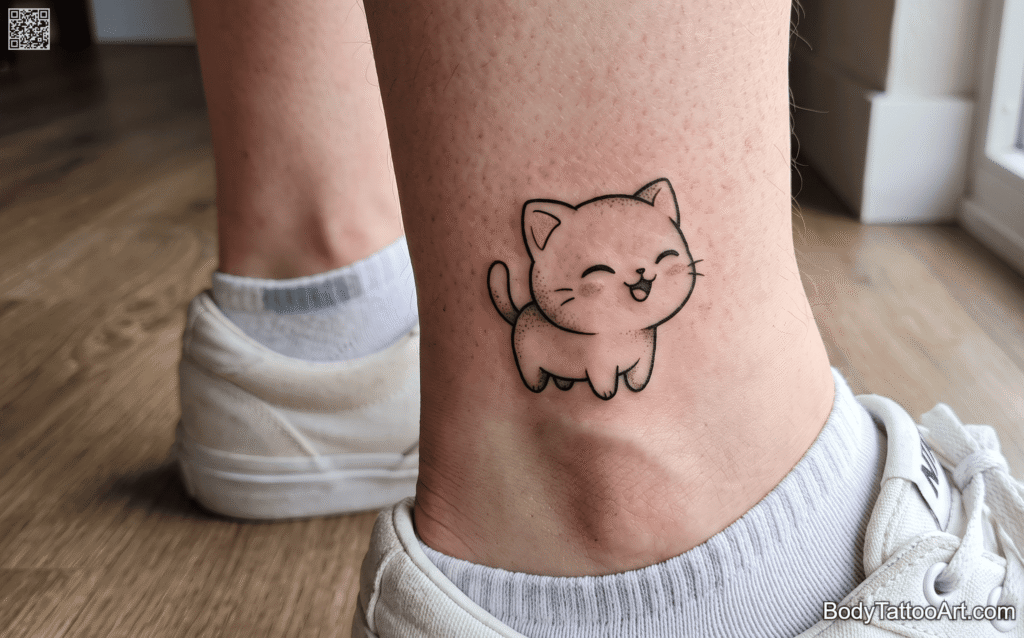
Short, stubby limbs, an oversized head, and a tiny body give this cat an exaggerated cartoon proportion often seen in chibi art. The expression is simple, just two curved lines for closed happy eyes and a small triangle nose.
Placement: Inner ankle
Style: Chibi cartoon Cat Tattoos
Why it stands out: The extreme proportion shift makes it feel more like a character than a realistic animal.
Ideal for: People who want something fun and lighthearted.
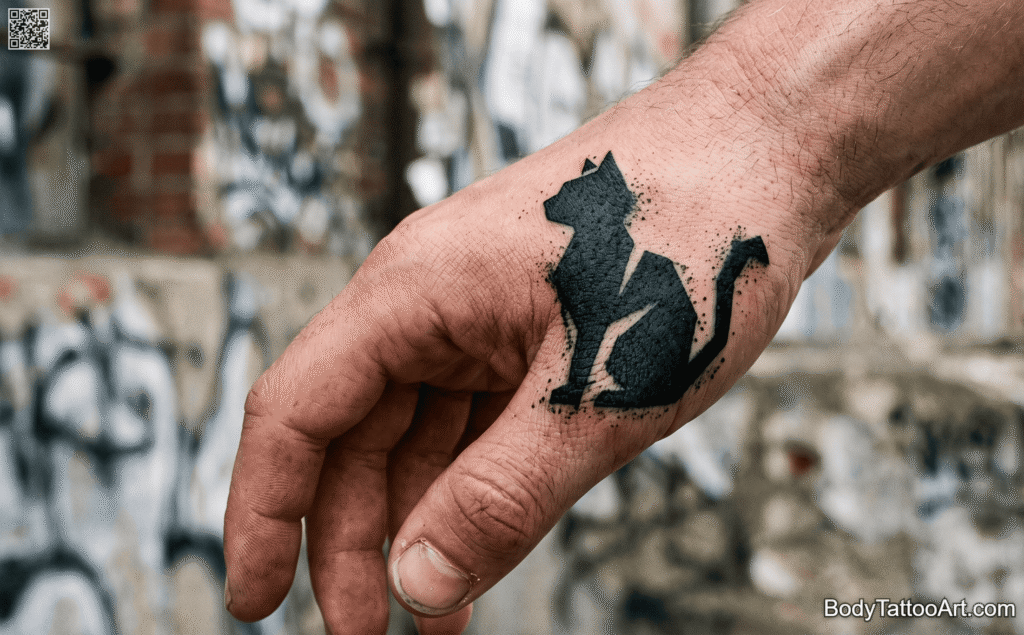
This design looks like it was cut from a spray paint stencil, with sharp, angular gaps breaking up an otherwise solid cat shape. The rough edges are intentional, giving it a street-art quality instead of a clean illustration look.
Placement: Side of the hand
Style: Stencil Cat Tattoos
Why it stands out: The deliberate gaps and rough edges give it an urban, graffiti-inspired edge that feels different from typical tattoo linework.
Ideal for: People drawn to street art and graphic design influences.
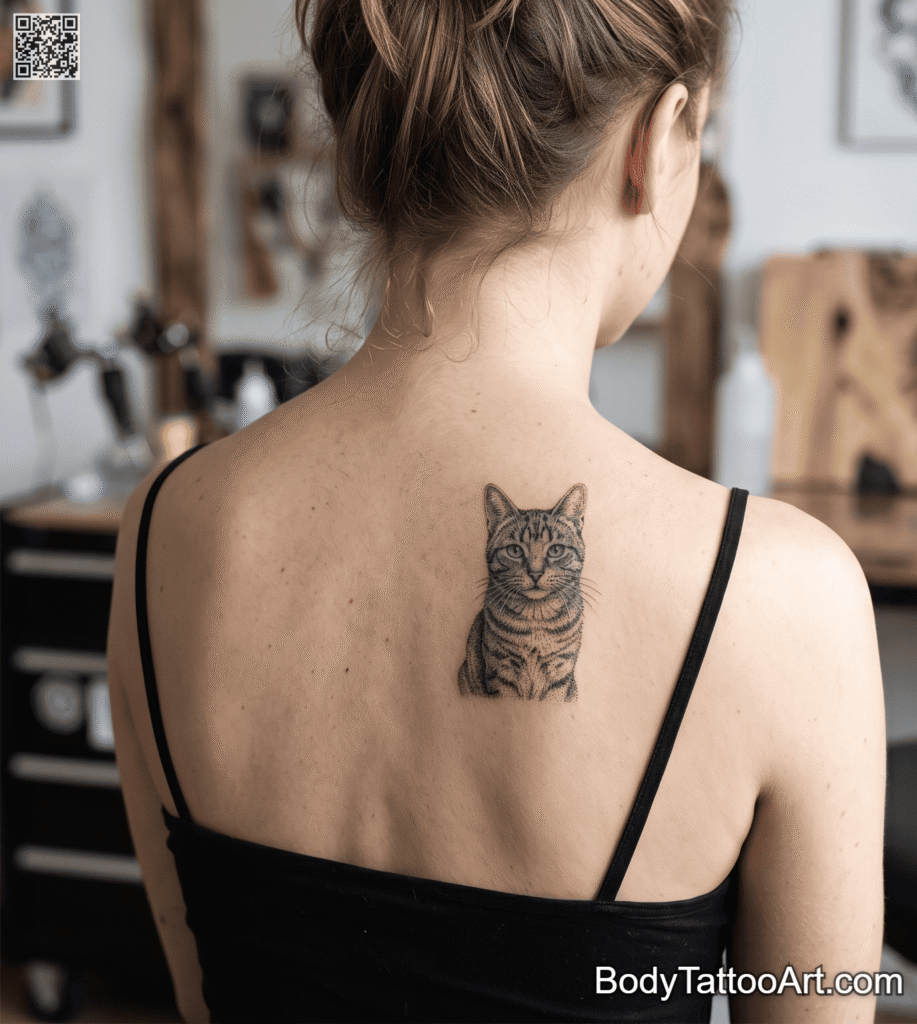
Every part of this cat, from the fur texture to the shadow beneath its paws, is built from tiny individual dots placed by hand. Denser dot clusters create darker areas, while sparse dots form lighter highlights, all without a single solid line.
Placement: Upper back
Style: Pointillism Cat Tattoos
Why it stands out: The patience required to build shading from dots alone gives the finished piece a fine, almost engraved texture.
Ideal for: People who appreciate slow, detailed craftsmanship in a design.
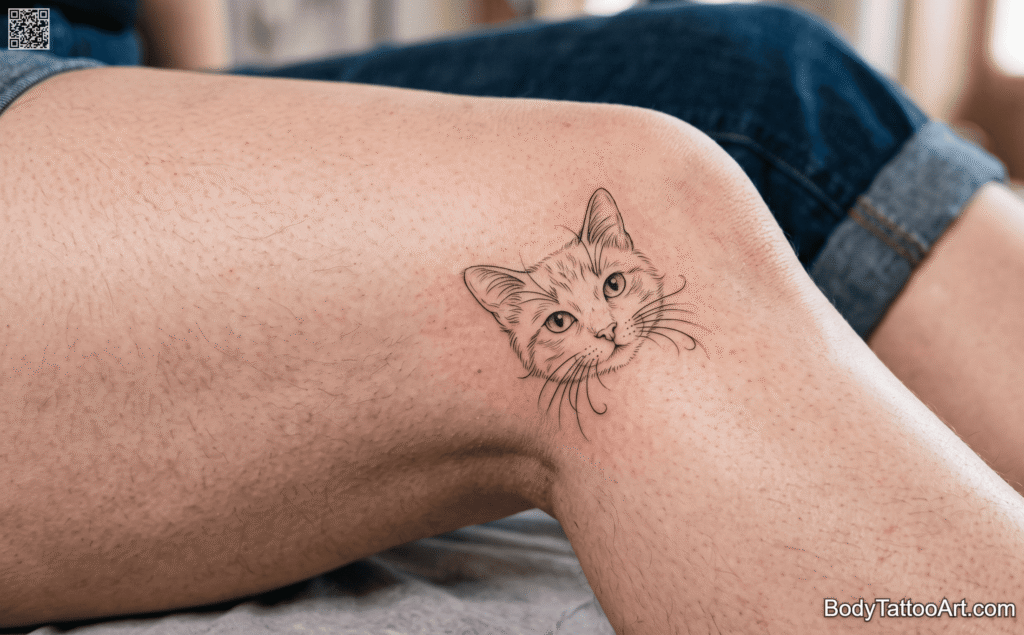
Extremely thin, precise lines outline a cat’s face with special attention paid to individual whisker strands and fine fur texture around the ears. Every line stays delicate and light, never turning bold or thick anywhere in the design.
Placement: Behind the knee
Style: Fine line Cat Tattoos
Why it stands out: The consistent thinness across every line, even in areas that usually get bolder shading, makes it feel especially delicate.
Ideal for: People who prefer soft, understated tattoos.
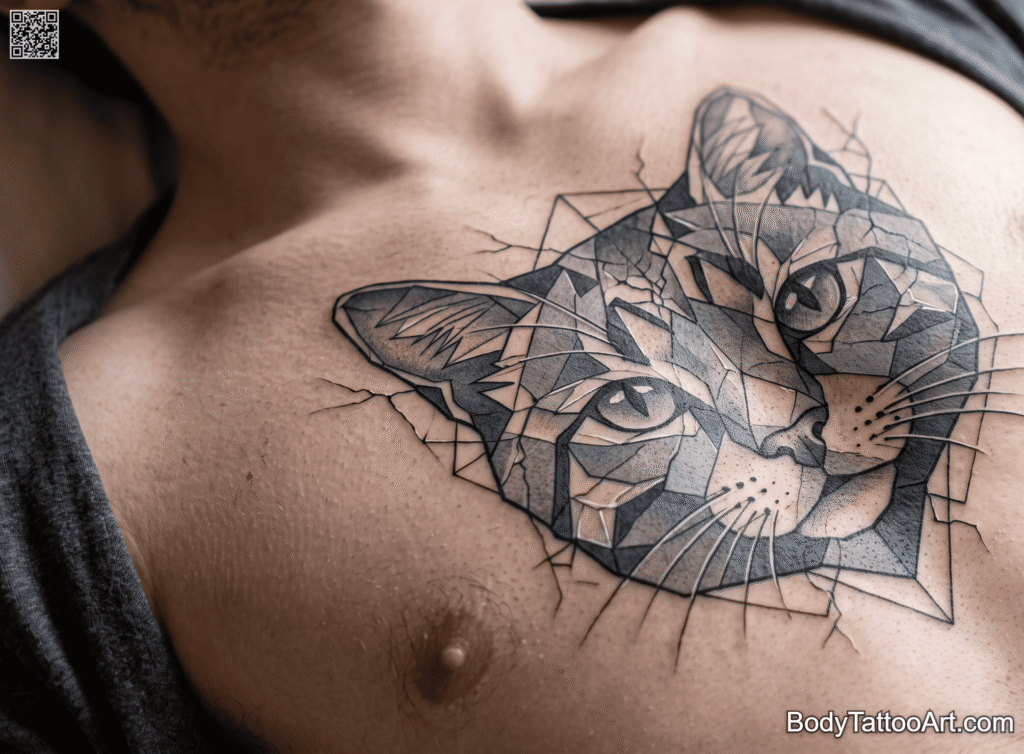
This cat’s face is broken into irregular polygon fragments, each shaded a slightly different tone, similar to a cracked mirror effect. Some fragments overlap slightly, creating a sense that the image is caught mid-shatter.
Placement: Sternum
Style: Fragmented geometric Cat Tattoos
Why it stands out: The shattered, overlapping fragments give the design tension that a smooth, single-piece image would not have.
Ideal for: People who like edgy, unconventional portrait styles.
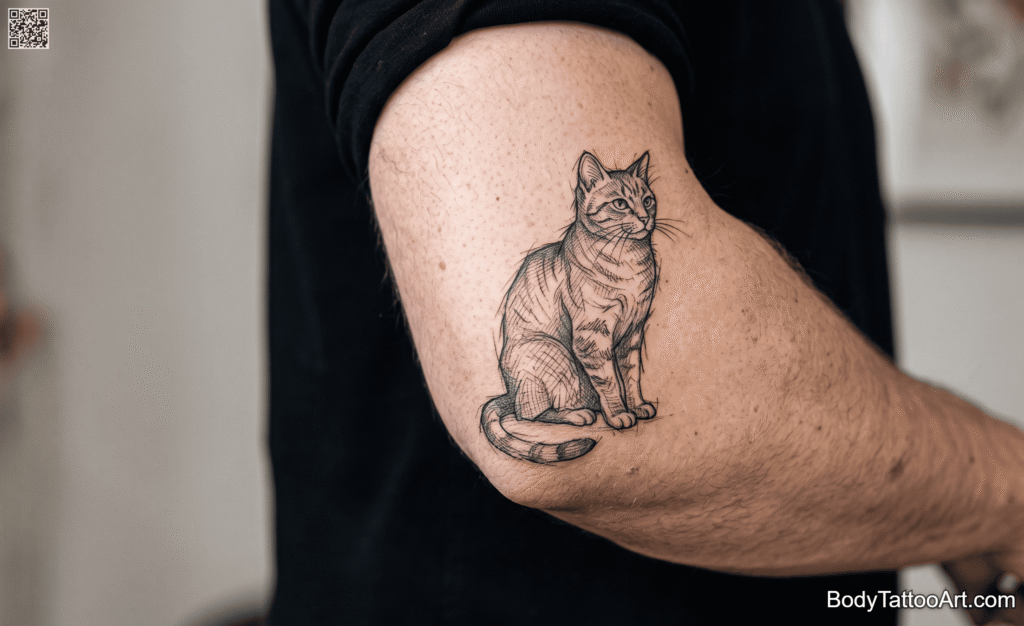
Cross-hatched lines and visible pencil-like strokes give this cat a hand-sketched appearance, as if it were copied straight from a drawing pad. The shading builds up in layered strokes rather than smooth gradients.
Placement: Elbow
Style: Sketch style Cat Tattoos
Why it stands out: The visible strokes keep the process of drawing visible in the final tattoo, rather than hiding it under smooth shading.
Ideal for: People who like the look of an unfinished sketch made permanent.
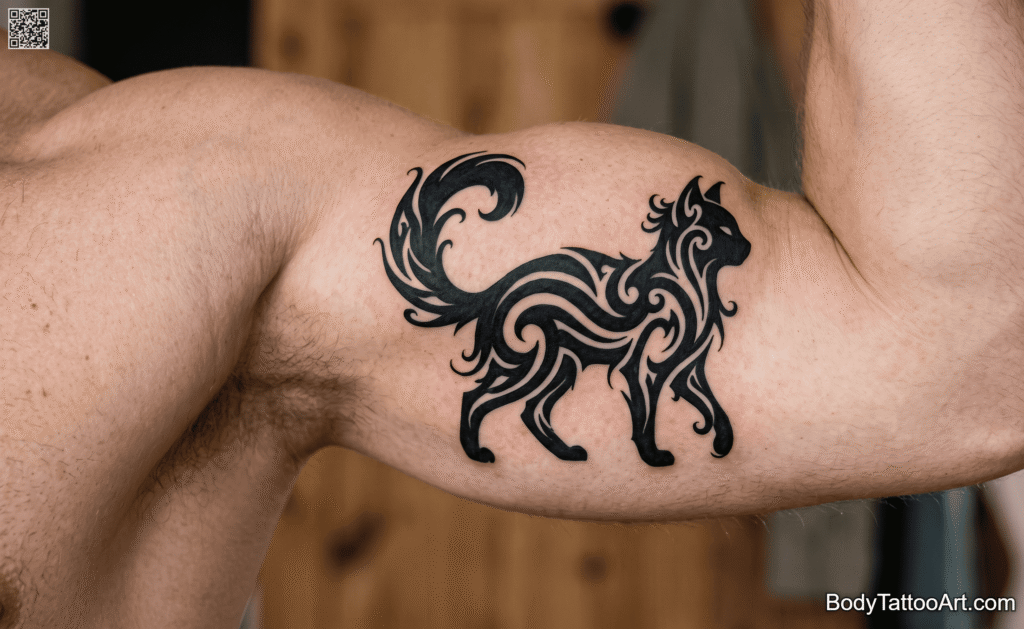
Sweeping, curved black shapes form a cat silhouette using thick tribal-style linework, with pointed flourishes extending off the tail and ears. The lines stay bold and continuous, without any small internal detail.
Placement: Outer bicep
Style: Tribal-inspired blackwork Cat Tattoos
Why it stands out: The flowing, curved shapes give the design a sense of motion despite being a completely solid, static silhouette.
Ideal for: People who like bold, graphic tattoos with strong curves.
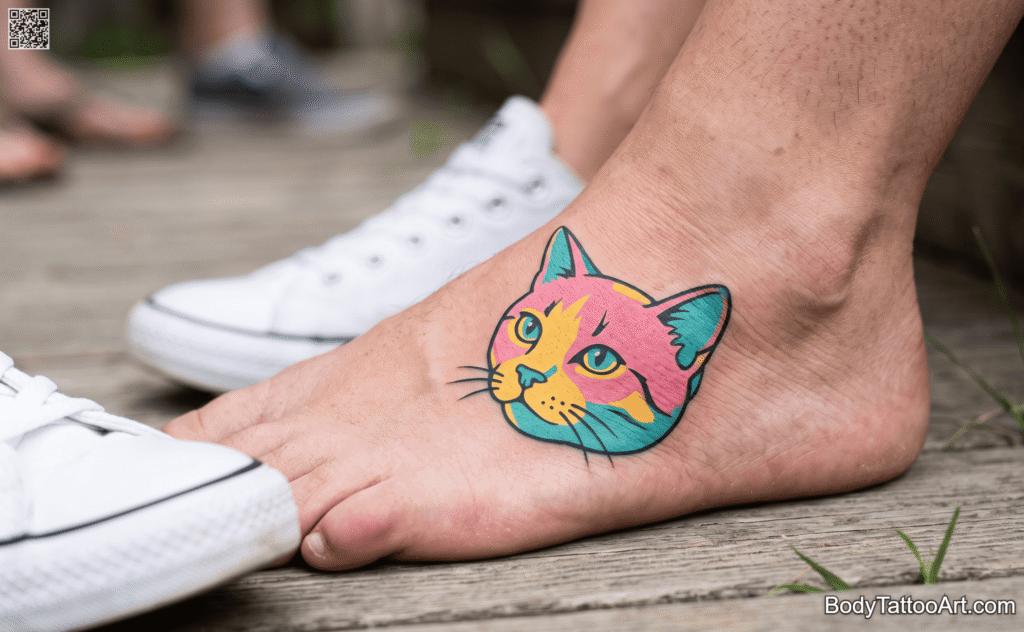
Flat, bright sections of color divide this cat’s face into blocks, similar to a screen-printed pop-art poster. Each section is a single solid color with hard edges instead of blended transitions, using bold pink, yellow, and teal.
Placement: Top of the foot
Style: Pop-art color block Cat Tattoos
Why it stands out: The hard color divisions give it a graphic, print-like quality that feels closer to poster art than traditional tattoo shading.
Ideal for: People who want bright color without realistic shading.
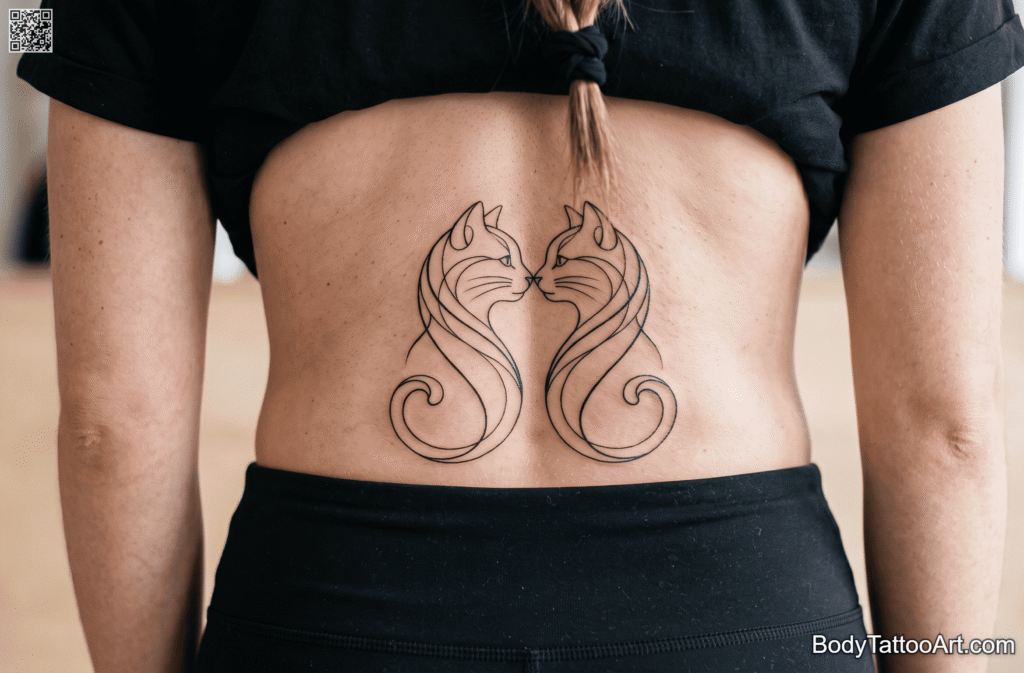
Two identical cat profiles face each other, mirrored perfectly down a central line, creating a symmetrical pattern rather than a single figure. The linework stays clean and even on both sides.
Placement: Lower back
Style: Symmetrical linework Cat Tattoos
Why it stands out: The mirrored repetition turns a simple animal profile into a balanced pattern instead of one standalone image.
Ideal for: People who like symmetry and pattern-based designs.
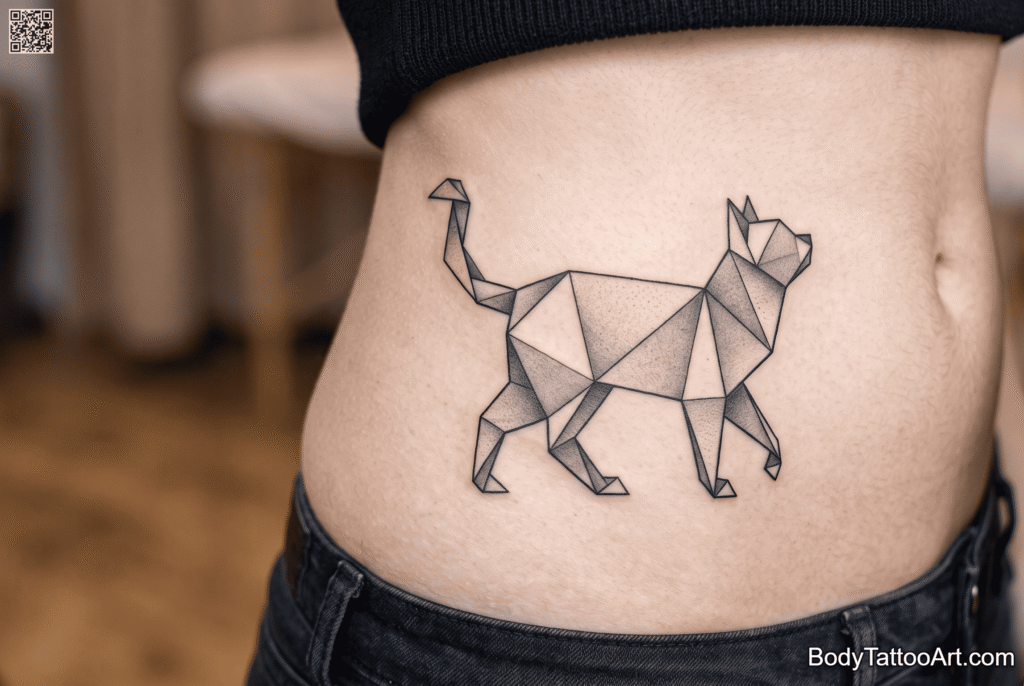
Sharp, angular folds and creased lines give this cat the appearance of folded paper origami rather than a drawn illustration. Flat shaded triangles suggest where the paper would catch light and shadow.
Placement: Hip
Style: Origami-inspired geometric Cat Tattoos
Why it stands out: The folded-paper illusion makes it look like a physical object rather than a flat drawing.
Ideal for: People who like clever, illusion-based designs.
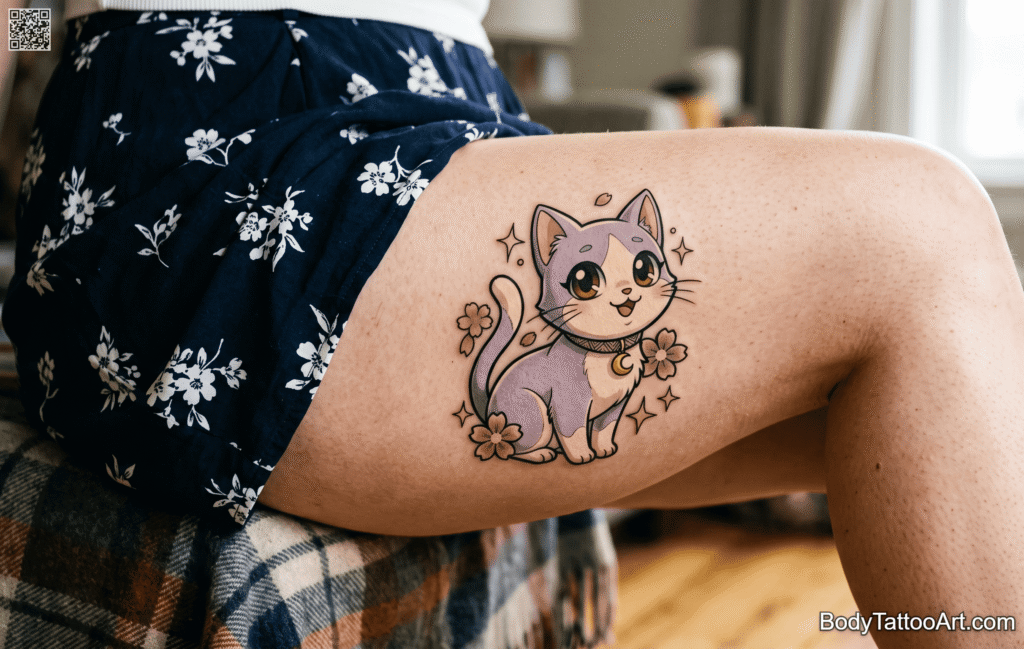
Large expressive eyes, a small button nose, and clean cel-shaded coloring give this cat an anime character look. The lines are smooth and rounded, with soft color gradients limited to just two shading tones.
Placement: Thigh
Style: Anime-inspired Cat Tattoos
Why it stands out: The expressive eyes give the design personality that more literal, realistic styles usually skip.
Ideal for: Anime fans and people who like character-based tattoos.
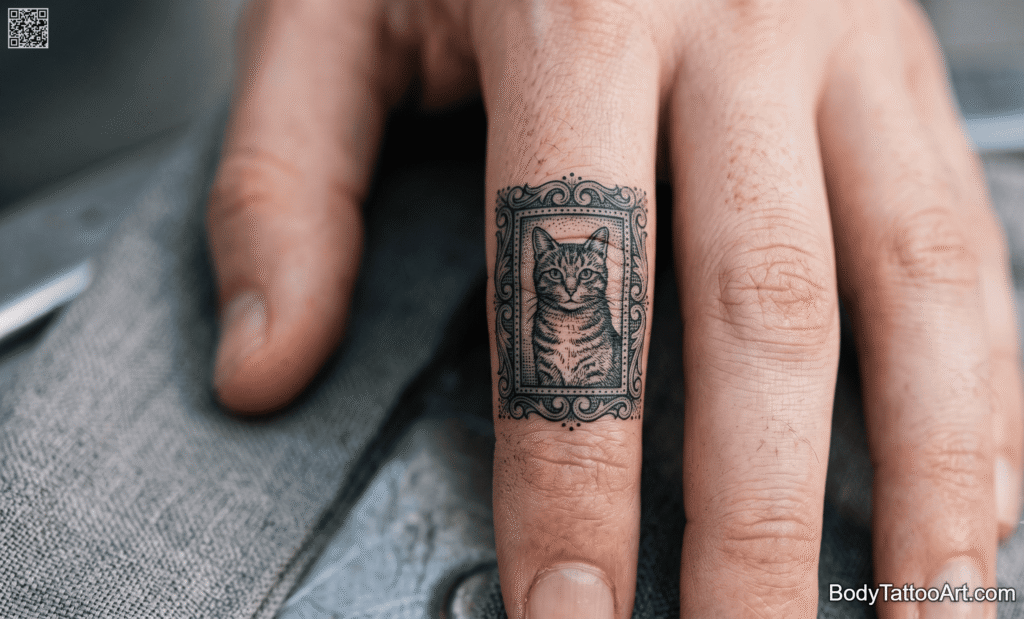
A decorative border frames this cat like an old postage stamp illustration, with fine engraved-style crosshatching and a slightly worn, aged linework quality. The pose is formal, facing forward and centered within the frame.
Placement: Finger
Style: Vintage engraving Cat Tattoos
Why it stands out: The stamp-like framing and engraved texture give it a collectible, old-world printed quality.
Ideal for: People who like vintage and antique-inspired tattoos.
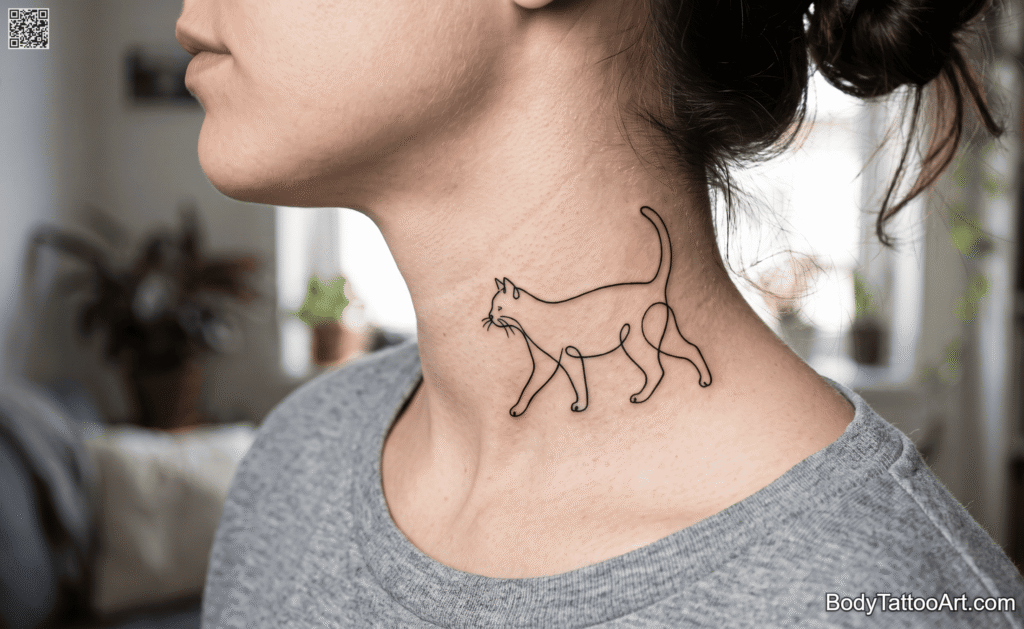
Unlike a sitting pose, this design captures a cat mid-stride using one unbroken line that never lifts, tracing the legs, back, and tail in one fluid motion. The walking posture gives it a completely different energy from a static seated design.
Placement: Lower neck
Style: Single-line / fine line Cat Tattoos
Why it stands out: Capturing a walking motion in a single unbroken line takes more line planning than a still, seated pose.
Ideal for: Minimalist lovers who still want a sense of movement.
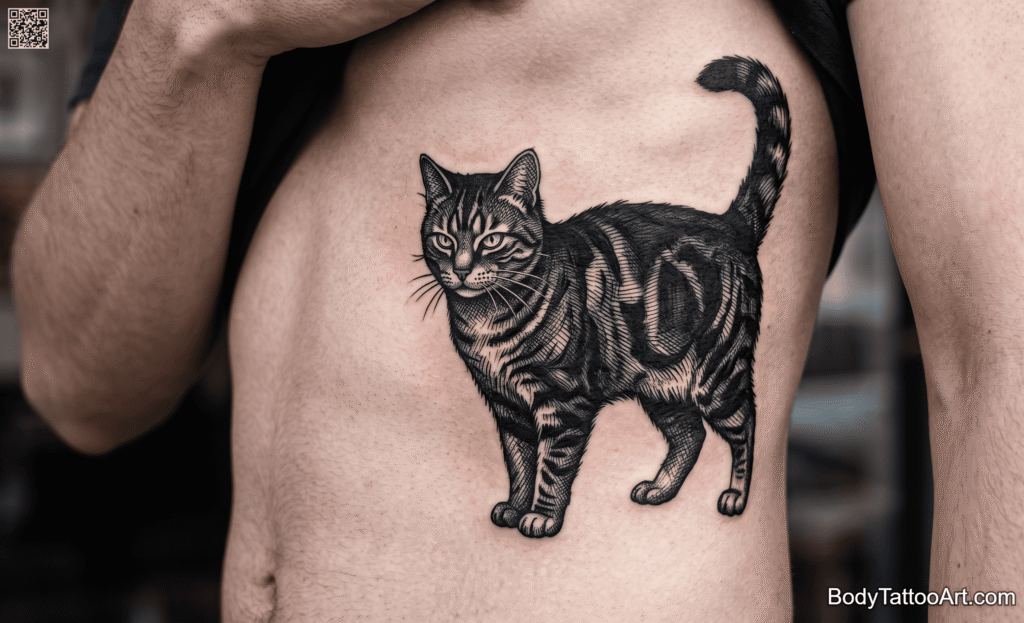
Dense, layered crosshatching builds up deep shadow across most of this cat’s body, leaving only a few small highlighted areas untouched. The heavy ink saturation gives it a dramatic, high-contrast weight compared to lighter blackwork styles.
Placement: Rib side
Style: Heavy blackwork with crosshatching Cat Tattoos
Why it stands out: The dense saturation creates dramatic shadow depth rather than relying on a flat, solid fill.
Ideal for: People who like darker, more dramatic tattoo styles.
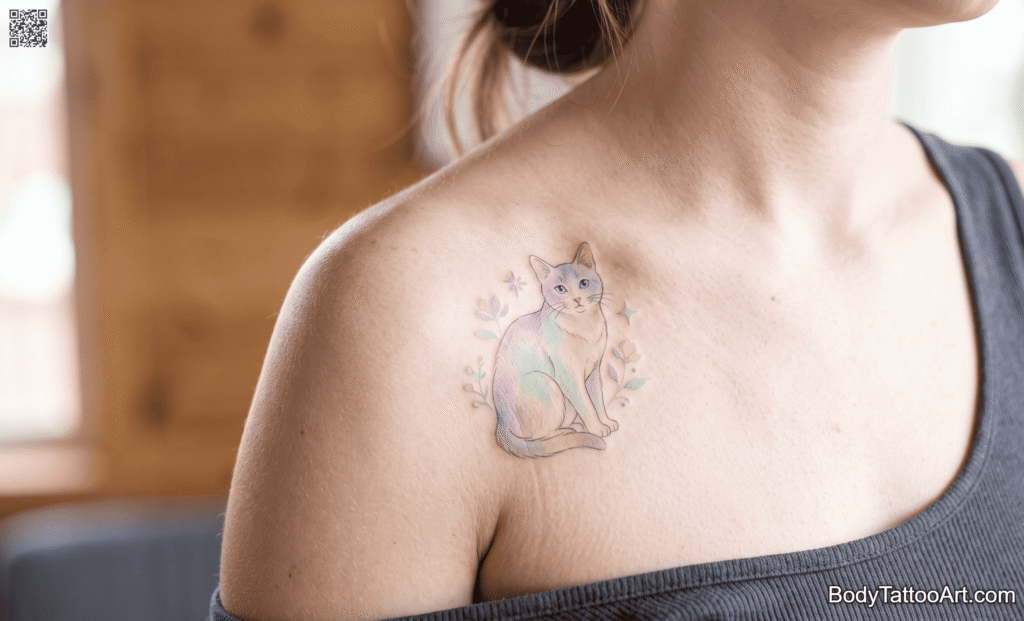
Gentle pastel tones in lilac, mint, and soft peach shade this cat’s fur with a light, airy blend rather than bold saturated color. The linework stays thin so the soft coloring remains the main focus.
Placement: Shoulder (front)
Style: Soft color / pastel Cat Tattoos
Why it stands out: The muted, blended palette gives it a gentle quality that stronger color styles do not have.
Ideal for: People who like color but want something soft and subtle.
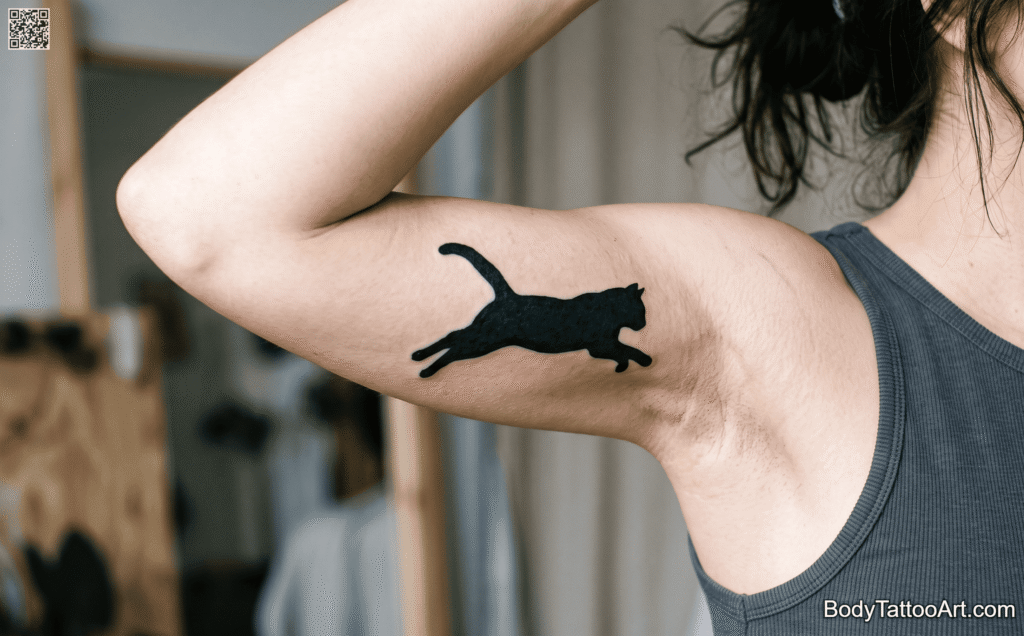
This design catches a cat fully airborne, legs stretched out and back arched mid-leap, rendered as a solid black silhouette. The dynamic pose gives it far more energy than a resting or seated design.
Placement: Underarm side
Style: Blackwork silhouette Cat Tattoos
Why it stands out: The mid-motion pose captures energy and action instead of stillness, which is rare among silhouette-style tattoos.
Ideal for: People who want an active, energetic design rather than a calm one.
Cat tattoos clearly have room for a lot of range, from tiny single-line outlines to detailed grey-wash portraits. Anyone who likes exploring animal tattoos this closely might also enjoy the dolphin tattoo and bear tattoo collections, which follow a similar mix of styles and placements. Choosing the right one usually comes down to how bold or subtle the wearer wants the final piece to feel, and how much detail they are willing to sit through in the chair.