Physical Address
304 North Cardinal St.
Dorchester Center, MA 02124
Physical Address
304 North Cardinal St.
Dorchester Center, MA 02124

There’s a reason, the monstera leaf has become one of the most recognizable shapes in tattoo culture. That split leaf silhouette — the deep cuts, the fenestrations, the bold geometric spread — is naturally dramatic. It doesn’t need to be dressed up or combined with anything else. On its own, a monstera leaf tattoo already has presence, structure, and visual weight that most botanical subjects spend years building a reputation for.
What makes monstera leaf tattoos genuinely interesting as a tattoo subject is how differently the same shape can read depending on the approach. A single realistic monstera leaf in grey-wash looks nothing like one broken into geometric planes or reduced to dotwork texture. The leaf itself stays recognizable across every style — and that iconic silhouette is the canvas.
Monstera leaf tattoos feature the foliage of the Monstera deliciosa — the tropical plant better known as the Swiss cheese plant. The leaf is defined by its dramatic split lobes and the natural holes (called fenestrations) that form as the plant matures. These openings in the leaf give it an immediately recognizable silhouette that reads as bold and graphic even at small scales.
In tattoo form, the monstera leaf works across a huge range of sizes and styles. A single leaf can fill an entire thigh or sit neatly on a wrist. The split lobes create natural directional lines that artists use to guide composition. The fenestrations add visual interest inside the leaf’s form — something to shade around, cut through, or use as negative space. Few botanical subjects give tattoo artists this much built-in structural material to work with.
The monstera plant originates in the tropical rainforests of Central and South America and has carried symbolic associations across many cultures. In some East Asian traditions, it represents a long and healthy life. In the Victorian language of plants, large tropical leaves were associated with abundance and resilience.
For many people choosing a monstera leaf tattoo today, the symbolism is personal — it often reflects growth, adaptability, and finding beauty in unusual forms. The plant’s distinctive holes, which develop as an adaptation to allow light to pass through in dense forest canopies, have become a metaphor for finding light in difficult conditions.
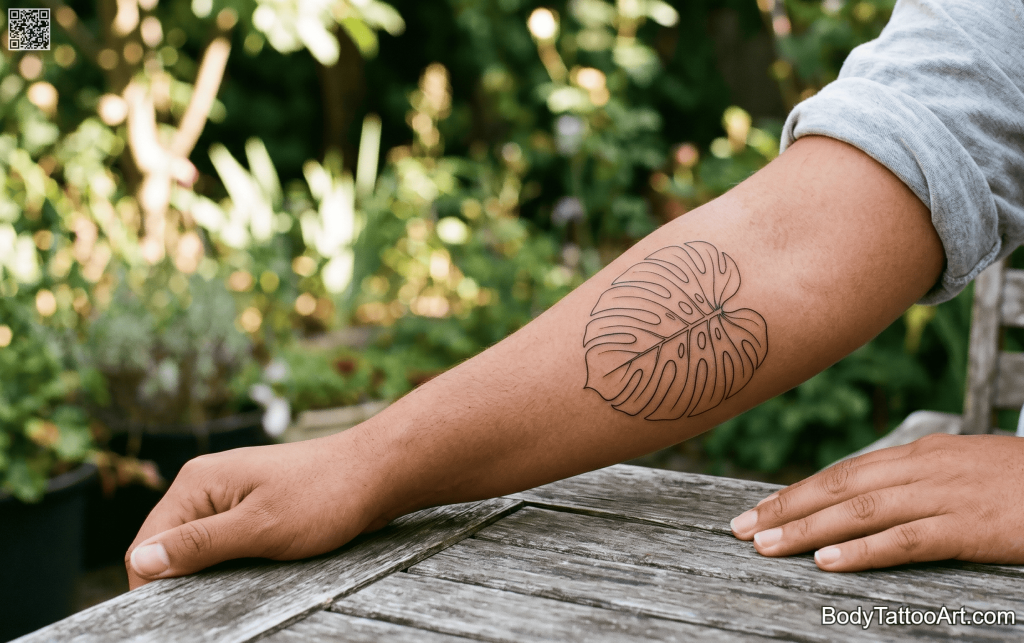
One large monstera leaf rendered in clean fine line with no shading, no fill, just the outline and the natural fenestration holes left open. The leaf sits at a slight diagonal angle. Every split and curve of the lobe edges is drawn with a single continuous ink line. Nothing fills the space inside — the skin shows through the holes exactly as it would through a real leaf.
Placement: Outer forearm
Style: Single needle fine line Monstera Leaf Tattoo
Why it stands out: The complete absence of shading or fill makes the monstera leaf’s silhouette do all the work. The open fenestrations framed by clean line are enough — this design earns its impact through restraint.
Ideal for: First-timers, minimalist collectors, people who want botanical ink without visual noise.
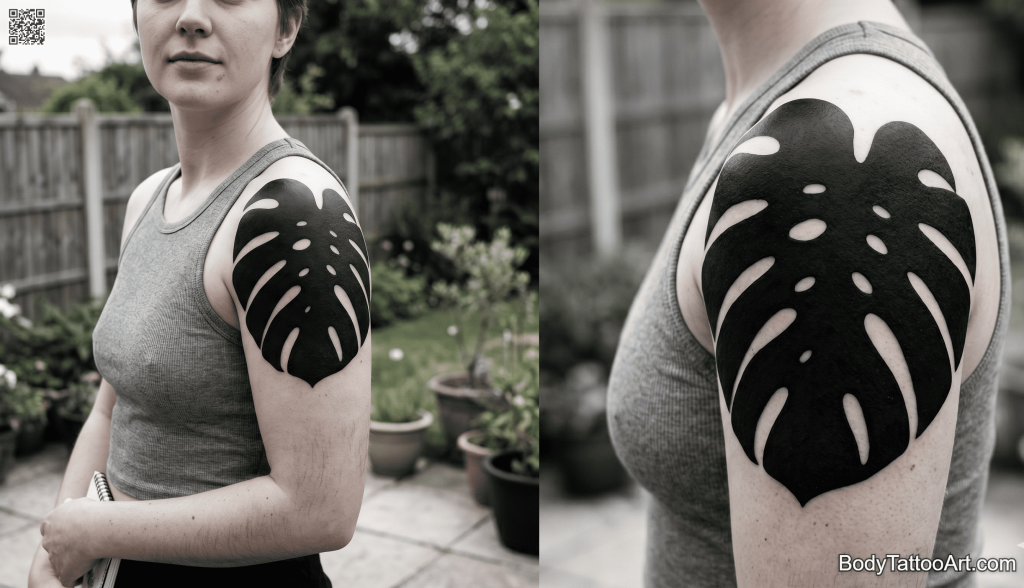
A monstera leaf rendered entirely in solid black — every surface, every lobe, every internal section filled completely. The only breaks in the black are the natural fenestration holes, which are left as pure empty skin. The contrast between heavy black and the sharp white of the skin through the holes is the entire visual statement.
Placement: Upper arm / shoulder cap
Style: Blackwork solid fill Monstera Leaf Tattoo
Why it stands out: The monstera’s natural holes become the design when everything else is blacked out. The fenestrations read as cutouts of light against the dark leaf mass — simple, powerful, graphic.
Ideal for: Bold blackwork collectors, people building a dark sleeve, high-contrast aesthetic fans.
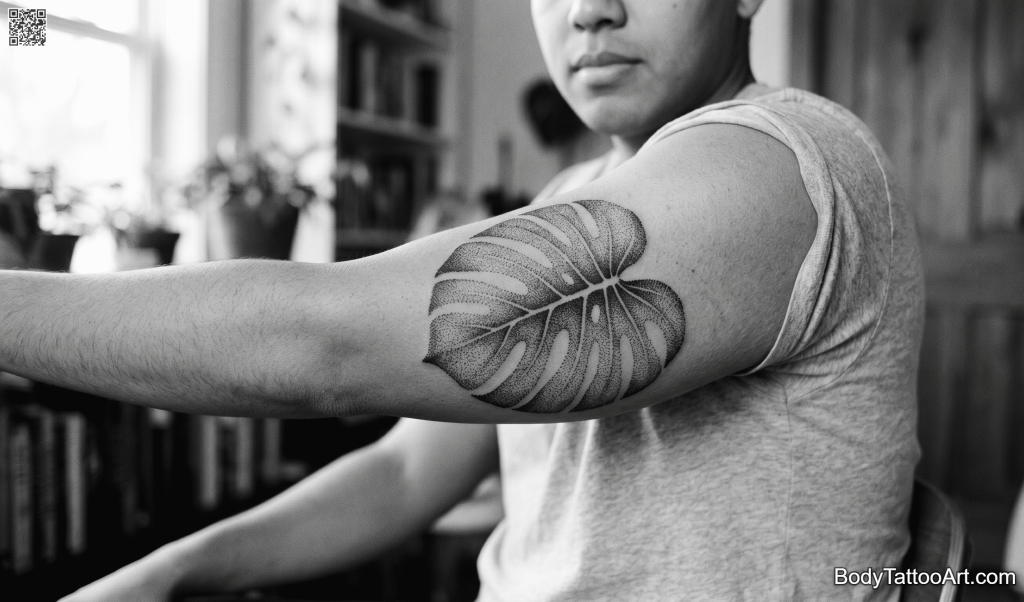
A monstera leaf built entirely from dots — no outlines, no solid fills, just thousands of tiny dots building up density to form the shape, shadow, and vein structure. The edges of the leaf are the densest areas. The center veins are marked by even denser dot clusters. The fenestrations are surrounded by gradual dot-fading rather than sharp edges.
Placement: Inner upper arm
Style: Dotwork / stipple Monstera Leaf Tattoo
Why it stands out: Dotwork removes all hard lines and replaces them with gradual density. The monstera leaf rendered this way looks almost textured — like a physical surface rather than a drawn image.
Ideal for: Dotwork enthusiasts, people who love tactile-looking tattoos, those who want botanical ink with serious technical depth.
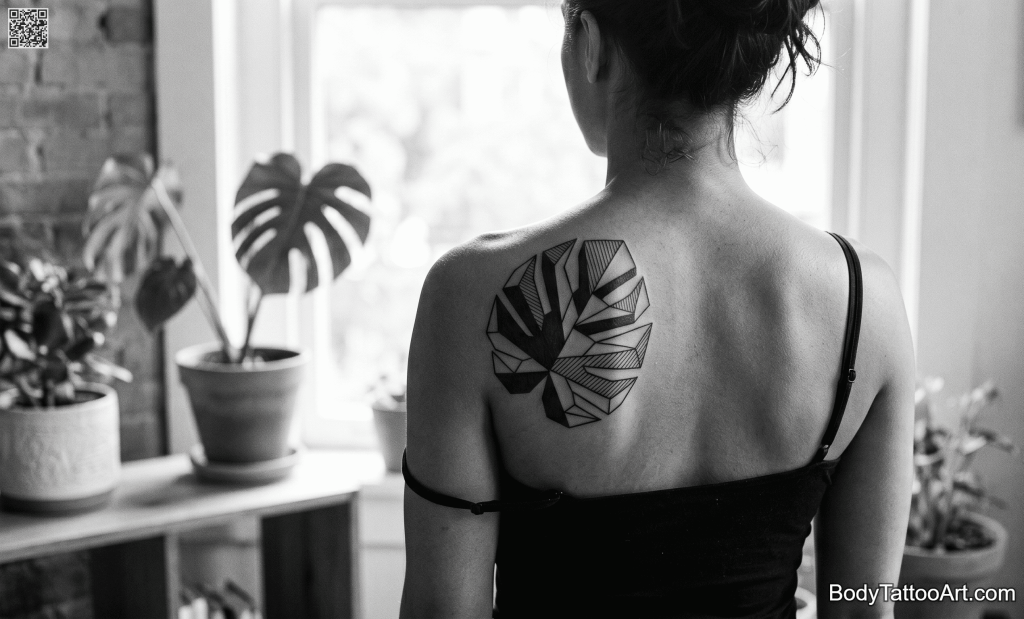
The monstera leaf is divided into flat geometric sections — each lobe and surface area split into angular planes like a low-poly 3D render. Some planes are filled solid black, others are left empty, and others carry parallel line hatching. The leaf’s organic shape contains hard angular interior geometry.
Placement: Shoulder blade
Style: Geometric blackwork Monstera Leaf Tattoo
Why it stands out: The contrast between the organic curves of the monstera silhouette and the sharp angular interior planes creates immediate visual tension. It reads as architecture wrapped inside a plant form.
Ideal for: Geometric tattoo fans, people who want botanical ink with an industrial edge, those building a graphic blackwork collection.
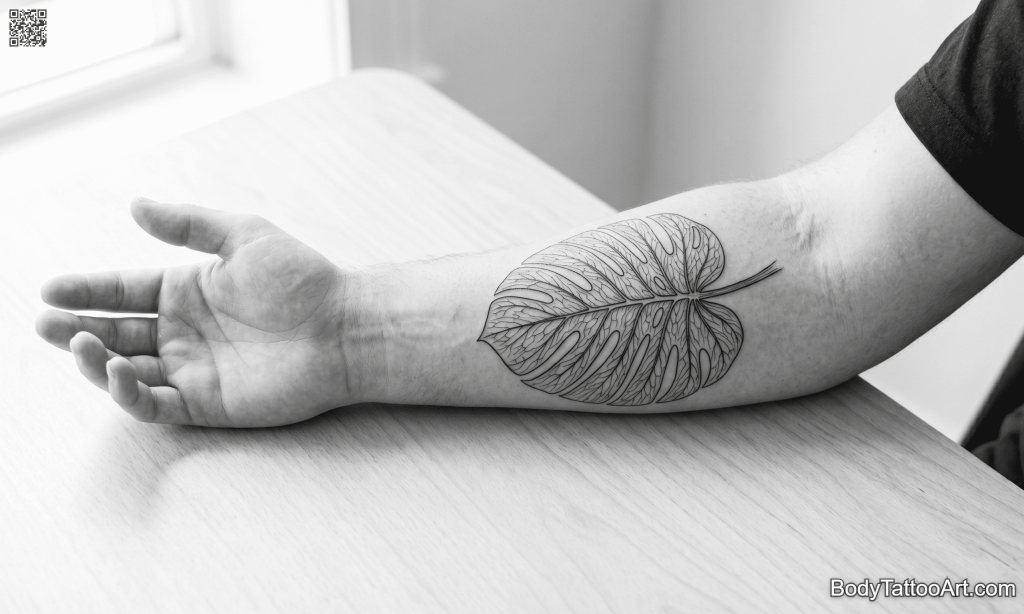
A monstera leaf outlined in thin fine line with the entire interior vein system mapped in detail — the primary central vein, all secondary veins branching off it, and even the finer tertiary network between them. No shading, no fill. Just the vein architecture rendered like a scientific diagram.
Placement: Inner forearm
Style: Botanical illustration / single needle Monstera Leaf Tattoo
Why it stands out: The monstera leaf has one of the most complex and beautiful vein structures of any broad-leafed plant. Isolating that vein network as the sole design subject turns a familiar shape into an almost anatomical study.
Ideal for: Science and biology aesthetics lovers, fine line tattoo collectors, people who want botanical detail that rewards close inspection.
Botanical tattoos with bold leaf forms are having a serious moment right now. Eucalyptus leaf tattoos bring a completely different energy — elongated, graceful, and incredibly versatile in style. Fern leaf tattoos go darker and more intricate, perfect for filling longer body spaces. For those drawn to florals alongside botanicals, floral vine tattoo designs offer a softness that pairs naturally with strong leaf forms. Palm leaf tattoos have a similar tropical presence to the monstera and are worth exploring for comparison. And for anyone interested in how leaf shapes translate into full sleeve compositions, oak leaf tattoos show a completely different kind of botanical boldness.
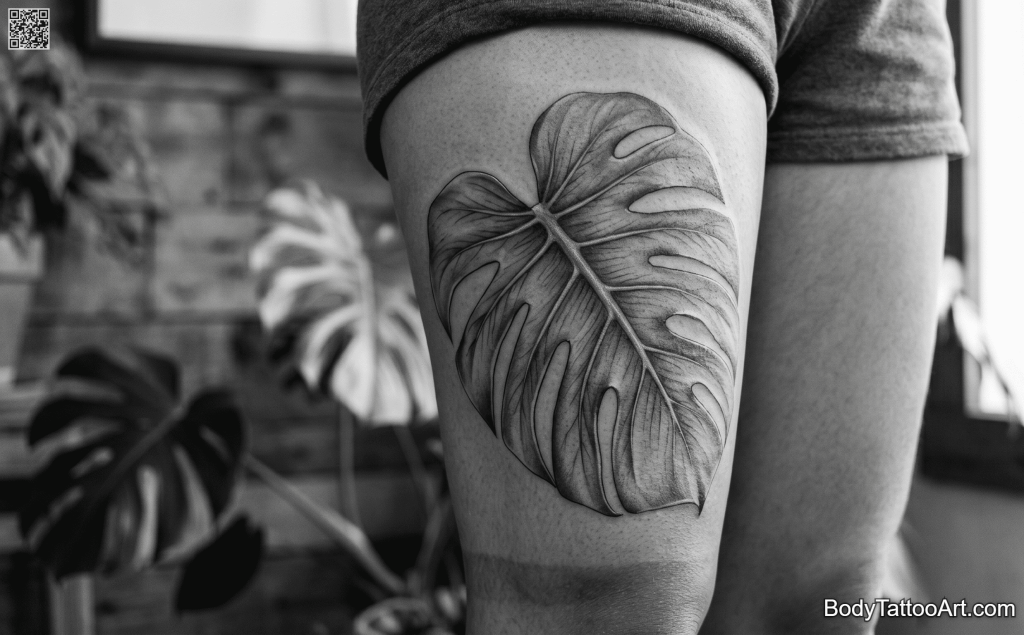
A single monstera leaf section — just the top third of the leaf — rendered in grey-wash realism. The surface shows subtle variations in tone, the slight sheen of a waxy leaf surface, shadow pooling in the fenestration edges, and the raised ridge of the central vein. The leaf is cropped so it fills the entire placement area.
Placement: Outer thigh
Style: Grey-wash realism Monstera Leaf Tattoo
Why it stands out: Cropping the leaf and zooming into a portion of it rather than showing the full shape gives this an entirely different scale logic. It feels less like a tattoo of a leaf and more like a photograph of one.
Ideal for: Realism fans, people who want large thigh pieces with botanical subject matter, those who appreciate tactile-looking shading.
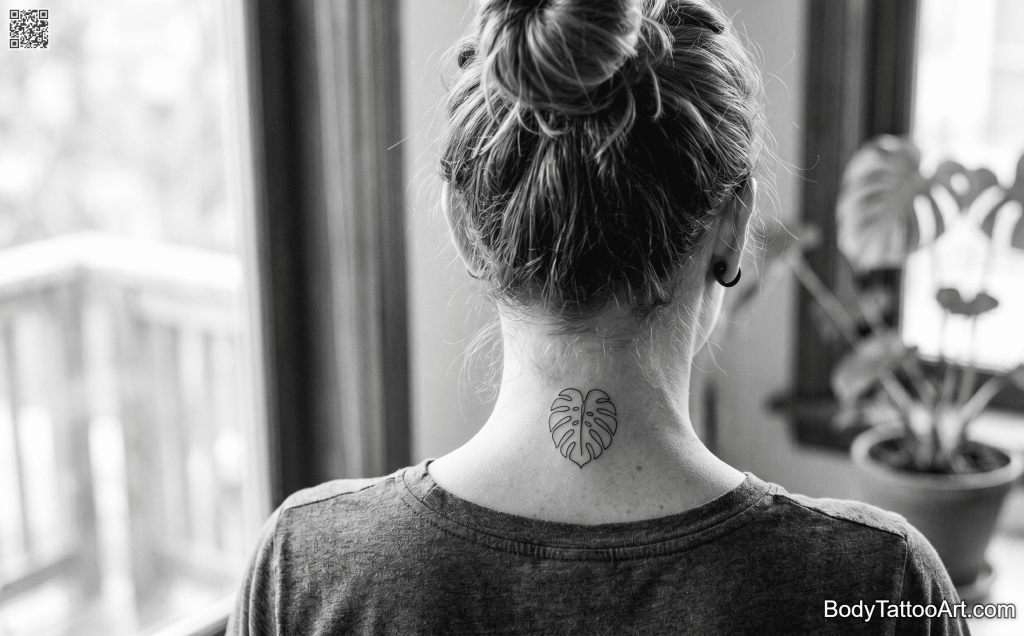
The monstera leaf outline is drawn as a single continuous contour line — just the outer silhouette, the lobe edges, and the fenestration outlines. Nothing inside. No veins, no shading, no interior lines. The interior of the leaf is completely empty skin.
Placement: Back of the neck
Style: Minimal contour line Monstera Leaf Tattoo
Why it stands out: The monstera silhouette is strong enough to read perfectly with zero interior detail. The absolute minimalism makes this feel intentional and confident rather than unfinished.
Ideal for: Extreme minimalists, people who want neck tattoos that are visible but not heavy, fine line purists.
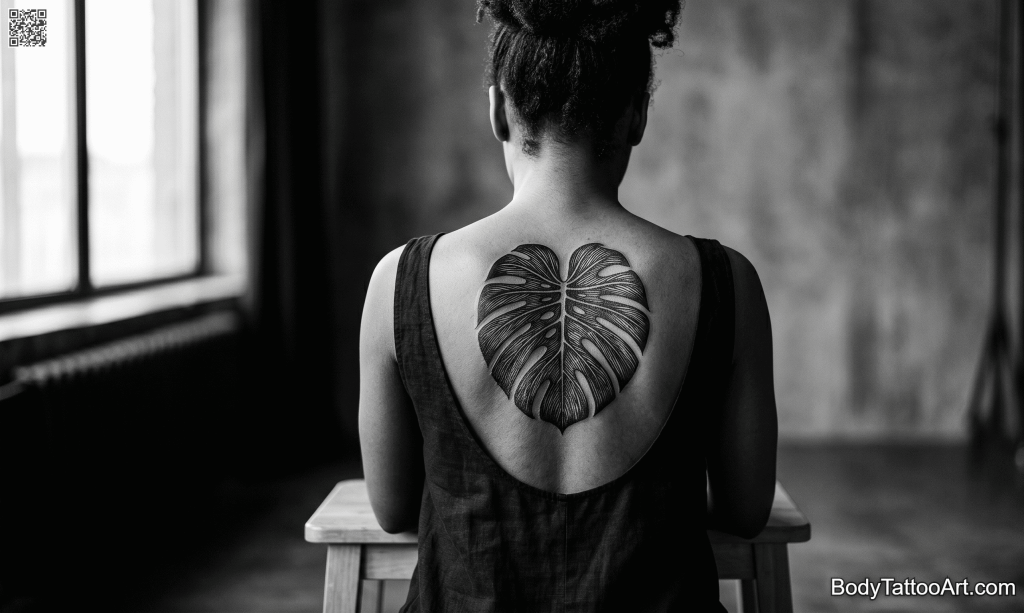
The monstera leaf is rendered in a scratchboard style — a dark background with white lines scratched through to reveal the leaf structure. The leaf’s surface appears as white-scratched detail on black, with the vein lines and lobe edges created by the scratched marks rather than drawn outlines.
Placement: Upper back between shoulder blades
Style: Scratchboard / reverse engraving Monstera Leaf Tattoo
Why it stands out: The visual logic is completely reversed — white marks on black rather than black marks on skin. The monstera leaf appears luminous and carved rather than drawn.
Ideal for: Dark and dramatic tattoo fans, people who want a statement back piece, those drawn to printmaking and engraving aesthetics.
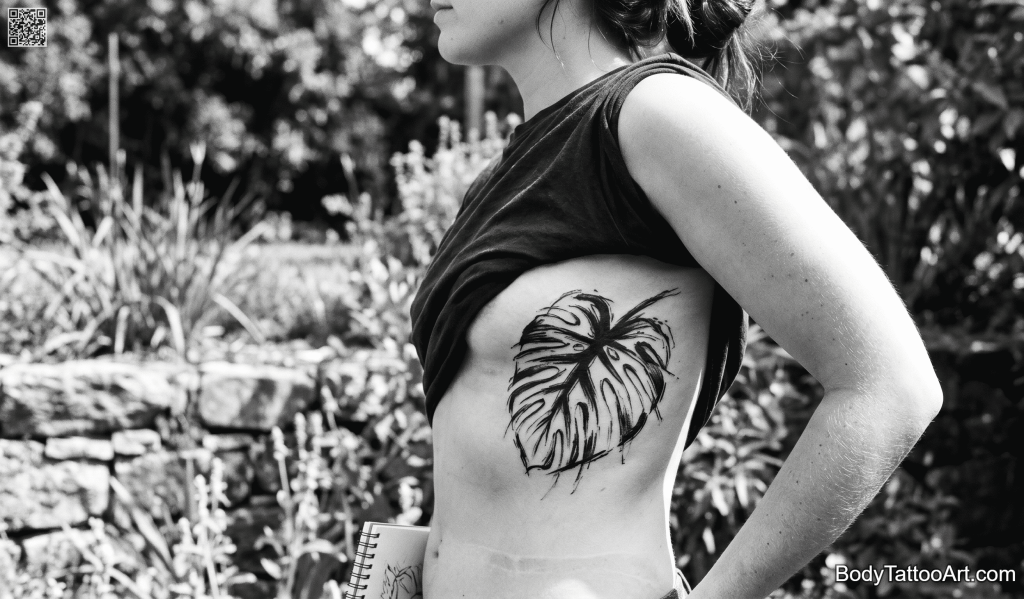
The monstera leaf is painted with thick expressive brushstroke marks — deliberately loose, with visible variation in line weight and some marks trailing off at the ends. The leaf is recognizable but not precise. The brushwork has energy and looseness that contrasts with the plant’s naturally bold structure.
Placement: Ribcage / side
Style: Brushstroke / sumi-e inspired Monstera Leaf Tattoo
Why it stands out: The intentional looseness of brushstroke technique on a leaf with such strong natural geometry creates an interesting visual friction. It feels painted, immediate, and expressive.
Ideal for: Fine art aesthetics lovers, people who prefer organic marks over technical precision, those drawn to East Asian ink painting traditions.
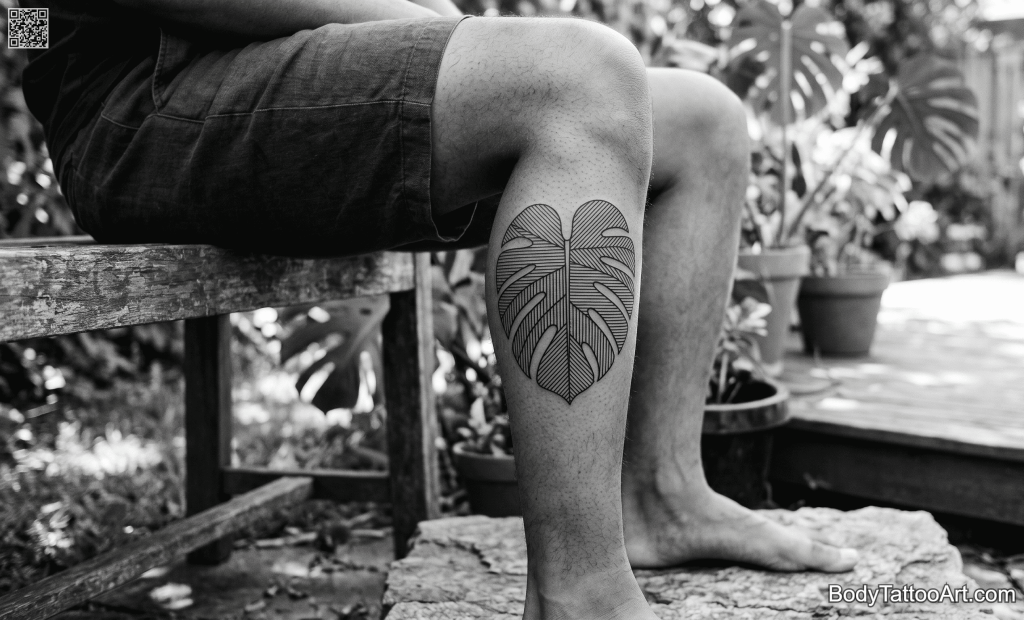
A monstera leaf where each lobe section is filled with tightly packed parallel lines running in a different direction — some sections horizontal, some diagonal, some vertical. The lines are even, precise, and architectural. No shading gradient — just the rhythm of the lines themselves creating tonal variation through density.
Placement: Shin / front lower leg
Style: Technical line fill / graphic Monstera Leaf Tattoo
Why it stands out: Using directional line variation across different sections gives the monstera leaf a quilt-like structure. Each section becomes its own visual zone. The leaf reads as both botanical and geometric simultaneously.
Ideal for: Graphic design aesthetics lovers, people who want bold shin pieces, those who appreciate technical linework over tonal shading.
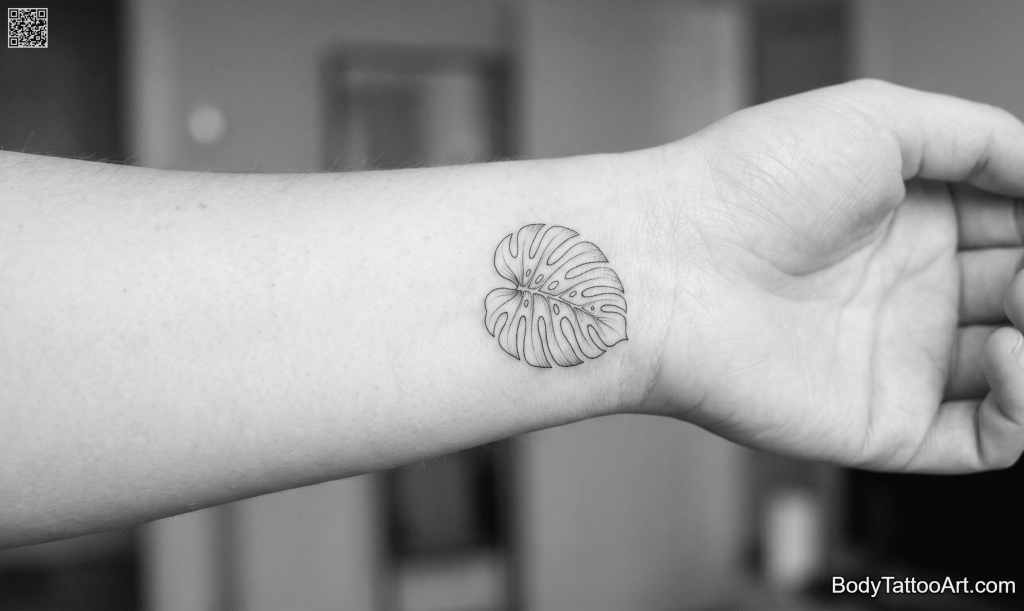
A monstera leaf tattoo about 3–4cm tall — the full leaf silhouette with basic interior vein structure, all rendered in micro fine line. At this scale every line has to be precise. The fenestrations are clearly present, the lobes are accurate, and the vein line is single and clean.
Placement: Inner wrist
Style: Micro fine line Monstera Leaf Tattoo
Why it stands out: Shrinking the monstera to stamp scale while keeping the fenestrations and lobes readable is a technical challenge. The resulting tattoo has the detail quality of something much larger compressed into a tiny form.
Ideal for: People who want small but detailed botanical tattoos, minimalists who want wrist ink, fine line micro tattoo collectors.
A monstera leaf outline in thin black fine line filled with a loose single-color watercolor wash — a muted blue-green tone applied with deliberately uneven edges that bleed slightly outside the leaf boundary at points. The color is not solid; it fades unevenly across the surface.
Placement: Collarbone / clavicle
Style: Fine line with watercolor wash Monstera Leaf Tattoo
Why it stands out: The monstera outline keeps the design structured while the watercolor interior gives it softness and color without going loud. The color bleeding slightly outside the line at points makes it feel like something painted rather than tattooed.
Ideal for: People who want subtle color in their botanical tattoos, fine line collectors who want a painterly touch, those drawn to muted tonal palettes.

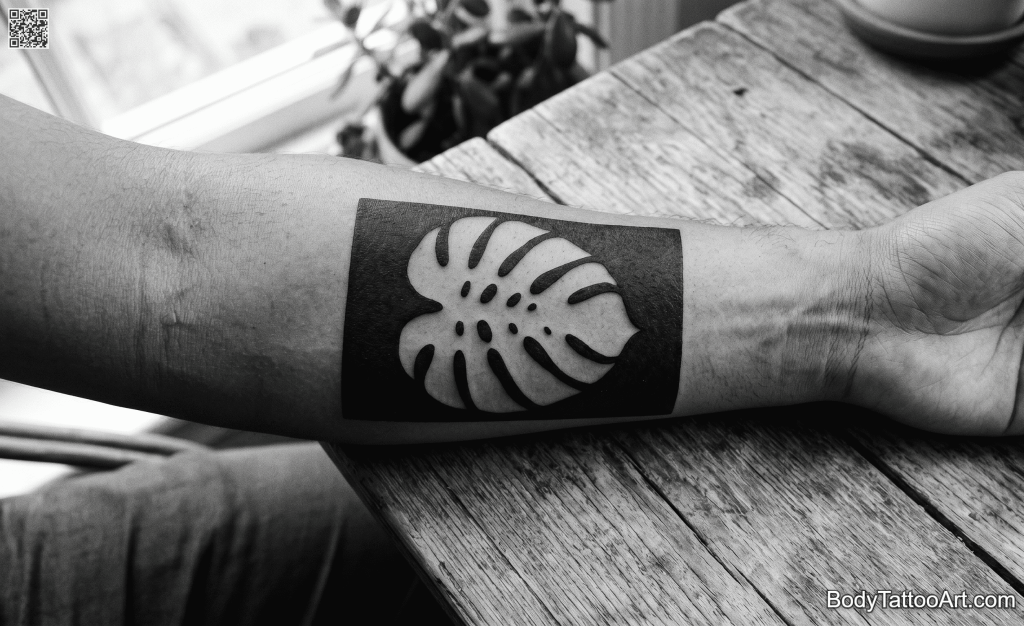
A solid black rectangular patch tattooed on the forearm with monstera leaf shapes left as untattooed skin cutouts within the black field. Three monstera fenestrations and the outline of the full leaf appear as bare skin shapes within the dark rectangle.
Placement: Forearm
Style: Negative space blackwork Monstera Leaf Tattoo
Why it stands out: The monstera exists only as absence here — its shape defined entirely by what isn’t tattooed. The solid black field makes the skin-shaped monstera glow with contrast.
Ideal for: Bold blackwork collectors, people who love negative space optical effects, those who want high visual impact with a conceptual edge.
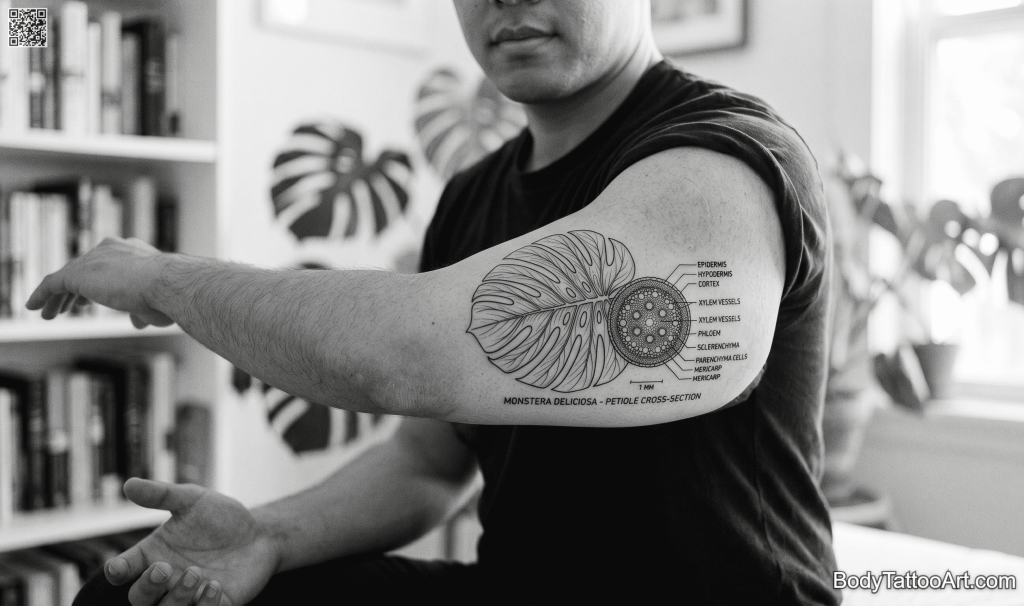
The monstera leaf is shown in cross-section — as if sliced horizontally through the stem and shown from the cut end. The interior cellular structure is suggested with fine circular and layered lines inside the stem cross-section, while the leaf lobes spread outward in their natural form. The composition combines a top-down view with a cross-sectional detail.
Placement: Inner bicep
Style: Scientific illustration / fine line Monstera Leaf Tattoo
Why it stands out: The cross-section botanical concept is almost never applied to tropical leaf tattoos. It turns the monstera into a specimen study rather than a decorative subject.
Ideal for: Science and natural history lovers, conceptual tattoo collectors, fine line enthusiasts who want something truly original.
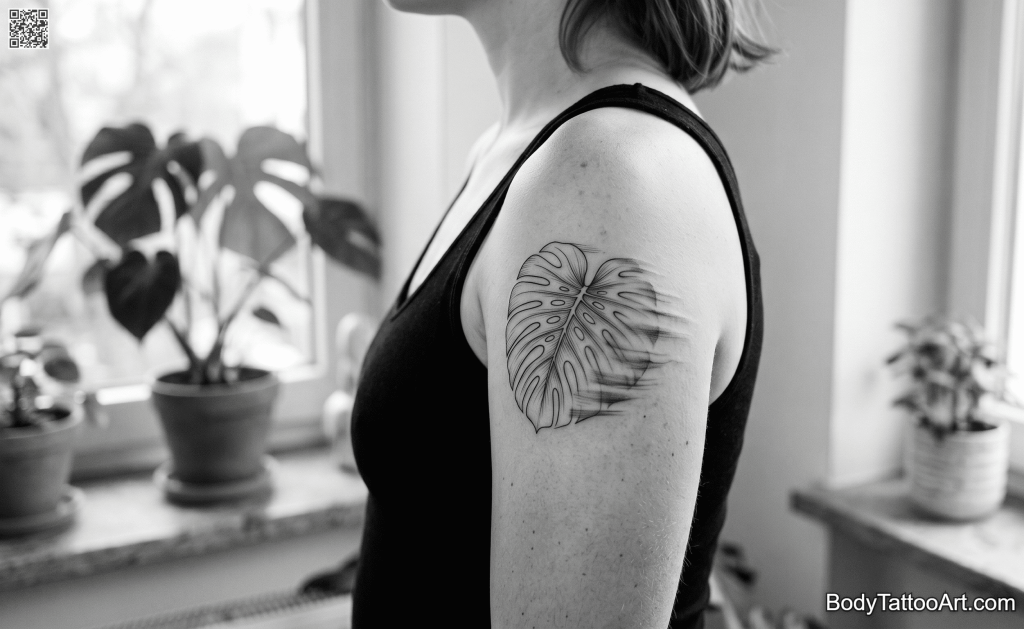
A monstera leaf drawn with deliberate motion blur — the leading lobe edges are crisp and sharp while the trailing side of the leaf dissolves into soft smear lines suggesting the leaf is moving through frame. The fenestrations on the trailing side elongate into blur streaks.
Placement: Upper arm
Style: Motion effect fine line Monstera Leaf Tattoo
Why it stands out: Motion blur applied to a broad tropical leaf creates a visual paradox — the monstera’s natural stillness contrasted with the energy of movement. The fenestrations elongating into streaks is a particularly unusual detail.
Ideal for: People who want dynamic botanical tattoos, those drawn to photography concepts translated into ink, anyone who wants botanical ink that feels kinetic rather than static.
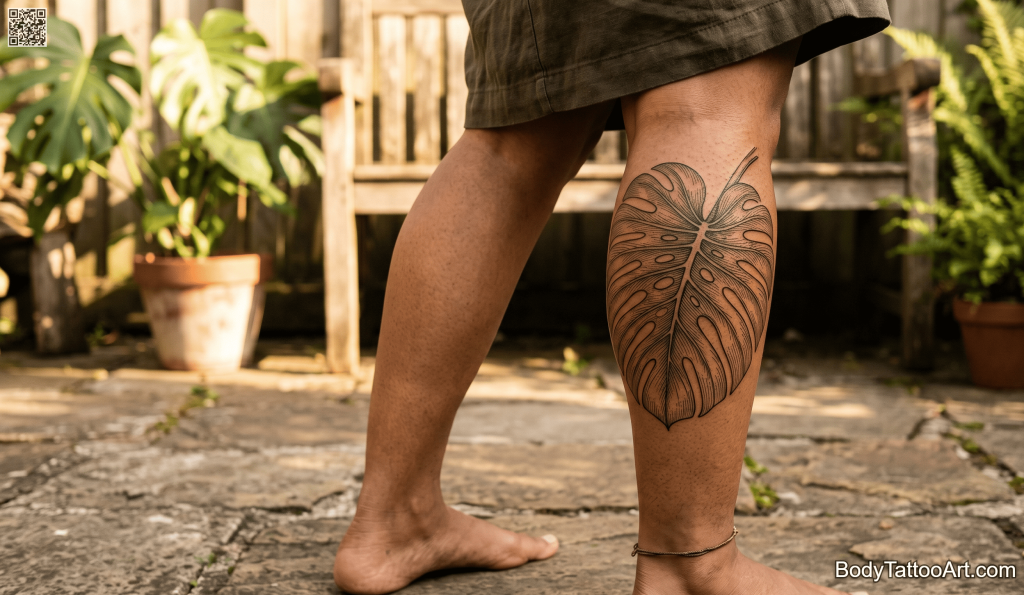
A monstera leaf rendered in the style of an 18th-century botanical engraving — fine crosshatching for shading, slightly thick outlines with a hand-engraved quality, and warm sepia-tone ink. The leaf shows every vein, every surface variation, every lobe curve rendered with the precision of a scientific field illustration.
Placement: Outer calf
Style: Engraving / botanical illustration — sepia ink Monstera Leaf Tattoo
Why it stands out: The sepia-tone engraving approach gives the monstera an aged, archival quality. It looks like something from a rare plant taxonomy book — worn on skin rather than pressed between pages.
Ideal for: History and science aesthetics lovers, vintage illustration fans, those who want a calf piece with old-world botanical quality.
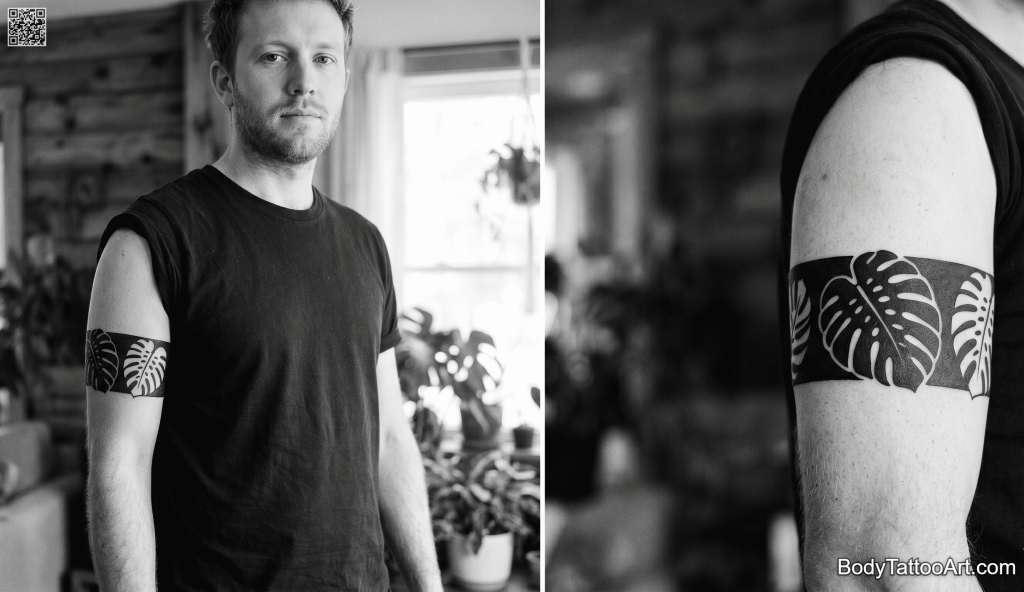
A monstera leaf silhouette repeated four times in a horizontal band wrapping the upper arm like an armband. Each leaf is the same size but rotated slightly differently. The leaves are drawn in clean blackwork fill with the fenestrations left open. The rhythm of the repeating shape creates a textile-like quality.
Placement: Upper arm armband
Style: Blackwork pattern repeat Monstera Leaf Tattoo
Why it stands out: The monstera leaf has a shape strong enough to carry a repeat pattern without becoming visually cluttered. The alternating rotations keep the armband composition dynamic rather than mechanical.
Ideal for: People who want armband tattoos with botanical subject matter, blackwork collectors, those who like pattern and surface design.
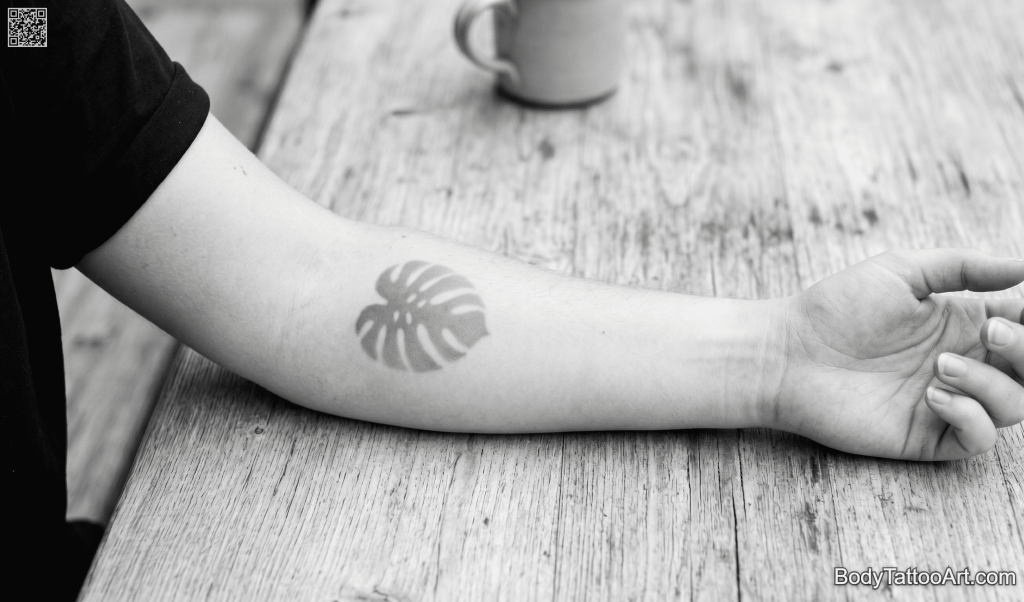
No leaf is drawn — only the shadow the monstera leaf would cast. A soft grey shadow shape on the skin, slightly offset as if light is coming from above-left. The shadow has the recognizable monstera outline but is rendered entirely in soft grey wash with no hard edges anywhere. The leaf itself is absent.
Placement: Inner forearm
Style: Shadow illusion / grey-wash Monstera Leaf Tattoo
Why it stands out: The concept forces the viewer’s eye to complete the missing leaf. The monstera is recognized through its shadow alone — one of the most conceptually unusual approaches to a botanical tattoo.
Ideal for: Conceptual tattoo lovers, people who want optical illusion designs, those who want botanical ink that makes people look twice.
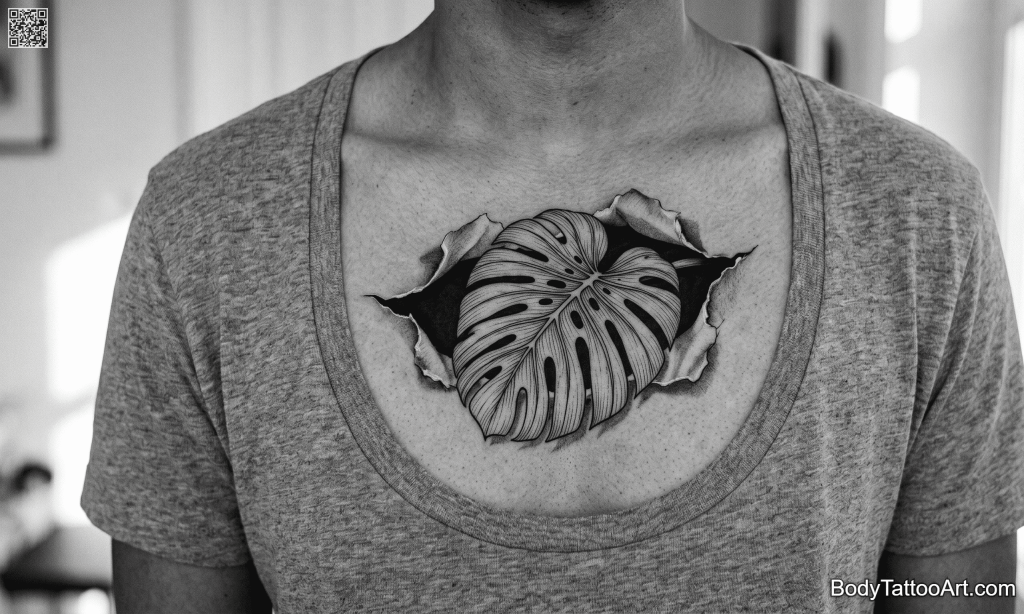
A monstera leaf appears through a torn paper opening on the skin. The torn paper effect is rendered with rough-edged tears and a dark void behind the opening. The monstera leaf sits in front of the tear, clean and fine-line, as if growing through a hole in the surface.
Placement: Collarbone / upper chest
Style: Trompe l’oeil / illustrative Monstera Leaf Tattoo
Why it stands out: The dimensional paper-tear illusion creates dramatic depth behind a clean botanical subject. The monstera emerging from a void has a dynamic quality that a standard botanical placement doesn’t achieve.
Ideal for: Illusion tattoo fans, people who want botanical ink with a conceptual layer, illustrative tattoo collectors.
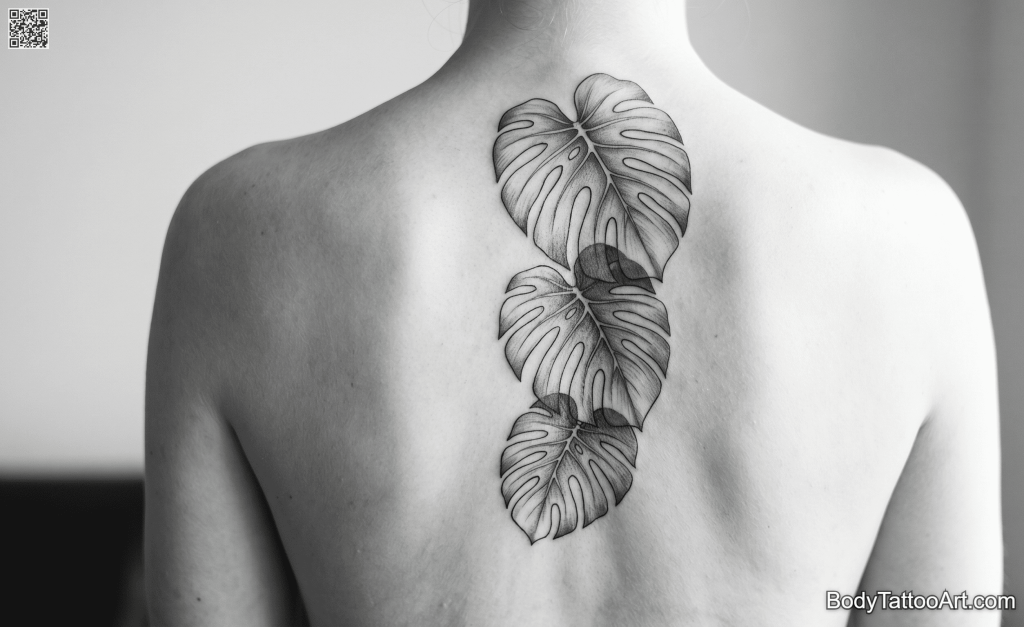
Three monstera leaves stacked vertically in a column, each one overlapping the bottom of the one above it. The overlapping areas are shaded darker to show depth. Each leaf is slightly different in angle. The topmost leaf is largest and most detailed, the bottom leaf smallest and most simplified.
Placement: Spine / back centerline
Style: Grey-wash with fine outline Monstera Leaf Tattoo
Why it stands out: The stacking creates a natural vertical composition that mirrors the structure of the spine. The decreasing scale and detail from top to bottom adds a sense of visual perspective along the body’s axis.
Ideal for: People who want spine tattoos with botanical content, grey-wash collectors, those who like compositionally considered botanical pieces.
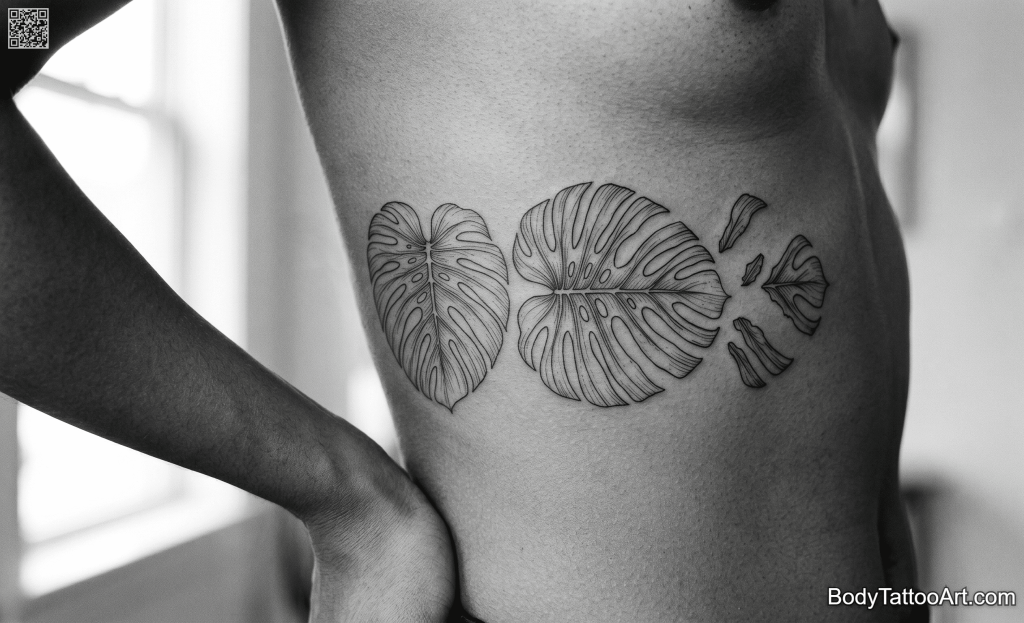
A monstera leaf is shown in three stages in a horizontal sequence — left: intact full leaf in clean fine line, center: the same leaf with some lobes beginning to separate, right: the individual lobe shapes drifting apart into loose fragments. Read left to right like a visual story.
Placement: Ribcage — horizontal spread
Style: Illustrative sequence / fine line Monstera Leaf Tattoo
Why it stands out: The deconstruction sequence turns a single botanical subject into a visual narrative. It asks the viewer to read across the tattoo rather than simply see it — one of the most compositionally ambitious ways to approach the monstera leaf.
Ideal for: Conceptual tattoo lovers, people who want their tattoos to tell a story, collectors who want ribcage work that’s genuinely original.
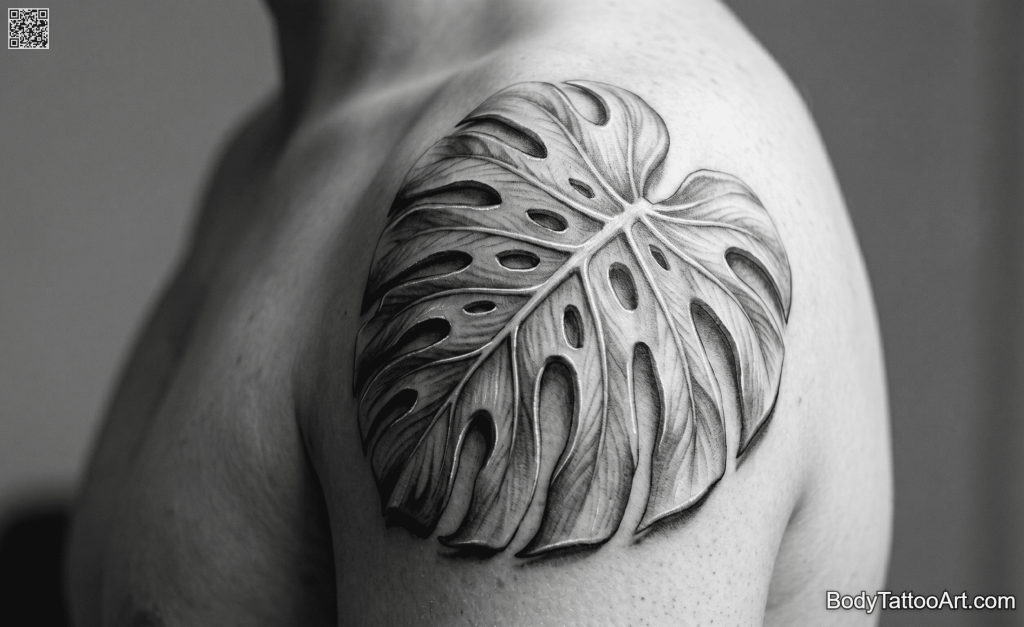
A monstera leaf shaded to appear physically raised from the skin — as if carved in bas-relief. Strong directional light comes from one side, creating distinct cast shadows on the opposite sides of every lobe and a bright highlight ridge along each raised vein. The fenestrations appear as genuine holes casting tiny shadows.
Placement: Shoulder / deltoid
Style: 3D sculptural grey-wash Monstera Leaf Tattoo
Why it stands out: The directional lighting and relief shading make the monstera appear to protrude from the skin. The fenestrations reading as genuine holes with shadow depth is the most visually convincing detail.
Ideal for: Realism and illusion tattoo fans, people who want dramatic shoulder pieces, those who appreciate dimensional shading technique.
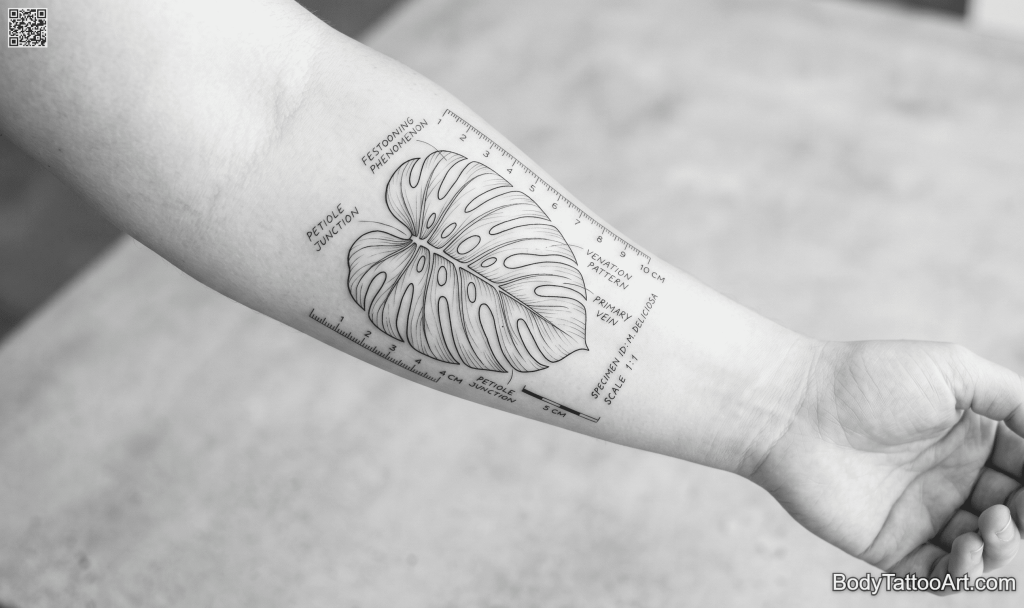
A monstera leaf in clean fine line with measurement tick marks and fine ruler lines along two edges — as if the leaf is being measured for a botanical specimen record. Small annotation marks in a handwritten-suggestion style sit beside the leaf. The presentation is clinical and precise.
Placement: Inner forearm
Style: Scientific specimen illustration / fine line Monstera Leaf Tattoo
Why it stands out: The measurement annotation context shifts the monstera tattoo from decorative to documentary. It reads as a page from a naturalist’s field journal worn permanently on skin.
Ideal for: Natural history and science aesthetics lovers, people who want conceptual additions to botanical tattoos, fine line collectors who want something with an unusual framing.
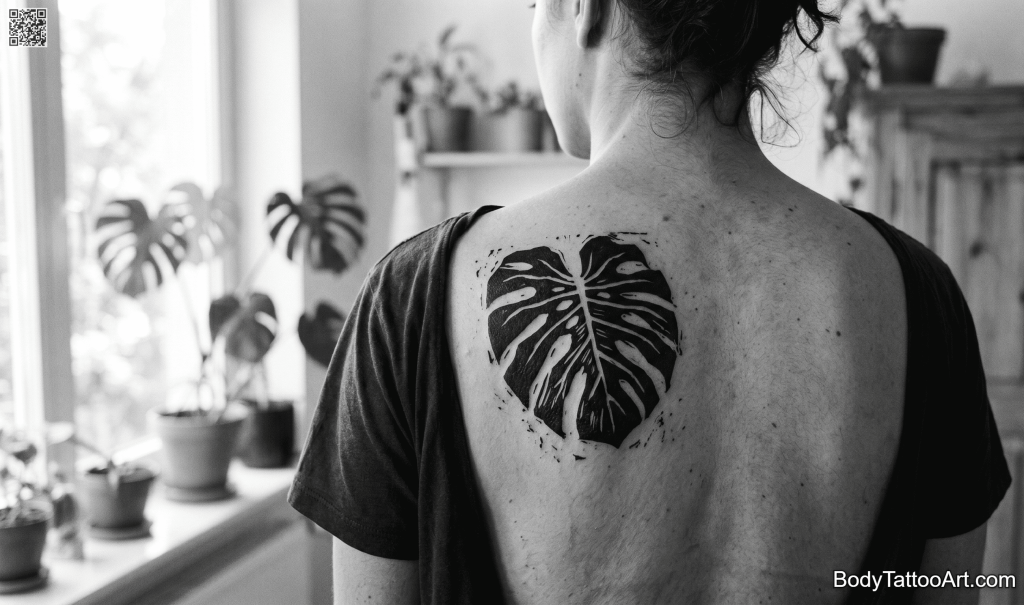
A monstera leaf rendered with the aesthetic of a hand-cut linocut print — thick irregular black marks, rough-edged white relief lines cut through the solid black fill showing the vein structure and lobe surface, bold contrast, and a deliberately crude handmade print quality throughout.
Placement: Upper back
Style: Linocut / relief print Monstera Leaf Tattoo
Why it stands out: The linocut aesthetic gives the monstera a raw, craft quality that’s the opposite of fine line botanical precision. Bold, textured, and proudly imperfect — the roughness is the whole point.
Ideal for: Printmaking and craft art lovers, bold blackwork collectors, people who want a large back piece with strong visual personality.
Twenty-four monstera leaf tattoos and not one of them repeats an idea. That’s the whole point of choosing the monstera leaf as a tattoo subject — the shape is strong enough to absorb any style, any technique, any conceptual approach without losing its identity.
From a 3cm micro stamp on the inner wrist to a full grey-wash close-up filling the outer thigh, from a solid blackwork silhouette to a shadow-only illusion with no leaf drawn at all — the monstera leaf holds its own across every interpretation. The split lobes, the fenestrations, the bold spread of the foliage — these are design features that tattoo artists genuinely love working with because they give so much structural material to play with.
Anyone considering a monstera leaf tattoo should look past the obvious botanical fine line sprig and ask what the design can actually do. The 24 ideas in this list prove the answer is a lot more than most people expect.