Physical Address
304 North Cardinal St.
Dorchester Center, MA 02124
Physical Address
304 North Cardinal St.
Dorchester Center, MA 02124

Olive branch tattoos have been around for a long time, and there’s a reason they never really go out of style. The design is clean, versatile, and works across so many different tattoo styles — from the most delicate fine line work like Dandelions to bold blackwork like Roses that commands attention. Whether placed along the forearm, wrapped around an ankle, or sitting quietly on a collarbone, olive branch tattoos fit almost anywhere on the body.
What makes them interesting from a design perspective is how much visual range they offer. The leaves can be rendered soft and feathery or sharp and structured. The branches can twist elegantly or stand rigid and architectural. Some artists add tiny olives for visual weight. Others strip everything back to just the line of the stem and a few leaves. The result each time feels different — which is exactly why olive branch tattoos continue to attract so many people to tattoo studios.
This blog rounds up 27 distinct olive branch tattoos ideas that each bring something different to the table. From minimalist single-stem designs to elaborate illustrative compositions, there’s something here for every kind of tattoo collector.
An olive branch tattoos are a design based on the branch of the olive tree (Olea europaea), typically depicted with small elongated leaves and sometimes bearing the fruit. The imagery has appeared in art, architecture, coins, and flags for thousands of years. In tattoo form, it usually stays close to the natural form of the branch — graceful, linear, and leafy.
The design works well in both small and large formats, which makes it popular among first-timers and experienced collectors alike.
The olive branch carries deep roots in history and culture. In ancient Greece, it was associated with Athena and used as a symbol of civilization and wisdom. In Roman tradition, olive branches were carried by those seeking peace or mercy. The image is referenced in the Bible, where a dove returns to Noah with an olive branch, signaling the end of the flood. Today, the olive branch remains one of the most universally recognized symbols of peace.
Beyond peace, olive branch tattoos are also associated with endurance, as the olive tree is one of the longest-living trees in the world — some specimens in the Mediterranean are over a thousand years old. This longevity makes the olive branch a quiet symbol of resilience and rootedness.
If you enjoy nature-inspired tattoo designs, you might also like exploring lotus tattoo ideas or floral blackwork styles that carry similar grounding energy.
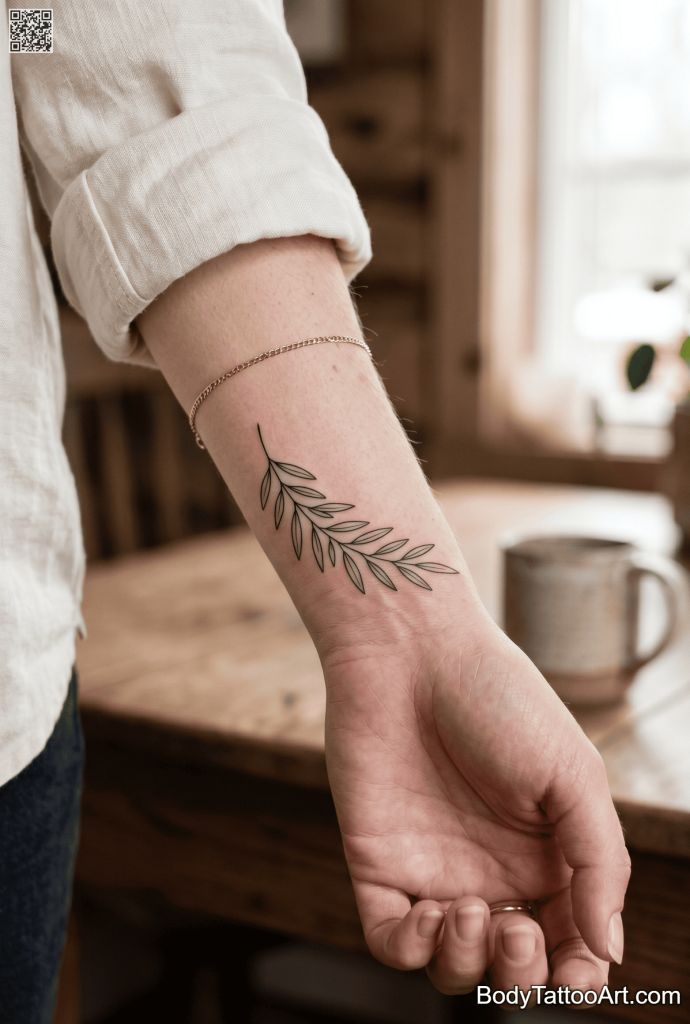
A single olive branch drawn with a continuous fine line, leaves spaced evenly along the stem, no shading, no fill. The design sits almost like a botanical sketch on skin. The proportions are precise — not too many leaves, not too few — and the stem has a slight natural curve that keeps it from looking stiff.
Placement: Inner wrist
Style: Fine line Olive Branch Tattoos
Why it stands out: The restraint in this design is what makes it work. Nothing is overdone. It’s confident in its simplicity.
Ideal for: First-time tattoo collectors, minimalist aesthetic fans, people who want something subtle but intentional.
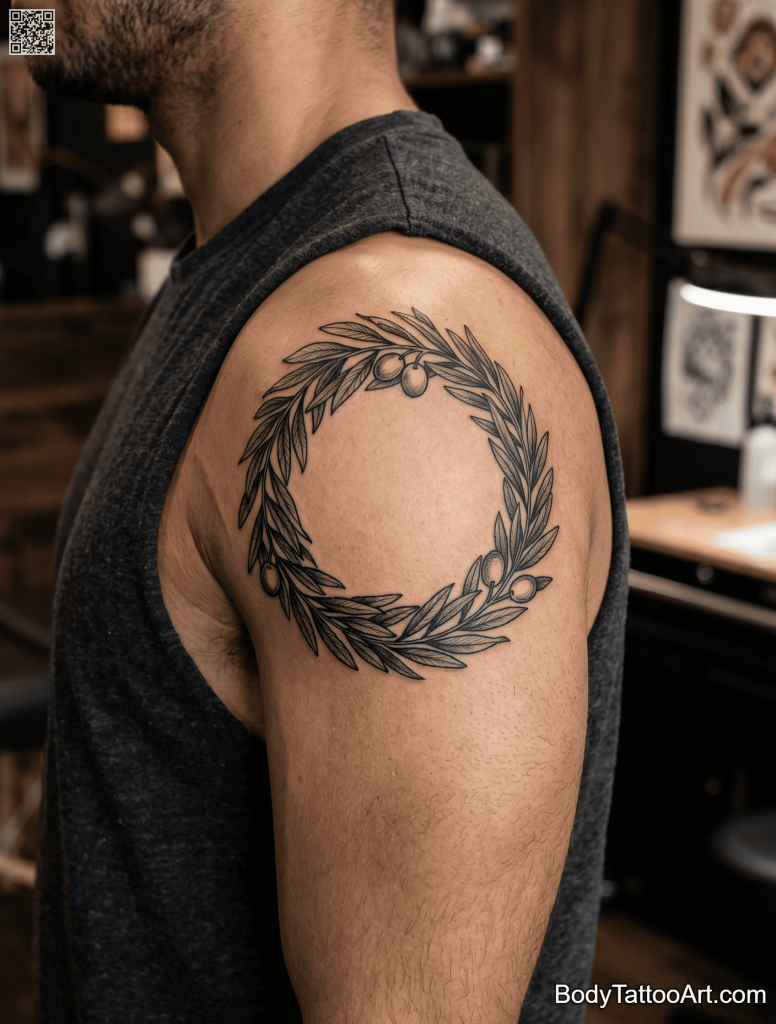
An olive branch bent into a full circle, with the two ends nearly touching at the bottom. The leaves overlap slightly as they travel around the ring, creating a layered, almost woven effect. The center of the circle is left completely empty, making the frame itself the focus. Small ink-drop olives appear at three points along the ring.
Placement: Upper arm / shoulder cap
Style: Illustrative blackwork Olive Branch Tattoos
Why it stands out: The circular form gives the design a medallion-like quality. It sits on the shoulder cap like a badge.
Ideal for: People who like structured, symmetrical designs and those planning sleeve additions later.
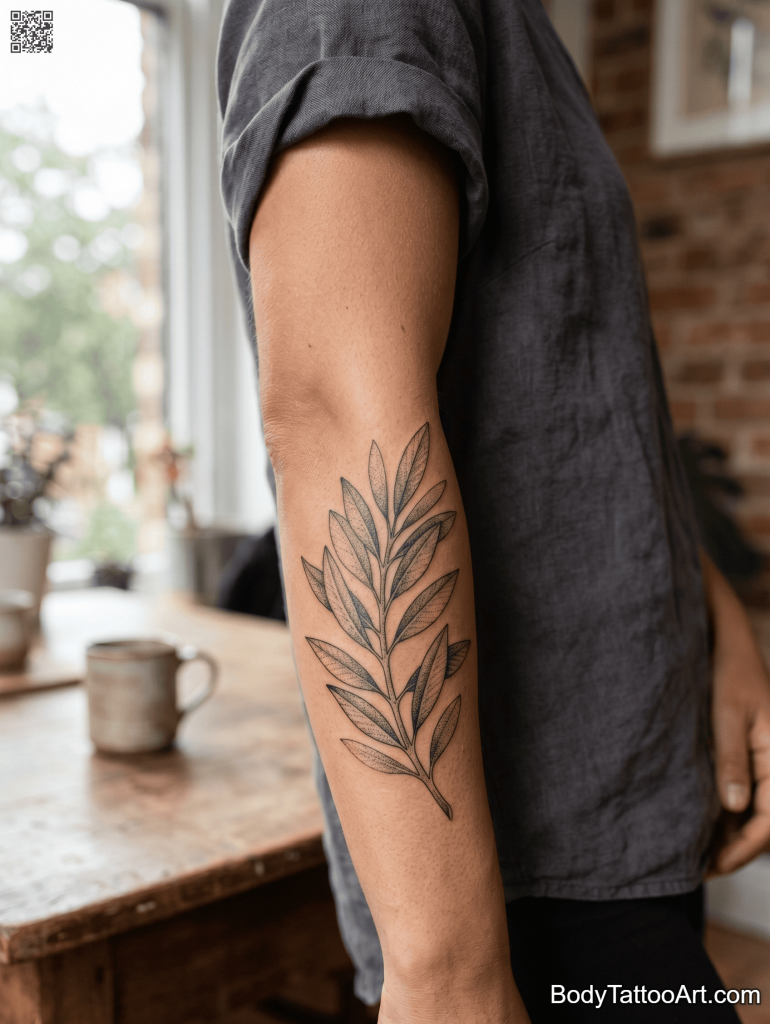
The leaves on this olive branch are shaded entirely with fine dotwork — hundreds of tiny dots that build soft gradients from dark to light. The veins in each leaf are visible, and the stem has a slight texture to it. It reads like a page from a vintage botanical illustration.
Placement: Forearm
Style: Dotwork Olive Branch Tattoos
Why it stands out: The dot shading gives the leaves a tactile, almost papery quality. It looks painstaking in the best way.
Ideal for: Collectors who appreciate technical tattooing and people who love botanical print aesthetics.
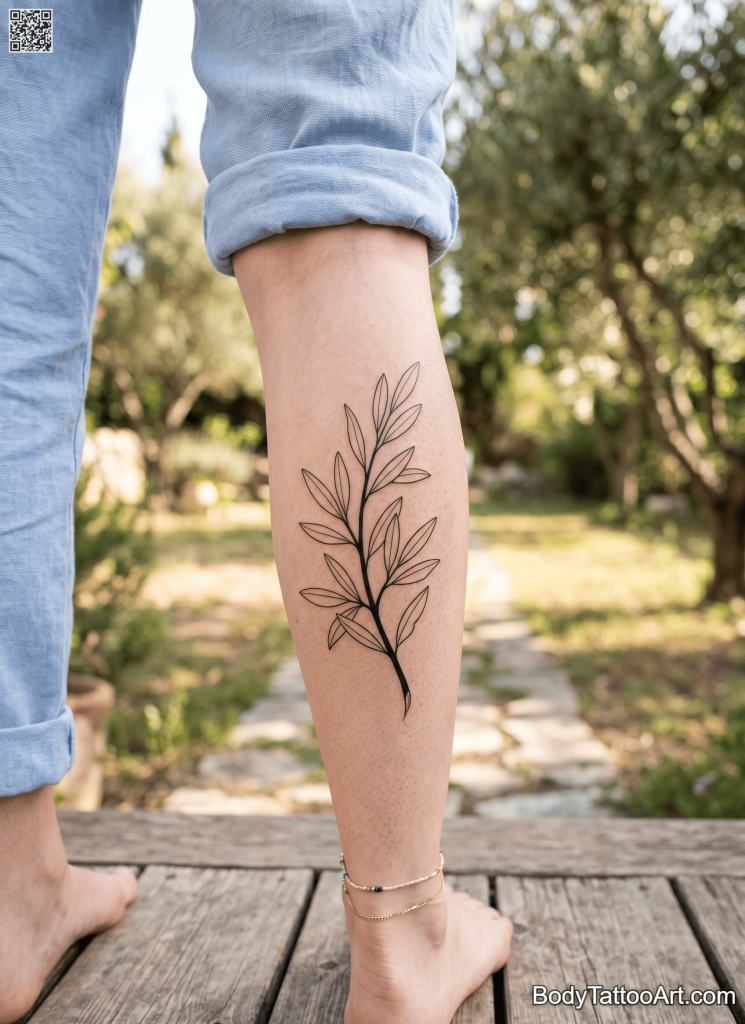
The leaves on this branch are outlined but not filled — instead, the skin itself becomes the light inside each leaf. Only the outline and a thin vein line through the center are tattooed. The contrast between the inked stem and the bare leaf interiors creates a striking graphic effect.
Placement: Calf
Style: Fine line with negative space Olive Branch Tattoos
Why it stands out: It plays with the idea of what gets inked and what doesn’t. The skin becomes part of the design itself.
Ideal for: People who like graphic design-influenced tattoos and those with lighter skin tones looking for a clean contrast effect.
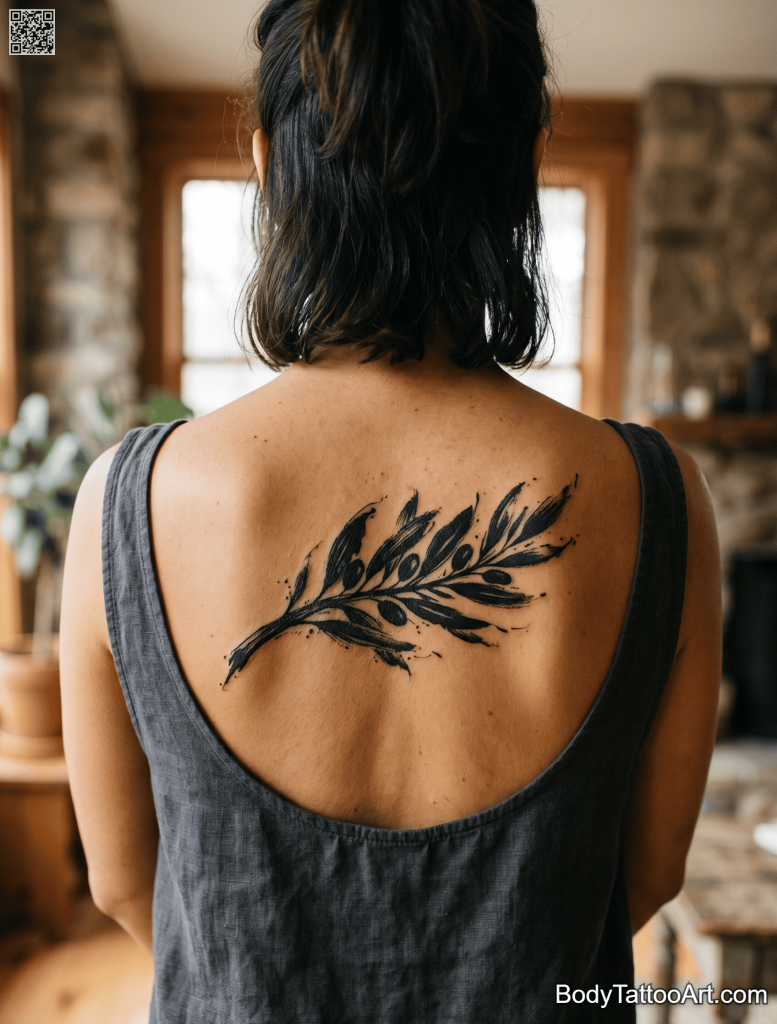
This olive branch looks like it was painted onto skin with a wide ink brush. The stem and leaves have visible stroke texture, with slightly uneven edges that give it an organic, handmade quality. The fills are dense and dark in the center, feathering out at the edges.
Placement: Upper back / between shoulder blades
Style: Brushwork blackwork Olive Branch Tattoos
Why it stands out: It has the confidence of a stamp. No hesitation in the lines, no delicate picking — just bold, direct mark-making.
Ideal for: Bold style collectors, people who prefer graphic tattoos over intricate ones.
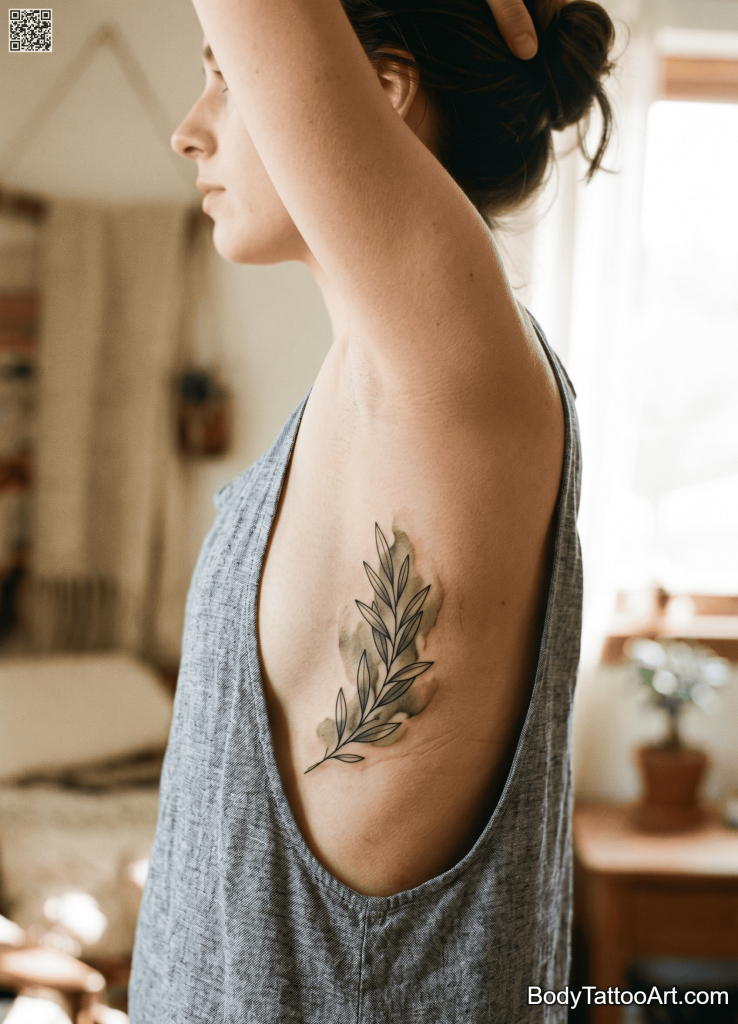
The olive branch itself is drawn in clean black fine lines, but behind the leaves there’s a soft watercolor-style wash of muted olive green and warm grey. The color pools unevenly, just like real watercolor would, bleeding slightly beyond the edges of the branch.
Placement: Rib cage
Style: Fine line with watercolor Olive Branch Tattoos
Why it stands out: The contrast between the precise linework and the loose color wash creates an interesting visual tension. It’s controlled and expressive at the same time.
Ideal for: Fans of color tattoos who still want a delicate, feminine feel.
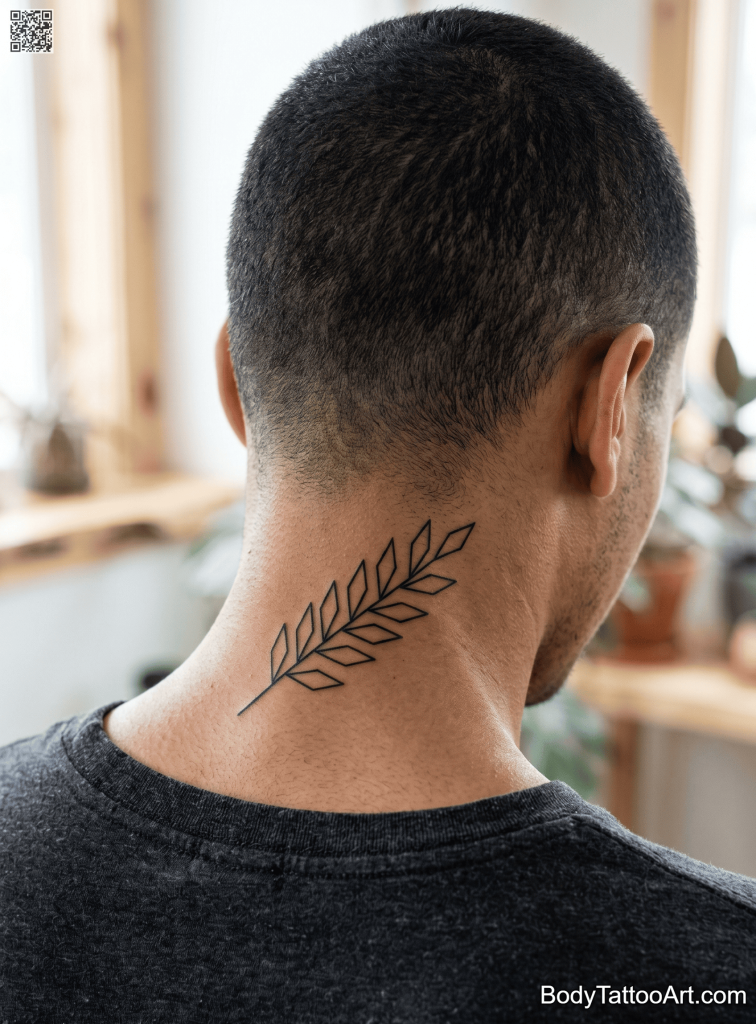
The olive branch here is stripped back to geometry — the leaves are rendered as sharp diamond shapes and the stem is a clean diagonal line. It’s recognizable as an olive branch but filtered through a graphic design sensibility. Very little organic curve; everything is angular and deliberate.
Placement: Back of the neck
Style: Geometric blackwork Olive Branch Tattoos
Why it stands out: It reinterprets a classic natural form through a modern visual language. It doesn’t look like any other olive branch tattoo.
Ideal for: Design-focused people, those who like tattoos that make people look twice.
A single olive branch that extends the full length of the forearm — from just above the wrist up toward the elbow crease. The leaves are spread generously along the stem and a few small olives hang from thin secondary stems. The design follows the natural contour of the arm, curving slightly as it travels up.
Placement: Full inner forearm
Style: Fine line botanical Olive Branch Tattoos
Why it stands out: The length and vertical travel of this design makes it feel like it belongs on the body. It works with the arm’s shape, not against it.
Ideal for: People planning forearm tattoos, those who love botanical illustration styles.
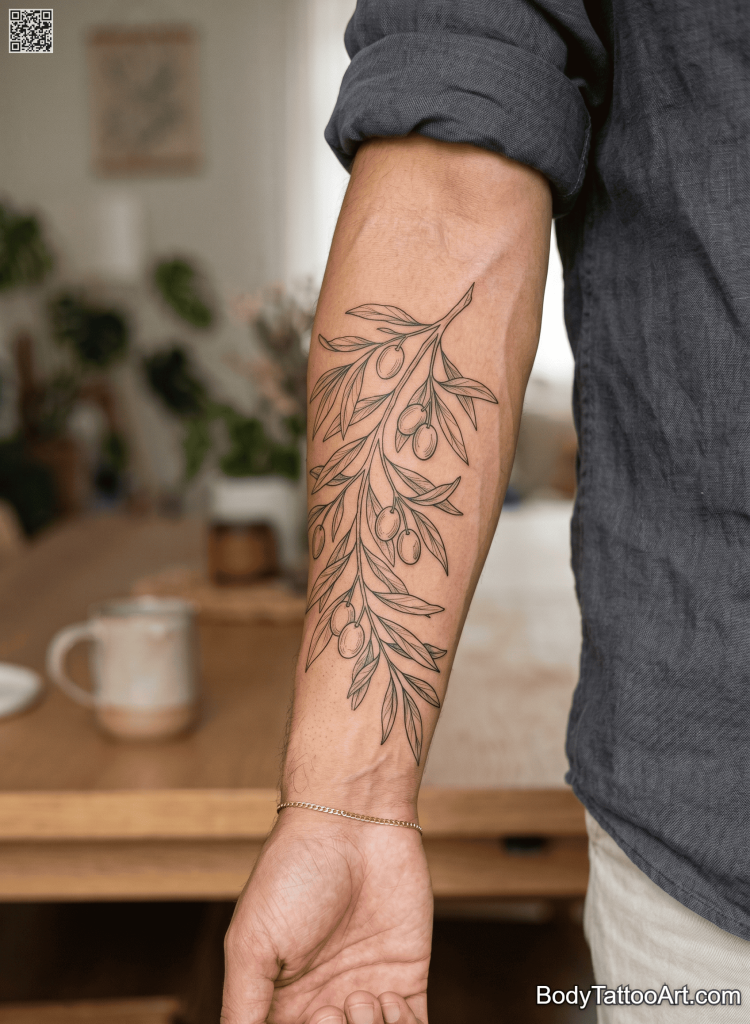
An extremely small olive branch — no longer than 3 cm — tucked just behind the ear. Two or three pairs of leaves, one tiny olive fruit, and a delicate curved stem. It’s barely visible at first glance, which is entirely the point.
Placement: Behind the ear
Style: Micro fine line Olive Branch Tattoos
Why it stands out: Scale is everything here. The restraint of keeping it so small gives it a quiet, personal quality.
Ideal for: Those wanting a discreet tattoo, minimalists, people getting their first tattoo.
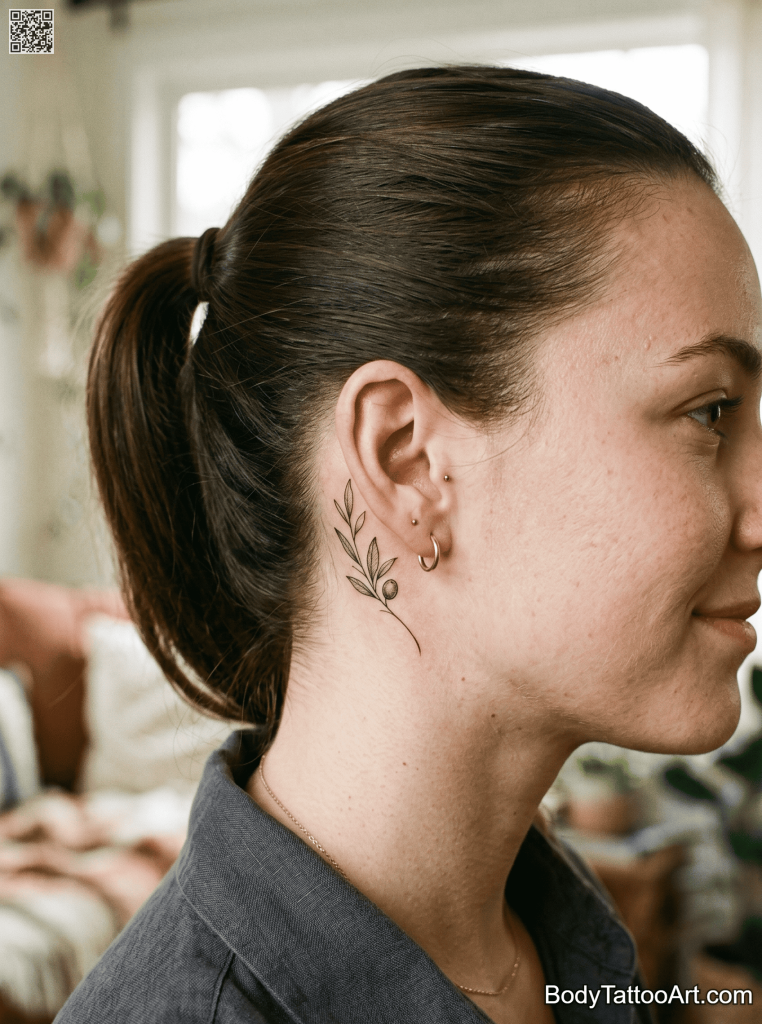
Two olive branches mirror each other on either side of the sternum, meeting at the center point just below the collarbone. The leaves on both sides are identical in arrangement, and the stems arch gently outward. Together they form a wide open V-shape that flatters the chest.
Placement: Sternum / chest
Style: Fine line symmetrical Olive Branch Tattoos
Why it stands out: The mirrored placement creates a visual balance that feels intentional and elegant. It frames the center of the chest without covering it.
Ideal for: People who prefer symmetrical placements, chest tattoo collectors.
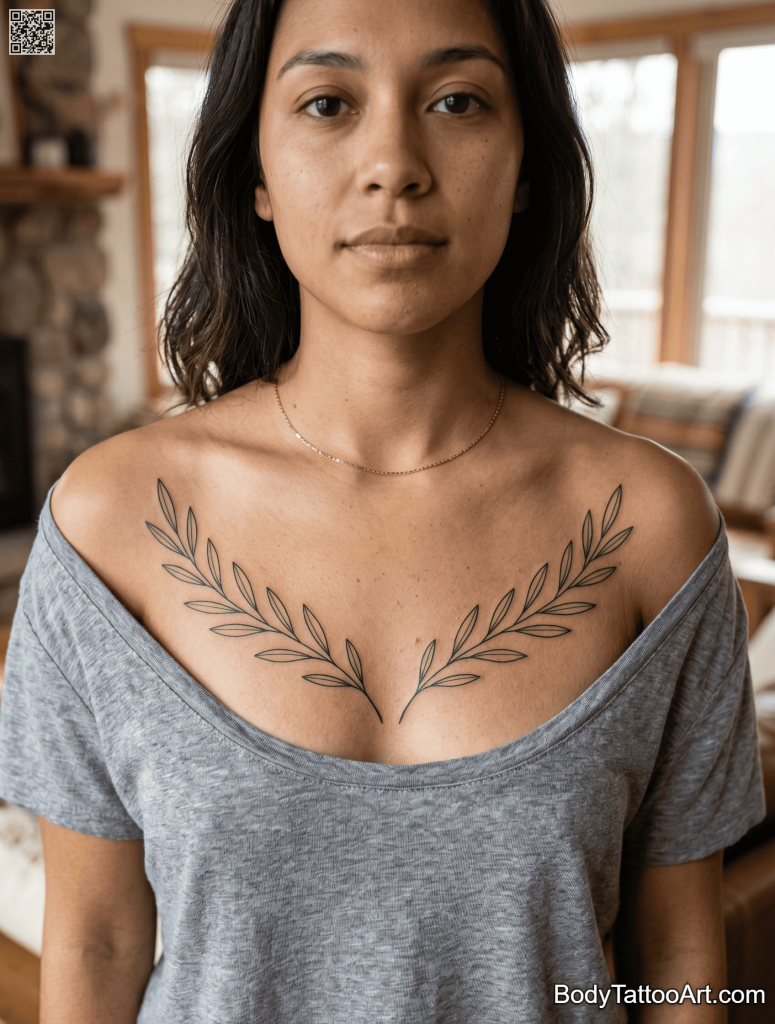
An olive branch wraps partway around the ankle — about three-quarters of the way — with the branch end and leaf tip finishing just above the ankle bone. The leaves have light grey-wash shading and the stems have a slightly woody texture. It sits like a natural bracelet.
Placement: Ankle
Style: Grey-wash fine line Olive Branch Tattoos
Why it stands out: The wrap-around placement makes the tattoo three-dimensional in a way flat placements don’t. It invites people to look at it from multiple angles.
Ideal for: People who like placement-specific designs, ankle tattoo fans.
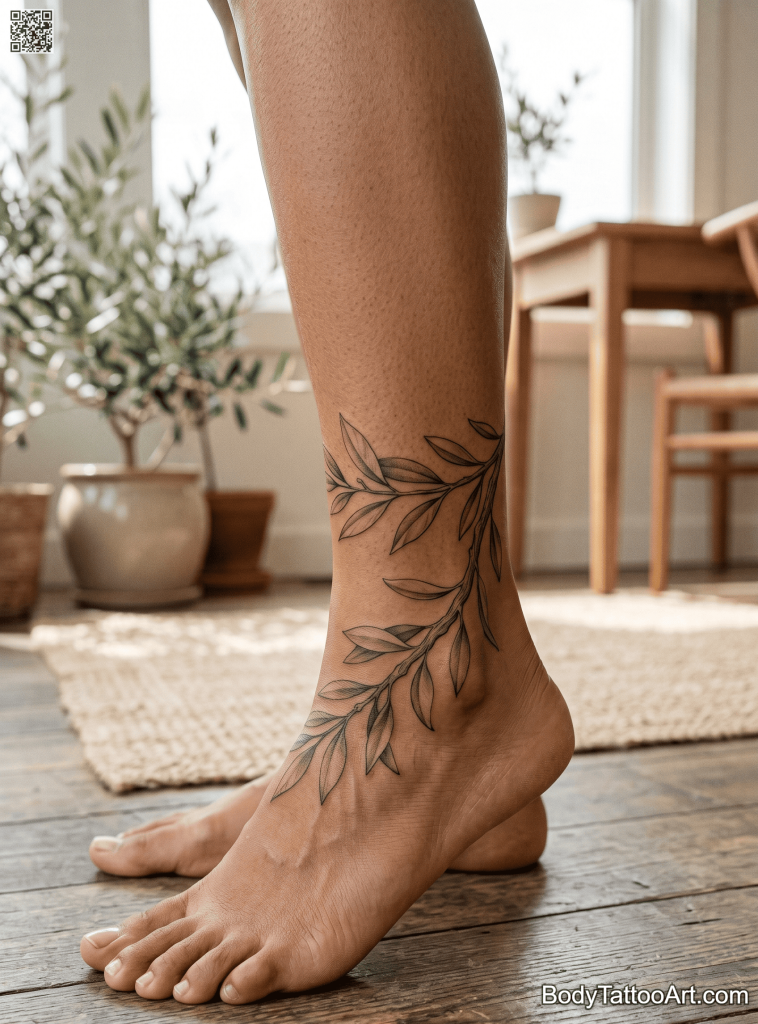
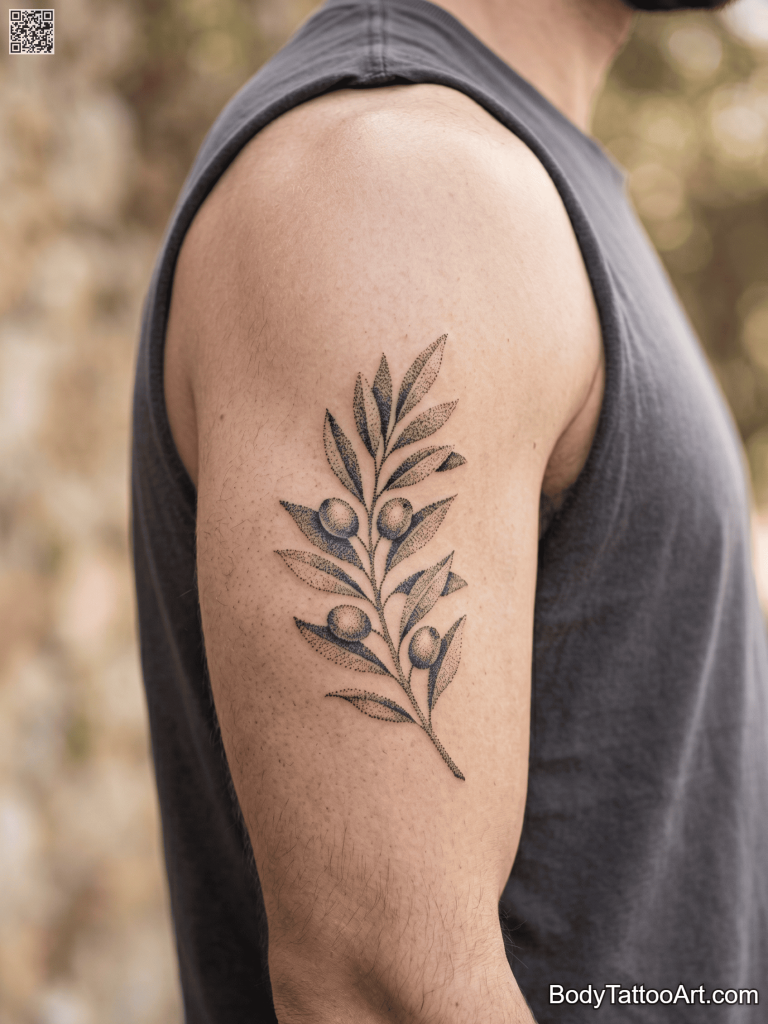
The entire branch — stem, leaves, and three small olives — is built entirely from stippling. No outlines, no solid lines. Just thousands of tiny dots of varying density that slowly build the form from near-white to deep black. The result looks like a pencil study transferred onto skin.
Placement: Outer bicep
Style: Stipple / pointillism Olive Branch Tattoos
Why it stands out: The tonal range achieved through dots alone is impressive. This design rewards close inspection.
Ideal for: Collectors who appreciate technical work, people who love monochromatic ink studies.
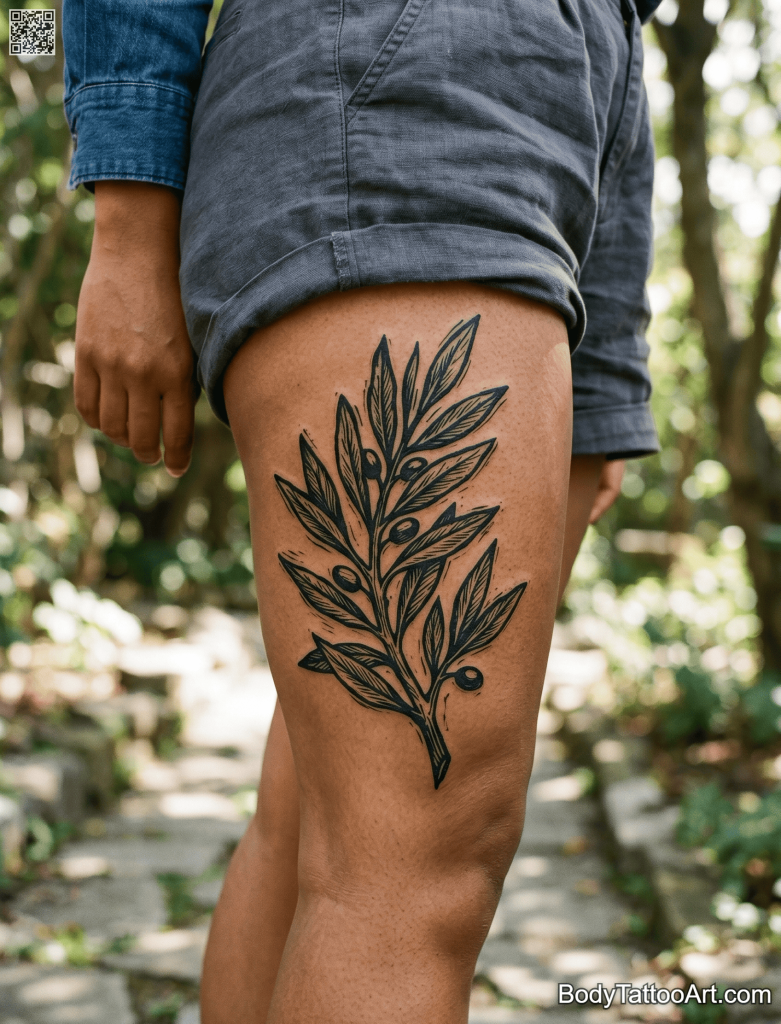
The leaves and stem are rendered with thick, deliberate block-print lines — like an old woodcut illustration. There’s visible grain texture inside the leaves, the edges are slightly rough, and the overall aesthetic feels aged and printmaking-inspired.
Placement: Upper thigh
Style: Blackwork woodcut Olive Branch Tattoos
Why it stands out: The printmaking reference gives it a historical, crafted quality. It looks like it was pressed from a wooden plate.
Ideal for: People drawn to folk art, vintage prints, and bold statement tattoos.
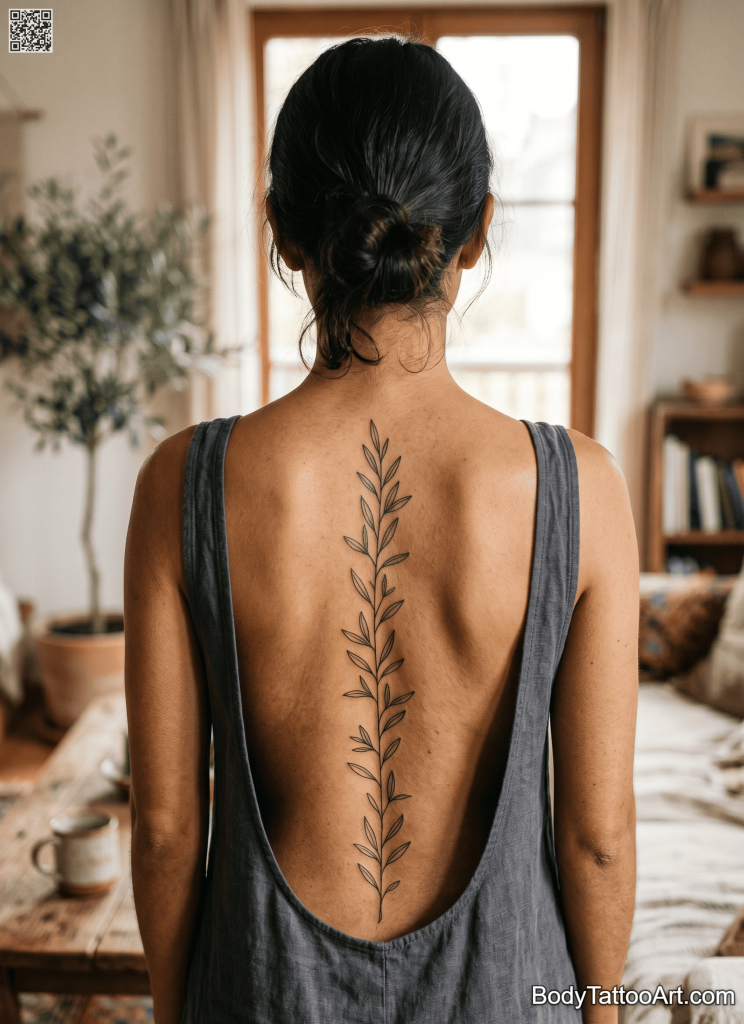
A long olive branch runs vertically along the spine, from the mid-back down to the lower back. The stem follows the line of the vertebrae closely, and the leaves extend outward on alternating sides, echoing the body’s bilateral symmetry. A few tiny olives are scattered along the lower half.
Placement: Spine / back center
Style: Fine line Olive Branch Tattoos
Why it stands out: The design is built around the body’s own axis. It doesn’t just sit on the back — it uses the spine as its structural center.
Ideal for: People planning back pieces, those who love placement-aware designs.
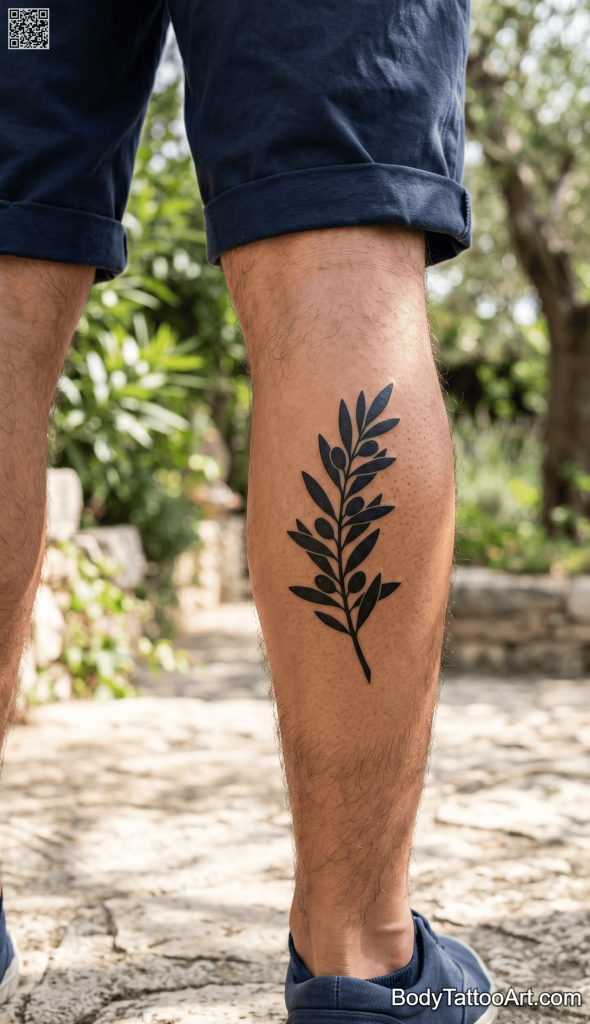
Each leaf on this branch is filled completely solid black — no shading, no vein detail, just dense flat black shapes along a clean stem. The contrast between the flat black leaves and the bare skin creates a graphic, high-impact look.
Placement: Shin / front of lower leg
Style: Blackwork silhouette Olive Branch Tattoos
Why it stands out: The flat black fill creates a strong visual impact that reads clearly even from a distance. Clean and graphic.
Ideal for: Bold tattoo collectors, people who prefer graphic styles over detailed realism.
The stem on this olive branch coils and curves with the exaggerated fluidity of Art Nouveau design — long, whipping curves that feel almost like movement captured mid-flow. The leaves follow the same flowing rhythm, each one curling slightly at the tip.
Placement: Hip / side torso
Style: Art Nouveau linework Olive Branch Tattoos
Why it stands out: The stylized line quality sets this apart from every naturalistic olive branch tattoo. It’s theatrical in the best sense.
Ideal for: Art history fans, people who love ornamental and decorative tattooing.
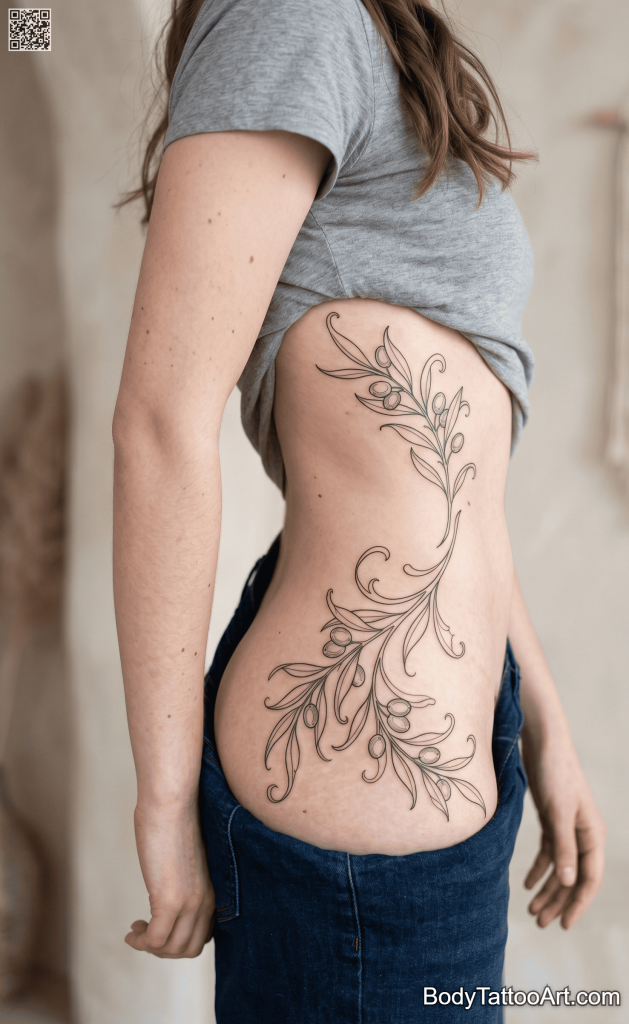
Leaves with full grey-wash shading, highlights picked out with white ink, and a stem that shows real bark texture — this olive branch is as close to photographically realistic as tattooing allows. Each leaf has dimensional form, catching light from a single direction.
Placement: Shoulder blade
Style: Realism / grey-wash Olive Branch Tattoos
Why it stands out: The level of tonal detail makes it look like an actual branch placed on the skin. The white ink highlights elevate it significantly.
Ideal for: Collectors of realistic botanical tattoos, people who want depth and dimension.
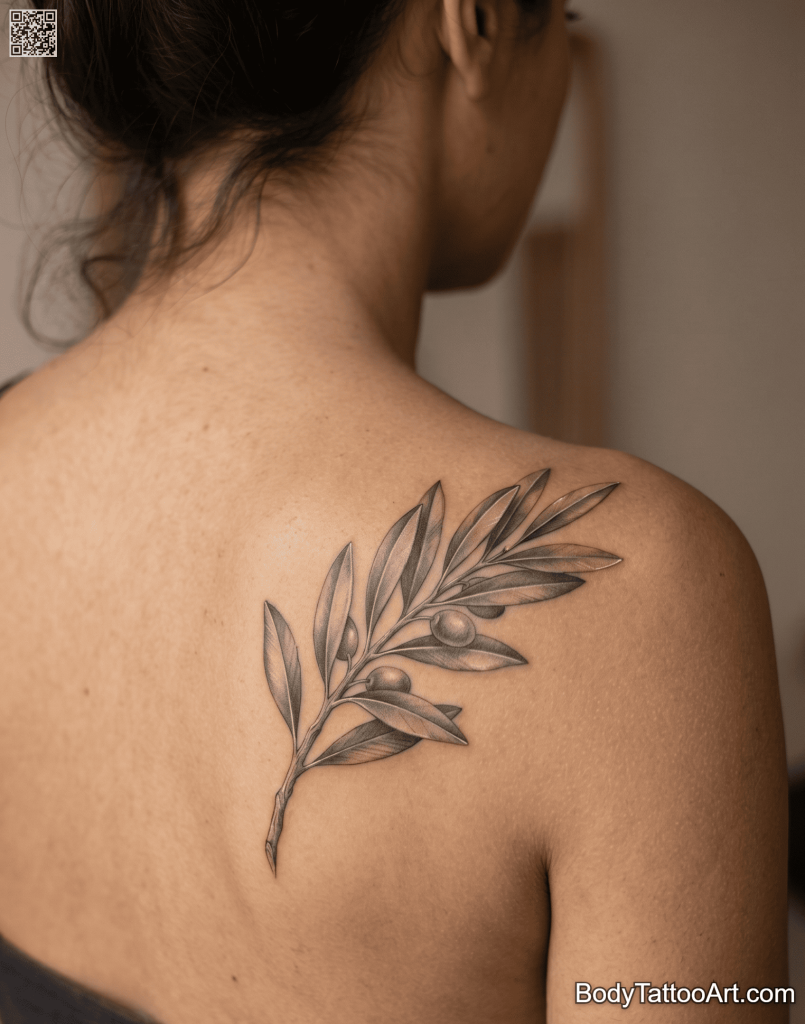
This looks like a quick artist’s sketch — loose, gestural lines with slightly imprecise edges. Some leaf outlines don’t fully close. The stem has visible hand-drawn irregularity. It has none of the precision of fine line work; instead, it feels spontaneous and alive.
Placement: Inner upper arm
Style: Sketch / illustrative Olive Branch Tattoos
Why it stands out: The imperfection is intentional and confident. It looks like a drawing that was too good to stay on paper.
Ideal for: People who prefer organic aesthetics over precision, art enthusiasts.
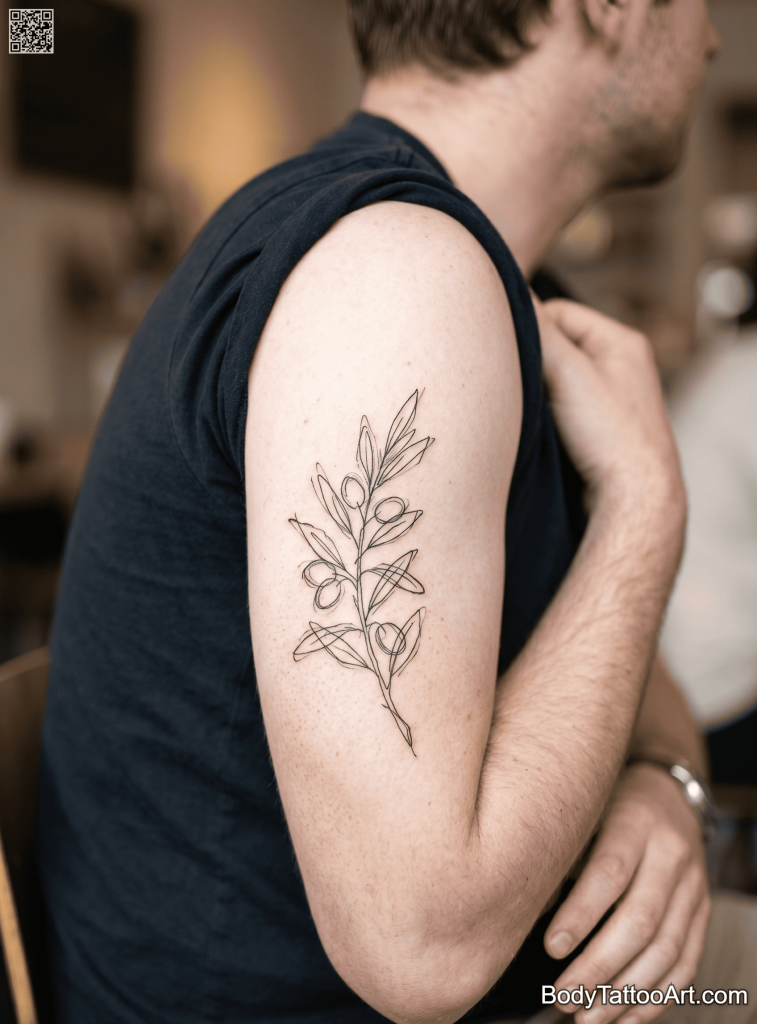
A short, softly curved olive branch drapes along the collarbone — following the line of the bone itself. The leaves cascade gently downward from the stem, and the overall shape echoes the natural curve of the shoulder. It sits like a delicate necklace.
Placement: Collarbone
Style: Fine line Olive Branch Tattoos
Why it stands out: It works with the collarbone’s natural curve so seamlessly that it looks like it was always meant to be there.
Ideal for: People who love jewelry-inspired placements, feminine tattoo styles.
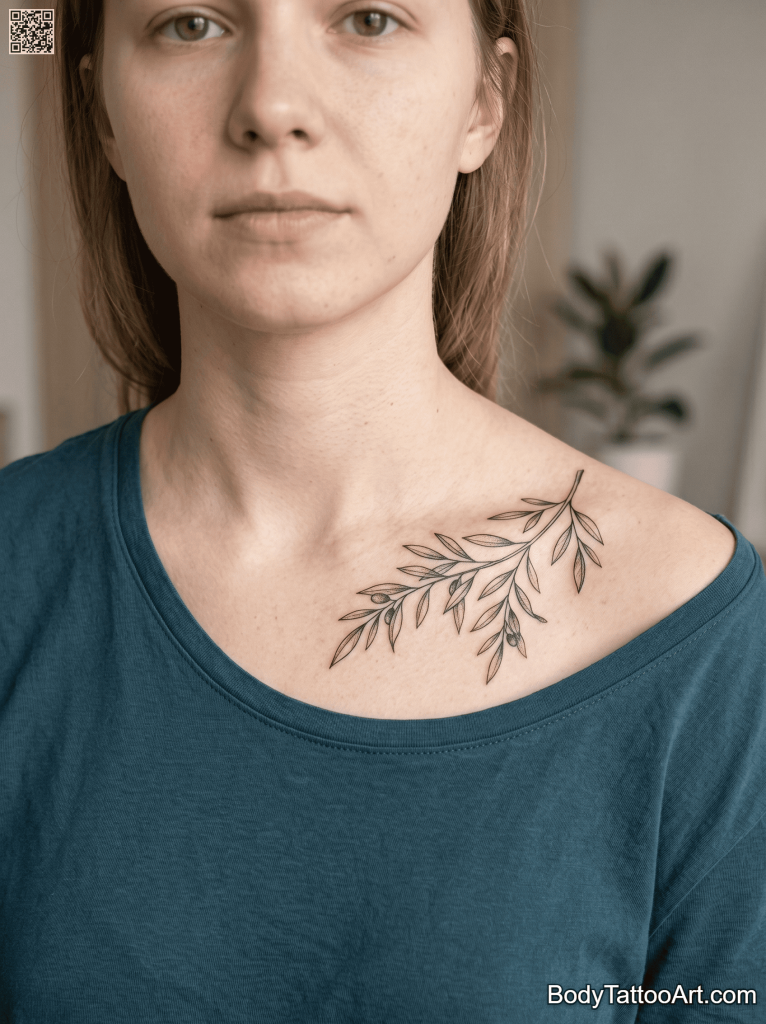
Rather than dot shading or grey wash, the shading on this olive branch is built entirely from fine cross-hatched lines — just like an engraving or etching. The darker areas have denser hatch patterns, the lighter areas have sparse ones.
Placement: Outer forearm
Style: Etching / cross-hatch Olive Branch Tattoos
Why it stands out: The cross-hatch texture gives it a currency-print quality. It looks engraved rather than tattooed.
Ideal for: People drawn to illustration and printmaking aesthetics, collectors who appreciate unique shading techniques.
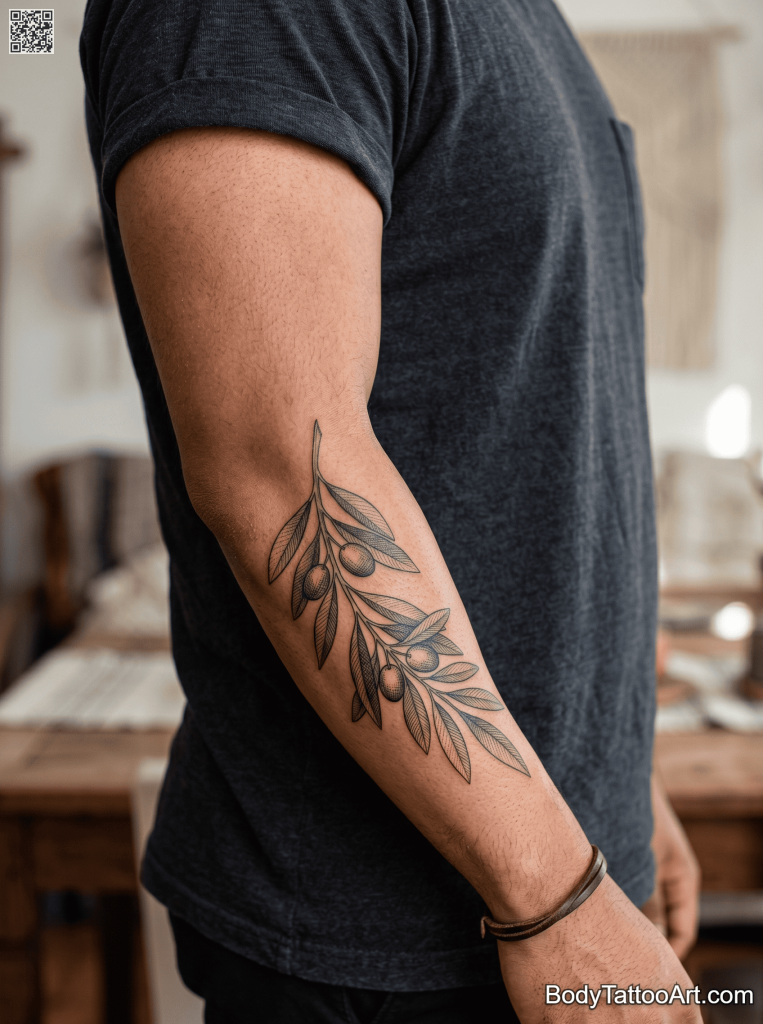
An ultra-minimal olive branch — reduced to just a stem and two or three leaf pairs — wraps around the index finger like a ring. Each leaf is barely 3–4mm in height. The design is intimate and barely visible unless the hand is held up close.
Placement: Index finger wrap
Style: Micro fine line Olive Branch Tattoos
Why it stands out: The extreme reduction of the form to fit the finger is a design challenge in itself. What’s left is only what’s essential.
Ideal for: People who love hidden or intimate tattoos, those wanting very small designs.
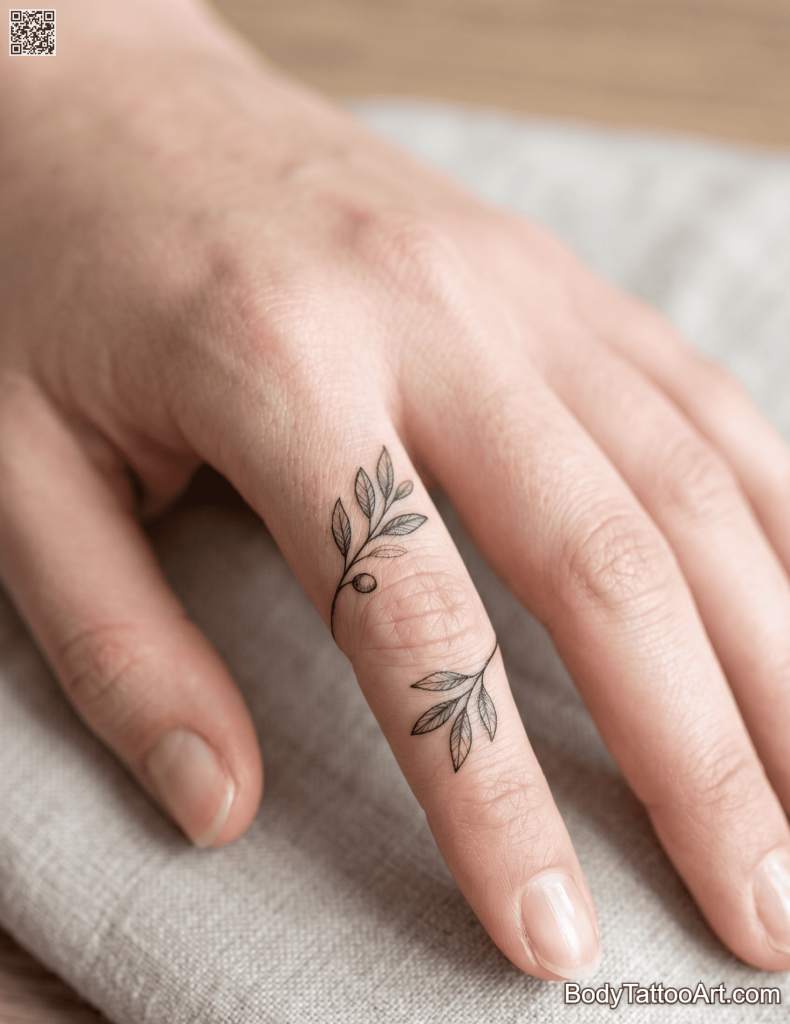
The stem and leaves are filled completely with black but given a deliberate texture — parallel line fills inside the leaves, a hatched bark pattern on the stem. It’s all black but never flat, because the fill pattern creates surface interest.
Placement: Upper arm / sleeve start
Style: Textured blackwork Olive Branch Tattoos
Why it stands out: The texture inside the black fill makes it visually complex even within a monochrome palette. It doesn’t need grey or white to have dimension.
Ideal for: Those building a blackwork sleeve, bold tattoo collectors.
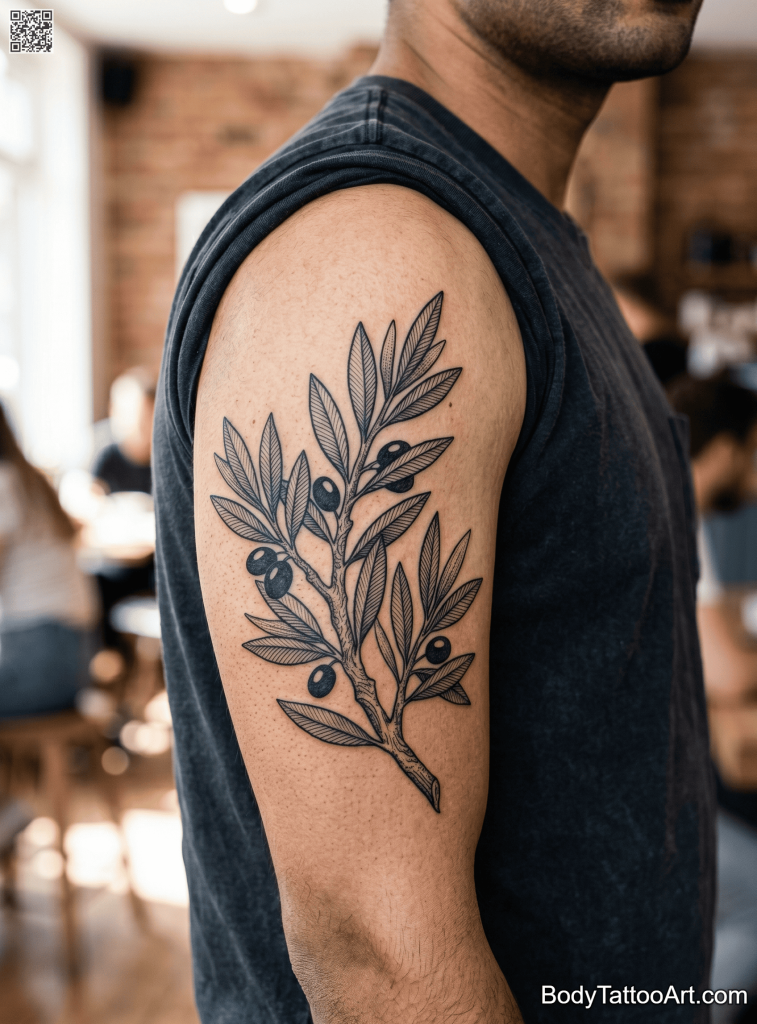
A clean illustrative olive branch sits in the center, but behind and around it there are small ink splatter marks — deliberate, placed drops and spray that frame the branch without overwhelming it. The splatter adds energy without making the design chaotic.
Placement: Outer calf
Style: Illustrative with splatter Olive Branch Tattoos
Why it stands out: The splatter breaks the formality of the botanical design. It feels fresh and gives the branch a more dynamic presence.
Ideal for: People who want something familiar but with a modern edge, fans of mixed-technique tattooing.
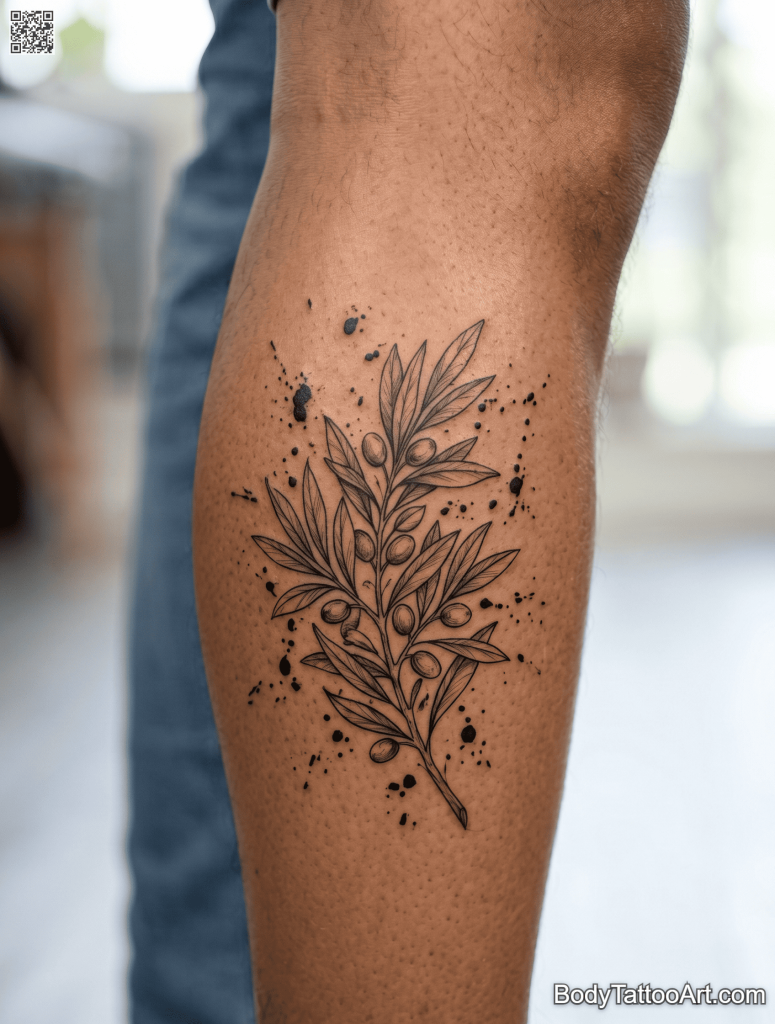
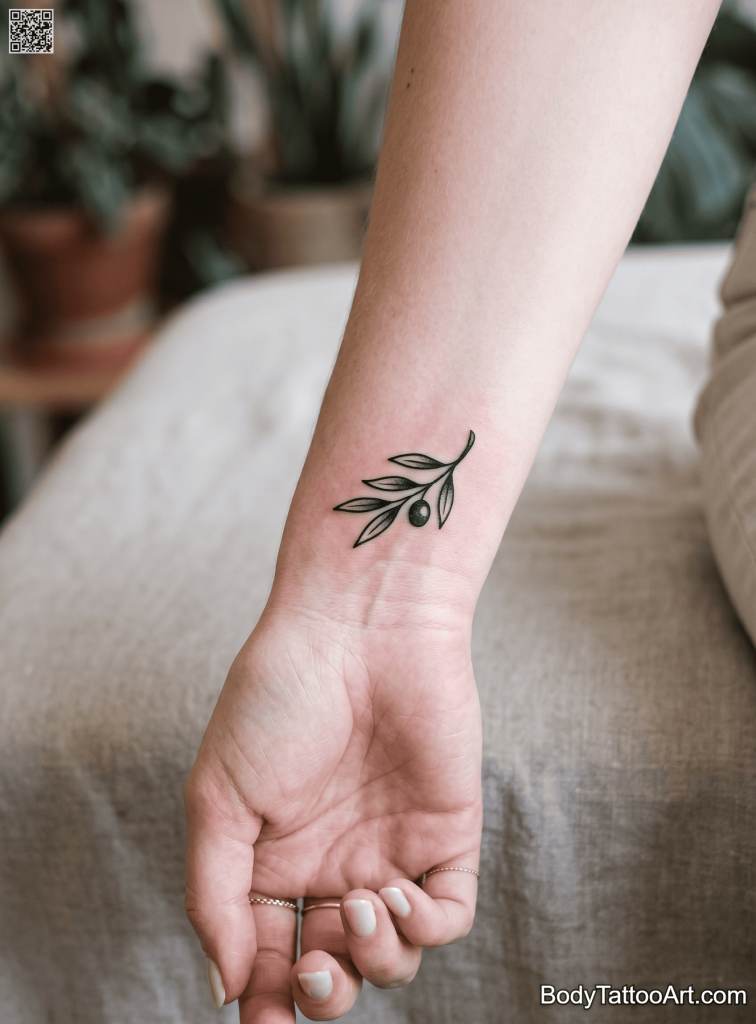
A tiny olive branch — barely 4 cm — sits just inside the wrist like a small stamp. Two or three leaf pairs, a short curved stem, one tiny olive. It’s the kind of tattoo that catches light and draws a second look.
Placement: Inner wrist
Style: Micro traditional Olive Branch Tattoos
Why it stands out: The small scale makes it feel personal. It’s not asking for attention — it’s just there, for the person wearing it.
Ideal for: First-time collectors, people who prefer understated tattoos.
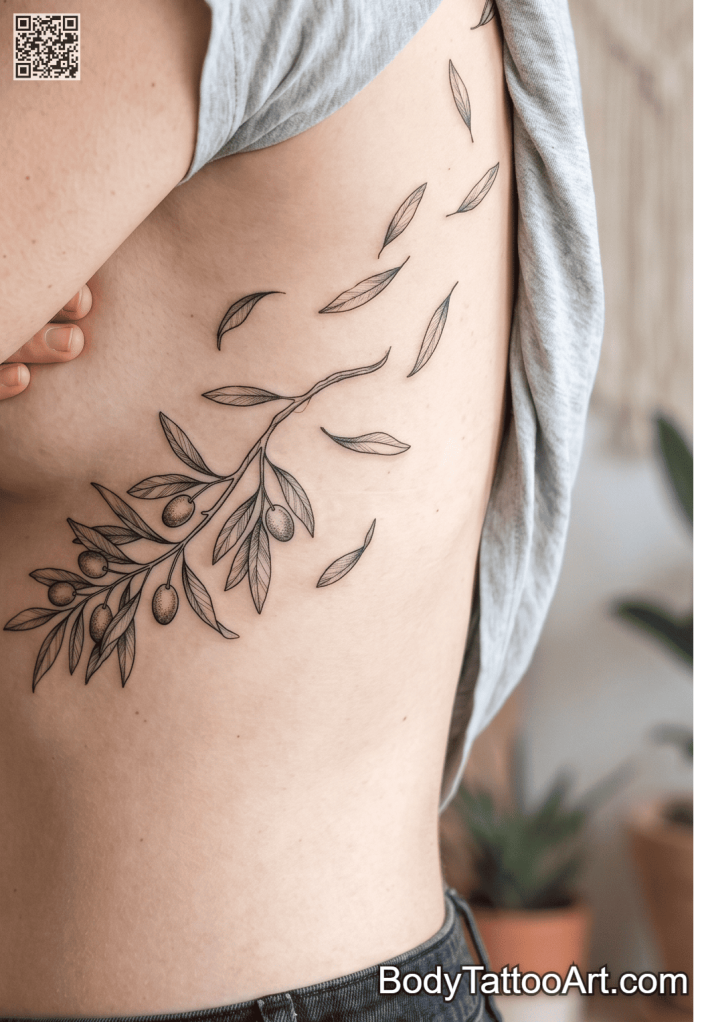
This design breaks the branch apart — the stem and a few attached leaves anchor the center, but several individual leaves are scattered away from it, as if blown by wind. Each detached leaf has its own gentle curve and shading. The overall effect is poetic and slightly unpredictable.
Placement: Ribs / side torso
Style: Fine line illustrative Olive Branch Tattoos
Why it stands out: The scattered composition makes it feel less static than a standard branch. There’s implied movement.
Ideal for: People who want an unconventional take on the design, those who love organic, flowing layouts.
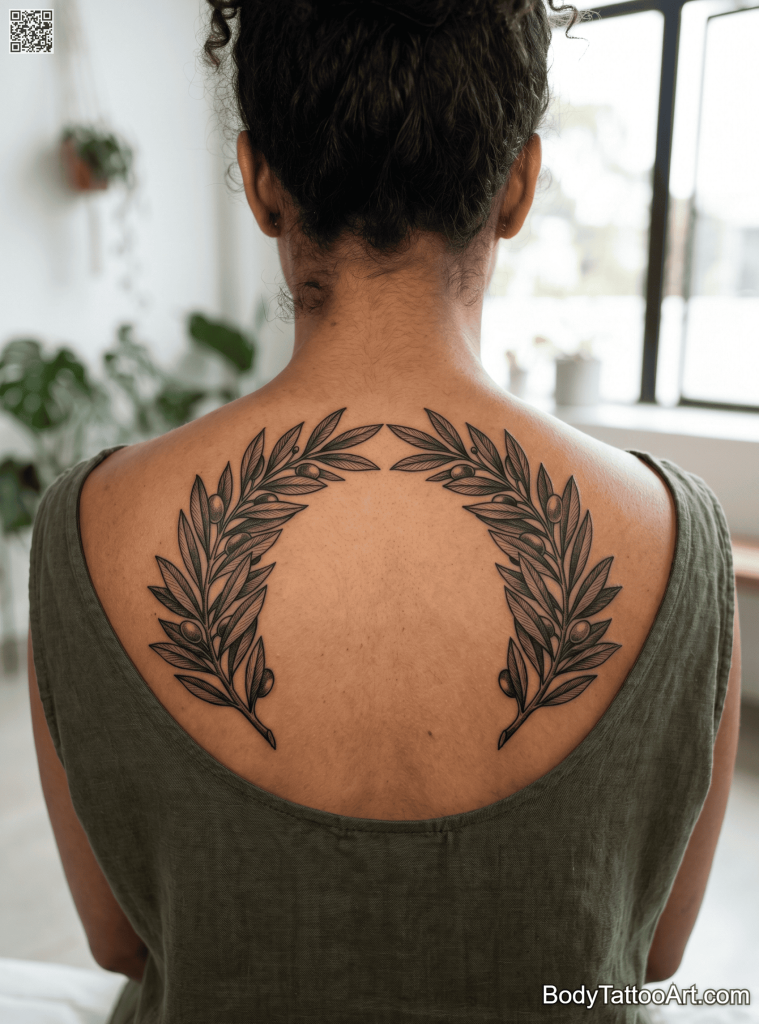
Two olive branches arranged to form an arch shape — one on each side, meeting at the top center. The arch is wide enough to frame a significant area without any fill inside. The branches themselves are detailed in blackwork, with layered leaves giving depth to the frame.
Placement: Upper back
Style: Blackwork illustrative Olive Branch Tattoos
Why it stands out: The arch formation creates a strong structural composition. It frames the upper back beautifully and has an almost architectural quality.
Ideal for: People planning large back pieces, those who love structural compositions.
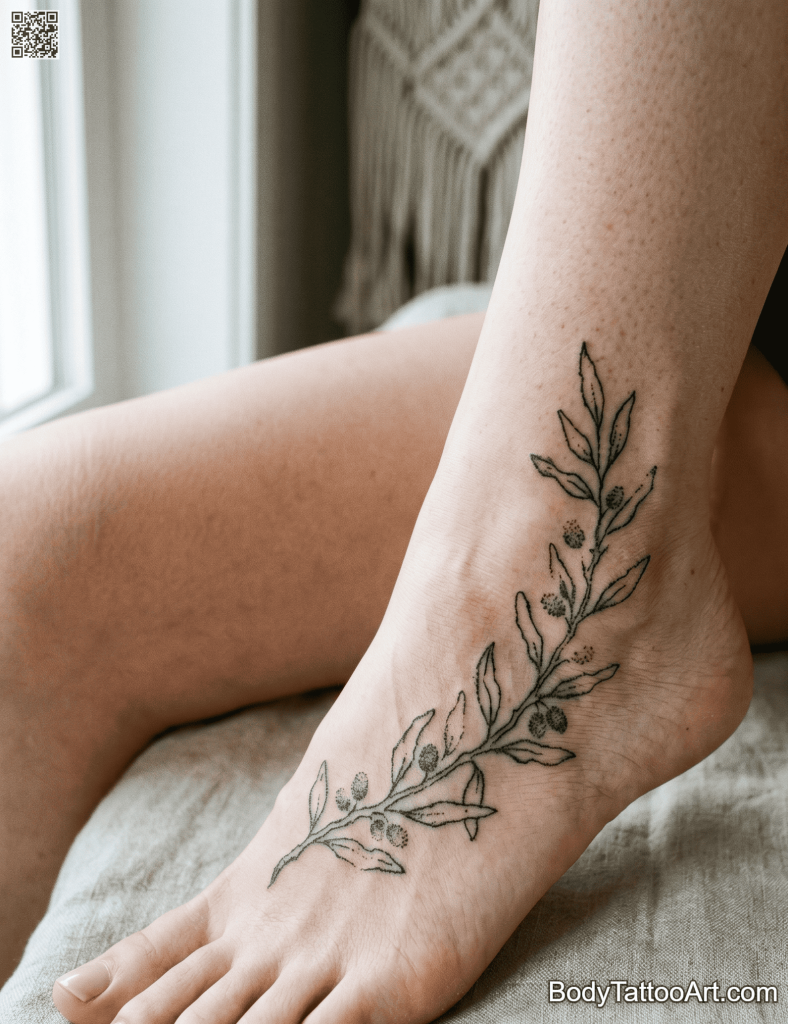
This olive branch carries the distinct visual quality of hand-poke tattooing — slightly uneven line weight, subtle ink density variation, and a raw, handmade texture throughout. It’s not imprecise — it’s a different kind of precision. The leaves have thin irregular outlines and the stem shows the characteristic softness of poked ink.
Placement: Ankle / top of foot
Style: Hand-poke Olive Branch Tattoos
Why it stands out: Hand-poke tattoos have a tactile, intimate quality that machine tattoos don’t replicate. The natural variation in line makes every piece genuinely one of a kind.
Ideal for: People who value the handmade and the artisanal, those drawn to slower, more meditative tattoo processes
Olive branch tattoos prove that one of the oldest symbols in human visual culture still has a lot of life in it. The 27 designs above show just how different a single motif can look depending on style, scale, placement, and artistic approach. From micro wrist stamps to full spine-following branches, from dotwork studies to bold blackwork silhouettes — the range is genuinely wide.
What stays consistent across all of them is that the olive branch, in whatever form, carries a quiet visual confidence. It doesn’t need to be loud to make an impression. That’s probably why olive branch tattoos continue to be one of the most requested designs in studios worldwide.
If you’re still exploring nature-based tattoo ideas, it’s worth looking into botanical fine line tattoos more broadly — floral designs like cherry blossom or peony tattoos follow a similar visual logic and are just as versatile in terms of style and placement. Take the time to find a tattoo artist whose line quality matches the style you want — with olive branch tattoos especially, the execution makes all the difference.