Physical Address
304 North Cardinal St.
Dorchester Center, MA 02124
Physical Address
304 North Cardinal St.
Dorchester Center, MA 02124

Ivy vine tattoos are one of those designs that never really go out of style. The vine shape works with the body in a way few other subjects do — it follows curves, wraps around limbs, climbs the spine, and trails along collarbones without ever looking forced. That’s what makes ivy vine tattoos such a popular choice across so many different tattoo styles and body types.
Whether someone wants a thin, delicate vine crawling up their wrist or a full blackwork piece snaking around an entire arm, ivy vine tattoos adapt to the vision. This blog puts together 29 completely different ivy vine tattoo designs — different in style, placement, composition, and feel. No two are alike.
Ivy Leaf Tattoos has been used as a symbol across cultures for centuries. In ancient Greece and Rome, ivy was associated with Dionysus and Bacchus — gods of wine, celebration, and creativity. In medieval Europe, ivy clinging to stone walls became a symbol of survival and persistence. Because ivy grows in almost any condition and holds on to whatever surface it finds, it became a natural symbol of endurance.
Ivy vine tattoos today carry those same ideas in different ways — the ability to adapt, to hold on, to keep growing even in difficult places. Beyond that, the visual appeal of ivy vine tattoos is strong enough to stand entirely on its own, separate from any meaning.
For more on the plant’s history and classification, the Wikipedia page on Hedera (Ivy) is a solid reference.
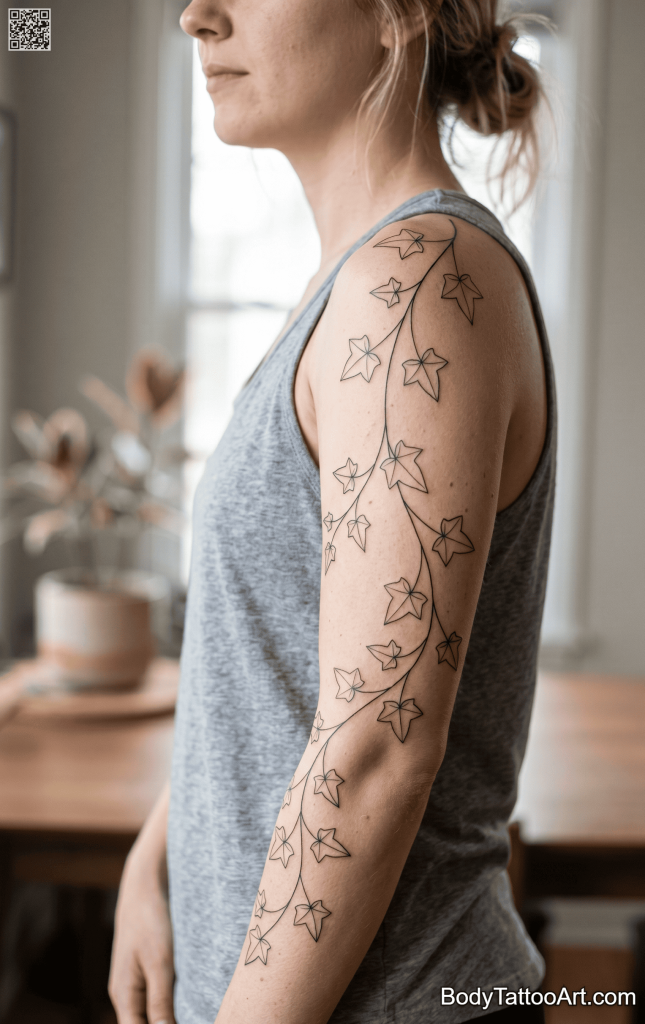
One clean ivy vine trails from the shoulder down the arm, with leaves spaced evenly along a single central stem. The leaves are simple and pointed, each one slightly different in size. No shading — just clean, unbroken outlines with thin linework.
Placement: Shoulder to mid-forearm
Style: Minimalist fine line Ivy Vine Tattoos
Why it stands out: The spacing between leaves keeps this from feeling crowded. The vine moves down the arm naturally, almost like it grew there.
Ideal for: First-timers, minimalist lovers, people who want something quiet but intentional.
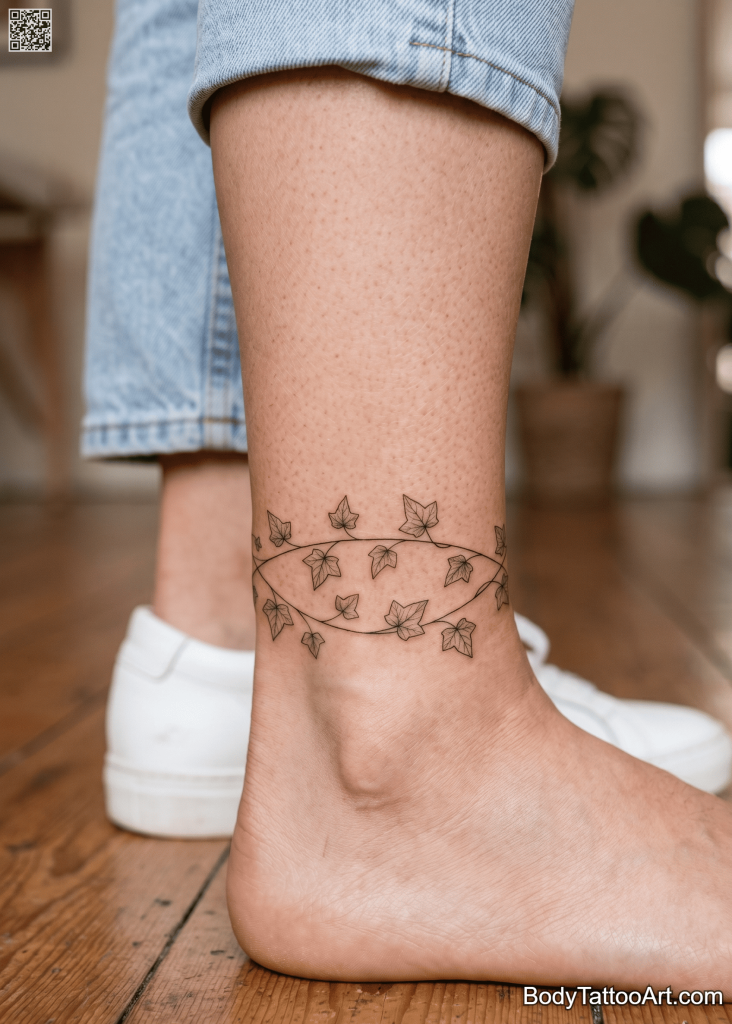
Ivy vine tattoos that wrap fully around the ankle look like natural jewellery. This one circles the ankle once, with small leaves pointing outward at irregular intervals. The vine is thin and the leaves have tiny veins drawn inside them with hair-fine lines.
Placement: Ankle
Style: Fine line with vein detailing Ivy Vine Tattoos
Why it stands out: The circular wraparound placement turns the ankle into a frame. The leaf veins add detail without adding heaviness.
Ideal for: People who want something dainty and wearable, minimalist fans.
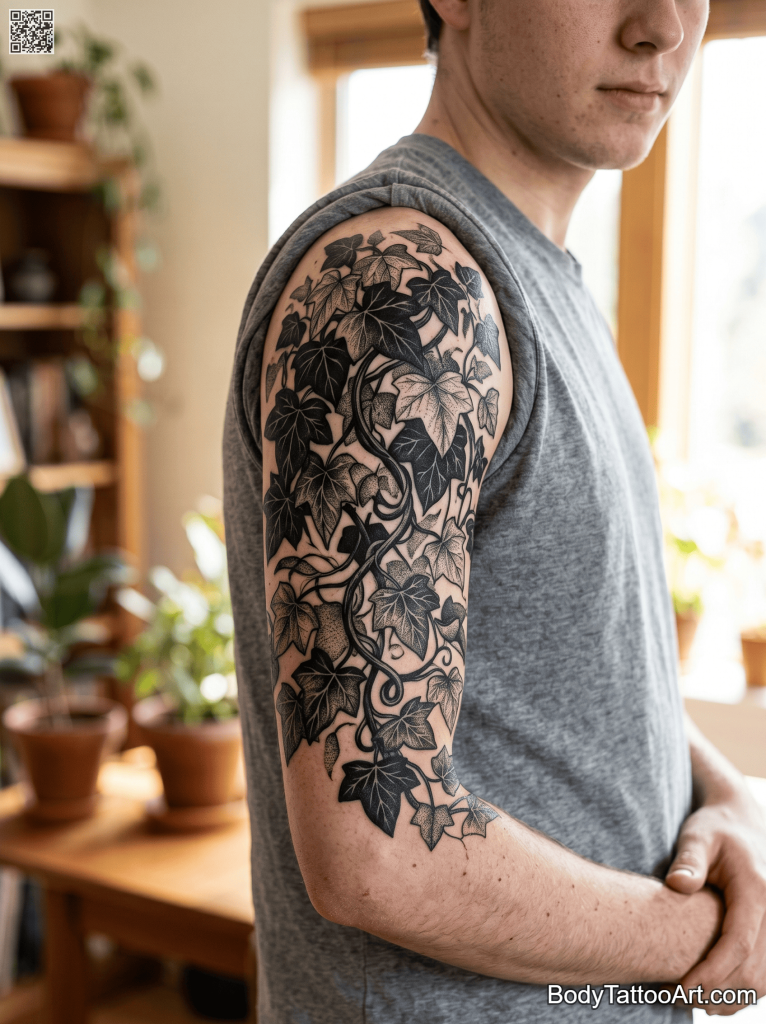
A thick section of ivy vine tattoos in blackwork fills the upper arm. Leaves overlap each other in dense layers, some fully black and others partially filled. The vine twists multiple times through the composition, creating a tangled, lush feel.
Placement: Upper arm
Style: Blackwork Ivy Vine Tattoos
Why it stands out: The overlapping leaves and dense ink coverage make this feel like a patch of real ivy pulled from a stone wall. Nothing is sparse or delicate here.
Ideal for: Bold tattoo fans, people building sleeves, those who like heavy ink coverage.
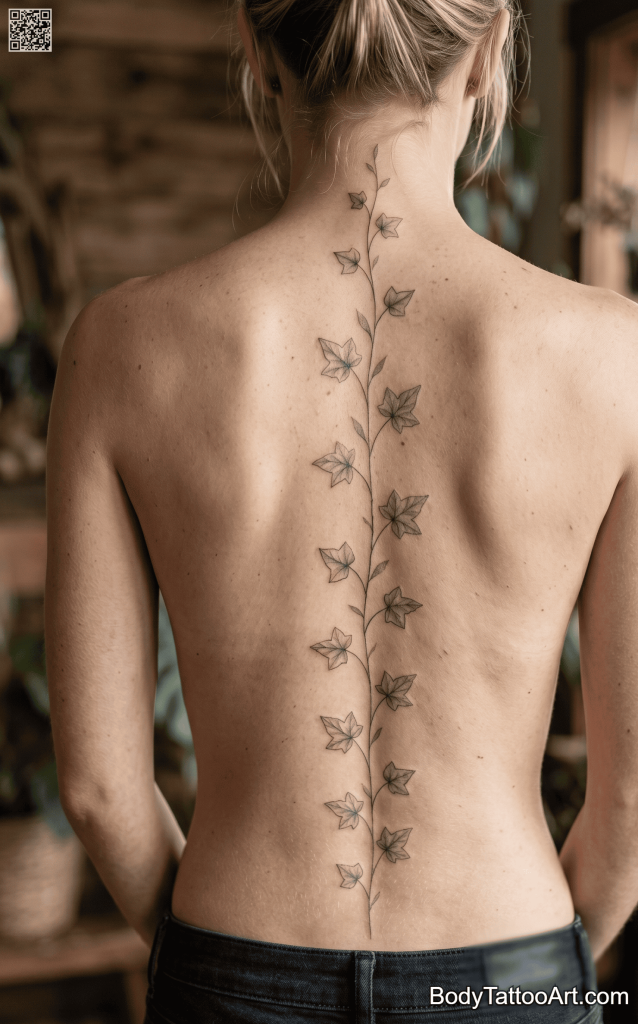
This ivy vine tattoo runs straight up the spine from the lower back to the base of the neck. The vine stays central and the leaves branch left and right alternately. The composition is narrow but long, designed specifically for the spine’s vertical line.
Placement: Full spine
Style: Fine line grey wash Ivy Vine Tattoos
Why it stands out: The alternating left-right leaf pattern creates a natural rhythm that feels made for the spine. It’s one of the cleanest uses of vertical placement in ivy vine tattoos.
Ideal for: People who want a back tattoo that feels elegant and elongated.
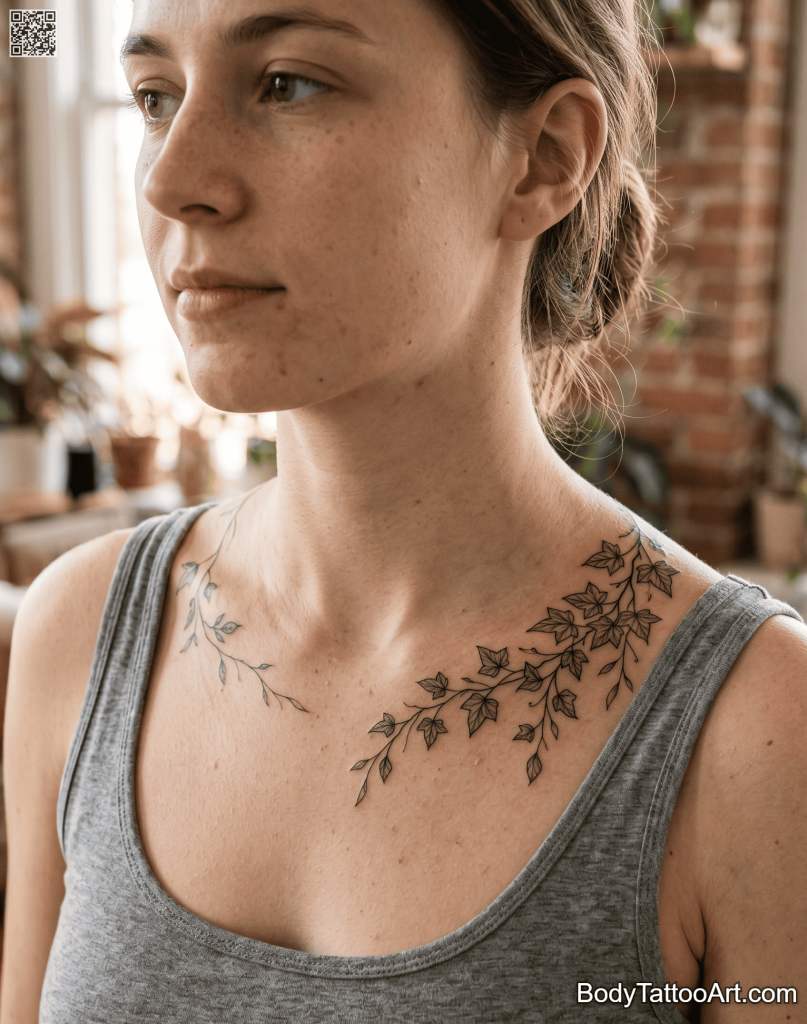
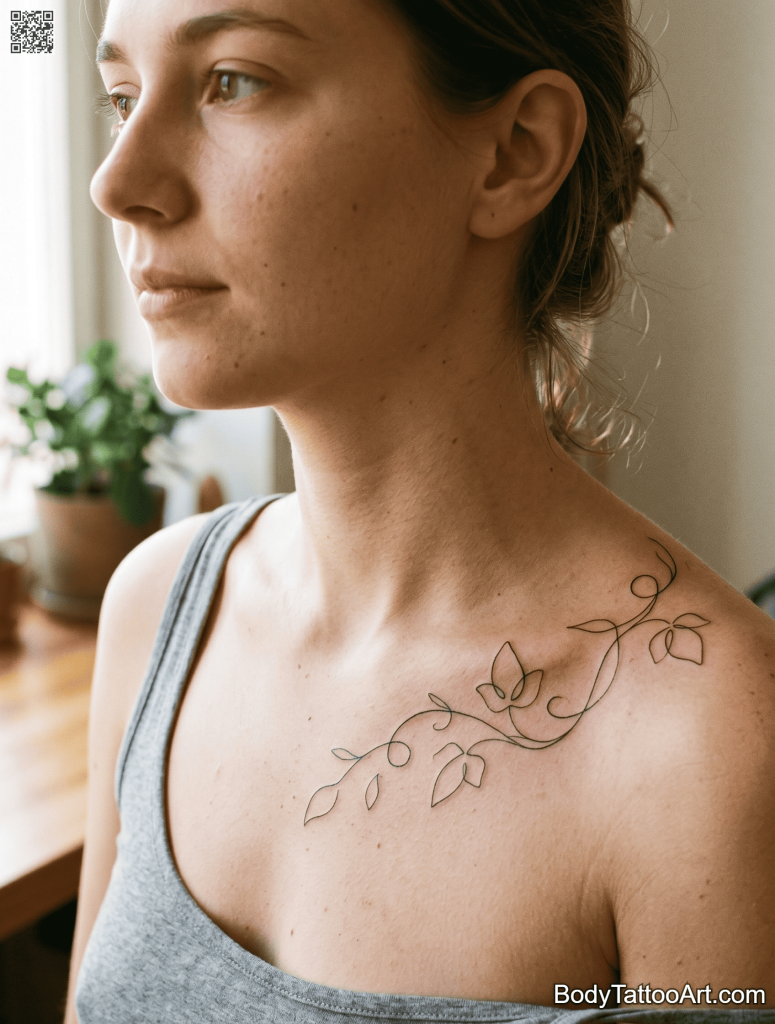
A delicate ivy vine drapes along the collarbone, following its natural curve. The vine sits just below the bone and the leaves hang downward slightly, as if pulled by gravity. It’s asymmetrical — heavier with leaves on one side and trailing into a bare stem on the other.
Placement: Collarbone
Style: Fine line Ivy Vine Tattoos
Why it stands out: The asymmetry feels deliberate and organic. Ivy vine tattoos along the collarbone always follow the shape of the bone, but this one plays with gravity rather than fighting it.
Ideal for: People who want a feminine, structural placement tattoo.
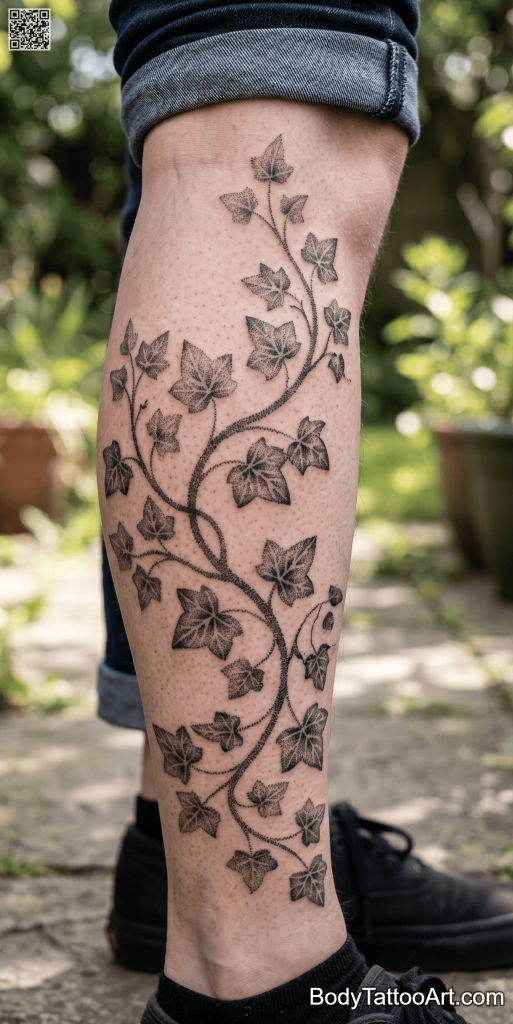
Every element of this ivy vine tattoo — the vine itself, the leaves, the shadows — is built from dots. No lines are used. The density of dots shifts to create depth, with heavy dotting in the leaf centers and lighter dotting at the edges.
Placement: Outer calf
Style: Dotwork Ivy Vine Tattoos
Why it stands out: Dotwork gives ivy vine tattoos a textured, almost hand-stamped quality. Up close, it’s all dots. From a distance, it reads as a fully formed vine.
Ideal for: Dotwork enthusiasts, people who appreciate meticulous detail.
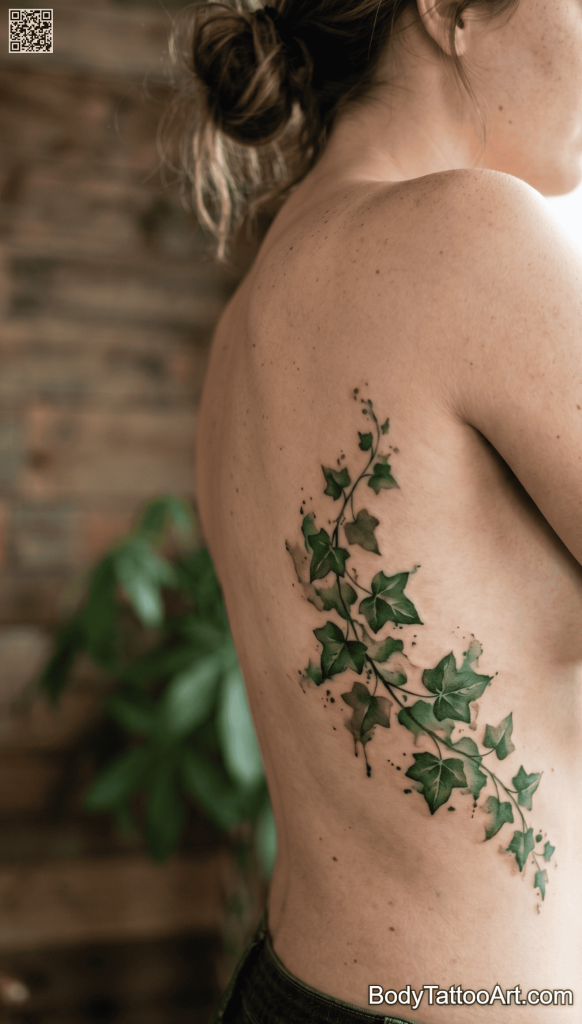
This ivy vine tattoo uses loose watercolor washes in deep green and olive tones. The vine shape is suggested by color rather than outlined. Leaves bleed at the edges into soft color splashes, and the background has faint colour bleed as well.
Placement: Ribcage
Style: Watercolor Ivy Vine Tattoos
Why it stands out: There are no hard edges anywhere. The whole piece looks like a watercolor painting placed directly onto skin — fluid and unrepeatable.
Ideal for: Art lovers, people who prefer painterly tattoos, color tattoo fans.
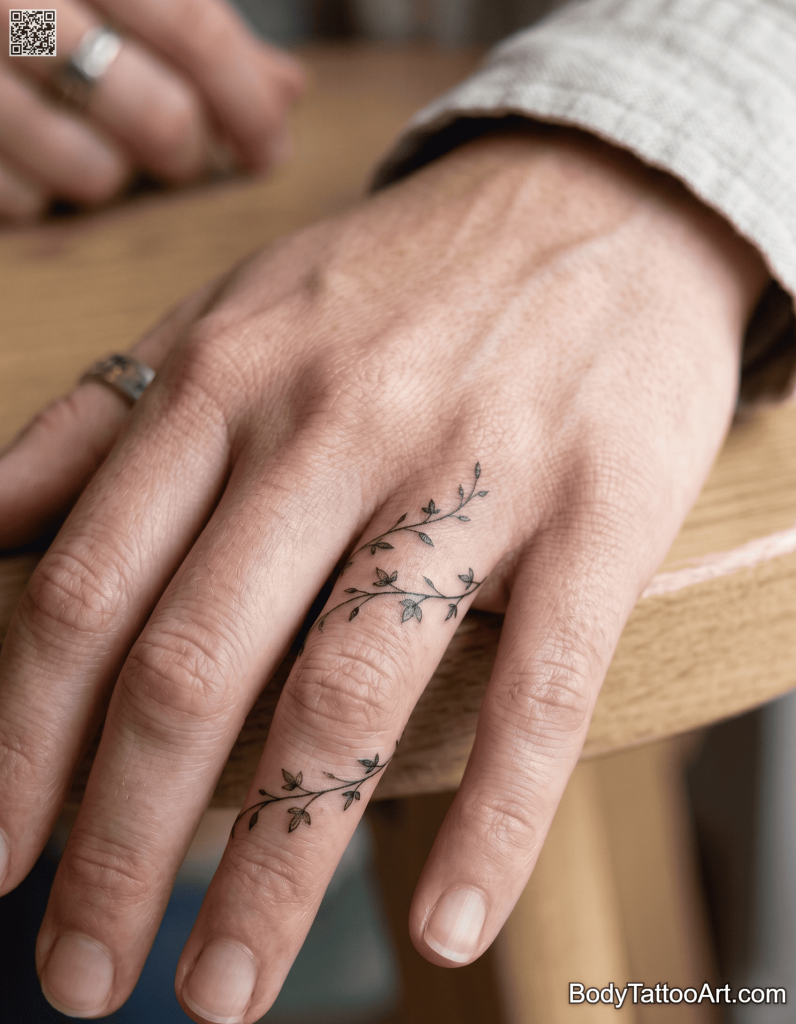
A tiny ivy vine tattoo winds around one finger from the base knuckle to the tip. The vine is a single thin line and the leaves are no bigger than a grain of rice. The whole thing fits in a compact spiral around the finger.
Placement: Ring finger
Style: Micro fine line Ivy Vine Tattoos
Why it stands out: Scale makes this one special. Everything about ivy vine tattoos usually involves length and spread — shrinking it down to finger size makes it feel unexpected and precious.
Ideal for: People who want something tiny and personal, minimalist fans, those curious about finger tattoos.
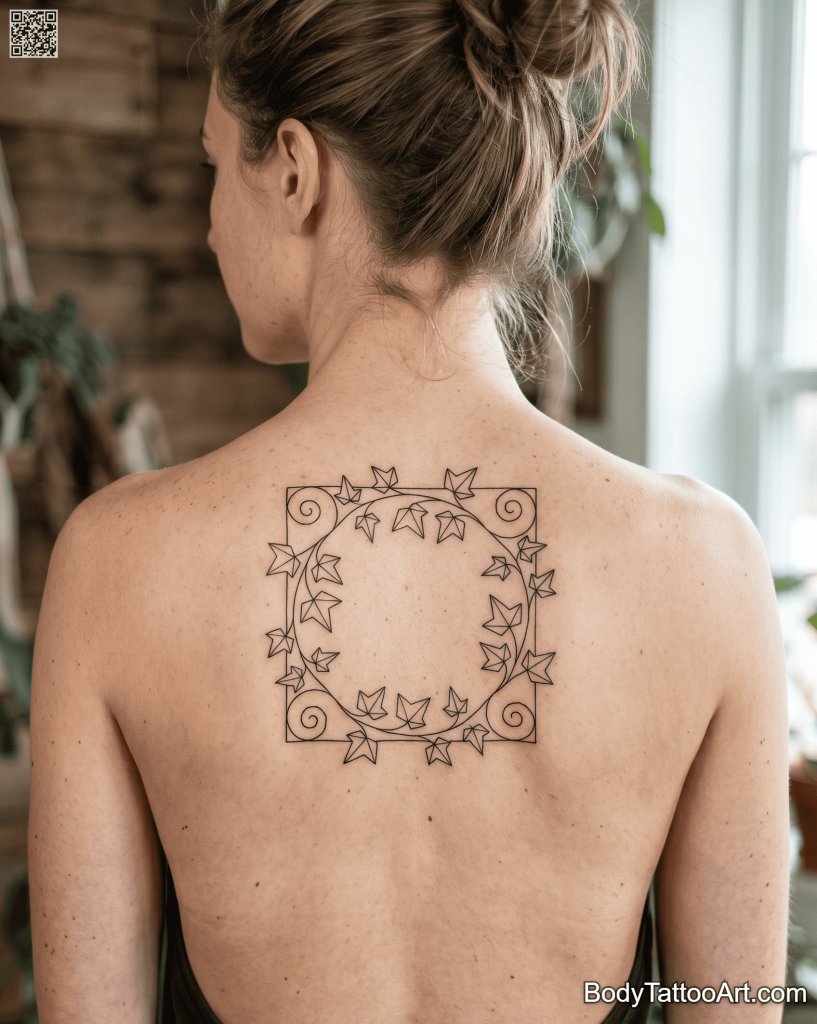
The ivy vine here follows the outline of a perfect square, curling at the corners and sending leaves inward. The center of the square is empty. The vine itself is made of thin clean lines and the leaves are simple and pointed.
Placement: Upper back
Style: Fine line geometric Ivy Vine Tattoos
Why it stands out: Pairing the organic movement of ivy with a rigid geometric frame creates an interesting visual contrast. Ivy vine tattoos rarely follow straight lines — this one does it by design.
Ideal for: People who like structured symmetrical tattoos, geometric tattoo fans.
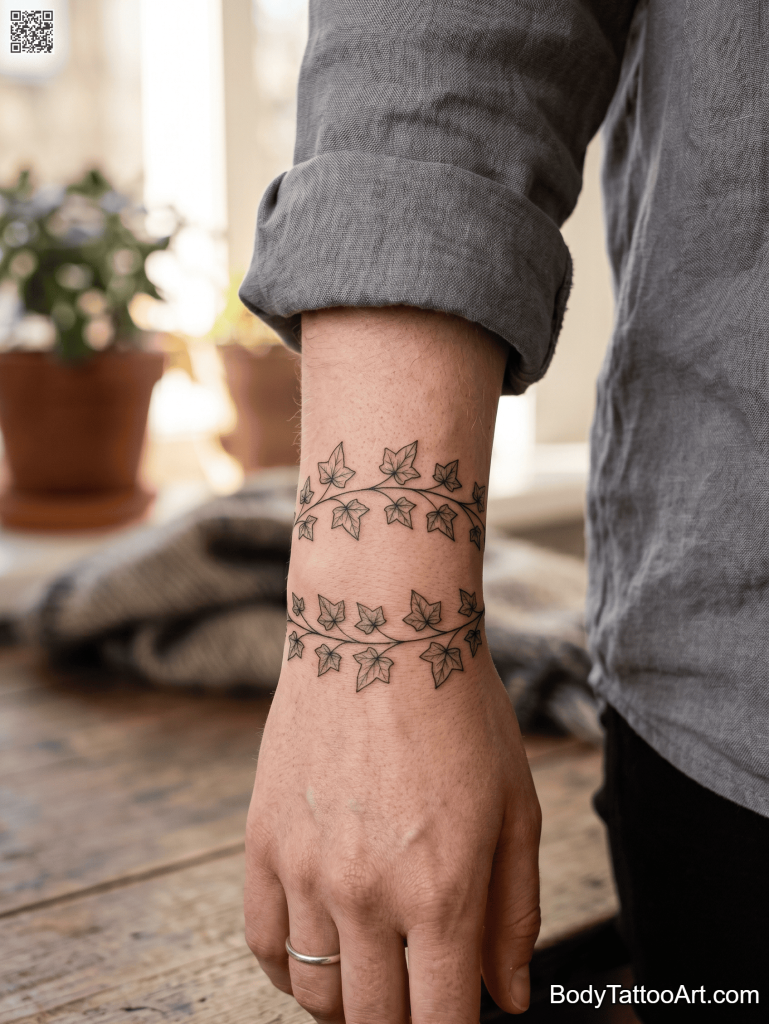
An ivy vine wraps horizontally around the forearm like a band, going all the way around. The band is made of a single vine with leaves that point upward on one side and downward on the other. It sits near the wrist and reads like a natural cuff.
Placement: Forearm / wrist area
Style: Fine line blackwork Ivy Vine Tattoos
Why it stands out: The cuff effect is clean and wearable. Ivy vine tattoos in band form have a timeless quality — this version keeps it tight and minimal.
Ideal for: People who want a bracelet-style tattoo, those new to ink.
Those who love plant-based tattoo designs might also enjoy exploring fern tattoos for something similarly delicate and trailing. Eucalyptus tattoos offer another leafy option with a softer, more elongated feel. And for a bolder botanical take, oak tree tattoos are worth a look.
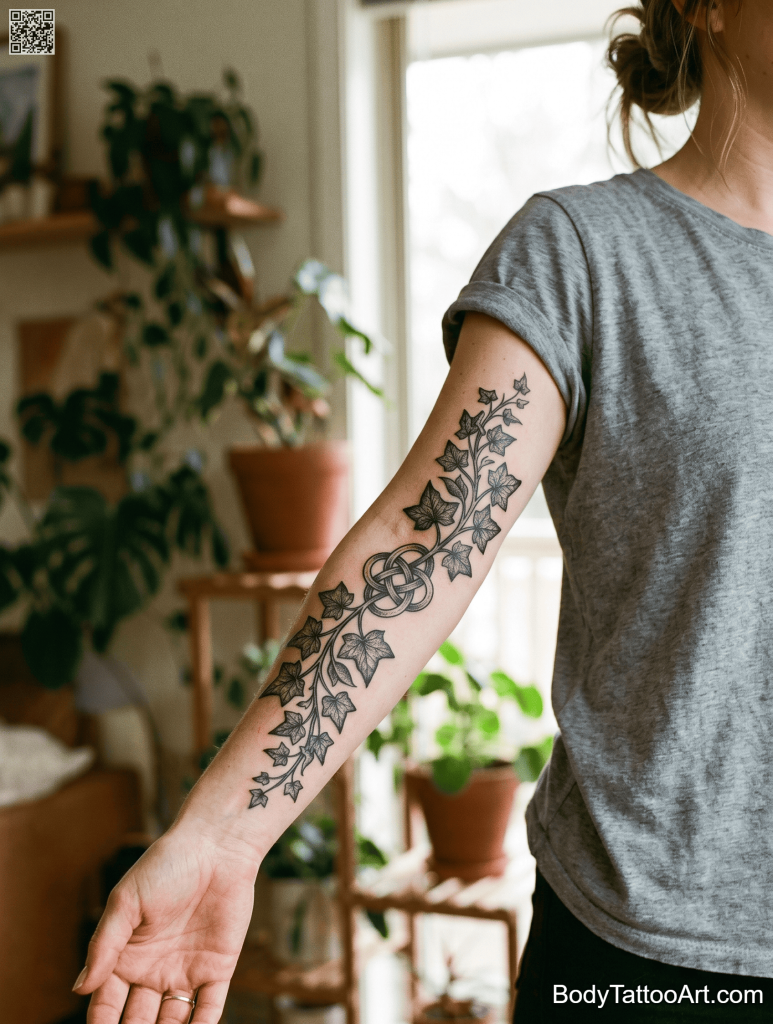
Instead of flowing freely, this ivy vine knots around itself in the center of the composition. The knot sits at the forearm and the vine trails upward and downward from it, with leaves growing along both directions.
Placement: Forearm center
Style: Illustrative blackwork Ivy Vine Tattoos
Why it stands out: The knot is the focal point — ivy vine tattoos almost never have a center of interest, but this one does. The vine wraps around itself before continuing, which gives the design structure.
Ideal for: People who want a vine tattoo with a visual anchor point.
This ivy vine tattoo is drawn in a loose, sketchy style — overlapping lines, rough leaf edges, and visible sketch marks. Nothing is clean or precise. The whole piece looks like it was drawn in a notebook with a felt-tip pen.
Placement: Inner bicep
Style: Sketch / illustrative Ivy Vine Tattoos
Why it stands out: The intentional roughness makes this feel personal and expressive. Ivy vine tattoos in sketch style look raw in a way that polished fine line work never does.
Ideal for: People who love raw, expressive aesthetics, creative and artistic types.

A long ivy vine tattoo falls from the hip down the outer thigh, following the leg’s natural curve. The vine starts with tightly grouped leaves near the hip and spreads out as it falls, with more space between leaves near the knee.
Placement: Hip to outer thigh
Style: Grey wash fine line Ivy Vine Tattoos
Why it stands out: The gradual spread of leaves from dense to sparse creates a natural cascade effect. The vine looks like it’s genuinely growing downward.
Ideal for: People who want a longer flowing piece, thigh tattoo enthusiasts.

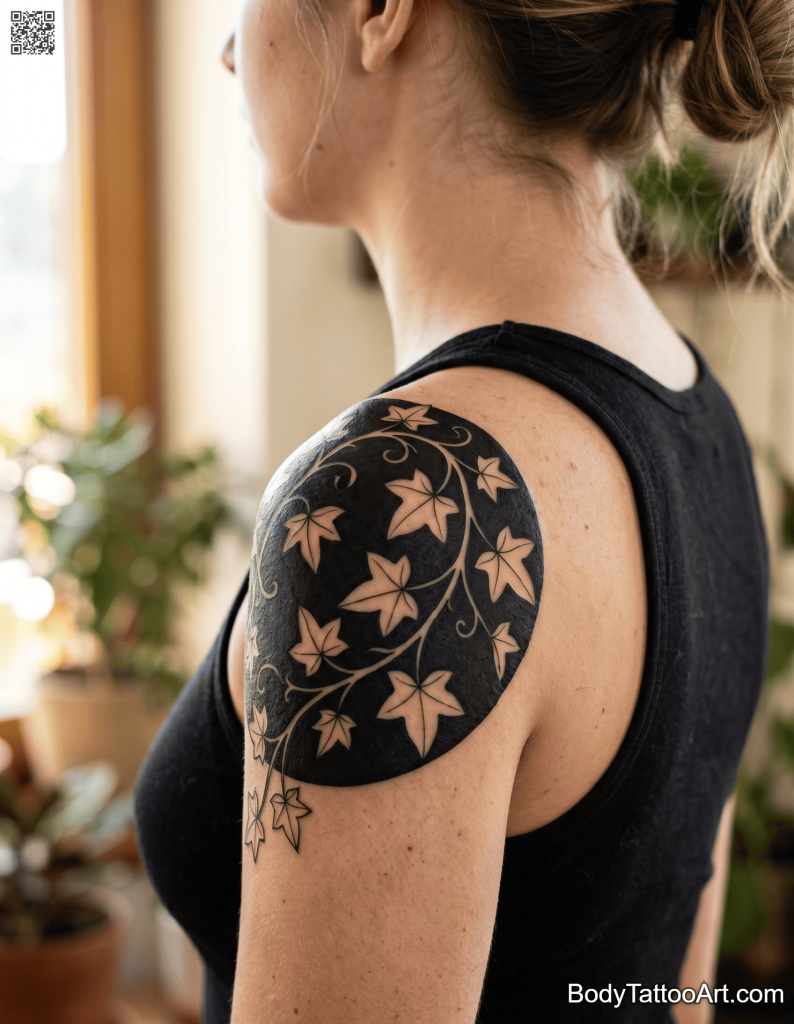
The background is filled with solid black ink and the ivy vine — stem and leaves — is left as bare skin. The vine appears light against the dark field. The leaves have perfect smooth edges within the black.
Placement: Shoulder cap
Style: Negative space blackwork Ivy Vine Tattoos
Why it stands out: Reversing the ink makes these ivy vine tattoos look like they’re cut out of the skin. It’s bold, graphic, and completely different from any traditional vine approach.
Ideal for: Bold tattoo lovers, people who want high contrast and modern aesthetics.
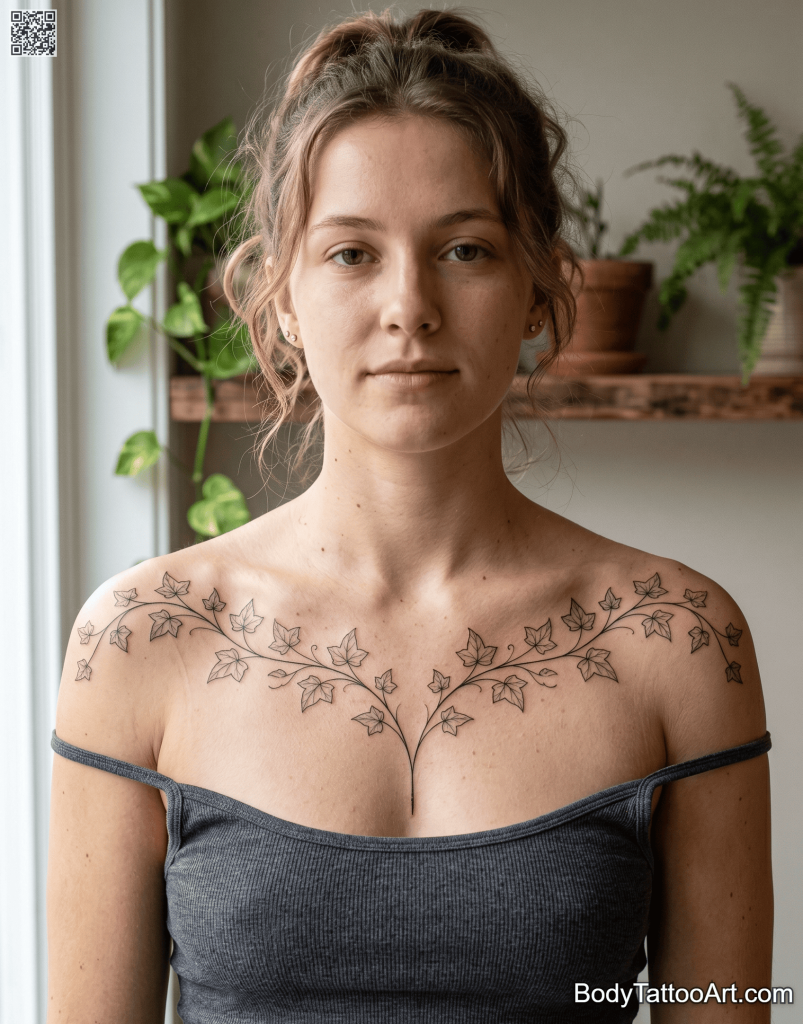
An ivy vine tattoo spreads across the upper chest, starting at the center sternum and branching toward both shoulders. The vine splits into two directions from one central stem, creating a symmetrical wingspan shape.
Placement: Upper chest
Style: Fine line Ivy Vine Tattoos
Why it stands out: The split from one central point gives the design a wingspan quality. Ivy vine tattoos rarely go symmetrical — this one uses symmetry to create a strong chest piece.
Ideal for: People who want a centrepiece chest tattoo, symmetry fans.
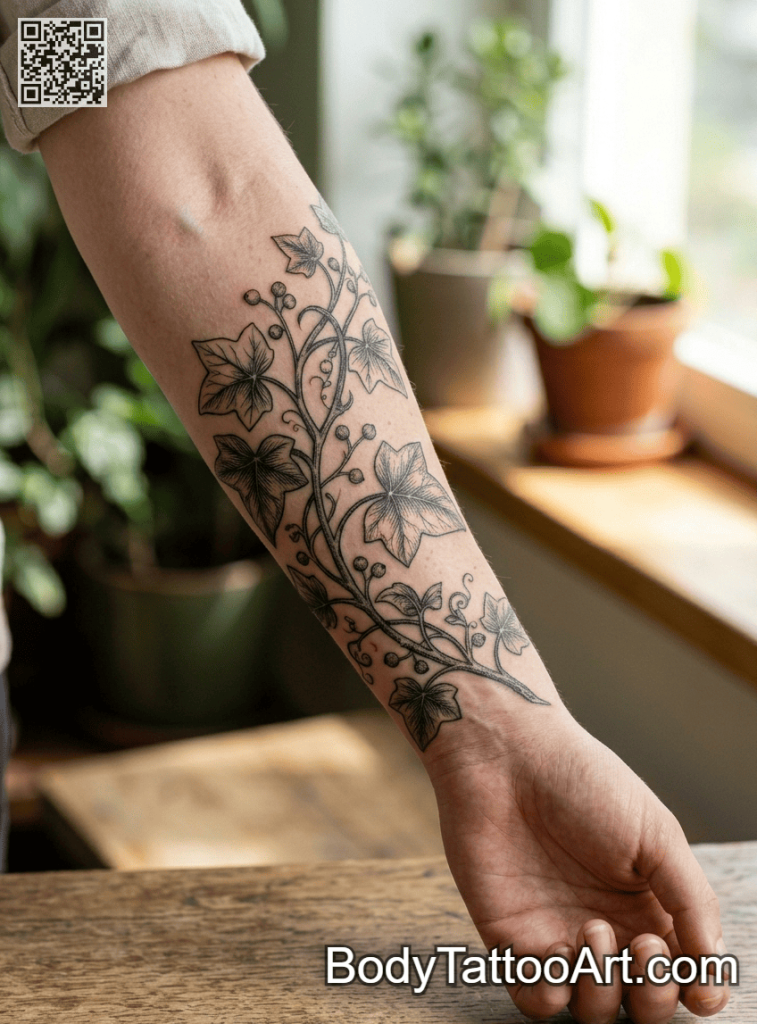
This ivy vine tattoo mimics the style of old botanical engravings — parallel lines build up into shadows, cross-hatching fills the underside of leaves, and the whole piece looks like an illustration from a 19th-century plant encyclopedia.
Placement: Inner forearm
Style: Engraving / etching Ivy Vine Tattoos
Why it stands out: The historical visual reference makes ivy vine tattoos feel scholarly and unusual. The detail level is high but never overwhelming.
Ideal for: History lovers, people who appreciate vintage aesthetics, collectors.
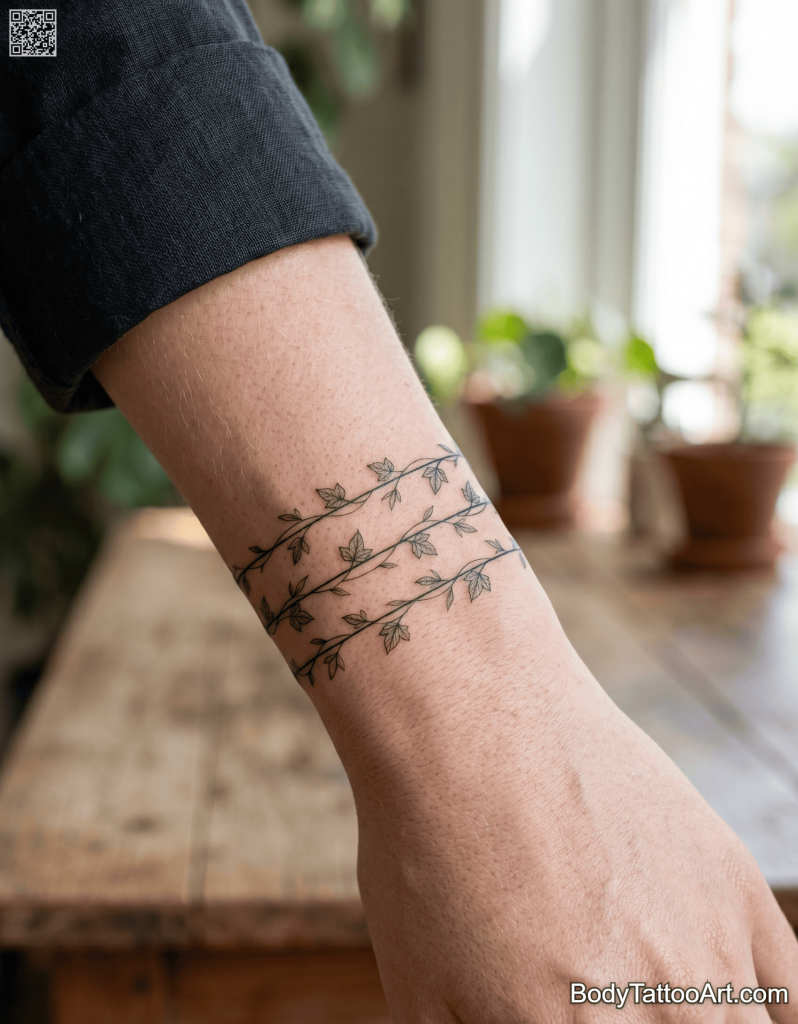
Fine ivy vine tattoos wrap precisely around the wrist three times in thin parallel layers. Each ring is a single vine with small leaves. The three rings sit close together, creating the impression of a delicate stacked bracelet.
Placement: Wrist
Style: Micro fine line Ivy Vine Tattoos
Why it stands out: The stacked ring effect is elegant and precise. Three separate vines at this scale require real restraint in the design — nothing overlaps, everything stays clean.
Ideal for: People who love jewellery-style tattoos, fine line enthusiasts.
Ivy vine tattoos completely cover this full arm sleeve. Vines twist and layer over each other from wrist to shoulder, with leaves filling every space. The shading alternates between deep black in the shadows and lighter grey where leaves catch light.
Placement: Full arm sleeve
Style: Blackwork with grey wash Ivy Vine Tattoos
Why it stands out: Total coverage turns the arm into a single large composition. The variation in leaf direction and shading keeps the eye moving from wrist to shoulder without any section feeling repetitive.
Ideal for: Sleeve collectors, people committed to large blackwork pieces.

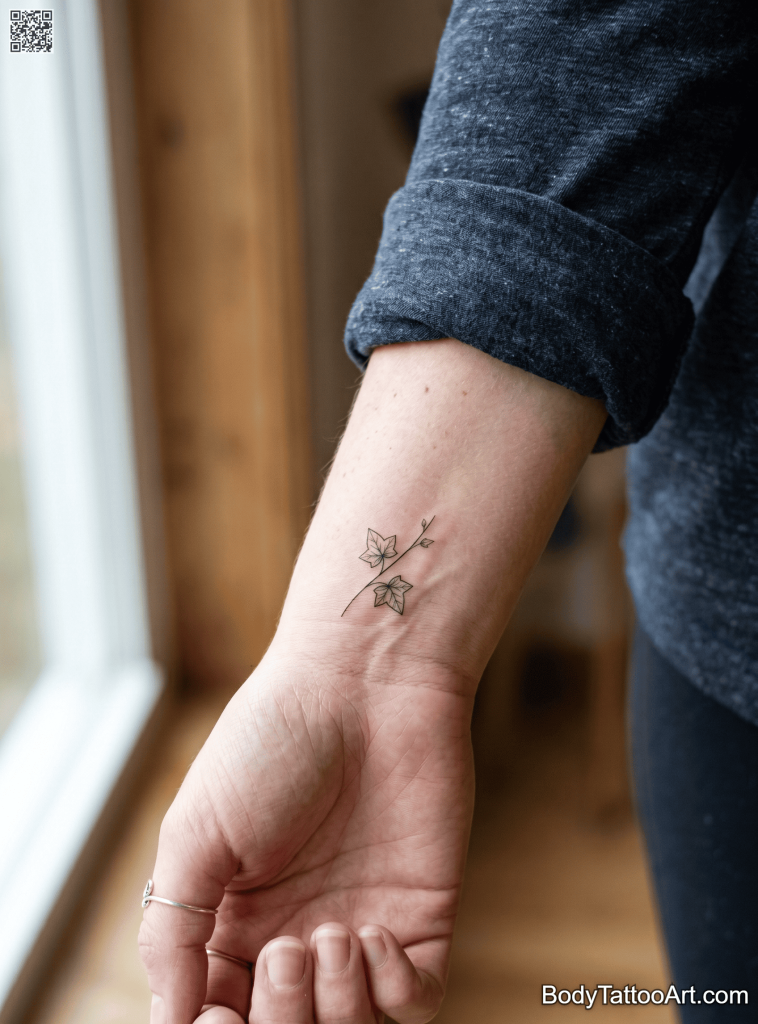
A tiny ivy vine trails diagonally across the wrist, just two or three small leaves on a short stem. The whole design is no longer than a thumbprint. The lines are barely visible up close, which makes the tiny detail feel like a secret.
Placement: Inner wrist
Style: Micro minimalist fine line Ivy Vine Tattoos
Why it stands out: Ivy vine tattoos at this scale feel like something personal and quiet. It’s not meant to be seen by everyone — just those close enough to look.
Ideal for: People who want the smallest possible tattoo, those wanting a first tattoo.
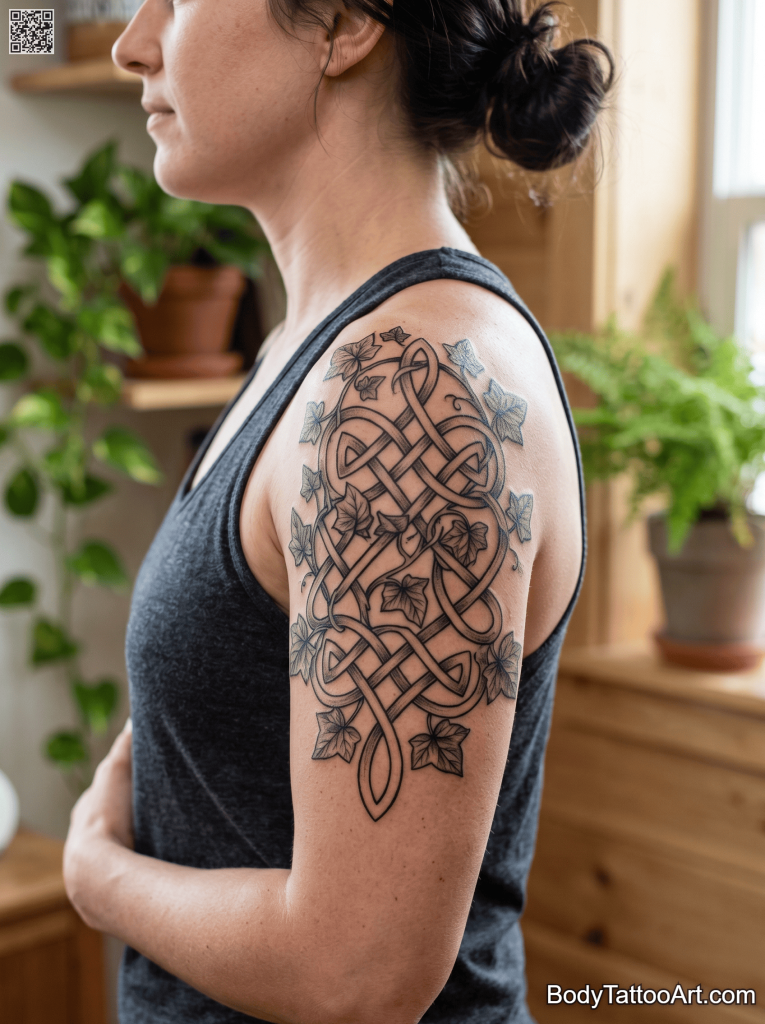
The vine in this design weaves in and out of itself in the style of Celtic knotwork — an unbroken interlaced line that loops and crosses while still reading as a vine. Leaves grow from the crossing points.
Placement: Upper arm
Style: Celtic blackwork Ivy Vine Tattoos
Why it stands out: The interlacing gives ivy vine tattoos a structural complexity that plain vine designs don’t have. The pattern is continuous — the eye can follow it all the way through without finding an end.
Ideal for: People with Celtic heritage or a love of interlaced pattern work.
Looking for more flowing nature-inspired designs? Bamboo tattoos carry a similarly vertical, growing energy. And anyone drawn to delicate trailing designs should check out lavender tattoos as well.
This design suggests ivy without literally drawing it. Curved abstract lines and teardrop shapes evoke the leaf and vine form without being realistic. The composition is loose and open, with plenty of negative space.
Placement: Collarbone / upper chest
Style: Abstract fine line Ivy Vine Tattoos
Why it stands out: Most ivy vine tattoos are representational. This one is not. The abstraction makes it personal — the viewer fills in the rest.
Ideal for: Abstract art lovers, people who want something unconventional.
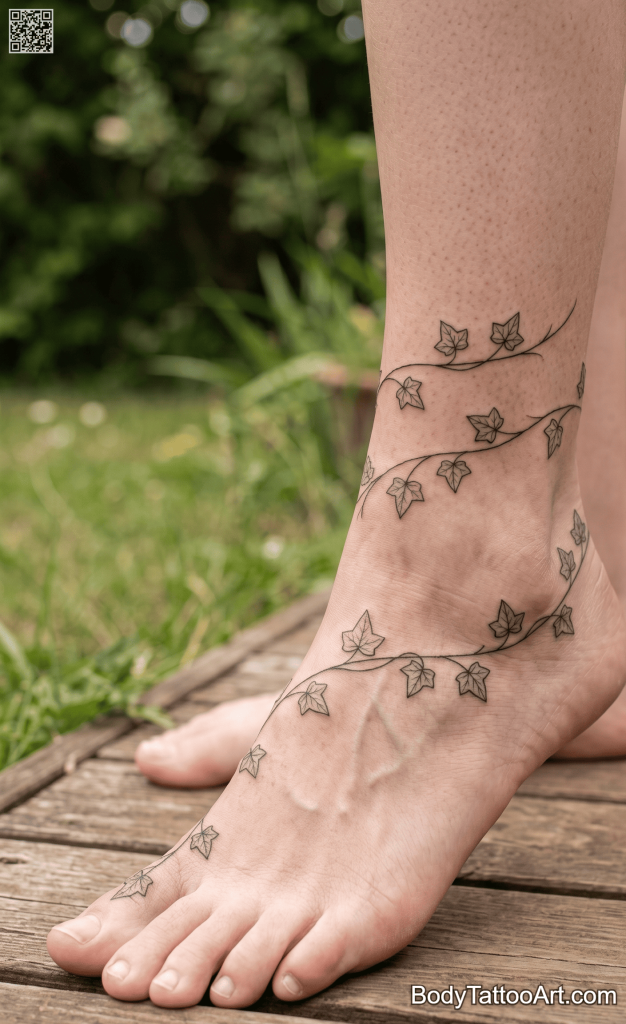
An ivy vine tattoo starts at the big toe, trails across the top of the foot, and winds around the ankle in one long continuous line. Leaves grow along the vine at natural intervals, some following the curve of the foot and others pointing upward.
Placement: Foot to ankle
Style: Fine line Ivy Vine Tattoos
Why it stands out: Foot and ankle tattoos are underrated for vines. The vine wrapping from toe to ankle covers a natural progression of curves — ivy vine tattoos built for this kind of flow.
Ideal for: People who want something flowing and nature-inspired on the foot.
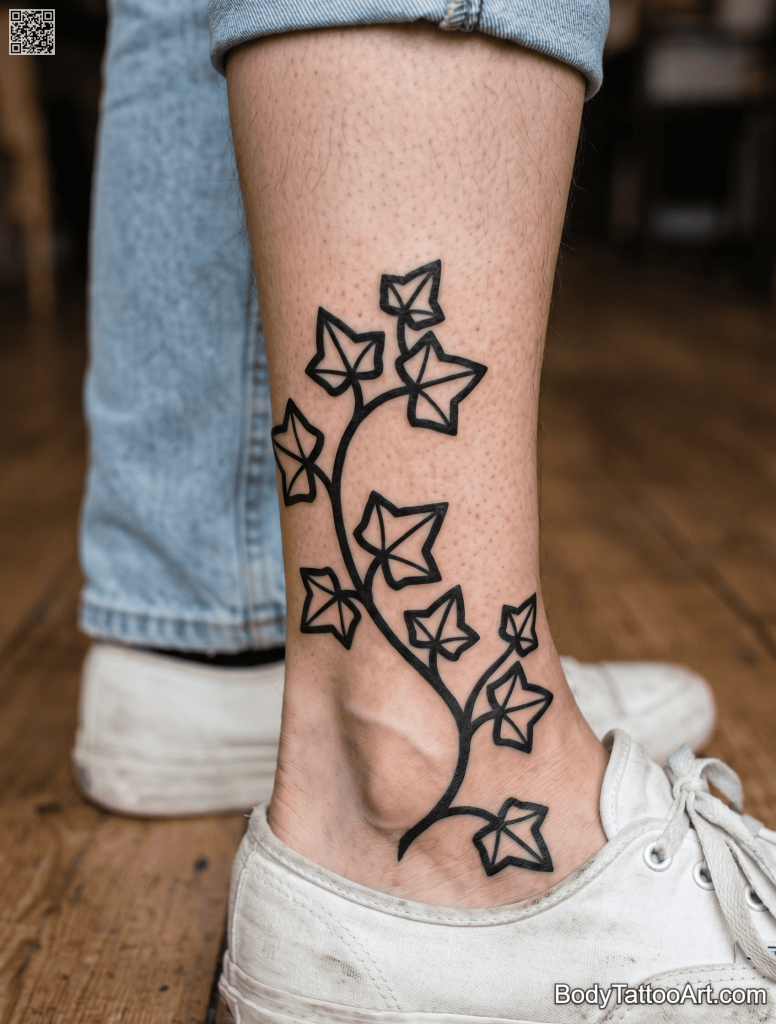
Bold flat shapes and zero shading — this ivy vine tattoo is made entirely of solid black geometric leaf outlines and a thick vine line. Nothing tapers, nothing fades. The leaves are identical in shape, spaced in a repeating pattern.
Placement: Outer ankle
Style: Bold graphic / flat design Ivy Vine Tattoos
Why it stands out: Repetition and flatness make this feel modern and design-led. It looks almost like a pattern from a fabric print — clean and intentional.
Ideal for: People who prefer graphic design aesthetics, those who like pattern-based tattoos.
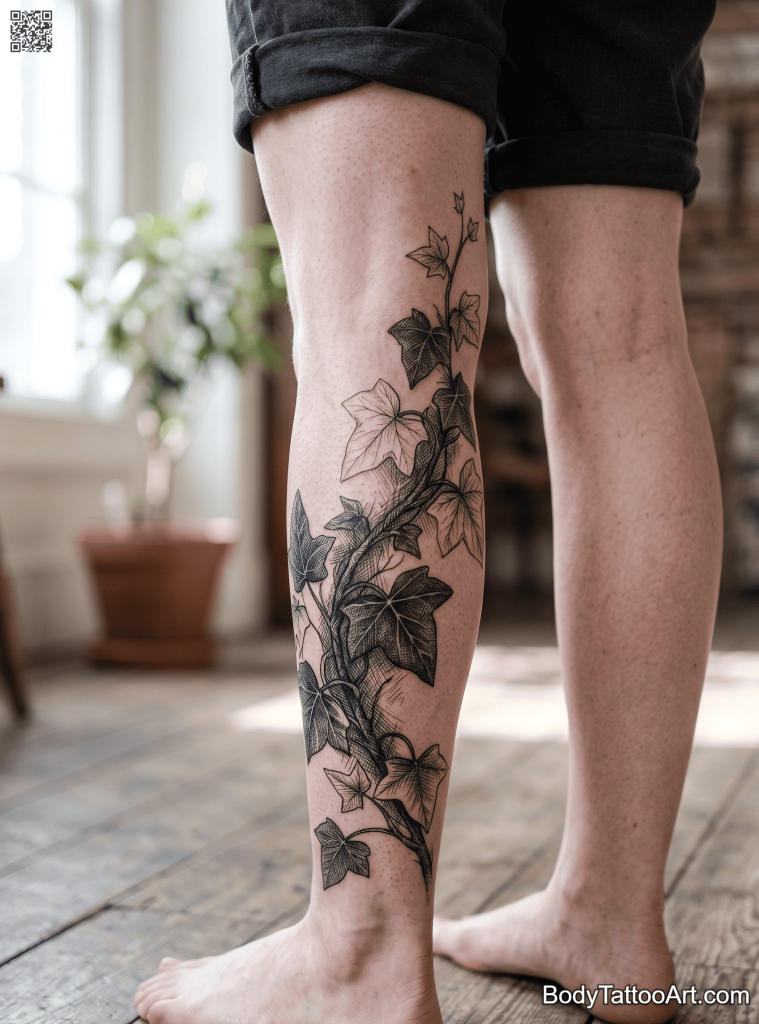
Every shadow and tonal shift in this ivy vine tattoo is created with crosshatching. The undersides of leaves are dense with diagonal lines, the vine is built up with parallel marks, and the lightest areas are left almost bare.
Placement: Inner calf
Style: Crosshatch / pen and ink Ivy Vine Tattoos
Why it stands out: Crosshatch creates a completely different surface quality than shading or dotwork. These ivy vine tattoos look like they came from a technical drawing — precise but with warmth.
Ideal for: People who appreciate detailed technical tattoo work.
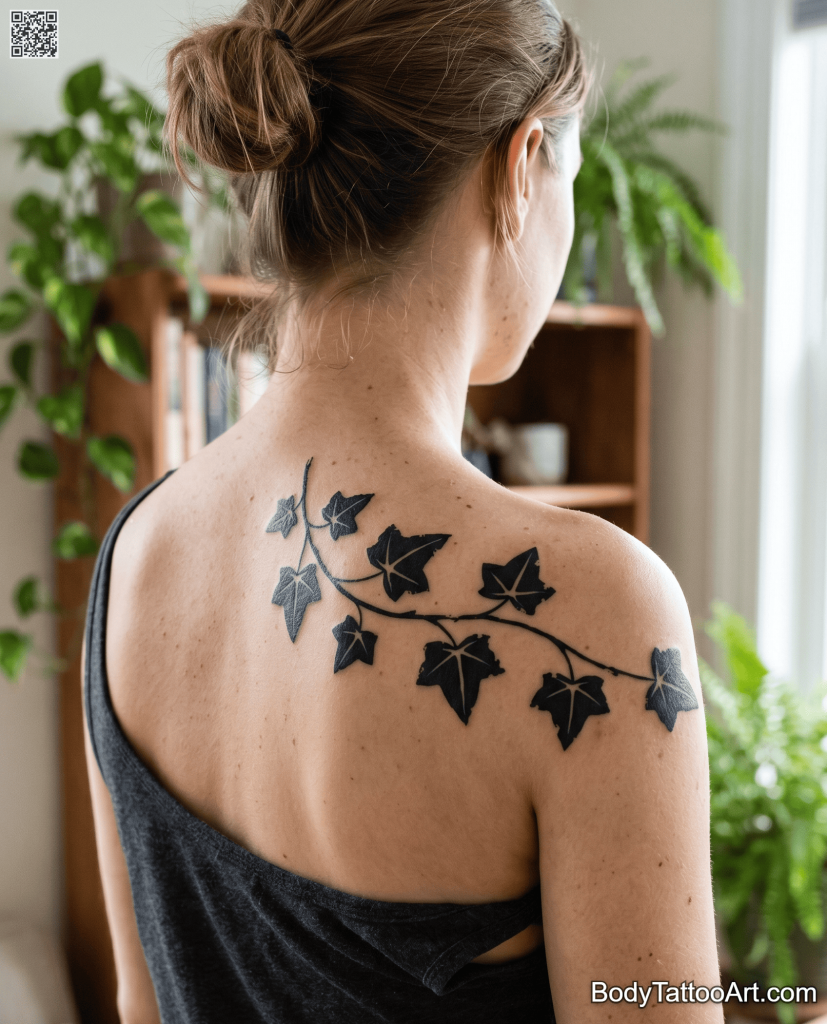
This design looks like an old stencil — ivy leaves are cut-out shapes filled with solid ink, edges slightly rough and imperfect as if painted through a stencil. The vine connecting them is a single flat line.
Placement: Upper back shoulder area
Style: Stencil / graphic blackwork Ivy Vine Tattoos
Why it stands out: The rough edges and cut-out quality give ivy vine tattoos a totally different character. It’s raw and handmade-looking in a deliberate way.
Ideal for: People who love graphic art aesthetics, those drawn to bold but simple designs.
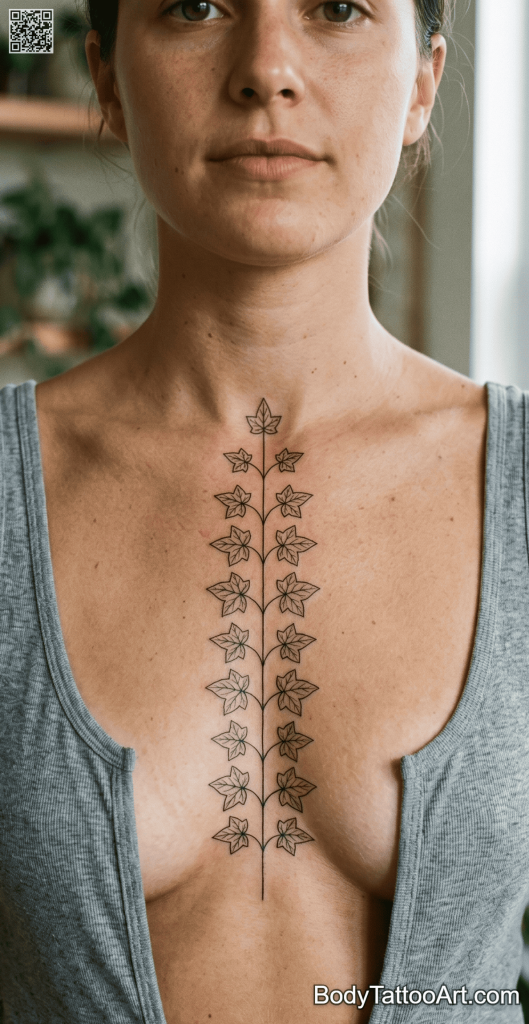
A single ivy vine tattoo drops straight down from the base of the throat to the sternum. Leaves grow horizontally left and right from the central stem, creating a clean symmetrical ladder-like composition.
Placement: Sternum
Style: Fine line Ivy Vine Tattoos
Why it stands out: The ladder-like horizontal leaf pattern gives ivy vine tattoos a very different structure from the usual trailing composition. The symmetry is clean without being rigid.
Ideal for: People who want a sternum tattoo that feels elegant and geometric.
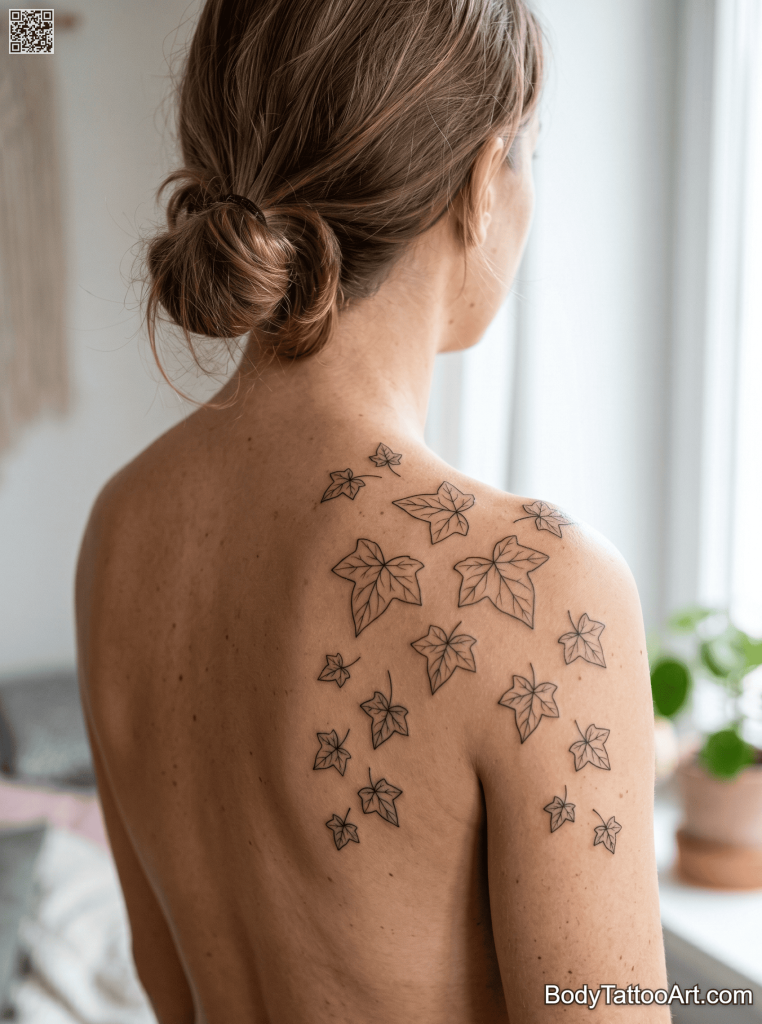
Instead of a continuous vine, this design scatters individual ivy leaves across a section of skin — no vine connecting them. The leaves are in different sizes and angles, placed as if they fell and landed randomly.
Placement: Shoulder blade area
Style: Minimalist fine line Ivy Vine Tattoos
Why it stands out: Disconnecting the leaves from the vine turns the composition on its head. These ivy vine tattoos are made of presence and absence — some leaves are whole, some are just outlines.
Ideal for: People who want something non-traditional, those who love subtle compositions.
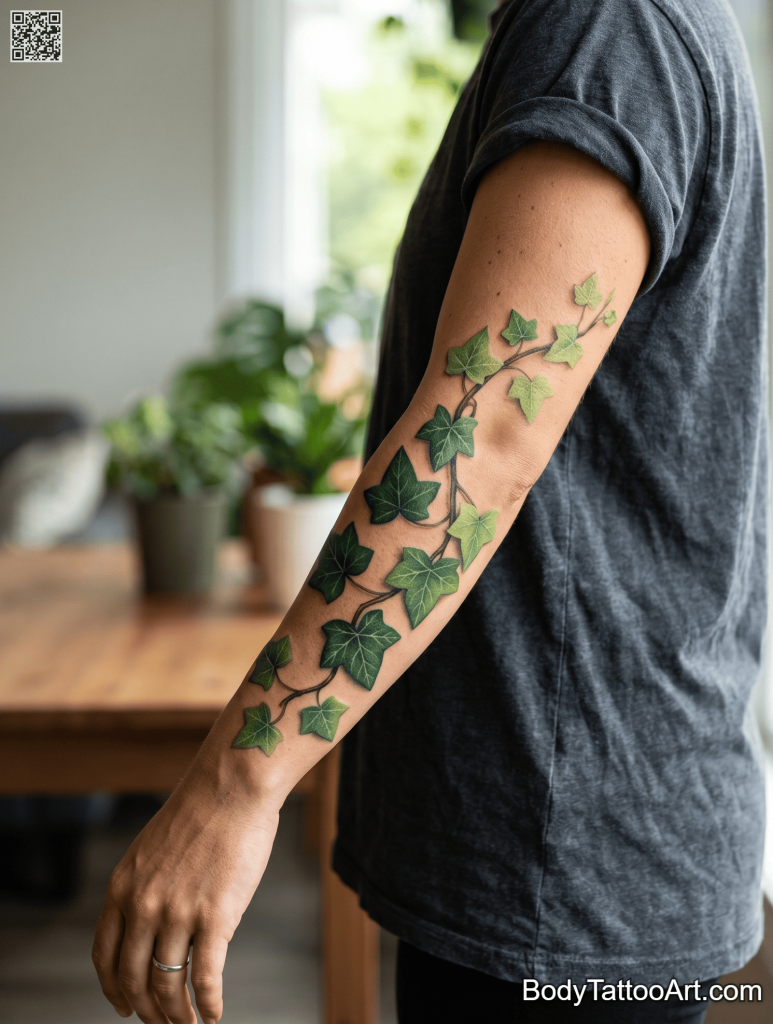
This ivy vine tattoo moves through a colour gradient from deep forest green at the base to pale lime green at the tips of the leaves. The vine itself stays dark throughout, and the leaves shift colour from dark at the base to almost yellow-green at the edges.
Placement: Forearm
Style: Color realism Ivy Vine Tattoos
Why it stands out: The colour gradient mimics the way real ivy leaves actually look — darker and older at the base, newer and lighter at the growing tips. It’s a naturalistic colour choice that rewards attention.
Ideal for: Color tattoo fans, people who want plant tattoos that look botanically real.
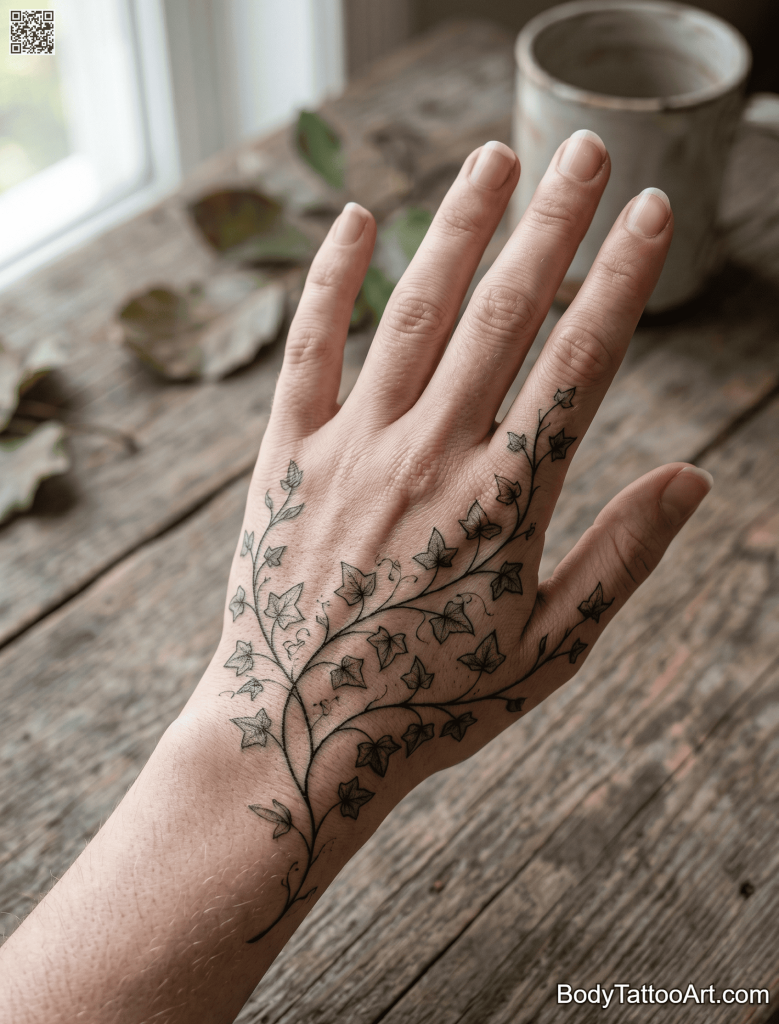
An ivy vine tattoo crawls across the back of the hand from the wrist to the knuckles. The vine splits into two near the wrist — one branch goes toward the index finger side, one toward the pinky side — and leaves fill the space in between.
Placement: Back of hand
Style: Fine line blackwork Ivy Vine Tattoos
Why it stands out: Hand tattoos demand designs that work with the hand’s movement. The split vine follows the natural spread of the hand, so the tattoo shifts and breathes with every gesture.
Ideal for: Experienced tattoo collectors, people who want visible tattoos with a natural feel.
Ivy vine tattoos prove that one plant can look completely different in the hands of twenty-nine different design approaches. Fine line, blackwork, watercolor, negative space, Celtic knotwork, micro realism — each style unlocks a new version of the same subject.
What makes ivy vine tattoos consistently appealing is how well the vine shape works with the body. It trails, wraps, climbs, and spreads in ways that feel natural on skin. Whether it’s a tiny finger wrap or a full blackwork sleeve, the ivy vine never really fights the body — it moves with it.
Anyone building their next tattoo idea should consider not just the subject but the style and placement together. Ivy vine tattoos reward that kind of thinking more than most.