Physical Address
304 North Cardinal St.
Dorchester Center, MA 02124
Physical Address
304 North Cardinal St.
Dorchester Center, MA 02124

There is something about a phoenix tattoo that never gets old. The image of a massive bird rising through smoke and flame has been a go-to tattoo subject for decades — and for good reason. Phoenix tattoos work across almost every style: fine line, blackwork, watercolor, geometric, dotwork. They can be minimal and delicate or bold and dramatic. Whether the tattoo covers an entire back or sits quietly on a wrist, phoenix tattoos hold visual weight that few other designs can match.
This list covers 25 phoenix tattoos that are genuinely different from each other — in style, composition, and placement. No repeated ideas, no filler. Just 25 distinct ways to wear this iconic bird.
The phoenix is one of the oldest mythological birds across world cultures. In ancient Greek mythology, the phoenix was said to live for hundreds of years before bursting into flame and rising again from its own ashes. Similar versions of the story appear in Egyptian, Chinese, and Persian mythology.
Phoenix tattoos are often chosen by people who have lived through something difficult and come out the other side. The image carries ideas of transformation, resilience, and renewal — but at their core, phoenix tattoos are simply one of the most visually striking designs in tattoo history.
For a deeper dive into the mythology, the Wikipedia page on the phoenix covers the symbolism across different world cultures in solid detail.
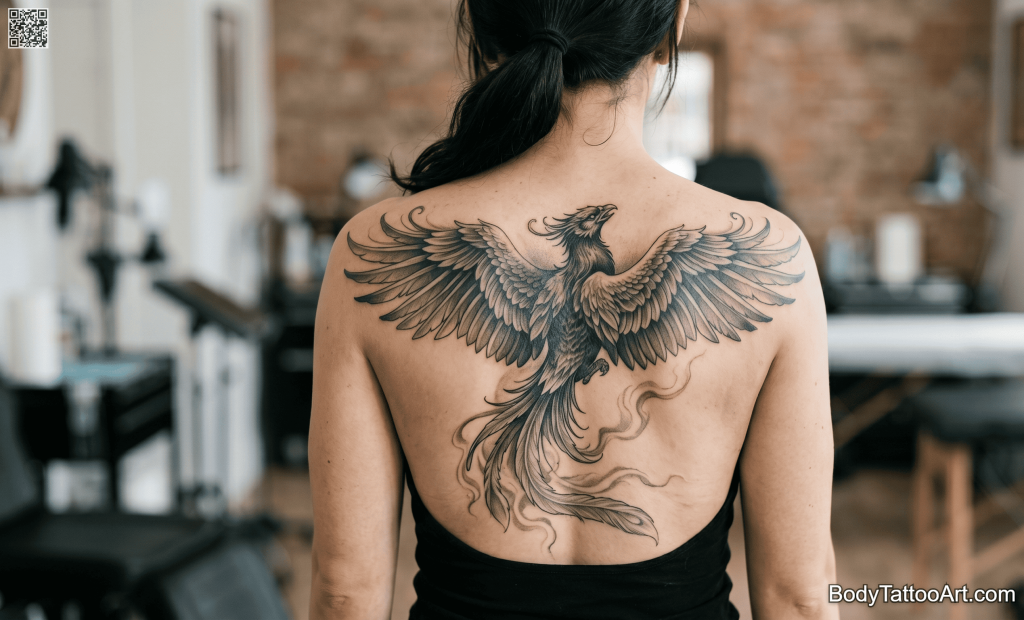
A wide-winged phoenix captured mid-flight, rendered entirely in ash-grey and black ink. The wings arc upward with the primary feathers spread and slightly curled at the tips. Smoke wisps trail from the lower body without any flames — keeping the mood cold and eerie rather than fiery. The contrast between the dark body and lighter feather edges gives the bird real dimension.
Placement: Upper back
Style: Grey-wash realism Phoenix Tattoos
Why it stands out: Most phoenix tattoos lead with fire. This one strips that away entirely and lets the bird itself carry the drama. The smoke without flame creates a quiet, haunting version of the design.
Ideal for: People who prefer dark, moody aesthetics and collectors looking for large back pieces.
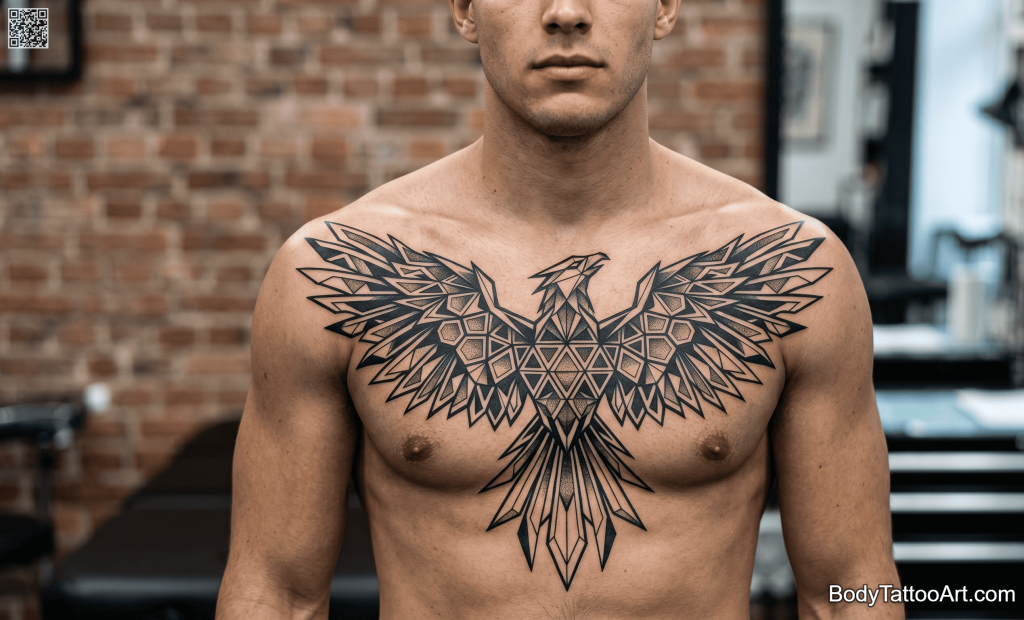
The body of this phoenix is built entirely from sharp geometric shapes — triangles, hexagons, and angular lines that form the wings, tail, and beak without using any curved strokes. The result looks like a bird assembled from broken glass. Negative space inside the shapes keeps the design from feeling too heavy.
Placement: Chest
Style: Geometric blackwork Phoenix Tattoos
Why it stands out: Geometric phoenix tattoos are less common than flowing, feathered versions. The sharp angles make the bird feel architectural and modern rather than mythological.
Ideal for: Minimalist fans, people drawn to structured, graphic tattoo art.
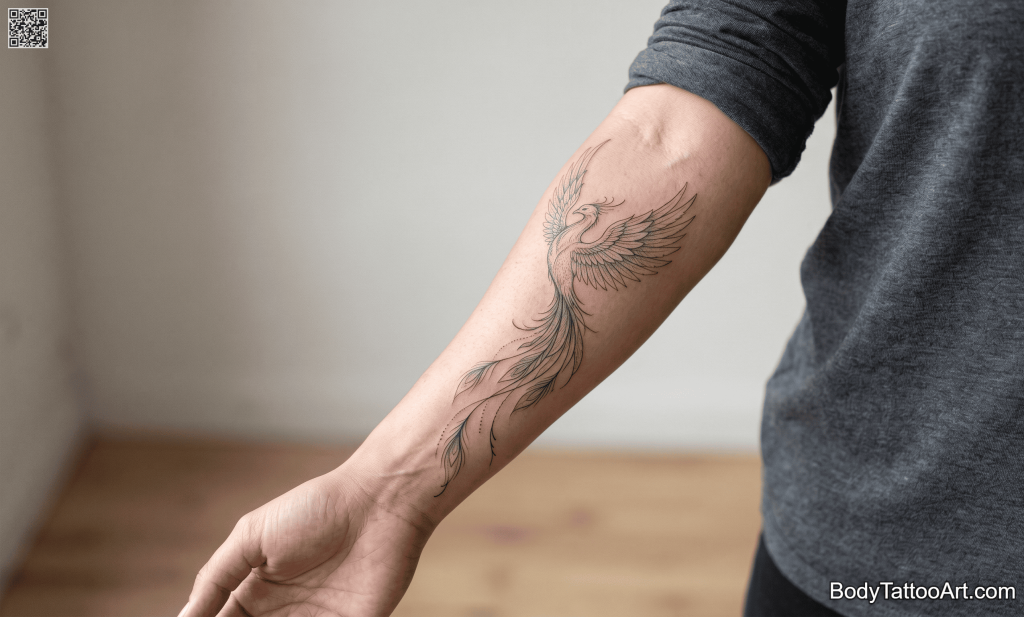
A single-needle fine line phoenix runs vertically along the inner forearm. The feathers are drawn with hair-thin strokes layered to suggest texture without heavy shading. The tail tapers to a pointed end near the wrist. The whole piece has an almost illustrative, hand-drawn quality — delicate but detailed.
Placement: Inner forearm
Style: Fine line Phoenix Tattoos
Why it stands out: Fine line phoenix tattoos work particularly well when the design follows the natural shape of the arm. The vertical orientation creates a clean, elongated silhouette that feels intentional.
Ideal for: First-timers, people who prefer subtle tattoos, minimalist collectors.
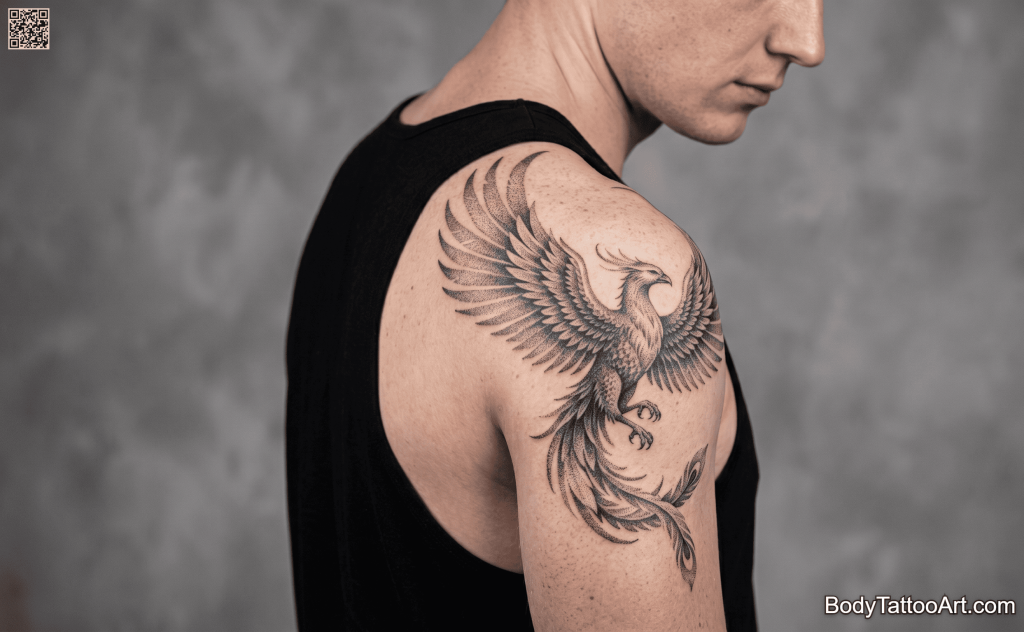
This phoenix is built entirely from dots — thousands of tiny stippled points that form the wings and body through density variation. Darker areas have tightly packed dots; lighter areas thin out to bare skin. The result is a textured, almost engraved look. The bird’s wings curve over the shoulder cap in a natural arc.
Placement: Shoulder
Style: Dotwork Phoenix Tattoos
Why it stands out: Dotwork shading gives phoenix tattoos a completely different texture than traditional line shading. Up close the tattoo looks abstract; from a distance the bird snaps into focus.
Ideal for: People who appreciate detailed craft work and collectors interested in stippling techniques.
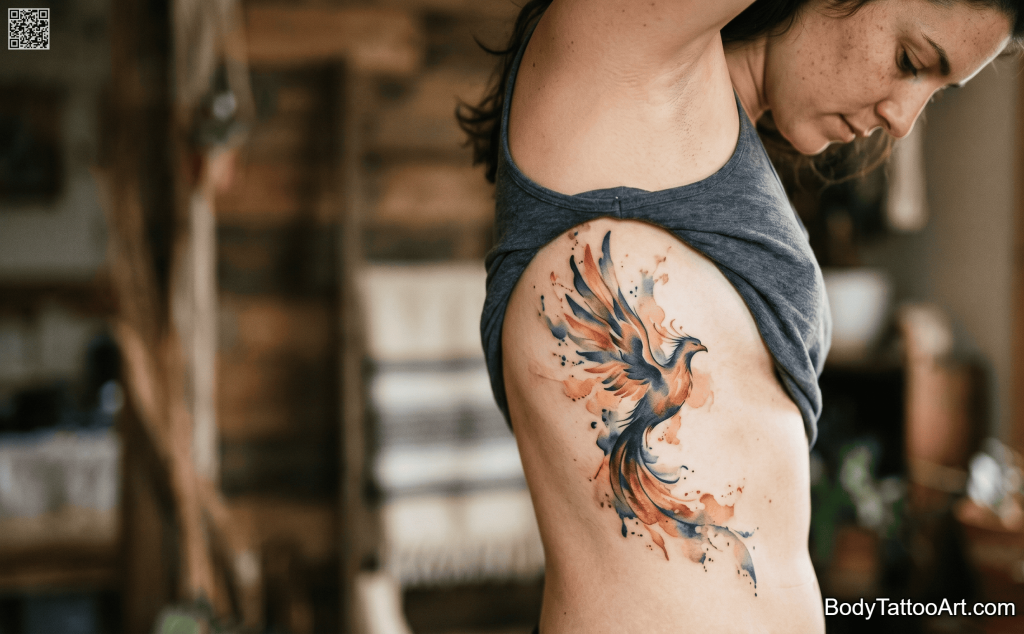
A loose, fluid phoenix bursts across the ribcage in washes of deep indigo, burnt orange, and soft gold. The bird’s outline is almost entirely absent — the shape is defined by the way the color bleeds and pools. Feather edges dissolve into raw watercolor splashes rather than hard lines.
Placement: Ribcage / side
Style: Watercolor Phoenix Tattoos
Why it stands out: Phoenix tattoos in watercolor style feel spontaneous and painterly. Skipping the black outline entirely keeps the design looking like it was actually painted onto the skin.
Ideal for: Art lovers, people who want color without the heaviness of traditional ink.
Looking for more bird-inspired ink ideas? Eagle tattoos carry their own strong symbolism and work well in many of the same styles as phoenix tattoos. If fire and intensity are the goal, dragon tattoo designs are worth exploring alongside phoenix concepts.
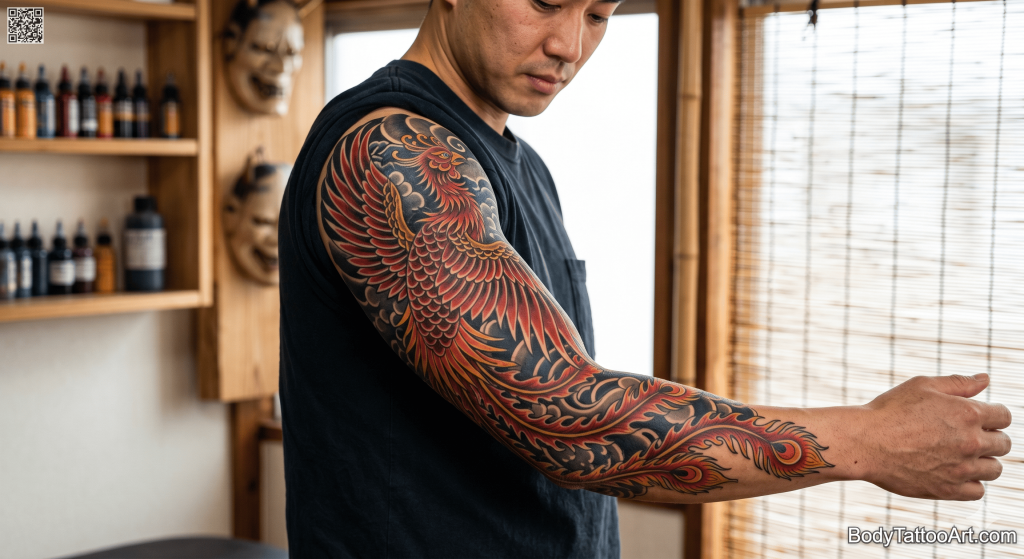
A traditional Japanese phoenix — called a Houou — fills the upper arm in bold red, orange, and black. The feathers are elongated and decorative, with sweeping curved lines typical of Irezumi style. The tail fans downward in three long plumes. The color palette is rich and saturated.
Placement: Upper arm / sleeve
Style: Japanese traditional (Irezumi) Phoenix Tattoos
Why it stands out: The Houou is a distinct bird from the Western phoenix — longer tail feathers, more ornate detailing, and a different visual language entirely. Traditional Japanese phoenix tattoos have a heritage and craft that sets them apart.
Ideal for: Fans of Japanese tattooing, sleeve collectors, people drawn to rich color work.
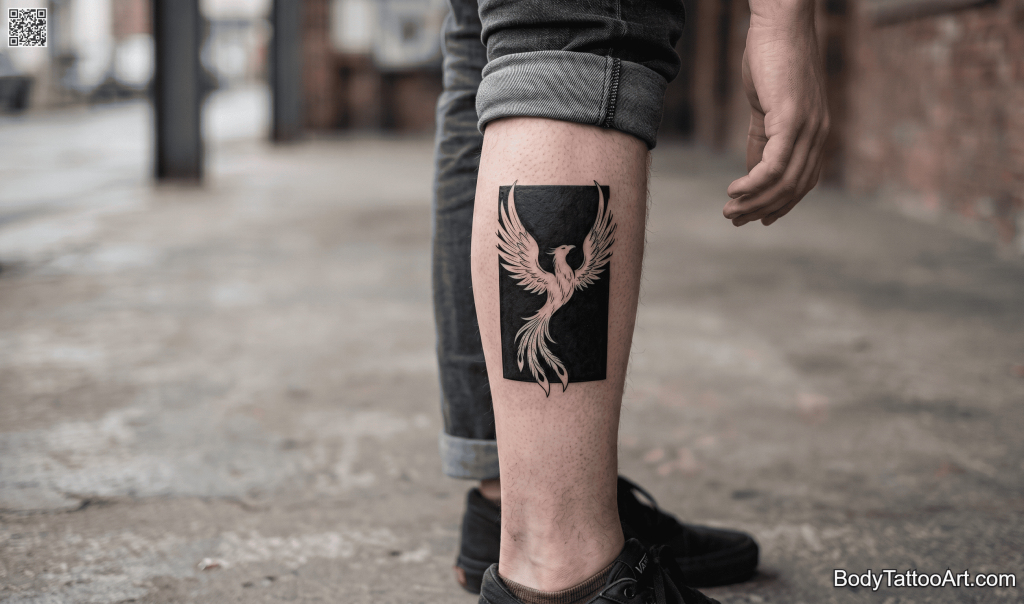
The bird’s silhouette is cut out of a solid black rectangle, leaving the phoenix shape as bare skin against black ink. Inside the silhouette, faint fine lines suggest feathers without filling in the space. The overall effect reads more like a woodcut print than a tattoo.
Placement: Outer calf
Style: Negative space / blackwork Phoenix Tattoos
Why it stands out: Negative space phoenix tattoos are rare and visually striking. The silhouette approach makes the skin itself part of the design rather than just a background.
Ideal for: Bold style enthusiasts, people who want something visually unusual.
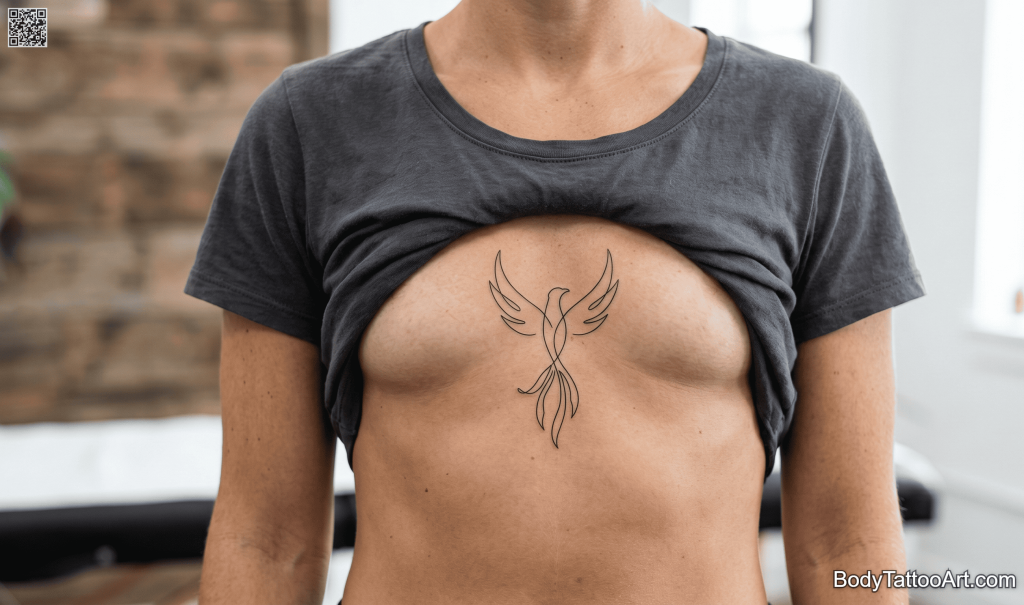
Just the outline — a single continuous line traces the shape of a rising phoenix from wing tip to tail with no shading, no fill, and no variation in line weight. The bird is small and sits in the center of the sternum. Clean, precise, barely there.
Placement: Sternum
Style: Single-line minimalism Phoenix Tattoos
Why it stands out: Phoenix tattoos don’t have to be large to be effective. A simple outline captures the silhouette instantly — the brain fills in the rest.
Ideal for: Minimalists, people wanting a small first tattoo, those who prefer subtle placement.
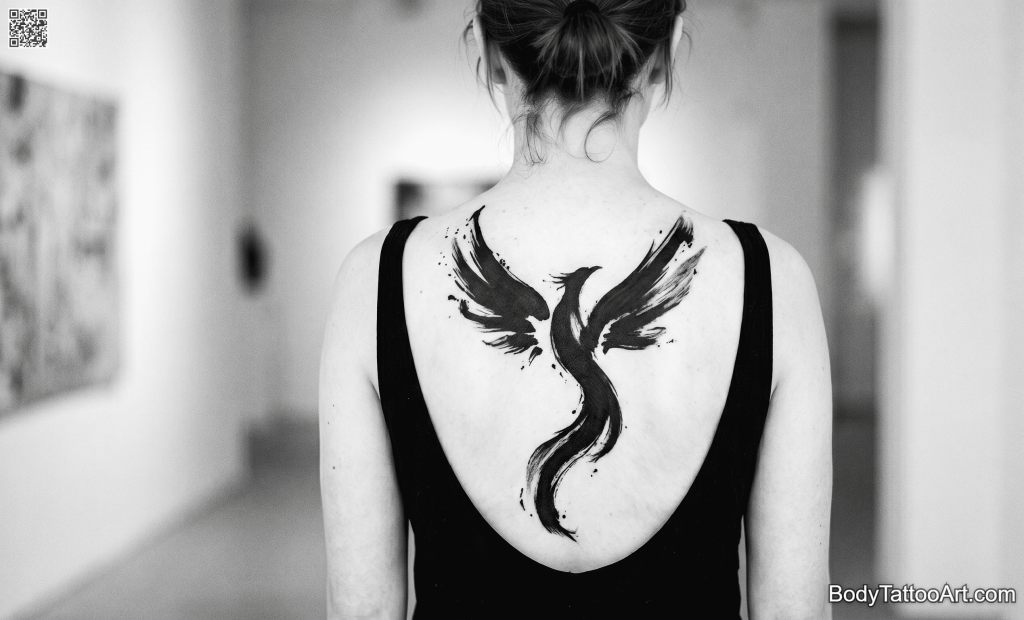
The phoenix here is formed from loose, gestural brushstroke shapes — thick ink strokes that suggest wings and a rising body without defining every feather. The style borrows from East Asian ink painting. Two or three dominant strokes create the form; the rest is left to the viewer’s imagination.
Placement: Upper back / shoulder blade area
Style: Abstract brushwork Phoenix Tattoos
Why it stands out: This approach is as much about what’s left out as what’s included. The restraint makes the piece feel sophisticated and artistic.
Ideal for: People with a background in art or design, collectors who value concept-driven tattoos.
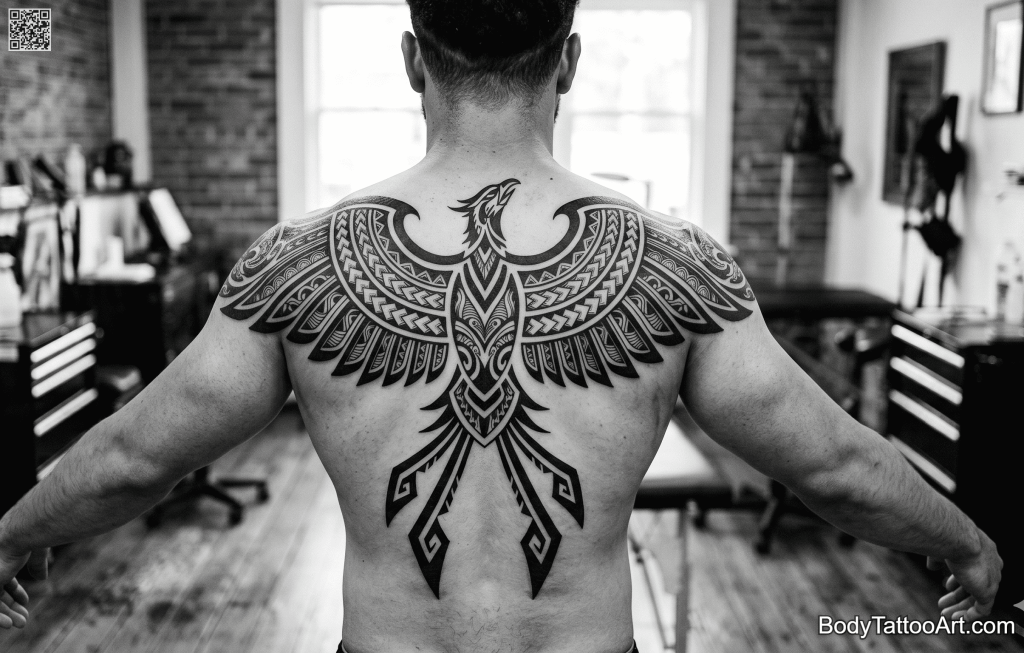
Heavy black tribal linework forms a stylized phoenix with symmetrical patterning across the wings. The design draws loosely from Polynesian tattoo traditions — bold black fills, repeating geometric motifs inside the wings, and thick outer borders. The tail drops in three angular points.
Placement: Upper back / shoulder span
Style: Tribal blackwork Phoenix Tattoos
Why it stands out: Tribal phoenix tattoos are powerful and graphic. The bold fills read from a distance and age extremely well on the skin.
Ideal for: People drawn to strong, high-contrast designs and those interested in Polynesian-influenced aesthetics.
Bird tattoos tell very different stories depending on the species. Owl tattoo designs carry a completely different energy from phoenix tattoos — quieter, more introspective. Meanwhile, snake tattoos share the phoenix’s association with transformation and shedding the old, making them natural companions in a sleeve concept.
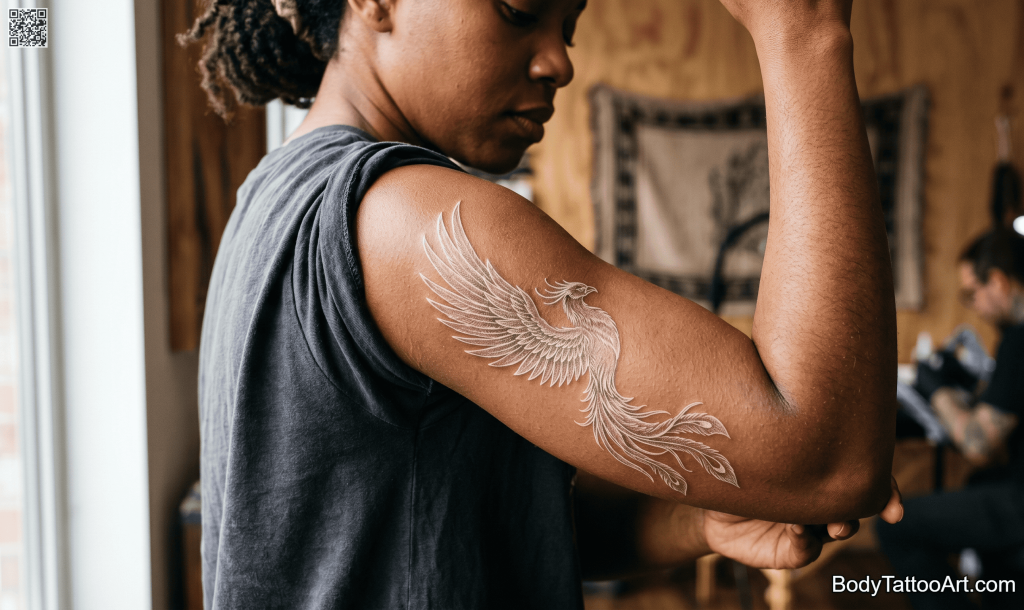
A phoenix rendered in white ink alone, placed on a darker skin tone so the subtle contrast creates a ghost-like, ethereal effect. The feathers have soft raised texture from the ink sitting on the surface. The design is visible primarily in raking light, which gives it an almost hidden quality.
Placement: Inner upper arm
Style: White ink Phoenix Tattoos
Why it stands out: White ink phoenix tattoos are bold choices because of how they interact with skin tone. The effect is unlike any other tattoo style — subtle from afar, intricate up close.
Ideal for: People with deeper skin tones who want something striking and different.
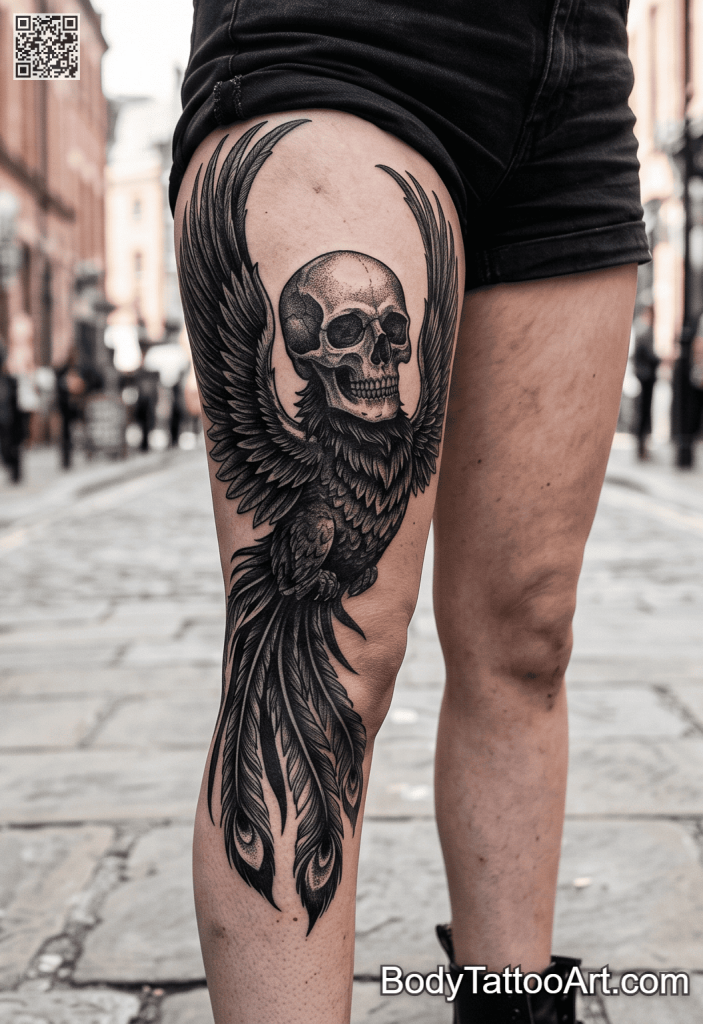
The phoenix body transitions midway into a detailed skull — the wings and upper body remain bird-like, but the head is replaced with a human skull rendered in blackwork. Dark feathers surround the skull like a collar. The piece is dark, graphic, and deliberately unsettling.
Placement: Thigh
Style: Blackwork / dark art Phoenix Tattoos
Why it stands out: This design forces a conversation between life and death in one image. The phoenix body carries the idea of rebirth while the skull grounding it brings mortality into the frame.
Ideal for: Dark art collectors, people who want phoenix tattoos with a more complex visual message.
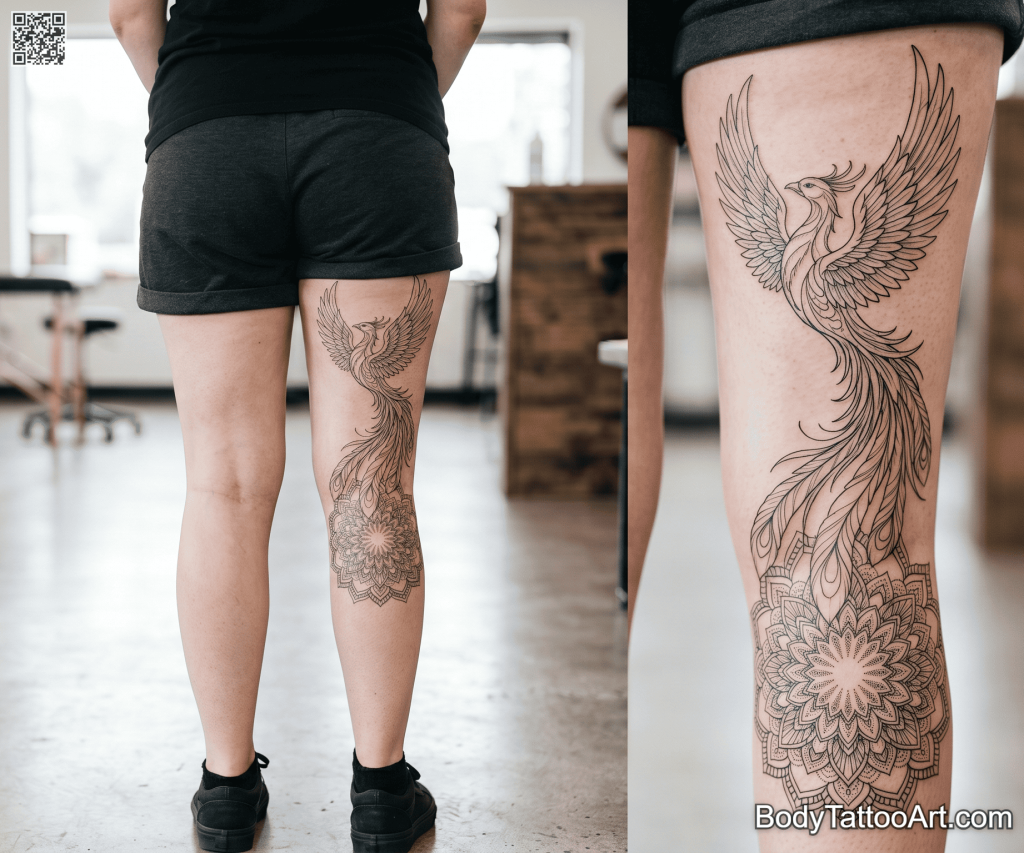
The phoenix’s tail fans out into a mandala-like circular pattern — concentric rings of fine linework that radiate outward from where the tail feathers begin. The bird itself is done in detailed linework with no shading. The mandala tail gives the piece a meditative, sacred geometry feel.
Placement: Back of thigh
Style: Fine line / ornamental Phoenix Tattoos
Why it stands out: The tail is usually the most dynamic part of a phoenix tattoo. Using mandala patterning instead of feathers creates a completely unexpected ending to the design.
Ideal for: People who love sacred geometry or ornamental tattoos and want something unusual.
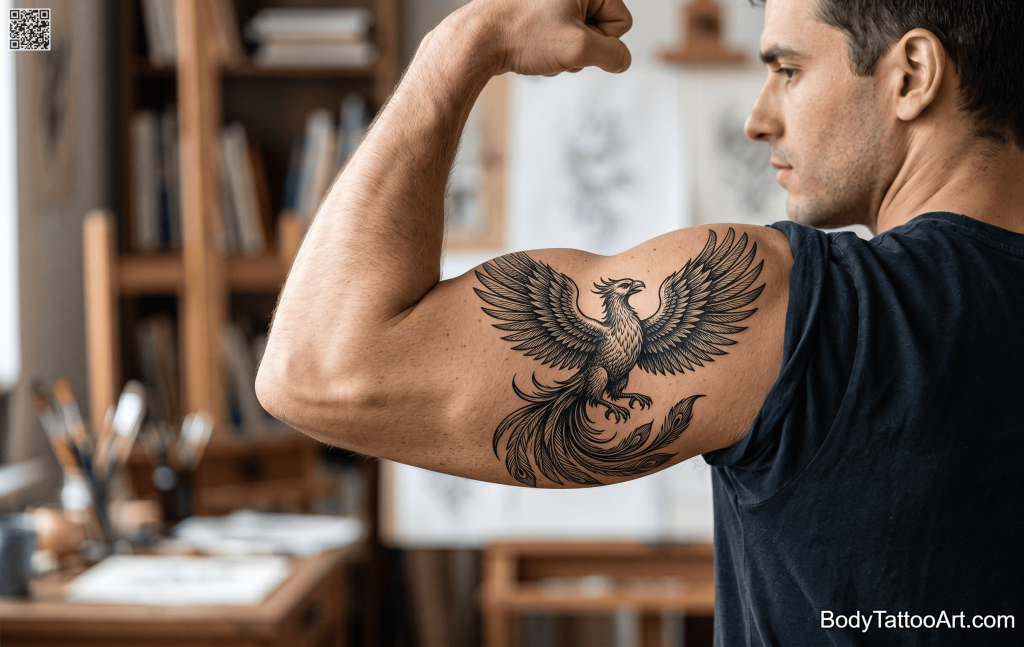
This phoenix looks like it was lifted from a 16th-century woodcut or copper engraving. Cross-hatching builds all the shadow and volume. The lines are fine and precise, running in organised parallel and diagonal sets. The overall effect is aged and historic, like an illustration from an old bestiary.
Placement: Upper arm
Style: Engraving / etching Phoenix Tattoos
Why it stands out: Engraving-style tattoos are a niche but growing approach. The precision required to pull off clean crosshatching is impressive — and the visual result is completely distinct from standard shading.
Ideal for: People who love vintage illustration aesthetics and collectors who appreciate technical craftsmanship.
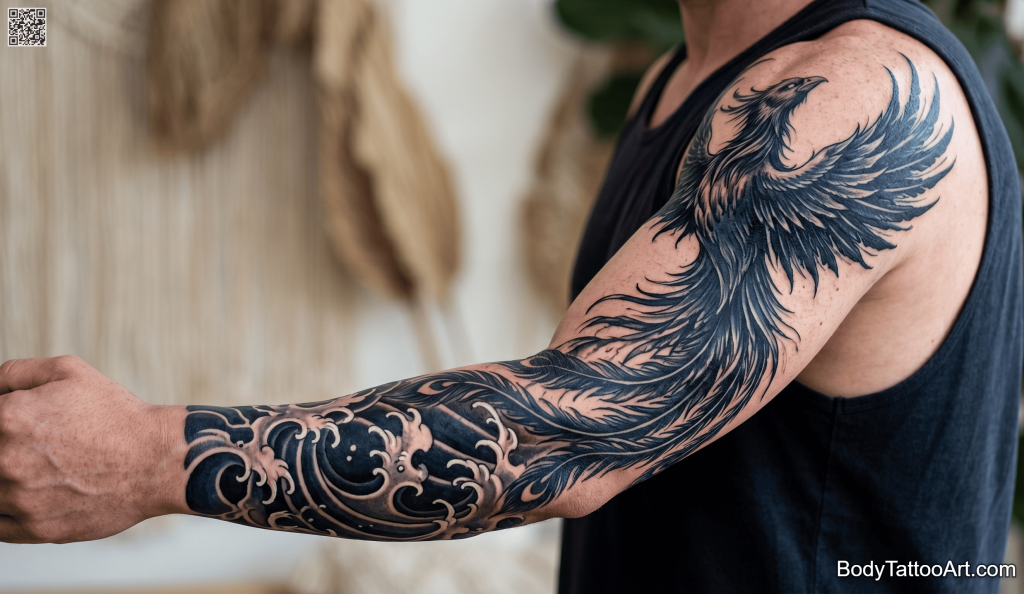
Instead of flames, this phoenix rises from stylized water — waves rendered in Japanese wave (Hokusai) style form the base of the composition. The bird ascends from the water with wet, slightly dragged feathers. The contrast between the fluid water movement and the stiff upward motion of the bird creates visual tension.
Placement: Full sleeve
Style: Japanese / illustrative hybrid Phoenix Tattoos
Why it stands out: Fire is the default element for phoenix tattoos. Water gives the design a completely unexpected foundation and changes the mood dramatically — from heat and destruction to depth and emergence.
Ideal for: Sleeve collectors, people interested in Japanese aesthetics with a twist.
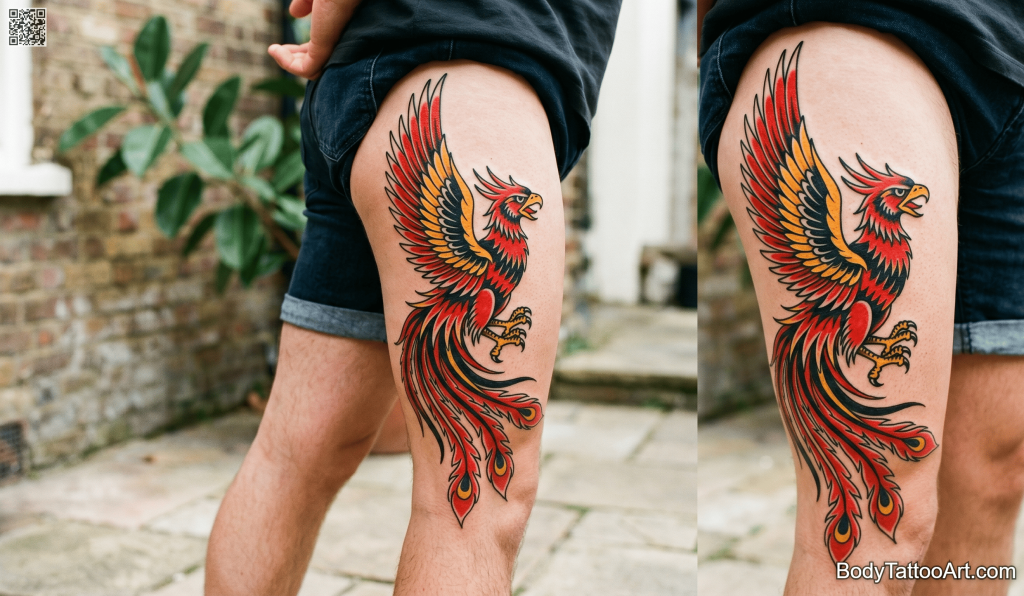
Bold American traditional phoenix tattoo in classic red, black, and yellow. Heavy black outlines, flat colour fills, minimal shading. The wings are raised in a classic display pose, the beak is open, and thick decorative feathers frame the whole piece. Zero subtlety — loud and proud.
Placement: Outer thigh
Style: American traditional Phoenix Tattoos
Why it stands out: American traditional phoenix tattoos are timeless for a reason. The thick outlines and flat fills are built to last on the skin for decades without fading into grey.
Ideal for: Traditional tattoo fans, people who want colour work that ages well.
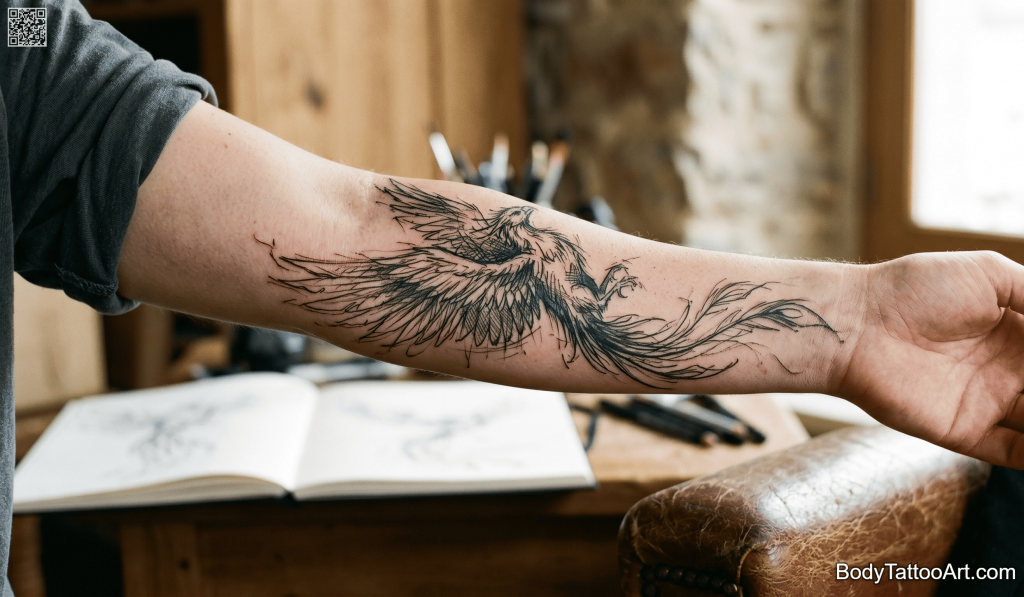
This phoenix looks like a pencil sketch transferred to skin — rough, slightly unfinished lines with visible stroke directions and loose hatching for shadow. Some parts of the bird are more defined while others trail off into incomplete marks. The effect is intentionally raw and unpolished.
Placement: Forearm
Style: Sketch / illustrative Phoenix Tattoos
Why it stands out: Sketch tattoos play with the boundary between art-in-progress and finished work. The deliberate incompleteness makes the design feel alive and dynamic.
Ideal for: People who love the look of illustration and sketchbook art translated to skin.
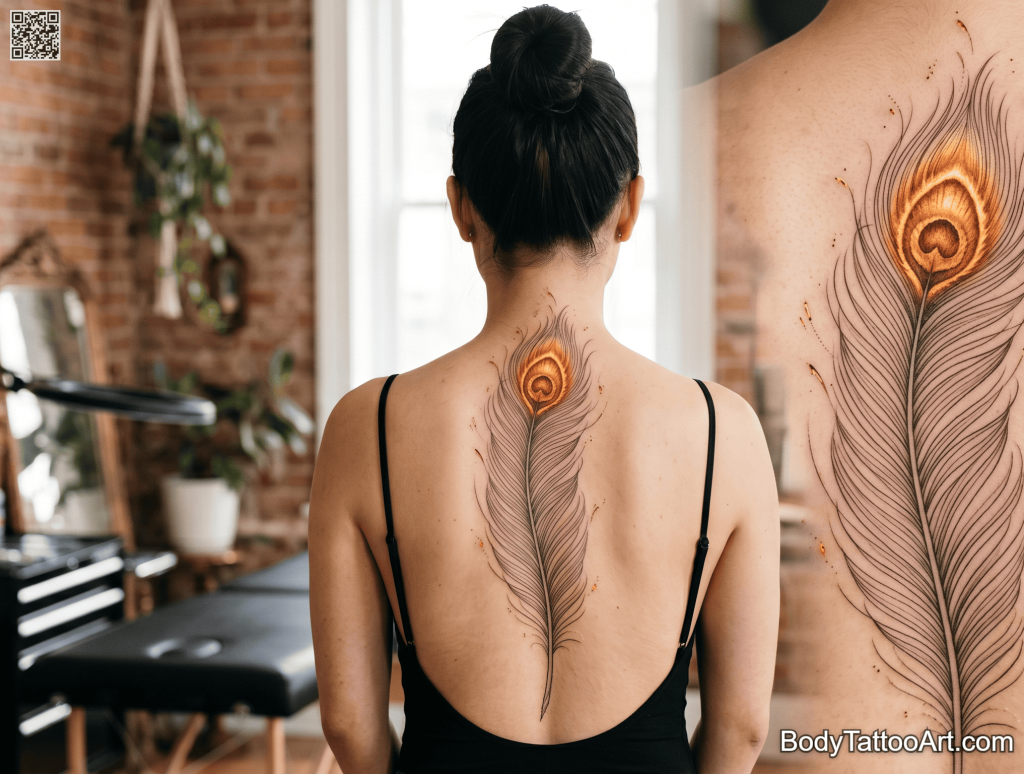
Rather than a full phoenix, this piece places a single large phoenix tail feather running down the length of the spine. The feather is rendered in fine detail — the shaft, the barbs, and the fiery coloured eye at the tip are all carefully drawn. Small embers float off the feather edges.
Placement: Spine
Style: Fine line / illustrative Phoenix Tattoos
Why it stands out: Single-feature phoenix tattoos are an underused idea. A spine feather tattoo creates a strong vertical piece that uses the body’s own architecture as part of the design.
Ideal for: People who want phoenix symbolism without a full bird, those who love spine placements.
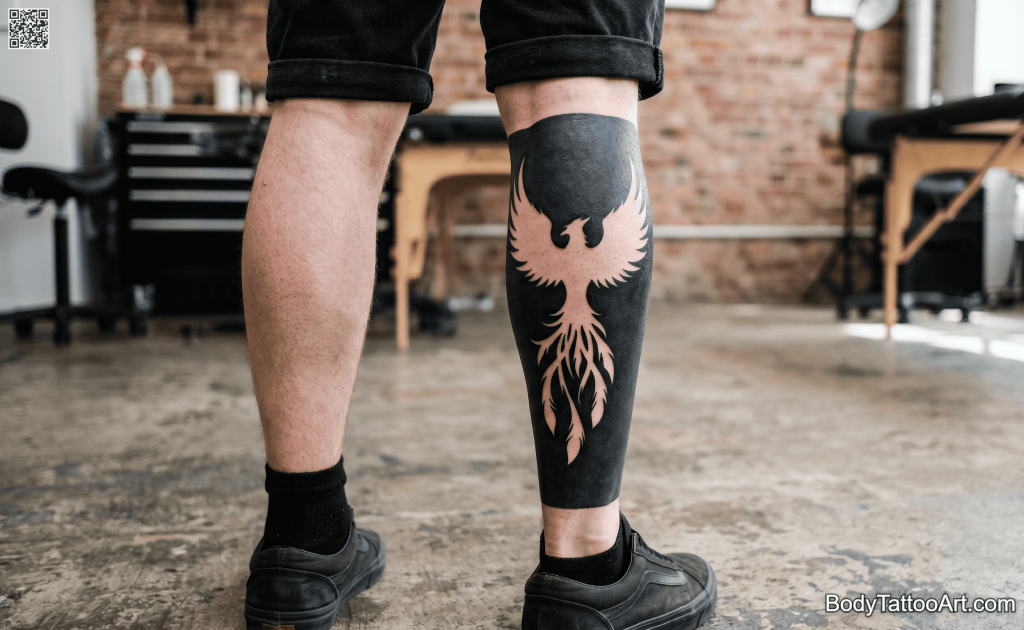
A solid black blocked leg sleeve with only the phoenix silhouette cut out as bare skin — the bird is defined entirely by negative space against a field of dense black ink. No internal detail at all. The silhouette alone is expressive enough to read as a phoenix in full flight.
Placement: Lower leg / calf sleeve
Style: Blackout with negative space Phoenix Tattoos
Why it stands out: Blackout tattoos are extreme and commitment-heavy. Using one to frame a phoenix silhouette results in one of the most high-impact tattoo concepts possible.
Ideal for: Experienced collectors, people ready to commit to a bold, permanent statement.
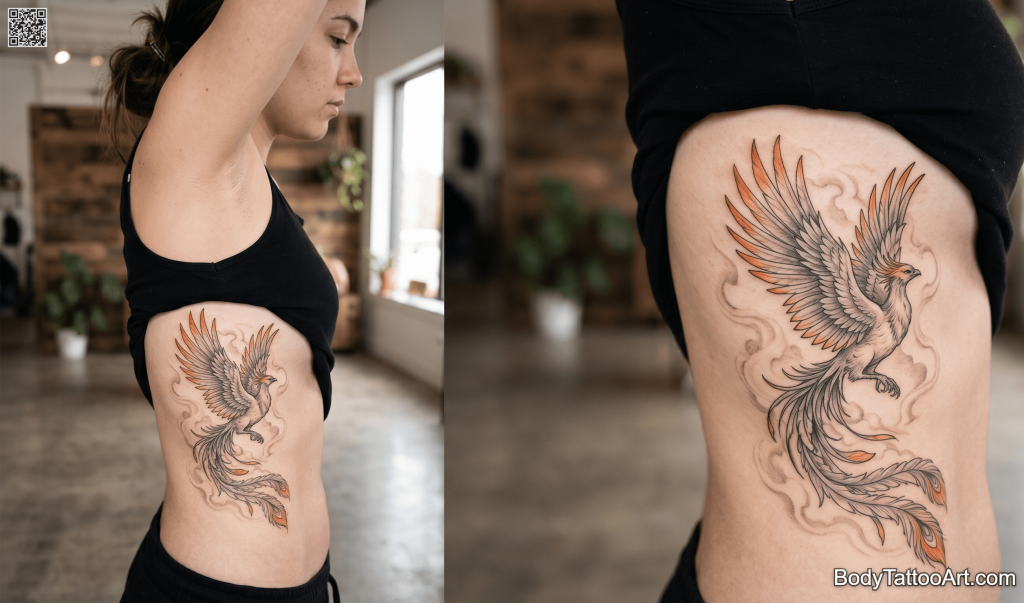
A mid-sized illustrative phoenix soars across the rib cage with cloud wisps forming the background. The bird is drawn in fine lines with soft grey shading and selective orange ink touches on the wing tips only. The clouds are light and airy, giving the impression of sky depth behind the bird.
Placement: Ribcage
Style: Illustrative / semi-realistic Phoenix Tattoos
Why it stands out: The orange limited to wing tips only is a smart compositional choice — it draws the eye to the most dynamic part of the bird without overwhelming the design with colour.
Ideal for: People who want colour work done subtly, fans of illustrative tattoo styles.
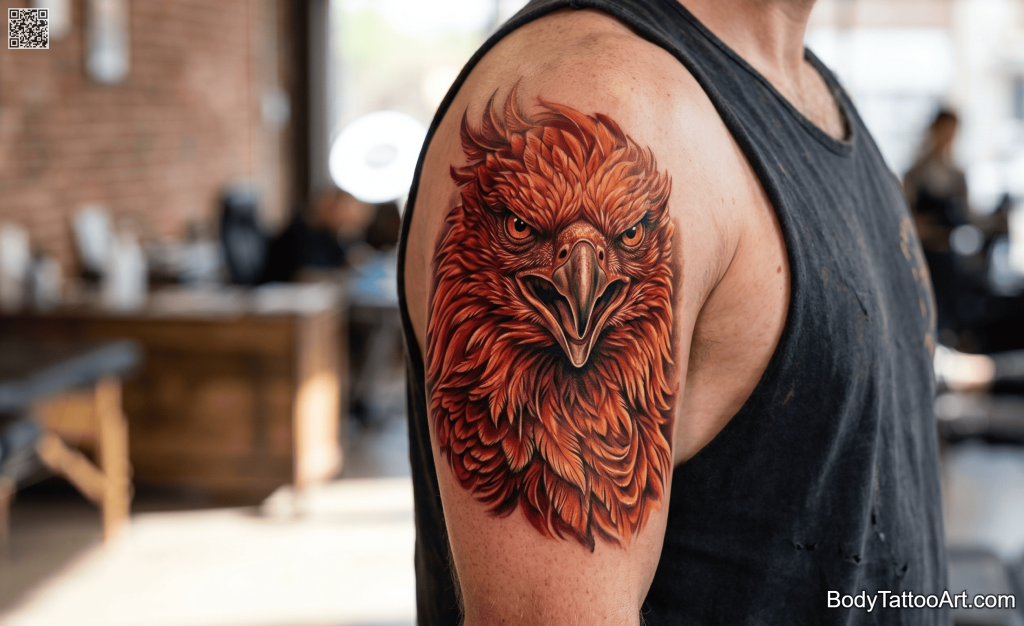
A tight crop portrait of just the phoenix head — beak slightly open, fierce forward-facing gaze, feathers ruffled around the face and neck with fiery orange and red colouring. The composition is close and confrontational, more like a portrait of an eagle than a traditional phoenix tattoo.
Placement: Upper arm
Style: Hyper-realistic colour realism Phoenix Tattoos
Why it stands out: Zooming into just the face of a phoenix is unusual. The intimacy of the composition makes this feel less like a mythological symbol and more like a living creature staring back.
Ideal for: Realism collectors, wildlife tattoo fans who want phoenix tattoos done differently.
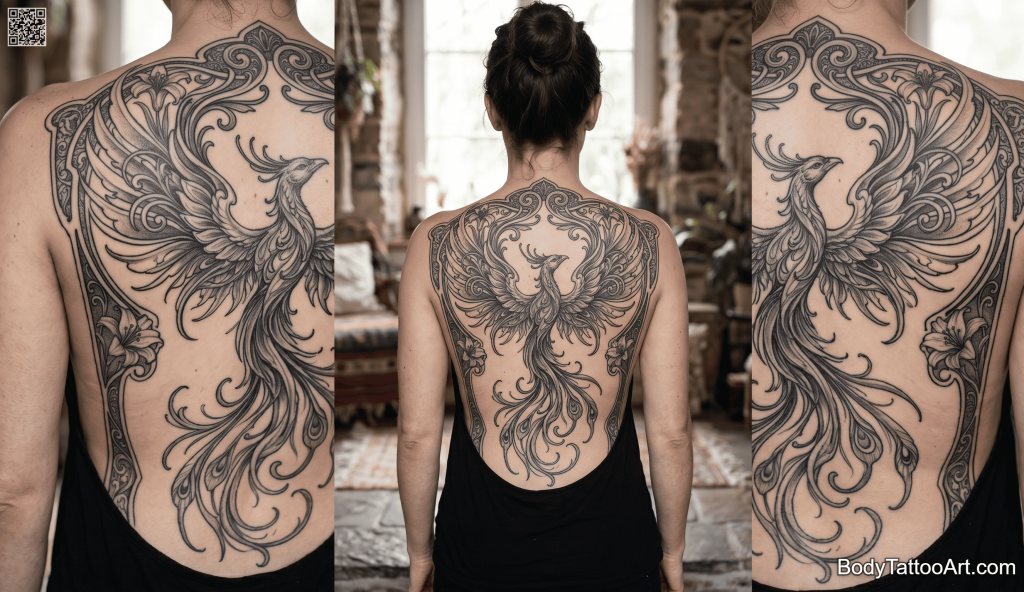
An Art Nouveau-inspired phoenix with elongated, decorative lines and flowing organic forms. The wings curve like stylised plant tendrils. The overall composition is symmetrical with ornate borders framing the bird. The style echoes Alphonse Mucha’s illustration work — elegant, decorative, and highly detailed.
Placement: Full back
Style: Art Nouveau / ornamental Phoenix Tattoos
Why it stands out: Art Nouveau phoenix tattoos are rarely attempted but visually spectacular when executed well. The decorative language of the style suits the phoenix’s natural elegance.
Ideal for: Art history enthusiasts, people who love ornamental tattooing and large back pieces.
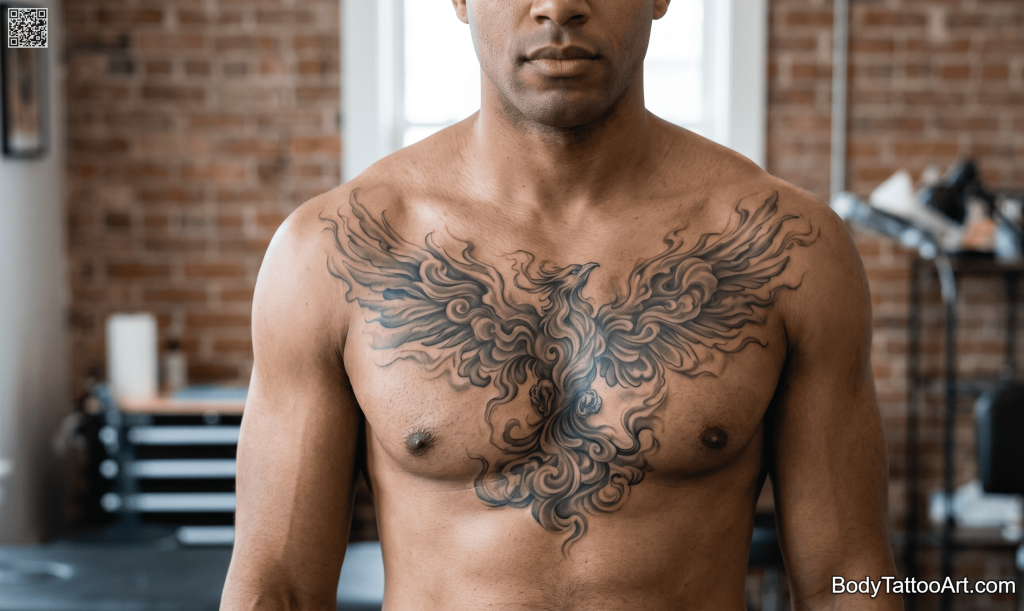
This phoenix is formed entirely from smoke — dense swirling grey and charcoal shapes that together read as a bird without any hard outlines at all. The piece blurs the line between the bird and the smoke it came from. It is impressionistic and deliberately ambiguous.
Placement: Chest / sternum area
Style: Smoke / abstract realism Phoenix Tattoos
Why it stands out: A phoenix made of smoke rather than fire inverts the usual visual logic of the design. The bird dissolves into the same substance it emerged from — a genuinely unusual concept for phoenix tattoos.
Ideal for: Abstract art fans, people who want phoenix tattoos that spark a second look.
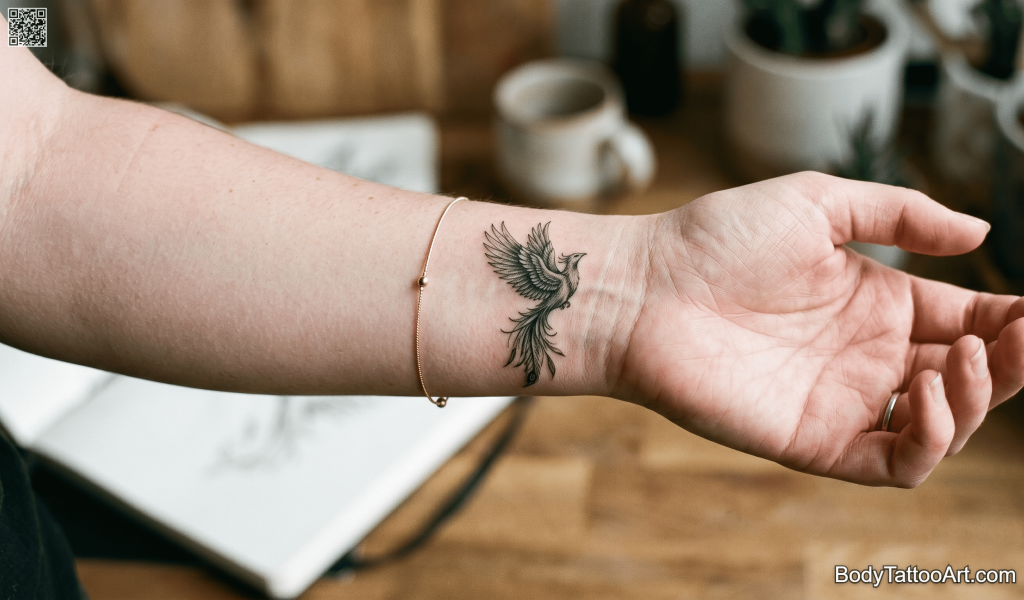
A tiny but highly detailed phoenix tattoo sits on the inner wrist — no bigger than a large coin. Despite the scale, the feather detail, shadow work, and sense of movement are fully present. The small size requires tight, precise lines and compressed but readable composition.
Placement: Inner wrist
Style: Micro-realism
Why it stands out: Micro-realism phoenix tattoos prove the concept works at any scale. The challenge of fitting real detail into a tiny space is exactly what makes these pieces impressive.
Ideal for: Collectors who love small detailed work, people wanting discreet but well-crafted tattoos.
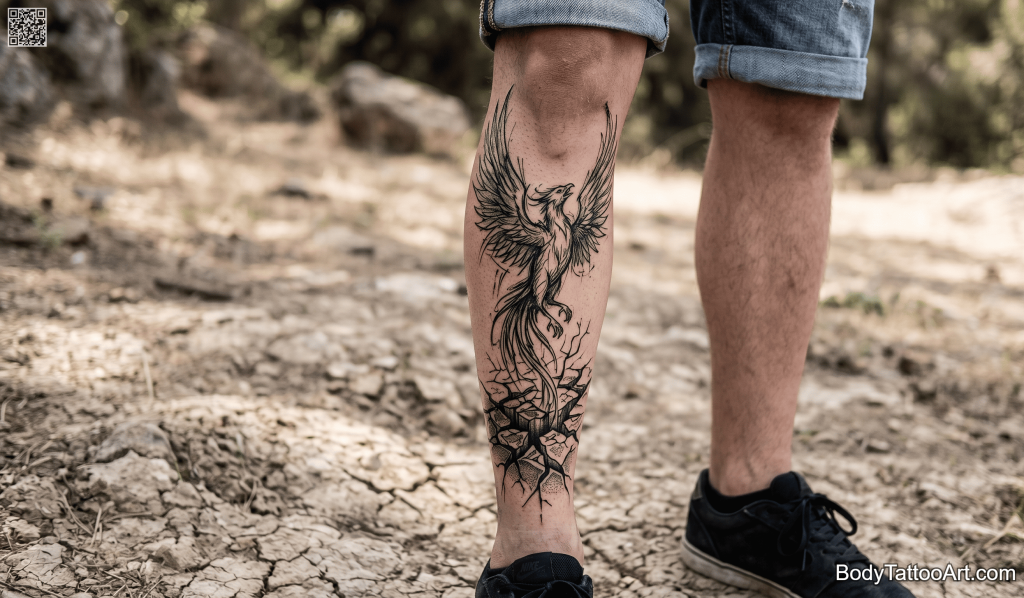
The bird emerges from cracked, broken ground rather than flames. Deep fissures radiate outward from the bird’s feet as it launches upward. The ground texture is rendered in detailed blackwork. The phoenix itself is drawn in a looser, more gestural style — the contrast between the textured earth and the fluid bird creates a strong visual split.
Placement: Shin / front of lower leg
Style: Blackwork and sketch hybrid
Why it stands out: Replacing the fire origin with cracked earth gives phoenix tattoos a completely different narrative foundation — emergence from the ground rather than from the sky. The textural contrast between the two elements is the real draw here.
Ideal for: Concept-driven collectors, people who want phoenix tattoos with an unusual compositional hook.
Phoenix tattoos are one of those rare subjects that genuinely work across every tattoo style, skill level, and body placement. The 25 ideas above cover everything from a simple wrist micro-piece to a full blackout calf sleeve — and every one of them takes a different visual approach to the same concept.
The key with phoenix tattoos is finding the version that feels personal — not just picking the most dramatic option. Whether the goal is a fine line sketch or a hyper-realistic portrait, the right phoenix tattoo is one that reads clearly, sits well on the body, and holds up over time.