Physical Address
304 North Cardinal St.
Dorchester Center, MA 02124
Physical Address
304 North Cardinal St.
Dorchester Center, MA 02124

Palm tree tattoos have been showing up everywhere — and for good reason. Whether it’s a bold blackwork piece running up the calf or a delicate fine line palm tree tattoo etched onto the wrist, there’s something about this design that just works on skin. It carries a visual weight that feels both grounded and free-spirited at the same time.
This blog rounds up 27 completely different palm tree tattoos — each one distinct in composition, style, and placement. No two share the same look. Whether someone is after something small and minimal or a large, dramatic statement piece, there’s a palm tree tattoo idea here for every kind of collector.
Palm trees have carried symbolic weight across cultures for thousands of years. In ancient Egypt, the palm was associated with the sun god Ra and represented immortality. In Roman tradition, palm branches were a symbol of victory. Across tropical and coastal cultures, the palm tree stands for endurance — it bends in storms but rarely breaks.
In modern tattoo culture, palm tree tattoos are often chosen to represent a love for warm climates, a laid-back philosophy, or a milestone connected to travel and freedom. They can also symbolize resilience, longevity, and the ability to thrive in harsh conditions.
Palm tree tattoos work across virtually every tattoo style — from hyper-realistic to geometric, from traditional to abstract expressionism — which is a big part of why they’ve stayed consistently popular.
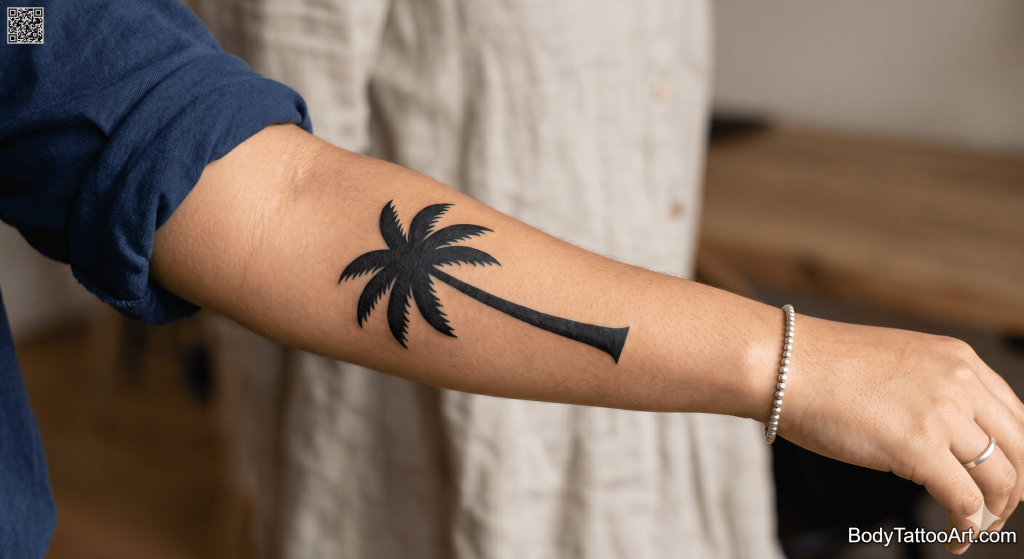
A single palm tree is rendered entirely in solid black silhouette — no detail, no shading, just a clean dark shape against bare skin. The fronds are slightly asymmetrical, giving it a windswept quality. The trunk tapers naturally at the base with a slight lean.
Placement: Inner forearm
Style: Blackwork silhouette Palm Tree Tattoos
Why it stands out: The design works entirely through negative space. No linework, no filler — just shape and contrast.
Ideal for: Minimalist tattoo lovers, first-timers, people who want something clean and timeless.
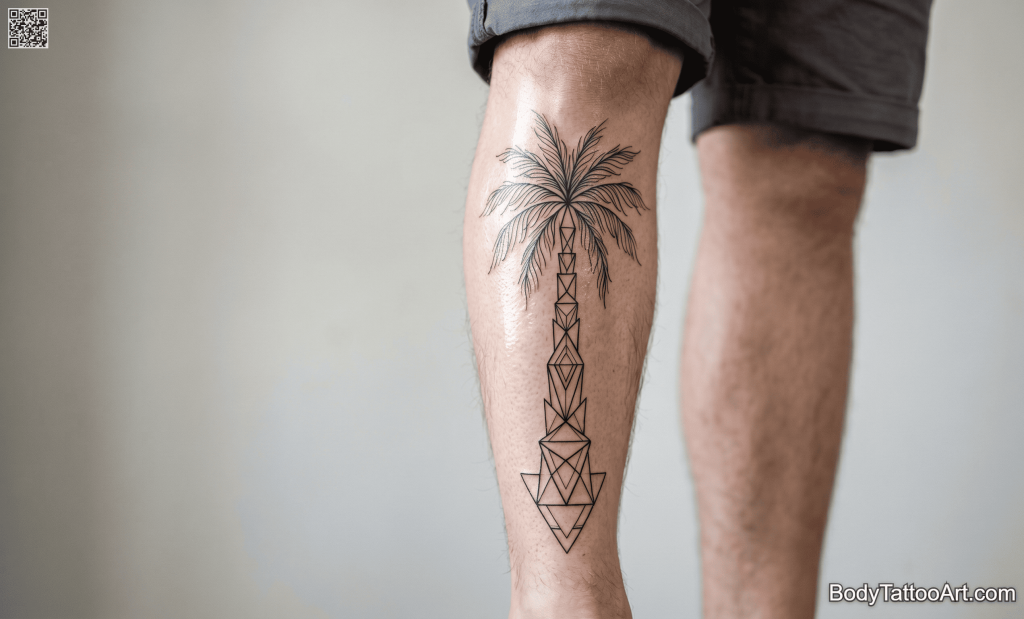
The trunk of the palm is broken into angular geometric sections — triangles and diamond shapes stack up to create the illusion of height. The fronds above flow freely in contrast, drawn in loose, organic fine lines. The combination of rigid structure below and soft organic movement above makes this a visually layered piece.
Placement: Shin
Style: Geometric fine line Palm Tree Tattoos
Why it stands out: The contrast between the structured trunk and loose fronds creates tension that holds the eye.
Ideal for: Geometry fans, those who like tattoos that mix order with organic flow.
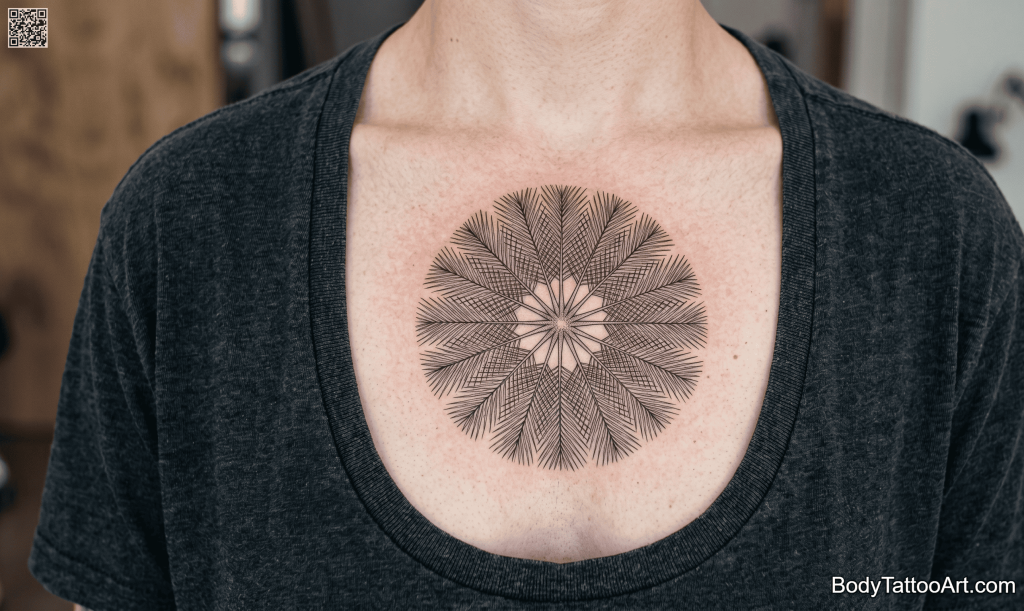
Instead of the full tree, this tattoo captures only the canopy from directly below — fronds radiating outward from a central point like a starburst. Each frond is detailed with individual leaflets drawn in hairline strokes. The composition fills a circular space naturally.
Placement: Upper chest / sternum
Style: Fine line botanical Palm Tree Tattoos
Why it stands out: An unusual perspective that most palm tree tattoos don’t use. The radial composition suits the sternum placement perfectly.
Ideal for: People who want a statement chest piece that isn’t a face or skull.
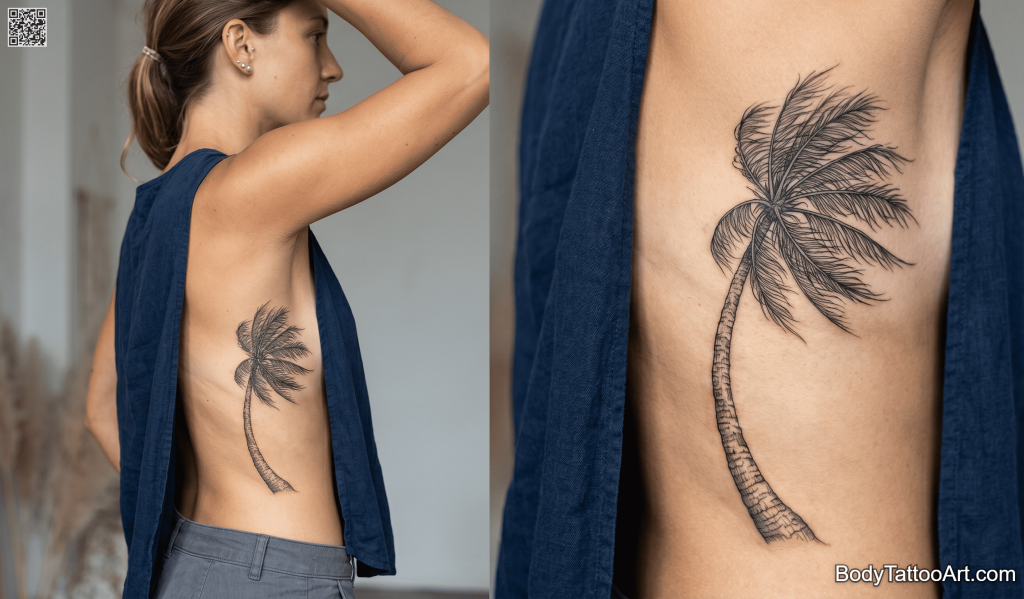
A tall, slender palm tree bends dramatically at almost a 45-degree angle — the full trunk curves across the skin. The fronds are blown to one side as if caught mid-gust. The movement in this palm tree tattoo makes it feel almost cinematic.
Placement: Ribcage / side torso
Style: Fine line realism Palm Tree Tattoos
Why it stands out: The diagonal composition follows the natural contour of the ribcage, making the placement part of the design’s story.
Ideal for: People who love dynamic, movement-based compositions.
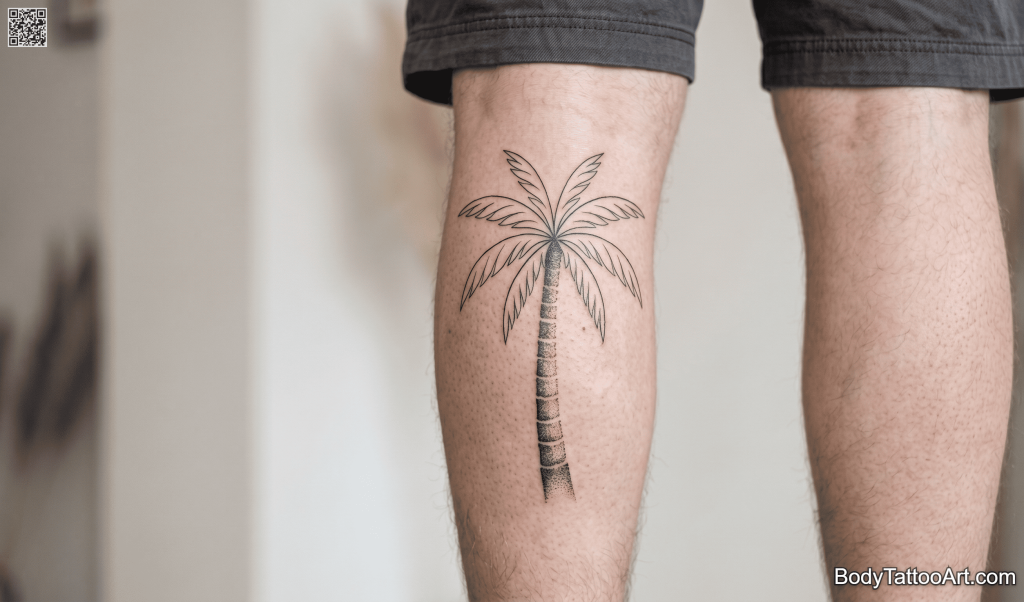
The trunk is built entirely from dotwork — thousands of tiny dots creating gradients of light and shadow with no actual lines. The fronds, in contrast, are left as bare outlines with no fill. The two techniques sit side by side in one design, creating a striking textural contrast.
Placement: Calf
Style: Dotwork / fine line hybrid Palm Tree Tattoos
Why it stands out: Two completely different tattoo techniques used on two parts of the same subject. Technically demanding and visually unusual.
Ideal for: Tattoo enthusiasts who appreciate craft and technical contrast.
If botanical designs are the vibe, exploring fern tattoo ideas might open up a whole new direction. These designs share the same clean, nature-forward energy that makes palm tree tattoos so consistently appealing.
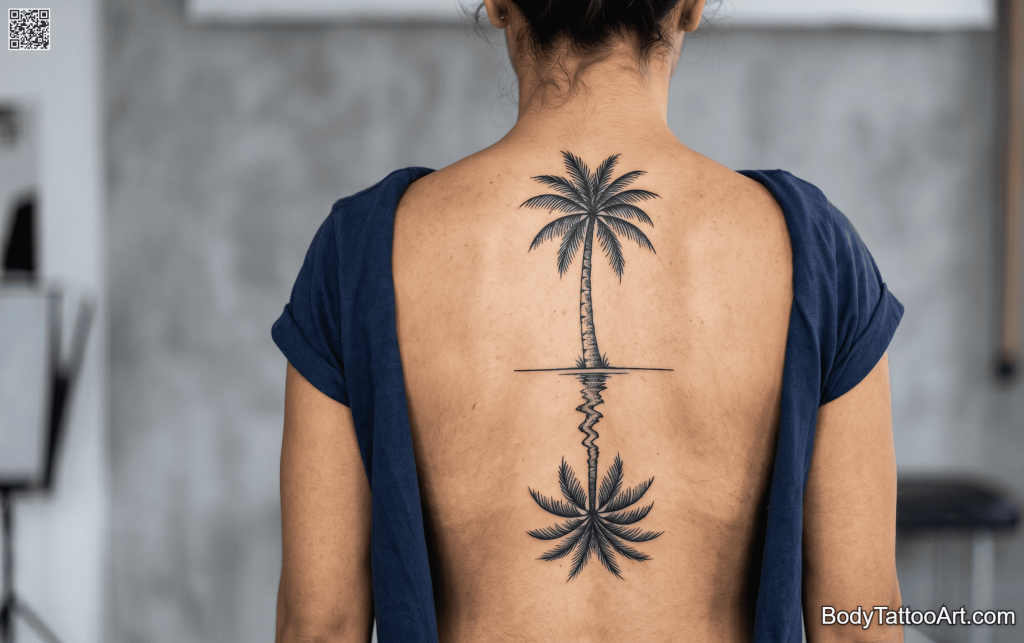
A palm tree and its perfect mirror reflection — the tree grows upward and its inverted double stretches downward. A thin horizontal line between them suggests a water surface. The reflected image is slightly distorted, as if rippling.
Placement: Spine / back of neck extending down
Style: Blackwork Palm Tree Tattoos
Why it stands out: The symmetry along the spine is deliberate and architectural. The reflected distortion adds depth to an otherwise flat composition.
Ideal for: People wanting a spine or back-of-neck tattoo with visual symmetry.
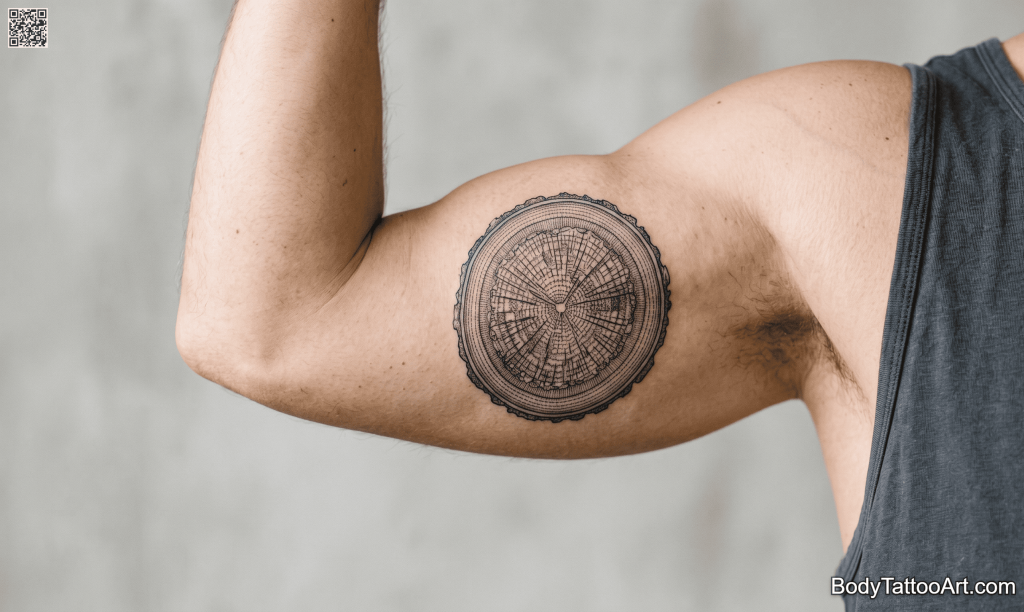
A cross-section of a palm trunk — like a botanical illustration — takes up the full composition. Concentric rings and fiber patterns inside the trunk are drawn with scientific precision. No fronds. No context. Just the raw interior structure of the tree.
Placement: Upper arm / bicep
Style: Fine line botanical illustration Palm Tree Tattoos
Why it stands out: It’s a palm tree tattoo that most people won’t immediately read as one. Unexpected and conversation-starting.
Ideal for: Science lovers, botanists, people who enjoy conceptual tattoo ideas.
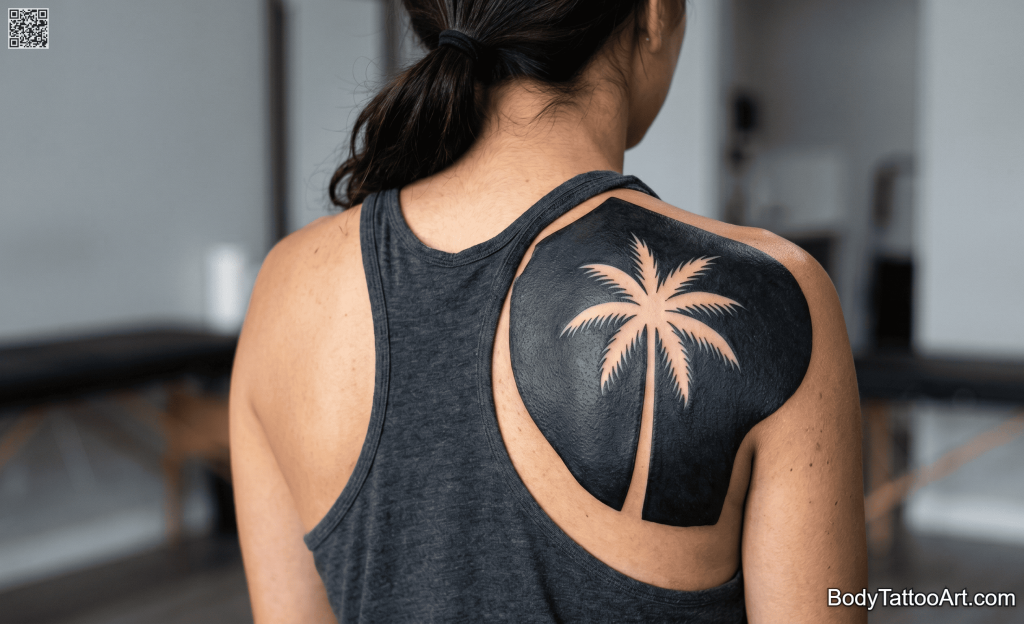
The palm tree is not drawn directly — instead, the area around it is filled in solid black, leaving the tree shape in bare skin. The fronds and trunk exist only as skin tone against dark ink. The contrast is sharp and striking.
Placement: Shoulder blade
Style: Negative space blackwork Palm Tree Tattoos
Why it stands out: The design is essentially an absence. It challenges how palm tree tattoos are usually rendered.
Ideal for: People who like bold, conceptual tattoo art with strong visual impact.
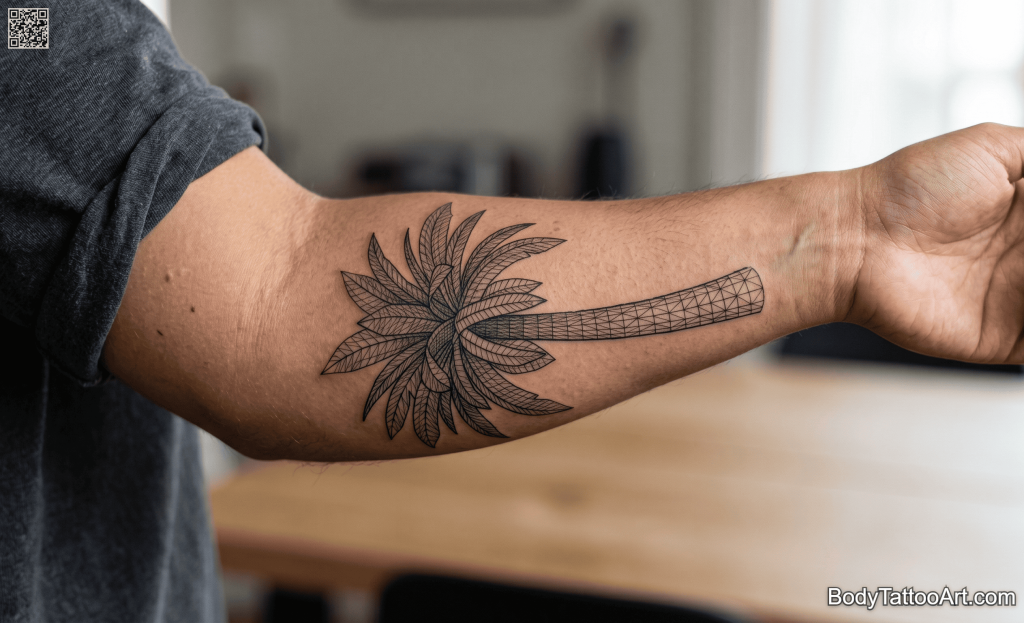
A palm tree rendered as if it were a 3D wireframe model — a grid of thin lines maps the surface of the trunk and fronds. The construction lines give it a digital, architectural feeling while still clearly reading as a natural form.
Placement: Forearm
Style: Geometric / technical linework Palm Tree Tattoos
Why it stands out: It looks like something pulled from a design software screen. Entirely unlike a conventional palm tree tattoo.
Ideal for: Designers, architects, tech professionals who want something visually unexpected.
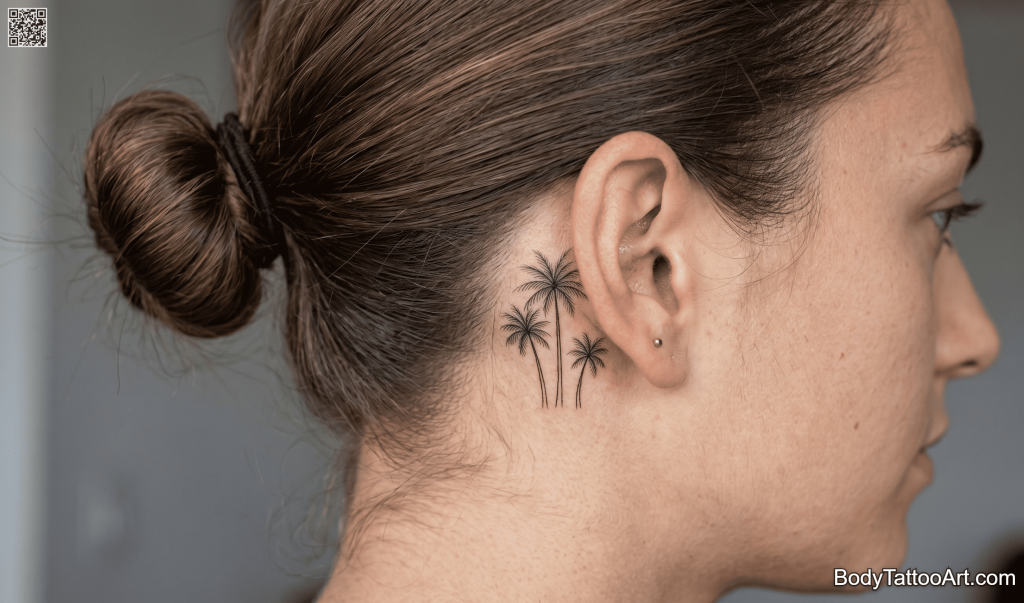
Three tiny palm trees — each no taller than two inches — grouped in a small cluster, slightly staggered in height. The tallest one leans slightly left, the middle stands straight, and the smallest tilts right. Together they read as a mini grove. Hairline strokes throughout.
Placement: Behind the ear
Style: Micro fine line Palm Tree Tattoos
Why it stands out: Scale is everything here. The detail packed into such a small space is what makes micro palm tree tattoos impressive.
Ideal for: People wanting a subtle, delicate design that only shows when the hair is pulled back.
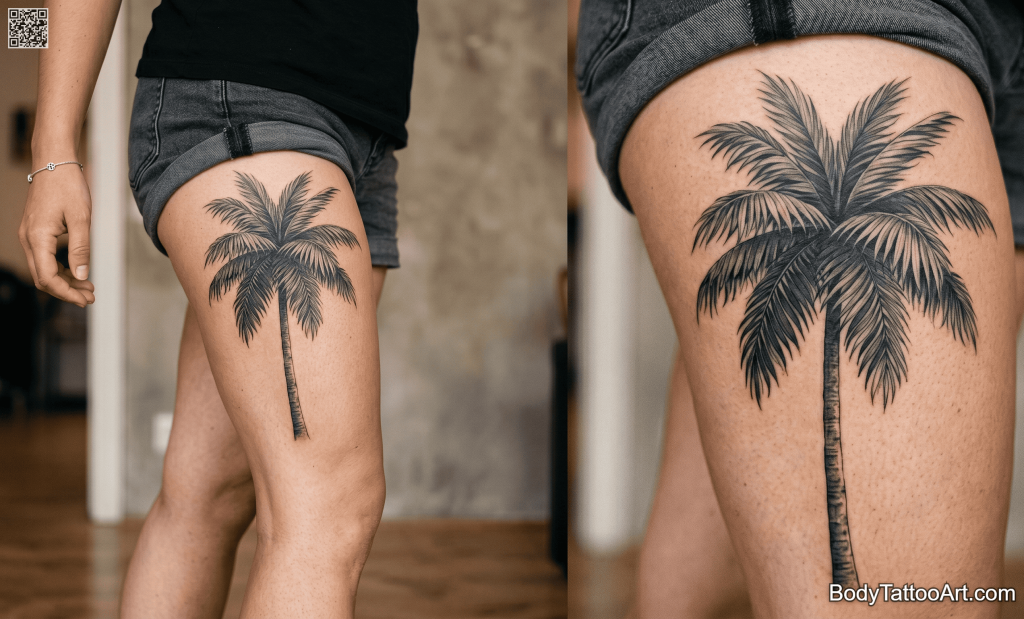
The fronds of this palm tree tattoo are exaggerated — longer, fuller, and layered over each other like pages of an open book. The trunk is straight and narrow, almost a afterthought below the dramatic canopy. The fronds have strong directional shading with dark undersides and lighter tops.
Placement: Thigh
Style: Grey-wash realism Palm Tree Tattoos
Why it stands out: All the drama is in the canopy. The contrast between the simple trunk and the detailed fronds creates strong visual hierarchy.
Ideal for: Thigh tattoo enthusiasts who want something organic but detailed.
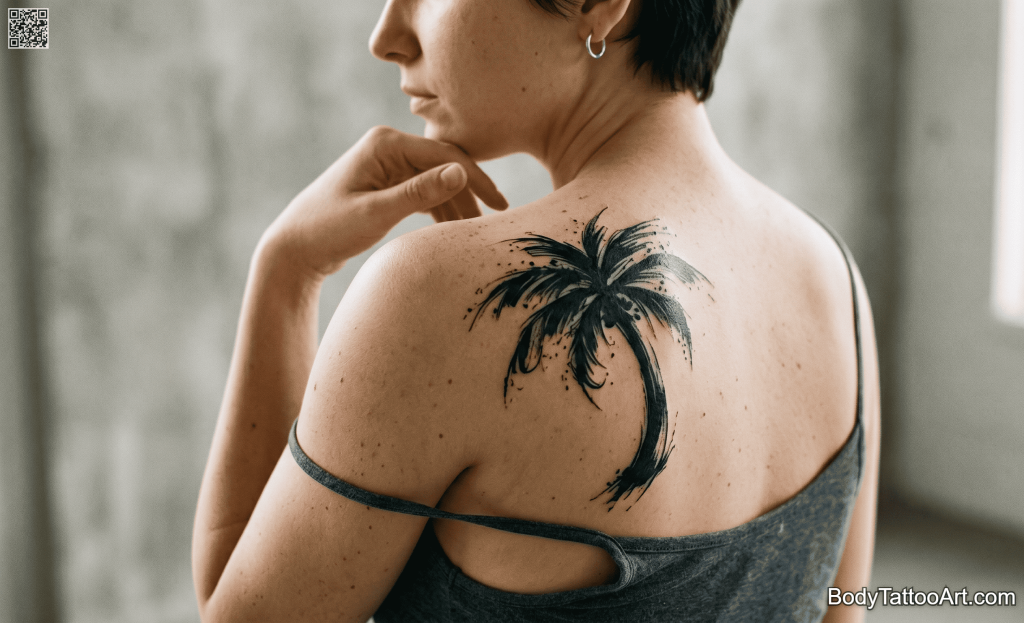
Loose, expressive brushstroke-style lines form the rough impression of a palm tree. The edges are not clean — they’re intentionally rough, like ink applied with a flat brush at speed. The composition has energy and looseness that feels almost painterly.
Placement: Upper back / shoulder
Style: Abstract brushwork Palm Tree Tattoos
Why it stands out: The anti-precision approach makes this palm tree tattoo look like a gesture drawing captured permanently in skin.
Ideal for: People drawn to art-forward tattoos that reject traditional polish.
For those exploring nature-based tattoo themes, olive branch tattoo designs carry a similar earthy, grounded quality. Like palm tree tattoos, they translate beautifully into both minimal and detailed styles.
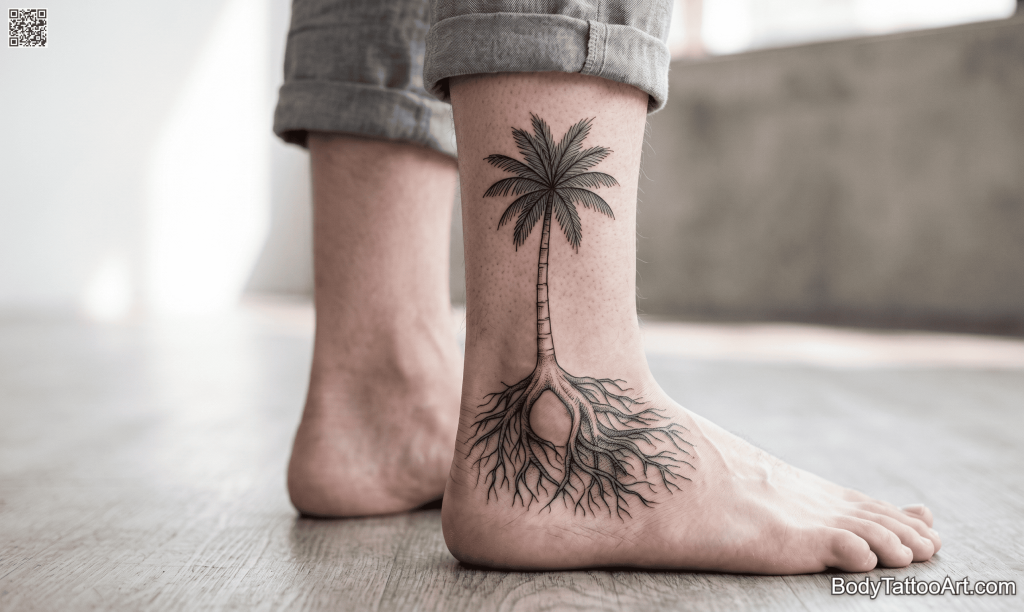
This palm tree tattoo flips expectations — most of the design is below the surface. The trunk above is short and clean, but below it, an intricate network of roots spreads wide and deep. The roots are drawn with fine lines and cross-hatching to add texture.
Placement: Ankle / lower leg
Style: Fine line with cross-hatching Palm Tree Tattoos
Why it stands out: The focus on the invisible part of the tree makes it conceptually interesting. The roots spread naturally around the ankle bone.
Ideal for: People who want a placement-driven tattoo where the body becomes part of the composition.
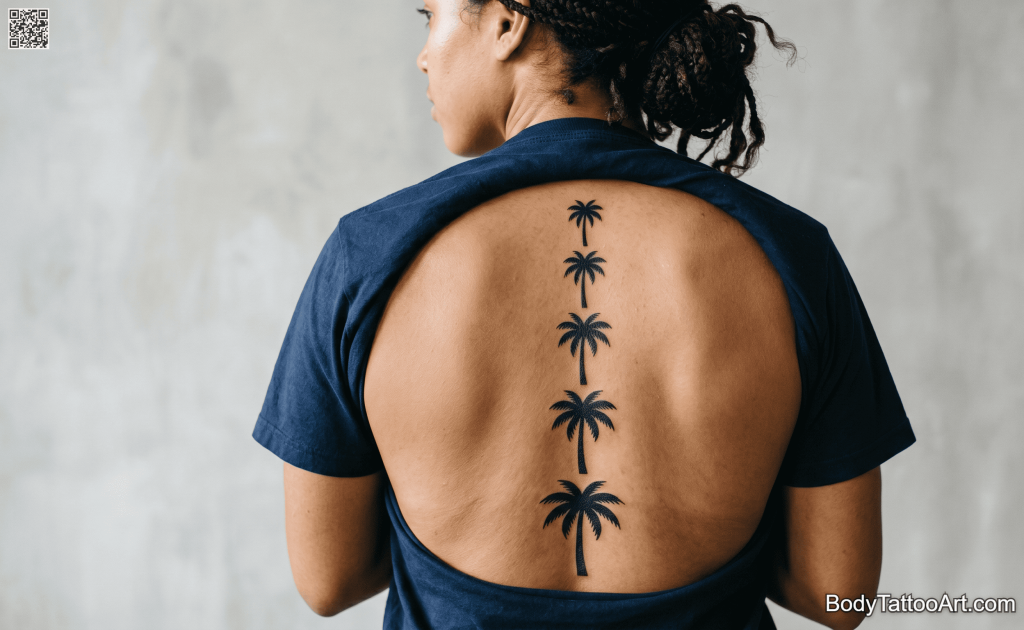
Five palm trees of identical shape are stacked vertically in a single column — each one slightly smaller than the one below it, creating a telescoping effect. The repetition is the design. No variation in style — only size.
Placement: Spine
Style: Blackwork minimal Palm Tree Tattoos
Why it stands out: Repetition as a design principle is underused in palm tree tattoos. The shrinking scale creates the illusion of depth.
Ideal for: Lovers of pattern-based tattoos and clean graphic design principles.
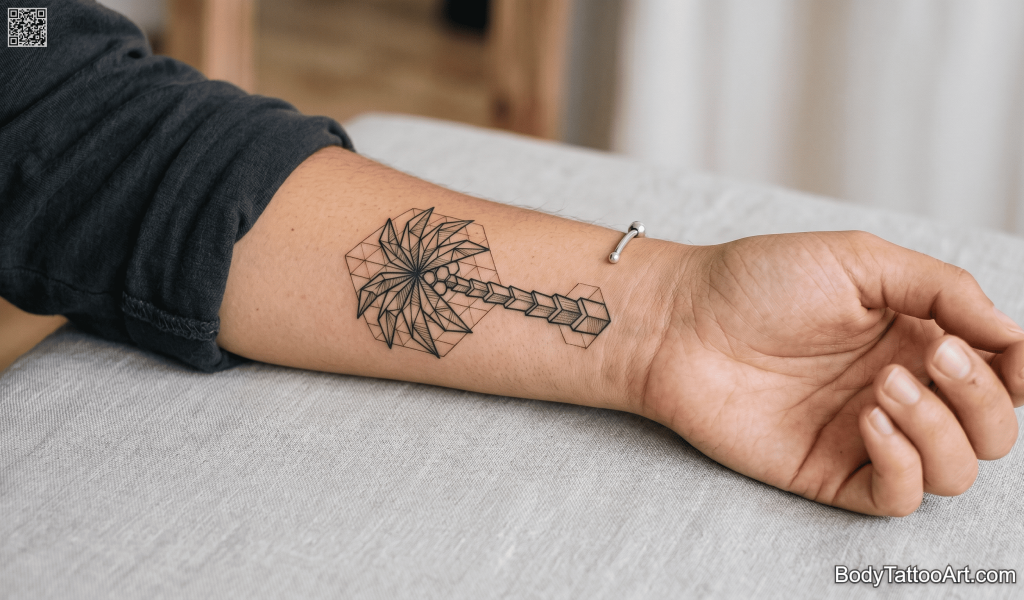
A palm tree is drawn in isometric projection — the trunk and canopy appear as a 3D cube-like construction drawn on an angled grid. It reads as both architectural and botanical at once.
Placement: Inner wrist
Style: Geometric / isometric Palm Tree Tattoos
Why it stands out: Isometric design applied to organic subject matter creates a fascinating visual dissonance. Genuinely uncommon in palm tree tattoos.
Ideal for: Graphic designers, illustrators, anyone interested in technical art styles.
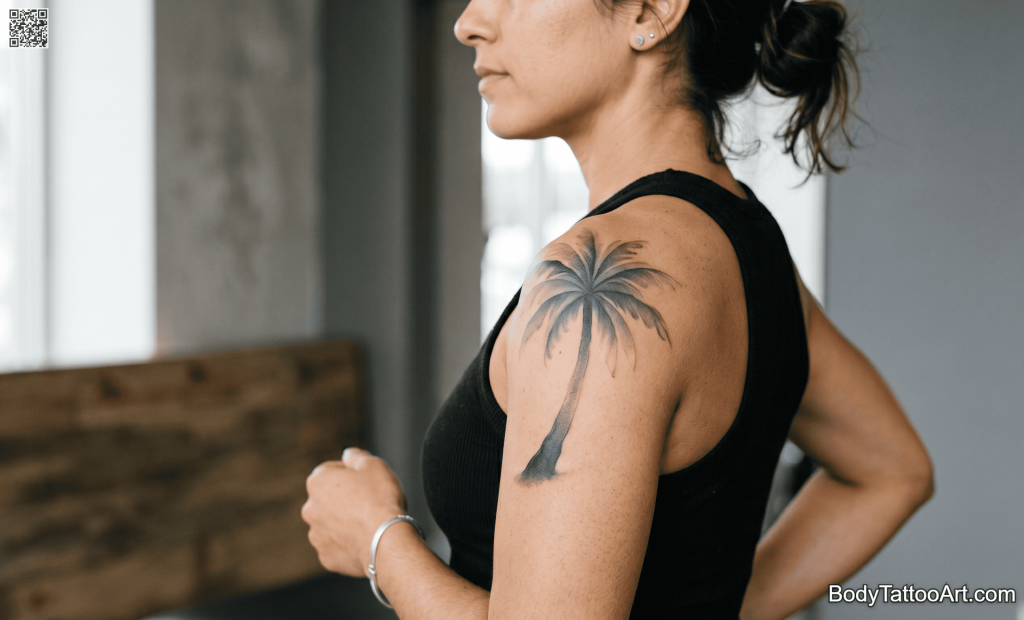
A palm tree painted in ink wash style — the base of the trunk is darkest, and the ink gradually fades to near-invisible at the frond tips. No outlines at all. The entire image exists in gradients of grey to white.
Placement: Shoulder cap
Style: Watercolour-adjacent / ink wash Palm Tree Tattoos
Why it stands out: The absence of outlines is the whole point. It’s a study in ink transparency rather than linework.
Ideal for: People who appreciate painterly tattoos over graphic ones.
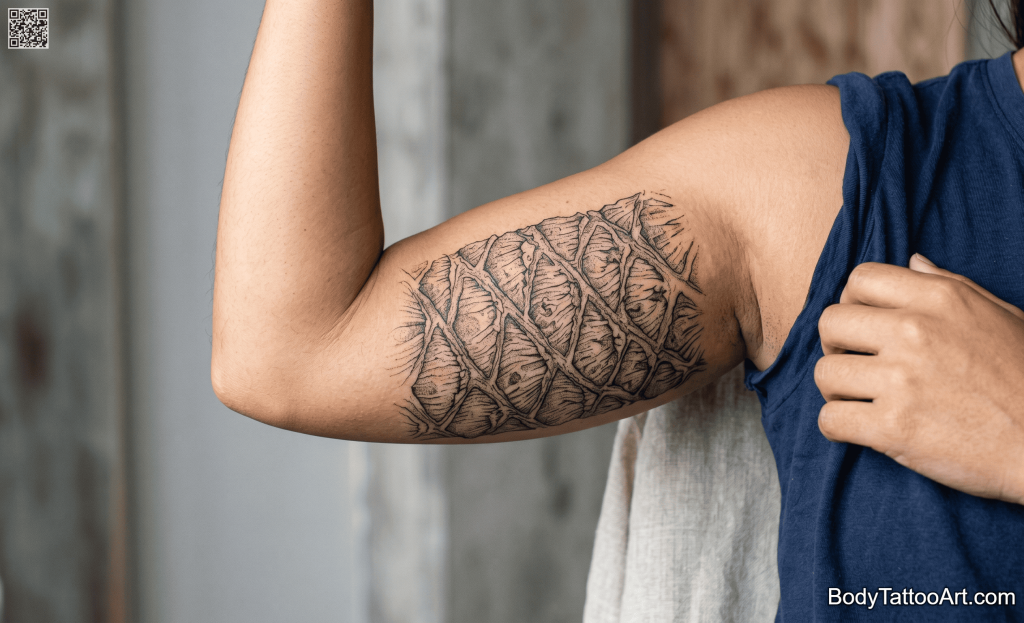
A close-up section of palm bark — just the mid-trunk, no canopy, no roots — fills the design space. The diamond-pattern bark texture is drawn in obsessive detail with fine lines and dotwork. It reads almost as an abstract pattern until the curved edges reveal it as a trunk.
Placement: Inner bicep
Style: Hyperrealistic fine line Palm Tree Tattoos
Why it stands out: Zooming in this far on a single texture is the kind of move that separates collector tattoos from casual ones.
Ideal for: Tattoo collectors, fine line enthusiasts, those who appreciate obsessive detail work.
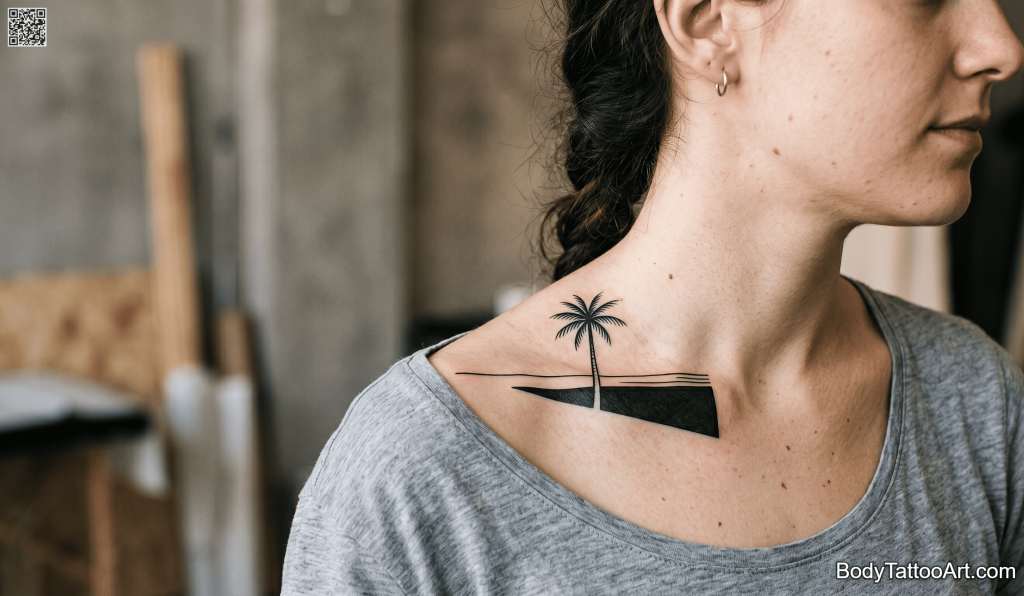
A single palm tree stands against a suggested horizon — a thin straight line cutting across the lower third of the composition. The sky above is left entirely empty. The ground below the horizon is solid black. The stark contrast and emptiness make this design feel vast.
Placement: Collarbone
Style: Blackwork graphic Palm Tree Tattoos
Why it stands out: The use of empty space is as deliberate as the drawn elements. The horizon line anchors the palm tree tattoo to the body.
Ideal for: People who love clean graphic compositions and understand that white space is a design tool.
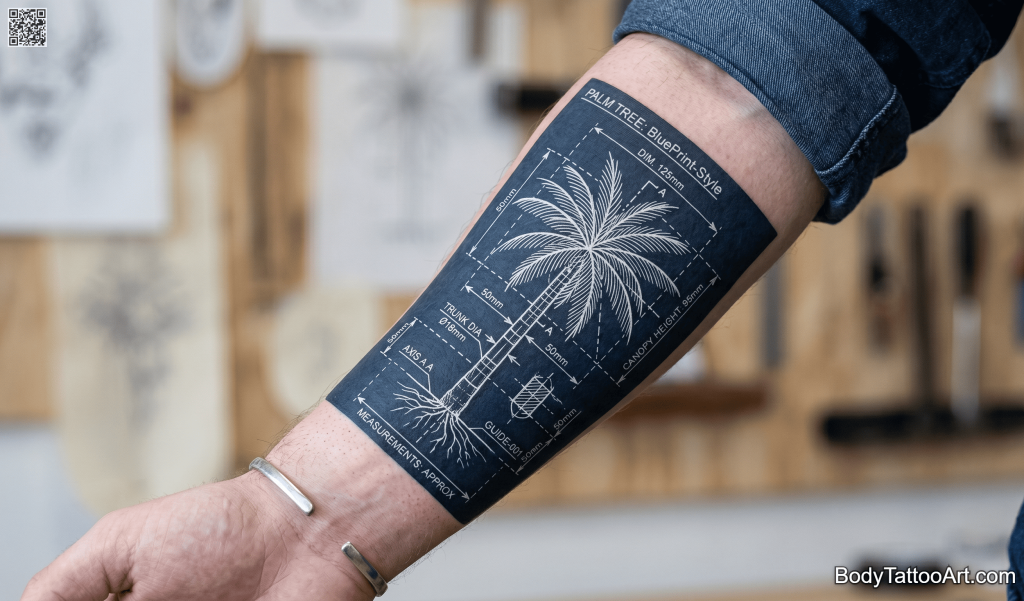
A palm tree drawn in the style of an architectural blueprint — white lines on a deep navy-blue tattooed background. Measurement annotations, dashed guide lines, and technical notation fill the space around the tree. The contrast between the dark field and white lines is sharp.
Placement: Forearm
Style: Blackwork with white ink details / blueprint aesthetic Palm Tree Tattoos
Why it stands out: The blueprint concept applied to a palm tree tattoo is completely unexpected and highly original.
Ideal for: Engineers, architects, or anyone who likes conceptual tattoo concepts.
The palm tree is drawn using topographic contour lines — the same kind used in elevation maps. Each line traces the three-dimensional surface of the trunk and canopy. From a distance it reads as a regular palm; up close it’s a topographic study.
Placement: Shoulder blade
Style: Fine line / contour map Palm Tree Tattoos
Why it stands out: The dual-read — normal at distance, intricate up close — is a hallmark of genuinely clever tattoo design.
Ideal for: Hikers, geographers, map enthusiasts, anyone drawn to conceptual fine line work.
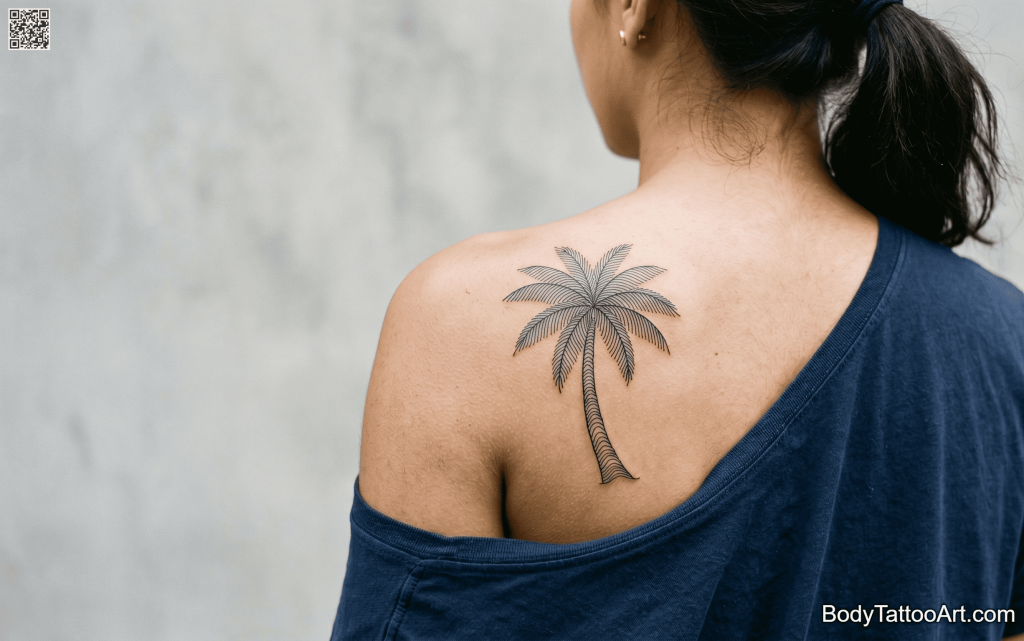
A single, extremely elongated palm tree — the trunk takes up 90% of the design. The fronds at the top are small and simple. The trunk has subtle ring detailing but no heavy shading. The design is all about height and proportion.
Placement: Outer calf running toward the knee
Style: Fine line minimal Palm Tree Tattoos
Why it stands out: The exaggerated height is the design decision. It challenges the usual proportions of palm tree tattoos.
Ideal for: Tall people who want a design that leans into verticality, or minimalists who like restraint.
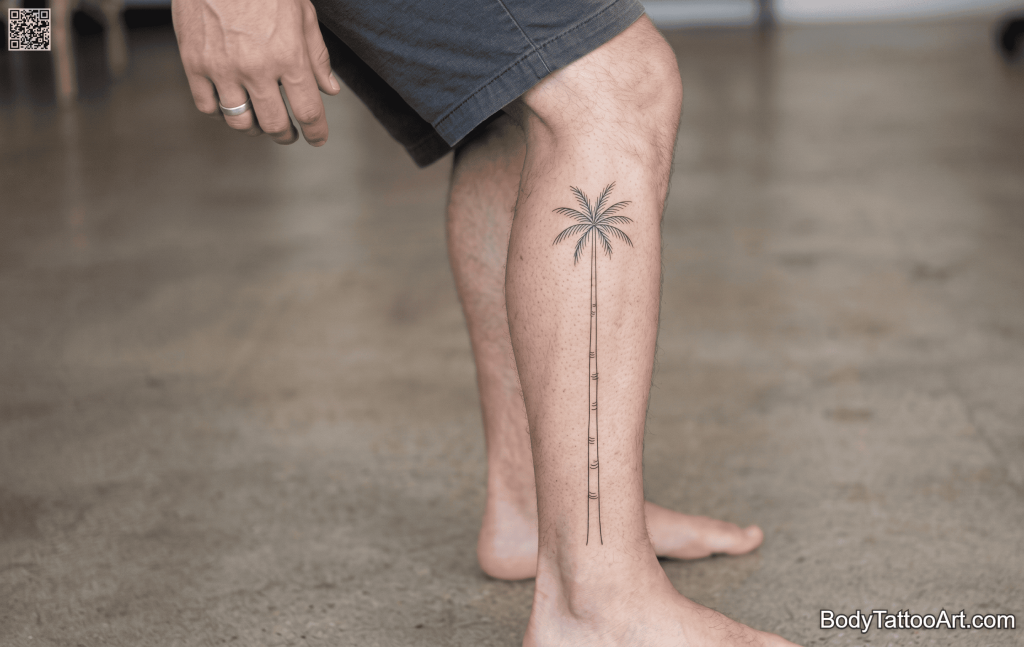
A palm tree outline is filled not with solid ink or shading — but with a wood grain pattern. Long flowing lines follow the grain direction of cut timber, turning the trunk into a cross-section reveal.
Placement: Back of hand / hand top
Style: Fine line graphic Palm Tree Tattoos
Why it stands out: The idea of showing the tree’s interior material within the shape of the tree itself is visually playful and conceptually tight.
Ideal for: People who enjoy pattern-within-shape tattoo compositions.
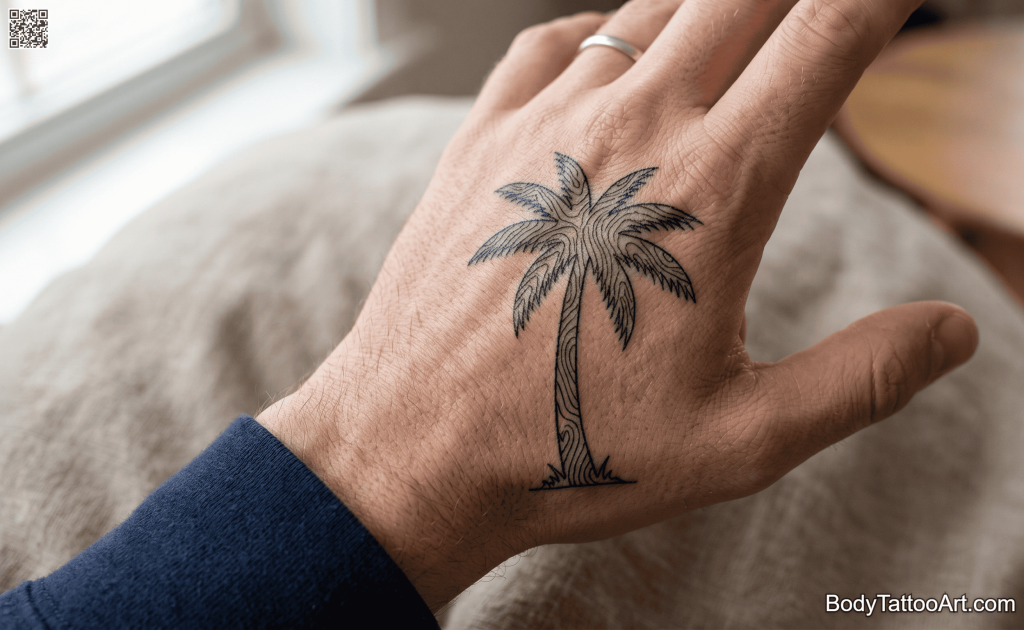
No trunk at all — just the top canopy of a palm, with the fronds spreading into a full fan shape. The fronds are drawn with detailed midrib lines and fine leaflet strokes. The base where they meet is tight and compact. It reads as a botanical illustration fragment.
Placement: Neck, below the ear
Style: Fine line botanical Palm Tree Tattoos
Why it stands out: Removing the trunk entirely changes what the tattoo communicates. It becomes about the crown rather than the tree.
Ideal for: People wanting a delicate neck piece that’s recognizable but unexpected.
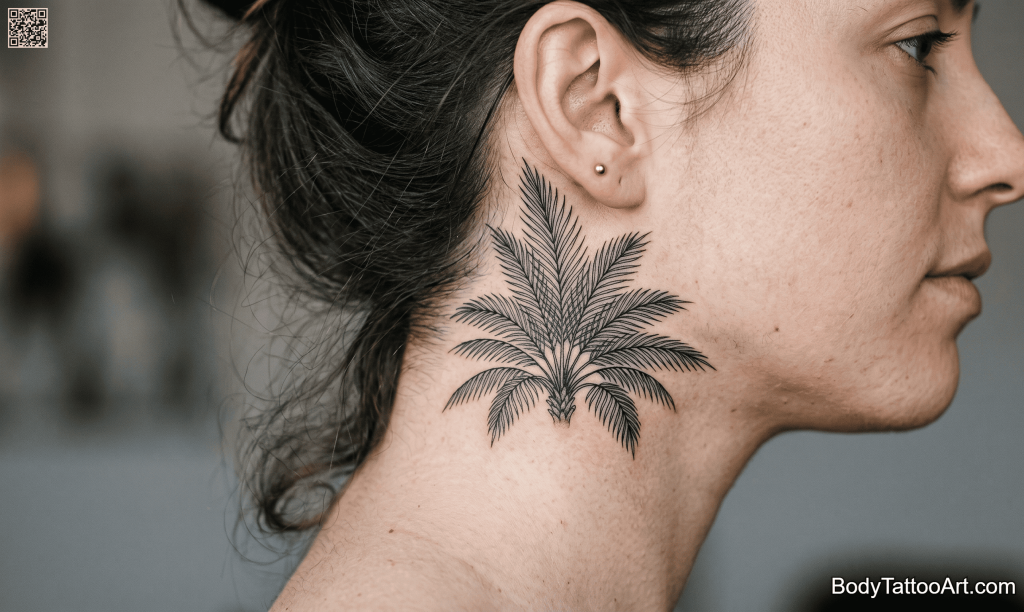
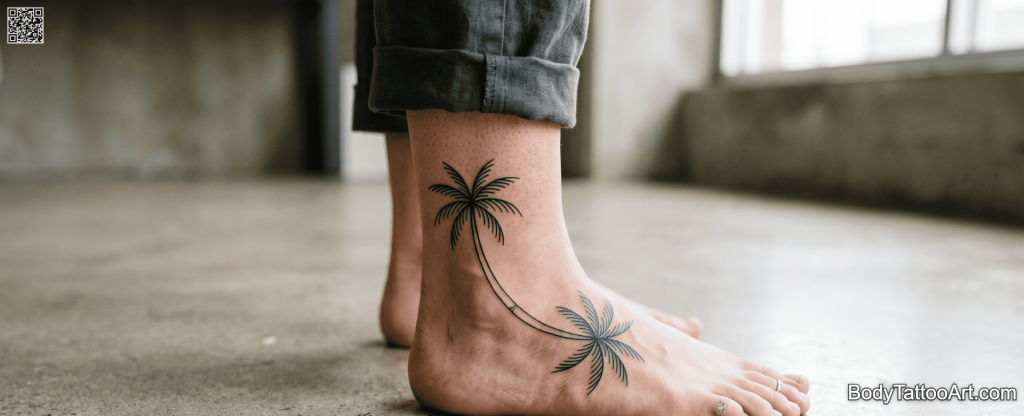
The palm tree itself is drawn in simple outline — but the shadow it casts is rendered in dense crosshatching on the ground below. The shadow is the most detailed, most ink-heavy part of the composition. The tree feels lightweight above its own heavy shadow.
Placement: Ankle / top of foot
Style: Fine line with crosshatch Palm Tree Tattoos
Why it stands out: Putting the visual weight in the shadow rather than the subject is an unusual compositional choice that rewards closer looking.
Ideal for: People who like tattoos with a built-in concept or visual riddle.
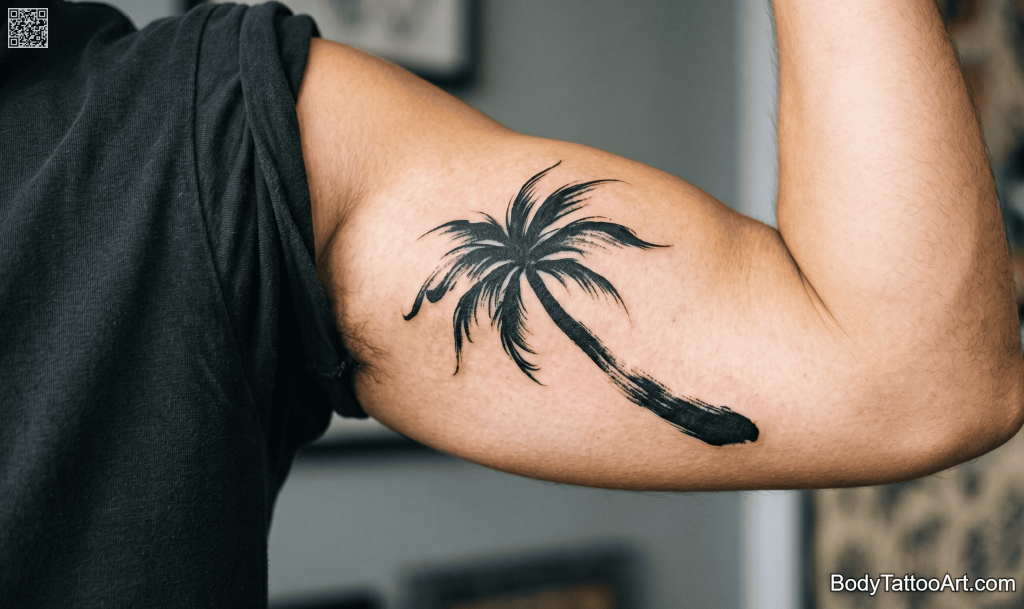
A palm tree painted in the sumi-e tradition — single gestural brushstrokes form the trunk and fronds with deliberate minimalism. The brushstrokes are thick at the base and taper to fine points. Ink coverage is intentionally inconsistent, leaving dry-brush texture visible.
Placement: Upper arm / outer bicep
Style: Sumi-e / Japanese ink painting Palm Tree Tattoos
Why it stands out: The dry-brush texture captured in tattoo ink is a technical feat. The piece has the spontaneous energy of a brushstroke painting.
Ideal for: People drawn to East Asian art traditions and calligraphic mark-making.
Tropical botanicals translate beautifully into tattoo form — and palm tree tattoos are just one entry point into that world. ivy tattoo designs go in a completely different direction with trailing, vine-like compositions.
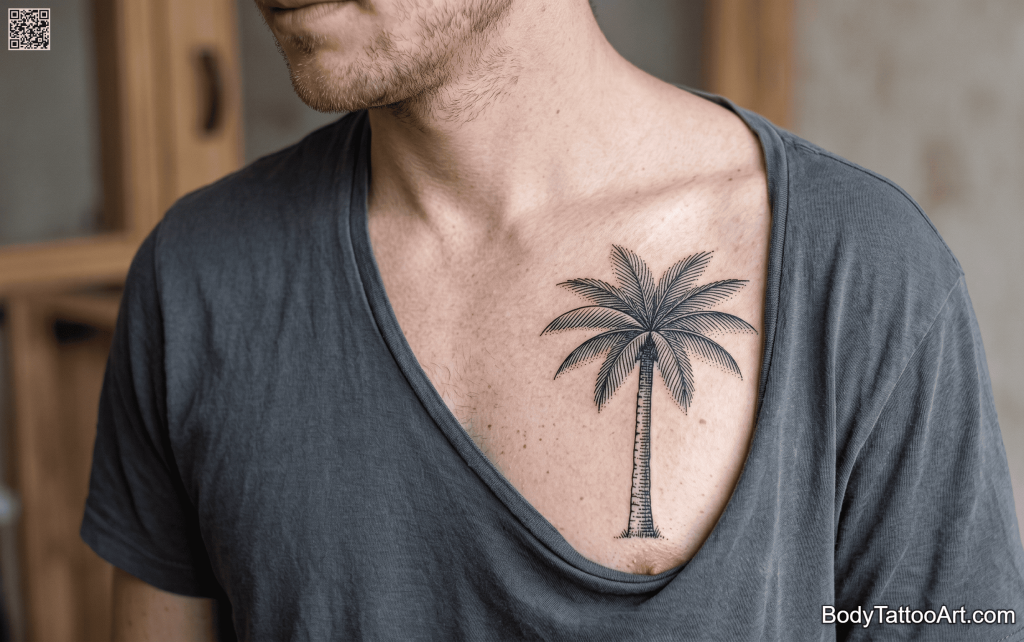
The entire palm tree is drawn to mimic a vintage wood engraving — parallel hatching lines of varying density build up the form. Darker areas have tightly packed lines; lighter areas have sparse lines with visible gaps. The overall effect looks like it was pulled from a 19th-century botanical journal.
Placement: Chest
Style: Engraving / etching Palm Tree Tattoos
Why it stands out: The engraving aesthetic gives palm tree tattoos a completely different register — historical, museum-quality, and deeply tactile looking.
Ideal for: People with an appreciation for historical illustration and printmaking traditions.
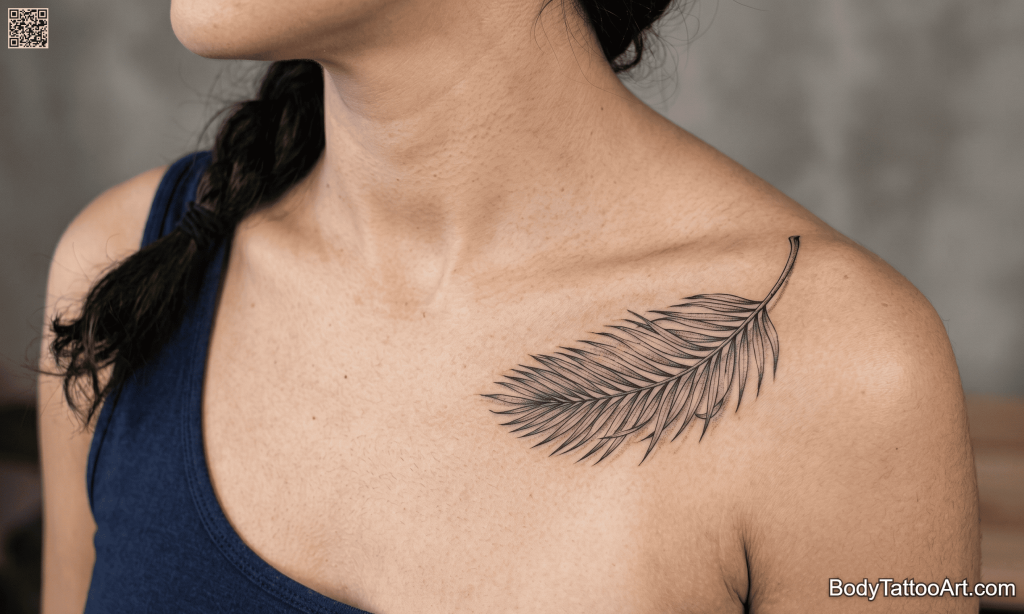
Not the whole tree — just one fallen frond, lying on its side as if it’s landed on the skin. The leaflets are drawn in fine detail, the midrib curves naturally, and there’s a subtle shadow below it suggesting it’s resting on a surface. Simple but unexpectedly evocative.
Placement: Collarbone / shoulder
Style: Fine line realism Palm Tree Tattoos
Why it stands out: Choosing one small part of a large subject and treating it with full attention is a mature design decision. It’s what separates thoughtful palm tree tattoos from generic ones.
Ideal for: People who prefer understated designs that still carry real visual craft.
Palm tree tattoos have earned their place as a genuinely versatile tattoo subject — not because they’re trendy, but because the form is so adaptable. A palm tree tattoo can be a minimalist one-line sketch, a technically demanding dotwork study, an architectural diagram, or a loose gestural painting. The subject stays the same; the approach changes everything.
The 27 designs above cover as wide a range of styles, placements, and compositional ideas as possible. Whether someone is booking their first session or adding to a full collection, there’s a version of a palm tree tattoo in this list that fits.
The most important thing — as with any tattoo — is choosing a design that works for the specific body placement and doesn’t just follow what’s popular. A palm tree tattoo done with intention will always outlast a trend.