Physical Address
304 North Cardinal St.
Dorchester Center, MA 02124
Physical Address
304 North Cardinal St.
Dorchester Center, MA 02124

Succulent tattoos have been quietly taking over the tattoo world — and honestly, it makes complete sense. These little plants are resilient, structurally fascinating, and visually unlike anything else in nature. Whether it’s the tight geometric rosette of an Echeveria or the plump stacked leaves of a Haworthia, there’s something about succulents that translates beautifully into ink.
What makes succulent tattoos so appealing is the range they offer. They can go minimal and delicate, or bold and graphic. The natural geometry of succulent leaves creates incredible design opportunities — symmetry, layering, shadow play — that most floral tattoos don’t have. That’s why more and more people are choosing succulent tattoos over traditional floral designs.
This blog covers 28 distinct succulent tattoo ideas, each with different styles, placements, and compositions. Whether someone is getting their first tattoo or adding to a collection, there’s something here for everyone.
Succulent tattoos carry quiet but powerful symbolism. Succulents survive in harsh conditions — drought, heat, neglect — and still thrive. That endurance translates into symbolism around resilience, patience, and self-sufficiency.
They also represent adaptability and growth without needing constant attention — something many people find deeply personal. In some interpretations, they symbolize the beauty of taking up space quietly, without demanding anything from the world around them.
For a deeper look at the biology and varieties of succulents that inspire these designs, the Wikipedia page on Succulent Plants is a great starting point.
Succulent tattoos are also connected to themes of quiet strength — they don’t bloom dramatically like roses, but their structural beauty is undeniable. That understated confidence is exactly what draws so many people to this design.
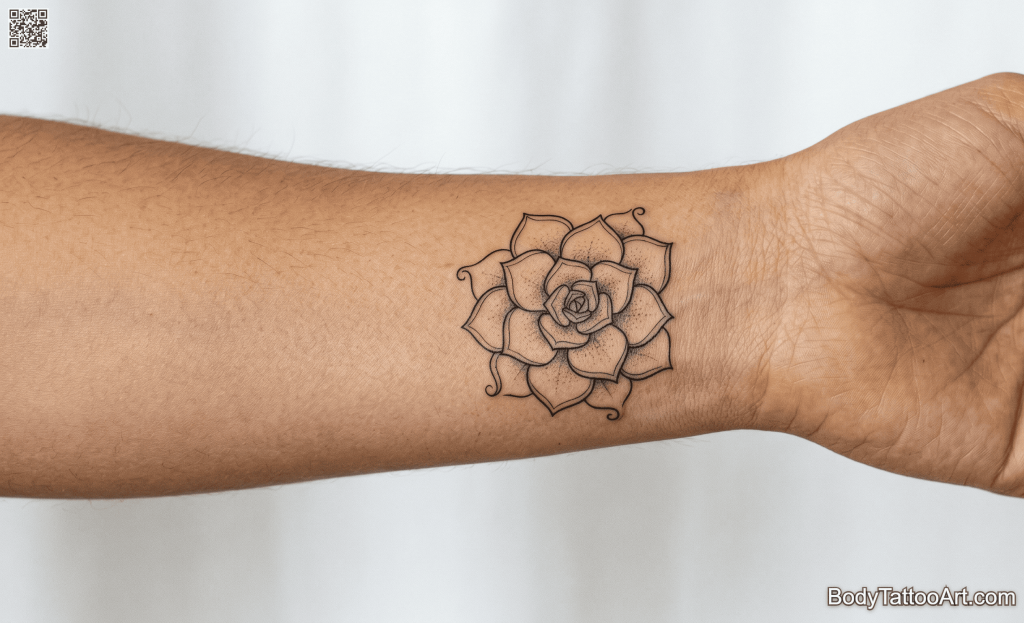
A single Echeveria drawn in fine line, with each leaf carefully outlined and a soft dot-shading gradient pulling inward toward the center. The outermost leaves curl slightly at the tips, giving the design natural movement. The composition is tight and circular, almost medallion-like.
Placement: Inner wrist
Style: Fine line with dot shading Succulent Tattoos
Why it stands out: The concentric layering of the leaves creates natural symmetry that looks intentional without being rigid. It’s clean, compact, and incredibly precise.
Ideal for: Fine line lovers, minimalists, first-time tattoo getters.
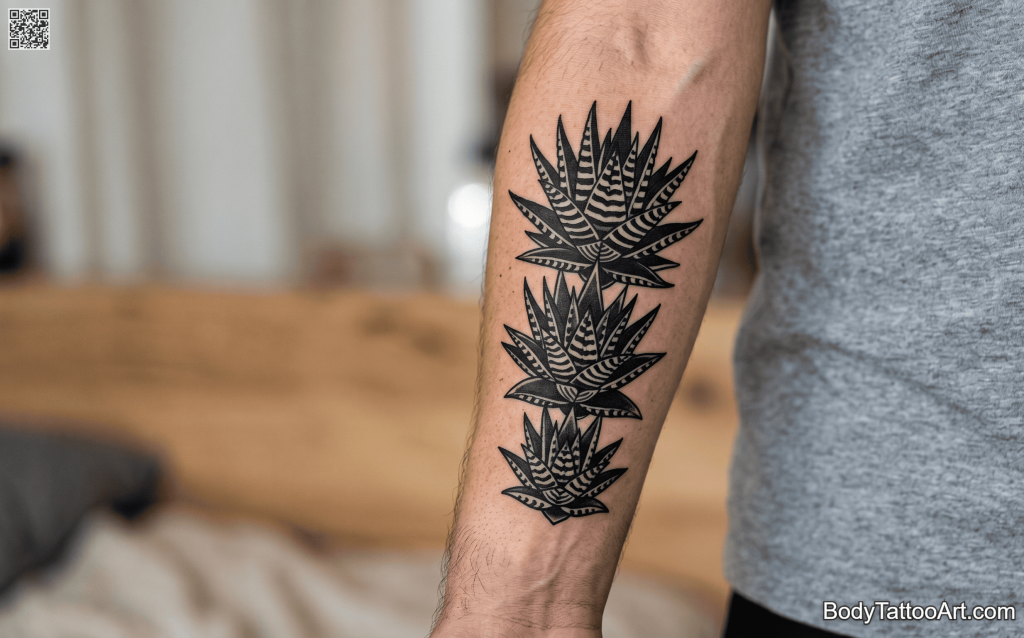
Three Haworthia plants of slightly different sizes stacked vertically, rendered in blackwork. The white striping pattern on Haworthia leaves is recreated through negative space — the skin showing through instead of white ink. The overall composition is long and narrow, flowing naturally along the body.
Placement: Forearm (vertical)
Style: Blackwork with negative space Succulent Tattoos
Why it stands out: The use of negative space to recreate the Haworthia’s natural white stripes is clever and graphic. It feels architectural.
Ideal for: Bold style fans, blackwork collectors, people who prefer structured designs.
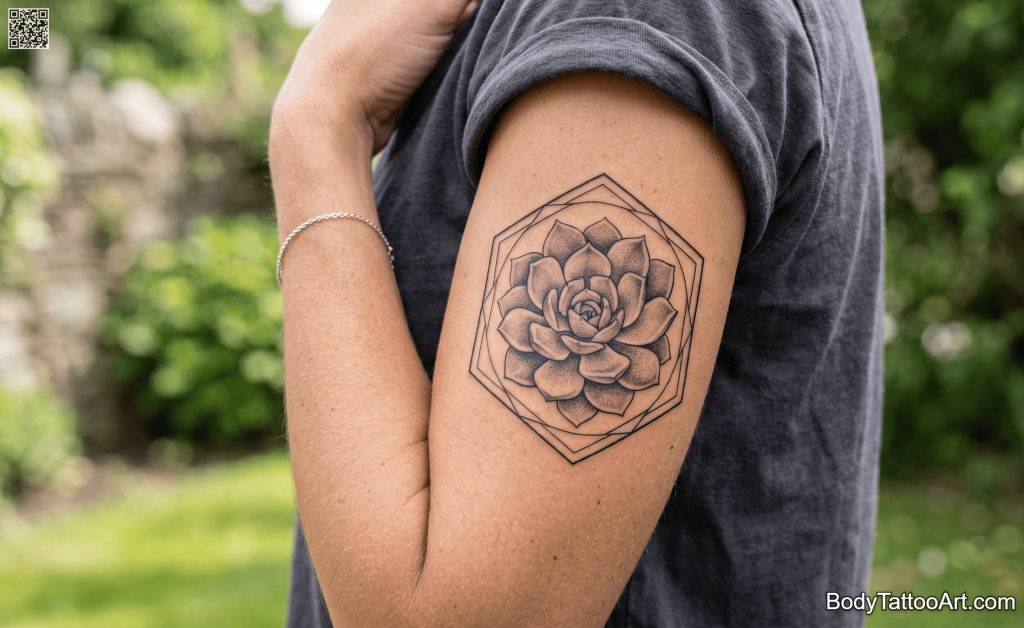
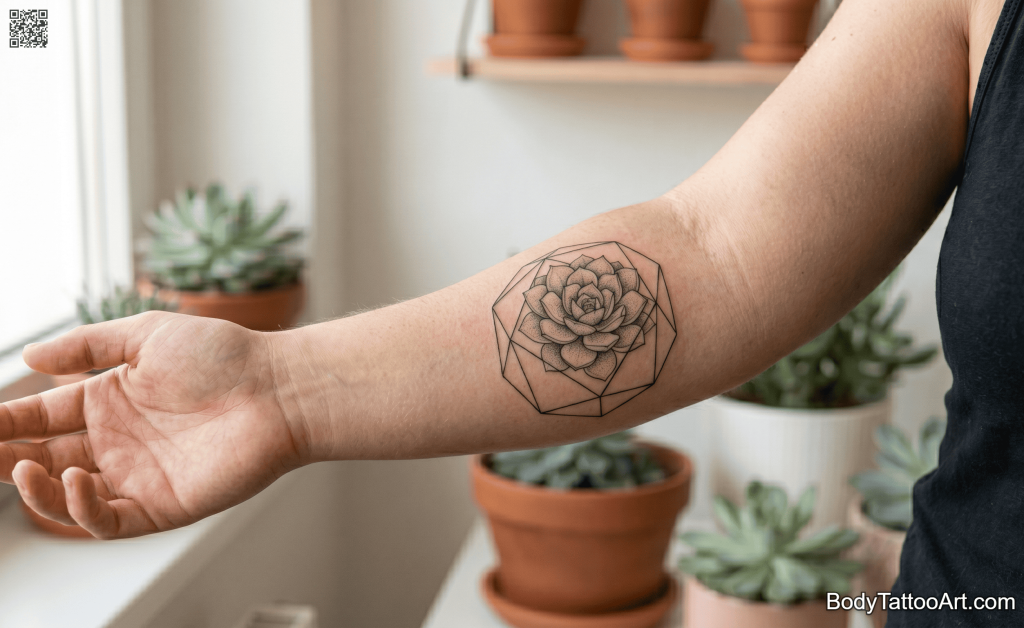
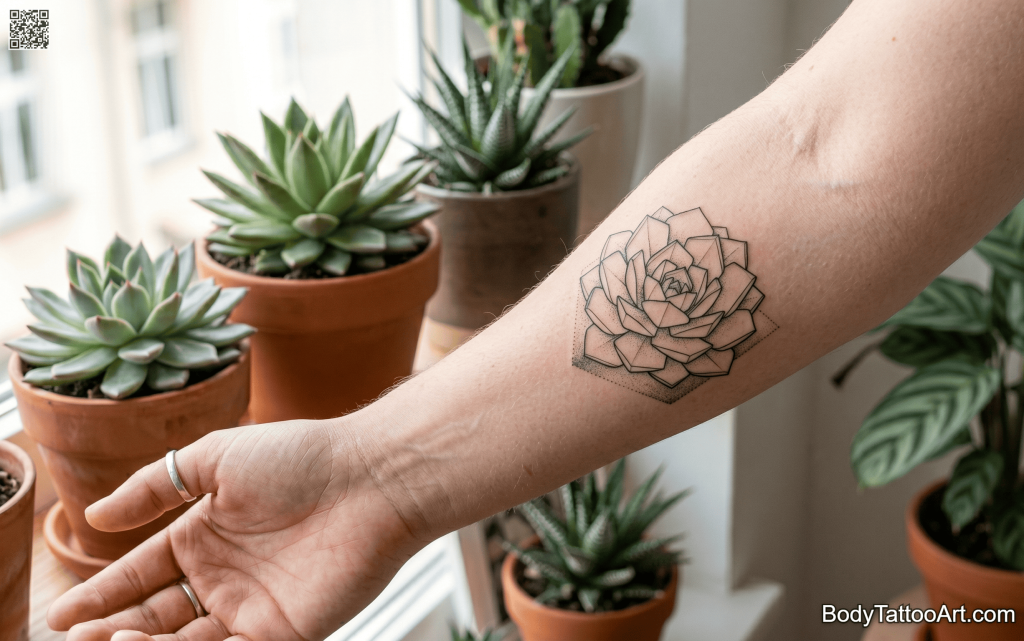
An Echeveria sits at the center of a hexagonal geometric frame. The succulent itself is detailed with realistic shading while the frame remains clean and line-based. The contrast between the organic plant and the rigid geometry creates an interesting visual tension.
Placement: Upper arm
Style: Geometric realism hybrid Succulent Tattoos
Why it stands out: The hard geometry of the frame makes the soft organic succulent pop dramatically. The two styles don’t fight — they complement.
Ideal for: Geometry tattoo fans, people who like contrast in design, intermediate collectors
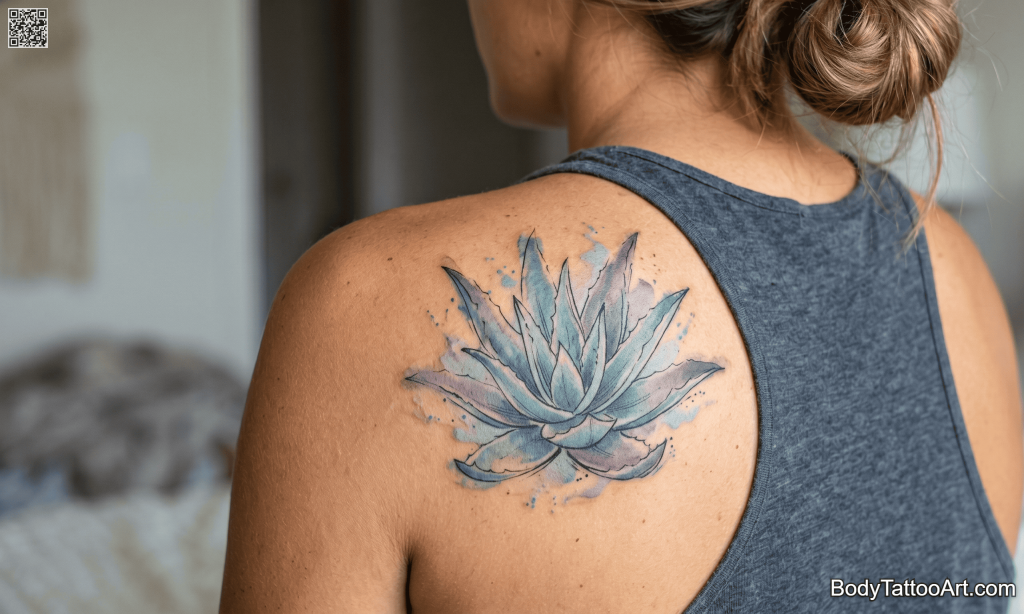
A single aloe plant rendered with loose, expressive brushstroke-style shading in muted blue-greens and dusty purples. The linework is minimal — the color does the heavy lifting. Edges bleed softly outward, mimicking actual watercolor on paper.
Placement: Shoulder blade
Style: Watercolor Succulent Tattoos
Why it stands out: Most succulent tattoos lean monochrome. This one embraces color in a restrained, painterly way. The soft bleeding edges feel artistic rather than decorative.
Ideal for: Color tattoo fans, people who prefer artistic over precise styles.
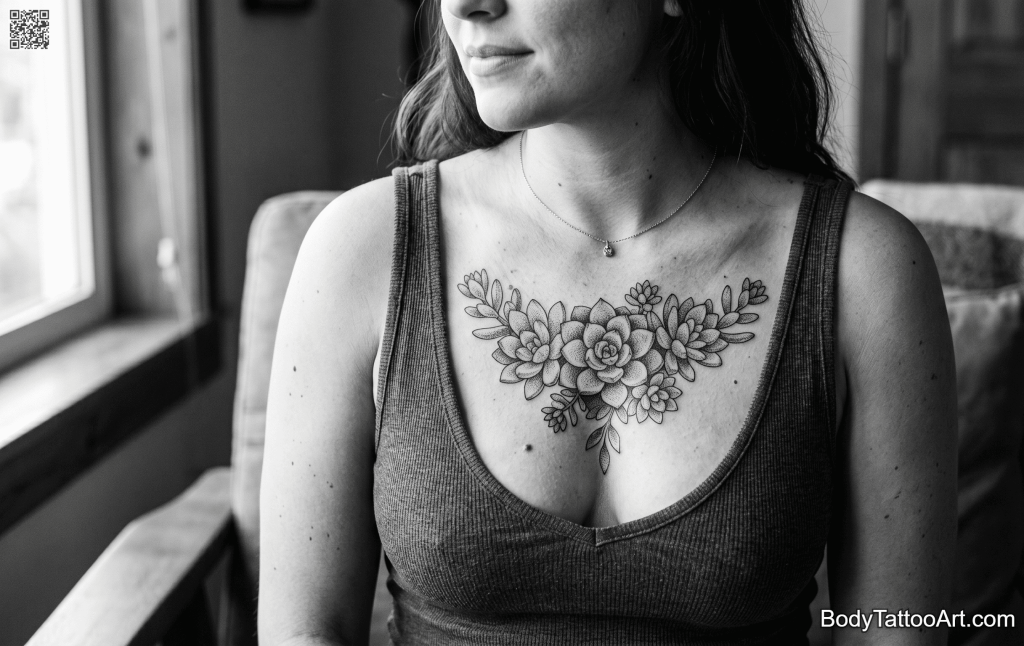
A dense cluster of Sedum succulents rendered entirely in dotwork — no solid lines, just thousands of tiny dots building up form and shadow. The result is a soft, almost velvet-like texture that catches the eye from a distance and rewards a closer look.
Placement: Sternum
Style: Dotwork Succulent Tattoos
Why it stands out: Pure dotwork on something as textured as a succulent creates incredible depth. The dots mimic the actual granular surface of Sedum leaves surprisingly well.
Ideal for: Dotwork enthusiasts, people getting sternum pieces, tattoo collectors.
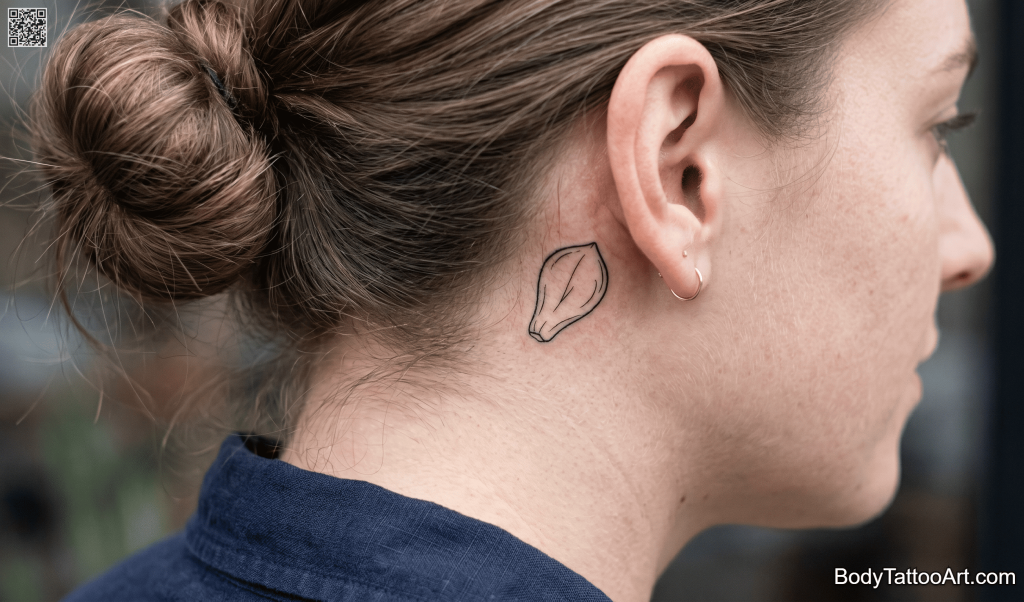
Just one plump succulent leaf — likely Jade or Crassula — rendered in the simplest possible outline with a single thin line and no shading whatsoever. The shape alone carries the design.
Placement: Behind the ear
Style: Minimalist line art Succulent Tattoos
Why it stands out: Sometimes the most restrained tattoo is the most striking. This one trusts the silhouette completely.
Ideal for: True minimalists, people wanting tiny or hidden tattoos, first-timers.
if succulent tattoos appeal because of their clean, botanical quality, it’s worth exploring fern tattoo designs and palm leaf tattoo ideas too — both share that same structural elegance.
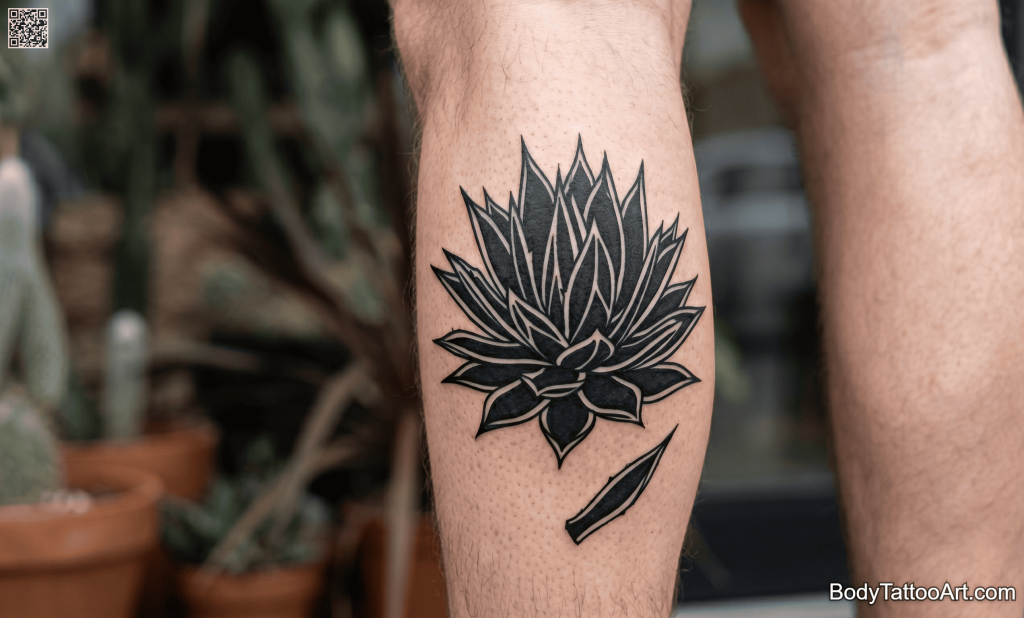
A large blackwork Agave rendered with thick, confident strokes. The pointed leaf tips are sharp and dramatic, and the shading uses thick-to-thin line variation to suggest volume. There are no gradients here — just bold, intentional mark-making.
Placement: Outer calf
Style: Blackwork Succulent Tattoos
Why it stands out: Agave has an angular, dramatic structure that’s made for bold blackwork. The sharp tips and bold strokes give this tattoo real presence.
Ideal for: Bold tattoo fans, people building leg sleeves, those who prefer graphic styles.
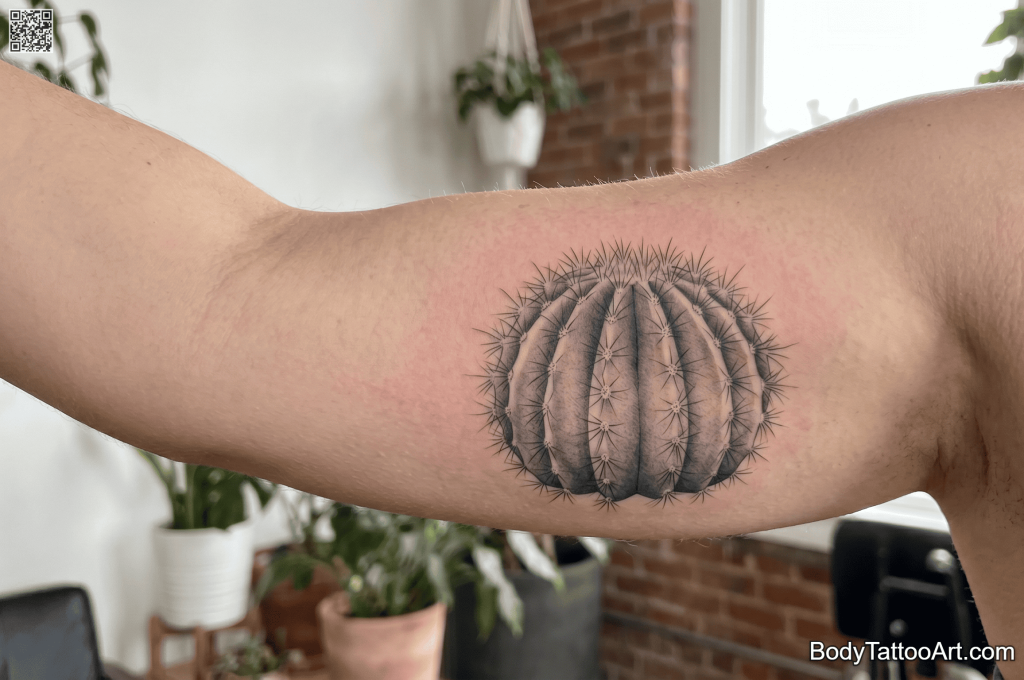
A barrel cactus — technically a succulent — rendered in detailed grey-wash realism. The ribbed texture is shaded with soft gradients, and the spines are individually drawn with fine hairlines. The overall effect is almost photographic.
Placement: Bicep
Style: Grey-wash realism Succulent Tattoos
Why it stands out: The ribbed texture of a barrel cactus is a shading challenge, and when done well it looks extraordinary. Each rib catches light differently.
Ideal for: Realism fans, collectors building arm pieces, people who appreciate technical tattoo work.
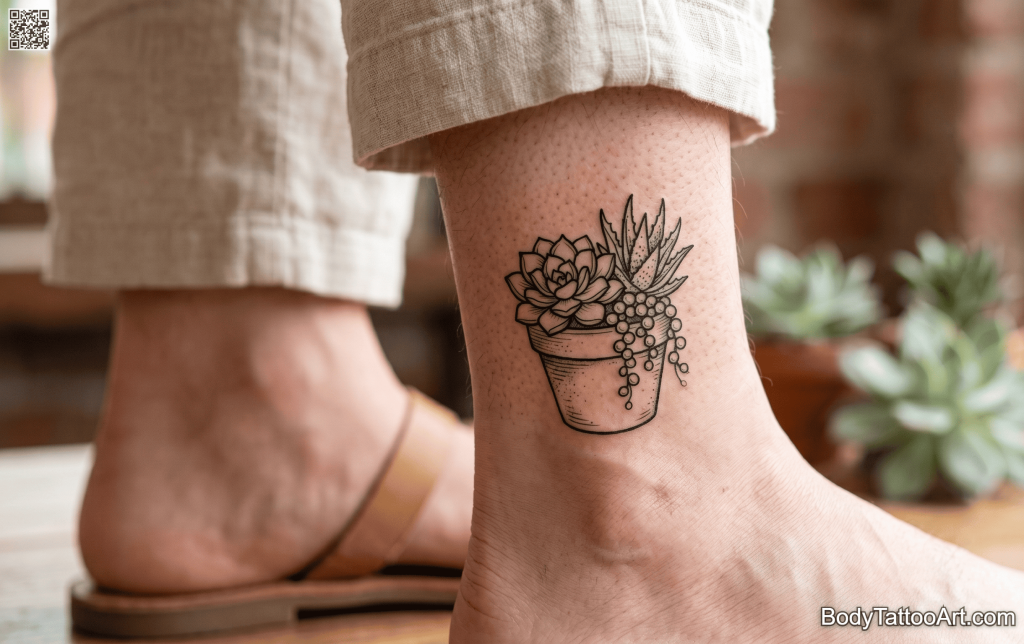
A small illustrated pot with three different succulent varieties peeking out — an Echeveria, a small aloe, and a trailing String of Pearls. The illustration style is clean and slightly cartoonish without being childish. Each plant is distinct in shape.
Placement: Ankle
Style: Illustrative / neo-traditional Succulent Tattoos
Why it stands out: The variety of leaf shapes in one compact design creates visual interest in a very small space. It’s charming without being cutesy.
Ideal for: People who love illustrated styles, ankle tattoo seekers, plant lovers.
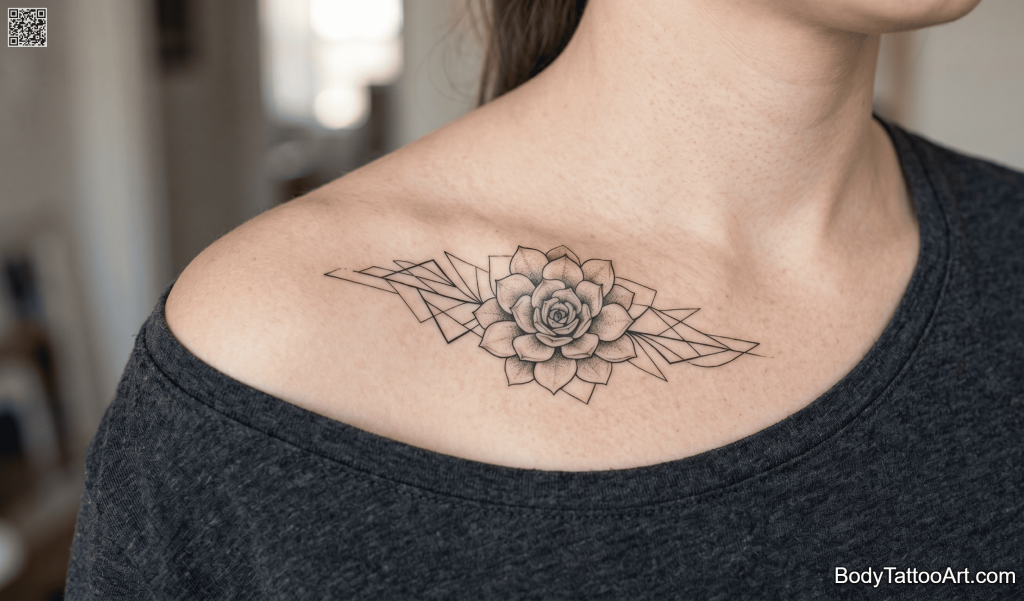
An Echeveria that’s been partially abstracted — the inner core is realistic while the outer leaves dissolve into clean geometric line segments and triangles. Half organic, half abstract.
Placement: Collarbone
Style: Abstract geometric Succulent Tattoos
Why it stands out: The contrast between the detailed core and the fragmented outer leaves makes the eye travel inward. It’s unexpected and visually layered.
Ideal for: Abstract tattoo lovers, collarbone piece seekers, creative collectors.
For people drawn to botanical tattoo ideas with that same clean geometry, olive branch tattoo designs and ivy tattoo ideas offer a great range of styles to explore.
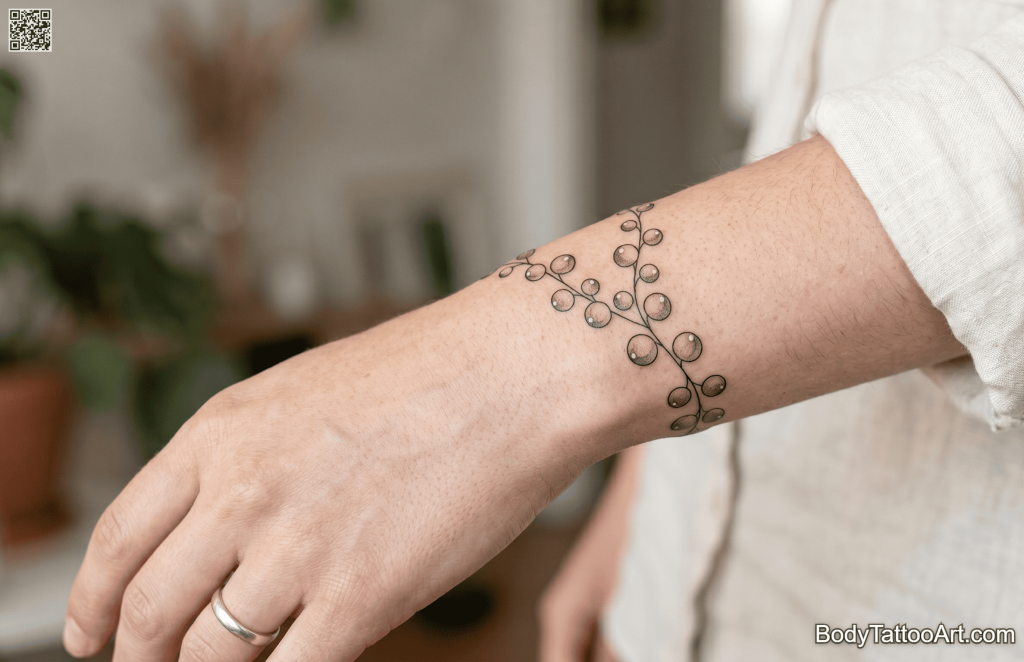
A String of Pearls succulent drawn to wrap around the wrist like a bracelet. The round pearls are shaded with a small highlight dot to give each one dimension. The trailing vine connects them naturally.
Placement: Wrist (wrap-around)
Style: Fine line with shading Succulent Tattoos
Why it stands out: The wrap-around concept suits String of Pearls perfectly — the plant actually trails in real life. The placement feels completely natural.
Ideal for: Delicate tattoo fans, people wanting bracelet-style designs, fine line lovers.
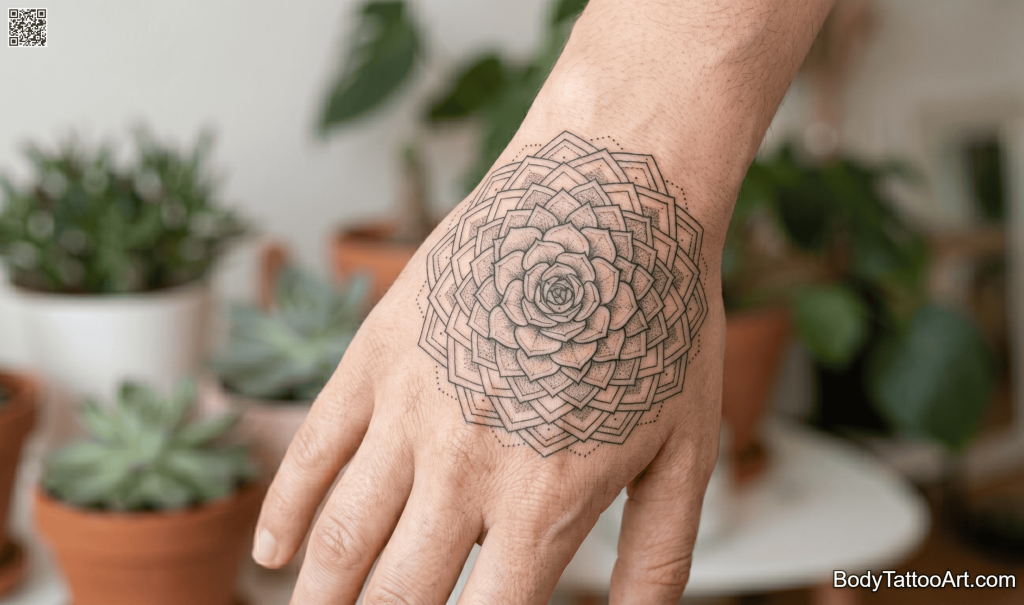
An Echeveria rosette that transitions gradually into a mandala pattern as it moves outward. The center is a fully detailed succulent, and the outer rings use petal-like geometric repetition mirroring the succulent’s own leaf arrangement.
Placement: Back of hand
Style: Geometric mandala Succulent Tattoos
Why it stands out: The transition is seamless because the succulent’s natural radial symmetry already echoes mandala structure. They feel like the same design in two different languages.
Ideal for: Mandala fans, back-of-hand piece collectors, those who love symmetry.
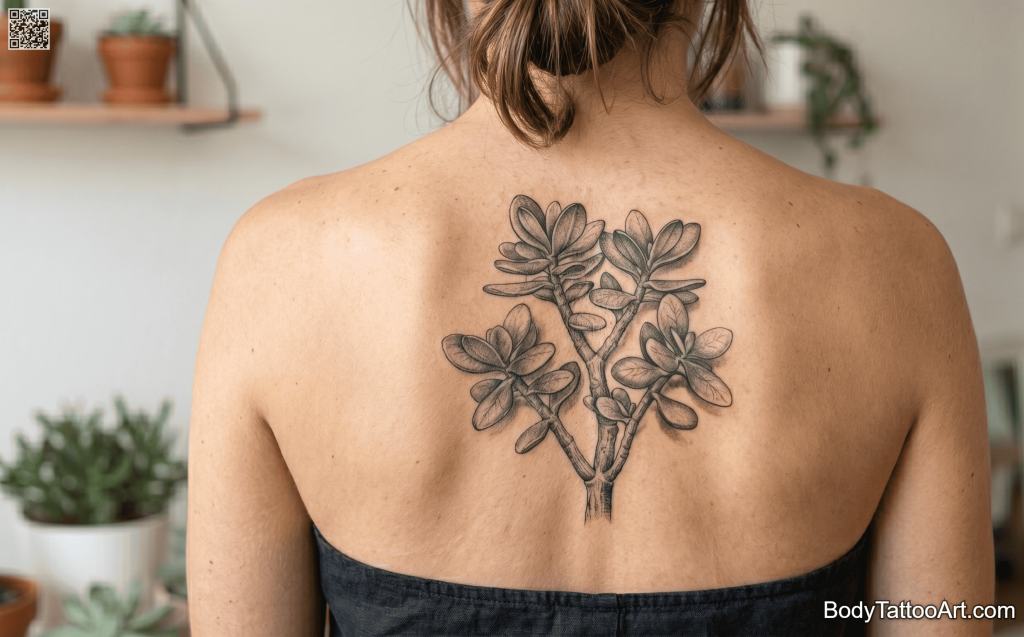
A Jade plant (Crassula ovata) rendered in clean realism — thick oval leaves with subtle vein detailing, woody branching stems, and soft drop shadow shading to give the plant lift off the skin.
Placement: Upper back (between shoulder blades)
Style: Realism Succulent Tattoos
Why it stands out: Jade plants have a bonsai-like silhouette that photographs beautifully. The woody branch structure gives this piece weight and grounding.
Ideal for: Realism collectors, people planning back pieces, plant enthusiasts.
An angular, geometric terrarium-style pot rendered in clean line art, containing a single large Echeveria. The pot has facets like a cut gemstone. No shading on the pot — all detail is in the succulent.
Placement: Forearm
Style: Line art / geometric Succulent Tattoos
Why it stands out: The contrast between the angular crystalline pot and the organic succulent inside creates a really satisfying visual balance. It’s graphic and botanical at once.
Ideal for: Geometric style fans, forearm piece collectors, people who like modern design aesthetics.
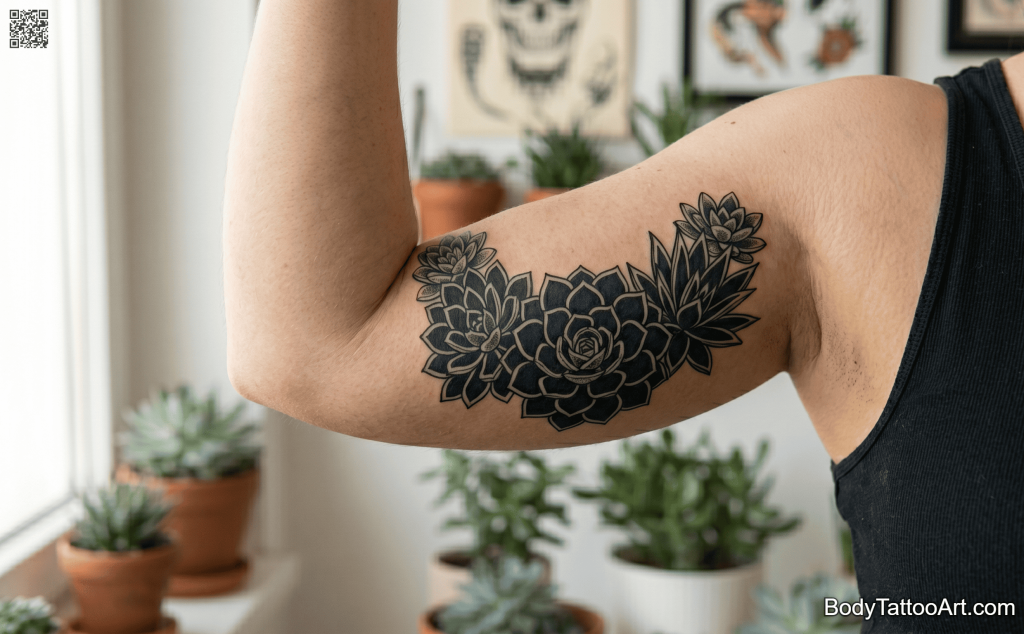
Five small succulent rosettes arranged in a crown or halo arc. Each rosette is slightly different in size and leaf shape. The blackwork style keeps it graphic and bold.
Placement: Upper arm (wrap)
Style: Blackwork Succulent Tattoos
Why it stands out: The crown composition gives the piece an almost ceremonial quality. Five distinct rosettes side by side show off how much variety exists even within succulent types.
Ideal for: Bold tattoo lovers, upper arm band seekers, collectors who love blackwork.
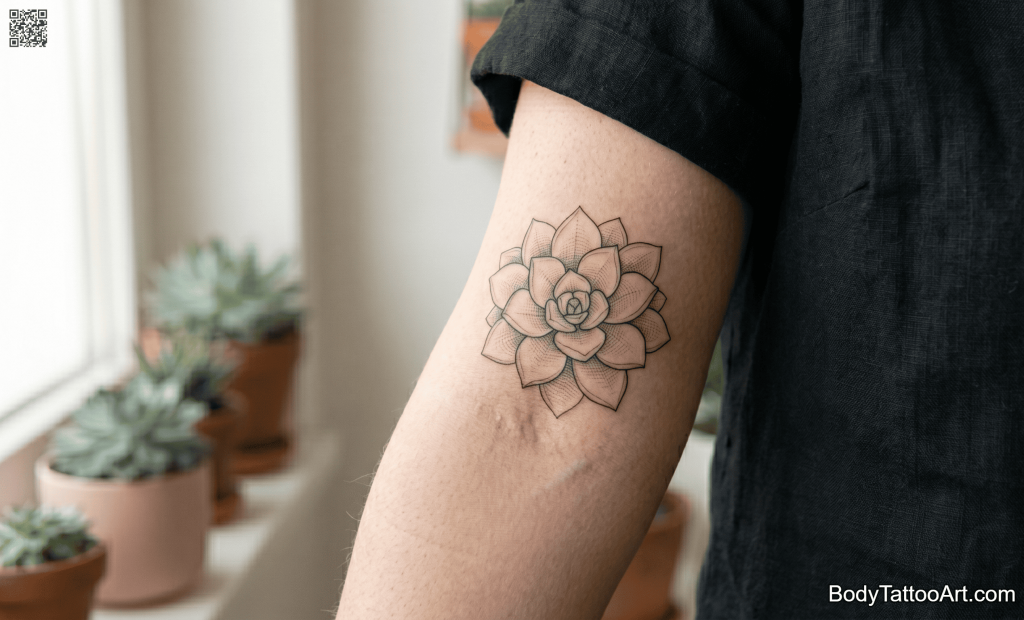
A Ghost Plant (Graptopetalum paraguayense) in ultra-fine line — the pale lavender-pink tones of the real plant translated into delicate crosshatching and micro-shading in black ink. The leaves overlap softly, and the composition fans outward like a real rosette.
Placement: Inner elbow
Style: Fine line with crosshatch shading Succulent Tattoos
Why it stands out: Ghost plants have a naturally ethereal quality — the fine line style honors that. The crosshatching creates texture without heaviness.
Ideal for: Fine line collectors, inner elbow piece seekers, people drawn to delicate botanical work.
People exploring botanical tattoos with this kind of delicate detailing might also love magnolia tattoo designs or camellia tattoo ideas — both reward the same kind of precise linework.
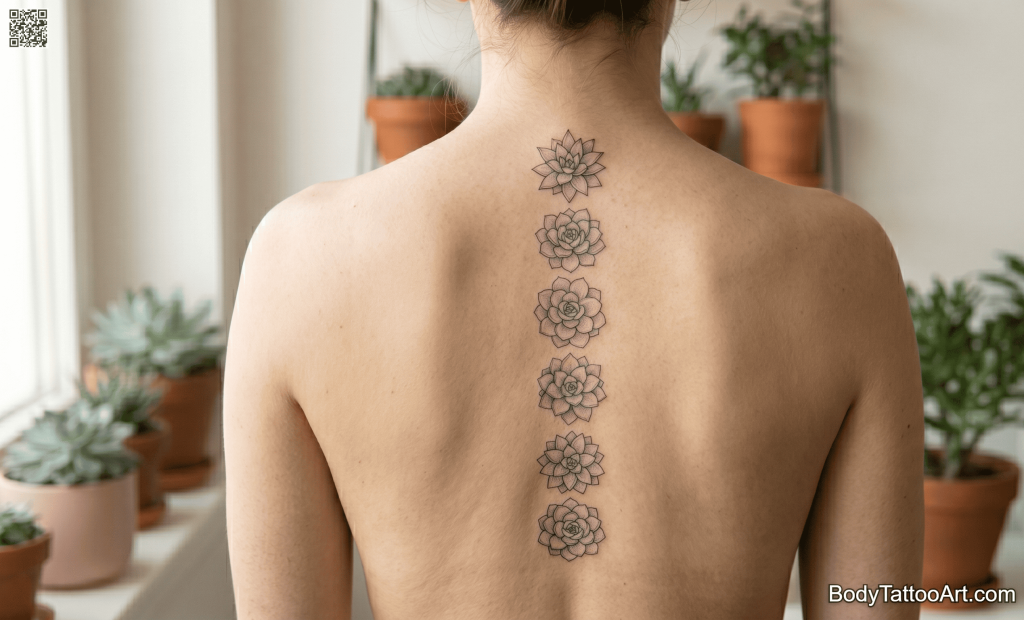
A vertical column of alternating succulent rosettes running along the spine — six to eight small Echeverias of different varieties placed in a clean single-file arrangement. Each rosette is unique in shape and size.
Placement: Spine (back)
Style: Fine line Succulent Tattoos
Why it stands out: The vertical rhythm of rosettes along the spine is both elegant and anatomically satisfying. Each one reads individually but together they form a cohesive column.
Ideal for: Back tattoo seekers, people planning spine pieces, collectors who love botanical repetition.
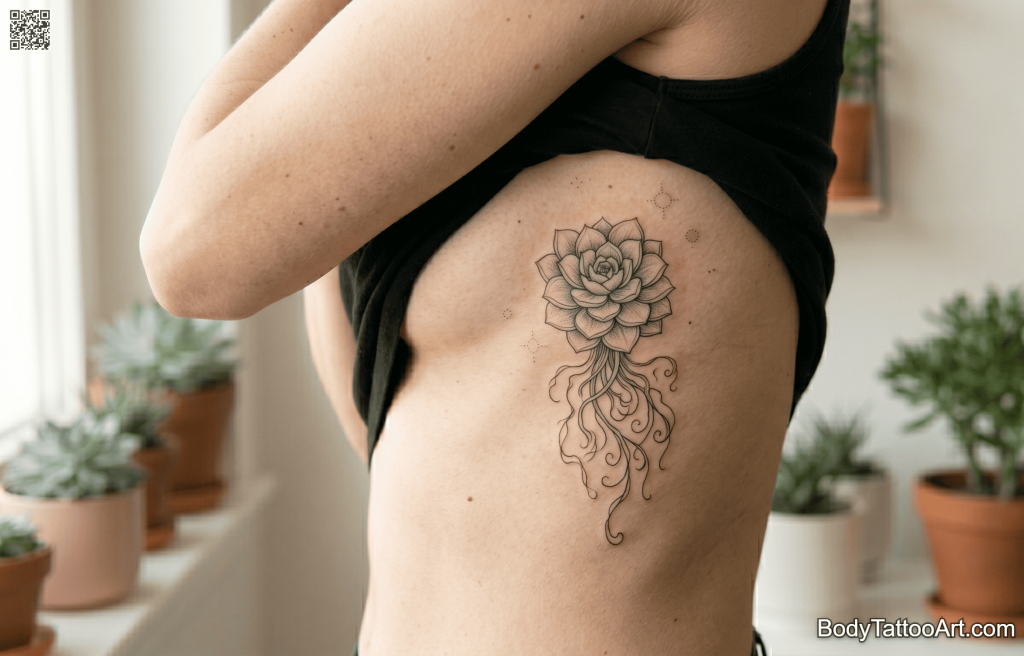
An Echeveria floating in mid-air with its roots exposed and hanging loosely below. The roots trail in organic, curling lines. The composition has a surreal, dreamlike quality — the plant exists in empty space.
Placement: Rib cage
Style: Surrealism / fine line Succulent Tattoos
Why it stands out: Exposing the roots adds a layer of raw honesty to the design. The floating composition and bare roots give it an emotional charge without spelling anything out.
Ideal for: People drawn to surrealist concepts, rib piece seekers, those who want something with visual depth.
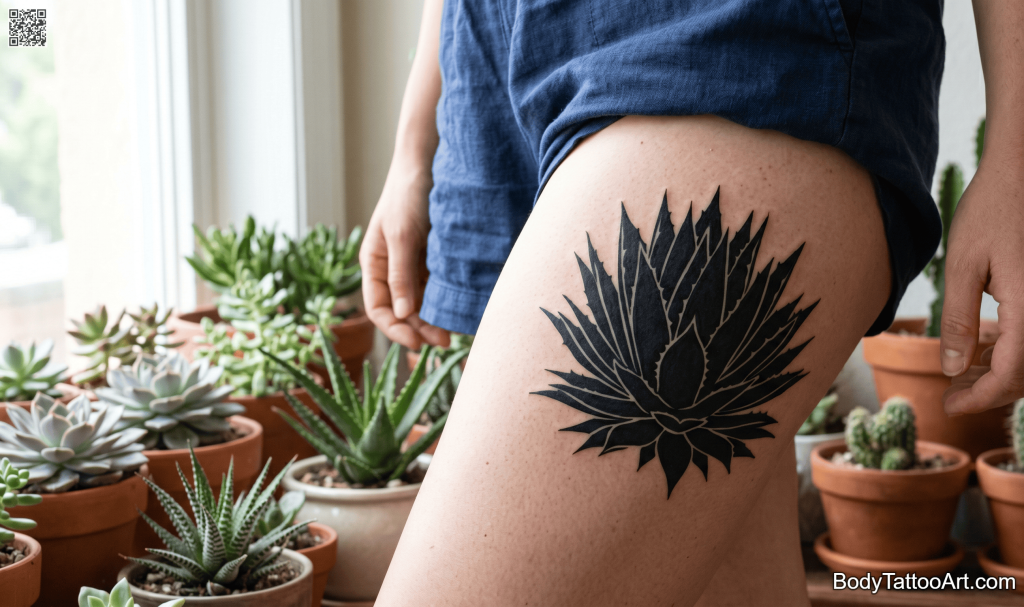
A pure black silhouette of an Agave plant — no detail, no shading, just the clean filled shape. The composition relies entirely on the dramatic spiky outline of the Agave to carry visual weight.
Placement: Outer thigh
Style: Silhouette / blackwork fill Succulent Tattoos
Why it stands out: Negative space is used in reverse — the plant is all black, and the skin becomes the light. The dramatic Agave silhouette is unmistakable and bold.
Ideal for: Bold blackwork fans, outer thigh piece seekers, those who prefer clean graphic designs.
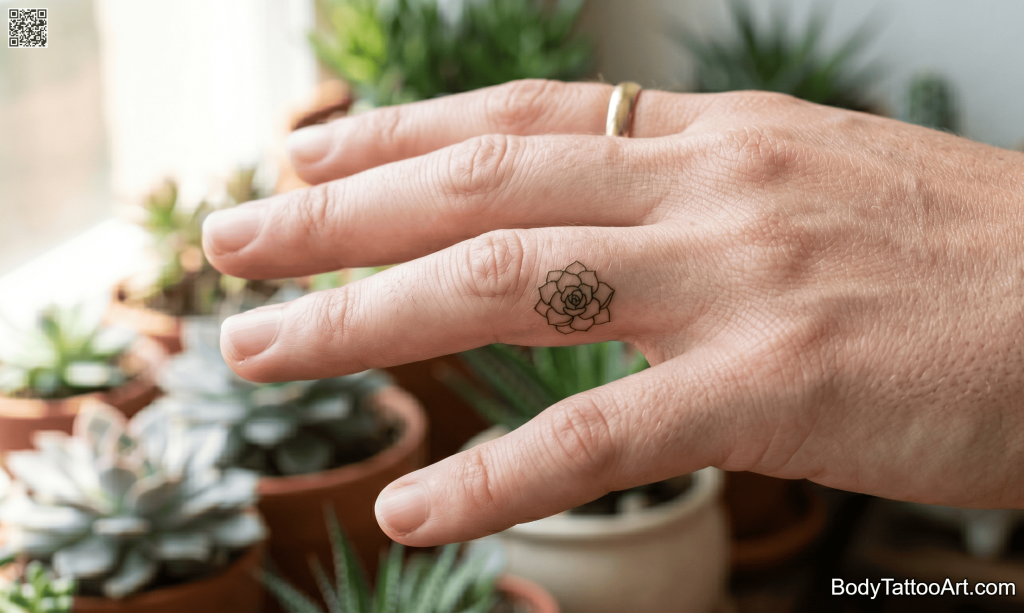
The world’s tiniest Echeveria — barely half an inch — rendered in a single fine continuous line. This is as small as a succulent tattoo can possibly get while still being recognizable.
Placement: Finger (side)
Style: Micro fine line Succulent Tattoos
Why it stands out: The challenge of capturing a rosette at micro scale in clean linework is enormous. When done well it’s quietly impressive.
Ideal for: People wanting very small or hidden tattoos, finger tattoo seekers, minimalists.
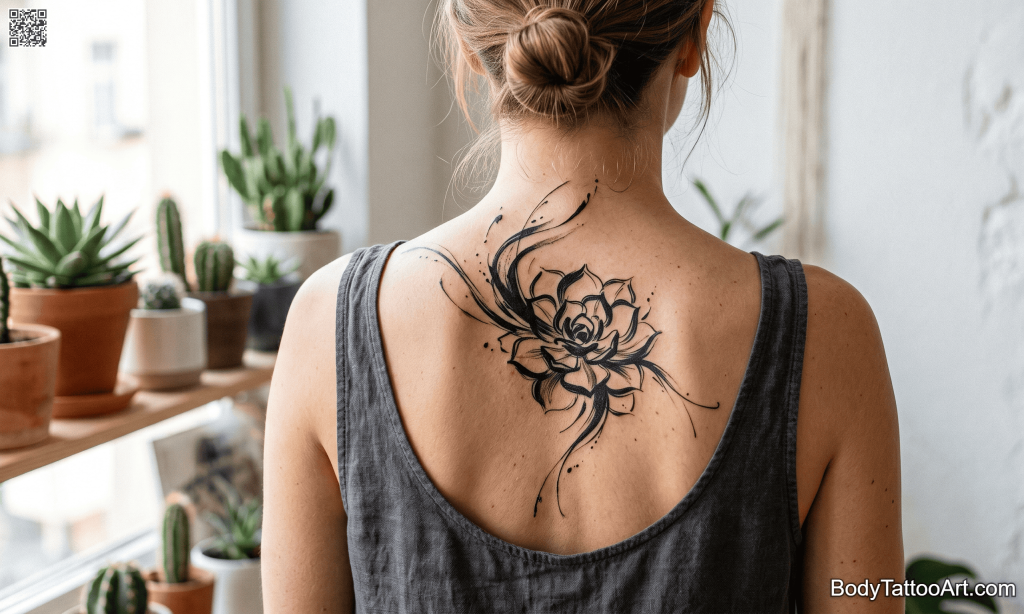
An Echeveria painted in loose, gestural brushstrokes — the design looks halfway between a tattoo and an abstract painting. Some strokes are thick and confident, others trail off. The composition is asymmetrical and free.
Placement: Upper back (one side)
Style: Abstract / brushstroke Succulent Tattoos
Why it stands out: The controlled looseness of the brushstroke style makes this feel like wearable art. It doesn’t try to be precise — and that’s the point.
Ideal for: People drawn to abstract art, upper back piece seekers, collectors wanting something unconventional.
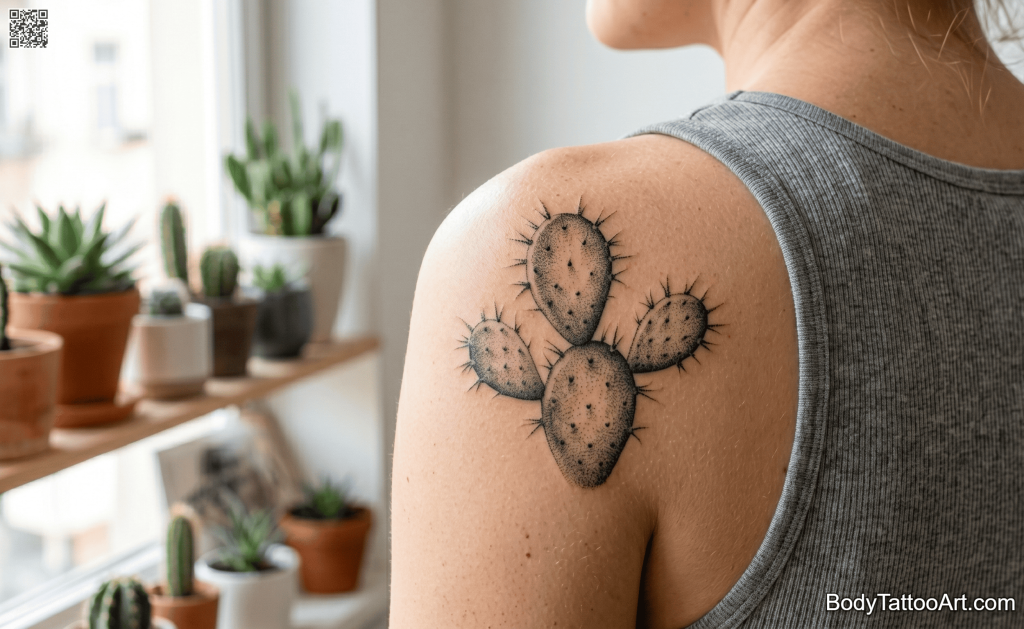
A Prickly Pear cactus (a fleshy succulent-like cactus) rendered entirely in stipple dotwork — the paddles built up through graduated dot density, each spine represented by a tiny cluster of tight dots.
Placement: Shoulder
Style: Dotwork stipple Succulent Tattoos
Why it stands out: The flat paddle shapes of prickly pear are a perfect dotwork subject. The density variation creates beautiful tonal depth in a very graphic plant form.
Ideal for: Dotwork fans, shoulder piece seekers, people who appreciate botanical precision.
An Echeveria drawn in isometric perspective — as if viewed from a slight angle above, with a clean three-dimensional box shadow beneath it. The leaves are rendered geometrically, each one a flat plane at a calculated angle.
Placement: Forearm
Style: Isometric illustration Succulent Tattoos
Why it stands out: The isometric perspective makes this feel like a design object rather than a plant sketch. It sits at the intersection of architecture and botany.
Ideal for: Design-minded people, those who love technical illustration aesthetics, forearm piece collectors.
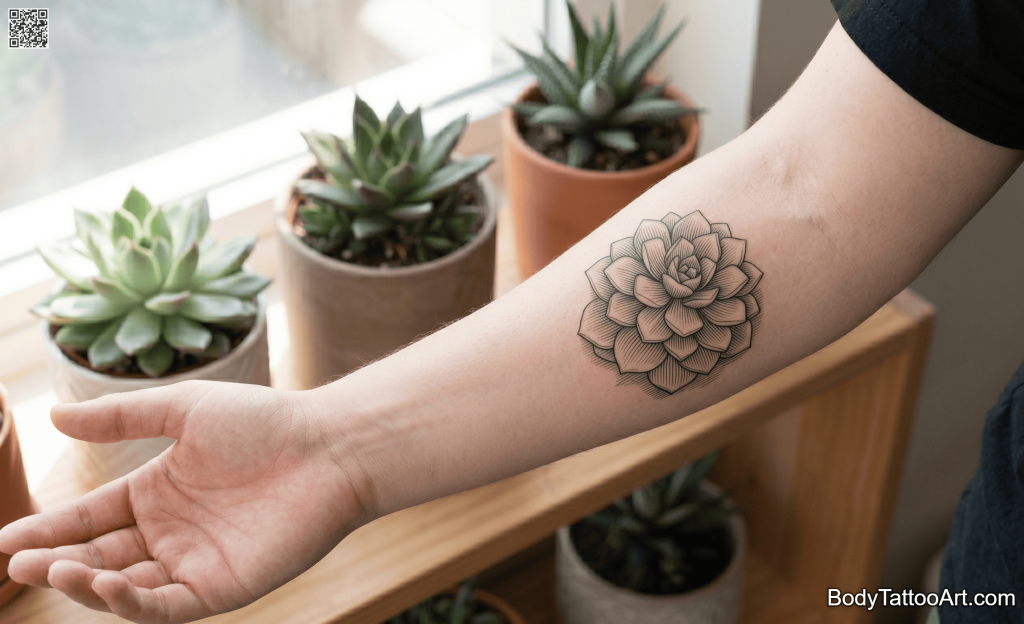
A Succulent rendered in old engraving style — parallel hatching lines building up all the shadow and texture, reminiscent of 19th-century botanical illustration prints. The detail is dense and precise.
Placement: Inner forearm
Style: Engraving / etching Succulent Tattoos
Why it stands out: The engraving aesthetic connects succulent tattoos to classical botanical illustration. It’s formal, detailed, and feels historically rooted.
Ideal for: Collectors who appreciate traditional illustration aesthetics, inner forearm piece seekers, detail-lovers.
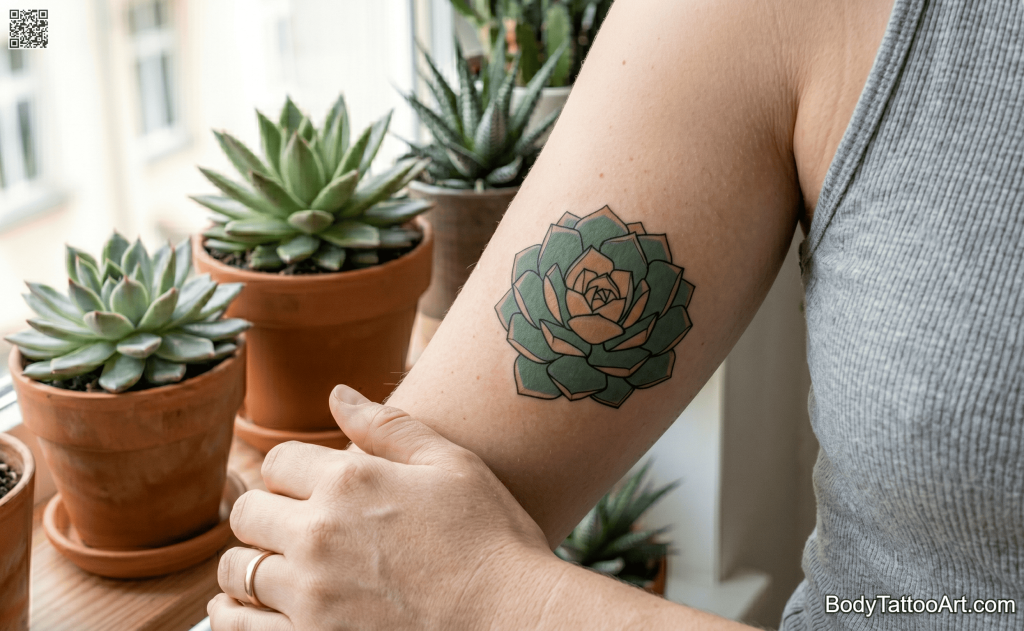
A flat, graphic Echeveria with bold outlines and solid color fills — deep sage green, dusty rose, and muted mustard. No shading, no gradients. Pure flat illustration.
Placement: Upper arm
Style: Flat graphic / neo-traditional color Succulent Tattoos
Why it stands out: The flat color approach feels modern and design-forward — more logo than traditional tattoo. The muted color palette keeps it sophisticated.
Ideal for: People who love graphic design aesthetics, color tattoo fans, those wanting something modern.
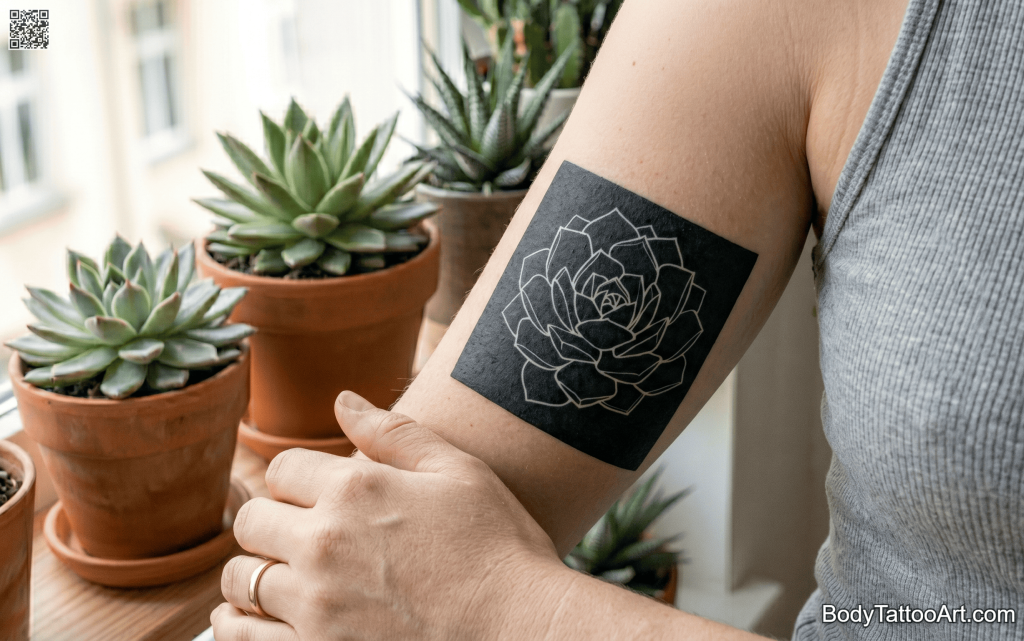
A succulent rendered in negative — black background with the plant in white line art, as if illuminated from within or photographed with x-ray film. The composition is dramatic and inverted.
Placement: Inner upper arm
Style: Negative/reversed blackwork Succulent Tattoos
Why it stands out: The inverted color scheme makes this read completely differently from most succulent tattoos. The white-on-black treatment gives it an otherworldly quality.
Ideal for: People drawn to dramatic or dark aesthetics, blackwork collectors, those wanting something unconventional.
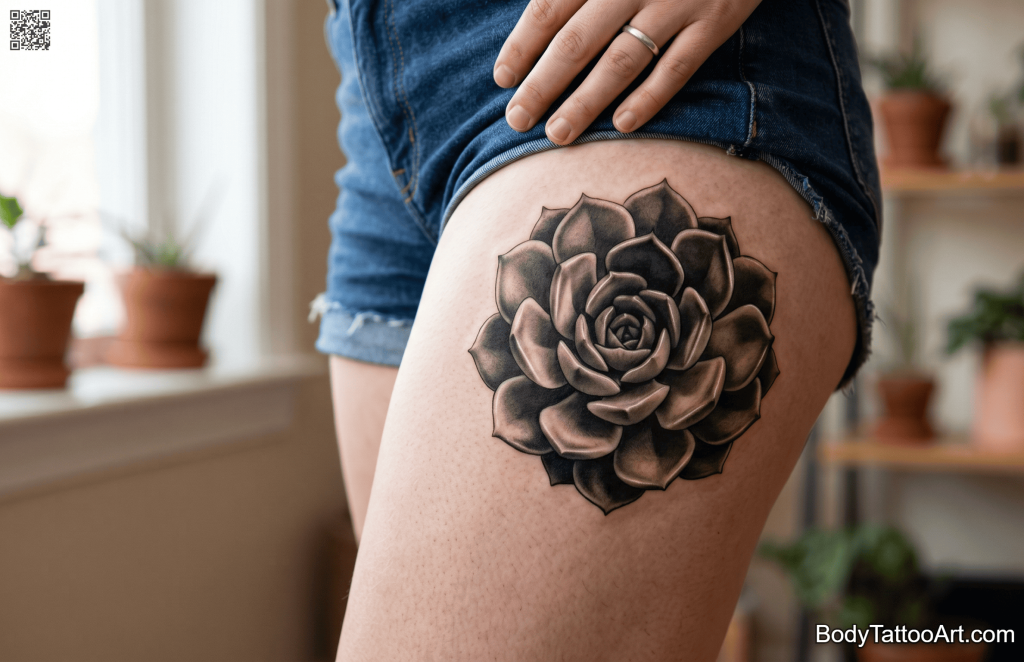
A deeply shaded Echeveria where heavy contrast and shadow are the main design element — the deepest shadows are almost pure black, and the highlights are left as bare skin. The drama is entirely in the light-to-dark transition.
Placement: Outer thigh
Style: High contrast black and grey realism Succulent Tattoos
Why it stands out: Extreme contrast realism on something as geometrically structured as a succulent creates a sculptural, three-dimensional effect. It looks carved rather than drawn.
Ideal for: Realism fans, bold contrast lovers, outer thigh piece collectors.
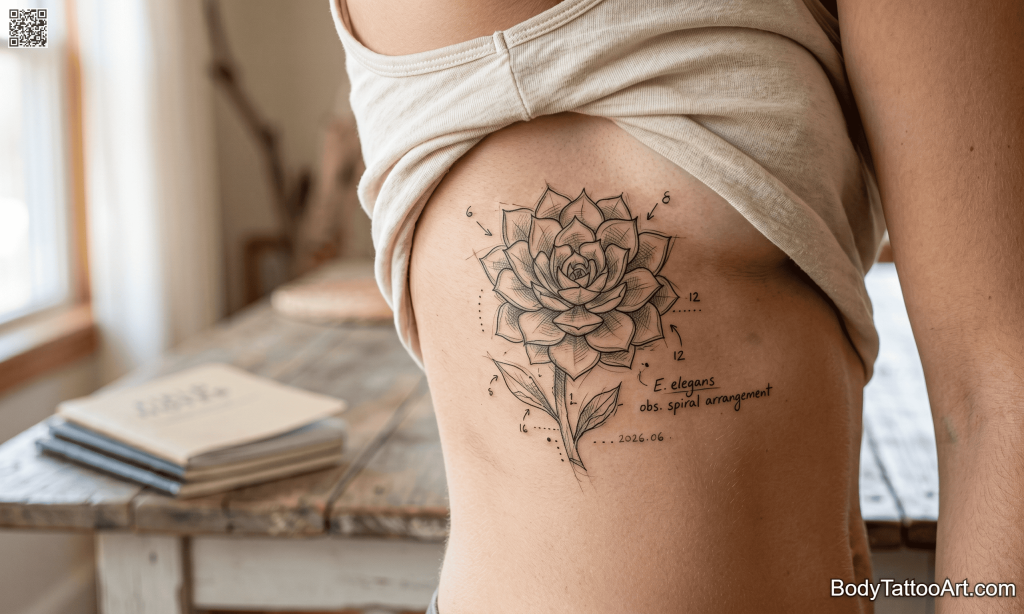
A loose, sketchy hand-drawn Echeveria that looks like it was lifted straight from a naturalist’s field notebook. Rough pencil-like lines, light crosshatching, and small annotation-style marks around the edges.
Placement: Ribs or side torso
Style: Sketch / illustrative Succulent Tattoos
Why it stands out: The intentional rawness and imperfection of the sketch style gives this piece a personal, lived-in quality. It’s the anti-perfectionist succulent tattoo — and it works beautifully.
Ideal for: People who love journaling and art aesthetics, rib piece seekers, those wanting something that feels personal over polished.
Succulent tattoos prove that a design doesn’t have to be dramatic to be beautiful. From the strict geometry of dotwork to the looseness of a brushstroke piece, from a micro-scale finger tattoo to a full outer thigh silhouette — the range within succulent tattoos is genuinely remarkable.
What ties all these ideas together is the plant itself: structurally interesting, naturally symmetrical, and endlessly adaptable. Whether the goal is something tiny and personal or a bold statement piece, there’s a succulent tattoo style that fits.
The best thing about succulent tattoos is that they age well — clean lines hold, bold fills stay graphic, and fine line work keeps its delicacy on the right skin. It’s worth taking time, finding a tattoo artist whose portfolio matches the style chosen, and trusting the process.
For more botanical tattoo inspiration, explore guides on lotus flower tattoos , Rose tattoos, Orchid Tattoos— all great companions to the succulent tattoo aesthetic.