Physical Address
304 North Cardinal St.
Dorchester Center, MA 02124
Physical Address
304 North Cardinal St.
Dorchester Center, MA 02124

There’s a reason willow tree tattoos keep showing up on mood boards and Pinterest saves. The willow is one of those subjects that translates into ink beautifully — the hanging branches, the soft sweep of the canopy, the way the whole tree seems to move even when it’s standing still. It’s a subject that works in almost every tattoo style without losing its identity.
This list covers 27 willow tree tattoos that are all genuinely different from each other. Different styles, different placements, different compositions. Whether someone is planning their first tattoo or filling in a sleeve, there’s a willow design here that deserves a second look.
The willow has been a symbol across cultures for thousands of years. In Chinese tradition, the willow represents grace, patience, and the ability to bend without breaking. In Celtic mythology, it was associated with the moon, water, and the flow of time. Ancient Greeks connected it to the underworld and transition.
The willow belongs to the genus Salix and thrives near water, which is part of why it’s been linked to fluidity and adaptability in so many cultures. Some species are also among the fastest-growing trees on earth, which adds to their symbolism of resilience. For more on the willow’s history and cultural role, the Wikipedia page on Willow is a solid starting point.
Willow tree tattoos today are chosen as much for the visual drama of the drooping branch structure as for the symbolism. The cascading canopy gives tattoo artists a natural flow to work with — and that flow translates into some of the most elegant compositions in botanical tattooing.
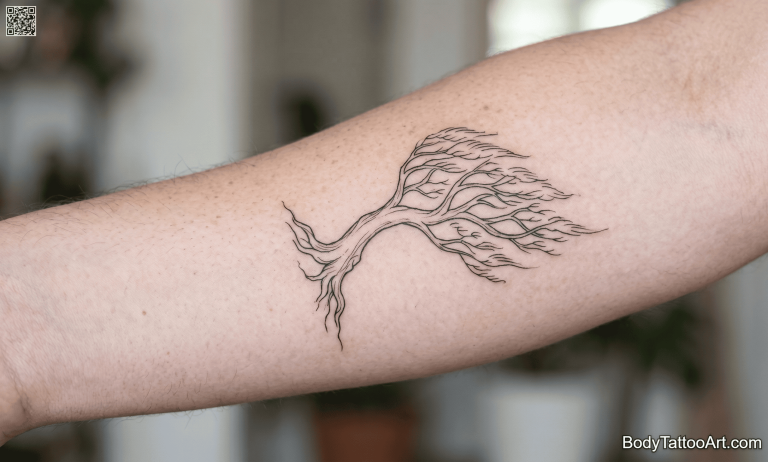
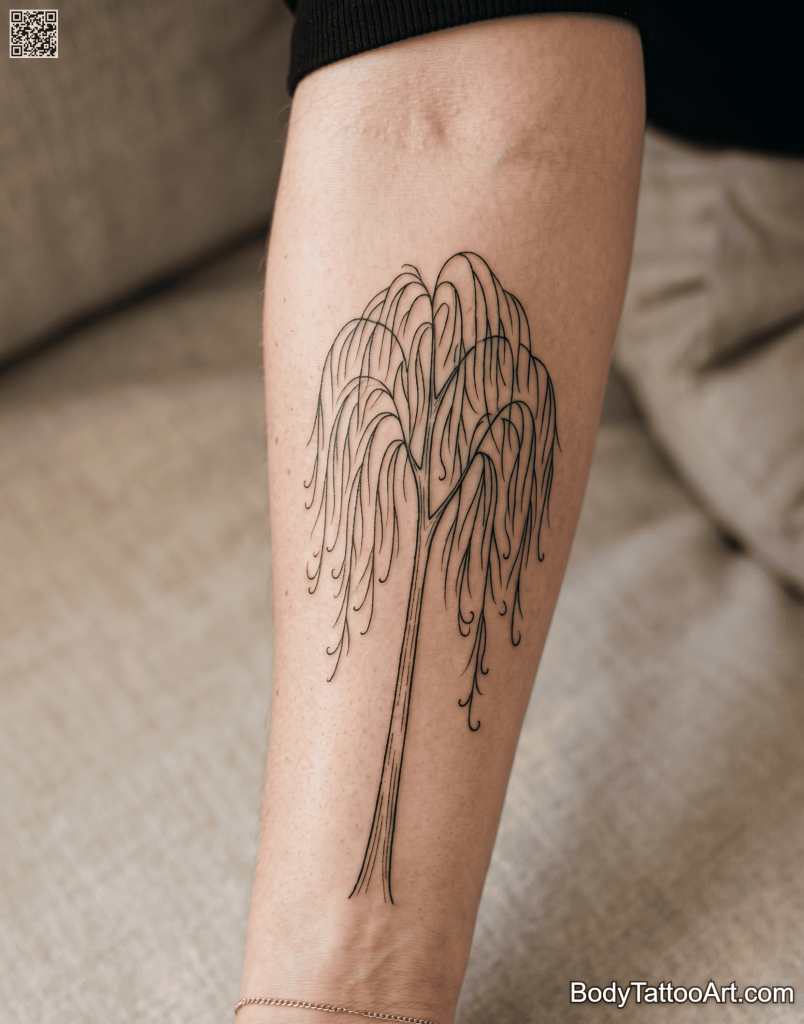
A full willow tree rendered in fine linework — the trunk straight and tapered, the branches cascading downward in long, flowing strands. Each strand ends in a slight curl. No shading fill, just the line structure of the tree doing all the work.
Placement: Inner forearm
Style: Fine line Willow Tree Tattoos
Why it stands out: The drooping branch lines on a vertical forearm placement create a natural pull downward, like the tree is growing with the arm. Willow tree tattoos in pure linework are striking precisely because of how much they achieve without shading.
Ideal for: First-timers, minimalist tattoo lovers, and people who want something botanically accurate but light on ink saturation.
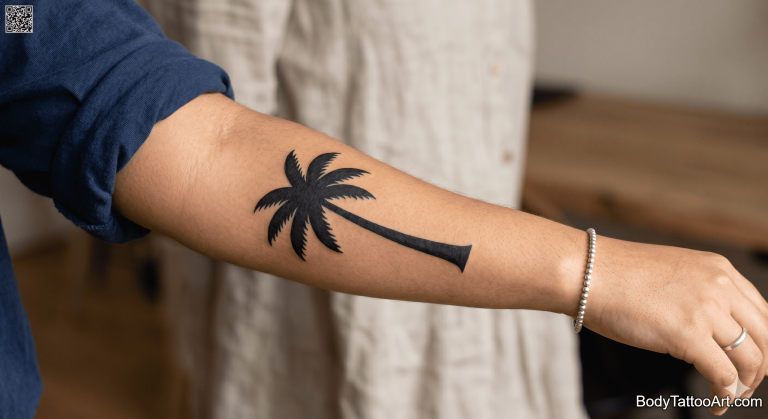
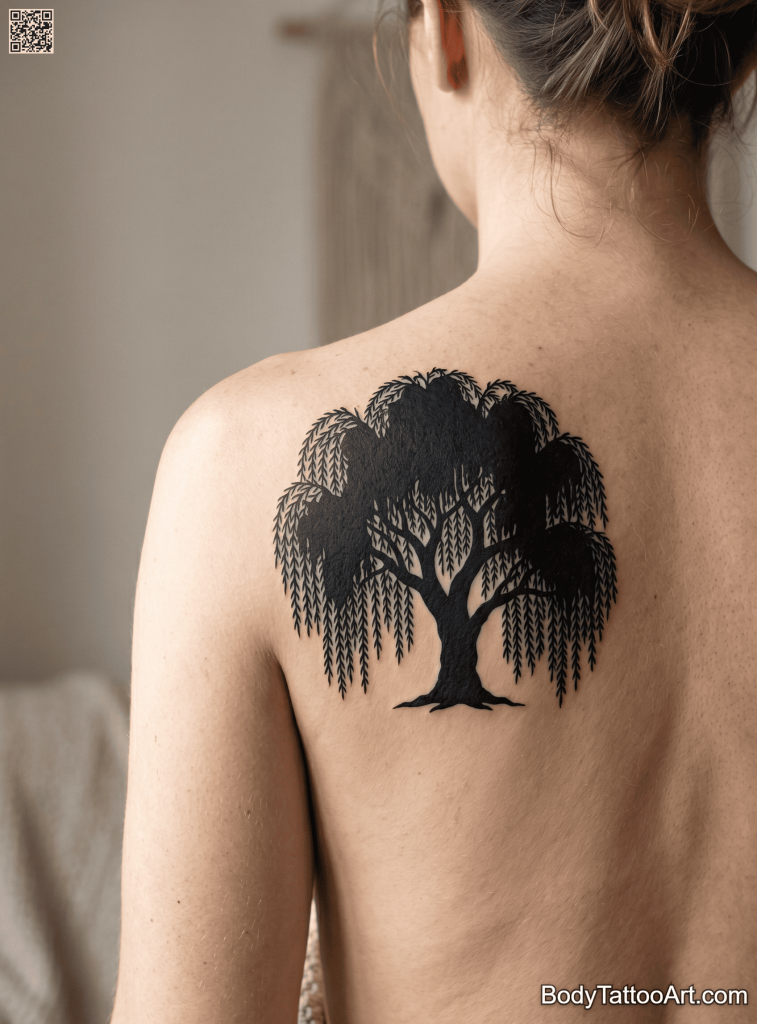
A fully filled black silhouette of a willow tree — no internal detail, just the complete shape in solid ink. The branch strands hang in dense clusters, the canopy wide and heavy. The base of the trunk is slightly thicker, anchoring the whole piece.
Placement: Shoulder blade
Style: Blackwork silhouette Willow Tree Tattoos
Why it stands out: Silhouette willow tree tattoos let the shape speak entirely. The width of the canopy spread across the shoulder blade is naturally framed by the body’s geometry. It reads as dramatic and complete from a distance.
Ideal for: Bold style fans, those who prefer high-contrast ink, and people planning a back or shoulder piece.
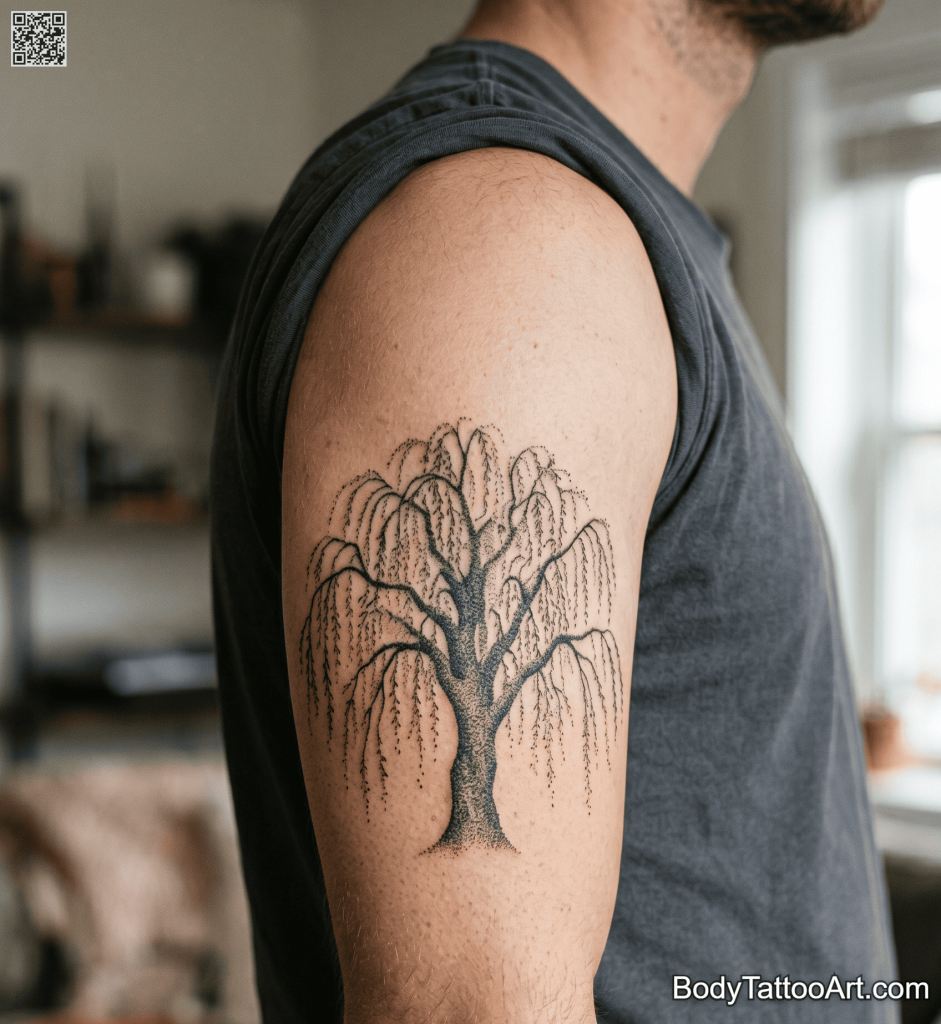
A willow tree built entirely from stipple dots — no linework borders. The trunk is densest at the center with dots fading outward, and the cascading strands are rows of tiny dots that thin out toward the tips.
Placement: Upper arm
Style: Dotwork Willow Tree Tattoos
Why it stands out: The dot-fade on the branch tips gives the impression that the strands are dissolving into air. Among willow tree tattoos, this one has the most textured, atmospheric quality. It rewards close inspection.
Ideal for: Tattoo collectors, people drawn to technical craftsmanship, and those who want subtle texture in their ink.
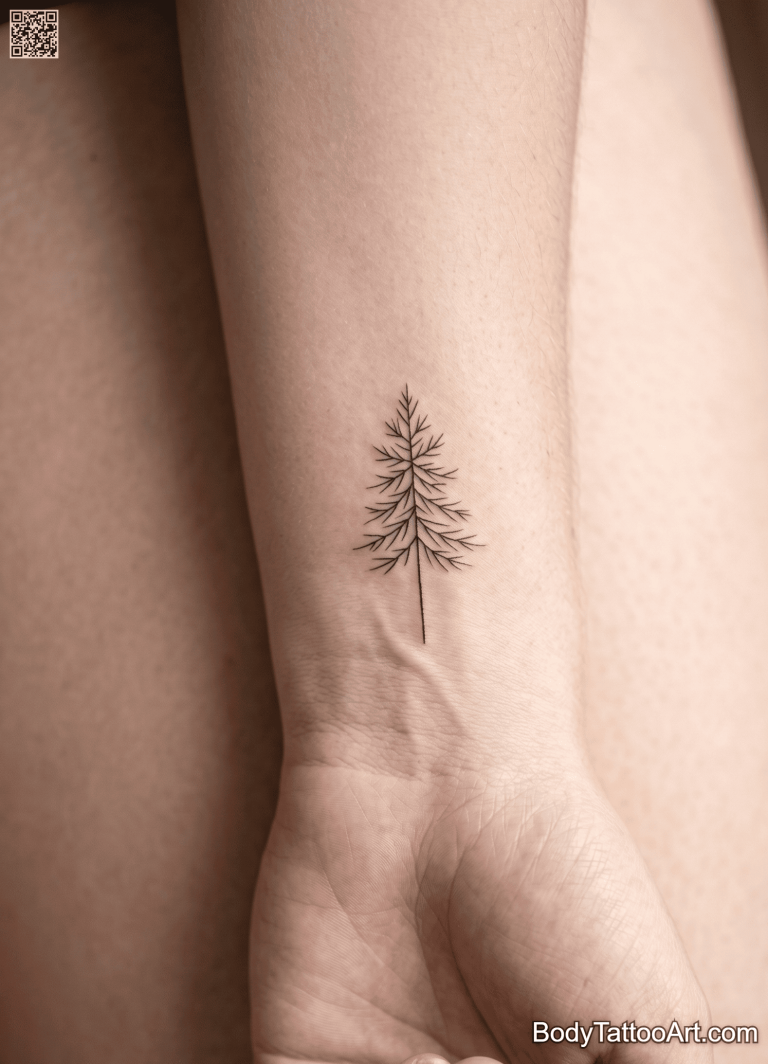
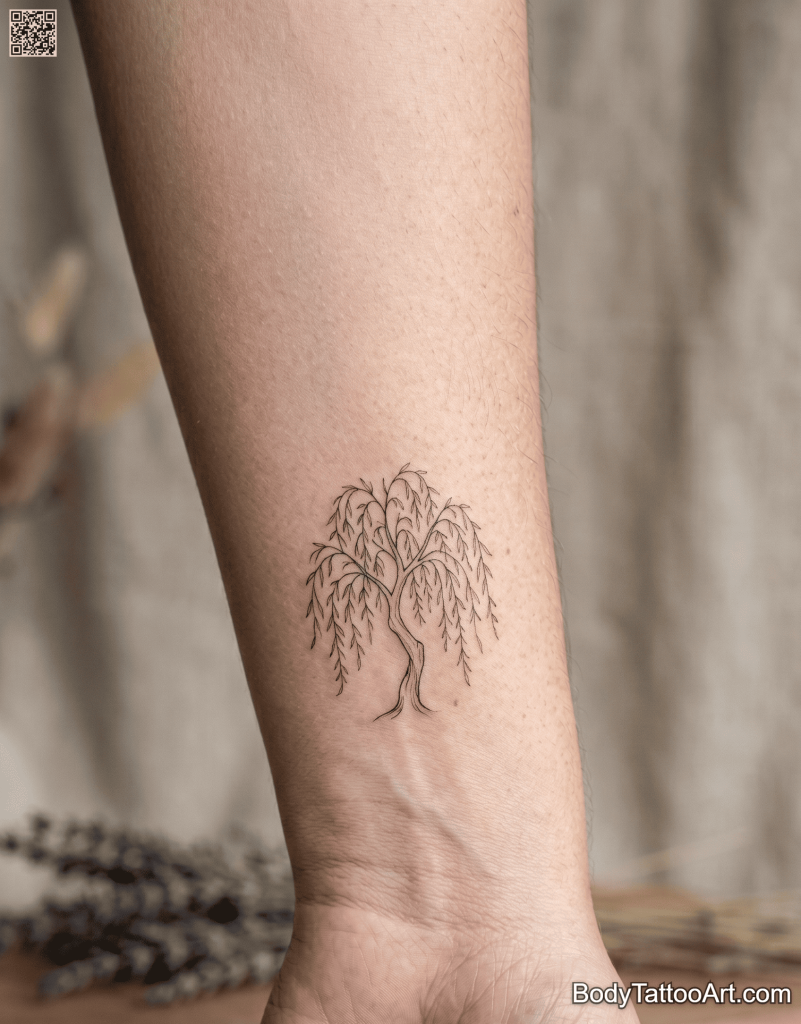
A tiny willow tree, perfectly proportioned, sitting just above the wrist. The tree is small enough to fit within a 2-inch area but has enough detail to clearly show the hanging branches and tapered trunk. Single needle precision throughout.
Placement: Wrist
Style: Single needle fine line Willow Tree Tattoos
Why it stands out: Micro willow tree tattoos test an artist’s ability to maintain proportion at a tiny scale. The delicacy of the single needle lines at this size is genuinely impressive up close.
Ideal for: People who want subtle, small tattoos, first-timers, and those who prefer discreet placement.
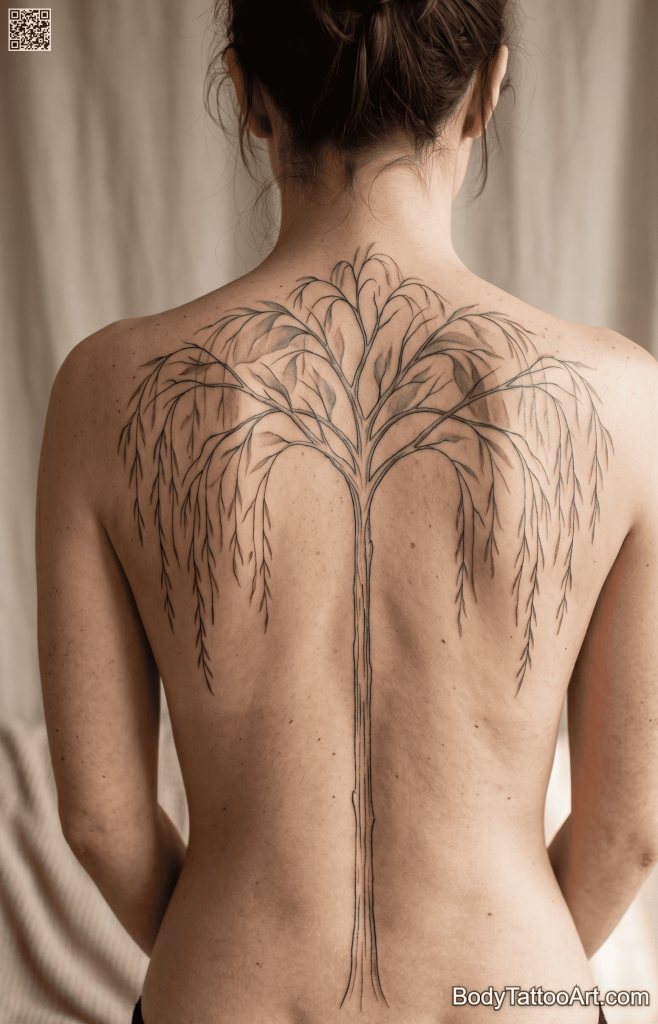
A willow tree designed specifically for the spine — the trunk runs straight down the vertebrae and the branches fan outward from the sides. The hanging strands drape left and right away from the spine symmetrically.
Placement: Spine
Style: Fine line with light grey shading Willow Tree Tattoos
Why it stands out: Spine placements need vertical compositions that feel intentional. Willow tree tattoos work exceptionally well here because the trunk-to-branch proportion maps perfectly onto the spine’s vertical length.
Ideal for: People planning spine pieces, symmetry lovers, and those who want a nature tattoo with strong placement logic.
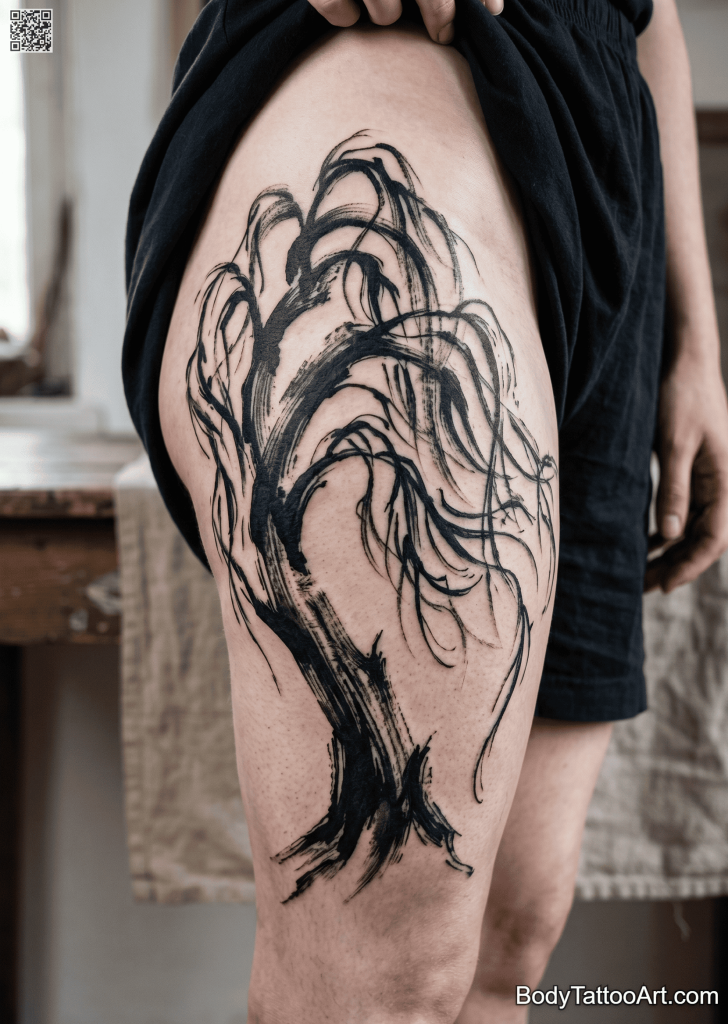
A willow tree painted in loose, expressive brushstrokes — the trunk is a thick dragged mark, the branches are gestural sweeps of varying widths. Nothing is precise or symmetrical. The energy of the brushwork is the whole point.
Placement: Outer thigh
Style: Abstract brushwork Willow Tree Tattoos
Why it stands out: Among abstract willow tree tattoos, this one prioritizes movement over structure. The uneven strokes give the piece a raw, painterly quality that looks more like a canvas than skin.
Ideal for: People drawn to expressive, artistic styles and those who appreciate imperfection as part of the aesthetic.
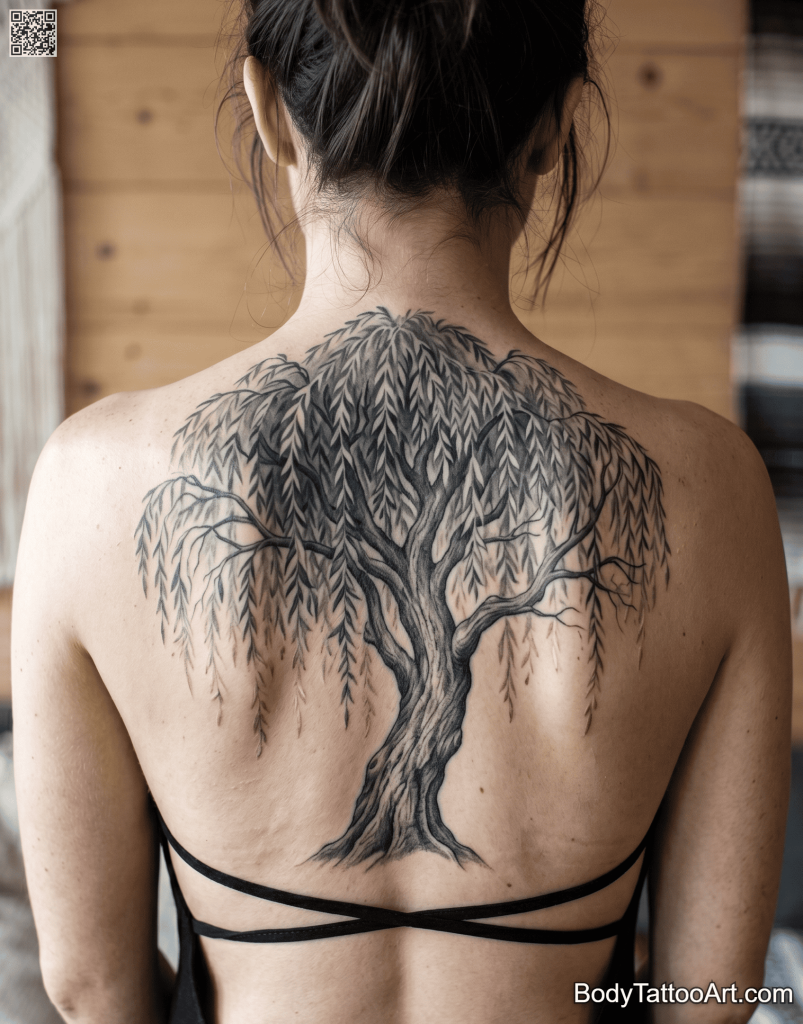
A willow tree in grey wash — the canopy full and rounded, the hanging strands rendered in soft gradients from deep grey at the base to near-white at the tips. The trunk has bark texture suggested through varied shading pressure.
Placement: Upper back
Style: Grey wash Willow Tree Tattoos
Why it stands out: The gradient from dark to light across the hanging strands gives this version of willow tree tattoos a sense of light hitting the canopy. It reads as three-dimensional without being a full realism piece.
Ideal for: Those who want depth and softness in their ink and fans of tonal shading over linework.
Fern tattoo designs are another great option for botanical ink lovers who want something delicate and detail-heavy. And if the appeal is the flowing, organic line quality of willow tree tattoos, ivy tattoo ideas carry that same visual fluidity across the skin.
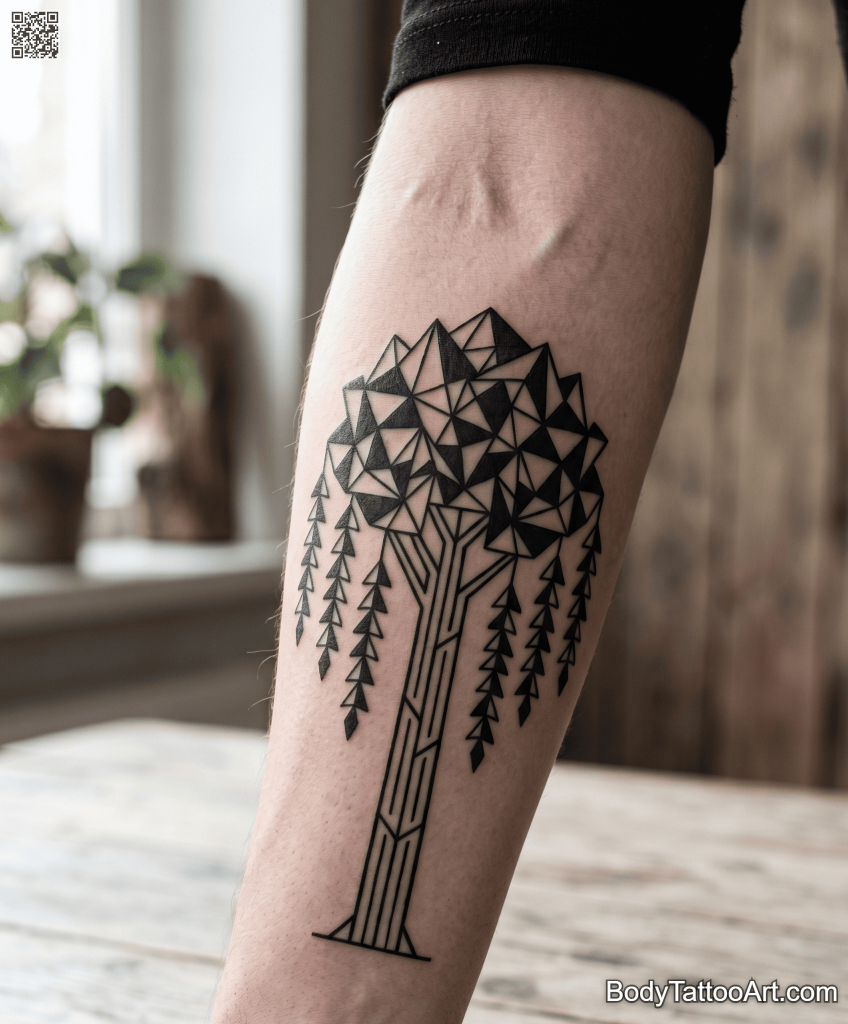
A willow tree constructed entirely from geometric shapes — triangles and straight lines form the canopy, the trunk is a pair of converging vertical lines, and the hanging branches are replaced with downward-pointing triangular clusters.
Placement: Forearm
Style: Geometric blackwork Willow Tree Tattoos
Why it stands out: Translating the willow’s organic drape into a geometric structure is a visual challenge. When it works, these willow tree tattoos look like architectural drawings of nature rather than nature itself.
Ideal for: Fans of geometric tattoo styles, designers, and those who want structured, graphic ink.
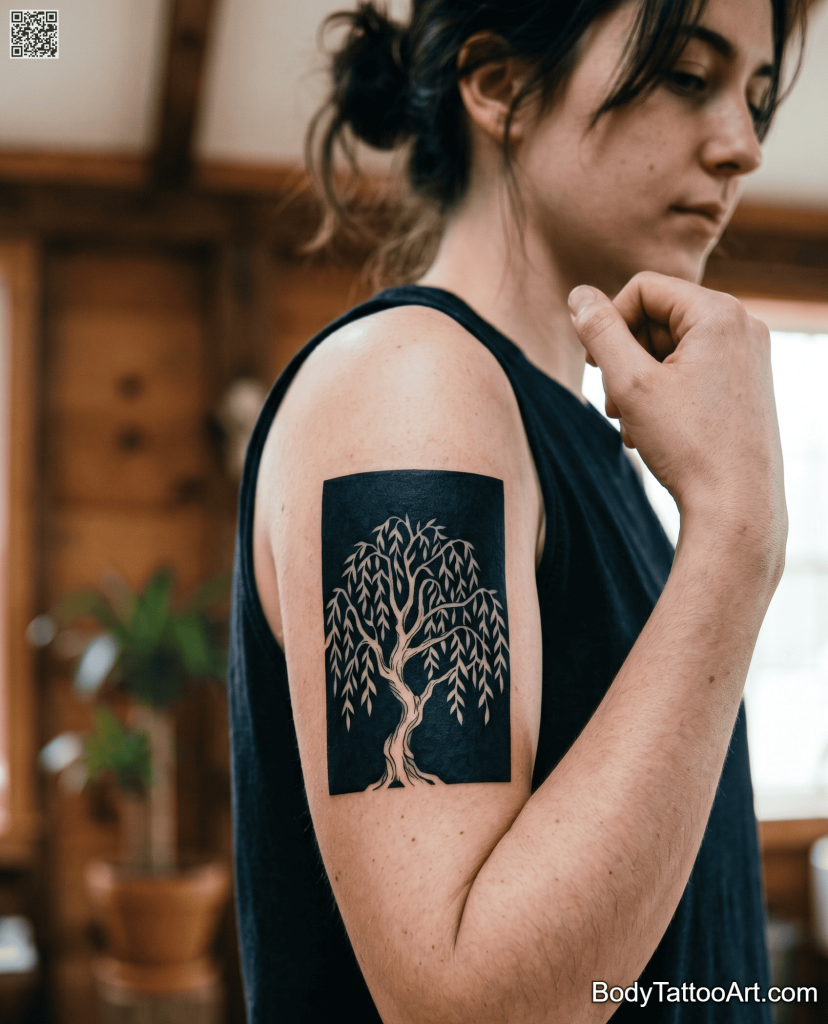
A solid black rectangle tattooed on the skin, with the willow tree cut out as bare skin in the center. The hanging branches are visible through the negative space — the tree is defined entirely by the black fill surrounding it.
Placement: Inner bicep
Style: Blackwork negative space Willow Tree Tattoos
Why it stands out: The concept reversal — inking everything but the tree — is conceptually strong. Among willow tree tattoos, this one is the most visually surprising because the subject doesn’t technically exist in ink.
Ideal for: Bold style enthusiasts, concept-driven tattoo collectors, and those wanting something genuinely different.
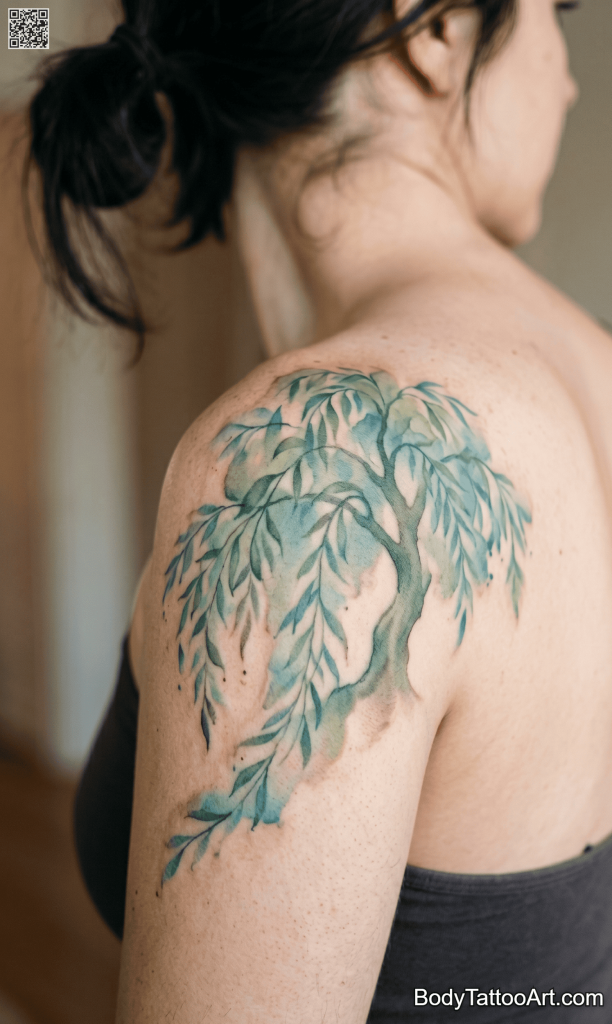
A willow tree in soft watercolor — green and blue washes bleed outward from the tree’s shape with no defined edges. The trunk is hinted at in a slightly darker tone and the hanging branches dissolve into colour rather than ending cleanly.
Placement: Shoulder cap
Style: Watercolor Willow Tree Tattoos
Why it stands out: Watercolor willow tree tattoos done without outlines are among the most painterly tattoo styles available. The colour bleed mirrors the way a willow’s canopy actually blurs its edges in wind.
Ideal for: People who love artistic, painterly tattoos and those drawn to soft, muted colour palettes.
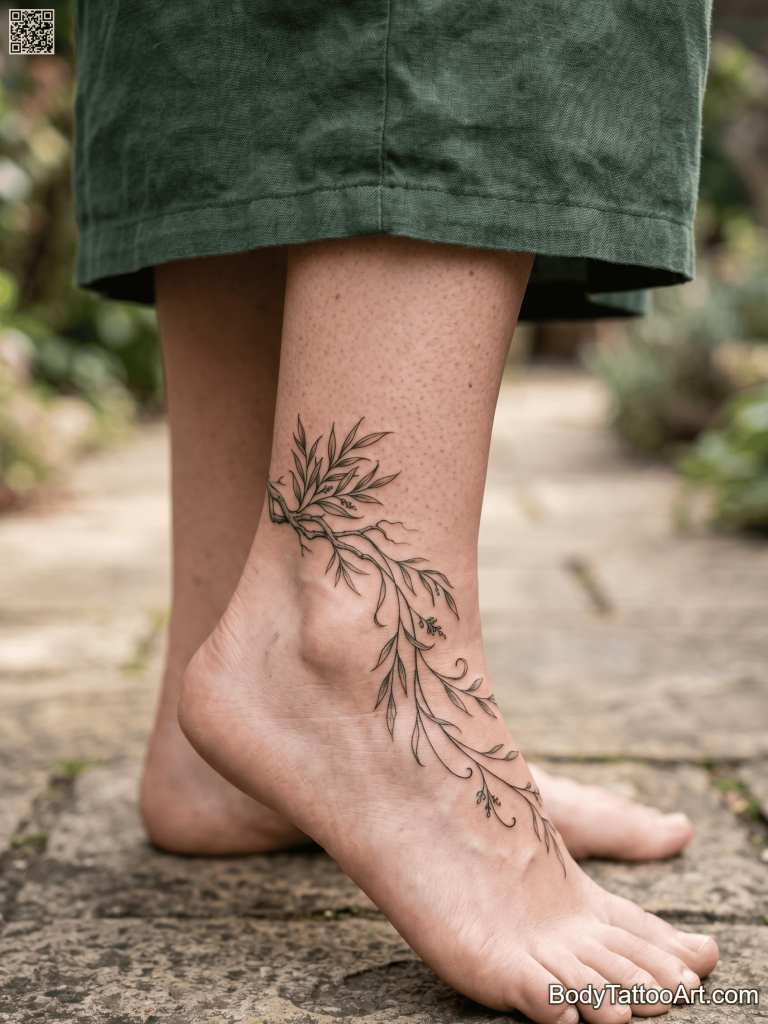
A willow tree’s hanging branch strands wrap around the ankle — the trunk sits on the outer ankle and the long strands drape and curl around toward the inner ankle. The composition uses the ankle’s cylindrical shape to create a wrap-around effect.
Placement: Ankle
Style: Fine line blackwork Willow Tree Tattoos
Why it stands out: Most willow tree tattoos show the full tree upright. This design isolates just the draping strands and wraps them around the ankle like a botanical band. It’s a placement-driven concept that only works on this body part.
Ideal for: People who want placement-aware designs and those who love wrap-around ankle tattoos.
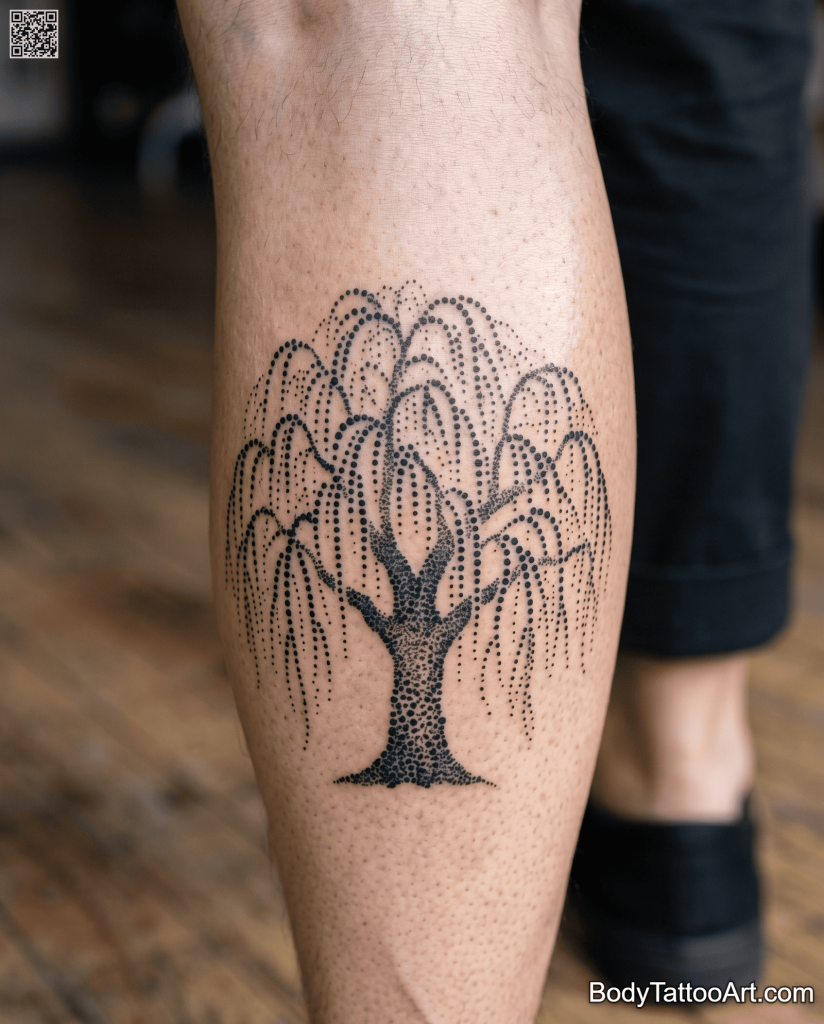
A willow tree built from dots of varying sizes only — no lines at all. Larger dots form the trunk mass, medium dots shape the branch strands, and tiny dots represent the outermost tips. The whole tree is composed through dot size rather than linework.
Placement: Calf
Style: Pointillism Willow Tree Tattoos
Why it stands out: Pure dot-size-based composition for willow tree tattoos is technically demanding. The result looks almost engraved — a textured, deliberate surface that looks completely different from standard dotwork.
Ideal for: Detail-obsessed collectors and those who want something that rewards a close look.
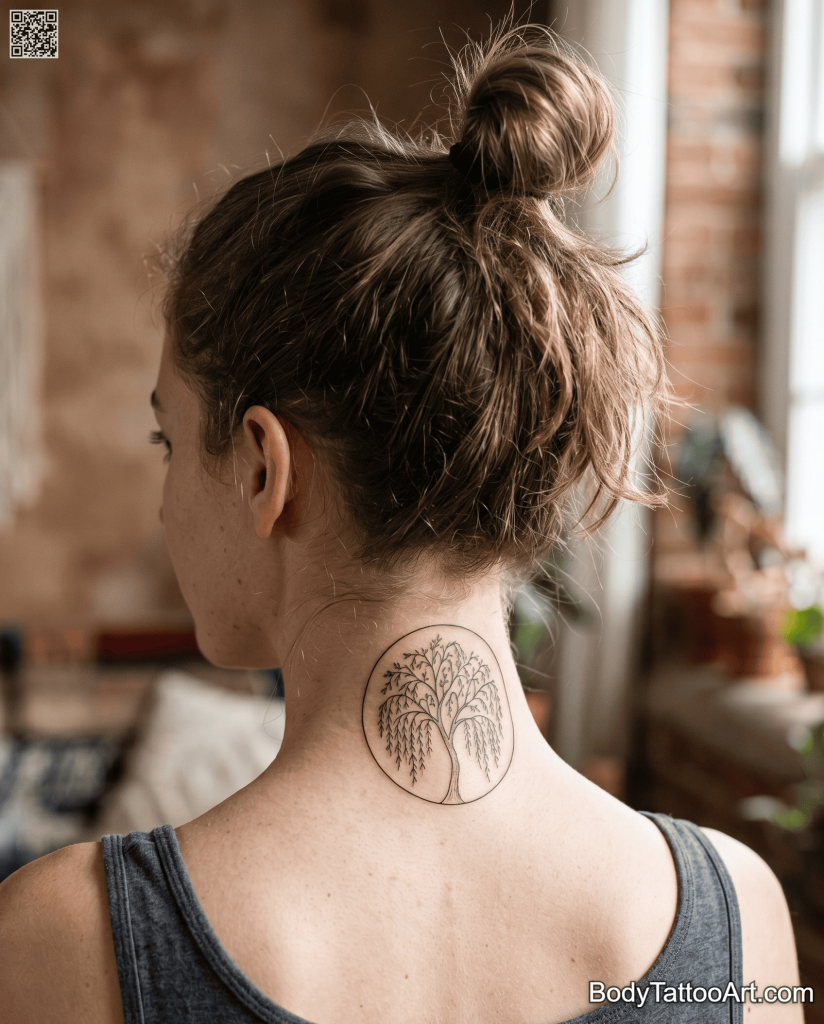
A willow tree enclosed within a thin circle, the canopy just reaching the inner edge of the ring at the top, the hanging strands filling the lower half of the circle naturally. The tree fills the frame without touching the edges.
Placement: Nape of neck
Style: Fine line Willow Tree Tattoos
Why it stands out: The circular frame turns the willow into a contained composition — like a botanical illustration or a coin design. Willow tree tattoos framed this way look finished and intentional at any size.
Ideal for: People who love medallion-style tattoo compositions and those planning a nape placement.
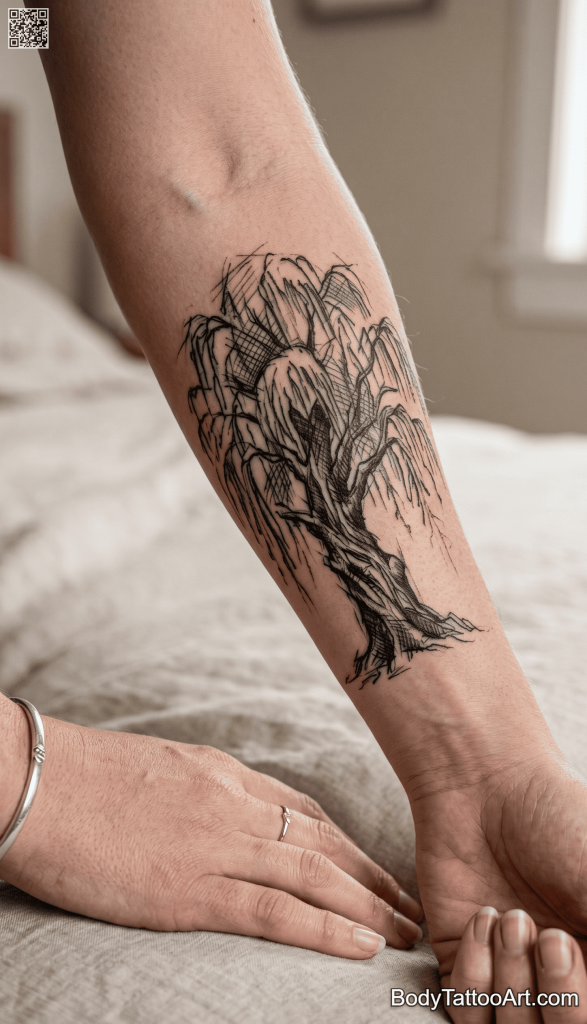
A willow tree drawn in a sketchbook style — rough linework, visible crosshatching for shading on the trunk and upper canopy, and slightly unfinished edges on the branch tips. It looks like a field sketch from a naturalist’s journal.
Placement: Inner forearm
Style: Sketch / illustrative Willow Tree Tattoos
Why it stands out: The deliberate roughness of sketch willow tree tattoos is an aesthetic choice that requires real skill to look convincingly hand-drawn rather than poorly executed. The crosshatching adds texture without heaviness.
Ideal for: People who love artistic, handmade-feeling tattoos and botanical illustration enthusiasts.
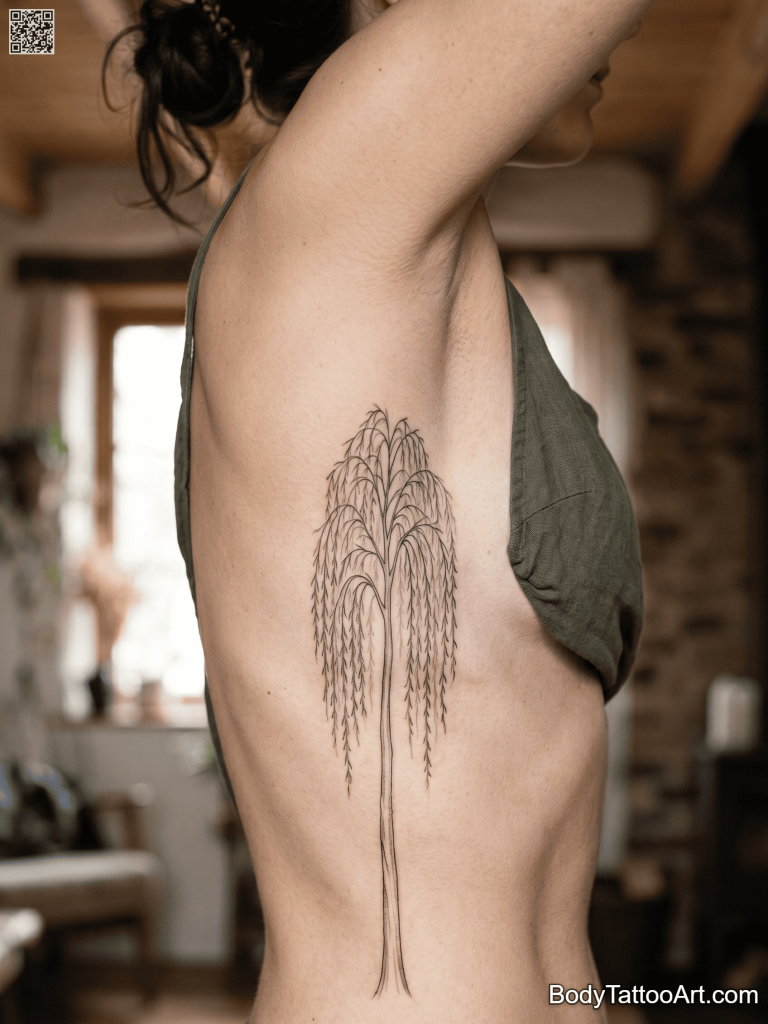
A willow tree stretched vertically to fit the ribcage — long trunk, relatively narrow canopy, strands falling straight downward without much outward spread. The whole composition is elongated to follow the ribcage’s vertical lines.
Placement: Ribcage
Style: Fine line with minimal shading Willow Tree Tattoos
Why it stands out: Ribcage placements demand vertically dominant compositions. Willow tree tattoos adapted for this placement look sleek and body-aware — the elongated trunk follows the body’s own vertical structure.
Ideal for: People planning ribcage tattoos and those who want a delicate, body-mapped design.
For those exploring large-scale botanical tattoos, oak leaf tattoo designs offer powerful, structured compositions that pair well with tree-themed ink. Olive branch tattoos are a quieter, equally elegant option for those drawn to botanical tattoo styles.
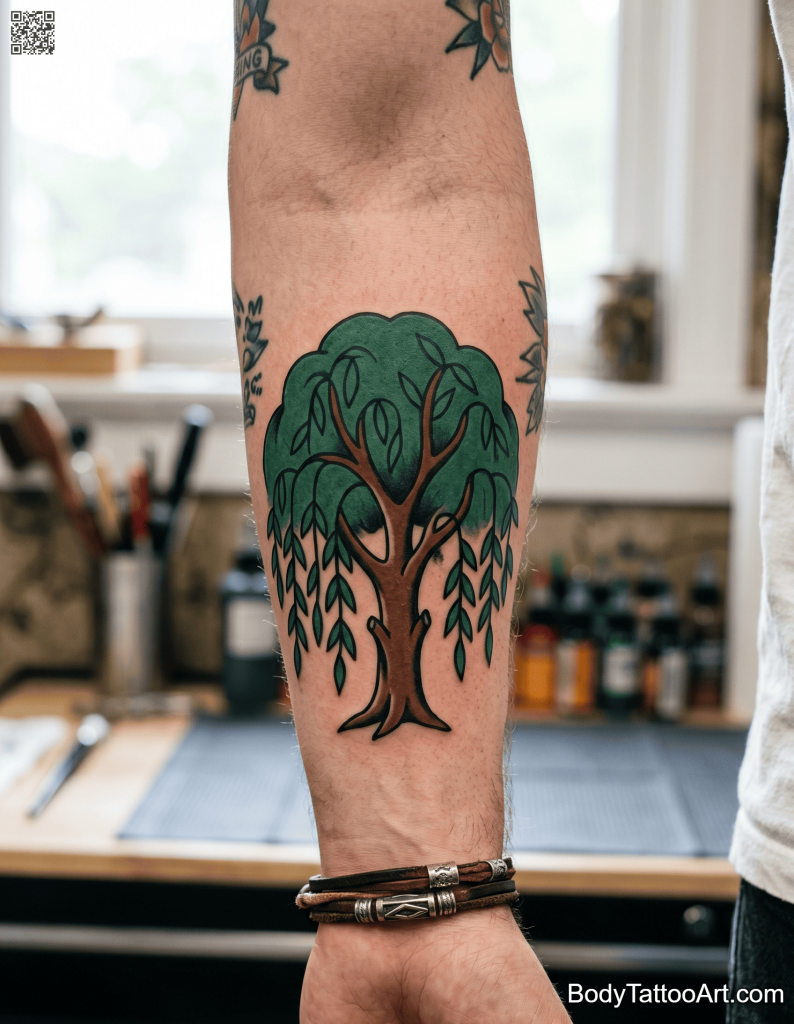
A willow tree in American traditional style — thick, even black outlines, flat colour fills in deep green for the canopy and brown for the trunk, minimal shading, bold and graphic. The branch strands are simplified into broader sweeping shapes.
Placement: Forearm
Style: American traditional Willow Tree Tattoos
Why it stands out: Traditional style willow tree tattoos are genuinely uncommon. The thick outline simplifies the willow’s detail into something that reads as vintage and strong. It ages exceptionally well in skin.
Ideal for: Traditional tattoo fans, collectors going for a vintage-flavoured nature piece, and those building a traditional sleeve.
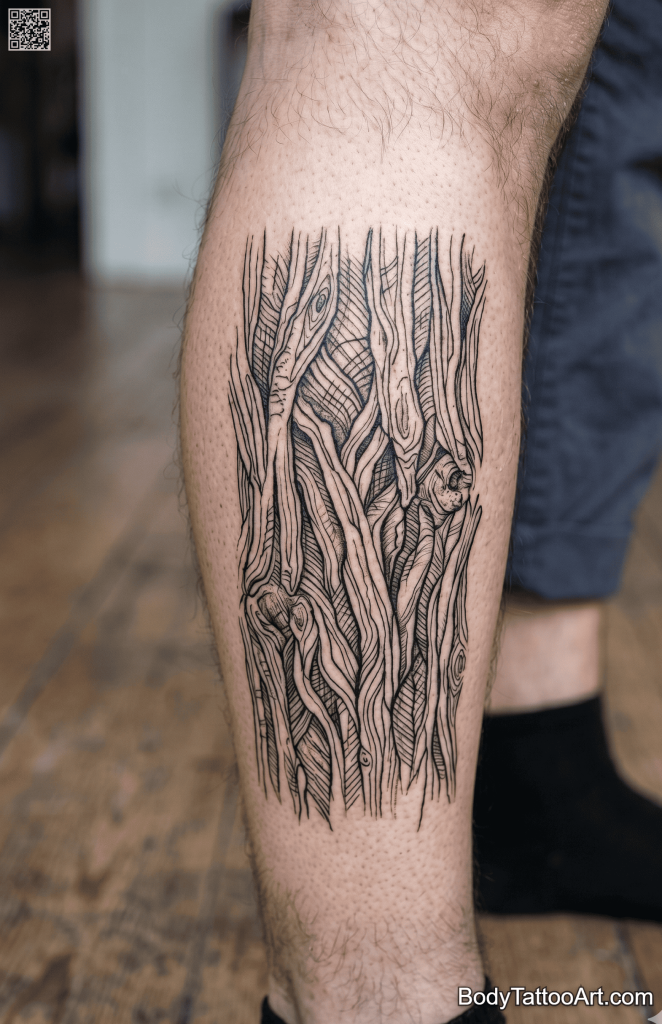
A tattoo zoomed in on just the bark of a willow — vertical ridges, deep grooves, soft knots. The composition is abstract without a recognisable full-tree outline. The entire piece is texture and surface detail.
Placement: Outer calf
Style: Detailed illustrative linework Willow Tree Tattoos
Why it stands out: Zooming into bark is an unusual approach for willow tree tattoos. Most designs show the full tree — this one studies the surface. The result is a deeply textural, botanical illustration-style piece.
Ideal for: Tattoo collectors, those who love detail-heavy botanical ink, and people wanting something conceptually different.
A band of willow trees of varying sizes wrapping around the upper arm — small, medium, and large trees alternating, all in solid black silhouette. The band has a flat top edge and a natural bottom edge following the roots.
Placement: Upper arm band
Style: Blackwork silhouette Willow Tree Tattoos
Why it stands out: A wrap-around band of willow tree tattoos uses the cylinder of the arm as a horizon line. From any angle, a different section of the forest is visible. The varying tree sizes prevent the design from feeling repetitive.
Ideal for: People who love wrap-around placements and those wanting a bold, nature-themed arm band.

A willow tree rendered in isometric perspective — structured, three-dimensional, the canopy and trunk built from precise geometric angles. The hanging strands are replaced with downward diagonal lines following the isometric grid.
Placement: Shoulder cap
Style: Geometric / illustrative Willow Tree Tattoos
Why it stands out: Isometric willow tree tattoos occupy a space between nature and digital architecture. The shoulder cap’s curve makes the 3D illusion look more convincing against a rounded surface.
Ideal for: Designers, those who love graphic tattoo styles, and people who want a tech-meets-nature concept piece.

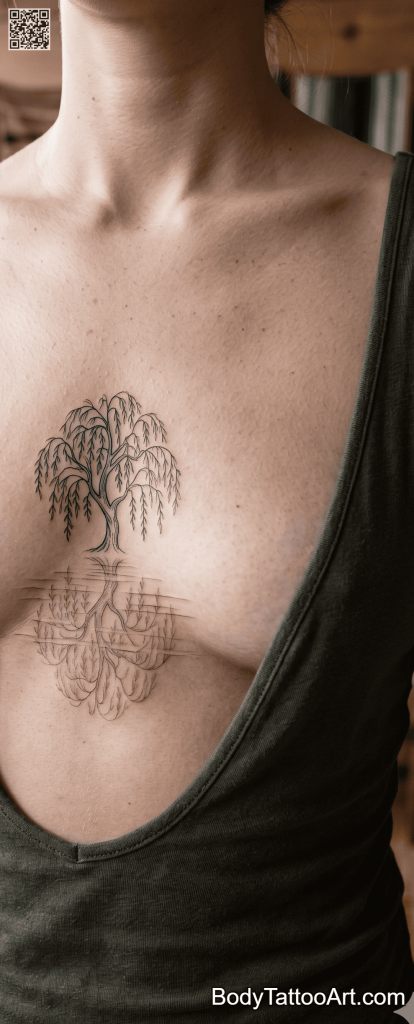
A willow tree standing upright with its mirror image reflected directly below — the reflection slightly lighter in shading with thin horizontal ripple lines breaking up the image. Together the tree and its reflection form a full vertical composition.
Placement: Sternum
Style: Fine line with light shading Willow Tree Tattoos
Why it stands out: The sternum placement centres the reflection naturally. The vertical symmetry of willow tree tattoos using the reflection concept feels architecturally sound — the body’s natural midline becomes the waterline.
Ideal for: Symmetry lovers, people planning a sternum piece, and those who enjoy conceptual compositions.
A willow tree divided into geometric fragment sections, each filled with a different grey or black tone. The overall tree shape is clear but the surface looks like shattered stained glass or a mosaic.
Placement: Forearm
Style: Graphic / illustrative Willow Tree Tattoos
Why it stands out: The mosaic fill makes the canopy look like it’s made of light-catching panels. Among graphic willow tree tattoos, the stained glass approach is rare and visually complex without becoming messy.
Ideal for: Art lovers, graphic tattoo fans, and those wanting a statement forearm piece.

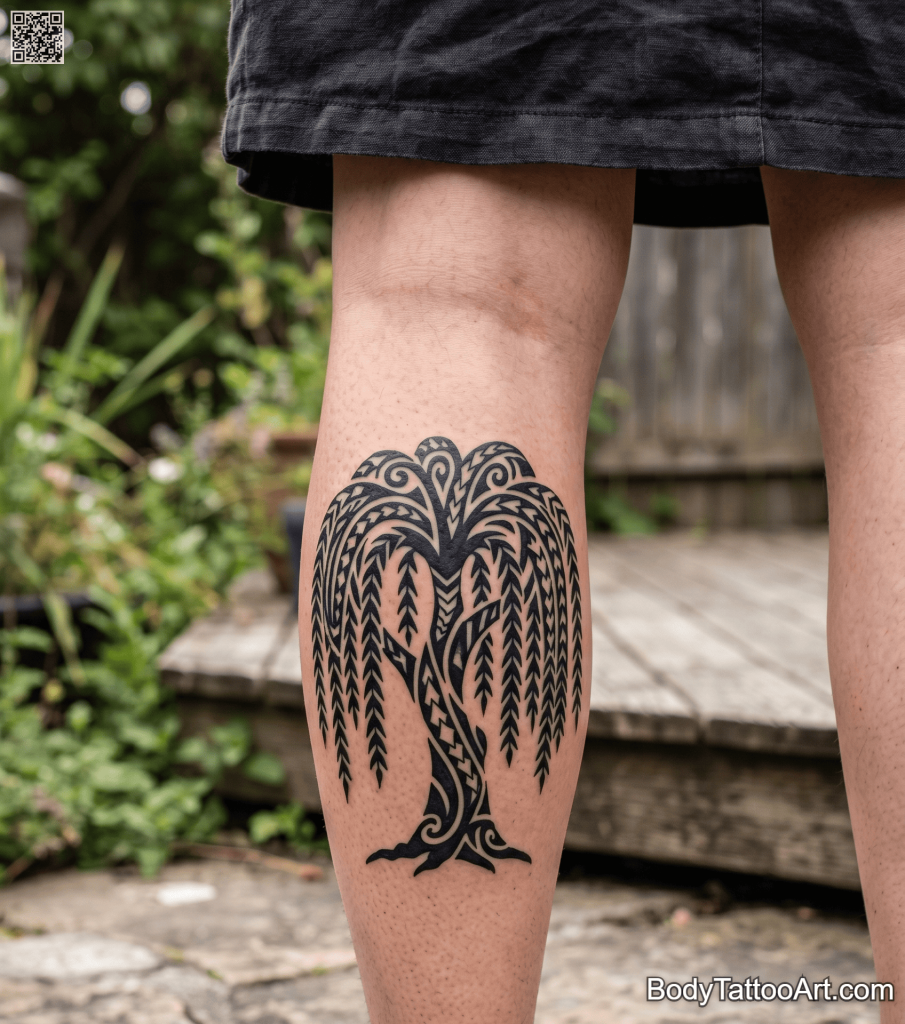
A willow tree shape filled entirely with tribal-style pattern work — repeated bold black shapes, pointed geometric forms, and symmetric marks inside the canopy and trunk silhouette. No organic shading, flat tribal fill only.
Placement: Calf
Style: Tribal Willow Tree Tattoos
Why it stands out: Tribal willow tree tattoos are uncommon. Taking the willow’s recognisable drooping silhouette and filling it with tribal pattern work creates a collision between organic form and graphic culture that reads as genuinely bold.
Ideal for: Those drawn to tribal aesthetics and those who want something flat, heavy, and graphic.
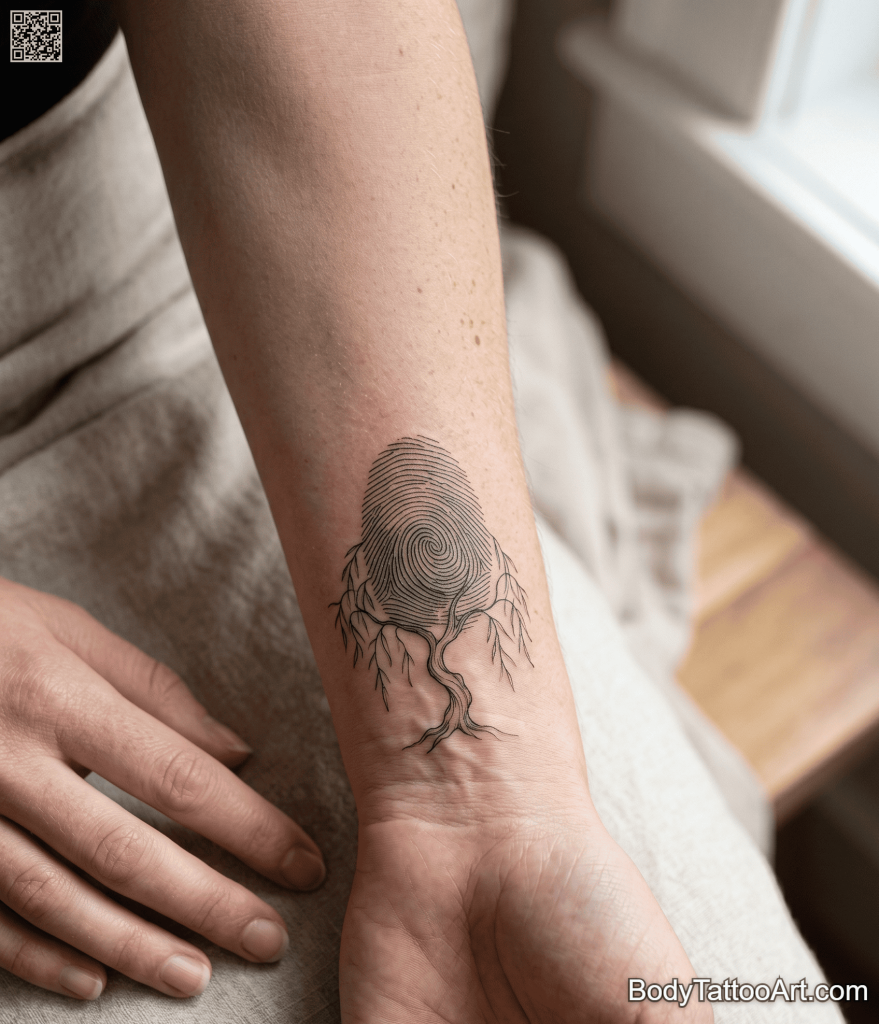
The swirling loops of a fingerprint form the canopy of a willow tree — at first glance it reads as a fingerprint, but the shape and the downward-sweeping lines reveal the willow on closer inspection.
Placement: Inner wrist
Style: Single needle fine line Willow tree tattoos
Why it stands out: The fingerprint format applied to willow tree tattoos is both conceptually clever and technically demanding at a small wrist scale. It rewards the viewer who looks twice.
Ideal for: People who love concept-driven tattoos and those wanting small, detail-rich wrist ink.
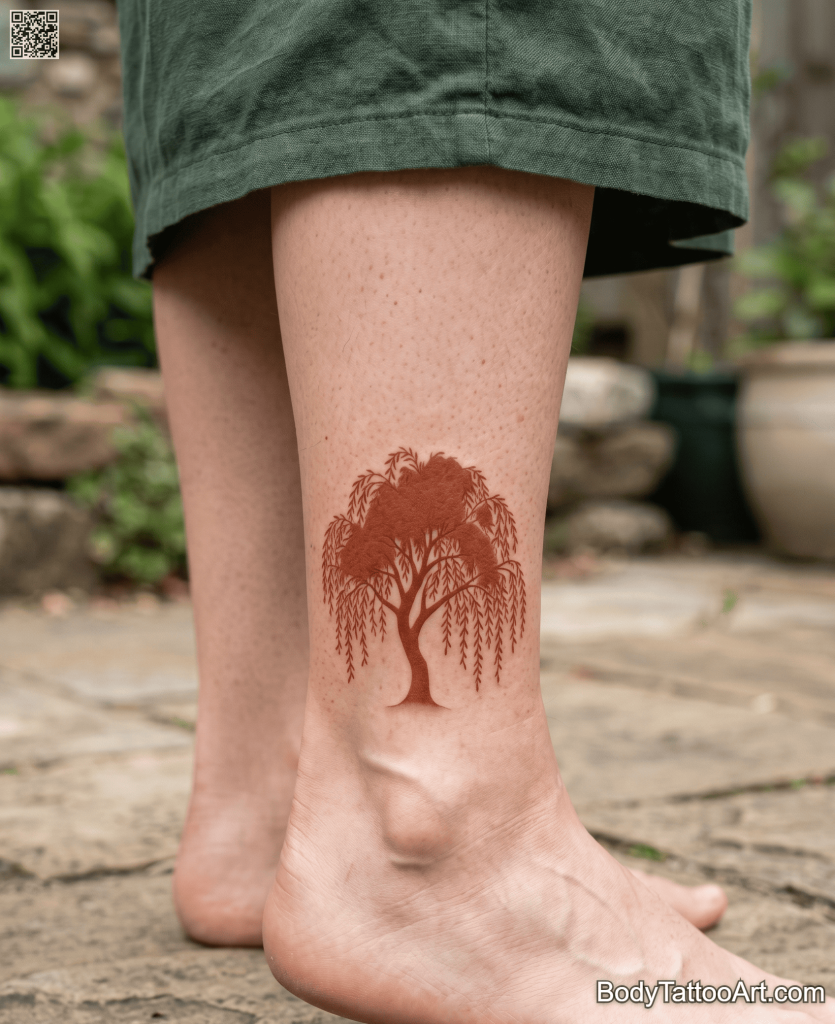
A willow tree silhouette rendered in a single warm burnt sienna or terracotta ink tone — no black, no outlines, just a flat earthy colour fill in the complete tree shape with hanging strands included.
Placement: Inner ankle
Style: Silhouette / colour fill Willow Tree Tattoos
Why it stands out: Most willow tree tattoos go black. Choosing a single warm earth tone shifts the whole feeling of the design — softer, warmer, and unusual enough to stop people mid-glance.
Ideal for: Those open to non-black colour in minimalist tattoos and people who want something botanically grounded but visually distinctive.
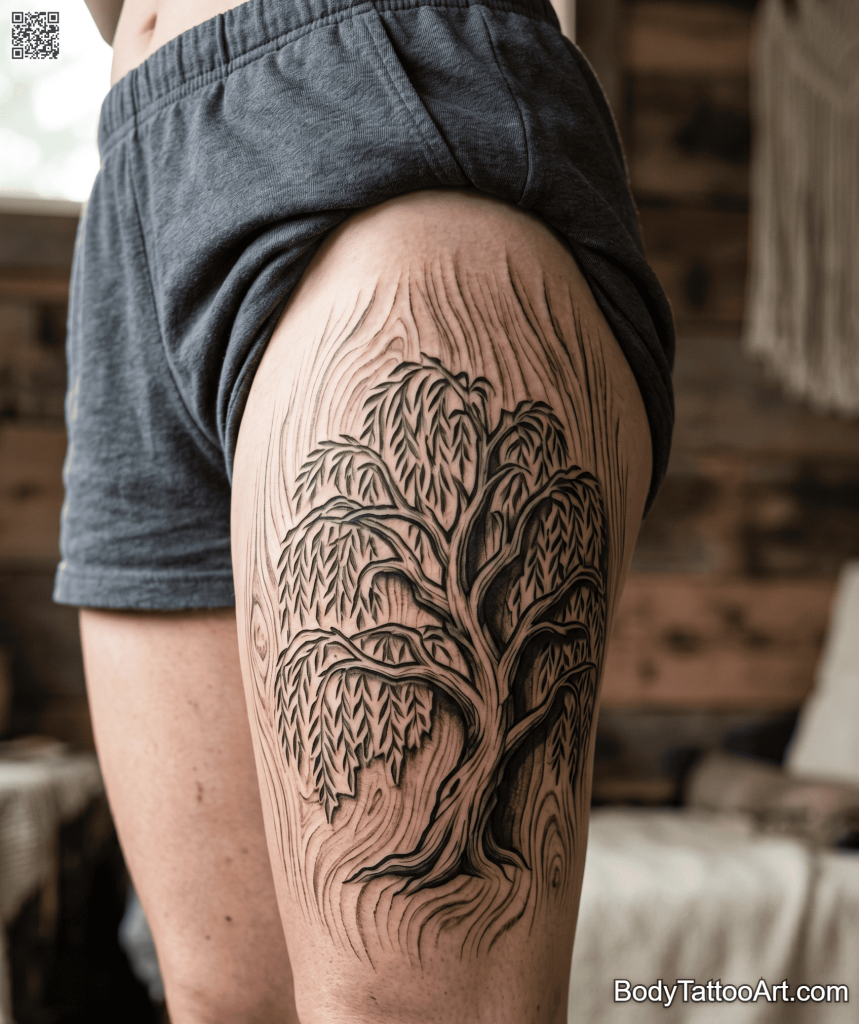
A willow tree that looks carved into wood — the design mimics relief carving with chiselled linework, cut-shadow shading on one side, and a rough wood grain texture running through the trunk and canopy.
Placement: Outer thigh
Style: Illustrative / textural Willow Tree Tattoos
Why it stands out: The wood-carved illusion applied to willow tree tattoos creates a layered, meta-concept. The grain texture running through the design adds tactile depth that’s unusual in botanical tattoo work.
Ideal for: Craft and texture enthusiasts and people who want concept-layered ink.
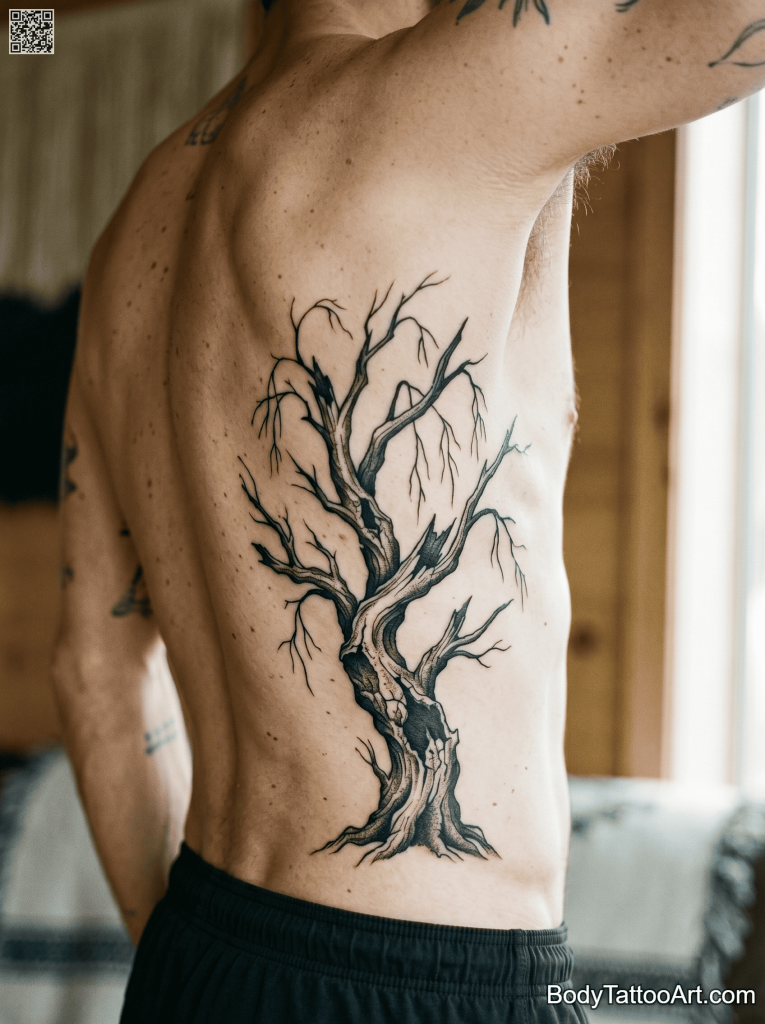
A willow tree with most of its hanging strands stripped — only the trunk and a few broken, partially bare branches remain. Heavy blackwork shading concentrates at the damaged sections. The composition suggests a storm-struck tree.
Placement: Ribcage
Style: Blackwork with dramatic shading Willow Tree Tattoos
Why it stands out: Most willow tree tattoos lean into the fullness of the canopy. This one removes it deliberately. The result is raw, exposed, and visually striking in the way damaged natural forms often are.
Ideal for: People who gravitate toward darker aesthetics and those who want a willow tattoo with visual tension.
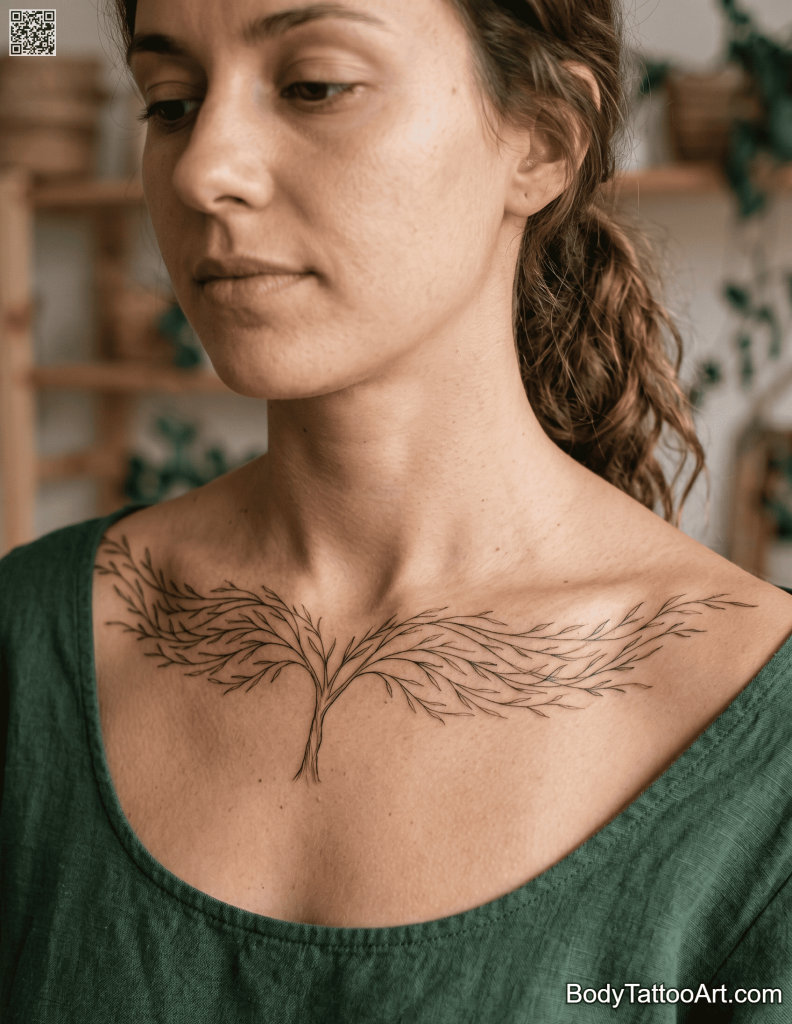
A willow tree positioned so that the trunk sits at the base of the throat and the long hanging branch strands drape outward across the collarbone left and right. The composition follows the collarbone’s natural curve.
Placement: Collarbone
Style: Fine line Willow Tree Tattoos
Why it stands out: This is placement-driven design at its most intentional. Willow tree tattoos that use the collarbone as a horizontal branch — letting the strands drape naturally with the bone’s shape — are rarely seen and visually stunning.
Ideal for: People planning collarbone tattoos and those who want placement to be as important as the design itself.
Willow tree tattoos are one of those subjects that never really gets overused — the variety of styles available and the natural drama of the drooping canopy mean no two pieces ever truly look the same. From a micro single-needle wrist tattoo to a full upper back grey wash piece, the willow adapts to almost every scale and style without losing what makes it recognisable.
The placement matters as much as the design with willow tree tattoos. The collarbone drape, the spine trunk, the ankle wrap — these aren’t just aesthetic choices, they’re decisions about how the tree interacts with the body. That’s what separates a good tattoo from a great one.
Before booking, it’s worth spending time looking at artist portfolios specifically for tree tattoos. Willow tree tattoos demand clean linework for fine line styles and confident shading for grey wash — the technique varies hugely by style. Find an artist whose strengths match the design, and the result will be worth it.
For more nature-inspired ink ideas, exploring eucalyptus tattoo designs is a great next step for those who love botanical compositions.