Physical Address
304 North Cardinal St.
Dorchester Center, MA 02124
Physical Address
304 North Cardinal St.
Dorchester Center, MA 02124

Dolphins have been inked on skin for decades, and honestly, it’s not hard to see why. There’s something about the way a dolphin moves — curved, fluid, effortless — that just translates beautifully into tattoo art. Whether rendered in crisp fine line or bold blackwork, dolphin tattoos carry a kind of visual energy that’s hard to ignore.
This collection brings together 25 dolphin tattoo ideas that span styles, scales, and placements. From geometric constructions to watercolor splashes, from tiny wrist pieces to full forearm compositions — every design here is intentional and distinct. No repeated shapes, no recycled ideas.
If ocean-inspired ink is the direction, this list is a solid place to start.
Dolphins have carried symbolic weight across cultures for centuries. In ancient Greek mythology, they were considered sacred to Apollo and Poseidon — often depicted as divine messengers between worlds. Sailors historically saw dolphins as good omens, believing their appearance near ships meant safe passage ahead.
Beyond mythology, dolphins represent intelligence, social connection, agility, and freedom. They’re one of the few animals known for complex communication and play — qualities that make them deeply relatable to humans.
For more on dolphin behavior and cultural significance, visit the Wikipedia page on dolphins.
In tattoo culture, dolphin tattoos are chosen for both their visual elegance and their layered meaning. The arched, streamlined silhouette of a dolphin lends itself naturally to body contouring — making it one of the most versatile marine tattoo subjects across every style and skill level.
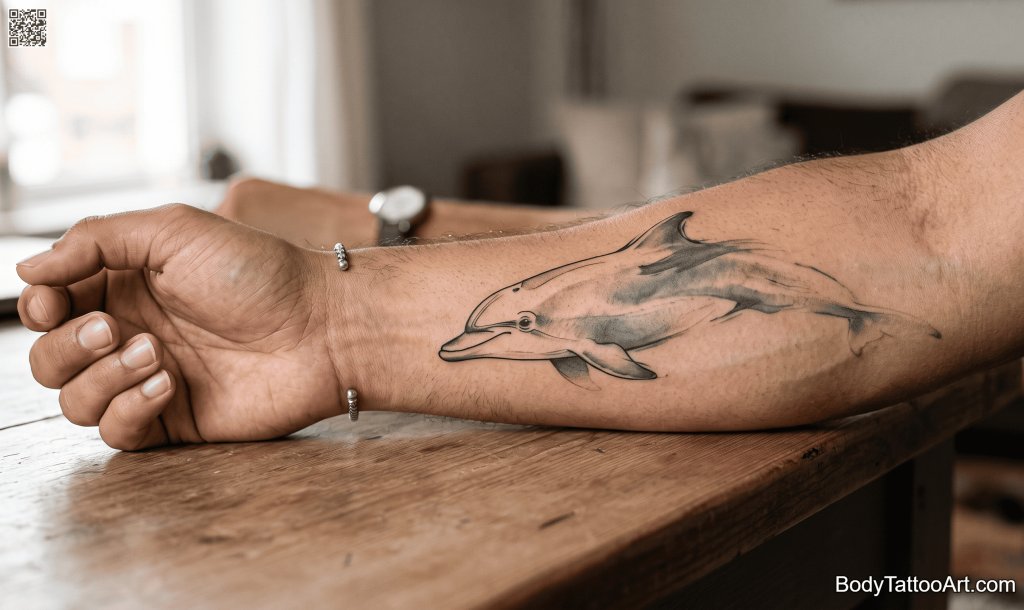
A single dolphin rendered in soft ink-wash technique, where the body dissolves into grey wash strokes at the tail end. The head is more defined with clean outlines, while the body gradually loses structure — as if disappearing into water. The contrast between the sharp front and the diffused tail creates movement without needing any background.
Placement: Inner forearm
Style: Ink-wash / watercolour grey Dolphin Tattoos
Why it stands out: The fading technique makes the dolphin look like it’s mid-dive, vanishing into depth. It’s a dynamic composition using only one tonal value.
Ideal for: Minimalists who want a design with artistic edge, watercolour fans, first-timers.
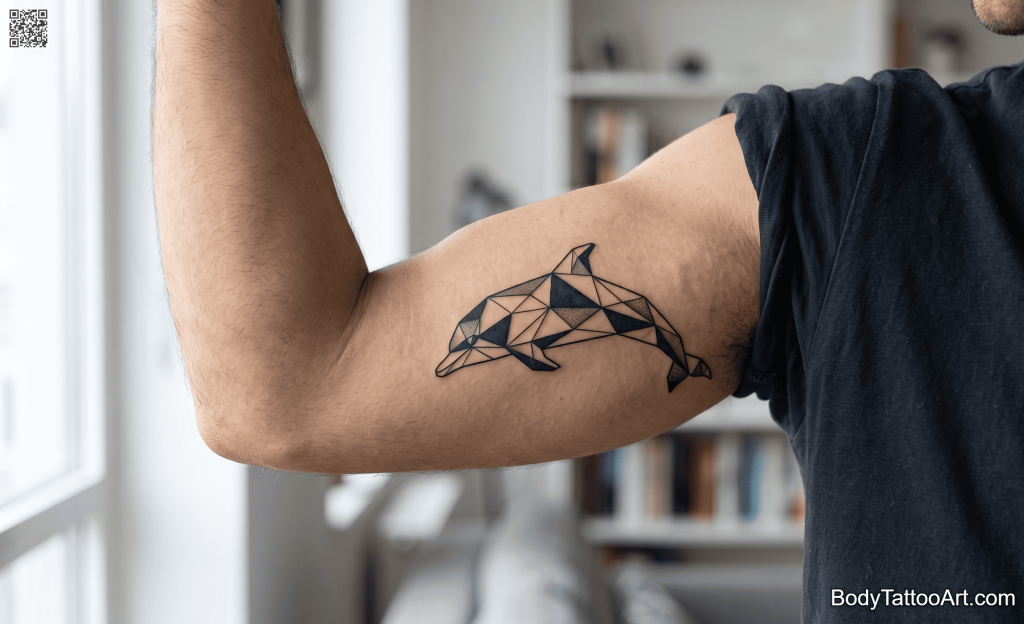
A dolphin built entirely from straight lines, triangles, and angular planes — like a low-polygon 3D render translated into tattoo ink. The body is divided into sections by sharp geometric lines, each section filled with a slightly different shade of black or left open. Clean, structural, modern.
Placement: Upper arm / bicep
Style: Geometric blackwork Dolphin Tattoos
Why it stands out: The contrast between the organic dolphin shape and the rigid geometric internal structure creates a visual tension that’s genuinely striking.
Ideal for: Architecture and design lovers, fans of structured blackwork, people who prefer bold over delicate.
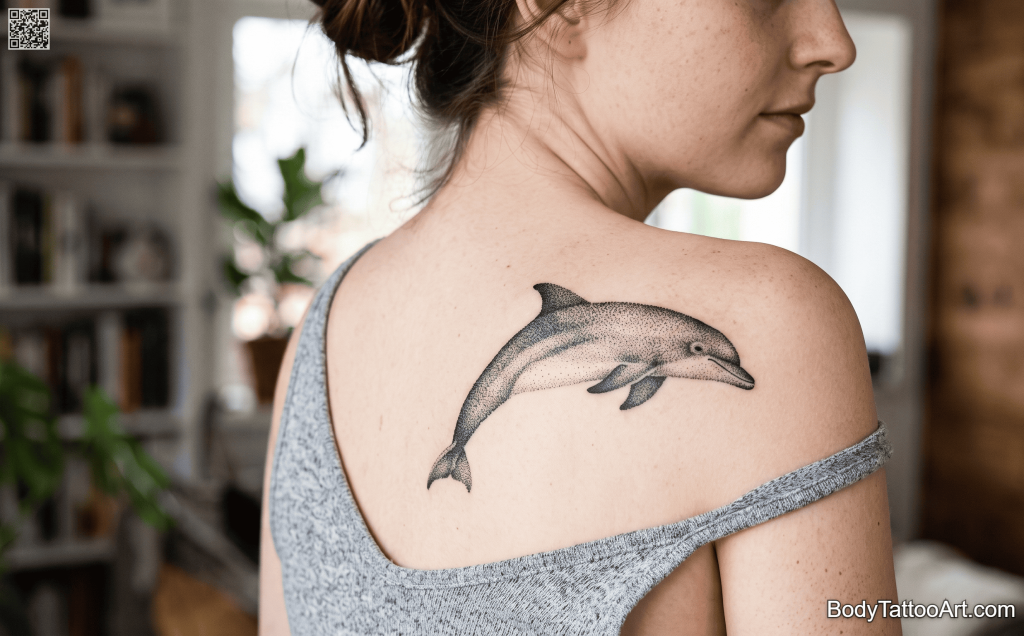
A full-body dolphin silhouette created entirely using stippling — thousands of tiny dots building up the form from the lightest grey to near-black. No outlines anywhere. The shape emerges purely from dot density. The fin and tail edge are the most concentrated, while the belly area stays light.
Placement: Shoulder blade
Style: Dotwork Dolphin Tattoos
Why it stands out: The absence of outlines makes the tattoo look like a shadow instead of a drawing — hauntingly soft and three-dimensional.
Ideal for: Dotwork enthusiasts, people who want something subtle from a distance but detailed up close.
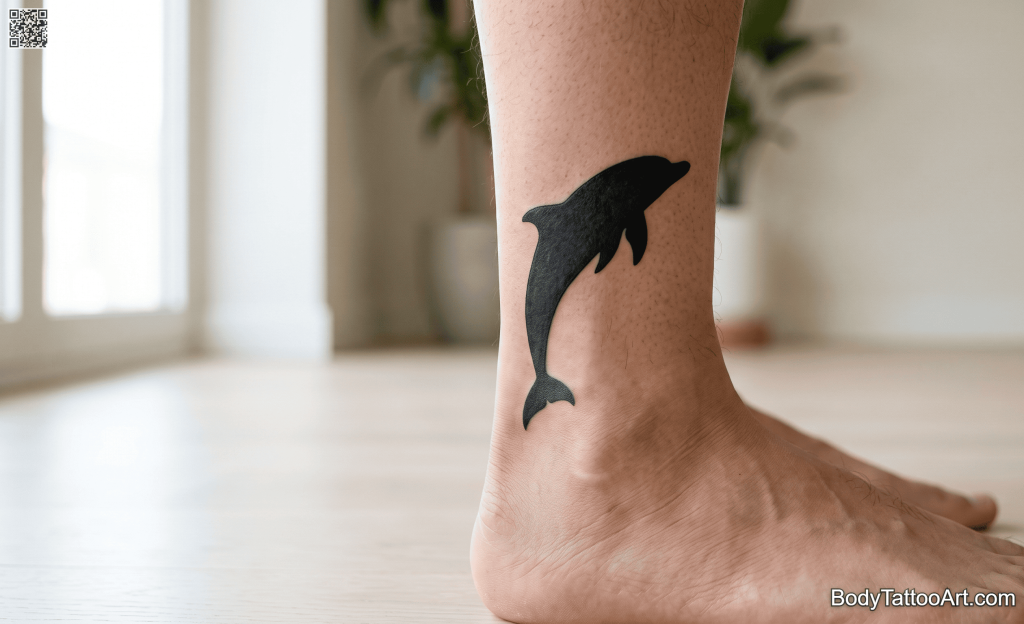
A bold, solid black silhouette of a dolphin mid-leap — body arched upward at a 45-degree angle, tail flicked below. No internal detail. Just a clean, confident black shape. The silhouette is slightly elongated to emphasize the arc of the jump.
Placement: Ankle / lower leg
Style: Blackwork silhouette Dolphin Tattoos
Why it stands out: Simplicity is the whole point here. The strong shape does all the work — no shading, no detail, no filler.
Ideal for: Minimalists, people wanting a small bold piece, those who prefer clean statement ink.
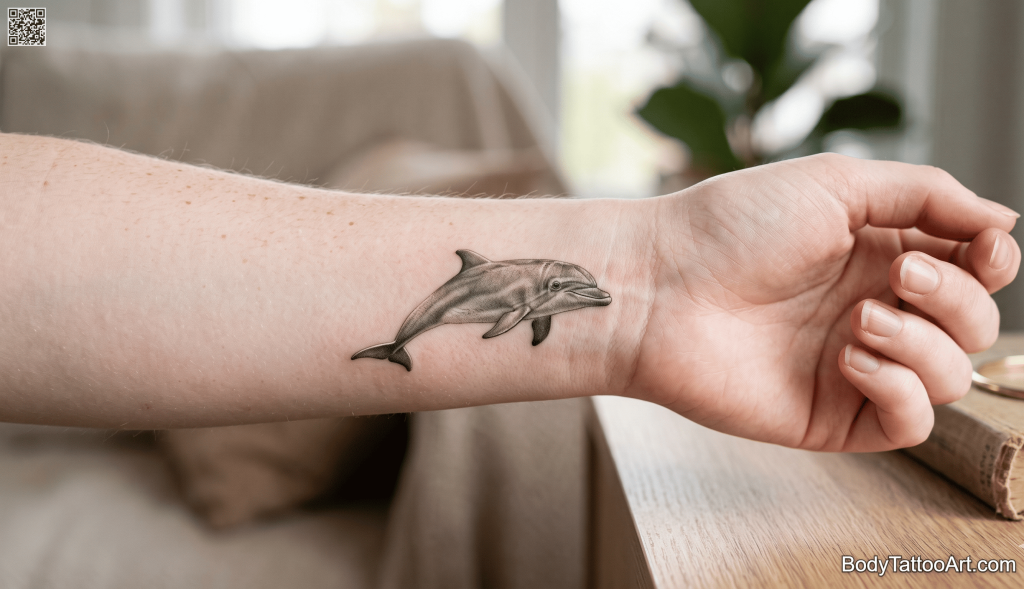
A tiny but hyper-detailed dolphin tattoo — small enough to fit on the wrist, but rendered with realistic skin texture, subtle grey shading, and a glassy-eyed expression. The scale contrast (tiny size, realistic detail) is the whole point of this design.
Placement: Inner wrist
Style: Micro realism Dolphin Tattoos
Why it stands out: The amount of detail packed into a small space is genuinely impressive. It reads as delicate from a distance and complex up close.
Ideal for: Detail-oriented collectors, people who want something small but impactful, fine line realism fans.
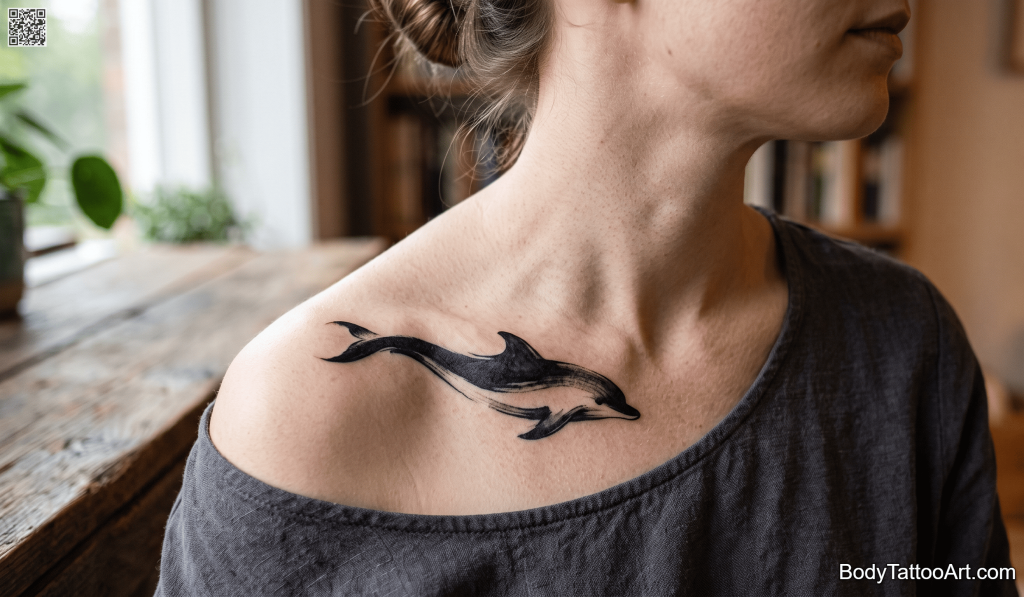
The entire dolphin is made from a single thick brushstroke — like a calligraphy swipe that just happens to curl into a dolphin shape. The stroke is heaviest at the dorsal fin and thins out at the nose and tail tip. It looks both spontaneous and intentional.
Placement: Collarbone / clavicle area
Style: Brushstroke / sumi-e inspired Dolphin Tattoos
Why it stands out: It reads more like a gesture drawing than a tattoo — fast, fluid, confident. The imperfection is the art.
Ideal for: People who love expressive mark-making, fans of Japanese brush art, those who want something unconventional.
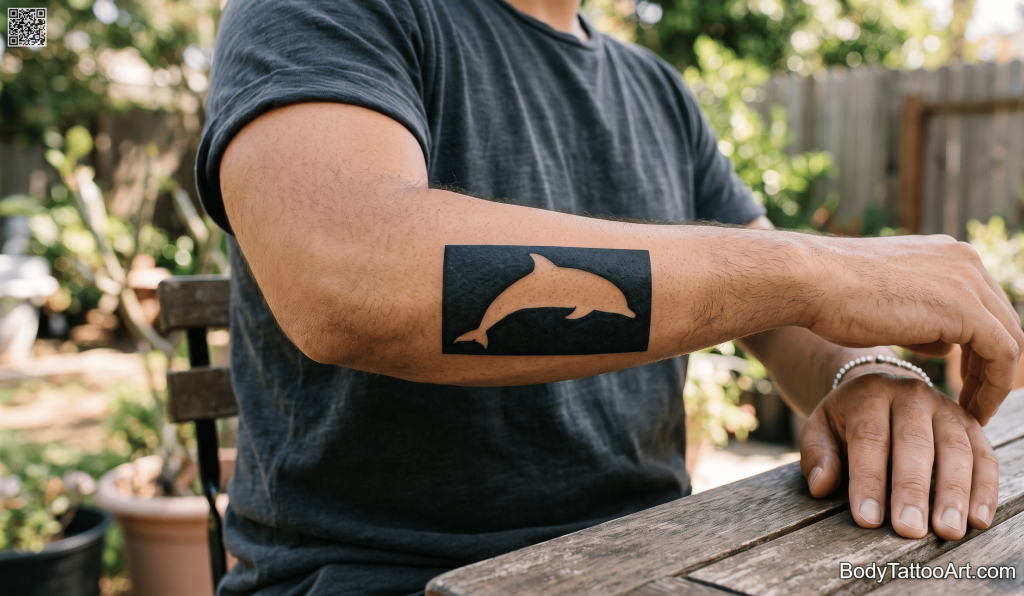
The dolphin shape is cut out of a solid black rectangle — meaning the dolphin itself has no ink. The surrounding space is filled with deep black, and the skin becomes the dolphin. The fins and tail edges are crisp and clean.
Placement: Outer forearm
Style: Negative space blackwork Dolphin Tattoos
Why it stands out: It flips the usual logic of tattooing — the empty space is the subject. The result is graphic and eye-catching.
Ideal for: Bold blackwork fans, people who want something that sparks conversation, those who prefer graphic design aesthetics.
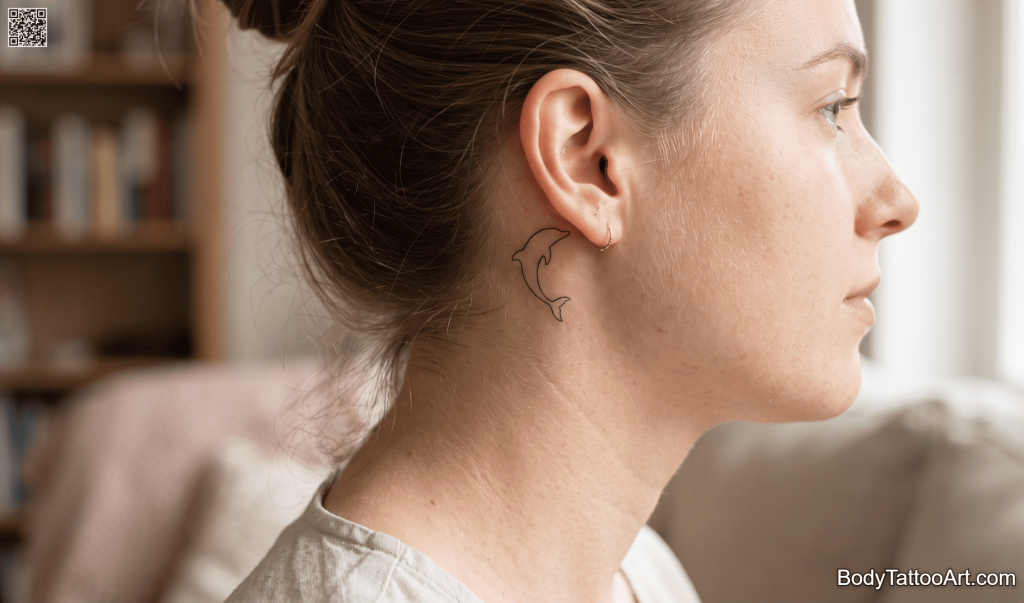
An ultra-thin single-line dolphin — just the outer contour, drawn in one continuous hairline stroke. The line is so fine it almost disappears at certain angles. No fill, no shading, no embellishment.
Placement: Behind the ear
Style: Single-line fine art Dolphin Tattoos
Why it stands out: Restraint is the strength here. One unbroken line doing the work of an entire drawing.
Ideal for: Minimalists, people who prefer discreet placements, first-time tattoo seekers.
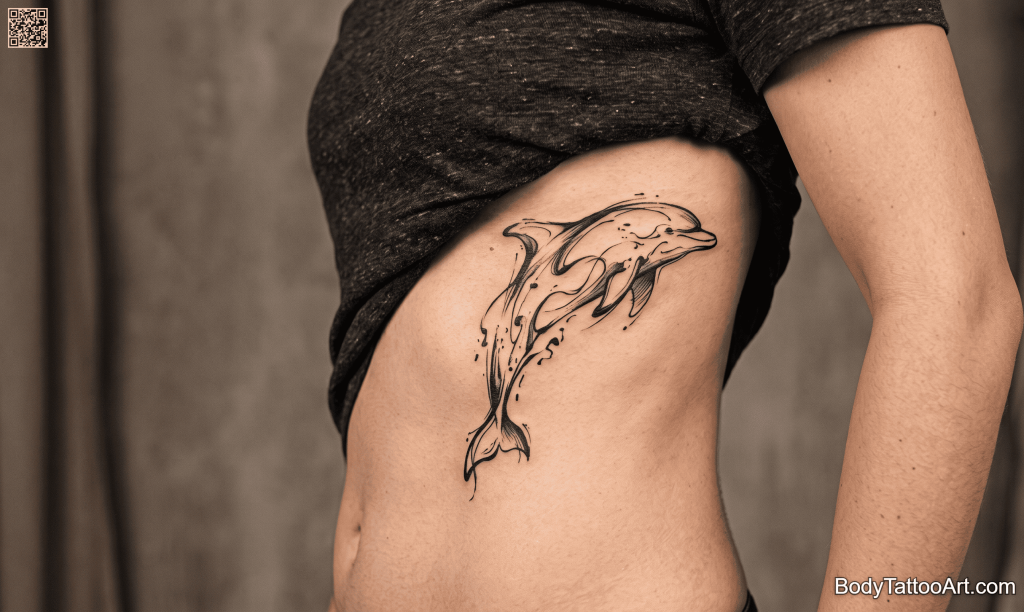
A dolphin shape that breaks apart into fluid abstract strokes — the body is loosely readable as a dolphin, but sections of it dissolve into free-flowing black lines and abstract curves. Part representational, part purely visual.
Placement: Ribcage / side torso
Style: Abstract expressionist Dolphin Tattoos
Why it stands out: It sits between illustration and abstract art — not fully one thing, which makes it far more interesting than either alone.
Ideal for: Art lovers, people who want something that feels personal and interpretive, those who prefer one-of-a-kind designs.
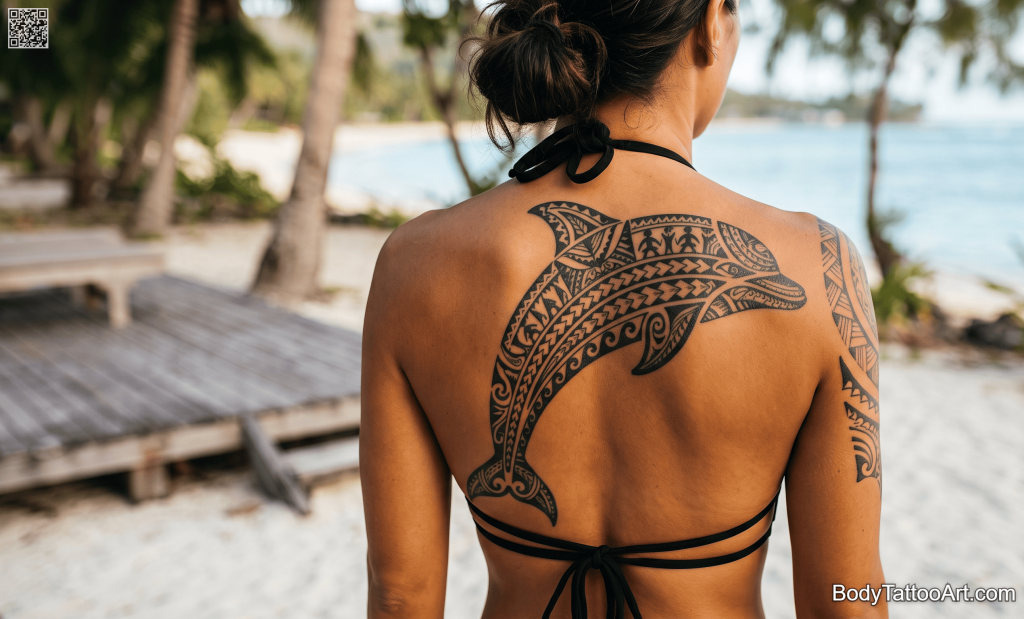
A bold, symmetrical dolphin built from traditional Polynesian tribal patterns — thick black bands, spearhead fills, and curved lines following the dolphin’s body shape. The tail fans out into a wide tribal spread.
Placement: Upper back / shoulder
Style: Polynesian tribal Dolphin Tattoos
Why it stands out: The tribal patterning gives the dolphin visual weight and cultural grounding. It fills the placement naturally without looking overcrowded.
Ideal for: Fans of bold blackwork, those with Pacific Islander heritage or appreciation for Polynesian art, people wanting a statement back piece.
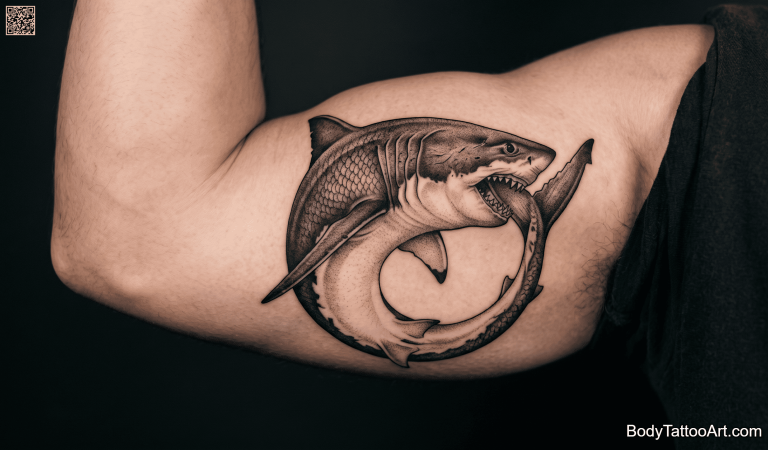
If bold marine animals resonate, it’s worth exploring how similar visual energy appears in eagle tattoo designs, shark tattoo ideas, and wolf tattoo compositions. Many of the same principles — silhouette strength, shading depth, and placement harmony — apply across the board.
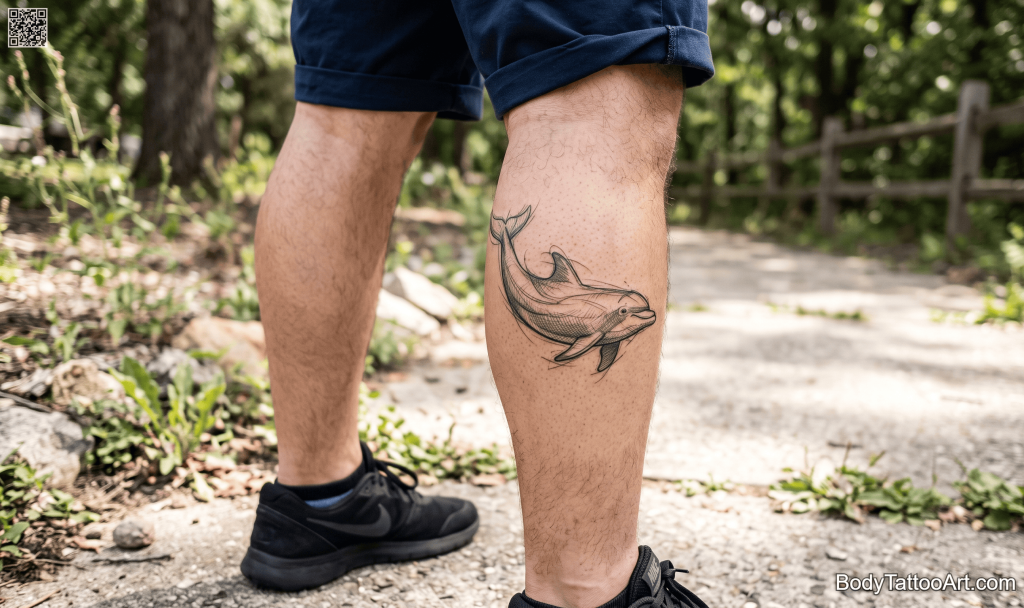
Looks like a pencil sketch transferred to skin — loose, hatched lines building form and shadow. The dolphin has a rough, unfinished quality with visible cross-hatching on the underside and looser strokes near the tail.
Placement: Calf
Style: Sketch / illustrative Dolphin Tattoos
Why it stands out: The deliberately rough quality makes it feel handmade and personal — not machine-polished. The visible process is part of the charm.
Ideal for: Artists, illustrators, people who want tattoos that look like drawings.
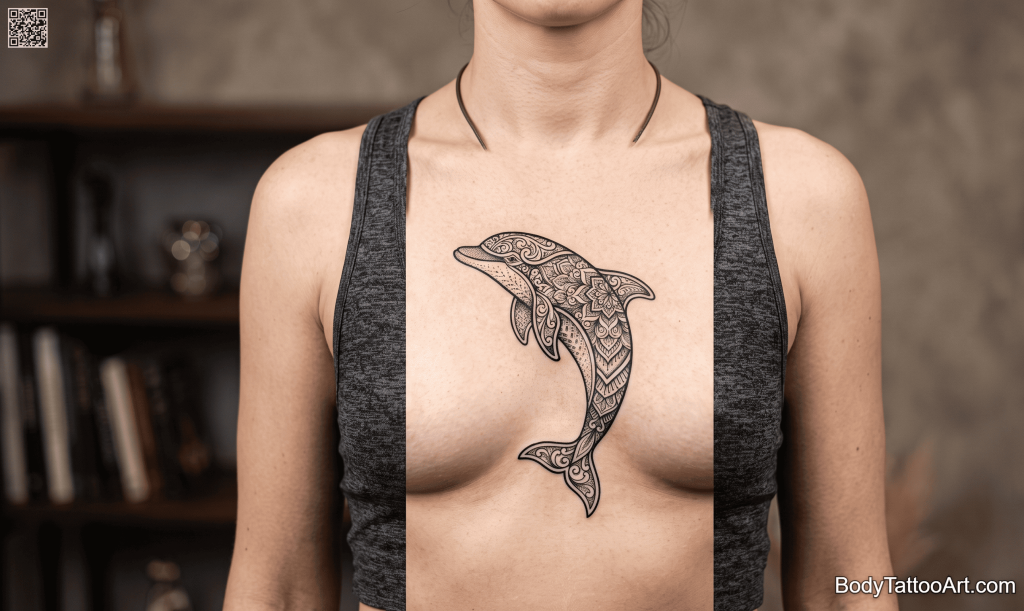
The dolphin’s body is decorated with mandala-inspired ornamental details — fine filigree patterns, symmetrical dot clusters, and delicate linework overlaying the surface like etched jewellery. The outline is clean while the interior is intricately patterned.
Placement: Sternum / chest centre
Style: Ornamental / mandala Dolphin Tattoos
Why it stands out: The contrast between the curved organic shape and the symmetrical interior patterns creates a jewellery-like quality on the skin.
Ideal for: People who love ornamental or spiritual tattoo aesthetics, those wanting a centrepiece tattoo.
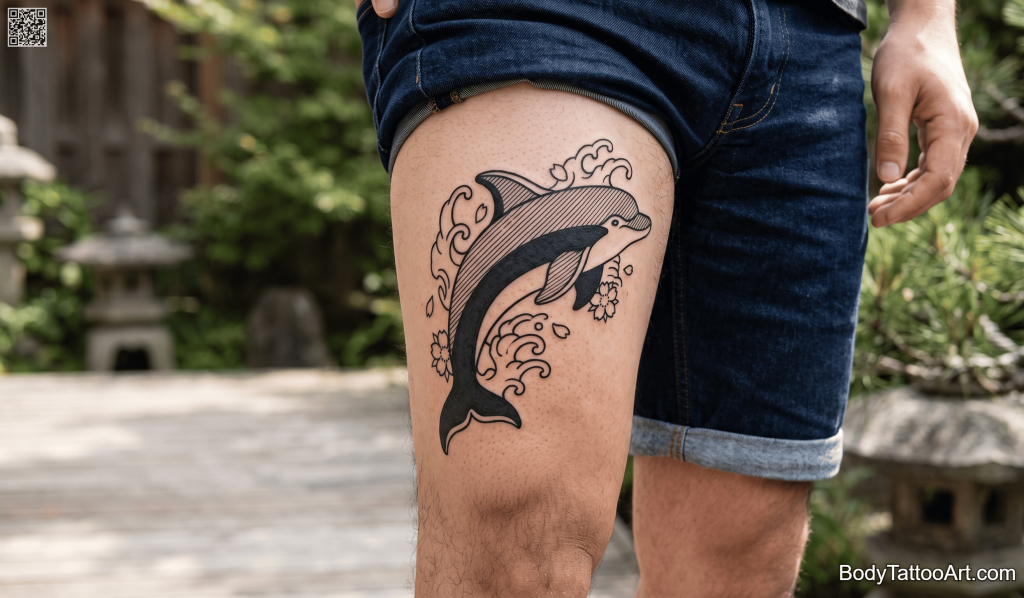
Inspired by Japanese woodblock printing — bold outlines, flat shading sections, and a slightly stylised anatomy. The dolphin’s body has distinct zonal fills: one section pure black, one with diagonal hatch lines, one left open. Old-world aesthetic.
Placement: Thigh
Style: Japanese woodblock / ukiyo-e inspired Dolphin Tattoos
Why it stands out: The graphic flatness contrasts beautifully with the natural dolphin form. It looks like it belongs on a vintage print, not just on skin.
Ideal for: Japanese art enthusiasts, collectors of illustrative tattoos, people who want historical aesthetic references.
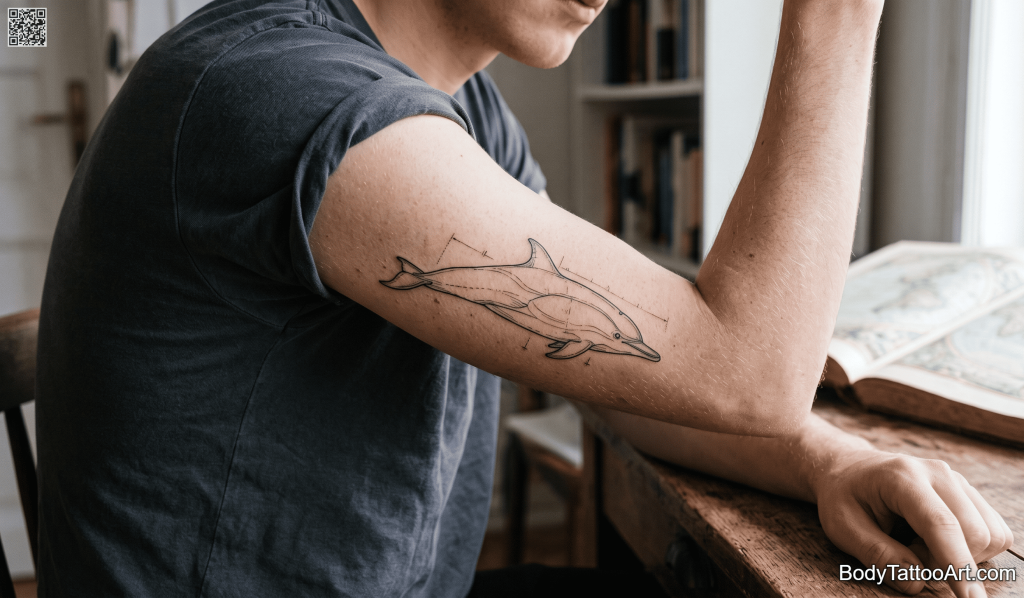
A dolphin drawn in the style of a scientific illustration — precise proportions, clearly labelled internal structure lines (not text, just fine measurement-style marks), and anatomically accurate body shape. The style nods to vintage natural history illustration.
Placement: Inner upper arm
Style: Scientific illustration / fine line Dolphin Tattoos
Why it stands out: The clinical precision gives it an intellectual quality. It’s the kind of tattoo that reads as a statement about curiosity and knowledge.
Ideal for: Marine biology fans, science communicators, people who love vintage reference material aesthetics.
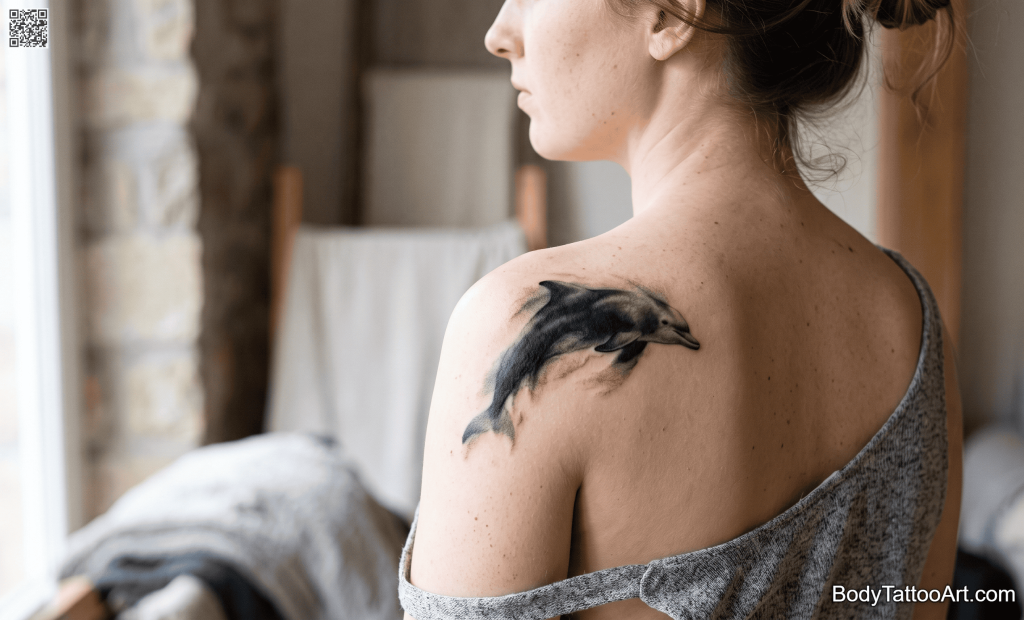
A dolphin created using heavy black ink with intentional smudging — the edges of the body are blurred and soft as if drawn in charcoal and partially smeared. The contrast between the dense centre and the feathered edges gives a smoky, atmospheric quality.
Placement: Shoulder cap
Style: Smudge / painterly Dolphin Tattoos
Why it stands out: The blurred edges make the dolphin look like it’s appearing through fog or water. Nothing else quite replicates this soft visual weight on skin.
Ideal for: People who love atmospheric, moody aesthetics, those who want something that reads as artistic rather than decorative
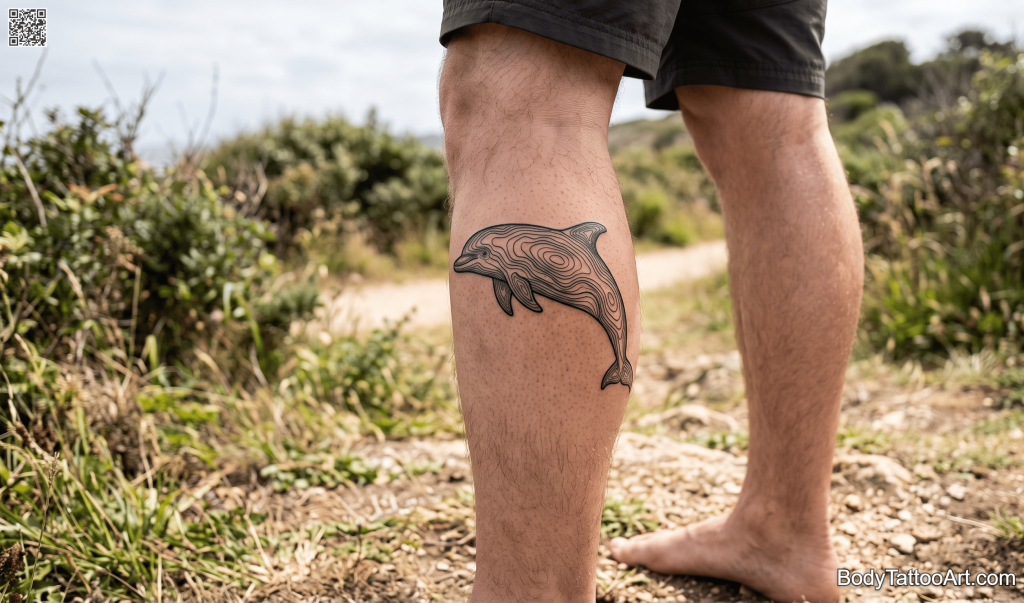
The dolphin silhouette is filled with topographic contour lines — concentric curves following the body’s shape, spaced evenly like a terrain map. The outer silhouette is clean black, and the interior lines vary in thickness.
Placement: Outer calf
Style: Topographic / geometric fill Dolphin Tattoos
Why it stands out: It’s an entirely unexpected use of interior space. The contour lines give the impression of three-dimensional form without any shading.
Ideal for: Design thinkers, geography or science enthusiasts, people who want something genuinely uncommon.
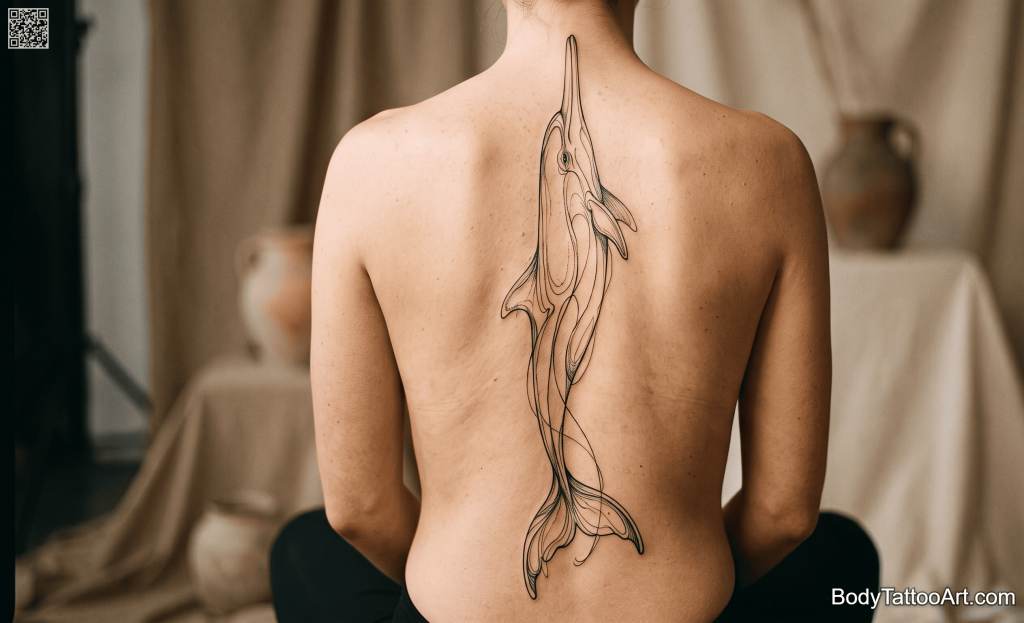
A dolphin with a dramatically elongated body — stretched and slightly distorted the way Dalí might approach it. The nose is longer than anatomically correct, the tail widens into an oversized fluke. The proportions are intentionally off, giving it a dreamlike quality.
Placement: Spine / back centre line
Style: Surrealist illustrative Dolphin Tattoos
Why it stands out: The deliberate distortion transforms a familiar animal into something strange and arresting. It works particularly well running vertically down the spine.
Ideal for: Surrealism fans, people who want something conceptually distinct, artists who lean into unconventional aesthetics.
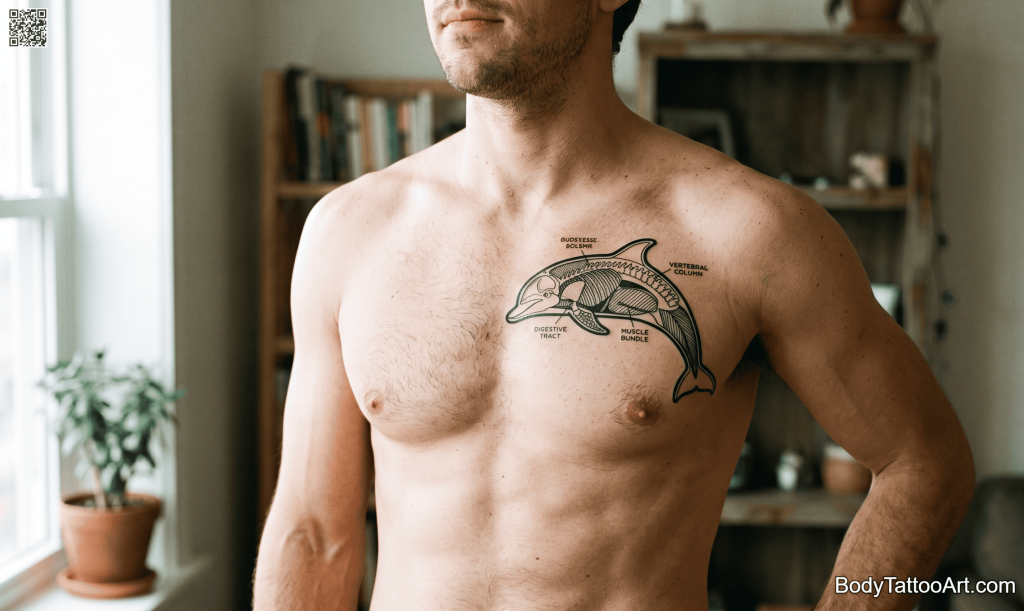
A dolphin presented as a cross-section cut — like an anatomical diagram showing the inside. The exterior has a clean outline, but the interior shows stylised structures filled with hatching, blocked zones, and fine detail lines. Not medical accurate, more artist-interpreted.
Placement: Chest / pectoral
Style: Diagrammatic / illustrative blackwork Dolphin Tattoos
Why it stands out: It takes the dolphin concept into completely unexpected visual territory. Less nature tattoo, more conceptual art.
Ideal for: Concept-driven collectors, biology and science fans, people who want something that starts a conversation.
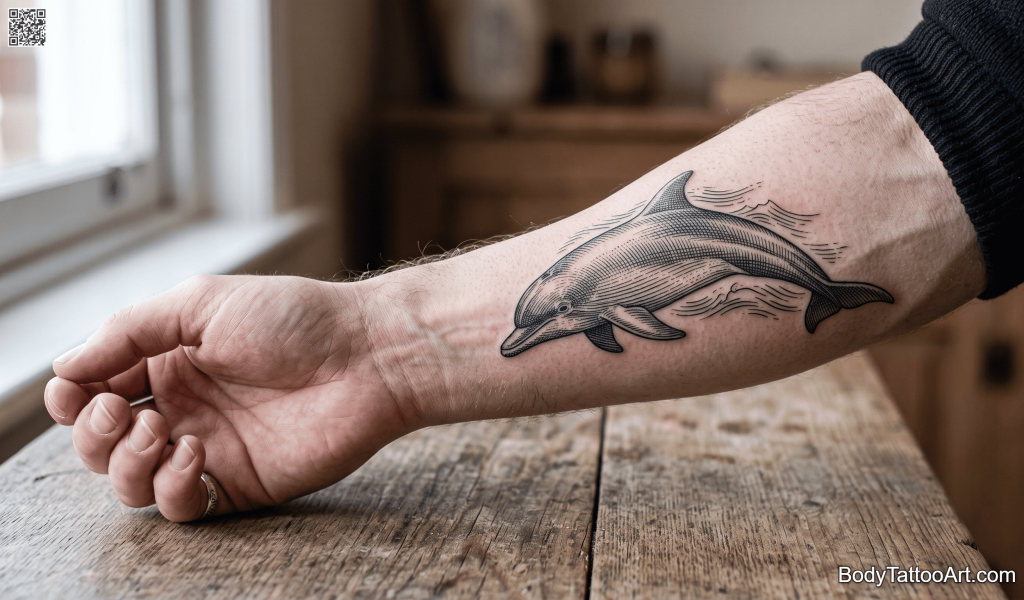
Inspired by old copper plate engraving — extremely fine parallel and cross-hatch lines building form and shadow. The dolphin has a vintage, almost coin-worthy quality. Fine white highlights are suggested through the spacing of lines, not by leaving skin.
Placement: Forearm
Style: Engraving / etching Dolphin Tattoos
Why it stands out: The density of fine lines creates a richness that’s closer to printmaking than conventional tattooing. It rewards close inspection.
Ideal for: Print art lovers, vintage aesthetic enthusiasts, people who appreciate craft and patience in artwork.
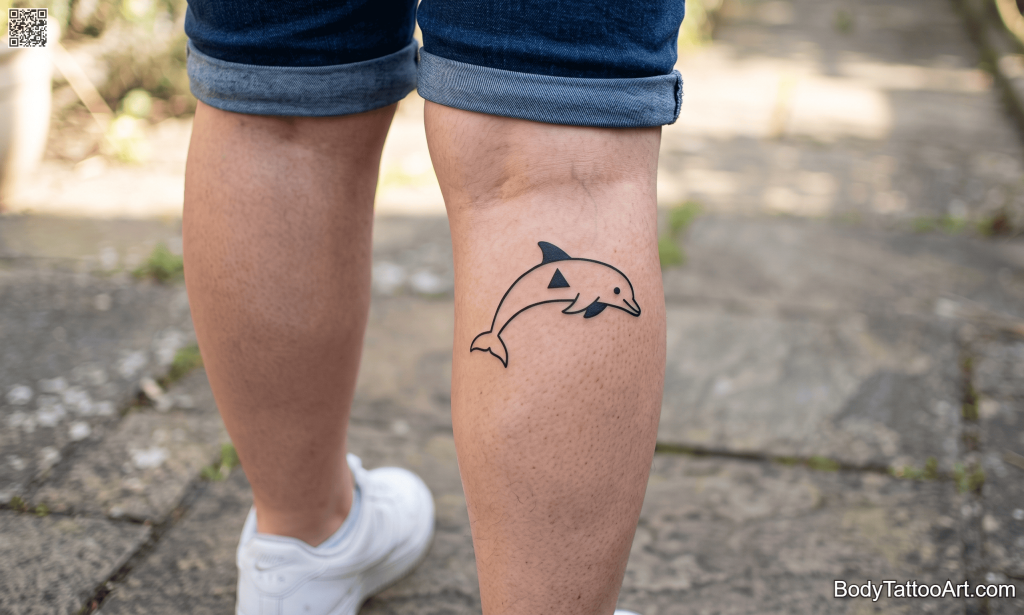
Clean, modern, and bold — a dolphin rendered in a flat design style. Simple shapes, no gradients, no shading. Just a clean anatomically simplified dolphin outline with one or two geometric interior shapes as detail markers. Inspired by icon design and vector illustration.
Placement: Behind the knee
Style: Flat / graphic design Dolphin Tattoos
Why it stands out: It doesn’t try to be realistic or complex. The confidence of simplicity makes it bold. Works especially well in small placements.
Ideal for: Design and tech industry folks, people who prefer clean graphic aesthetics, those wanting something small and modern.
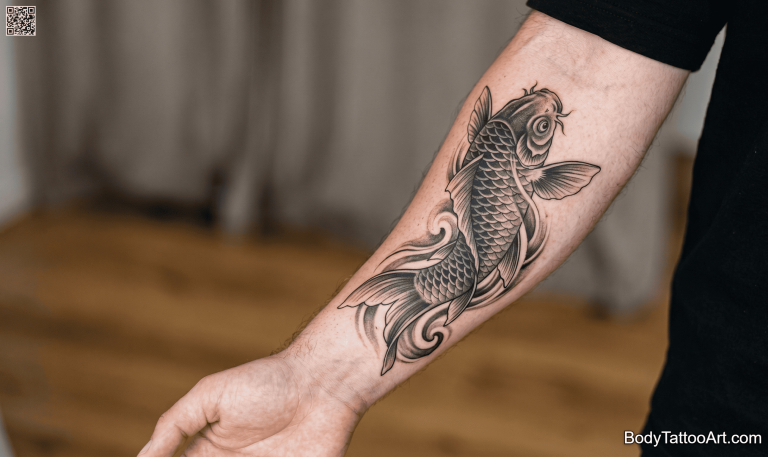
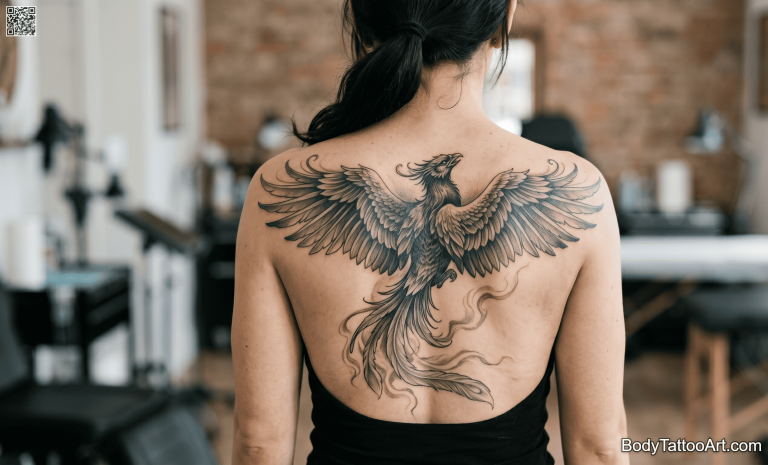
People often explore snake tattoo designs, koi fish tattoo compositions, and phoenix tattoo styles alongside dolphin tattoos when building a marine or nature-themed sleeve or collection. The overlap in style vocabulary — especially between fine line and blackwork — makes mixing these designs surprisingly cohesive.
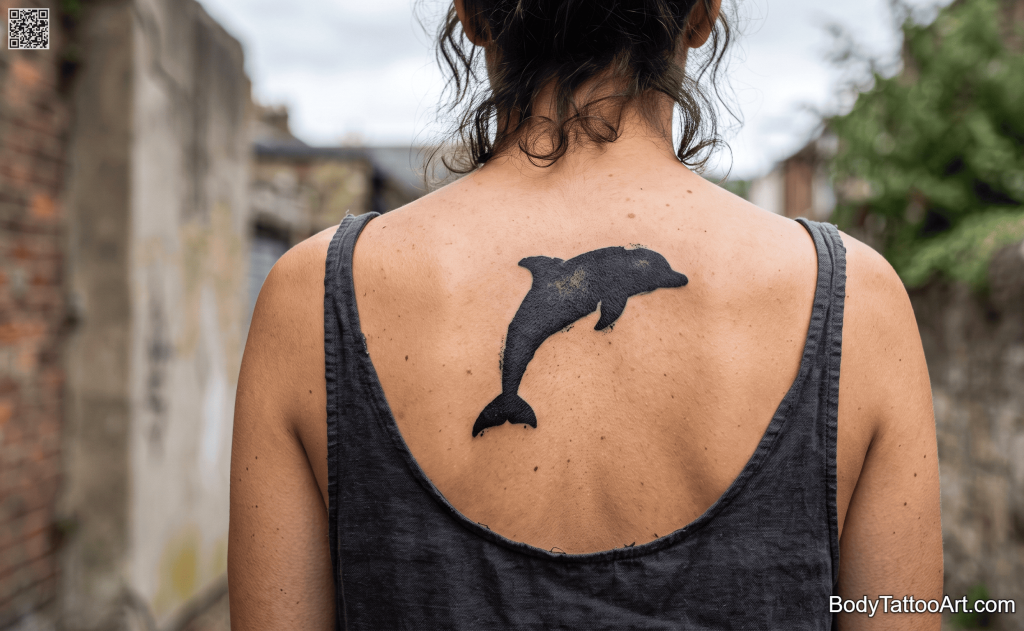
The dolphin looks like it was printed through a stencil — slightly uneven ink edges, a faint texture inside the solid black fill as if ink bled slightly through a cut-out. It deliberately mimics street art stencilling.
Placement: Upper back
Style: Stencil / street art Dolphin Tattoos
Why it stands out: The printed quality is unusual in tattoo art. The slight imperfection of stencil edges gives it a gritty, urban edge.
Ideal for: Street art and graffiti culture enthusiasts, people who want something with an alternative aesthetic.
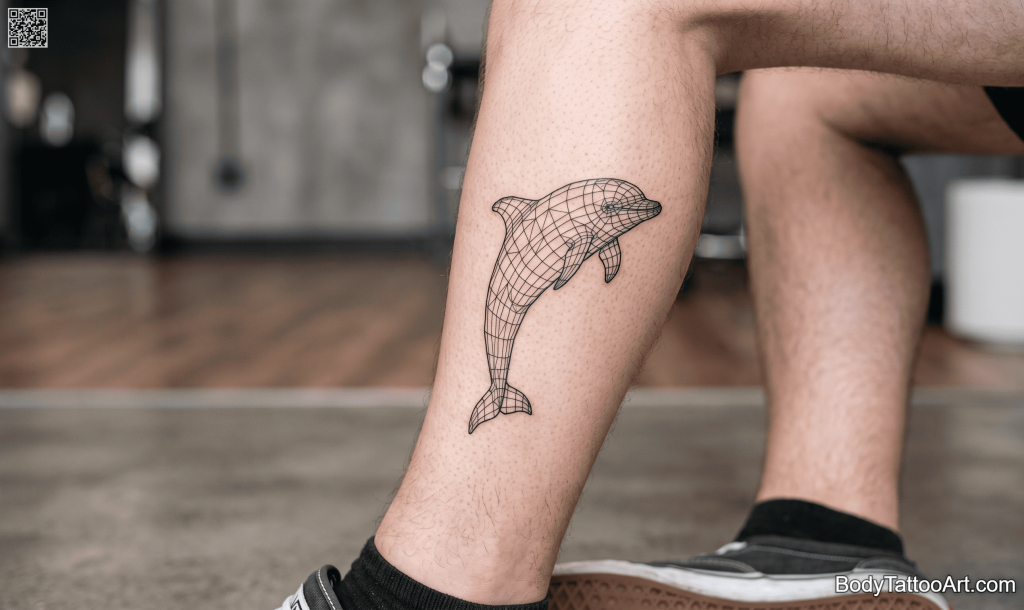
A dolphin made entirely of thin lines forming a wireframe — like a 3D model before texturing. The lines show the underlying geometry of the dolphin body: arching curves, grid sections, and perspective lines meeting at vanishing points.
Placement: Shin / front lower leg
Style: 3D wireframe / technical Dolphin Tattoos
Why it stands out: It looks like a render from 3D modelling software dropped onto skin. Completely different from any conventional dolphin tattoo.
Ideal for: Tech and digital art enthusiasts, 3D designers, people who want something that signals a digital-native aesthetic.
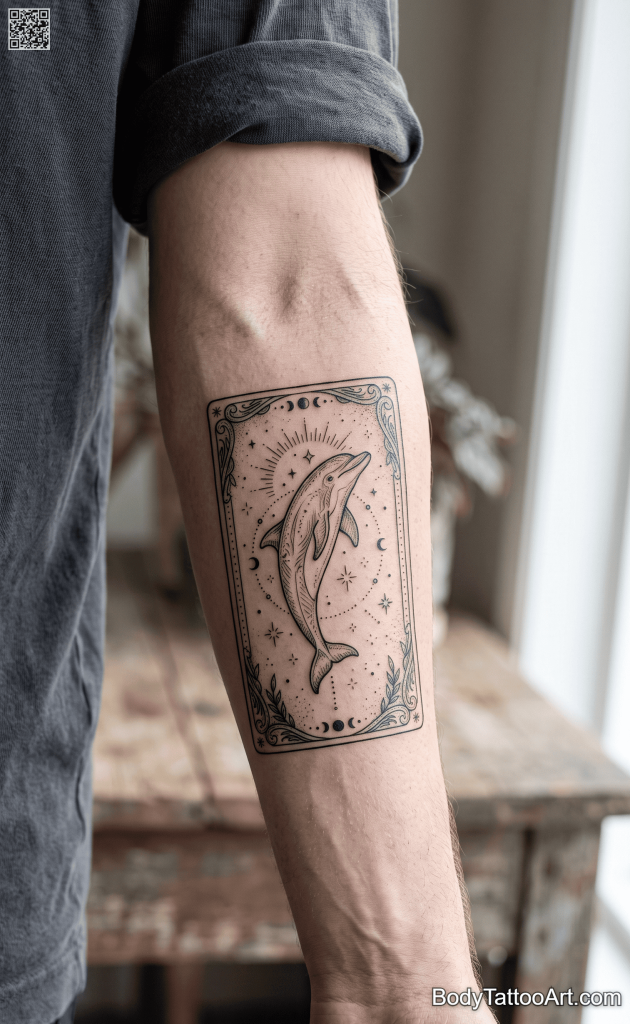
The dolphin is presented as if it’s the central illustration on a tarot card — bordered by a fine decorative frame, positioned symmetrically, with thin line decorative accents around it (stars, small geometric symbols) in the style of classic tarot illustration.
Placement: Forearm / vertical orientation
Style: Illustrative / tarot-inspired Dolphin Tattoos
Why it stands out: The framing device transforms the dolphin into an archetype — elevated and ceremonial. The vertical orientation suits forearm placement naturally.
Ideal for: Tarot enthusiasts, people who love illustrated book aesthetics, those who want a tattoo with a ceremonial visual quality.
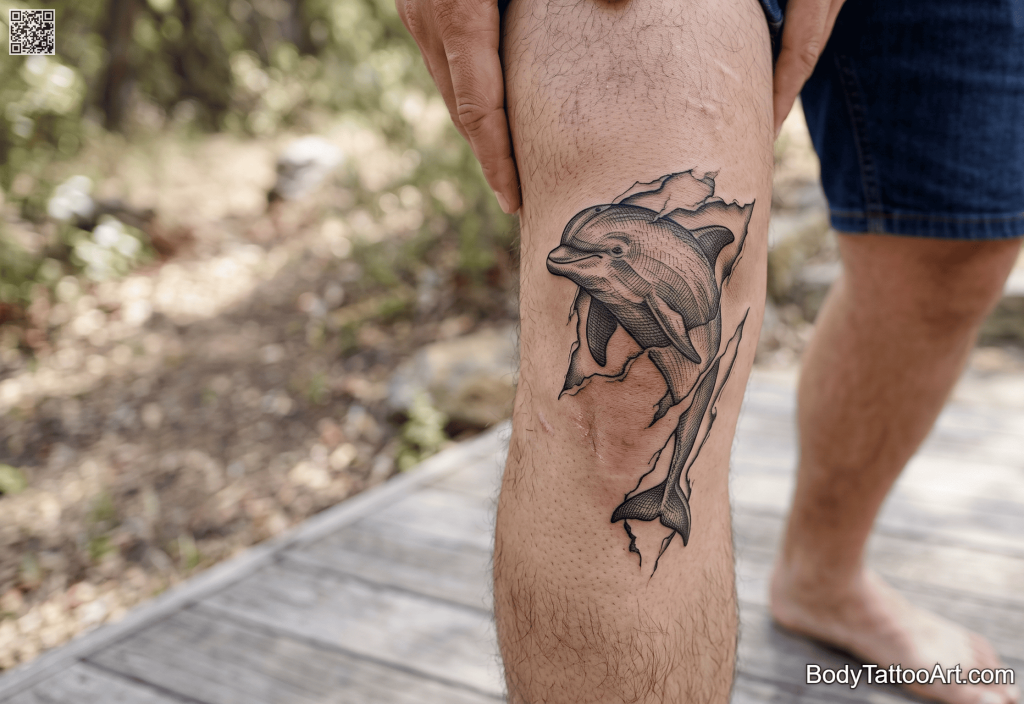
A dolphin silhouette where the edges look like torn paper — the outline is jagged and irregular as if the dolphin was ripped from a page. Inside the silhouette, fine hatching builds form. The deliberate rawness of the torn edge contrasts with the neat interior detail.
Placement: Knee / knee cap area
Style: Mixed / conceptual blackwork Dolphin Tattoos
Why it stands out: The torn paper illusion is a technique that requires real skill to execute well — and the contrast between the jagged outer edge and the neat interior makes it visually complex without being cluttered.
Ideal for: Conceptual tattoo lovers, collectors who appreciate optical illusion techniques, people who want something distinctive.
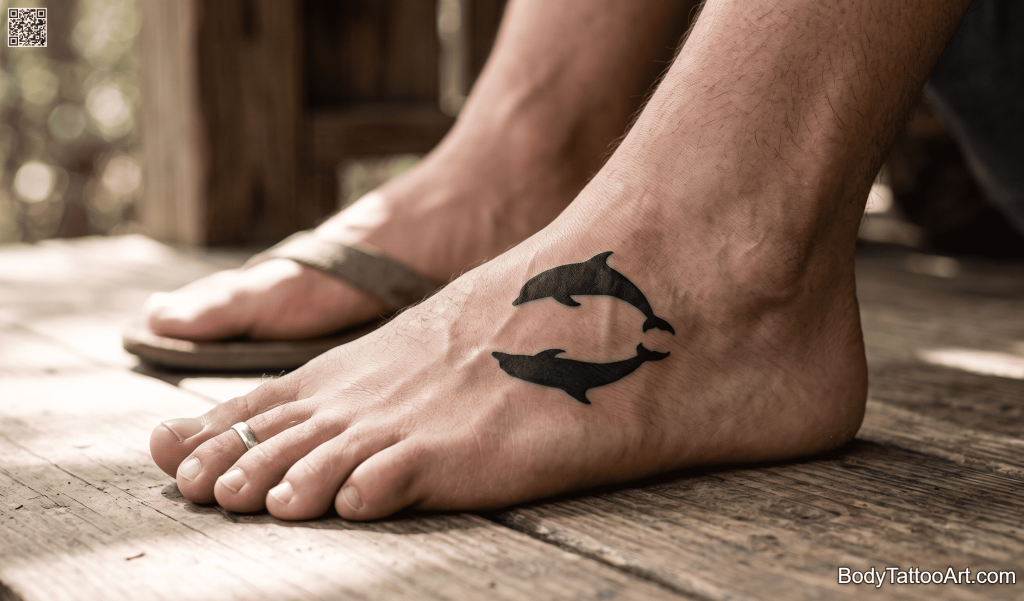
Two elements: a simple dolphin silhouette above, and below it (slightly separated), its own shadow — distorted and stretched as if the light source is coming from above. Both elements are in solid black. The shadow is wider and more spread than the dolphin itself.
Placement: Foot / top of foot
Style: Conceptual silhouette Dolphin Tattoos
Why it stands out: The shadow projection idea adds a second layer of visual reading to a simple design. It’s clever without being complicated.
Ideal for: People who love design thinking in their ink, minimalists who want something with a concept, those who appreciate optical elegance.
Dolphin tattoos are proof that a single subject can look completely different across 25 different executions. The silhouette is familiar — but the possibilities inside that shape are genuinely endless. Whether the preference is for tight fine line work, bold graphic shapes, or something more conceptual and unexpected, dolphin tattoos offer a visual range that most people don’t expect until they start looking.
The designs in this list lean into that range deliberately. No two compositions are the same, no two styles overlap. That’s the whole point.
For anyone building toward a larger nature-inspired collection, dolphin tattoos sit naturally alongside owl tattoo designs and dragon tattoo compositions in terms of the visual vocabulary they share — particularly around contrast, movement, and form.
Pick a style that fits the aesthetic — not just the meaning — and the result will feel much more personal.