Physical Address
304 North Cardinal St.
Dorchester Center, MA 02124
Physical Address
304 North Cardinal St.
Dorchester Center, MA 02124

Shamrock tattoos have been a staple of the tattoo world for generations, and they show no signs of slowing down. There’s something about this small three-leafed plant that keeps drawing people back — whether it’s the cultural roots, the compact shape, or the sheer versatility of the design.
What makes shamrock tattoos interesting is how much range they have. A shamrock can be razor-thin and barely visible on a wrist, or it can be bold and blocky across a shoulder. It can be the centerpiece of a full sleeve or a quiet little design tucked behind an ear. The shape is simple enough to work at any scale, but complex enough to carry serious artistic detail when pushed in that direction.
This blog brings together 27 distinct shamrock tattoo designs — each one different in style, placement, and visual approach. No two look alike. Whether the goal is something classic, something modern, or something completely unexpected, there’s a shamrock tattoo idea here worth bookmarking.
Shamrock tattoos are tattoos inspired by the shamrock — a young sprig of clover, most commonly white clover (Trifolium repens) or red clover, with three rounded leaflets on a single stem. The shamrock is the national symbol of Ireland and has been used for centuries as a marker of Irish identity, heritage, and pride. For similar plant inspiration, check out the clover tattoos as well.
The word “shamrock” comes from the Irish seamróg, meaning “little clover.” It’s a small plant, but it carries enormous cultural weight. Shamrock tattoos appear across every tattoo style — from delicate fine line work to heavy traditional blackwork — and they work on virtually every part of the body.
The most well-known story attached to shamrock symbolism comes from Saint Patrick, who is said to have used the three-leafed plant to explain the concept of the Holy Trinity to the Irish people. Each leaf represented one part — Father, Son, and Holy Spirit — making the shamrock a visual teaching tool that stuck around for centuries.
Beyond Christianity, the shamrock has long been associated with luck, particularly in the form of the four-leaf clover variation. In Irish folklore, finding a shamrock with four leaves rather than three was considered extraordinarily lucky, and this belief spread far beyond Ireland’s borders.
Shamrock tattoos also carry a strong sense of cultural identity. For the Irish diaspora — particularly in the United States, the United Kingdom, and Australia — a shamrock tattoo can be a way of honoring heritage and staying connected to roots. It’s a symbol that says something about where someone comes from without needing any words.
Shamrock tattoos today are worn for many reasons — heritage, luck, faith, or pure aesthetic appeal. The symbol is flexible enough to carry personal meaning or simply stand as a beautifully designed botanical tattoo.
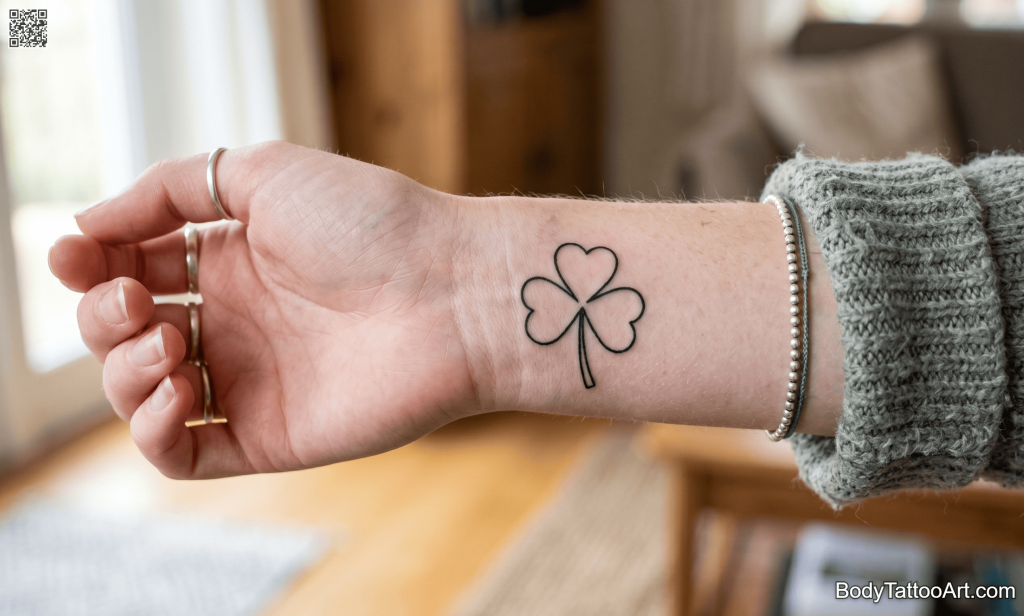
Three rounded leaves on a single upright stem, drawn with medium-weight black lines and no fill. The shape is clean and symmetrical — exactly what the word “shamrock” brings to mind. Nothing added, nothing removed.
Placement: Inner wrist
Style: Simple linework Shamrock Tattoos
Why it stands out: Sometimes the most direct version of an idea is the strongest. This shamrock tattoo earns its place by being exactly what it is — no decoration, no fuss, just a perfectly drawn shape.
Ideal for: First-timers, minimalists, people who want a quick meaningful tattoo.
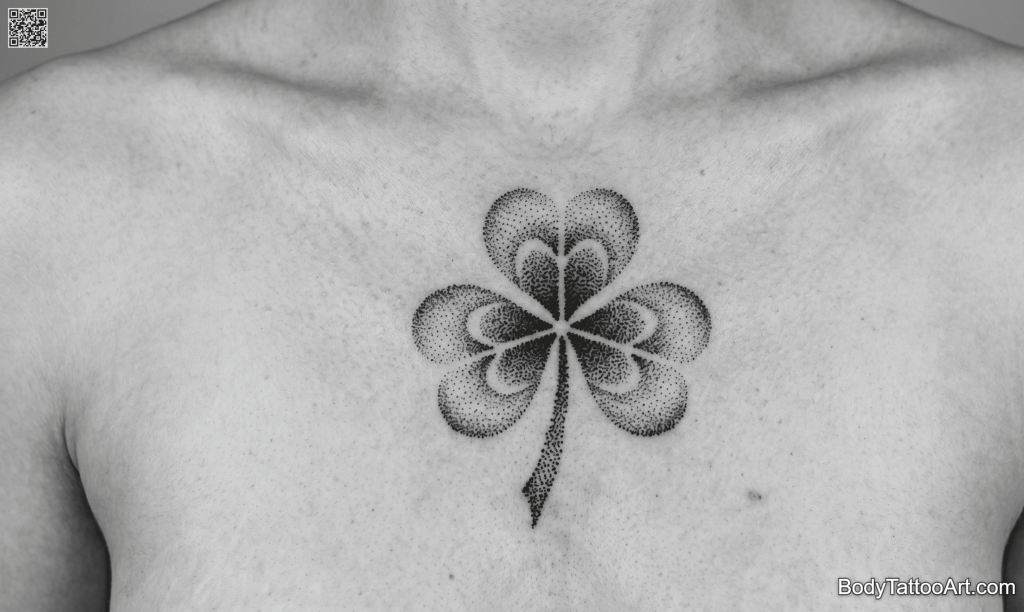
Every element of this shamrock is built entirely from dots — no outlines at all. The leaflets are darkest at the center and fade outward through stippling, giving the design a soft, almost glowing quality. The stem is suggested through a denser cluster of dots at the base.
Placement: Sternum
Style: Dotwork Shamrock Tattoos
Why it stands out: The all-dot approach gives this shamrock tattoo a texture that feels organic — like the plant is emerging from the skin rather than being drawn onto it.
Ideal for: People who love texture-first tattoo styles, dotwork fans, collectors who appreciate technique.
A shamrock tattoo with fully filled solid black leaves — no outlines, no gradients, just flat planes of deep black ink. The three leaf shapes are slightly enlarged and arranged tightly so they overlap just a little at the center.
Placement: Outer calf
Style: Blackwork Shamrock Tattoos
Why it stands out: Solid black fills are rare in shamrock tattoos and they give this one a graphic, modern feel. The contrast against skin is stark and eye-catching.
Ideal for: Bold tattoo fans, people who like strong graphic designs, those building a blackwork collection.
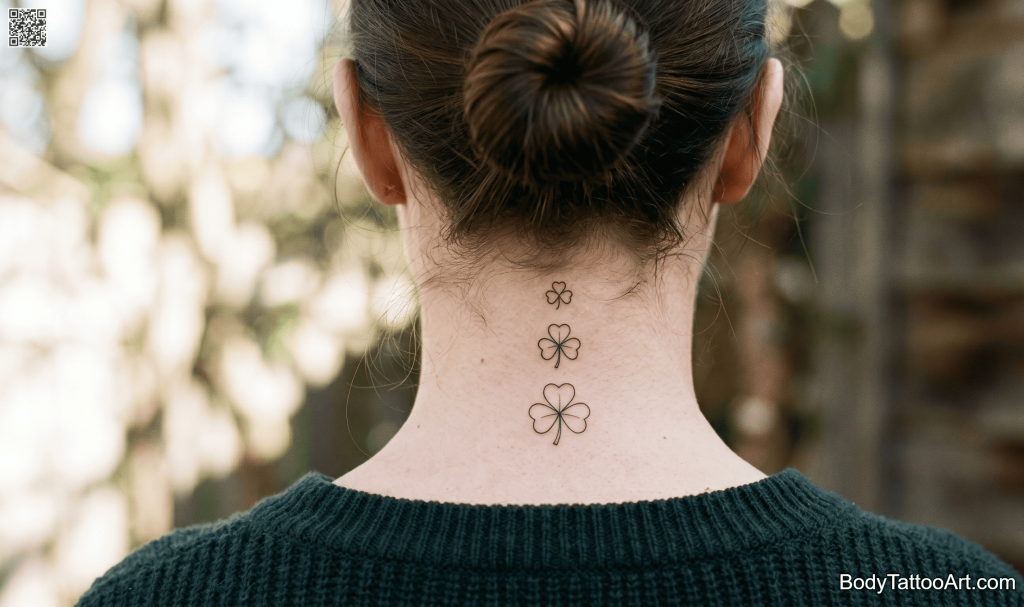
Three tiny shamrock tattoos stacked vertically — each one slightly smaller than the one above. The smallest sits at the top, the largest at the bottom. All three are drawn in fine line, with hairline-thin outlines and no fill.
Placement: Back of the neck / nape
Style: Micro fine line Shamrock Tattoos
Why it stands out: The decreasing scale creates a visual rhythm that’s unusual and eye-catching. It reads as a single piece but reveals itself as three on closer inspection.
Ideal for: People who love subtle nape tattoos, micro tattoo collectors, those who prefer low-profile designs.
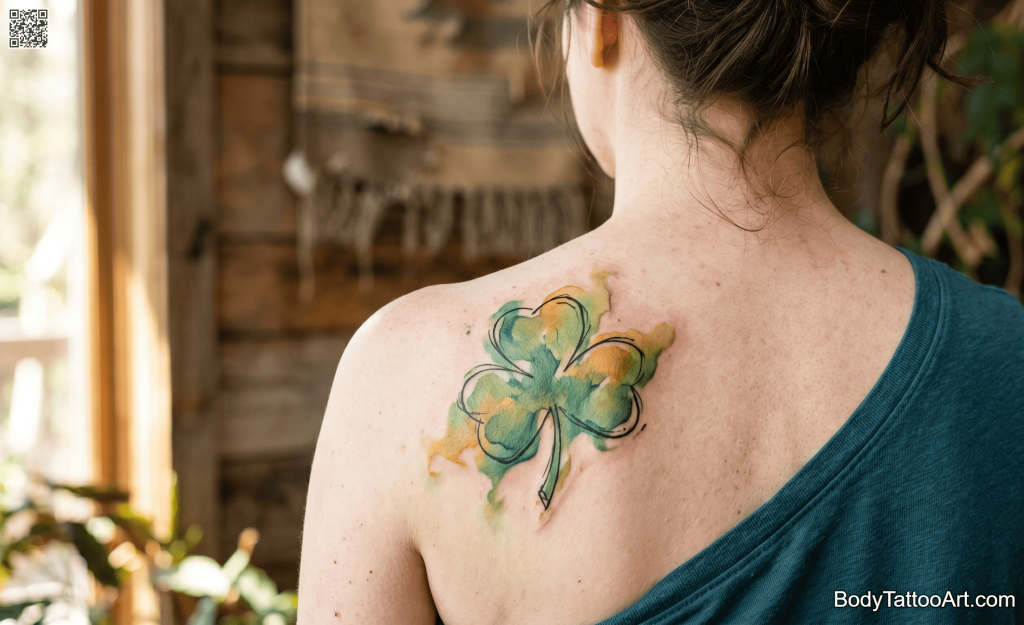
A shamrock shape drawn with loose linework, with soft green and gold watercolor washes bleeding inside and beyond the leaf outlines. The color doesn’t stay within the lines — it spills slightly outward, giving the design a painted, imprecise quality.
Placement: Shoulder blade
Style: Watercolor Shamrock Tattoos
Why it stands out: Shamrock tattoos in watercolor style are rare because the shape is so geometric. The spill of color beyond the outline softens it completely and gives it an artistic, spontaneous quality.
Ideal for: Color tattoo lovers, people who want something soft and painterly, those who prefer art-forward designs.
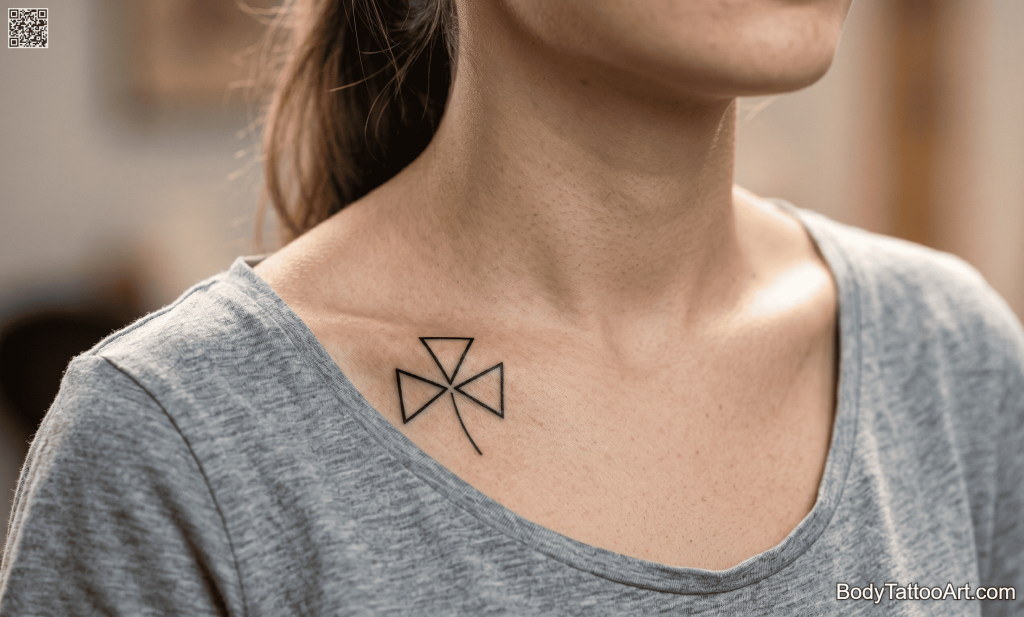
The three leaves of the shamrock are each replaced with equilateral triangles pointing inward, forming an abstract geometric figure that suggests a shamrock without literally drawing one. A single thin line stem anchors the shape.
Placement: Collarbone
Style: Geometric / fine line Shamrock Tattoos
Why it stands out: This shamrock tattoo barely looks like a shamrock — until the eye adjusts and the leaf shapes click into place. The abstract quality makes it feel modern and architectural.
Ideal for: Geometric tattoo fans, people who want recognizable-but-unexpected shamrock tattoos.
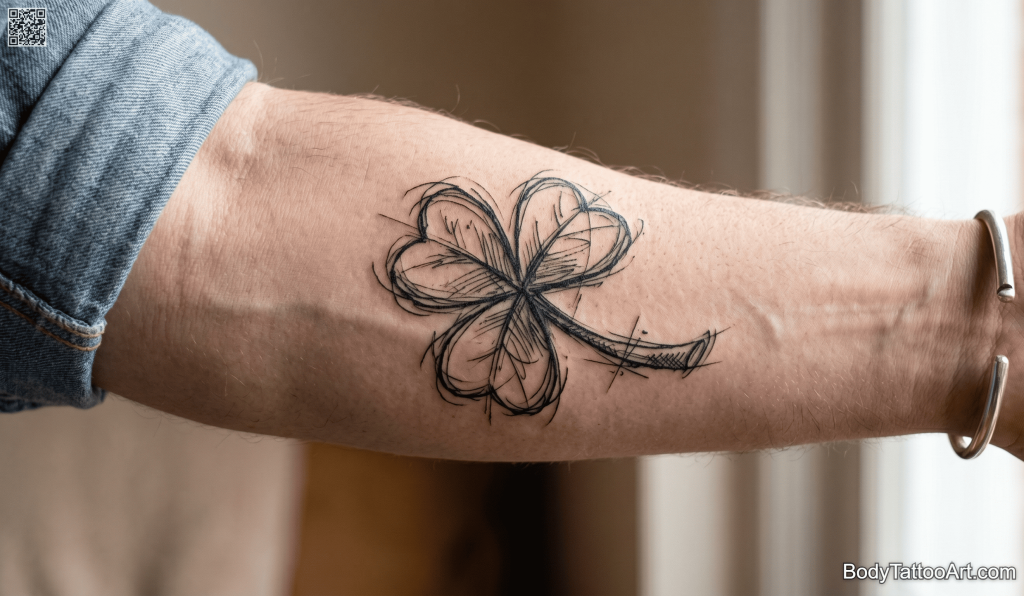
A shamrock drawn in loose sketch style — multiple overlapping lines suggesting the leaf shape without committing to a single clean outline. The stem has visible construction marks. The overall effect looks like a quick drawing from a naturalist’s field notebook.
Placement: Forearm
Style: Sketch / illustrative Shamrock Tattoos
Why it stands out: The intentional imperfection makes this shamrock tattoo feel personal and handmade. The visible sketch marks give it energy that polished line tattoos don’t have.
Ideal for: Art lovers, people who like raw and expressive tattoo aesthetics.
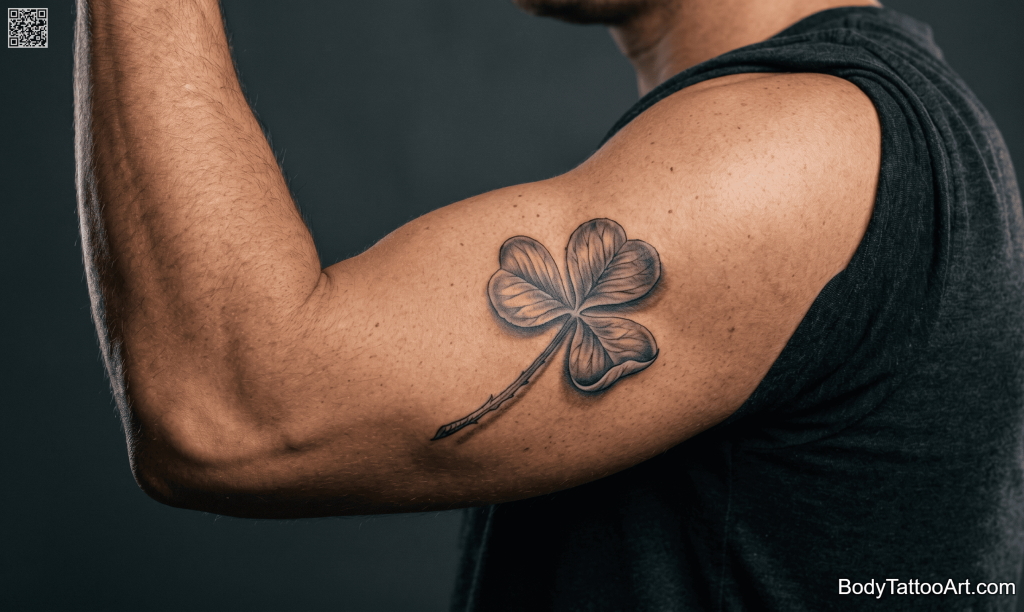
A single shamrock sprig rendered in black and grey realism — the leaves showing subtle vein detail, soft shadow shading on the undersides, and a slight curl at one leaf edge as if caught in a breeze. The stem shows fine bark texture.
Placement: Upper arm / bicep
Style: Grey-wash realism Shamrock Tattoos
Why it stands out: Realism treatment on shamrock tattoos is uncommon, and that’s exactly what makes it compelling. The level of botanical detail elevates a simple symbol into a serious piece.
Ideal for: Realism collectors, people who want their shamrock tattoo to look photographic.
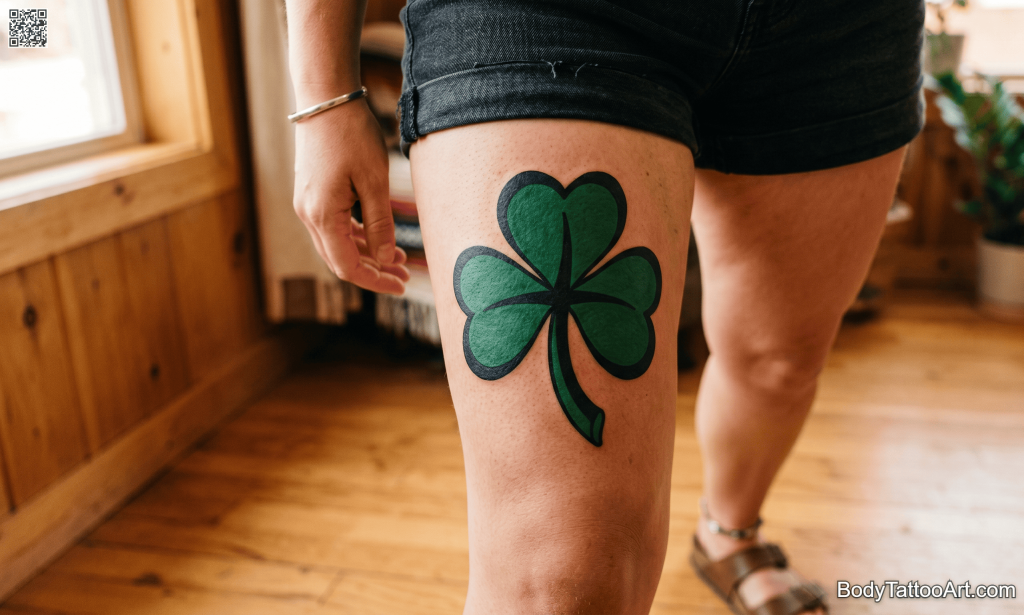
Bold black outlines, flat green fill, thick stem, and a slight banner curl at the top — though the banner itself is left blank, keeping the focus on the plant. Classic American traditional proportions with thick confident lines.
Placement: Upper thigh
Style: American traditional
Why it stands out: Shamrock tattoos in the traditional American style have a timeless quality. The thick outlines and flat fill age well and look good from a distance.
Ideal for: Traditional tattoo fans, people building a classic-style collection.
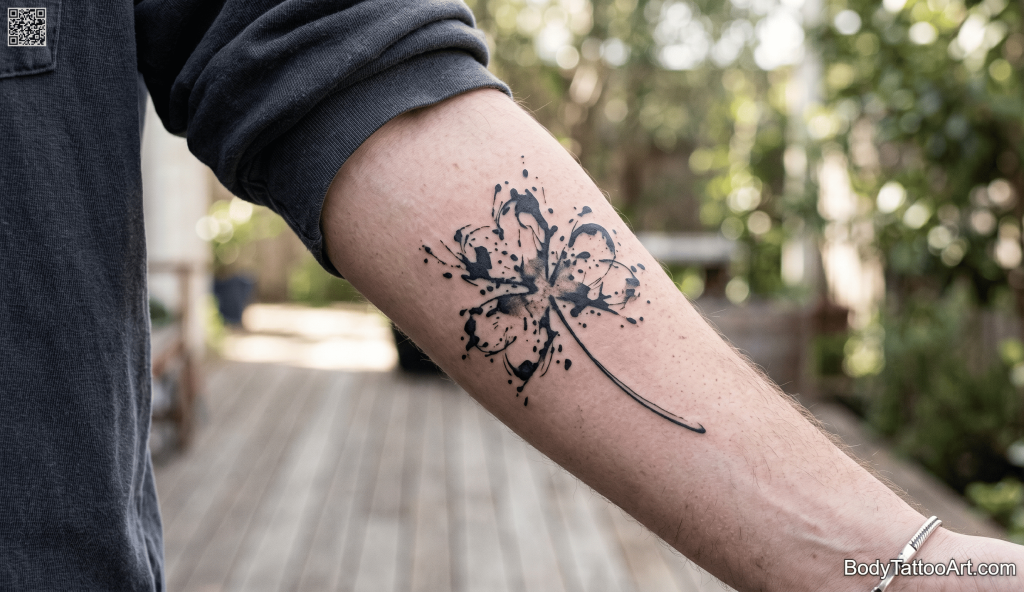
The shamrock shape is implied rather than drawn — ink splashes and organic black marks form the rough outline of three leaves, with the central stem being the only defined element. The rest is expressive and loose.
Placement: Outer forearm
Style: Abstract / freehand
Why it stands out: Shamrock tattoos usually lean toward clean and precise. This version throws all of that out and replaces it with expressive mark-making that still reads as a shamrock.
Ideal for: Experimental tattoo collectors, people who want unique shamrock tattoos that no one else has.
People who love the simplicity of shamrock tattoos often find themselves exploring fern tattoos or ivy leaf tattoos and ivy vine tattoos for their trailing, organic qualities.
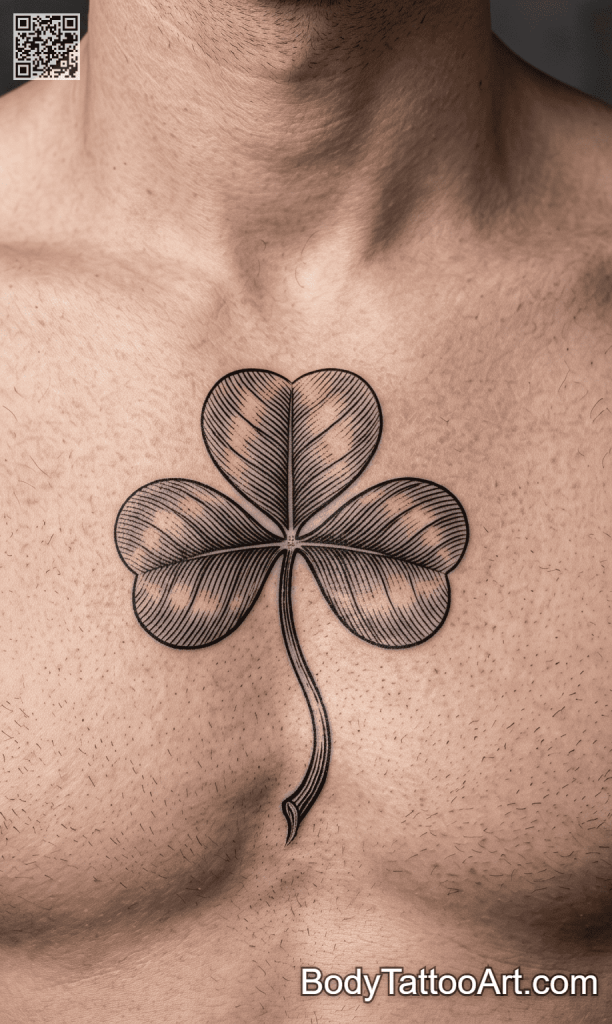
The leaves are shaded entirely through crosshatch lines — fine parallel marks layered at angles to build shadow and depth. No solid fills, no dotwork — just the engraving technique applied to a simple shamrock shape.
Placement: Chest / pec area
Style: Engraving / etching
Why it stands out: The crosshatch technique gives this shamrock tattoo an antique quality, like something lifted from a 19th-century botanical print. Rare and technically demanding.
Ideal for: Fine art tattoo fans, people who love historical illustration aesthetics.
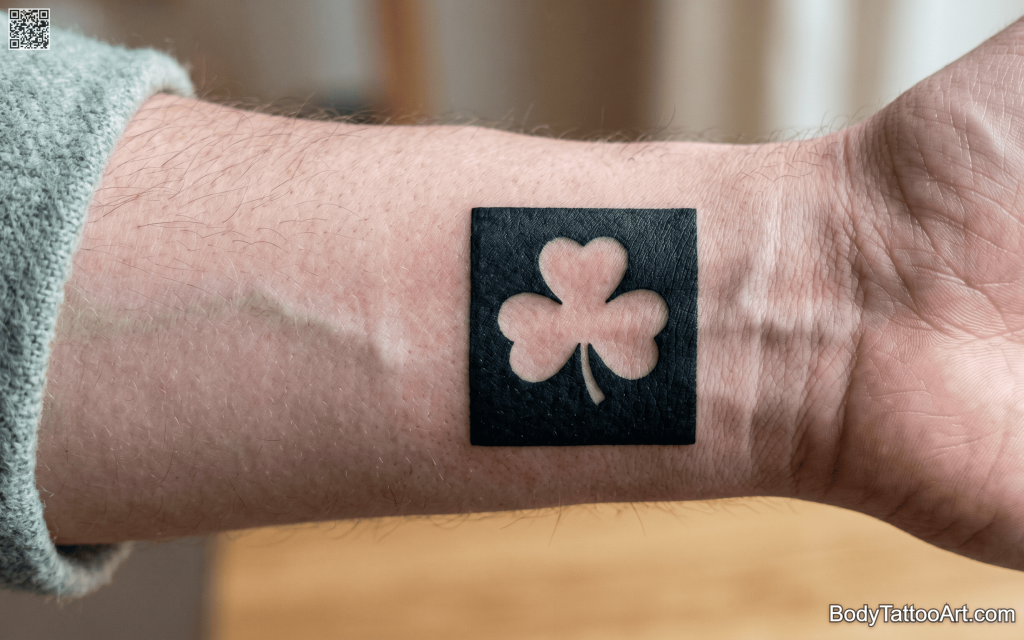
The shamrock shape is created entirely through negative space — the surrounding skin is left untouched, while a solid black rectangular background block contains the plant shape as a cutout. The shamrock appears white against black.
Placement: Inner wrist
Style: Negative space / blackwork
Why it stands out: Flipping the usual logic of shamrock tattoos — black ink as background instead of foreground — creates a striking optical effect. The skin itself becomes the tattoo.
Ideal for: People who love conceptual tattoo ideas, blackwork fans, those who want unique shamrock tattoos.
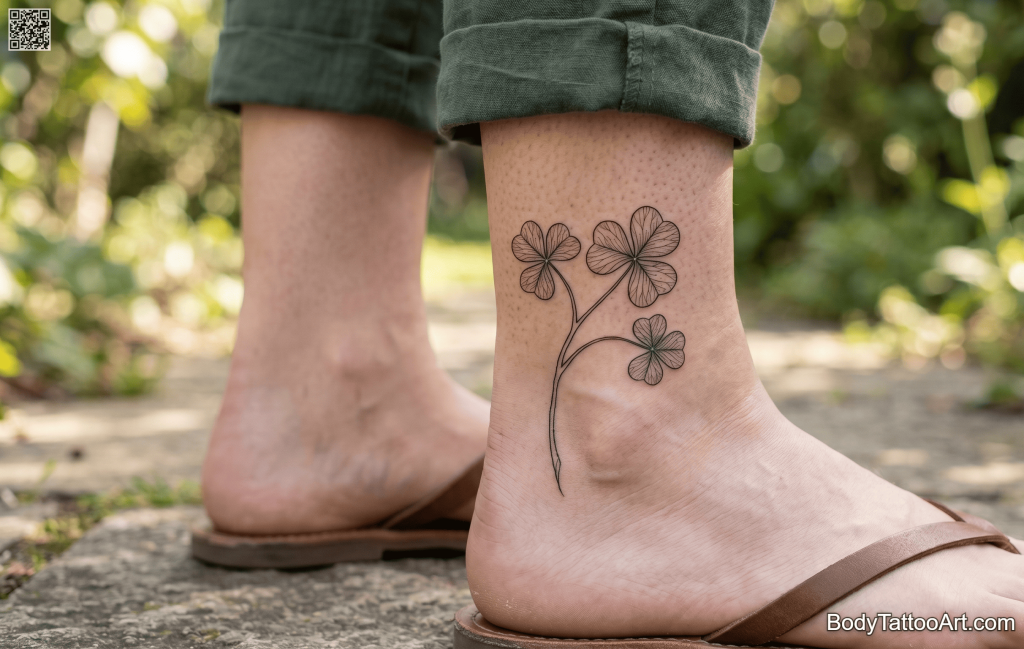
A detailed botanical illustration of a shamrock sprig — two or three leaves at slightly different angles, the stem bending naturally, and fine vein lines inside each leaflet. It looks like a page from a plant identification guide.
Placement: Ankle
Style: Fine line botanical
Why it stands out: The naturalistic angles and vein detail make this feel less like a symbol and more like an actual plant. Shamrock tattoos rarely go this far into botanical accuracy.
Ideal for: Nature lovers, botanical illustration fans, people who want elegant understated shamrock tattoos.
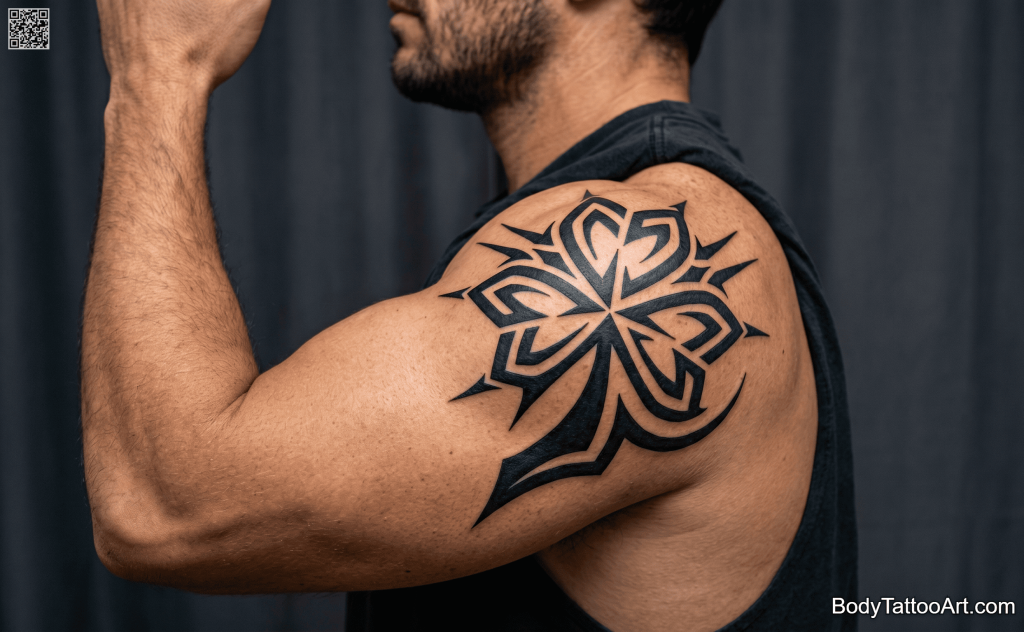
The shamrock shape is redrawn in a tribal style — thick black shapes with pointed ends, flowing curves replaced by angular cuts, and the three leaves flaring outward with bold spear-like tips. The stem becomes a thick tapered base.
Placement: Shoulder cap
Style: Tribal / blackwork
Why it stands out: Tribal shamrock tattoos are uncommon because the original shape is so soft and rounded. The angular reinterpretation turns it into something powerful and bold.
Ideal for: People with existing tribal work, bold tattoo fans, those who want masculine shamrock tattoos.
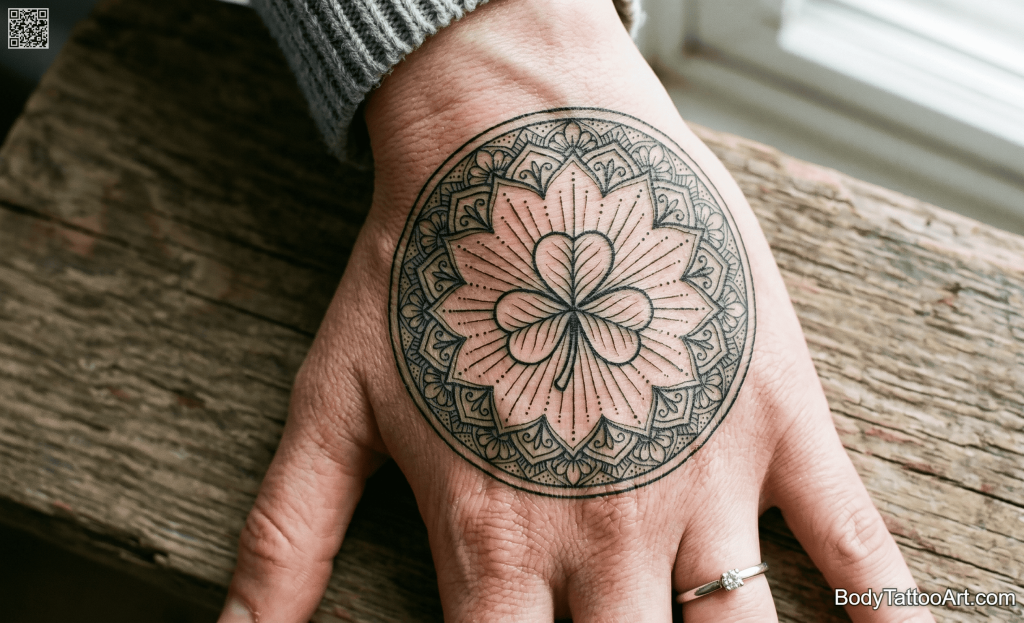
A shamrock sits at the center of a circular mandala, with fine geometric lines radiating outward from the leaf tips and petal-like sections filling the outer ring. The whole composition is contained within a perfect circle.
Placement: Back of hand
Style: Geometric mandala / linework
Why it stands out: Combining shamrock tattoos with mandala structure is unusual, and the result feels balanced and intentional. The shamrock anchors the center without being lost in the surrounding geometry.
Ideal for: Mandala tattoo lovers, people who want a symmetrical centerpiece design.
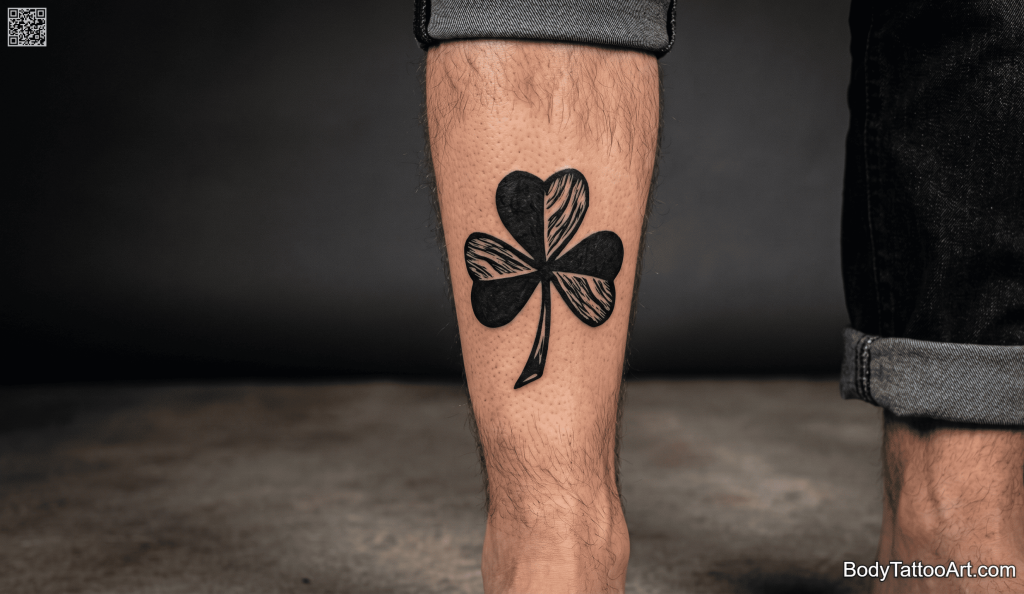
Flat planes of ink with deliberate rough texture marks, as if carved from a wood block and pressed onto skin. The leaves are simplified shapes with visible grain-like texture lines running through them. Clean outer edges, rough interior.
Placement: Shin / lower leg front
Style: Woodblock / graphic
Why it stands out: The graphic flatness and deliberate texture marks make this shamrock tattoo look like a print rather than a drawing. An artistic choice that’s rare in botanical tattoo work.
Ideal for: Graphic design fans, print art enthusiasts, people who want shamrock tattoos with a textural quality.
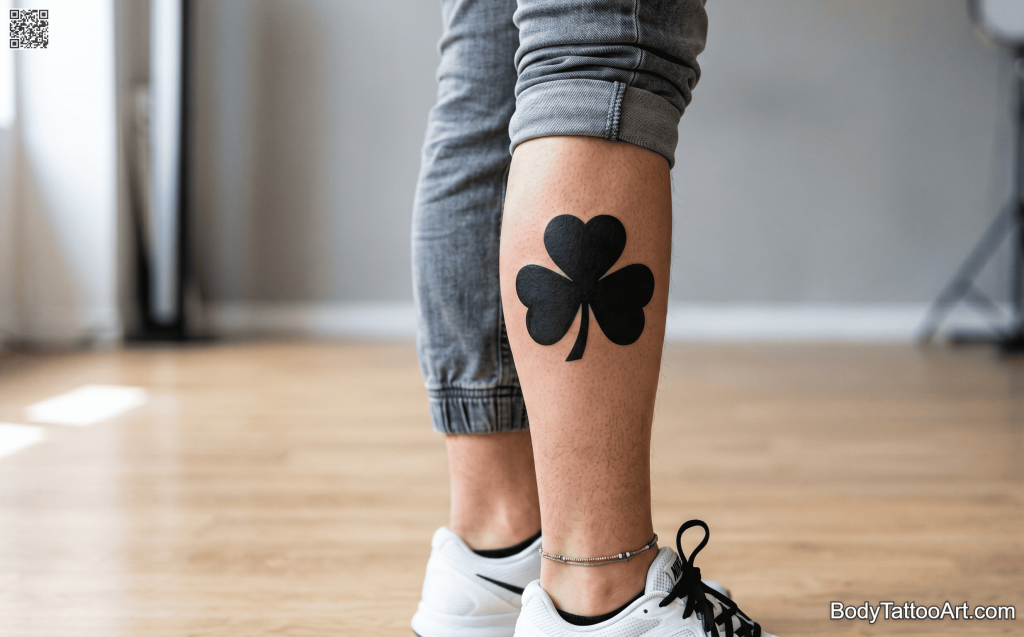
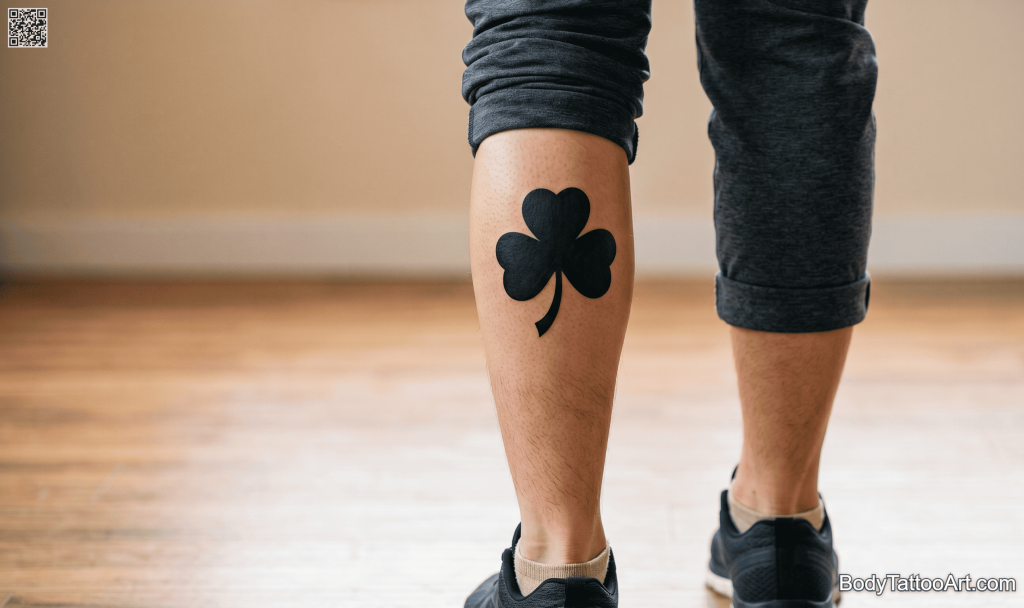
A large shamrock silhouette — leaves and stem filled entirely in black — with no outlines visible. The shape is clean and precise, edges crisp. The solid form reads as a stamp or seal.
Placement: Back of the calf
Style: Silhouette / blackwork
Why it stands out: The simplicity of a pure black silhouette gives shamrock tattoos a graphic strength. No technique distraction — just the shape, bold and final.
Ideal for: People who love clean bold designs, those who prefer shamrock tattoos with visual impact over detail.
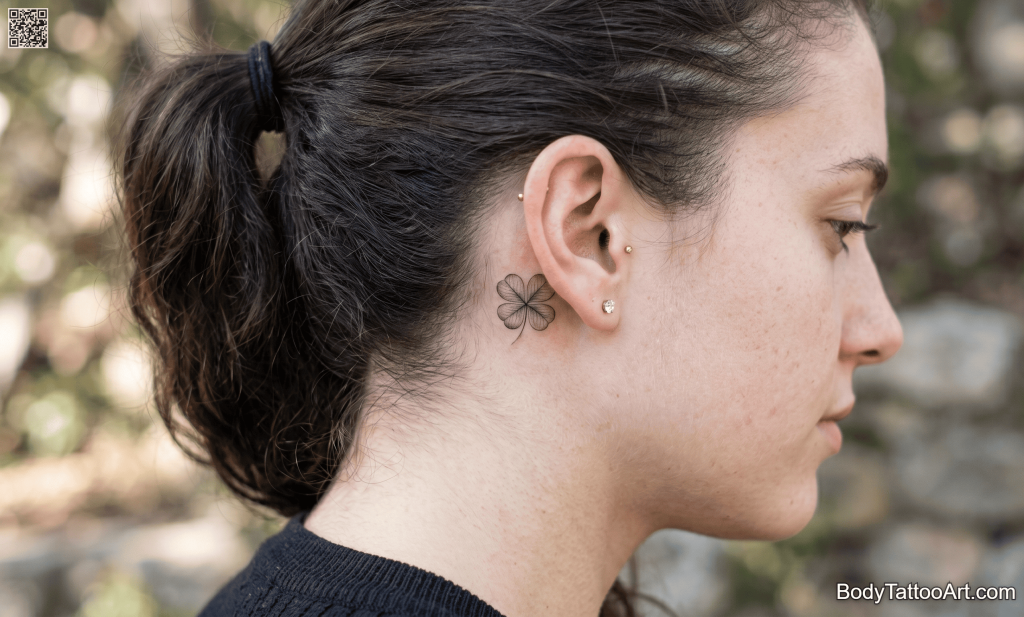
Instead of showing the full three-leaf cluster, this tattoo focuses on a single clover leaf — one rounded heart-shaped leaflet with fine vein work, rendered in extreme close-up proportion on a small area of skin. Minimal and surprisingly powerful.
Placement: Behind the ear
Style: Micro realism / fine line
Why it stands out: Zooming into one part of a shamrock and treating it as the whole composition is an unexpected approach. The single leaf still reads as part of the shamrock family, but the framing makes it feel completely fresh.
Ideal for: Micro tattoo fans, people who want very subtle shamrock tattoos.
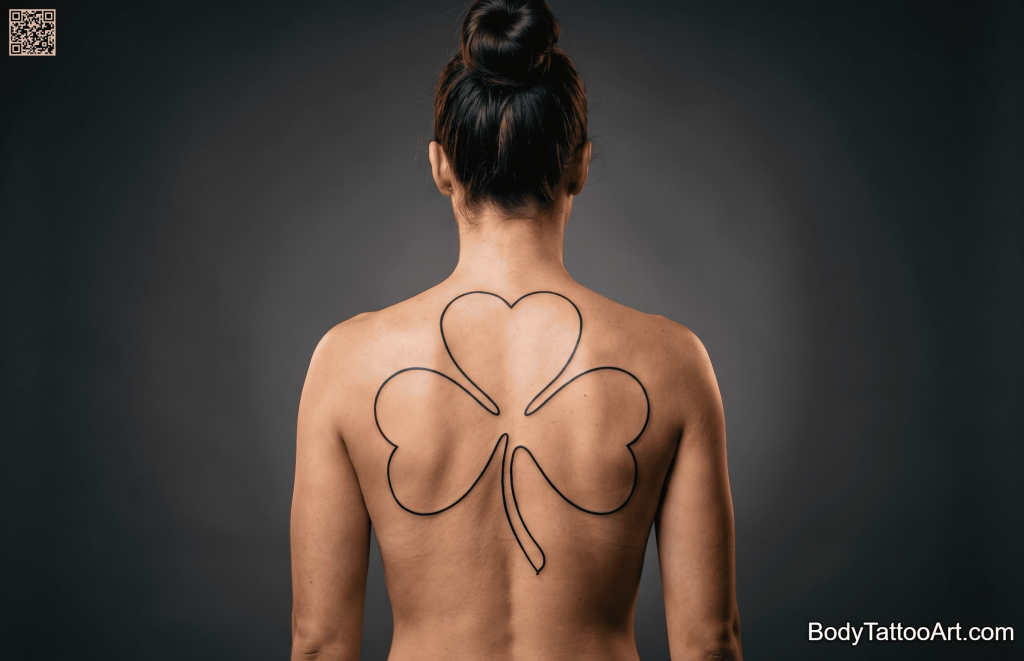
A large shamrock takes up significant space — shoulder to mid-back — but is rendered using only a single continuous outline. No fill, no shading, no interior detail. Just one clean line forming the entire shape.
Placement: Upper back
Style: Single line / continuous linework
Why it stands out: Scale without fill is a bold choice. The large empty outline has a presence that filled designs don’t — it asks the eye to complete the shape.
Ideal for: Minimalist fans who want a large piece, people who love negative space in their tattoos.
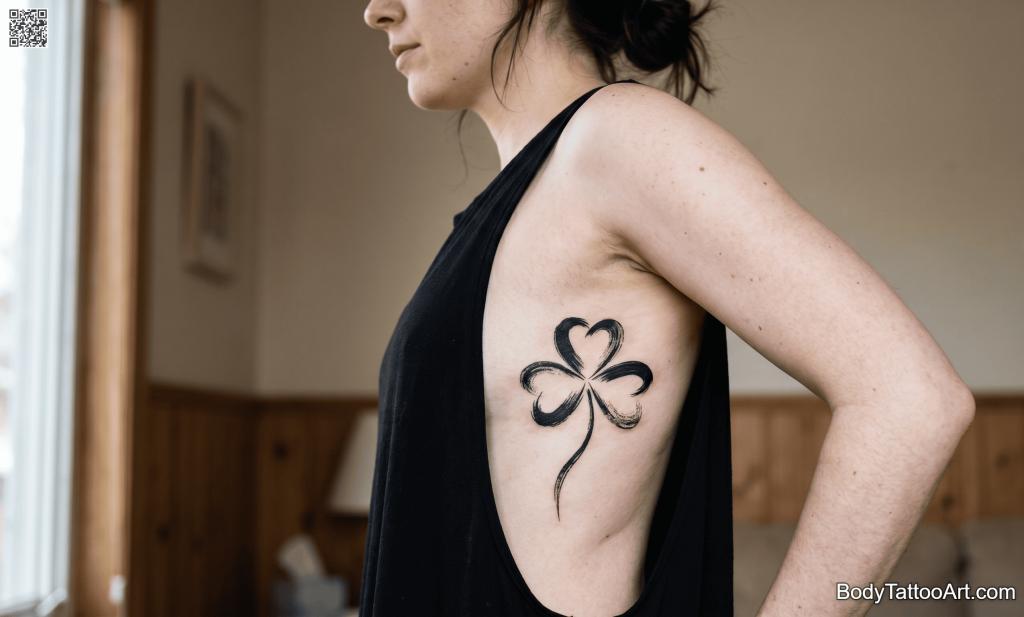
Each leaf is rendered as a single visible brushstroke — thick in the center, tapering at the edges, with slight texture showing through. The stem is one thin brushstroke. The overall effect looks like a calligraphy brush was used instead of a tattoo needle.
Placement: Ribcage / side
Style: Painterly / brushstroke
Why it stands out: Brushstroke shamrock tattoos have an immediacy that other styles lack. It looks spontaneous, like it was made in a single gesture.
Ideal for: People who love calligraphy aesthetics, those who want expressive shamrock tattoos with a handmade quality.
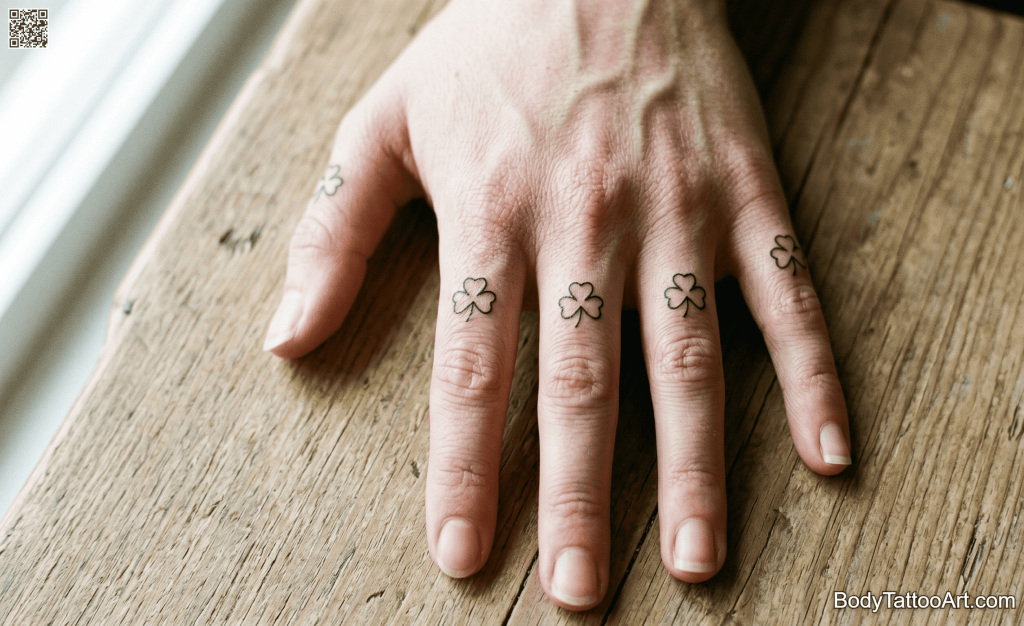
Five small shamrocks in a horizontal row, evenly spaced, each one identical in size and drawn with the same fine line style. The row sits on one flat plane — no variation in angle or height.
Placement: Finger / knuckle area
Style: Micro fine line
Why it stands out: Repetition as a design principle works well with a small shape like the shamrock. Five in a row creates a pattern rather than an individual symbol.
Ideal for: People who love finger tattoos, collectors who appreciate repeating motif designs.
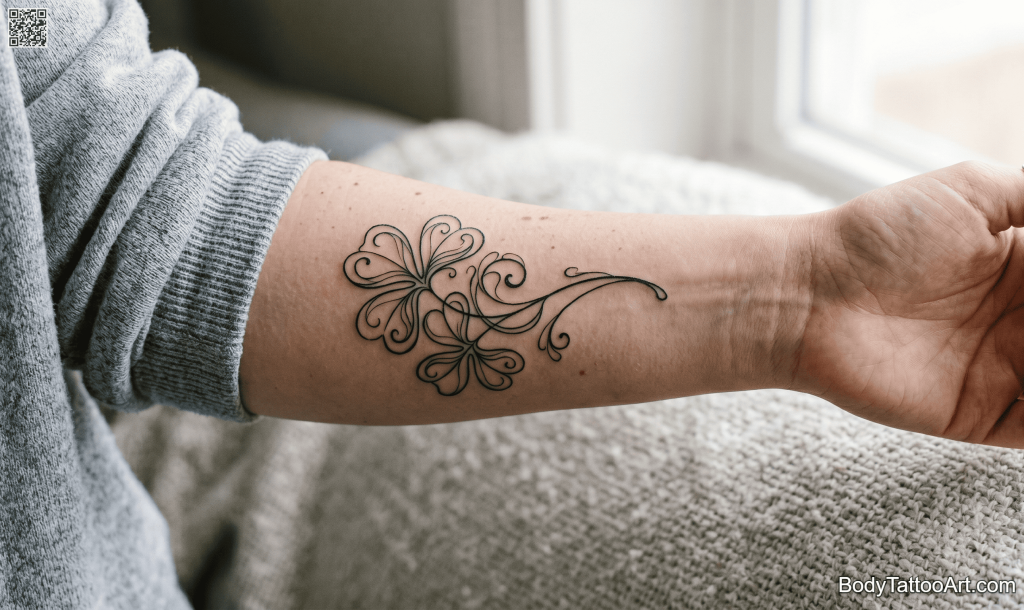
The shamrock leaves are elongated and given flowing Art Nouveau curves — the edges ripple slightly, the stem curves gracefully, and the overall silhouette has the decorative fluidity typical of the Art Nouveau movement.
Placement: Forearm inner side
Style: Art Nouveau / illustrative
Why it stands out: The Art Nouveau style gives shamrock tattoos an elegance they don’t often get. The decorative curves transform a simple plant symbol into something ornate.
Ideal for: Art history fans, people who love decorative illustration styles, those who want feminine shamrock tattoos with artistic depth.
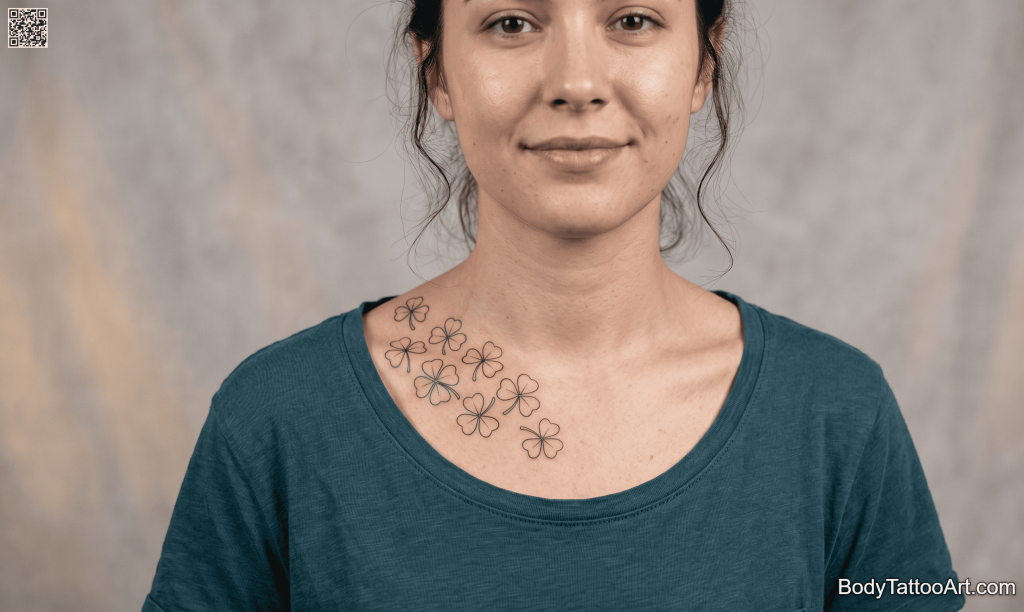
A cluster of seven or eight small shamrocks arranged tightly together — overlapping slightly, at different angles — as if scattered and stamped. The group reads as a single design, but each shamrock within it has its own angle and weight.
Placement: Collarbone / décolletage
Style: Illustrative / fine line
Why it stands out: A cluster of shamrock tattoos has more visual complexity than a single one, but stays cohesive because the shapes are all from the same source. The overlapping creates natural depth.
Ideal for: People who like layered, busy compositions, those who want shamrock tattoos with more visual interest than a single symbol.
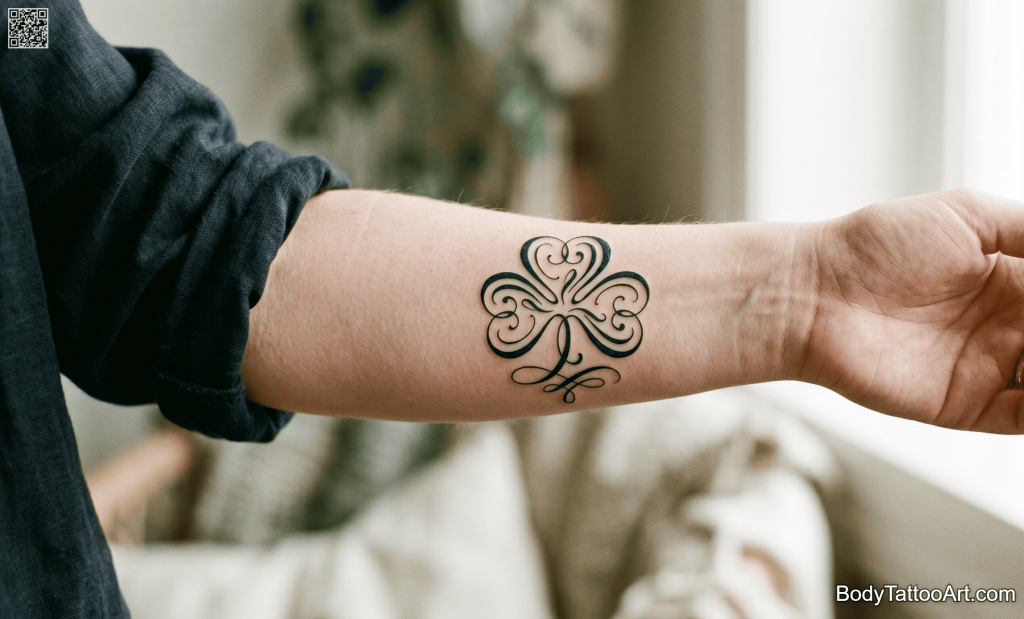
The shamrock is drawn in a formal monogram or lettering style — thick and thin strokes alternating across the leaf edges, mimicking the swells and hairlines of calligraphic letterforms. The leaves look almost like an ornate letter.
Placement: Inner forearm
Style: Calligraphic / lettering-inspired
Why it stands out: Treating the shamrock like a letterform rather than a botanical shape is genuinely unusual. The thick-thin stroke variation gives it a refinement that most shamrock tattoos skip entirely.
Ideal for: Lettering tattoo fans, people who want unique shamrock tattoos with a formal decorative quality.
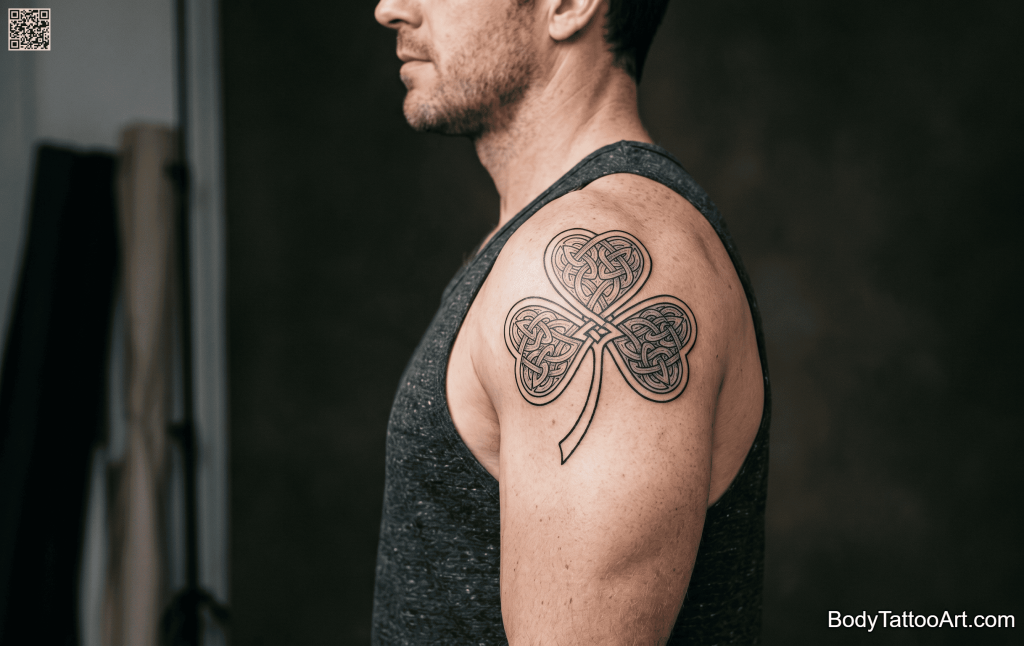
The three leaves of the shamrock are each filled with a simple Celtic knotwork pattern — interlaced lines that loop and cross within the leaf boundary. The stem is plain, keeping the knotwork contained within the leaves only.
Placement: Outer upper arm
Style: Celtic knotwork
Why it stands out: Celtic knotwork shamrock tattoos are expected, but versions where the knotwork is contained strictly inside the leaves — rather than forming the outline — are less common and cleaner.
Ideal for: Celtic heritage tattoo fans, people who want intricate shamrock tattoos with cultural depth.
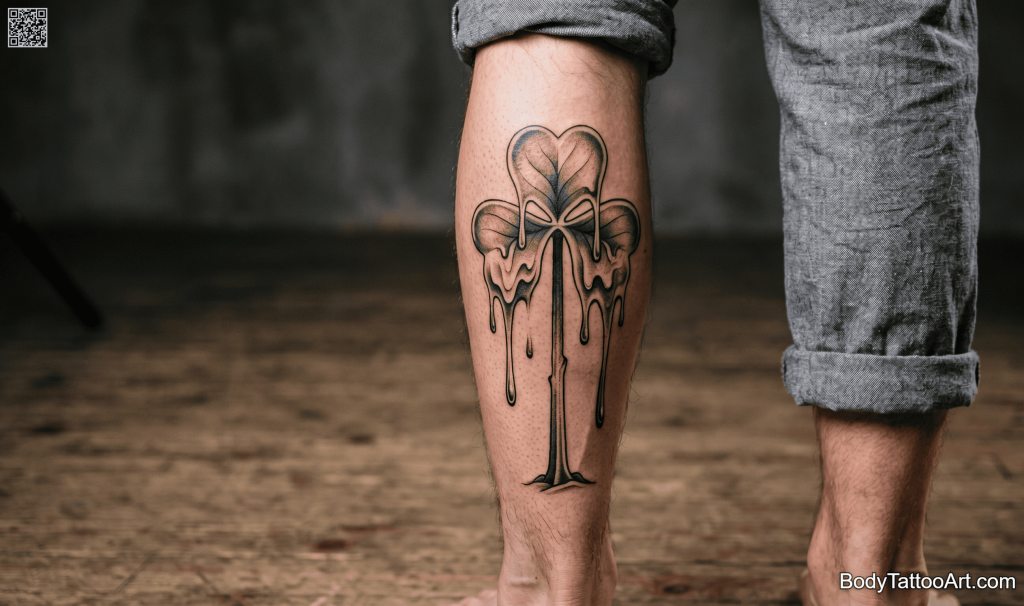
The shamrock’s leaves appear to drip and melt at the tips — the lower edges of each leaf elongating into liquid-looking drips that pull downward. The stem remains upright and solid, contrasting with the melting leaves above.
Placement: Calf
Style: Surrealist / neo-traditional
Why it stands out: Shamrock tattoos rarely get the surrealist treatment. The contrast between the solid, upright stem and the melting leaves creates a quiet visual tension.
Ideal for: Surrealist art fans, people who want conceptual shamrock tattoos, avant-garde collectors.
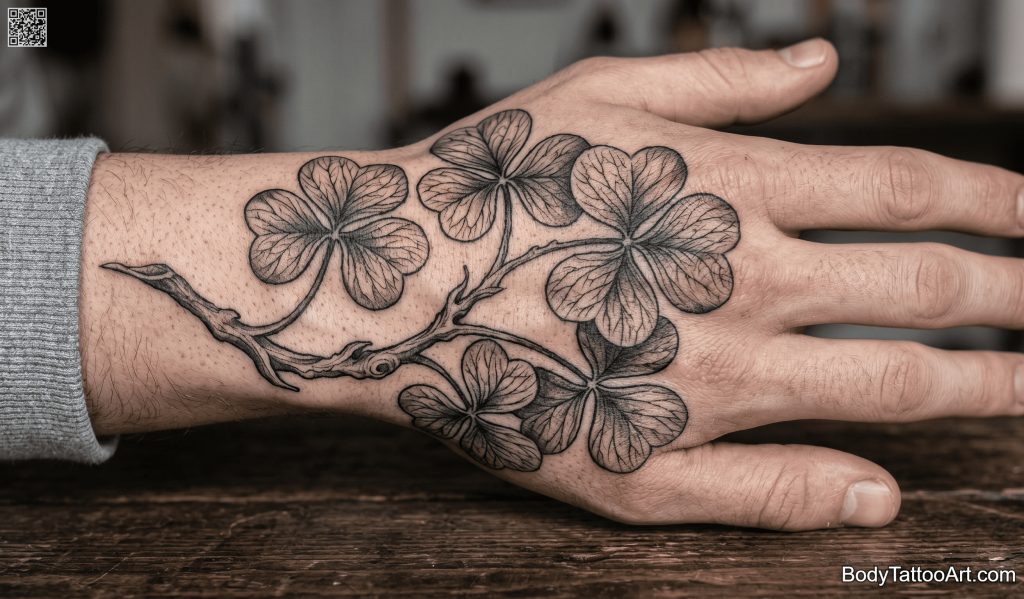
A large, detailed shamrock sprig spreads across the full back of the hand — from just above the wrist to the knuckles. The leaves are botanically detailed with veining, the stem shows natural texture, and the scale is generous enough to show real artistic work.
Placement: Back of hand / full hand
Style: Black and grey botanical
Why it stands out: Hand tattoos of botanical subjects require confidence and precision. At this scale, shamrock tattoos become a genuine showcase piece rather than a small symbol.
Ideal for: Bold tattoo collectors, people ready to commit to hand tattoos, those building themed botanical pieces.
Shamrock tattoos have stayed relevant for a reason. The shape is universally recognizable, culturally rich, and visually flexible enough to work in any tattoo style imaginable. From a micro fine line wrist tattoo to a bold blackwork hand piece, the same basic plant can take on completely different characters depending on the artist’s approach.
The 27 designs above show just how much range shamrock tattoos actually have. There’s no single way to wear one — only the version that feels right. Bring one of these ideas to a trusted tattoo artist, adapt it to the body and the vision, and let the design take on a personal life of its own.