Physical Address
304 North Cardinal St.
Dorchester Center, MA 02124
Physical Address
304 North Cardinal St.
Dorchester Center, MA 02124

Cactus tattoos have quietly become one of the most interesting choices in nature-inspired ink. There’s something visually satisfying about the cactus form — the thick arms, the spines, the geometric symmetry that nature somehow built without a ruler. It works in almost every tattoo style without losing its identity.
This list covers 27 cactus tattoo ideas, each one built differently from the last. Different placements, different styles, different compositional approaches. No design repeats itself, and no two entries feel like variations of the same template. Whether the goal is something tiny and precise or bold and dramatic, there’s a cactus tattoo here worth bookmarking.
Just the way Palm Tattoos are focused on palm trees, Cactus tattoos are designs centered on the cactus plant — its distinct silhouette, segmented arms, spine clusters, or full desert forms. The subject is versatile enough to work as a two-inch wrist piece or a sprawling back panel. It holds detail well in realistic styles and simplifies cleanly into minimalist or geometric work.
Part of what makes cactus tattoos so appealing is the built-in graphic quality of the plant itself. The ribbed texture, the repeating spine patterns, the branching arm structure — all of it translates naturally into tattooing. There’s no need to over-design it. The form does the work.
The cactus has long represented endurance and survival. It thrives in conditions that would kill most other plants — extreme heat, minimal water, harsh soil. In many Indigenous cultures of the American Southwest and Mexico, the cactus, particularly the saguaro, holds deep spiritual and communal significance, tied to seasons, food, and ceremony.
Across different traditions, cactus plants are associated with protection (the spines), resilience, and the ability to sustain life from within. In the language of flowers and plants, giving a cactus historically meant “I endure.” In modern tattoo culture, cactus tattoos carry that same quiet strength — standing firm without needing to announce it.
For a deeper look at the plant’s cultural and ecological significance, the Wikipedia entry on cacti is a solid starting point.
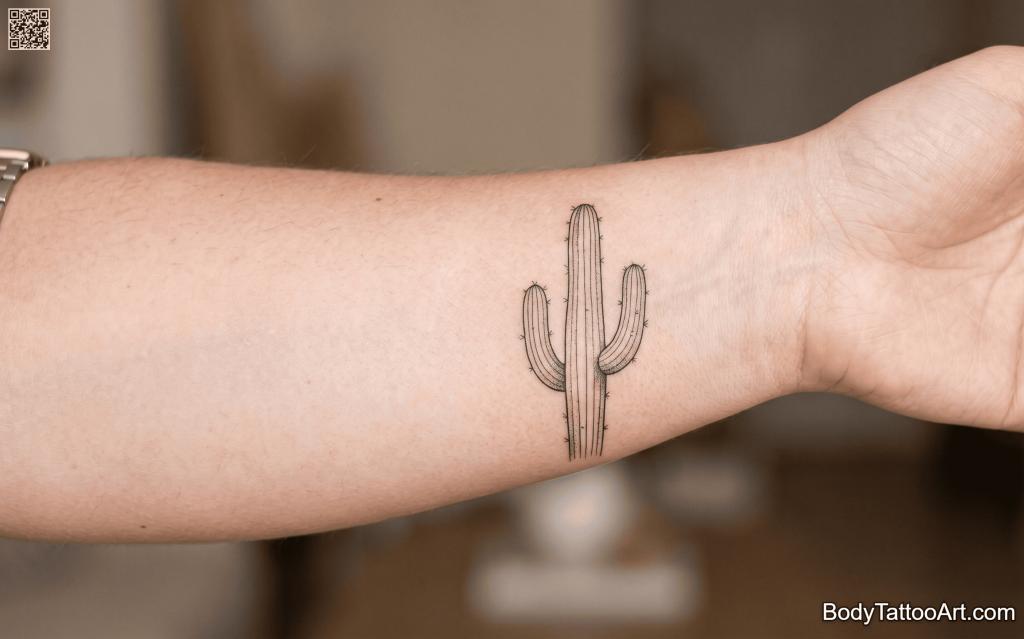
One tall saguaro cactus, drawn in clean fine lines with no background. The arms curve naturally upward, and subtle shading on one side gives it just enough dimension without tipping into realism. The silhouette is immediately recognizable — the classic desert form, stripped down and precise.
Placement: Inner forearm
Style: Fine line Cactus Tattoos
Why it stands out: The restraint is what makes it work. No filler, no extras — just a perfectly proportioned saguaro that reads from across the room.
Ideal for: Minimalist tattoo lovers, first-timers, people who want clean nature-inspired ink.
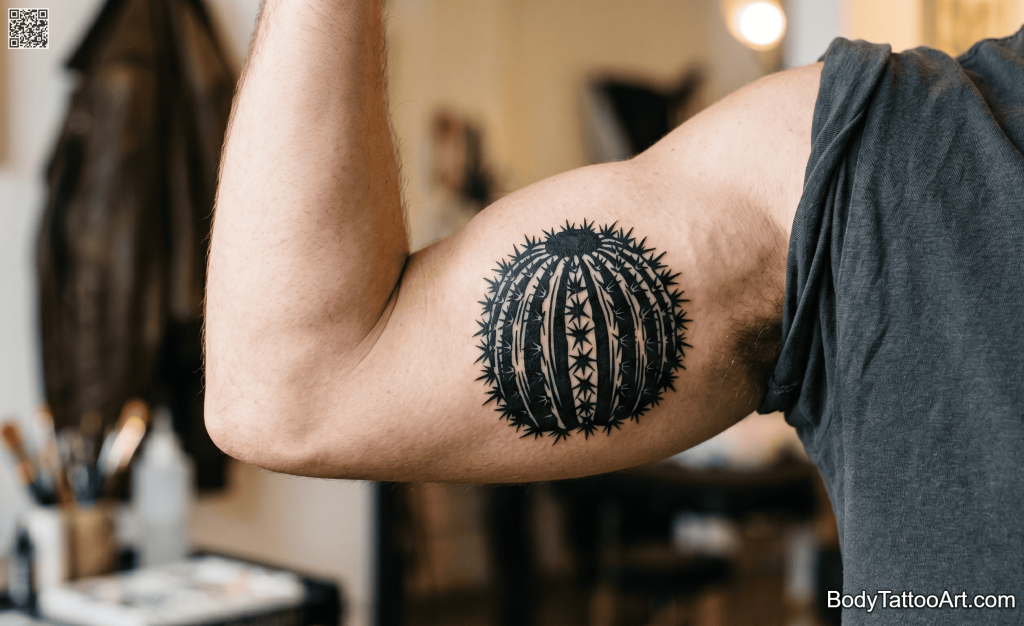
A squat, round barrel cactus rendered in bold blackwork. The ribbed sections are drawn with heavy solid lines, and the spine clusters are dense and sharp. The whole design has a graphic, almost woodcut quality — no grey, no gradients, just strong black shapes.
Placement: Upper arm / outer bicep
Style: Blackwork Cactus Tattoos
Why it stands out: The compact round form of a barrel cactus works brilliantly in blackwork — all those repeating ribs and spines become a bold, textured pattern.
Ideal for: Blackwork collectors, people wanting a strong arm piece, bold tattoo fans.
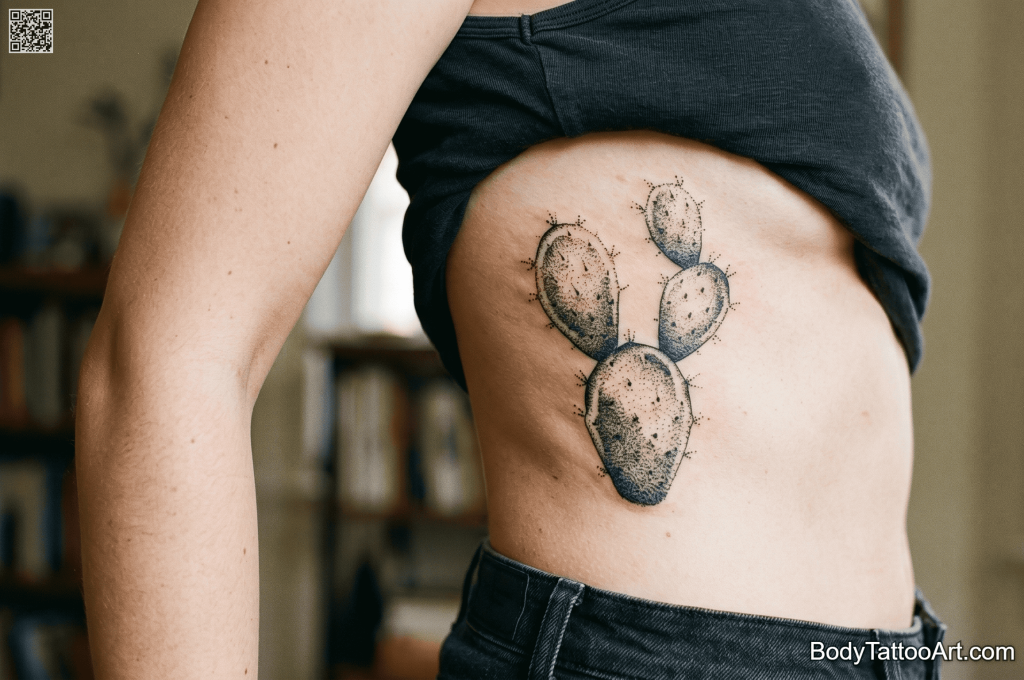
A prickly pear cactus with paddle-shaped pads, rendered entirely in stippling. The shading moves from tight dot clusters in the shadowed areas to scattered single dots along the edges. The spine clusters are made of tiny radiating dot bursts.
Placement: Ribcage
Style: Dotwork Cactus Tattoos
Why it stands out: The prickly pear’s wide, flat pads give the dotwork artist plenty of surface to work with. The textural contrast between dense and sparse dots gives the design beautiful tonal range.
Ideal for: Tattoo collectors who love technique-heavy work, dotwork enthusiasts, those wanting a ribcage piece with visual depth.
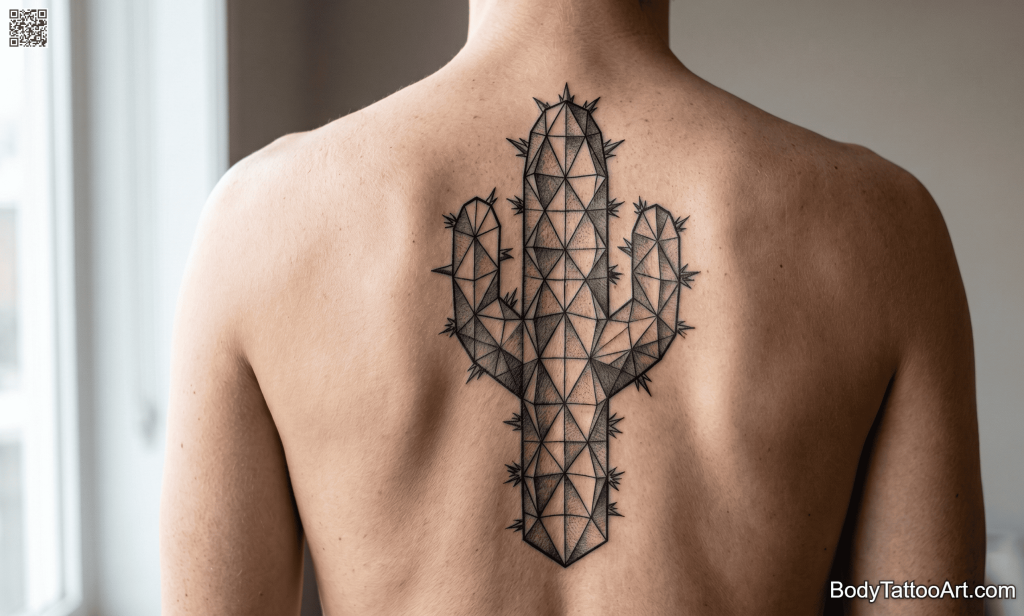
The cactus form is broken into a grid of geometric shapes — triangles, hexagons, and rectangles — each one shaded slightly differently to create the illusion of a three-dimensional form. The spines become small triangular protrusions from the grid edges.
Placement: Spine / center back
Style: Geometric Cactus Tattoos
Why it stands out: The modular grid structure makes this feel like architectural design. From a distance it reads as a cactus; up close it’s a study in geometric form.
Ideal for: Design-minded tattoo fans, geometry lovers, people wanting a structured back piece.
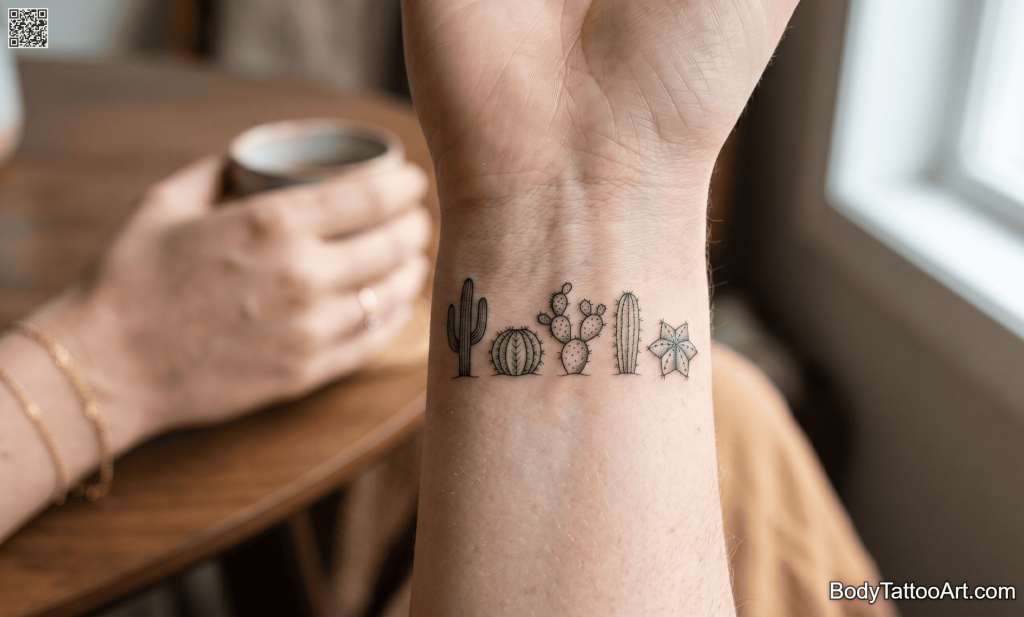
Five tiny cacti of different species — saguaro, barrel, prickly pear, columnar, and star cactus — arranged in a small horizontal row. Each one is rendered in fine line at about one inch tall. The variety creates a botanical collection feel.
Placement: Wrist / inner wrist
Style: Fine line micro Cactus Tattoos
Why it stands out: The variety of cactus species in a single small design is like wearing a tiny desert field guide. Each plant has its own distinct silhouette, so the row never feels repetitive.
Ideal for: Botanical illustration fans, people who love micro tattoos, those adding to a wrist collection.
Those who love the botanical collection approach to cactus tattoos might also enjoy exploring leaf and plant tattoo designs, where similar species-variety compositions show up in everything from aloe to echeveria.
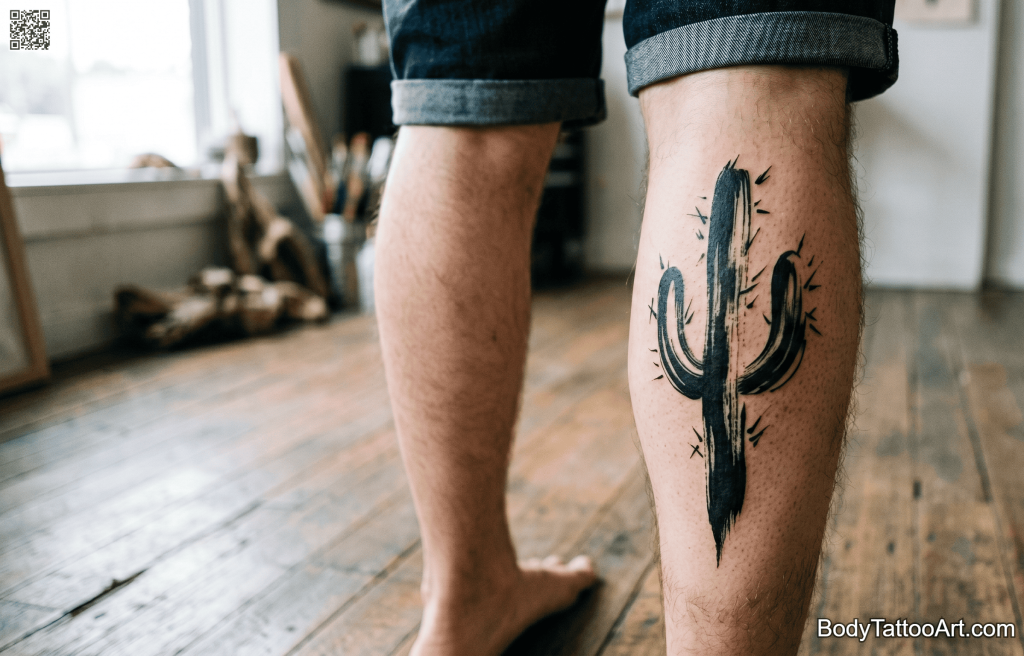
A sumi-e-style brushstroke cactus — thick confident strokes for the body, quick flicked strokes for the spines, loose gestural marks for the arms. It looks like it was painted with a single loaded brush in thirty seconds, which is exactly the appeal.
Placement: Calf
Style: Sumi-e / brushstroke Cactus Tattoos
Why it stands out: The speed and energy frozen in the brushstrokes gives this life. Every mark has direction and intent. It’s expressive in a way that detailed realism can’t replicate.
Ideal for: Fans of East Asian art traditions, people who love gestural design, calf piece seekers.
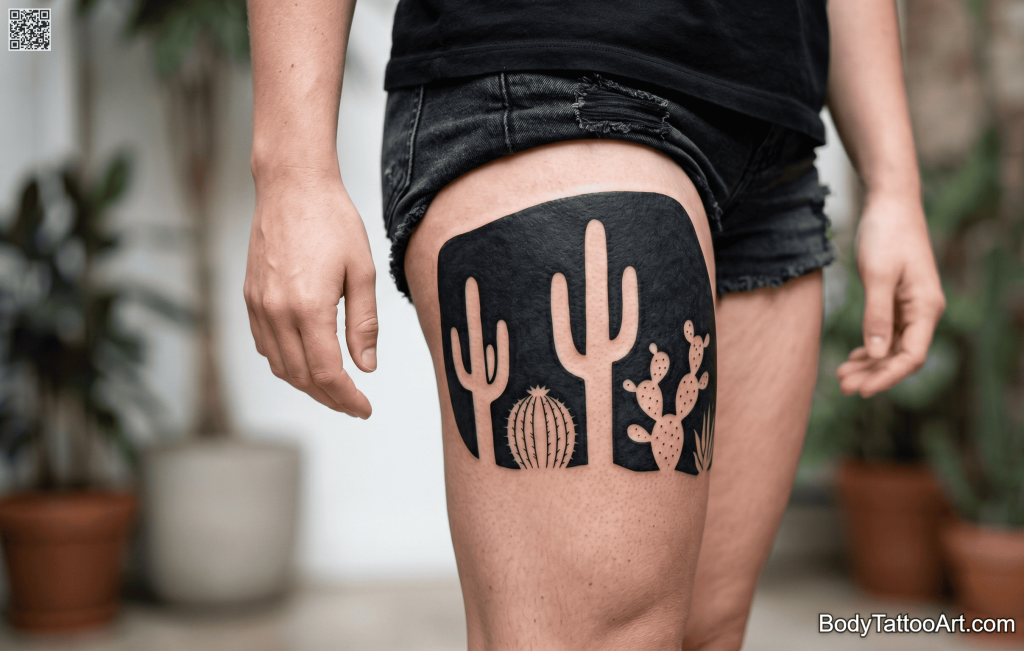
A wide desert horizon rendered in negative space — the cactus forms are left as untouched skin while the sky and ground around them are filled in solid black. The cacti glow pale against a dramatic dark background.
Placement: Outer thigh
Style: Negative space / blackwork Cactus Tattoos
Why it stands out: The inversion makes the cactus silhouettes feel luminous. It’s an unusual compositional approach that gives the whole design a surreal, graphic quality.
Ideal for: Bold blackwork fans, people drawn to graphic design aesthetics, those wanting a thigh piece with impact.
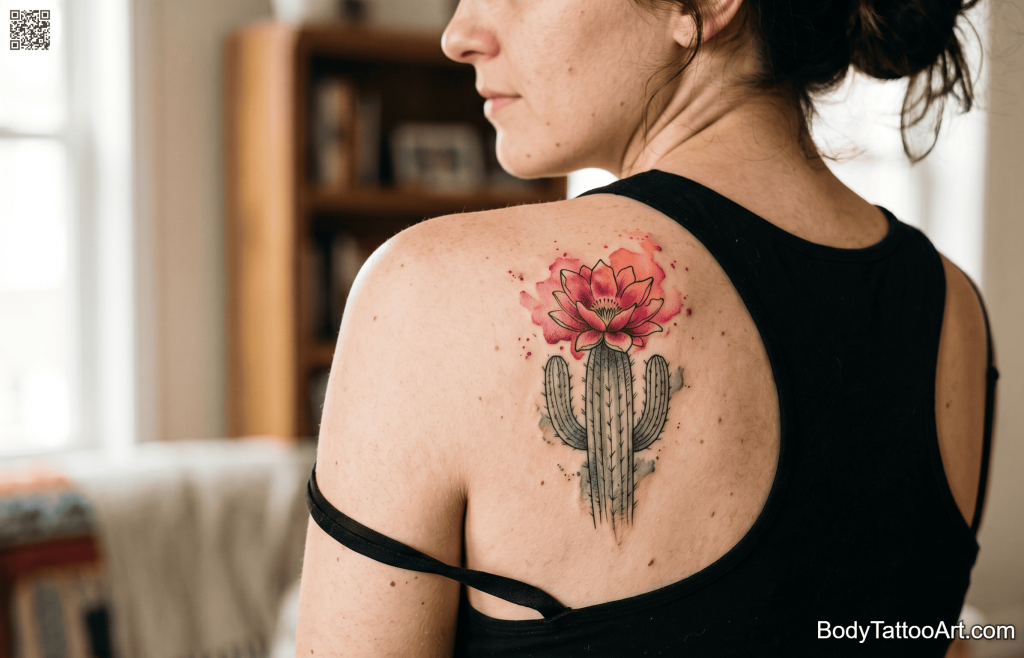
A cactus with a bloom at the top, rendered in loose watercolor washes. The cactus body is clean fine line; the flower at the crown bleeds outward in soft pinks and oranges that go beyond the linework edges.
Placement: Shoulder blade
Style: Watercolor with fine line Cactus Tattoos
Why it stands out: The structural cactus in fine line anchors the design while the bleeding color from the bloom gives it softness and life. The contrast between contained linework and free color is the whole visual point.
Ideal for: People drawn to painterly tattoos, those who want color without going fully traditional, shoulder piece seekers.
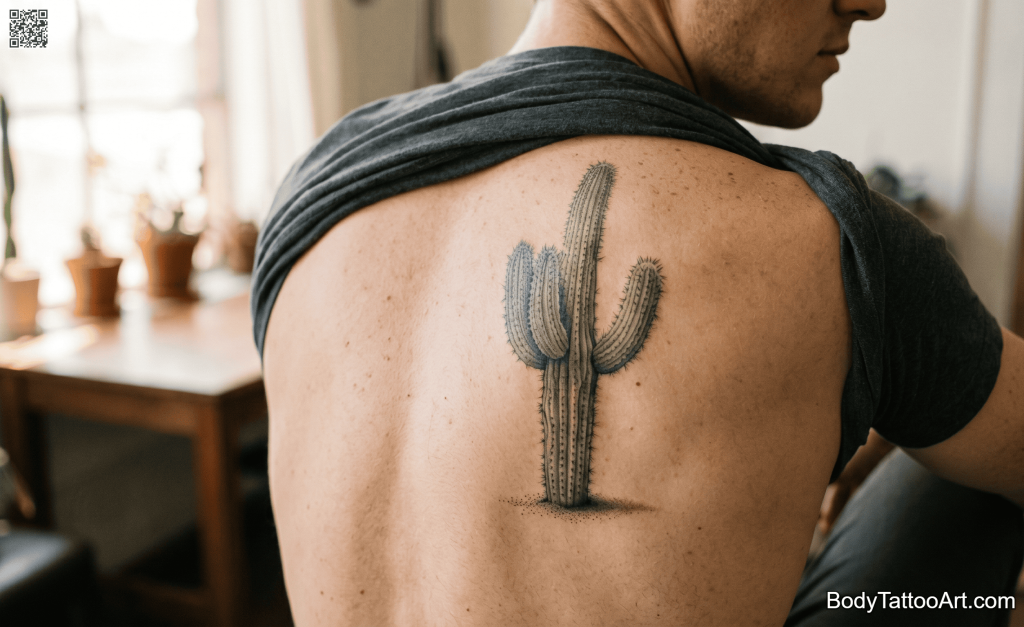
A full saguaro with two arms, rendered in grey-wash realism with careful light sourcing. The surface texture — all those vertical ribs and spine clusters — is fully detailed. A subtle ground shadow anchors it to the skin.
Placement: Upper back / shoulder
Style: Grey-wash realism Cactus Tattoos
Why it stands out: Bringing photographic realism to a cactus tattoo is less common than it sounds. The ribbed surface detail in grey-wash gives the plant real dimensionality and weight.
Ideal for: Realism tattoo fans, those wanting a detailed nature piece, upper back collectors.
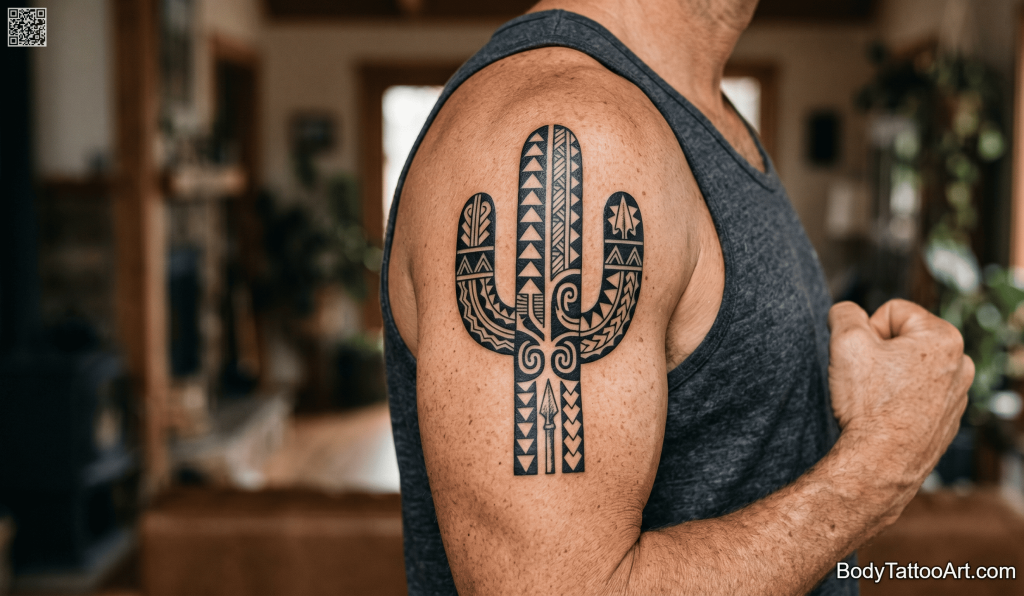
The saguaro form is redrawn using Polynesian tribal pattern language — bold black fills, triangular repetitions, and linear motifs replace the organic cactus surface detail. The silhouette is recognizably cactus; everything inside is tribal geometry.
Placement: Upper arm / sleeve section
Style: Tribal / Polynesian-influenced Cactus Tattoos
Why it stands out: The cactus silhouette gives the tribal fill a clear, recognizable container. The two visual languages work together without competing.
Ideal for: Fans of Polynesian tattoo traditions, those wanting bold arm work, tribal aesthetic enthusiasts.
For those who love bold, pattern-based nature tattoos, Fern leaf tattoo designs explore similar silhouette-plus-pattern territory, with a lot of crossover in tribal and blackwork approaches.
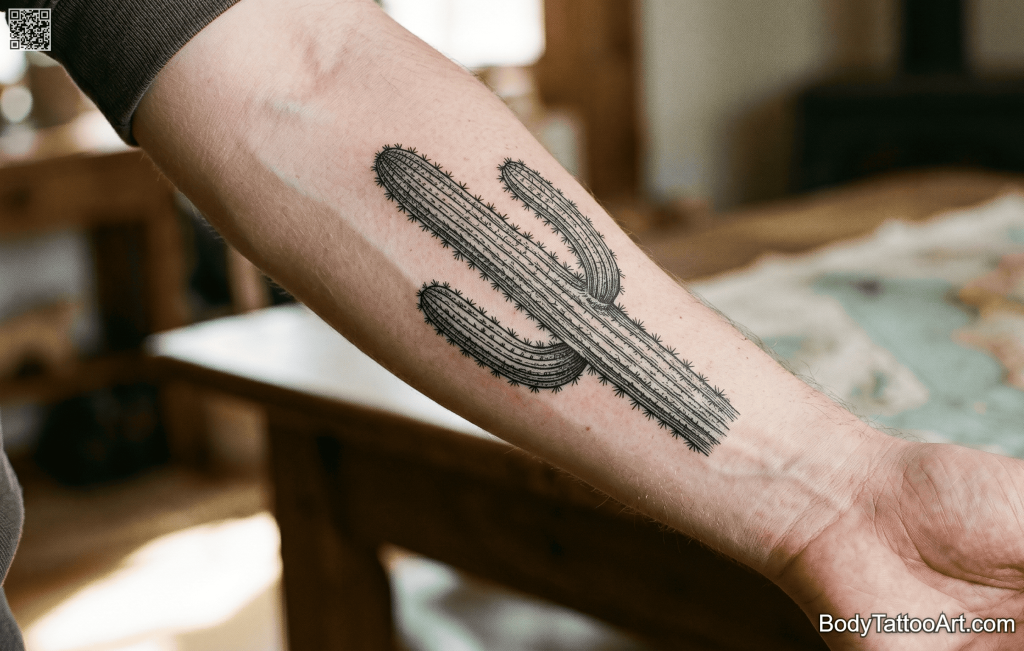
The cactus is rendered in Victorian botanical engraving style — dense hatching lines, cross-hatching in the shadows, and clean outlines that look like they were pulled from a 19th-century naturalist’s sketchbook.
Placement: Forearm
Style: Engraving / etching Cactus Tattoos
Why it stands out: The antique illustration quality is rare. The hatching creates a dense, richly textured surface that feels printed rather than tattooed.
Ideal for: Vintage aesthetics lovers, collectors with eclectic tastes, those drawn to illustration-style ink.
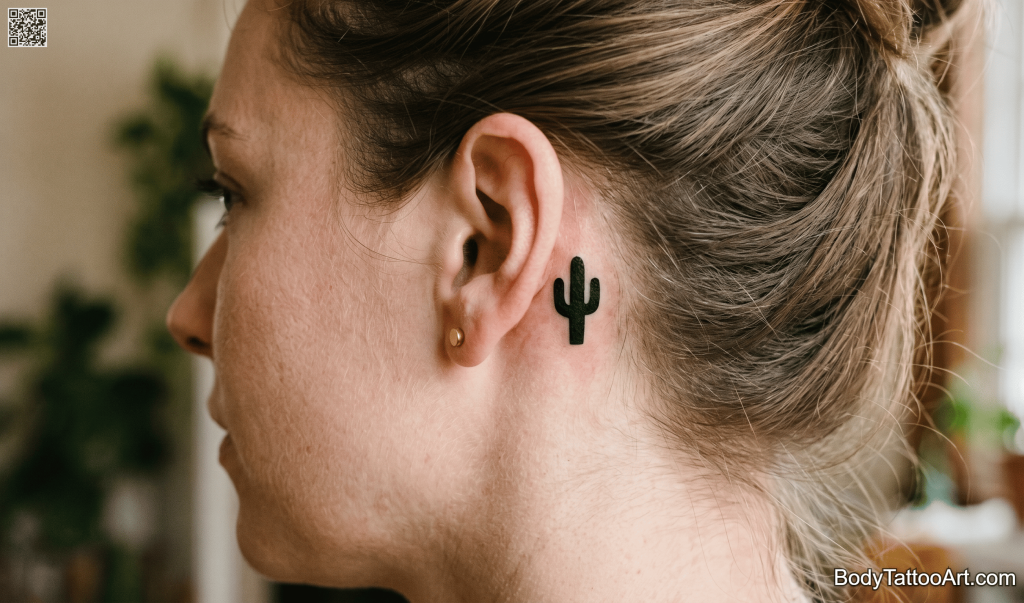
The cactus is reduced to its absolute outline — no internal detail, no shading, just the exact silhouette of a three-armed saguaro filled solid black. Clean, immediate, and completely unambiguous.
Placement: Behind the ear
Style: Silhouette / blackwork Cactus Tattoos
Why it stands out: The saguaro has one of the most instantly readable silhouettes in the plant world. As a solid black shape, it works perfectly at small scale and reads from any distance.
Ideal for: People who love small bold placements, blackwork minimalists, those wanting a discreet but striking piece.
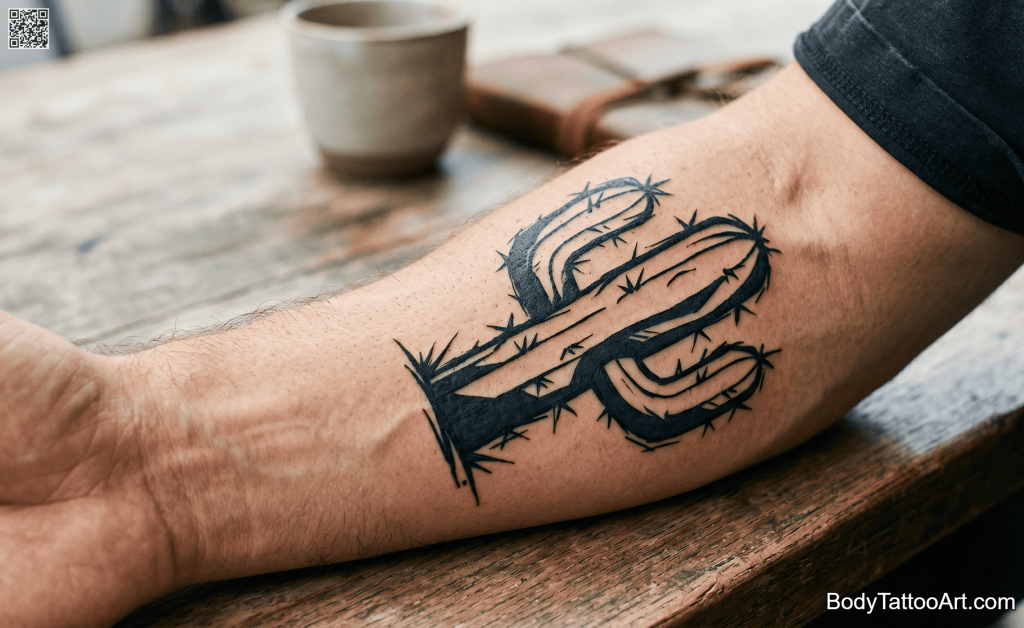
Thick outlines, flat black shadow fills, bold graphic contrast — this cactus looks like it belongs in a desert-set graphic novel. The arms have exaggerated proportions and the spines are drawn as sharp angular marks rather than delicate lines.
Placement: Outer forearm
Style: Neo-traditional / comic Cactus Tattoos
Why it stands out: The graphic boldness makes cactus tattoos feel fun without being cartoonish. The exaggerated proportions give it personality without losing the form.
Ideal for: Graphic novel fans, bold tattoo lovers, those wanting a high-energy arm piece.
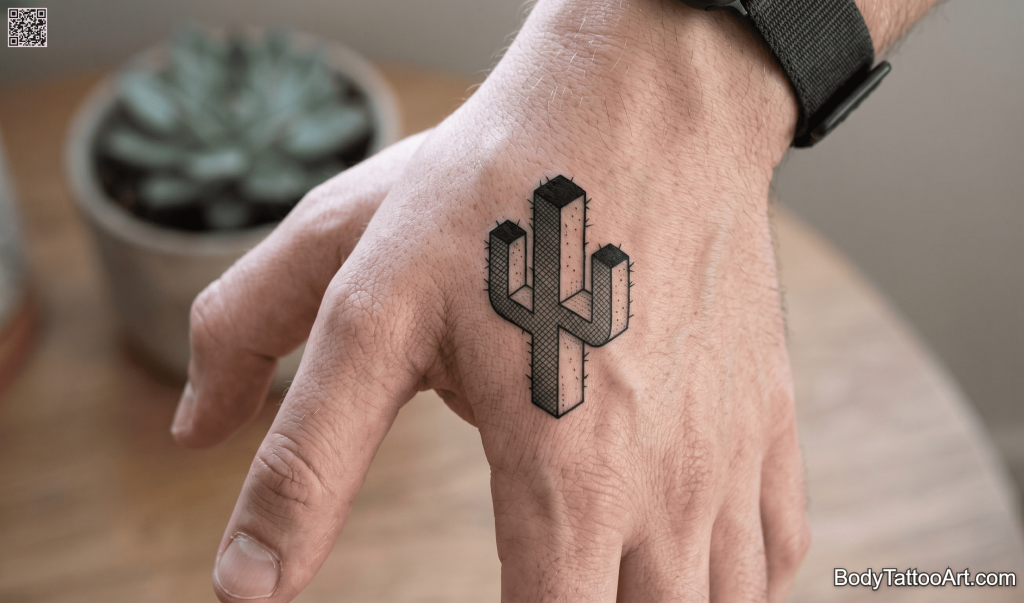
The cactus is rendered as a three-dimensional isometric object, as if modeled on a computer and printed onto skin. Each segment of the arm has visible top, front, and side planes shaded differently to create the 3D illusion.
Placement: Back of hand
Style: Geometric / isometric Cactus Tattoos
Why it stands out: The 3D architectural treatment is unexpected for a plant subject. It sits at the intersection of nature and digital design in a genuinely interesting way.
Ideal for: Designers, people drawn to conceptual tattoos, those wanting a hand piece that starts conversations.
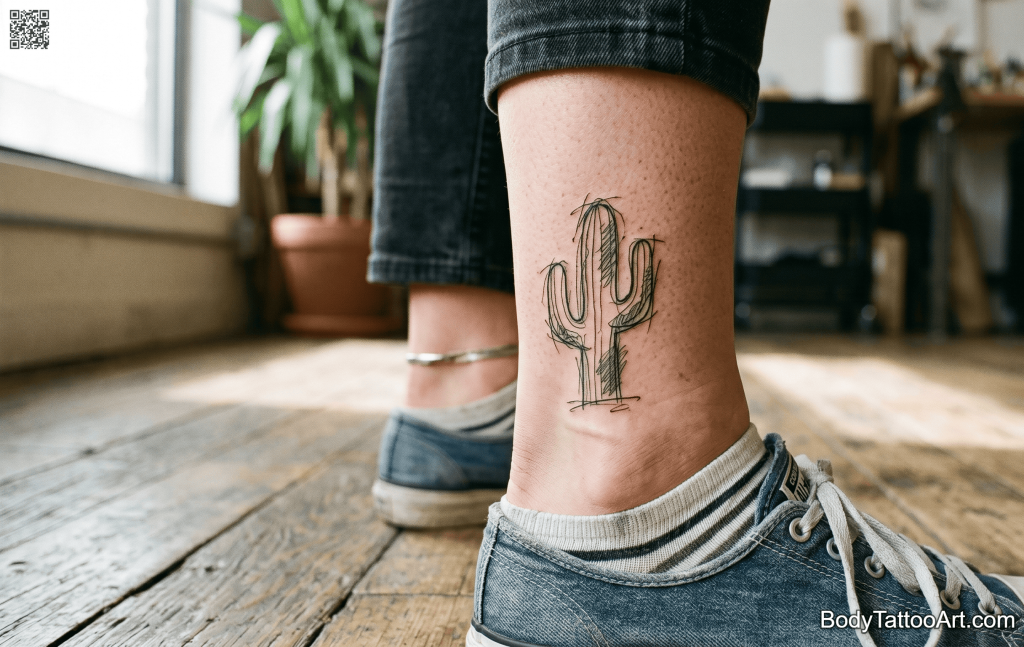
Rough double lines, intentional stray marks, inconsistent shading — this cactus looks like a quick sketch in a travel journal, captured in ink on skin. The imperfection is controlled and deliberate.
Placement: Ankle
Style: Sketch / illustrative Cactus Tattoos
Why it stands out: The hand-drawn quality makes it feel personal and spontaneous. It looks like it was drawn directly on the skin rather than transferred from a stencil.
Ideal for: People who love soft artistic aesthetics, those wanting something that feels handmade, ankle tattoo seekers.
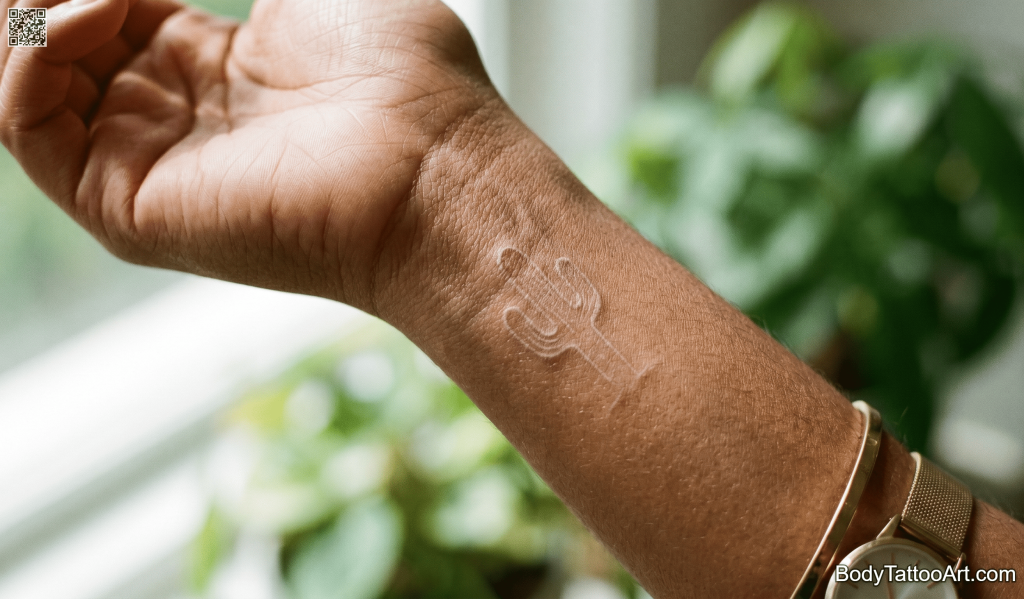
A cactus rendered entirely in white ink on darker skin. The design is subtle, almost invisible at certain angles — revealing itself only in direct light as a pale glowing form pressed into the skin.
Placement: Inner wrist
Style: White ink Cactus Tattoos
Why it stands out: White ink cactus tattoos are genuinely unusual. The subtlety requires the wearer to choose to show it, which makes it feel private and considered.
Ideal for: People who want discreet ink, white ink enthusiasts, those with medium to deep skin tones wanting understated design.
Those who appreciate subtle, understated cactus tattoos often also gravitate toward minimalist floral tattoos like rose, orchids, lavenders, peonies etc where white ink, fine line, and negative space techniques are used across a wide range of plant subjects.
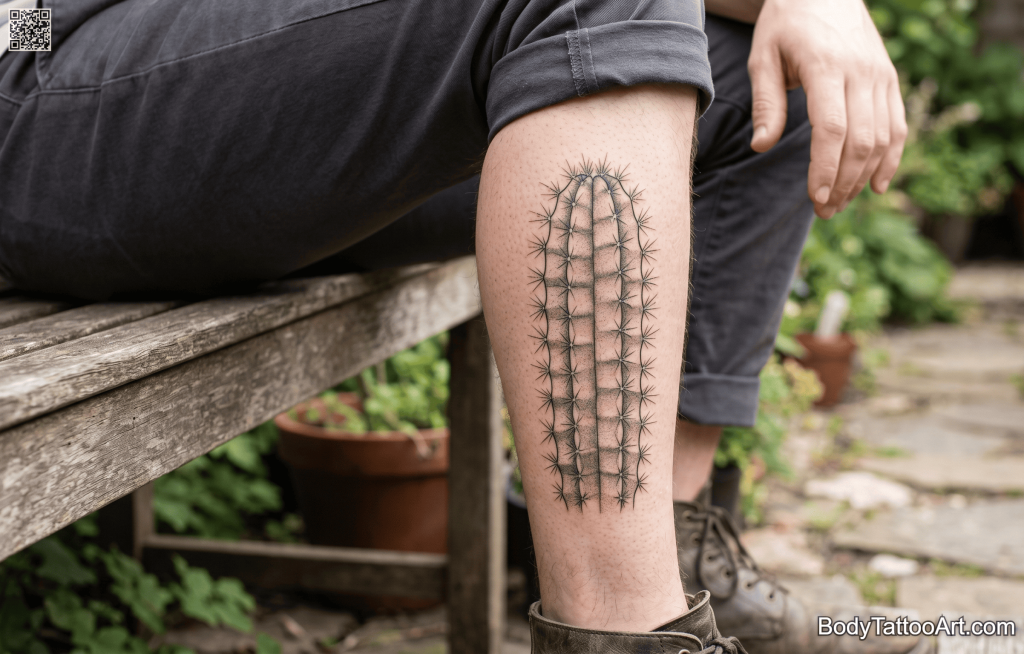
A tall columnar cactus where the surface ribbing is rendered with the same visual rhythm as bamboo segments — horizontal bands of shading creating a stacked cylindrical effect. The spines radiate outward from each band.
Placement: Shin / lower leg
Style: Fine line with grey-wash Cactus Tattoos
Why it stands out: The columnar cactus is underused in tattoo work. The cylindrical form works beautifully down the shin, and the banded shading gives it a sculptural quality.
Ideal for: People wanting leg pieces, those drawn to understated structural design, nature tattoo collectors.
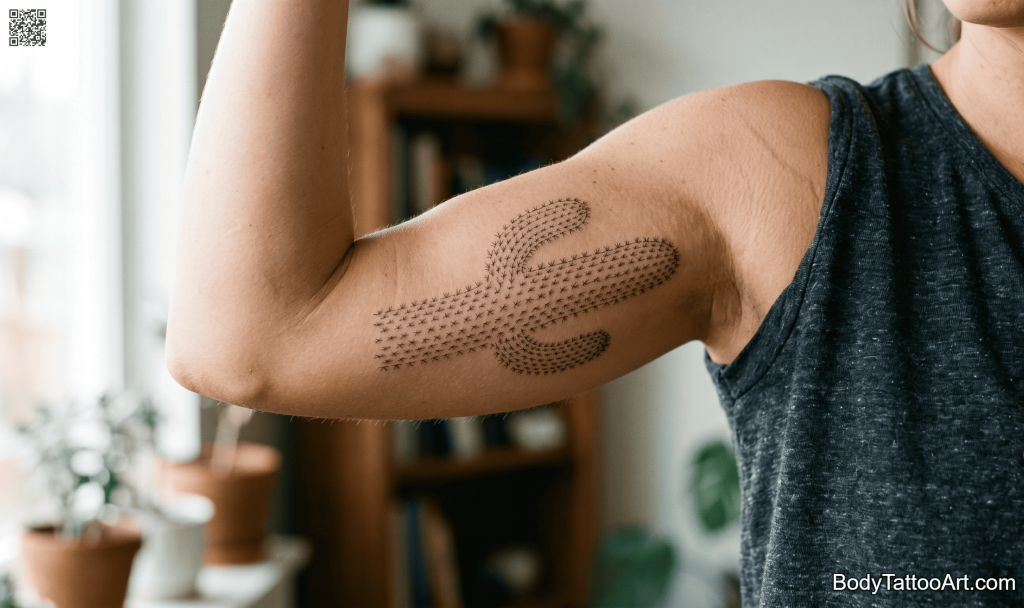
A cactus design where only the spine clusters are tattooed — no stalk, no arms, no outline. The spines float in the exact arrangement they’d appear on a real cactus, so the shape of the plant is implied but never drawn.
Placement: Inner bicep
Style: Fine line / conceptual Cactus Tattoos
Why it stands out: The absence of the cactus body is the whole point. The viewer’s brain fills in the form from the spine pattern alone — a conceptually clever and visually unusual approach.
Ideal for: People who love conceptual tattoo design, minimalists with an edge, those wanting a subtle but interesting arm piece
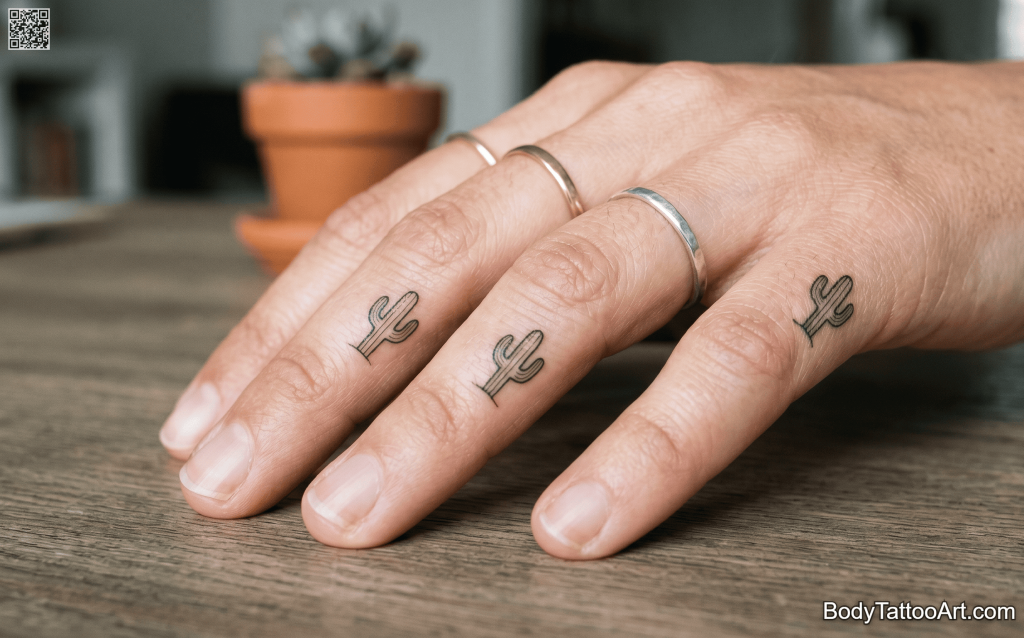
Three tiny saguaro cacti in a row, each barely half an inch tall, running across the first three fingers. Each cactus sits on its own finger pad like a tiny planted desert garden.
Placement: Finger knuckles
Style: Micro fine line Cactus Tattoos
Why it stands out: The three-finger spread gives the composition room to breathe while the tiny scale makes each cactus feel precious. The spacing is what makes it work.
Ideal for: Finger tattoo fans, people building hand collections, micro tattoo enthusiasts.
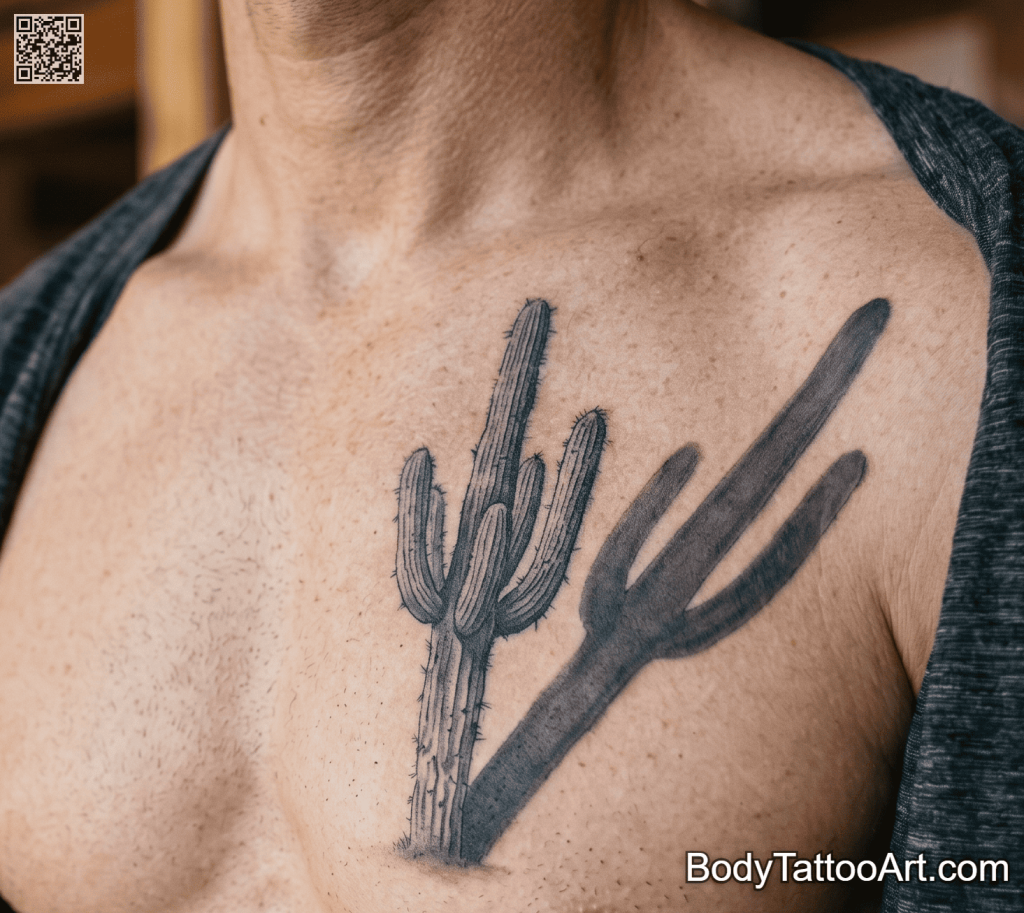
A realistic saguaro with its cast shadow stretching across the skin beside it, as if lit from a low sun angle. The shadow is darker, elongated, and slightly distorted — a second design element that anchors the whole composition.
Placement: Upper chest
Style: Grey-wash realism Cactus Tattoos
Why it stands out: The shadow as compositional element gives the tattoo a cinematic quality. It looks like a still frame from a desert film, with the late-afternoon light baked in.
Ideal for: Realism lovers, people who appreciate trompe l’oeil design, chest piece seekers.
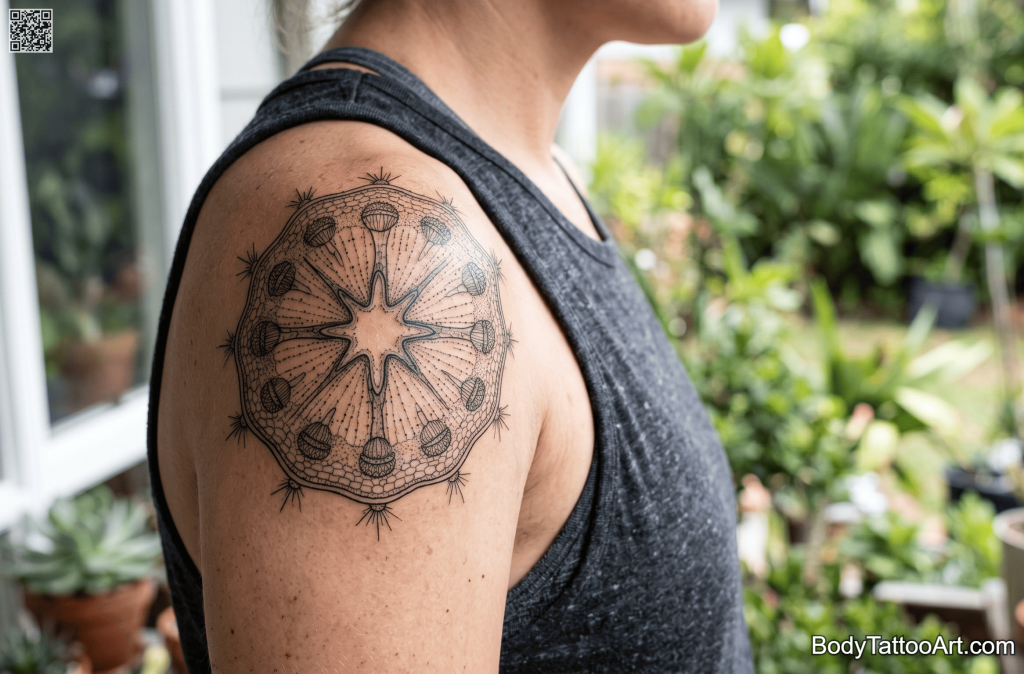
A top-down cross-sectional view of a cactus stalk — the internal star-shaped structure, the water-storage tissue, the vascular rings — rendered in fine line botanical illustration style.
Placement: Shoulder cap / deltoid
Style: Scientific illustration / fine line Cactus Tattoos
Why it stands out: Nobody looks at a cactus from this angle. The interior structure is genuinely beautiful and almost no one knows it exists, which makes this tattoo a constant conversation starter.
Ideal for: Science lovers, biology enthusiasts, people who enjoy unexpected conceptual tattoo choices.
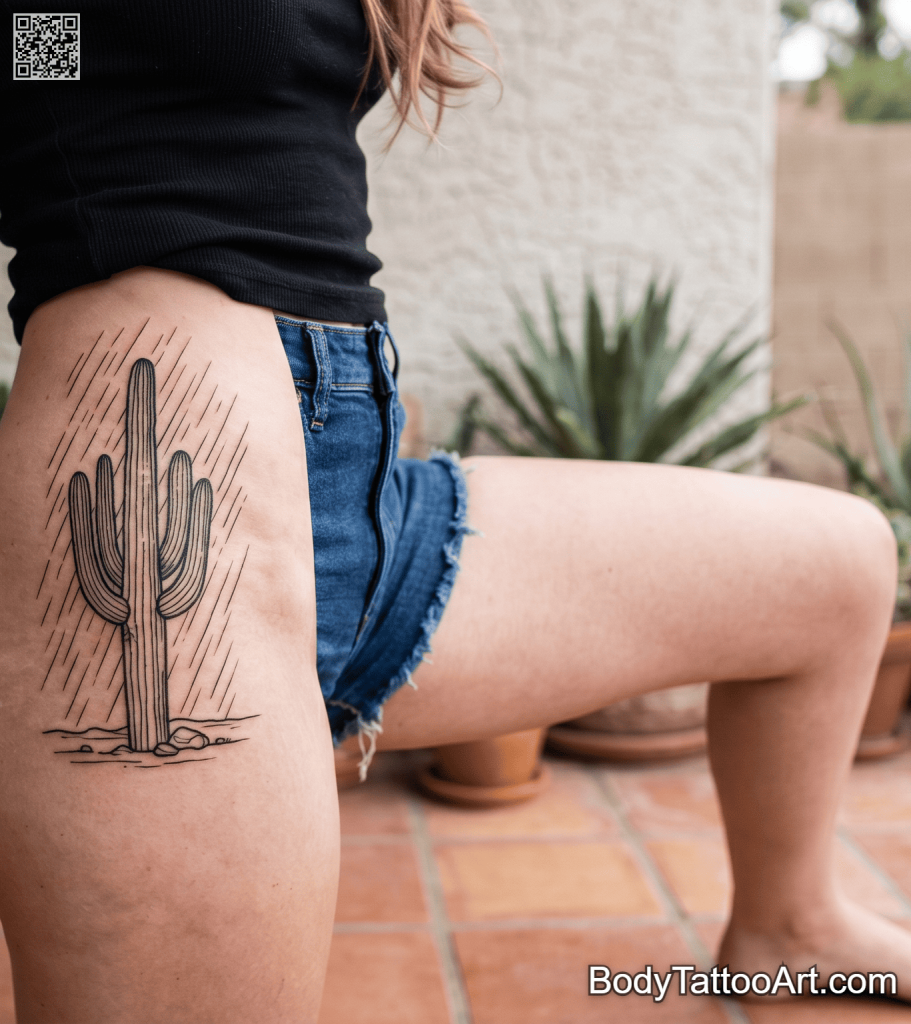
A saguaro cactus with diagonal fine lines crossing the entire composition, creating the visual impression of heavy rain falling across the desert scene. The rain lines pass over the cactus form, unifying plant and environment.
Placement: Hip / side hip
Style: Japanese-influenced linework Cactus Tattoos
Why it stands out: The rain lines add atmosphere and environmental storytelling without needing a full background. The cactus becomes part of a moment rather than a standalone image.
Ideal for: People drawn to atmospheric and moody compositions, Japanese-influenced tattoo fans, hip piece seekers
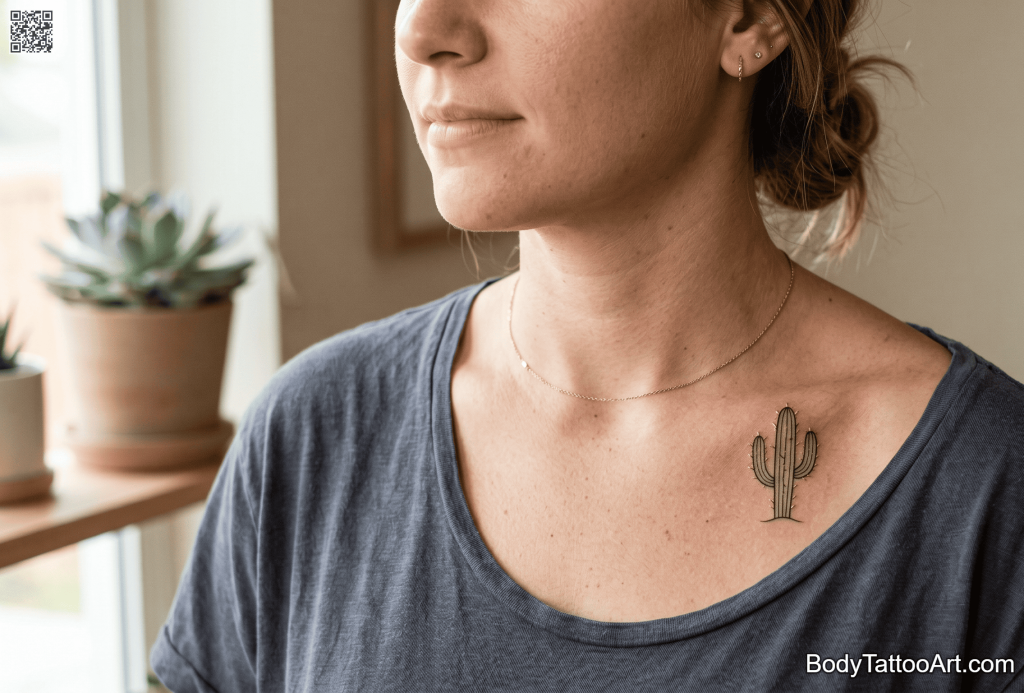
A fine line cactus with selective gold ink used at the spine tips and along the arm edges. The body of the cactus is in standard black; the gold details catch light differently and give the whole design warmth and presence.
Placement: Collarbone
Style: Fine line with color accent Cactus Tattoos
Why it stands out: The minimal gold detailing elevates what could be a straightforward fine line piece. It reads as luxurious without being ornate.
Ideal for: People drawn to delicate collarbone pieces, those who want a hint of color without committing to full color work
A prickly pear cactus with several pads shown in slightly different orientations, as if turning or swaying. Faint motion lines trail from the moving pads. The stillness of the main body against the motion of the outer pads creates tension.
Placement: Inner upper arm
Style: Illustrative / grey-wash Cactus Tattoos
Why it stands out: Adding implied motion to a stationary plant is compositionally unusual. The design feels alive in a way that static cactus tattoos rarely achieve.
Ideal for: People who love movement and narrative in their tattoos, those wanting something visually active, inner arm piece seekers.
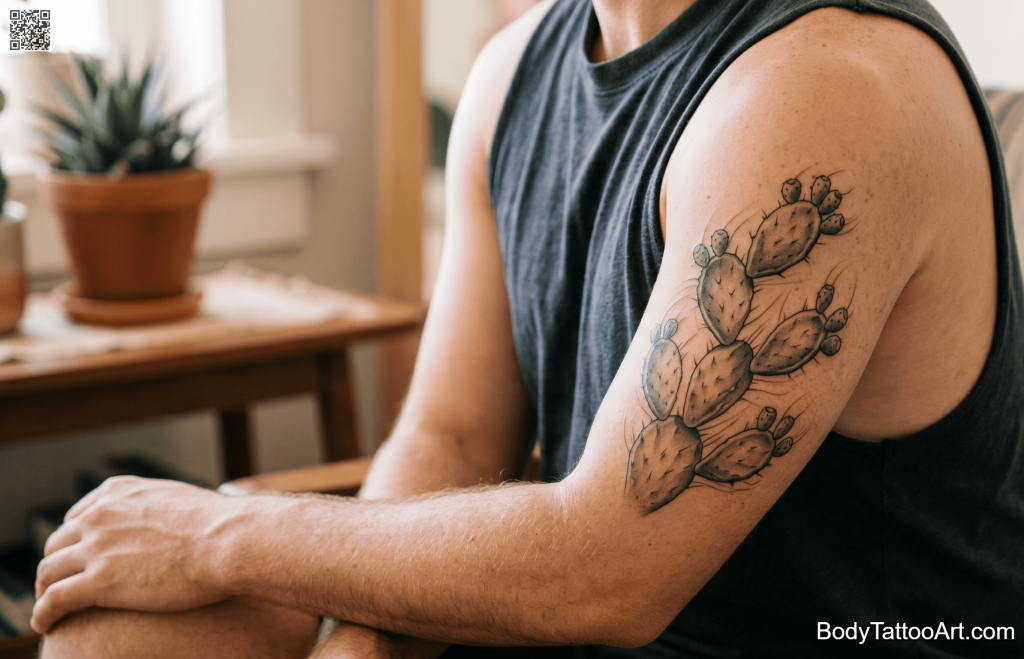
The spine clusters of a saguaro become stars. The connecting lines between spine positions become constellation lines. The overall shape of the cactus is legible but re-coded as a star map.
Placement: Wrist / inner wrist
Style: Fine line / conceptual Cactus Tattoos
Why it stands out: The dual reading — cactus and night sky — gives the tattoo a second layer of meaning that rewards closer inspection. The spine-as-star concept is elegant and clever.
Ideal for: Astronomy lovers, people who enjoy layered conceptual design, those wanting a wrist piece with depth.

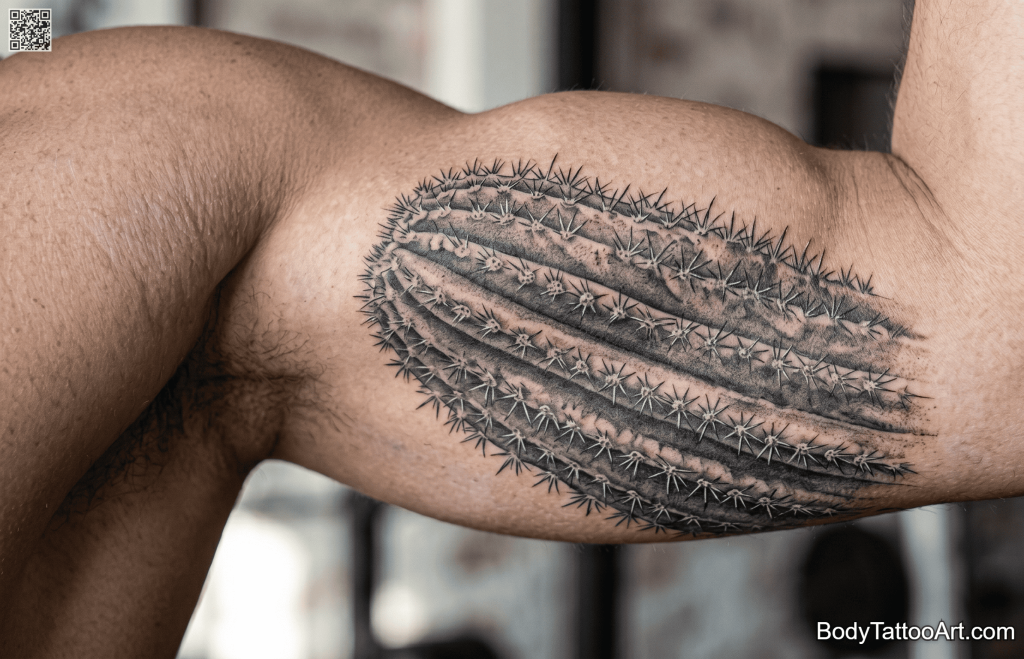
An extreme close-up of just one arm of a saguaro — zoomed in so the individual ribs, the spine clusters, and the surface texture fill the entire composition. No full-plant view. Just pure surface detail.
Placement: Back of upper arm / tricep
Style: Grey-wash realism Cactus Tattoos
Why it stands out: Zooming into the texture rather than showing the whole plant is an unexpected editorial choice. It’s like a macro photograph of the cactus surface, and the level of detail makes it genuinely stunning.
Ideal for: Realism collectors, people who appreciate botanical detail, those wanting a tricep piece with visual weight.
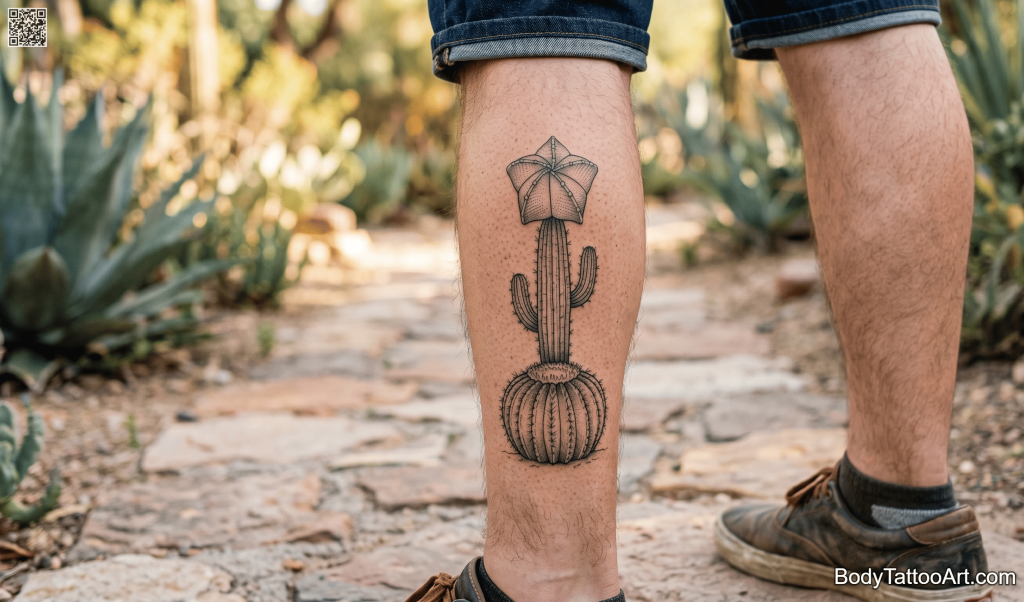
Three different cactus species stacked vertically in a totem-pole arrangement — barrel at the bottom, columnar in the middle, star cactus at the top. Each species is rendered in its own distinct visual style, creating a layered botanical column.
Placement: Outer calf
Style: Illustrative / fine line Cactus Tattoos
Why it stands out: The totem structure is compositionally inventive. Three species, three textures, three silhouettes — stacked into one vertical design that reads as both playful and carefully considered.
Ideal for: Botanical illustration fans, people building nature-themed collections, calf piece seekers who want something original.]
Cactus tattoos have more range than most people give them credit for. The plant’s natural geometry, its texture, and its instantly recognizable silhouette make it one of the most adaptable subjects in nature-inspired tattooing. From a tiny white ink ghost on the wrist to a full grey-wash realism piece on the back, the cactus holds up across styles, scales, and placements.
The 27 designs in this list show just how different cactus tattoos can be when composition and craft are taken seriously. No two look alike, and that’s entirely the point. The best tattoo is the one that feels like it was made for the person wearing it — and with this much variety to work from, that design is definitely somewhere in this list.