Physical Address
304 North Cardinal St.
Dorchester Center, MA 02124
Physical Address
304 North Cardinal St.
Dorchester Center, MA 02124

The lion has been tattooed onto human skin for longer than most tattoo traditions have existed. And yet it never feels done. Walk into any tattoo studio and there’s probably a lion reference pinned somewhere — because the subject is genuinely that versatile. The face alone offers more design material than most animals: the mane that can be styled in a dozen different ways, the deep-set eyes, the jaw structure, the layered fur around the cheeks.
But the best lion tattoos aren’t the ones that just render the animal accurately. They’re the ones that make a visual decision — a tight composition, an unexpected style, a placement that actually uses the body rather than just occupying it. That’s what the 28 designs below are about. Each one is different in structure, mood, and approach. None of them look like each other.
The lion’s symbolism runs deep and wide. In ancient Egypt, the lion represented the pharaoh’s power and was associated with the sun god Ra. In medieval European heraldry, the lion appeared on shields and crests to signal nobility, courage, and military strength. In Christianity, the lion of Judah is one of the oldest symbols of divine authority. Across sub-Saharan African traditions, lions appear in oral histories as ancestral guardians and symbols of community protection.
In modern tattooing, lion tattoos carry different meanings for different people — leadership, protection of family, personal resilience, the courage to face difficulty. None of those meanings are wrong, and none of them need to match. The lion works symbolically because it works visually first.
For a thorough look at lion symbolism across cultures, the Wikipedia article on the Lion as a cultural symbol covers centuries of documented meaning.
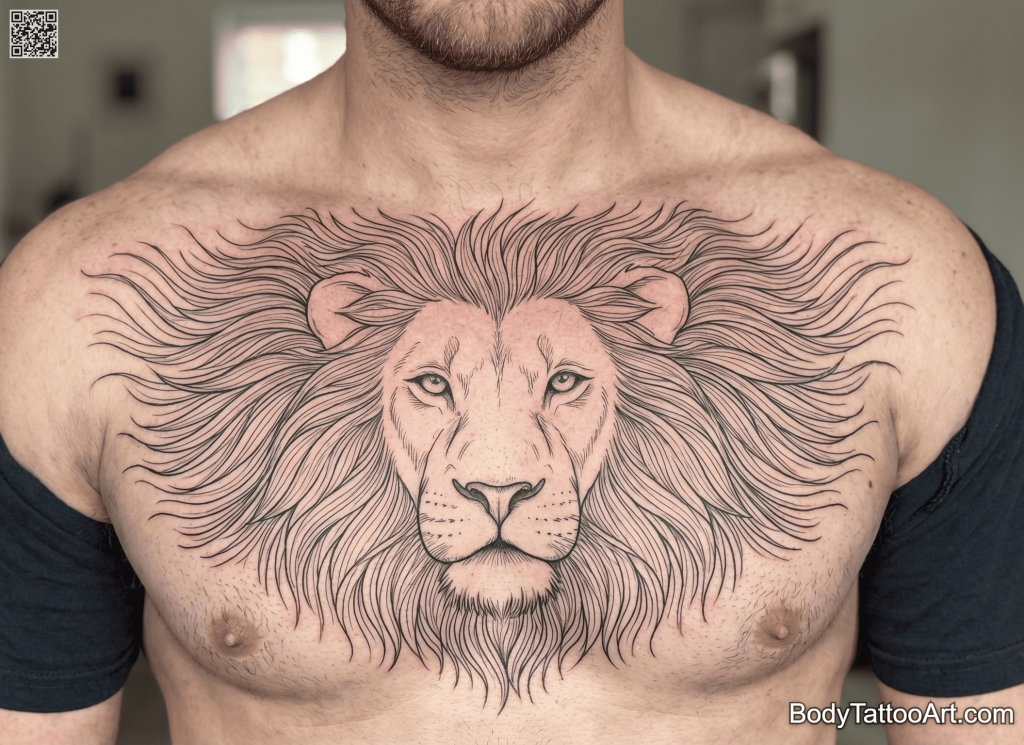
The lion’s face is centered and calm — but the mane is where all the work is. Hundreds of individual flowing strands radiate outward from the face, each one drawn separately with fine linework. The mane fills the chest entirely, spreading from collarbone to sternum. The face itself is almost secondary to the controlled chaos of hair surrounding it.
Placement: Chest
Style: Fine line realism Lion Tattoos
Why it stands out: Most lion tattoos focus on the face. This one treats the mane as the main event — and the chest is one of the only placements wide enough to carry that kind of spread without the design feeling cramped.
Ideal for: People who appreciate technical linework detail. Fine line collectors. Anyone who wants a large chest piece that reads clearly from a distance.
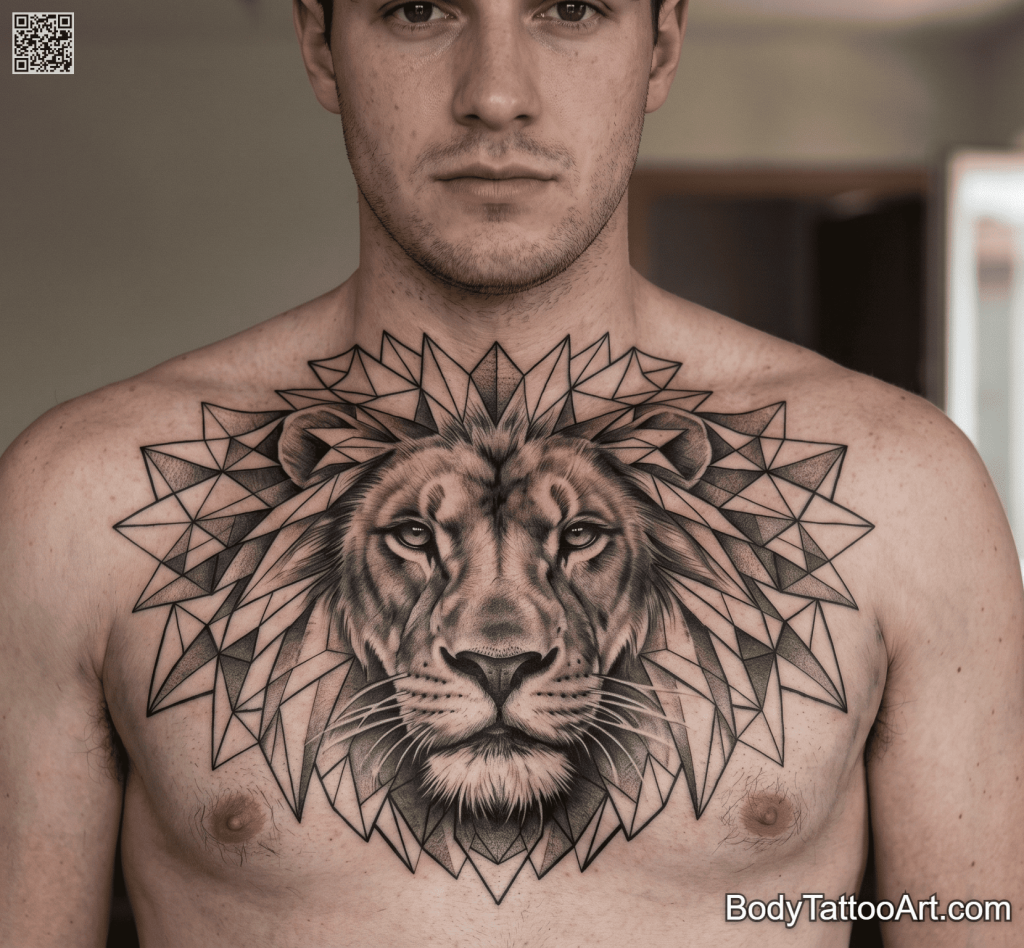
The lion’s face is realistic — detailed shading, accurate proportions, careful eye rendering. But the mane isn’t fur. It’s built from interlocking triangles, diamonds, and angular shapes that radiate outward in a structured geometric pattern. The contrast between the organic face and the architectural mane is the whole point.
Placement: Sternum / upper chest
Style: Realism and geometric hybrid Lion Tattoos
Why it stands out: The tension between the two halves of this design — one biological, one constructed — gives it a conceptual edge that purely realistic lion tattoos can’t touch.
Ideal for: People who like contrast-driven design. Those who want something that feels modern without losing the animal entirely.
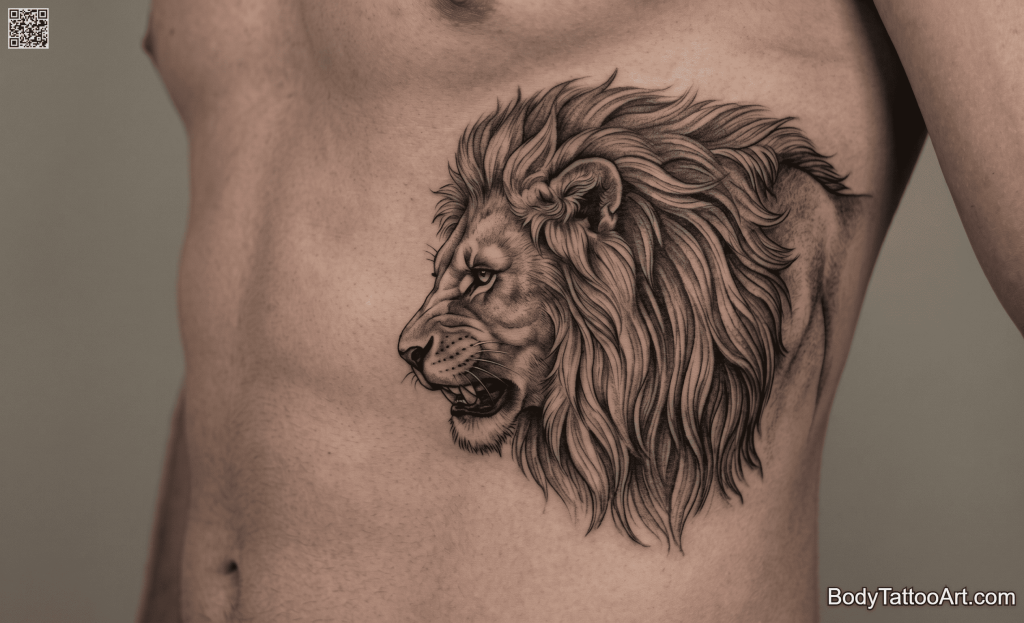
The lion in complete side profile — head slightly lowered, ears back, lips pulling into a low growl. The body is cropped at the shoulders. The eye is visible and alert. The mane falls forward around the face rather than fanning outward. It’s a quieter, more predatory pose than the usual front-facing roar.
Placement: Ribcage
Style: Black and grey realism Lion Tattoos
Why it stands out: Side profiles in lion tattooing are rare — nearly everything faces forward. The lowered, focused head position communicates tension without the drama of an open mouth. More implied than stated.
Ideal for: People who prefer restrained power over obvious aggression. Wildlife realism collectors.
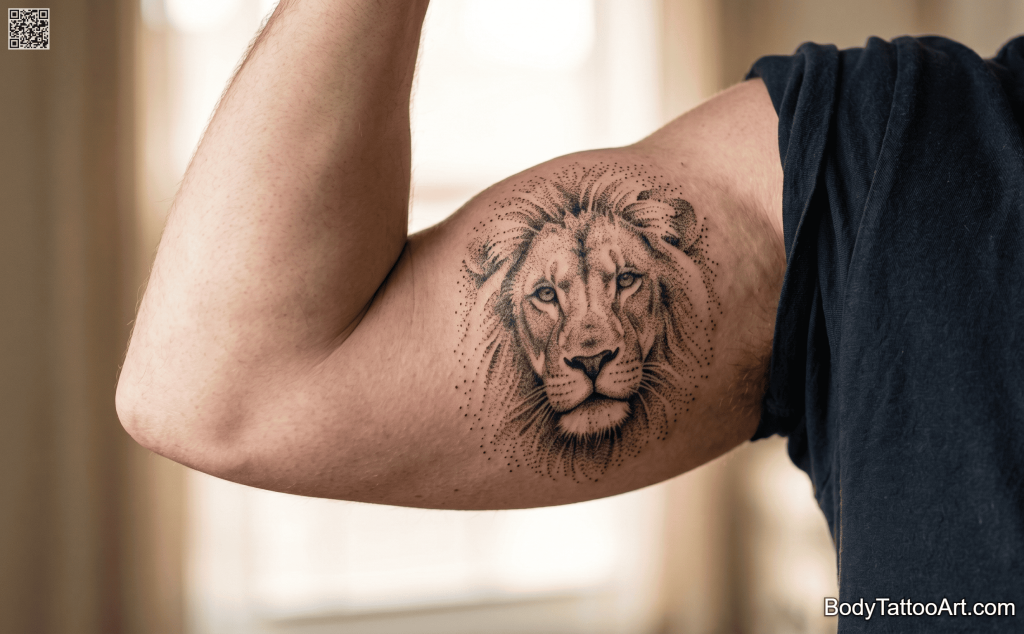
No outlines. No shading in the traditional sense. The entire lion portrait is assembled from individual dots — dense clusters where the fur is darkest, single scattered points at the edges where the image dissolves. The mane is the most complex zone: thousands of dots layering to create volume. The face is tighter, more controlled.
Placement: Bicep
Style: Dotwork Lion Tattoos
Why it stands out: Dotwork lion tattoos have a texture that photographs almost like printed halftone — a visual effect nothing else replicates. The image reveals itself differently at different distances.
Ideal for: Detail-obsessed collectors. People who study their tattoos up close. Those drawn to meditative, process-heavy art forms.
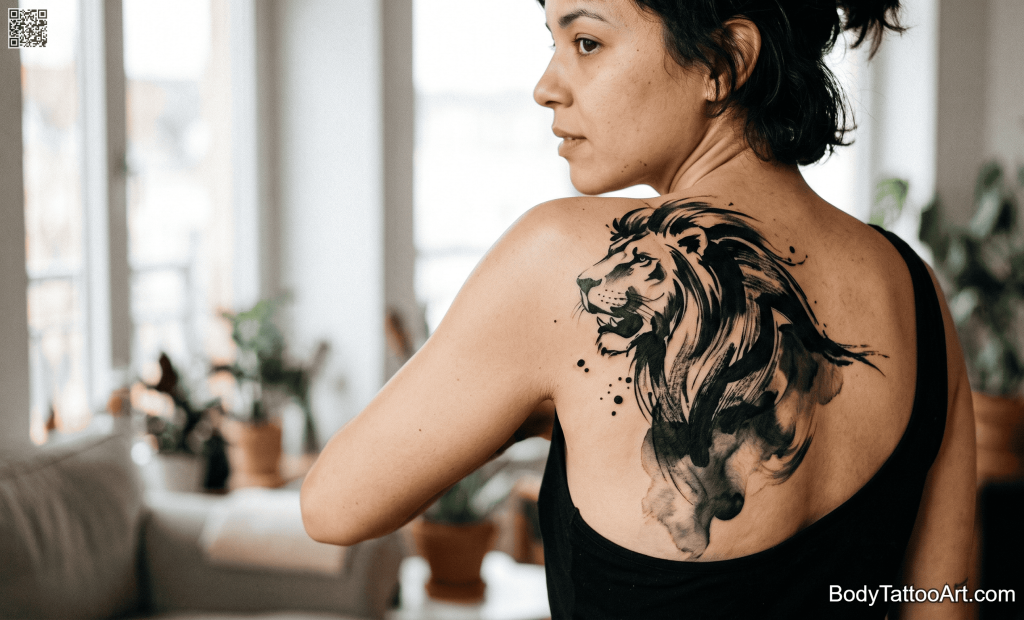
The lion is painted, not drawn — gestural strokes form the mane, the face is suggested in three or four decisive marks, and the body disappears into an ink wash at the bottom. There are splatters near the chin and base. The whole piece has the energy of something done fast, by someone who knew exactly what they were doing.
Placement: Upper back and shoulder
Style: Abstract brushwork Lion Tattoos
Why it stands out: Gesture-based lion tattoos are rare and hard to execute without looking accidental. When the marks are right, the design captures the lion’s presence without trying to render it accurately.
Ideal for: People drawn to sumi-e painting aesthetics. Collectors who want art-forward work rather than illustration.
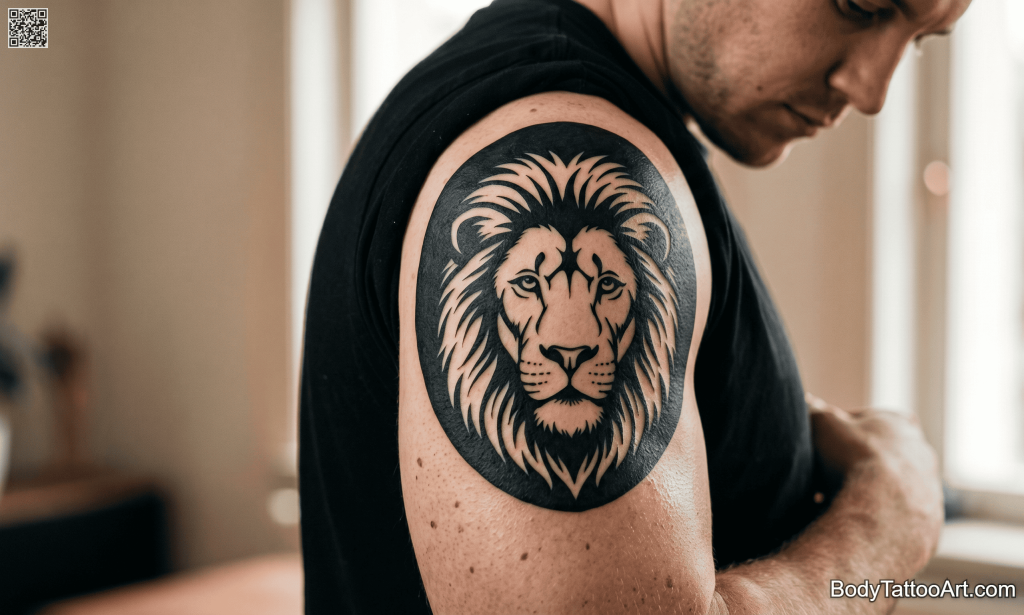
The entire design is reversed. Solid black fills the surrounding area of the upper arm, and within that dark field, the lion’s face — mane, eyes, nose, and all — is preserved as bare skin. The mane’s individual strands are the gaps between thin black marks. The face reads clearly but is formed entirely by what wasn’t inked.
Placement: Upper arm
Style: Negative space blackwork Lion Tattoos
Why it stands out: Negative space lion tattoos require the artist to think in reverse throughout — planning everything by what’s removed rather than added. The result tends to look nothing like conventional lion tattoos.
Ideal for: Blackwork collectors. People who like concept-driven tattooing. Those who want something that makes other people stop and look twice.
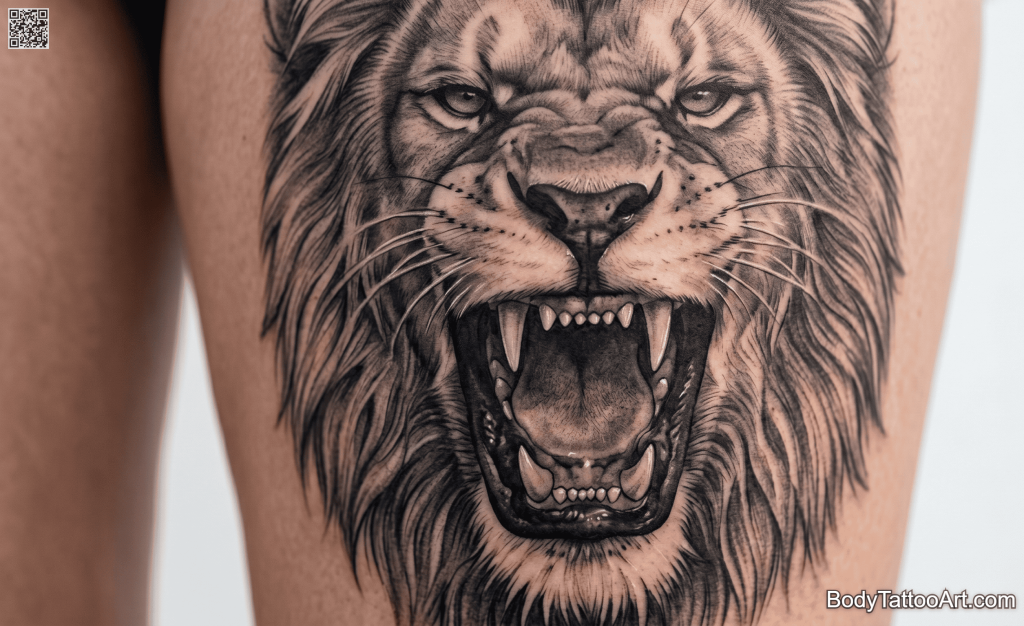
The face is tightly cropped — the full roar taking up the entire canvas, mouth completely open, the inside of the mouth shaded deeply, individual teeth rendered clearly. The eyes are narrowed with the effort. The mane fans out to the edges but gets cut off by the composition. It’s a design that fills its space completely with no room left over.
Placement: Thigh
Style: Black and grey realism Lion Tattoos
Why it stands out: Most lion face tattoos leave breathing room around the subject. This one refuses to. The cropped, filled composition creates urgency that open-space designs can’t.
Ideal for: Bold statement collectors. People who want the energy of a large piece in a focused area.
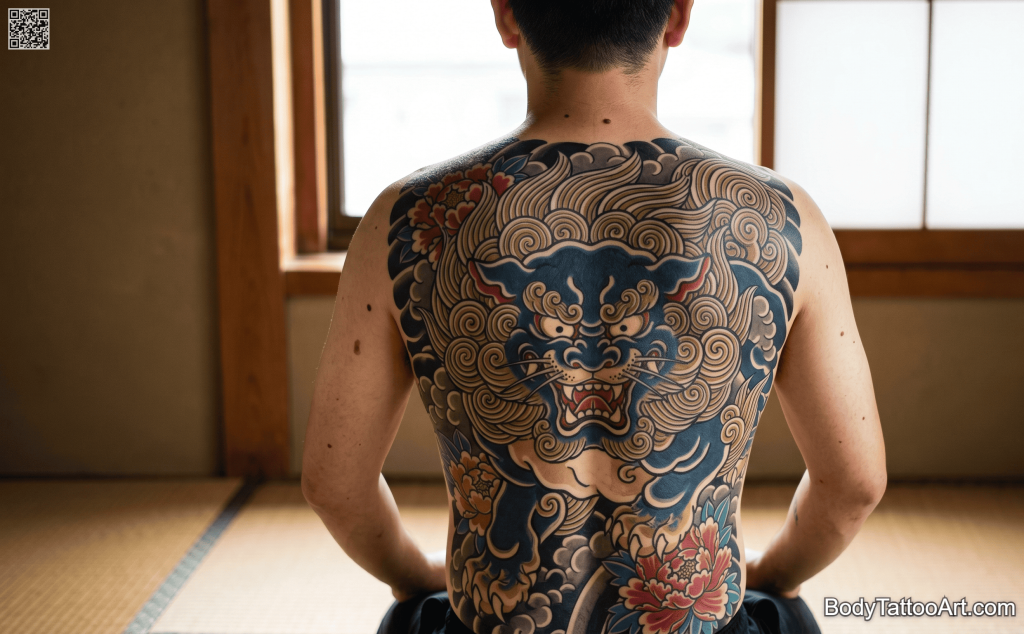
Flat fills, thick decisive outlines, and stylized proportions borrowed directly from Japanese woodblock printing. The mane is a bold shape rather than individual strands. The eyes are graphic. The overall effect is less anatomical study and more cultural artifact — like something that could have been printed on paper in Edo-period Japan.
Placement: Full back
Style: Japanese woodblock / traditional Lion Tattoos
Why it stands out: The flattening of the lion into graphic shapes removes all photographic reference and puts the design firmly in the tradition of printmaking. It ages differently — and better — than realism.
Ideal for: Japanese art enthusiasts. People building large traditional-style back pieces.
Lion tattoos share a lot of visual territory with other apex predator designs. If these are resonating, it’s worth exploring tiger tattoo designs,
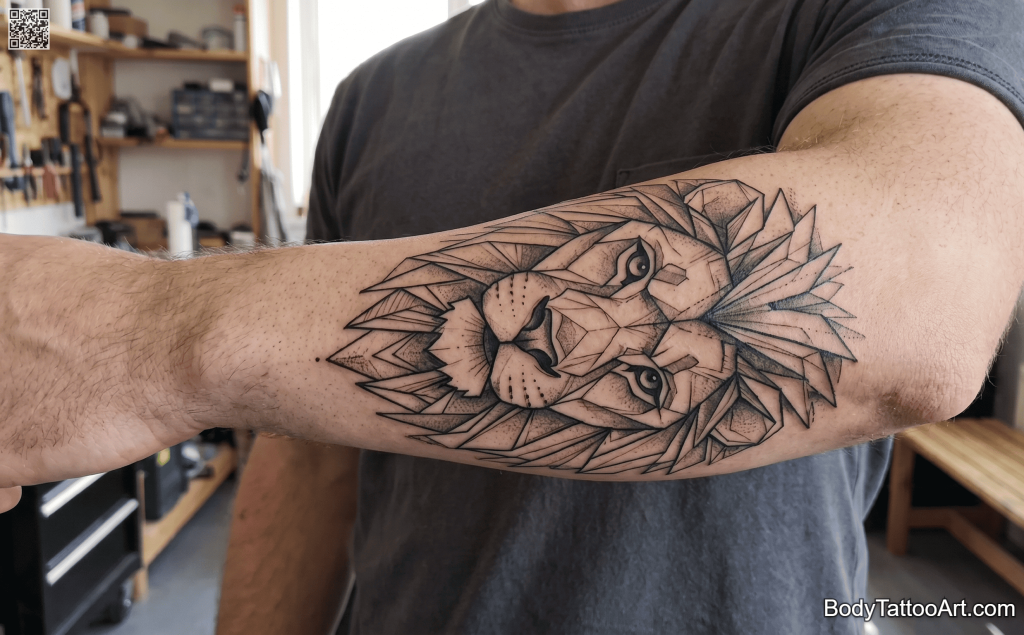
The face is divided into angular planes shown from multiple perspectives at once. One eye faces the viewer, the other appears in profile. The mane becomes a series of radiating geometric shapes rather than fur. The nose is flattened into an abstract form. The whole thing is assembled like a collage where every piece shows a different angle of the same object.
Placement: Forearm
Style: Cubist illustrative Lion Tattoos
Why it stands out: Treating the lion’s face as a Cubist subject turns it from a wildlife image into fine art. The complexity rewards sustained looking.
Ideal for: Art history enthusiasts. Collectors who want their tattoos to start a conversation.
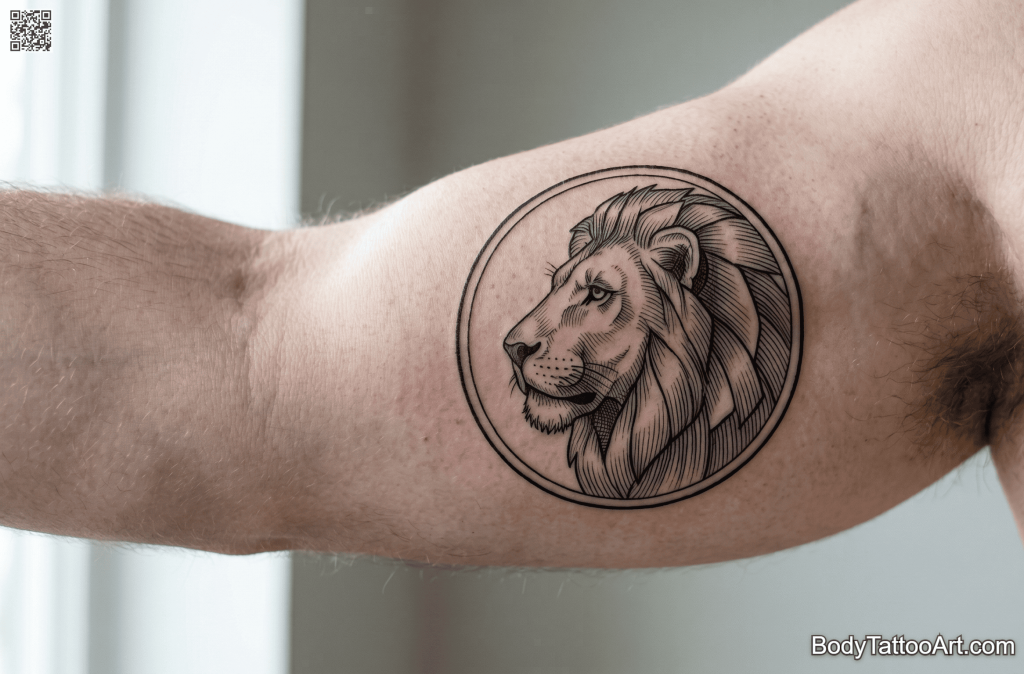
The lion is shown in strict profile — facing left — rendered with the clarity and precision of a coin engraving. Clean outlines, deliberate hatching for shading, no loose marks. The mane is compact and neatly structured. The whole thing fits inside a circle, like a medallion placed on the skin.
Placement: Inner bicep
Style: Engraving / medallion Lion Tattoos
Why it stands out: The coin reference gives this design a formality and permanence that feels completely different from portrait-style lion tattoos. It’s classical in the literal sense — designed to last.
Ideal for: People who appreciate historical art references. Those who want something structured and precise rather than expressive.
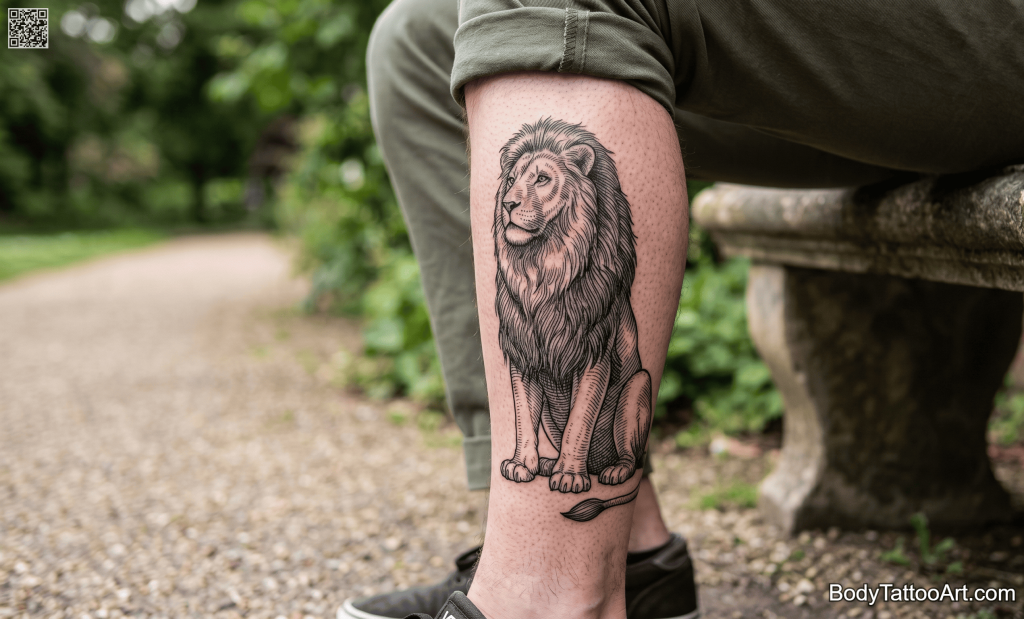
The entire lion — full body seated, facing three-quarters — is drawn using only lines. No fills, no washes, no solid black areas. Direction of hatching changes to follow fur growth patterns. Cross-hatching builds shadow under the chin, between the legs, beneath the mane. It’s the tattoo equivalent of a classical drawing study.
Placement: Shin
Style: Engraving linework Lion Tattoos
Why it stands out: The discipline of working entirely in line — no shading shortcuts, no fill areas — means every mark is committed. The result has a weight that belies the absence of dark fills.
Ideal for: People who appreciate draftsmanship. Collectors drawn to old-master drawing techniques.
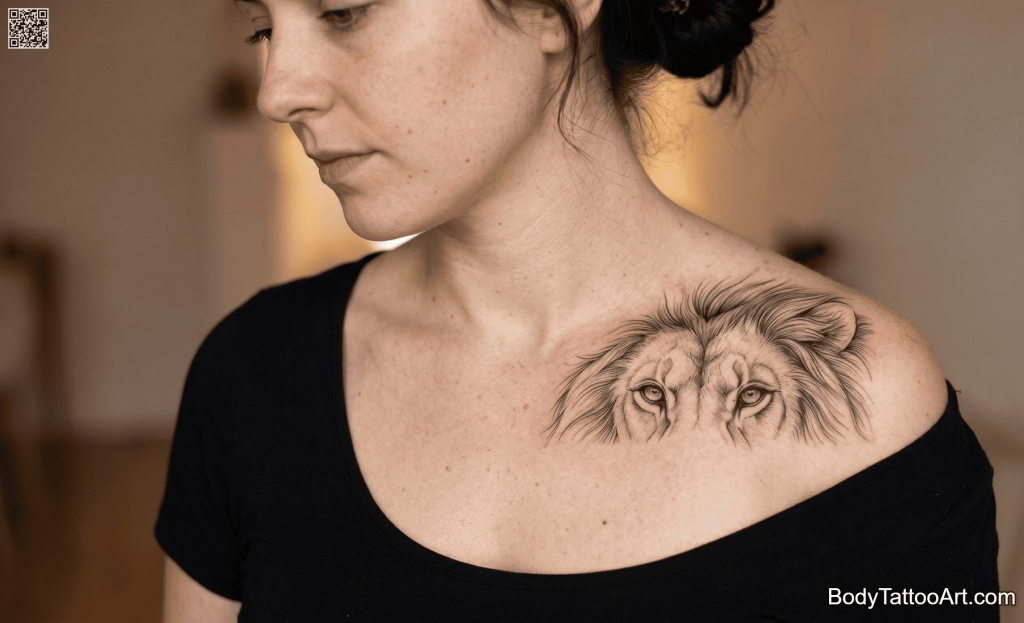
The top half of the lion’s face — from the mid-nose up — fills the composition. Just the brow, the wide-set golden-toned eyes, and the beginning of the mane spreading outward at the top. Nothing below. The cropping is unexpected and that’s exactly why it works.
Placement: Collarbone / neckline
Style: Fine line realism Lion Tattoos
Why it stands out: Radically cropped compositions are almost never used in lion tattooing. The mystery of the incomplete face creates more visual tension than a fully rendered portrait would.
Ideal for: People who want placement-specific, design-led work. Those who like understated tattoos that reward a second look.
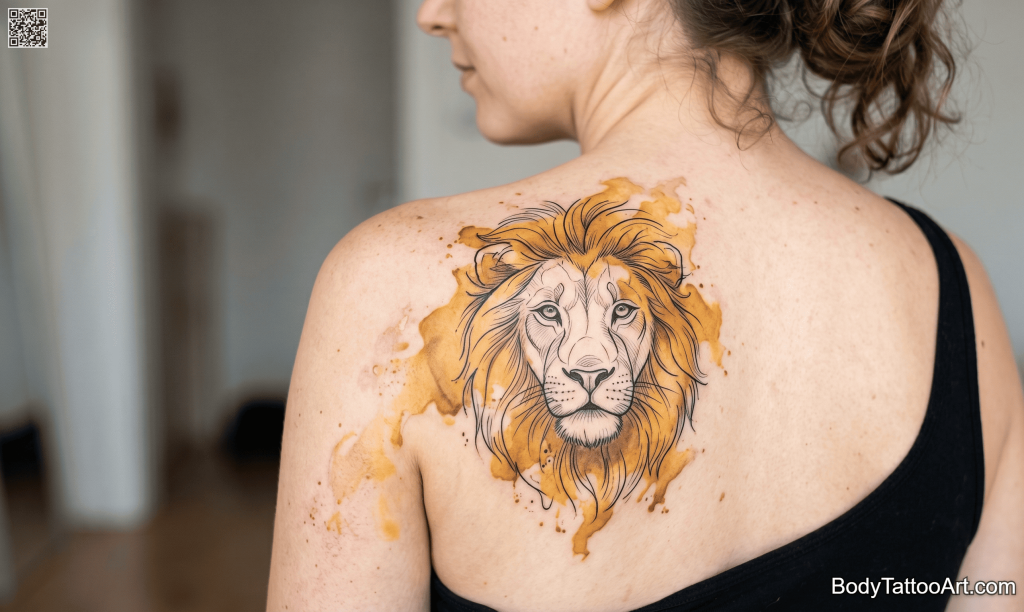
The lion’s face is drawn cleanly in fine black linework. The mane, instead of being rendered as fur, is filled with loose watercolor-style ink washes — deep gold fading to amber, with edges that bleed freely beyond the lines. The color areas don’t stay contained. They drift.
Placement: Shoulder blade
Style: Watercolor Lion Tattoos
Why it stands out: The contrast between the precise face and the loose, drifting color of the mane creates a design where control and freedom exist in the same space. The warm palette feels natural to the lion’s coloring.
Ideal for: Color tattoo enthusiasts. People who want warmth and looseness in their lion tattoo without sacrificing clarity.
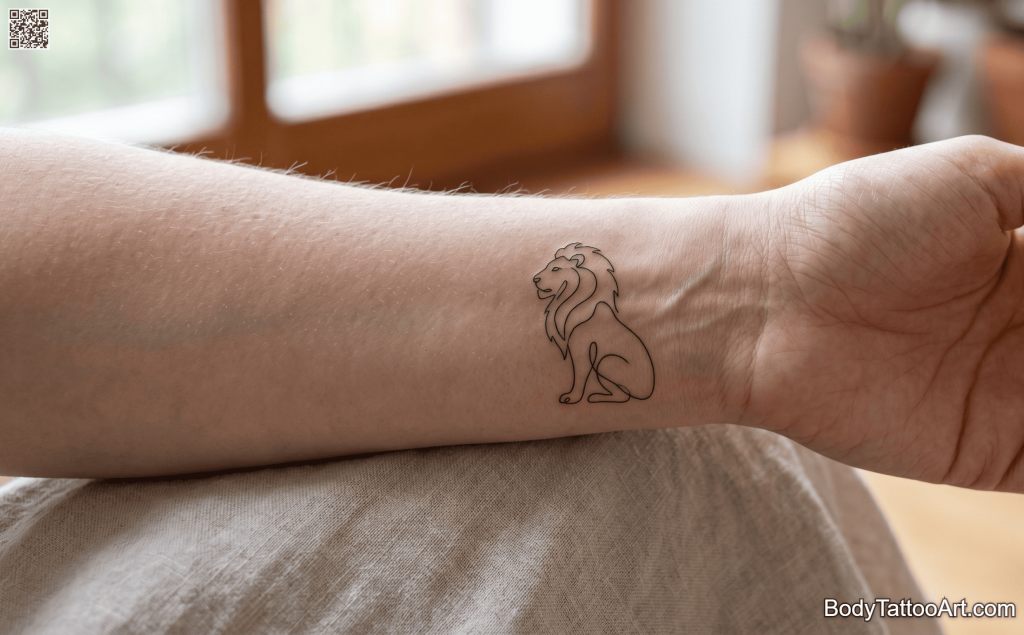
One unbroken line traces the lion’s full profile — head, mane, and body outline — from nose to haunches. No shading, no internal lines, no fills. The entire lion is contained in a single flowing contour. At this level of reduction, the proportions have to be perfect. They are.
Placement: Inner wrist
Style: Minimalist single-line Lion Tattoos
Why it stands out: One-line lion tattoos are more common than they used to be, but most of them lose the animal in the simplification. This one doesn’t. The proportions hold.
Ideal for: Minimalist collectors. First-time tattoo seekers. People who want something lasting in a small footprint.
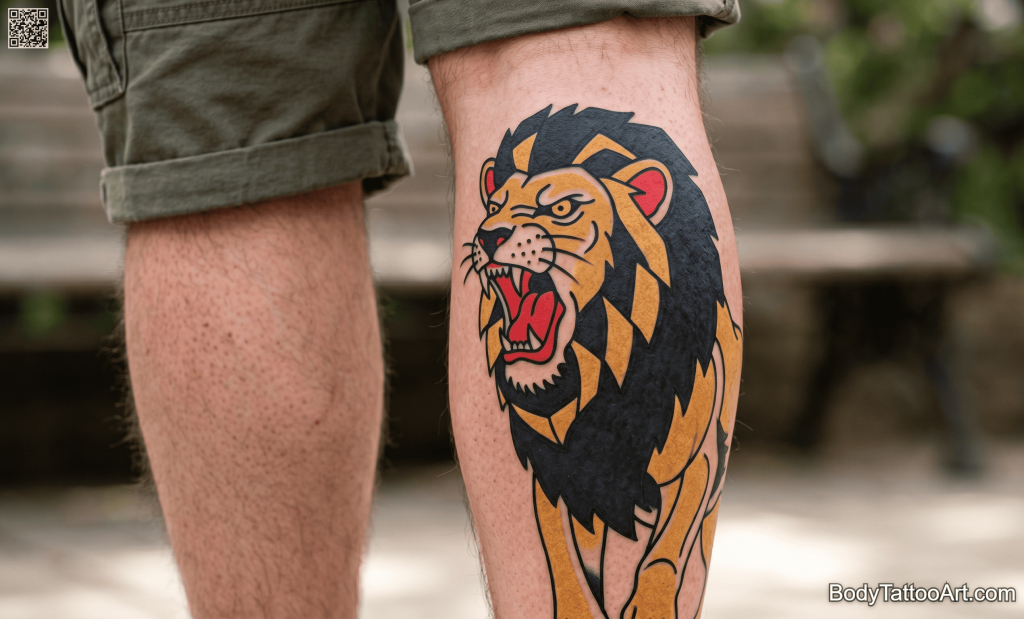
Classic American traditional — thick black outlines, a red and gold palette, flat color fills, zero gradient work. The lion roars in a three-quarter view. The mane is a bold dark shape. Red fills the inner ears and the inside of the mouth. Gold fills portions of the mane. It’s loud and it knows it.
Placement: Outer calf
Style: Minimalist single-line Lion Tattoos
Why it stands out: Traditional American lion tattoos age better than almost any other style. The bold lines and flat fills hold for decades. This style was built for longevity.
Ideal for: Old school tattoo fans. People building traditional American sets or sleeves.
Lion tattoos sit naturally within a broader world of powerful tattoo imagery. If exploring different floral-animal combination designs, check out related posts on Lotus with dragons, Phoenix with sunflowers,
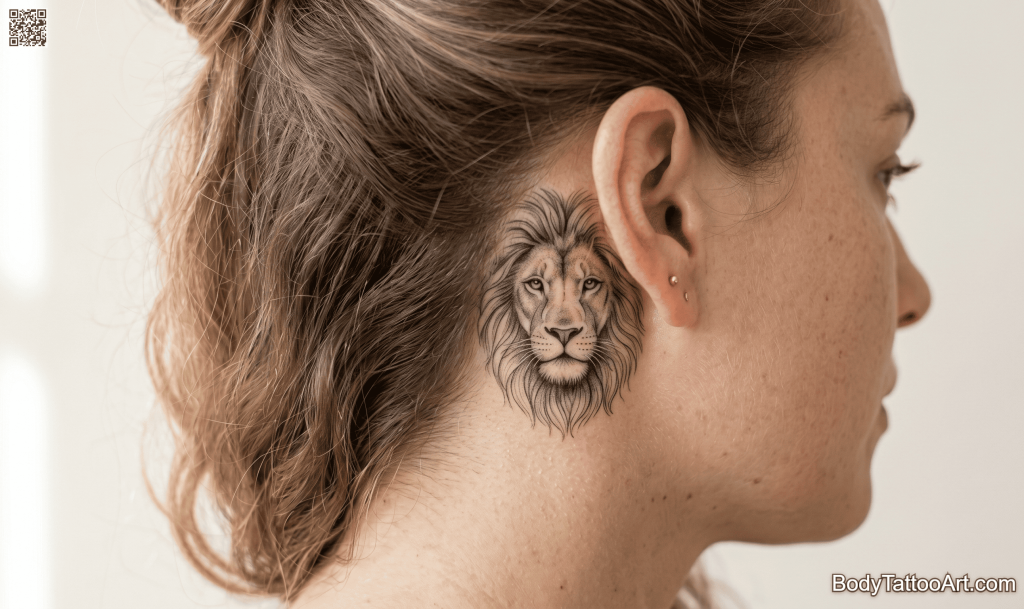
A complete lion face — mane, eyes, nose, and expression — compressed to the size of a large coin. The stripes of the mane are individually drawn. The eyes still carry depth. Nothing has been simplified to make the scale easier. It’s the full design, just very, very small.
Placement: Behind the ear
Style: Micro realism Lion Tattoos
Why it stands out: Micro realism demands a different skill set from large-scale work — knowing exactly which details to prioritize when space disappears. The result here doesn’t look compressed. It looks precise.
Ideal for: People who prefer personal over public tattoos. Fine line and micro realism collectors.
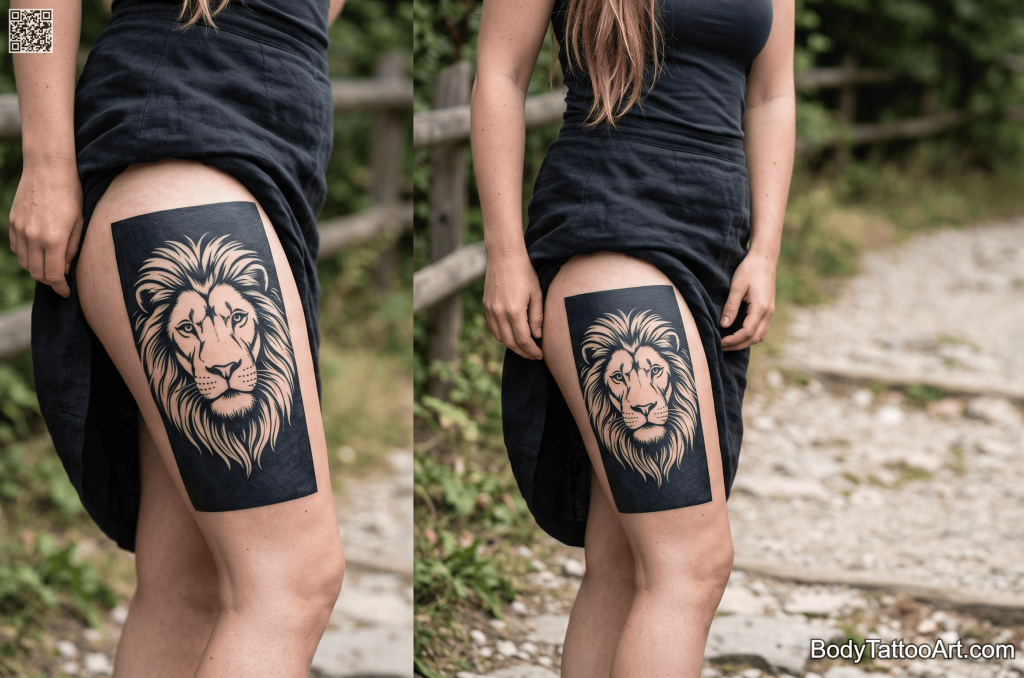
A large rectangular panel of the outer thigh is filled with solid flat black. Inside the black, the lion’s face is preserved as untouched skin — the mane radiating outward in the form of bare skin surrounded by black marks. The face is reversed out. The design is built entirely from the negative.
Placement: Outer thigh
Style: Blackout negative space Lion Tattoos
Why it stands out: The rectangular frame adds formality to the negative space concept. The lion isn’t floating — it’s contained, which gives it a different weight than most negative space designs.
Ideal for: Experienced collectors. People going for large-scale dramatic bodywork.
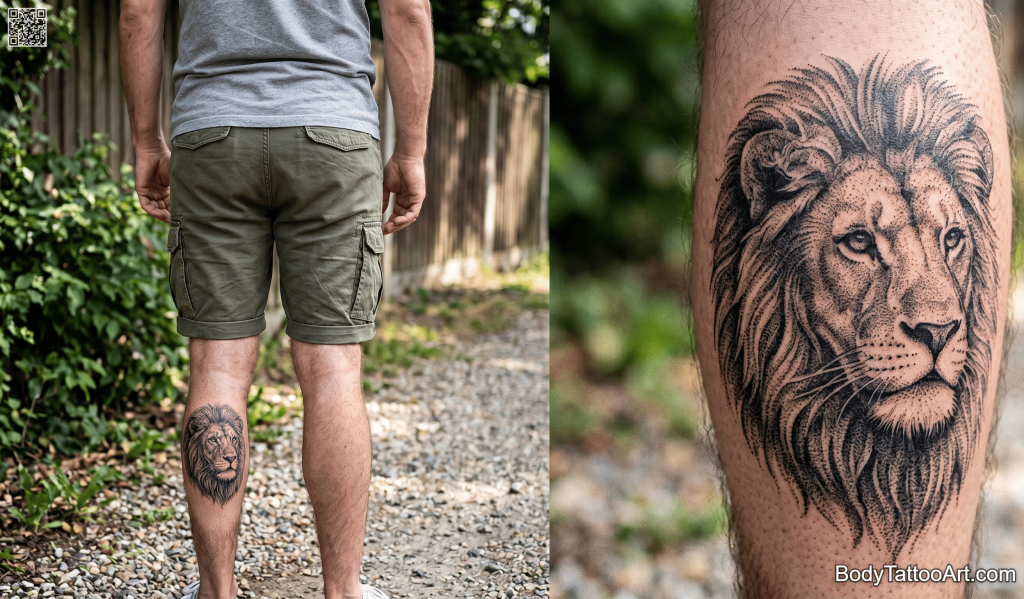
A full-face lion portrait built from evenly-spaced individual dots — not rough dotwork clusters, but true pointillist placement. Tone transitions slowly from dark to light. The mane is the densest zone. The face is tighter, more controlled. The overall image vibrates slightly at arm’s length in the way only stippling can produce.
Placement: Back of calf
Style: Stippling Lion Tattoos
Why it stands out: The optical quality of stippled work is genuinely different from anything else — the slight shimmer when viewed from different distances isn’t a trick, it’s the natural result of the technique.
Ideal for: Collectors who value technical process. People who appreciate pointillist fine art.
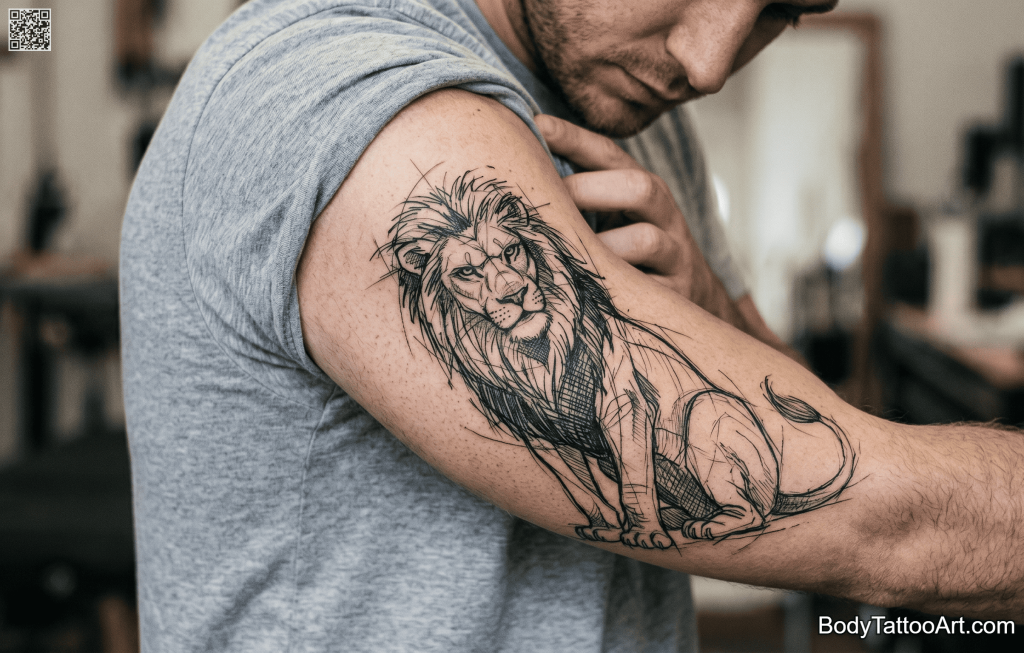
Loose pencil-style linework, slightly inconsistent stroke weights, visible construction lines that were never removed. The lion is seated, three-quarters facing, and the whole thing looks like it was drawn quickly by someone with strong foundations. The roughness is intentional and specific — not a failed rendering, a stylistic choice.
Placement: Outer forearm
Style: Sketch linework Lion Tattoos
Why it stands out: The imperfect, mid-process quality makes sketch lion tattoos feel more personal than polished realism. Like the design belongs to the person wearing it, not to a flash sheet.
Ideal for: Artists and illustrators. People who want a tattoo that feels genuinely handmade.
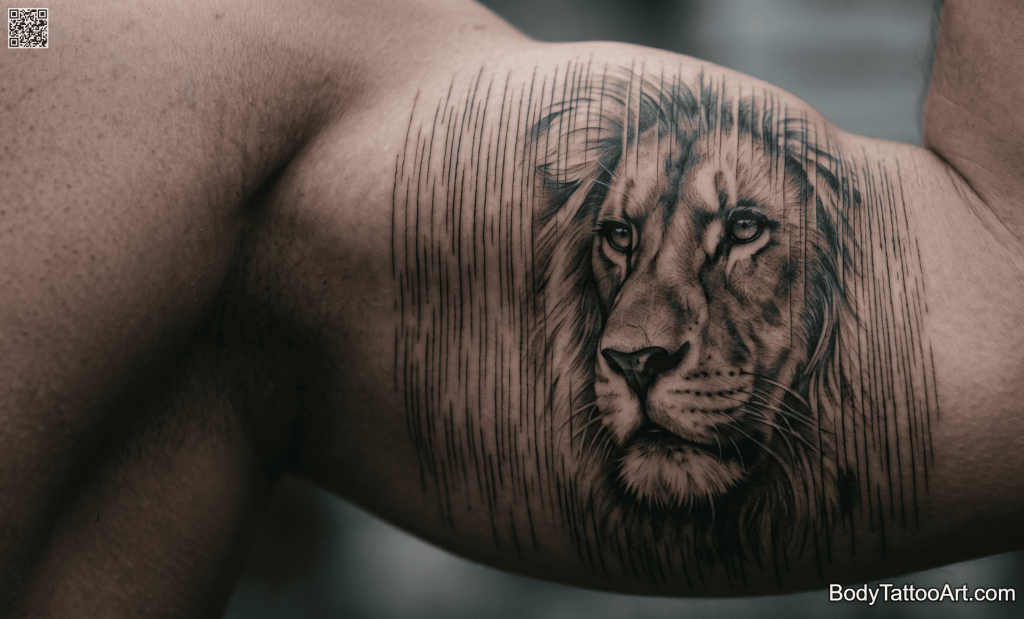
A realistic lion face — fully rendered, nothing simplified — with a field of fine parallel vertical lines falling across the entire composition from top to bottom at consistent spacing. The rain lines and the lion are both tattooed. The viewer looks through weather to see the animal. It turns a portrait into a scene.
Placement: Outer upper arm
Style: Realism with environmental texture Lion Tattoos
Why it stands out: The rain overlay adds atmosphere without changing the subject. It’s cinematic in the same way a still frame is cinematic — a moment caught in specific conditions.
Ideal for: People who want mood built into their tattoo. Collectors drawn to atmospheric and narrative-style work.
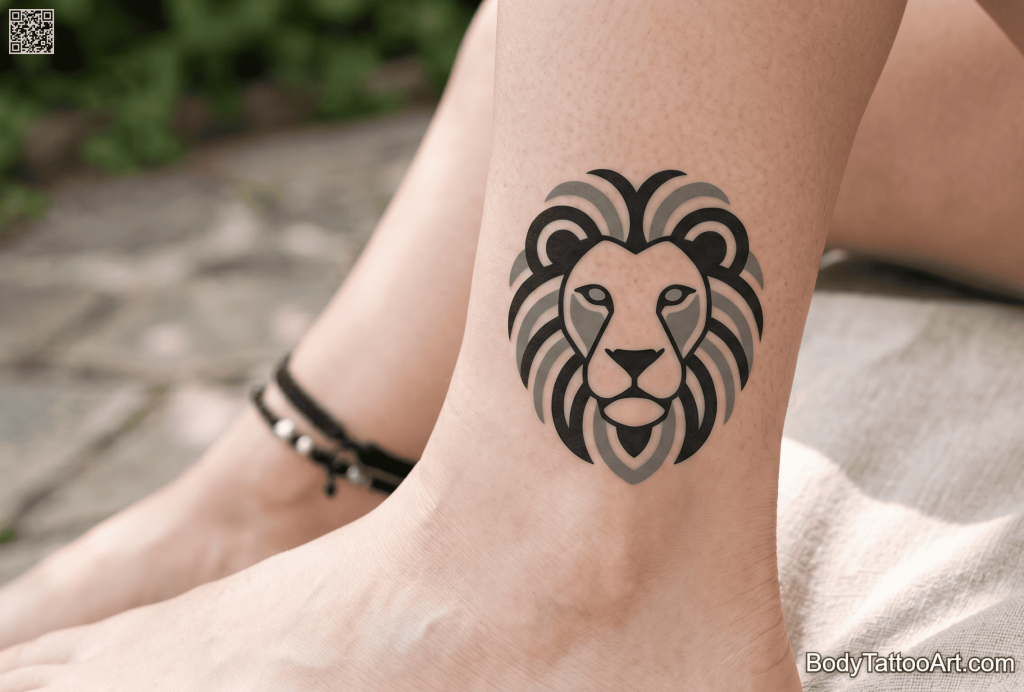
The lion’s face is reduced to clean flat shapes — no shading, no texture, no gradient. The mane is a series of rounded arcs in alternating dark and medium tones. The eyes are simple almond shapes with solid pupils. The nose is a clean triangle. It looks like a well-designed logo translated into ink.
Placement: Inner ankle
Style: Graphic / flat design Lion Tattoos
Why it stands out: Flat design lion tattoos are rare. The reduction to pure shape — no rendering technique — gives the design a visual confidence that more detailed work sometimes lacks.
Ideal for: Designers and visual creatives. People who prefer bold, simple shapes over detailed illustration.
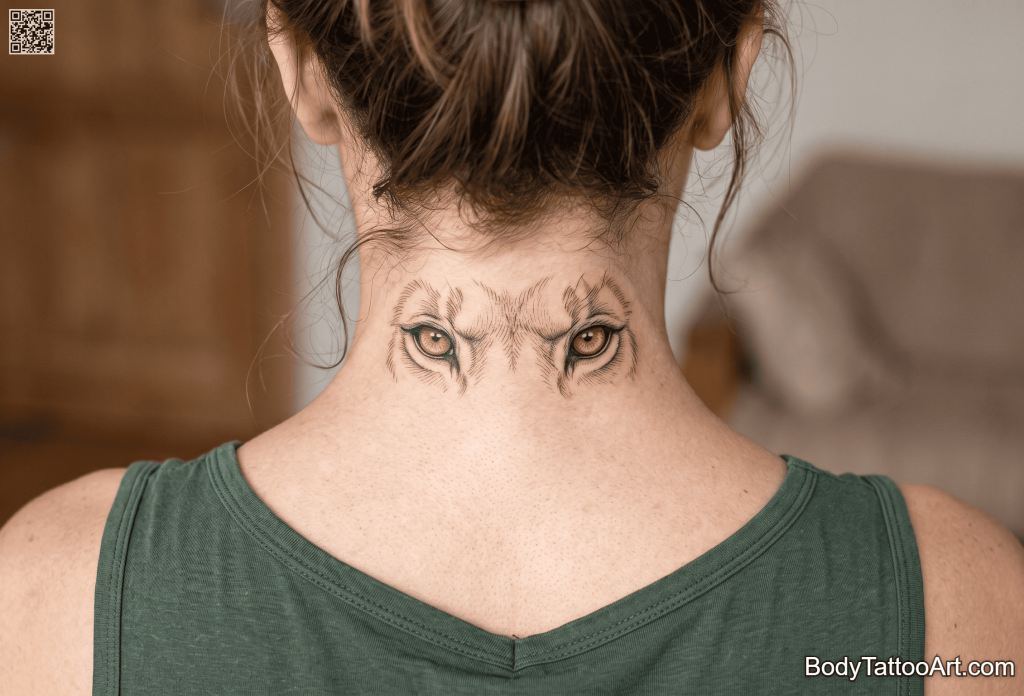
Two lion eyes — slightly too far apart to be human, the iris amber-toned in colour work, the brow fur slightly furrowed. No mane, no face, no context. Just the eyes looking out from wherever the tattoo is placed, watching.
Placement: Back of neck
Style: Fine line realism with colour Lion Tattoos
Why it stands out: The removal of the face and mane makes the eyes the entire story. There’s something slightly disquieting about two eyes without a face — which is exactly the right kind of disquiet for a tattoo.
Ideal for: People who want something unexpected. Those who like minimalist approaches to powerful subjects.
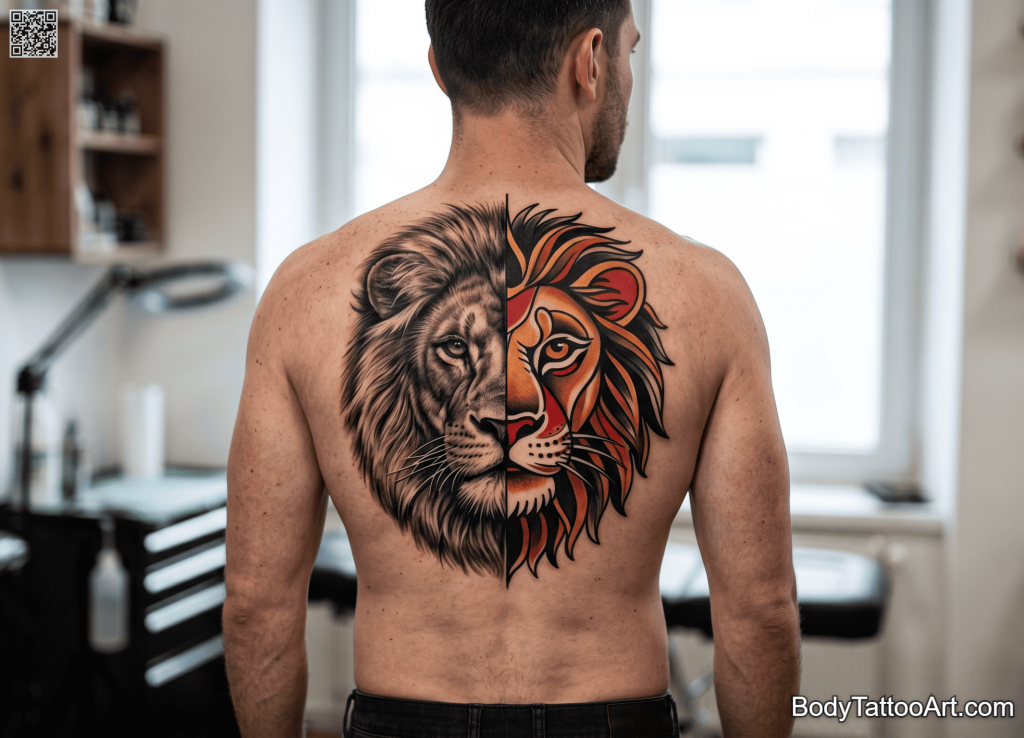
The face is divided vertically. The left half is full photorealistic black and grey rendering — every fur strand, every shadow in place. The right half is the same face in bold, flat American traditional style — thick outlines, no shading. Both halves meet cleanly in the center. The contrast is the subject.
Placement: Upper back
Style: Split realism and traditional Lion Tattoos
Why it stands out: The split face concept works when both halves are done to full standard in their own styles. This one treats both sides as complete rather than sacrificing either for the sake of the idea.
Ideal for: Collectors who think in concepts. People who want a tattoo that comments on tattooing itself.
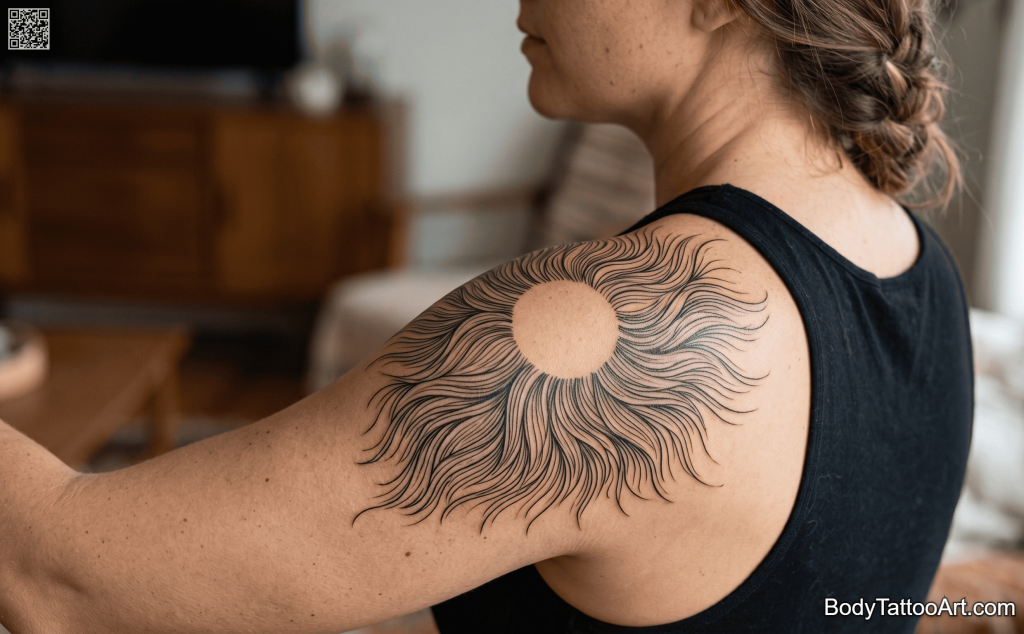
No lion face. Just the mane — radiating outward from an empty center, drawn as an ornamental pattern. Long curved fur strands extend in all directions like sun rays, each strand slightly different in weight and length. The center is blank skin. From a distance it looks like an abstract sun. Closer up, it reads as a lion.
Placement: Shoulder cap
Style: Ornamental linework Lion Tattoos
Why it stands out: It removes the most expected element of a lion tattoo — the face — and asks whether the mane alone carries the meaning. It does.
Ideal for: People who prefer pattern to portraiture. Those building ornamental tattoo collections.
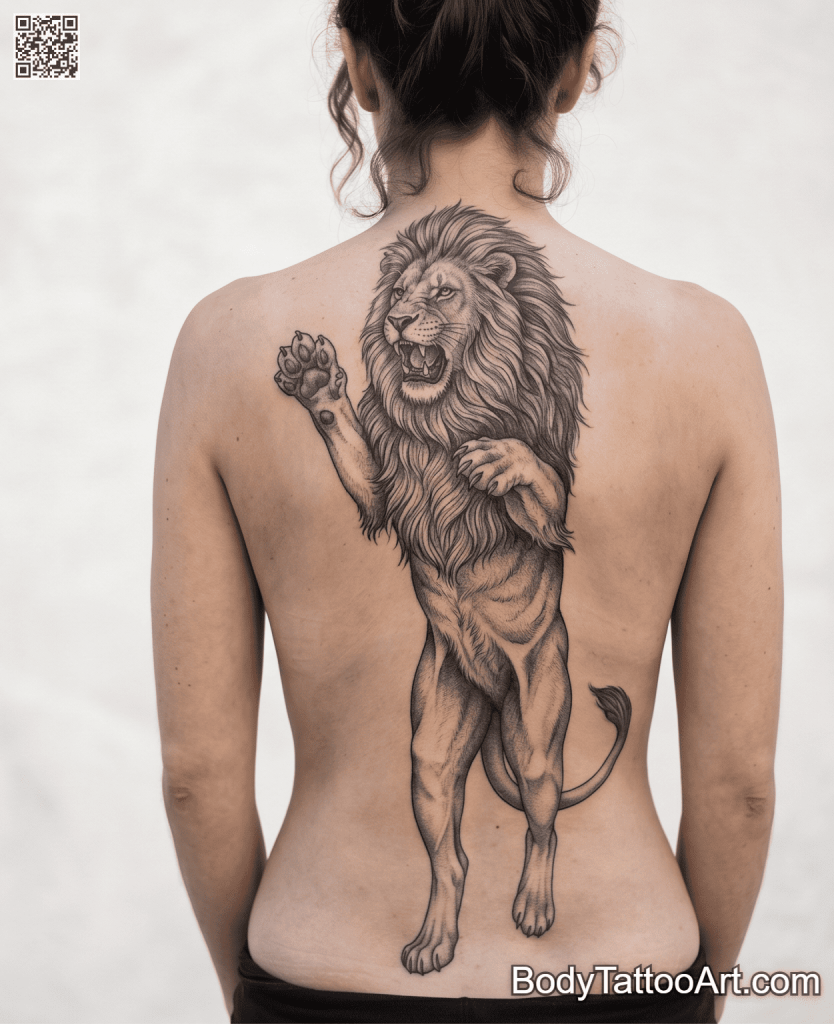
Full body — rearing up on the hind legs, front paws raised, mane falling forward, mouth open. The composition is tall and narrow, running the full length of the spine. Every strand of chest fur is drawn separately. The tail falls behind and curves. The body follows the spine so naturally it looks like the lion grew there.
Placement: Spine / full back center
Style: Black and grey realism Lion Tattoos
Why it stands out: The rearing pose is one of the few full-body animal compositions that genuinely works on the spine. The narrow vertical and the raised paws create natural upward movement through the design.
Ideal for: People building full back pieces. Collectors who think carefully about placement anatomy.
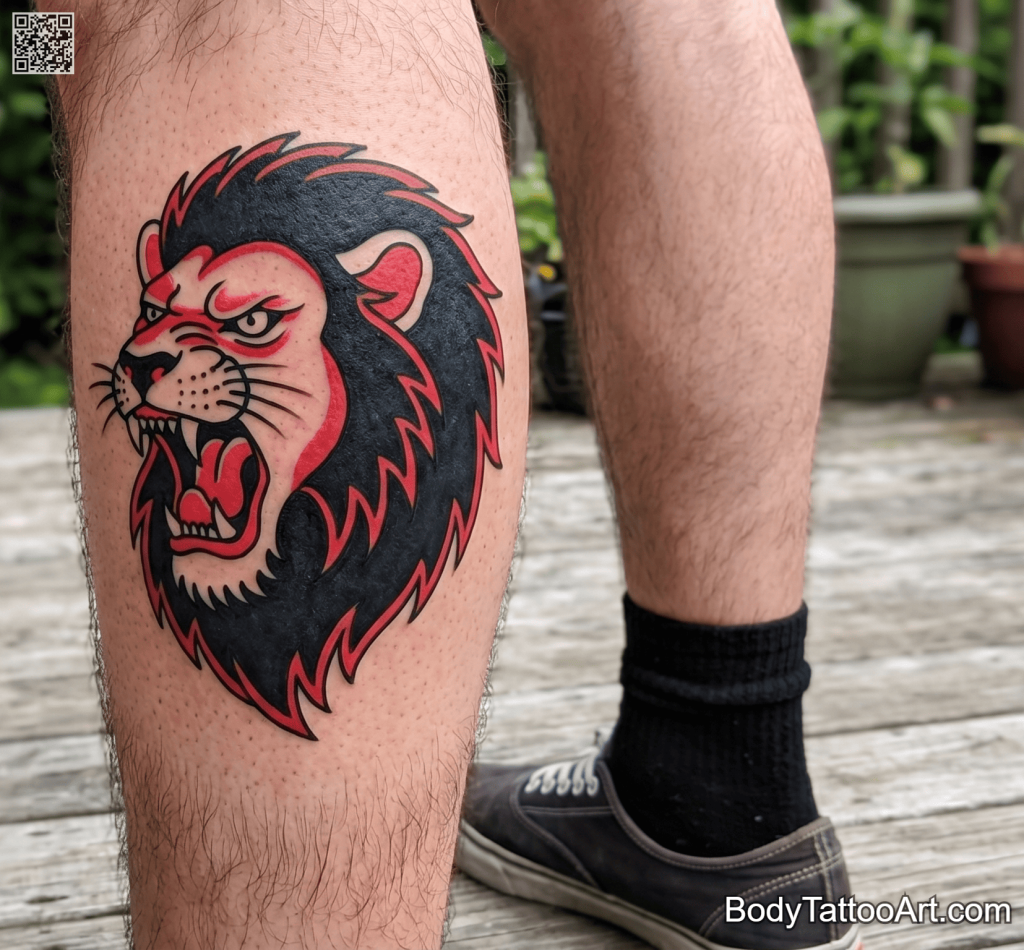
Red and black, flat fills, thick outlines, no grey tones. The lion’s mane is solid black with red highlights at the edges. The face uses red in the inner ears, the open mouth, and above the eyes. It’s not subtle. It’s not meant to be. This is the kind of tattoo that reads from across the room.
Placement: Outer calf
Style: American traditional, bold color Lion Tattoos
Why it stands out: The two-color restraint — red and black only — gives this tattoo a graphic punch that full-color traditional work sometimes dilutes. Less color, more impact.
Ideal for: Traditional collectors. People who want maximum visual impact in a single placement.
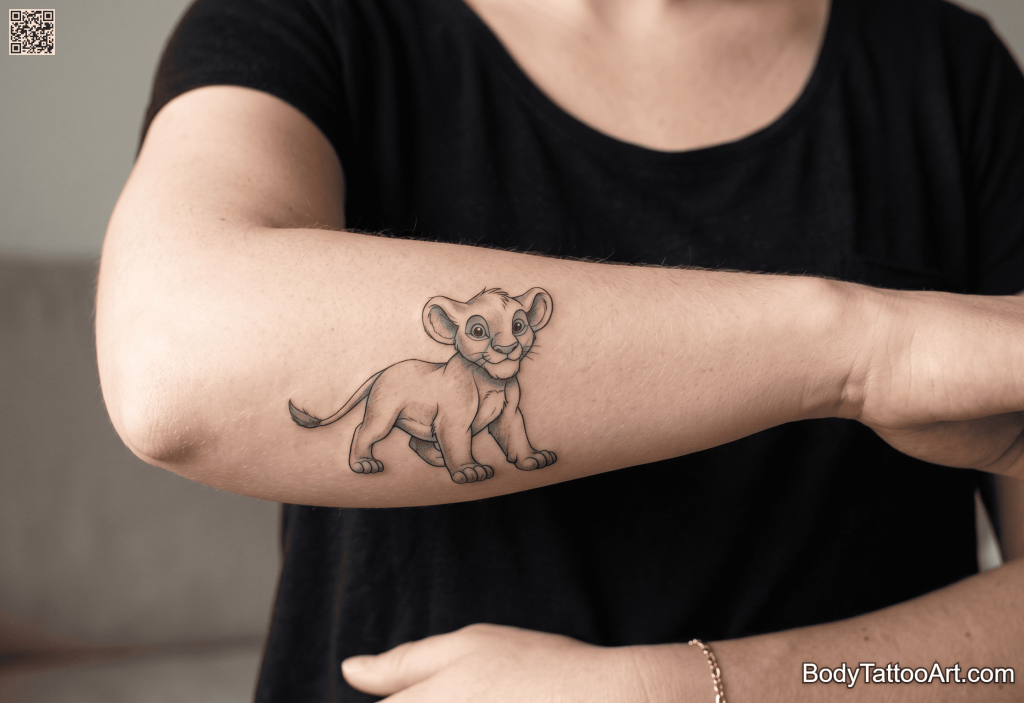
A young lion cub — head too big for the body, ears wide and forward, paws splayed. The pose is slightly awkward in the way young animals are slightly awkward. The style is clean illustrative with soft grey shading. The expression is curious rather than threatening. It’s a character study, not a power symbol.
Placement: Inner arm
Style: Soft illustrative Lion Tattoos
Why it stands out: Lion cubs bring an entirely different energy to lion tattooing — and that difference is the point. The observation and character in the drawing matter more than the symbolism.
Ideal for: Animal art lovers. People who want warmth and personality in their tattoo rather than intensity.
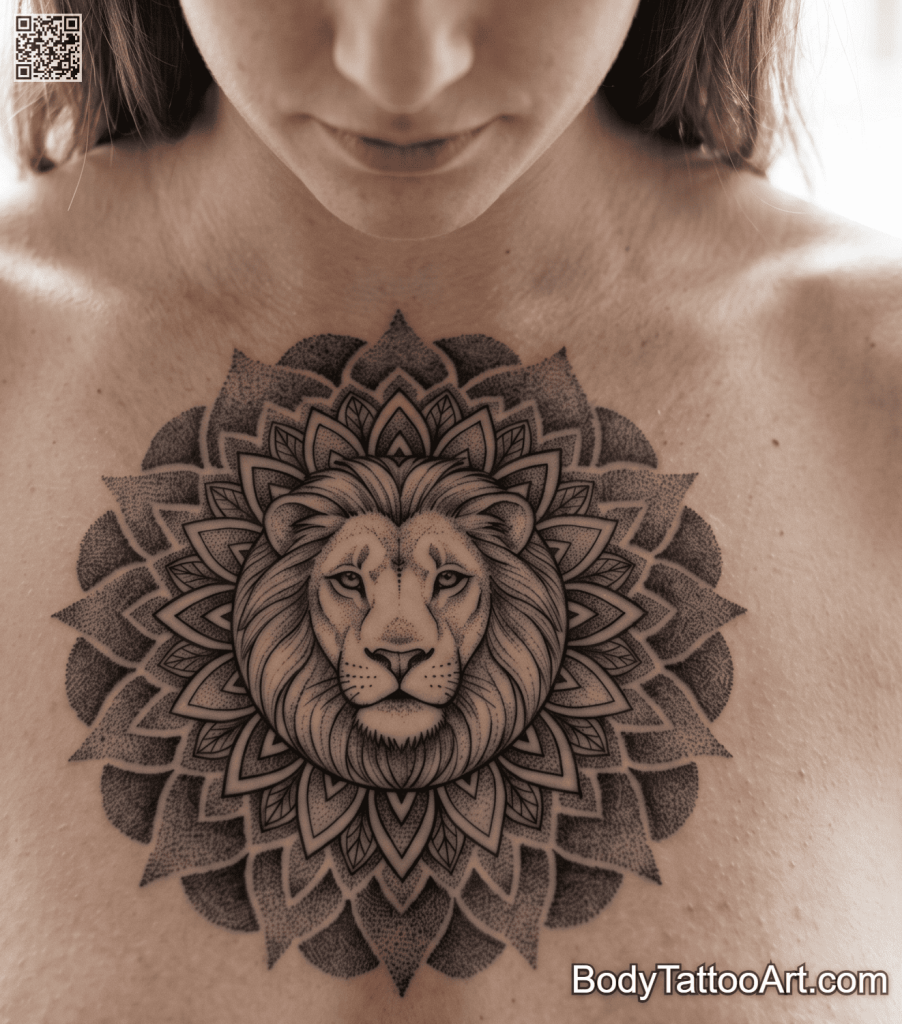
The lion’s face sits at the center of a detailed mandala — concentric rings of geometric petal shapes, fine dot patterns, and symmetrical ornamental details radiating outward from the nose. The mandala doesn’t decorate the lion. It contains it. Black ink throughout with dotwork in the outer ornamental rings.
Placement: Sternum
Style: Ornamental dotwork Lion Tattoos
Why it stands out: The hardest part of mandala-framed portraits is making the two elements feel like they belong to the same design rather than being layered. Here, the center face and the outer geometry share the same visual weight.
Ideal for: Ornamental tattoo collectors. People who want structured, centred compositions for the sternum.
Twenty-eight lion tattoos — none of them repeating a composition, a style, or a placement logic. That’s what this list was built to prove: that a subject can be used a thousand times and still offer something new, as long as the design thinking behind it is genuine.
The lion holds up because it’s not just a symbol — it’s a structure. The mane alone is a design element that can be rendered as fur, geometry, watercolor wash, negative space, or pure ornament. The face can be cropped, deconstructed, split, simplified, or blown up to fill an entire chest. The body can run the length of a spine or be reduced to a single eye on an inner wrist.
Lion tattoos work at every scale, in every style, for every kind of person. The starting point is always the same: pick the placement, then let the composition follow.