Physical Address
304 North Cardinal St.
Dorchester Center, MA 02124
Physical Address
304 North Cardinal St.
Dorchester Center, MA 02124

Snake tattoos have been around for centuries, and for good reason. They carry an undeniable visual power that works across every tattoo style — from the most delicate fine line to the boldest blackwork. Whether wrapped tight or stretched long, a snake tattoo commands attention without trying too hard.
What makes snake tattoos so popular today is how versatile they are. The serpentine shape adapts to almost any placement on the body, flowing naturally along curves, straight lines, and angles. The design possibilities are nearly endless, and that’s exactly what this blog explores.
Across cultures and history, the snake has represented transformation, protection, danger, healing, and rebirth. Ancient Egyptians associated serpents with royalty and the divine. In Greek mythology, snakes were linked to medicine and wisdom — a symbol still used in healthcare today. In Hinduism, the serpent Shesha holds up the universe itself.
For many people, snake tattoos represent personal transformation — the shedding of old skin to make room for something new. Others are drawn to the duality of the snake: both beautiful and deadly, both feared and revered.
To explore the deeper cultural history of snake symbolism, the Wikipedia article on Snake symbolism covers its roots across world mythologies in detail.
Snake tattoos also carry different meanings depending on the design — a coiled snake signals alertness, while a stretched one suggests movement and progress. The style, pose, and details all shift the energy of the piece.
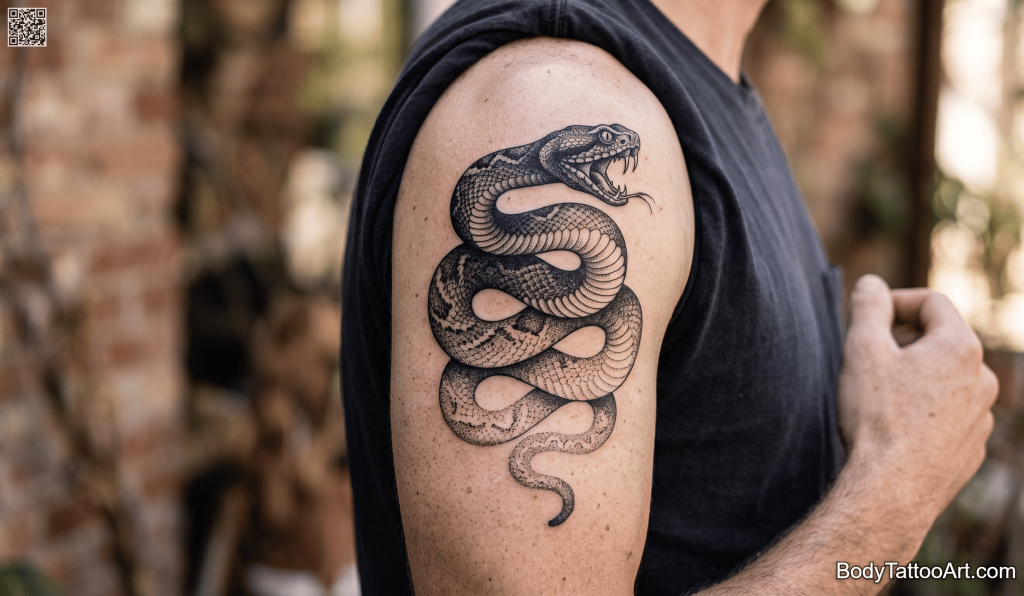
A tightly wound snake poised mid-strike, its head lifted with mouth slightly open. The scales are rendered in precise dot work, with the densest clustering near the head and lighter dots trailing through the body. The negative space between the coils creates a sense of tension without cluttering the composition.
Placement: Upper arm
Style: Dotwork Snake Tattoos
Why it stands out: The coiled pose builds visual tension entirely through form. The dot-based texture adds depth without heavy linework, keeping the design elegant under pressure.
Ideal for: Fans of geometric and dotwork aesthetics, collectors building an arm sleeve.
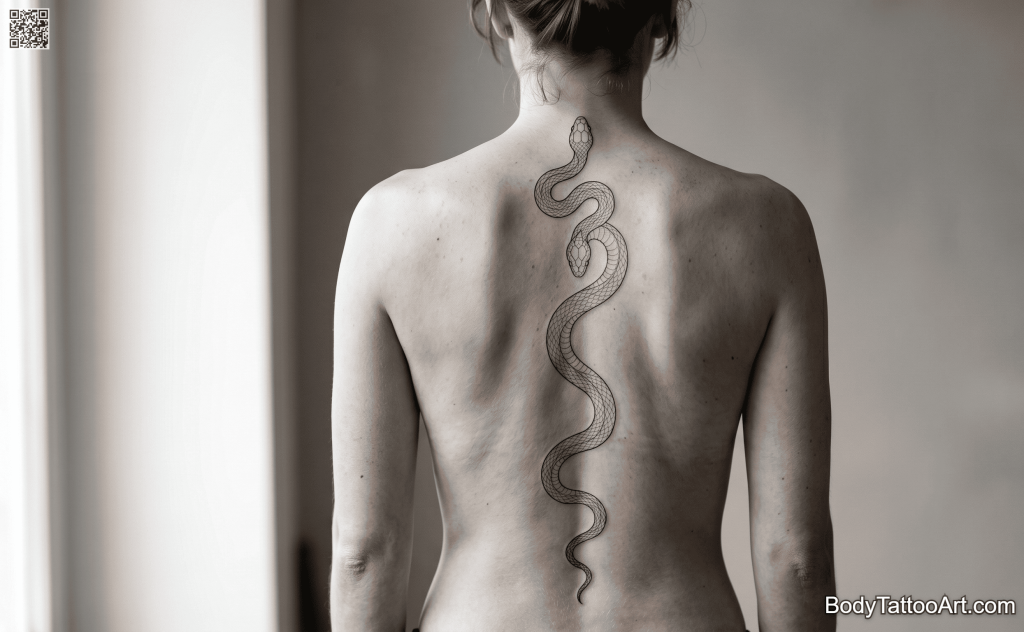
A long, slender snake runs straight down the spine, head between the shoulder blades and tail ending at the lower back. The body is drawn in fine line blackwork with minimal detail — just clean outlines and simple scale texture etched along the center.
Placement: Spine / back centerline
Style: Fine line blackwork Snake Tattoos
Why it stands out: The placement is everything here. The snake’s natural elongated form mirrors the spine perfectly, making the tattoo feel like it belongs there rather than sitting on top of it.
Ideal for: First-timers looking for an impactful placement, minimalist fans, those wanting a back piece with low commitment.
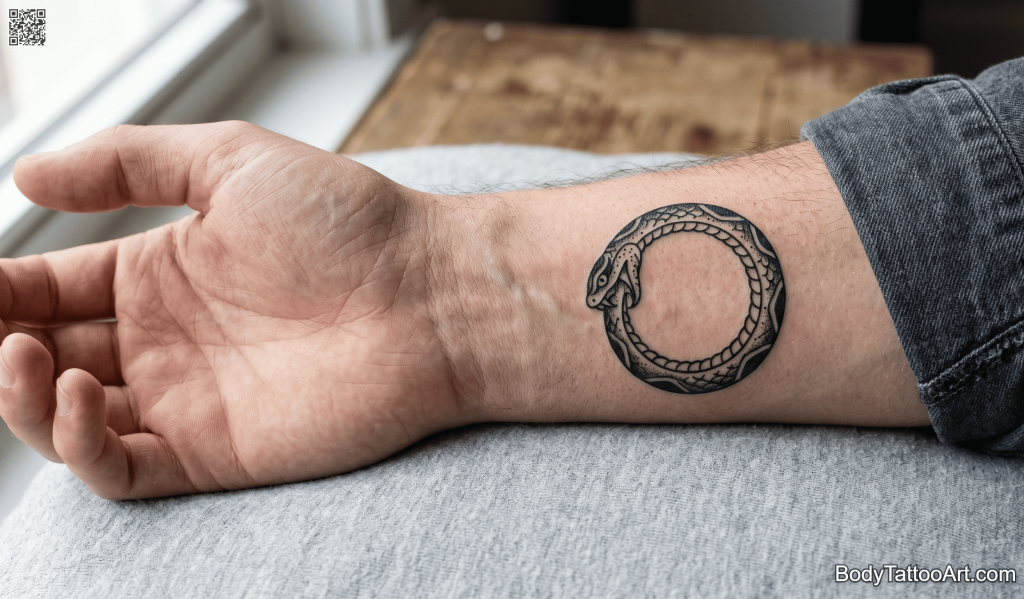
A snake biting its own tail to form a perfect circle, drawn in a bold traditional style with thick black outlines, flat fill, and minimal shading. The circular composition is clean and symmetrical.
Placement: Inner wrist
Style: Traditional / Neo-traditional Snake Tattoos
Why it stands out: The ouroboros is one of the oldest tattoo symbols in existence, but a clean traditional rendering keeps it from feeling overdone. The bold outlines hold up beautifully at small scale on the wrist.
Ideal for: History enthusiasts, traditional tattoo collectors, those wanting a meaningful small piece.
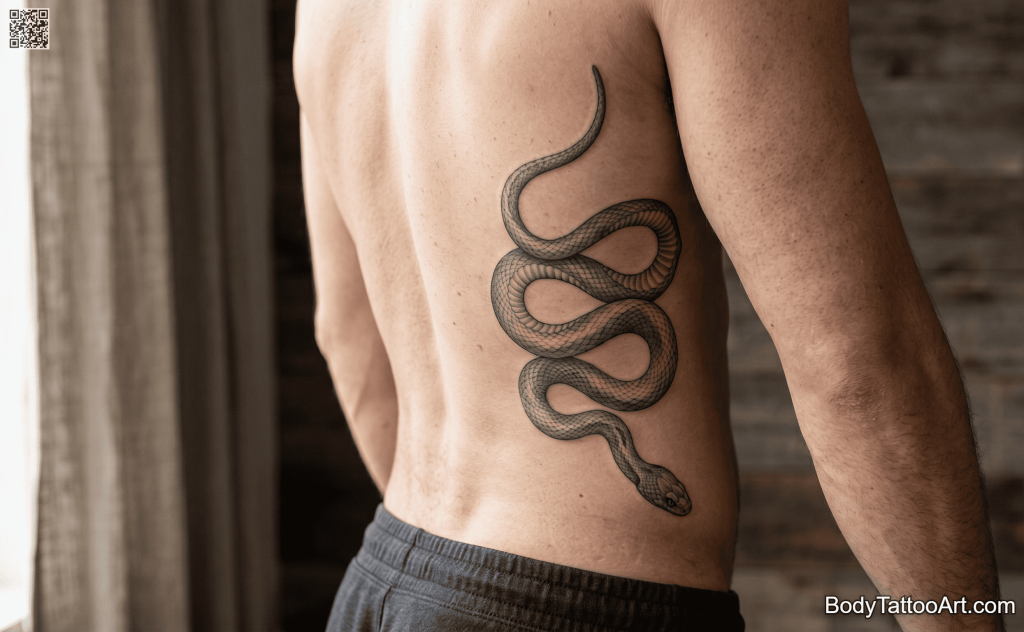
A snake curves along the side ribcage, its body following the natural arches between ribs. The texture is soft grey wash with subtle scale markings. The head rests near the hip and the tail tapers upward toward the underarm.
Placement: Side ribcage
Style: Grey wash realism Snake Tattoos
Why it stands out: The snake’s form maps onto the ribcage like it was designed for that exact space. The grey wash keeps it soft and organic rather than harsh.
Ideal for: Collectors who want body-aware placements, those open to a longer sitting.
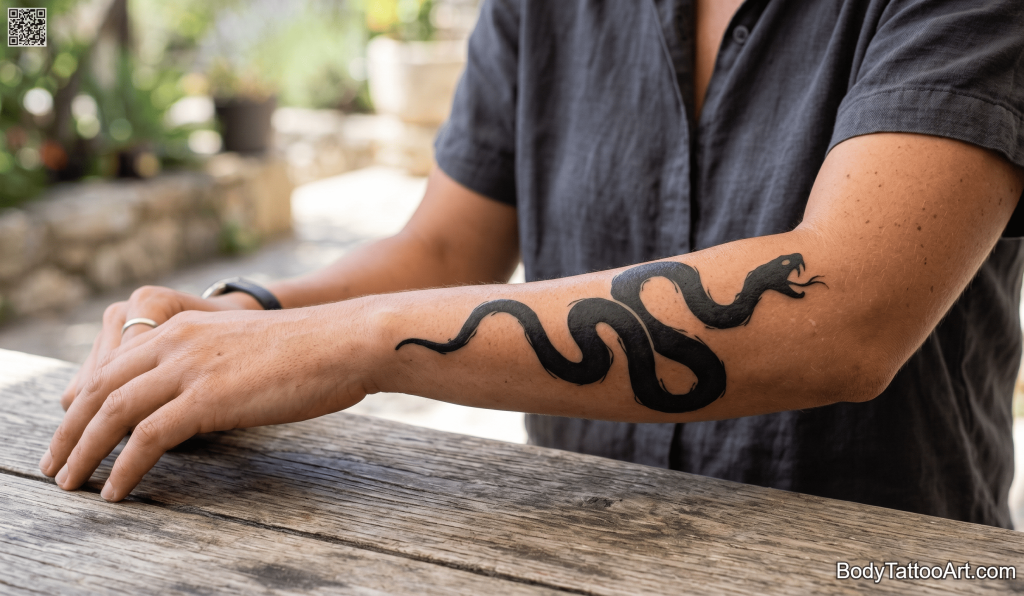
A solid black snake silhouette with no internal detailing — just the pure shape of a serpent mid-movement. The outline is slightly irregular and hand-drawn in feel, giving it an almost stamp-like quality.
Placement: Forearm
Style: Blackwork silhouette Snake Tattoos
Why it stands out: Sometimes the absence of detail is the detail. This snake reads instantly from across a room and ages exceptionally well because there’s nothing to blur or fade.
Ideal for: Minimalists, those who prefer bold and lasting tattoos, flash tattoo fans.
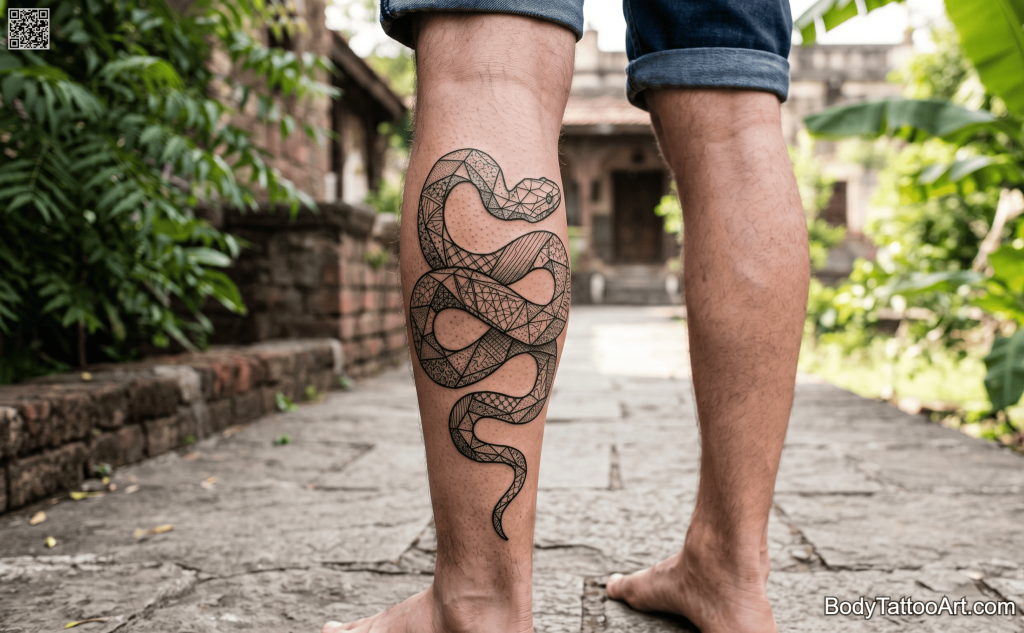
The snake’s body is broken into angular, mosaic-like segments — each section filled with a different geometric pattern. Triangles, hatching, and crosshatch fill alternate segments, creating a patchwork effect that feels modern and almost architectural.
Placement: Calf
Style: Geometric / illustrative Snake Tattoos
Why it stands out: Instead of rendering a snake realistically, this approach treats the body as a canvas for pattern play. Each segment draws the eye and rewards closer inspection.
Ideal for: Architecture and design lovers, collectors who want something visually unusual.
Snake tattoos pair exceptionally well with other nature-inspired pieces. If botanical tattoos are on the radar, the guide to fern tattoo designs explores how delicate greenery can complement dark, structured designs. For those leaning into animal energy, the deep dive into wolf tattoo ideas covers bold compositions that share a similar wild aesthetic with serpent pieces.
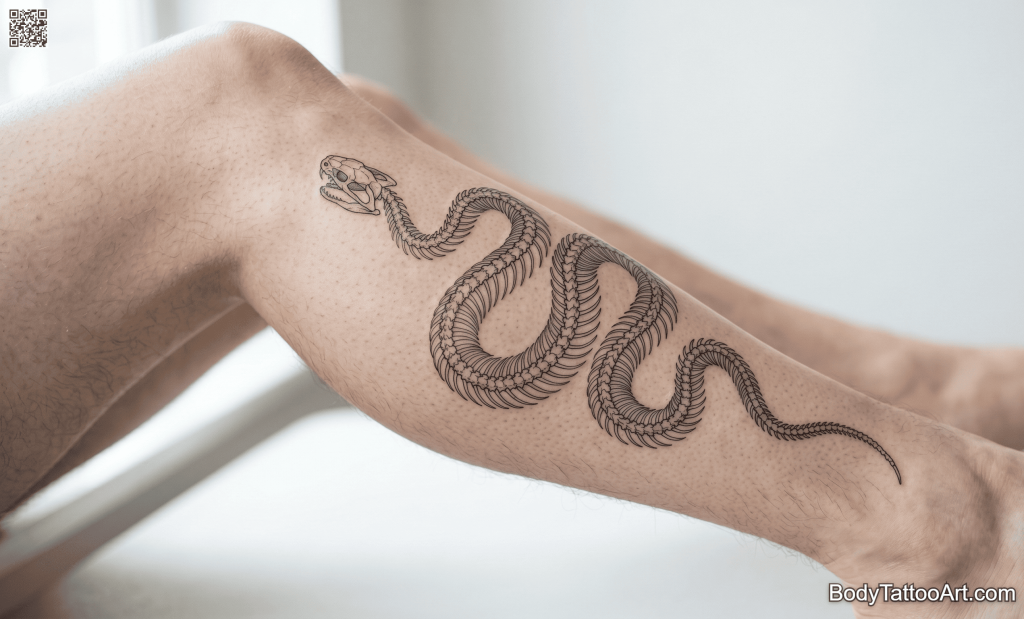
A snake rendered as a skeletal anatomical study — the skull, spine, and rib-like structures visible through the skin. The linework is precise and medical in quality, almost like a textbook illustration come to life.
Placement: Shin
Style: Fine line / illustrative Snake Tattoos
Why it stands out: It’s anatomical without being gory. The skeleton approach gives the snake an unusual visual angle that most tattoos never attempt.
Ideal for: Medical professionals, science enthusiasts, those who love dark but elegant aesthetics.
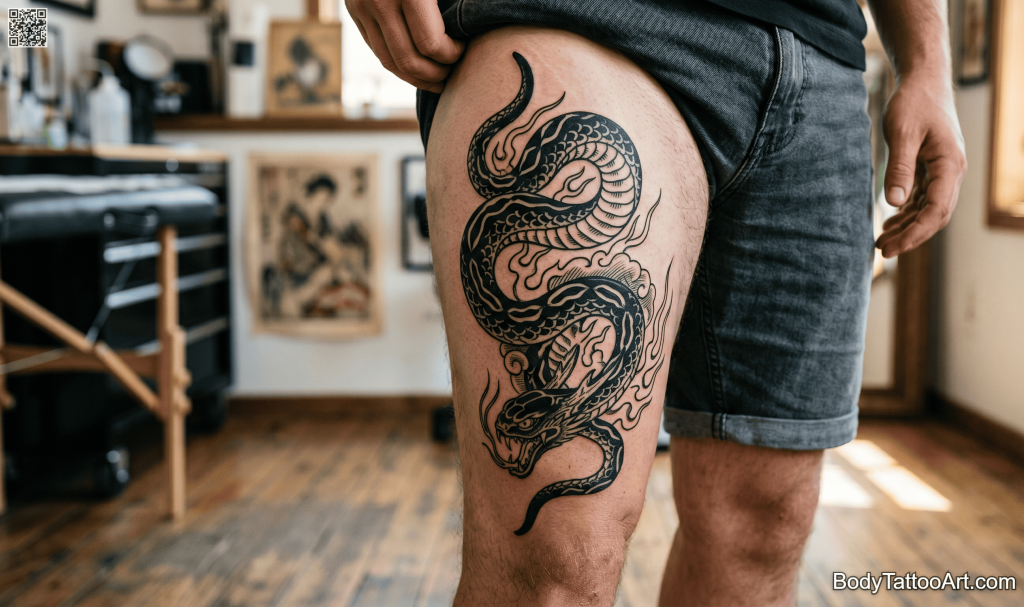
The snake is rendered in a style mimicking traditional Japanese woodblock prints — bold outlines, flat areas of black, and subtle hatching for shading. The body curves gracefully with a stylized, almost decorative quality.
Placement: Thigh
Style: Japanese traditional Snake Tattoos
Why it stands out: The flat graphic quality of woodblock printing translates beautifully into tattoo form. It reads as artistic even when reduced to black and grey.
Ideal for: Fans of Japanese art and traditional tattooing, collectors building a thigh or leg piece.
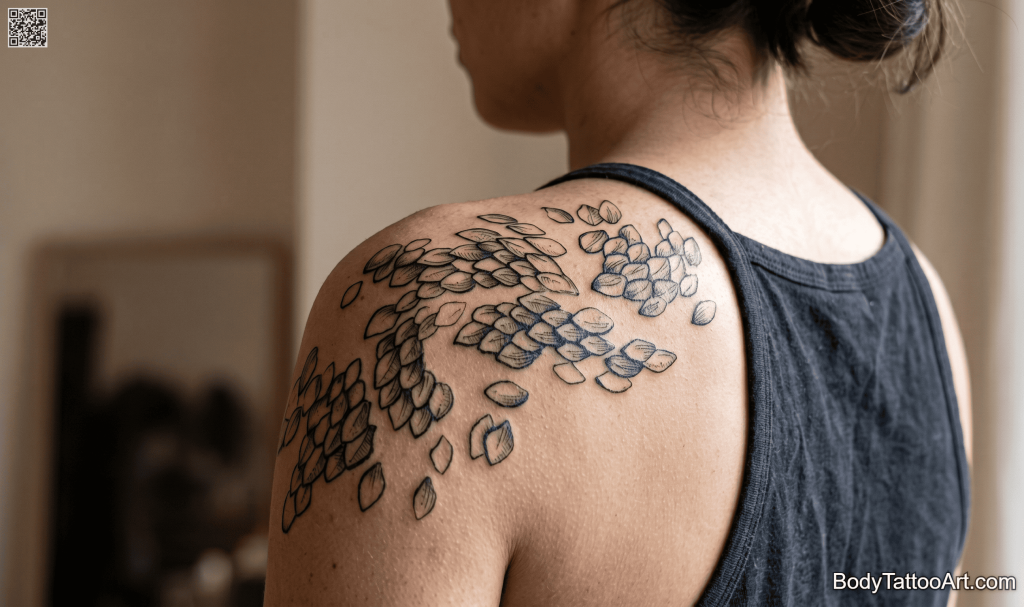
Instead of a full snake, this design isolates individual overlapping scales scattered across the skin in a loose, flowing arrangement — as if a snake passed through and left its impression behind.
Placement: Shoulder blade
Style: Abstract / blackwork Snake Tattoos
Why it stands out: It suggests a snake without showing one. The implication is more interesting than the explicit image, and the scattered pattern creates an organic texture unlike most tattoos.
Ideal for: Abstract art fans, those who want something understated and conversation-starting.
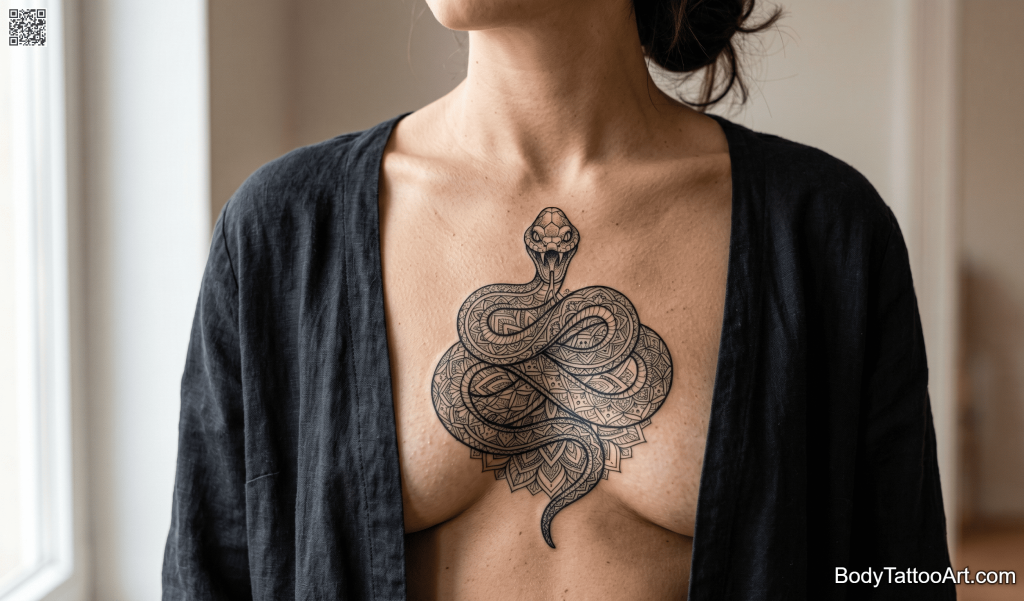
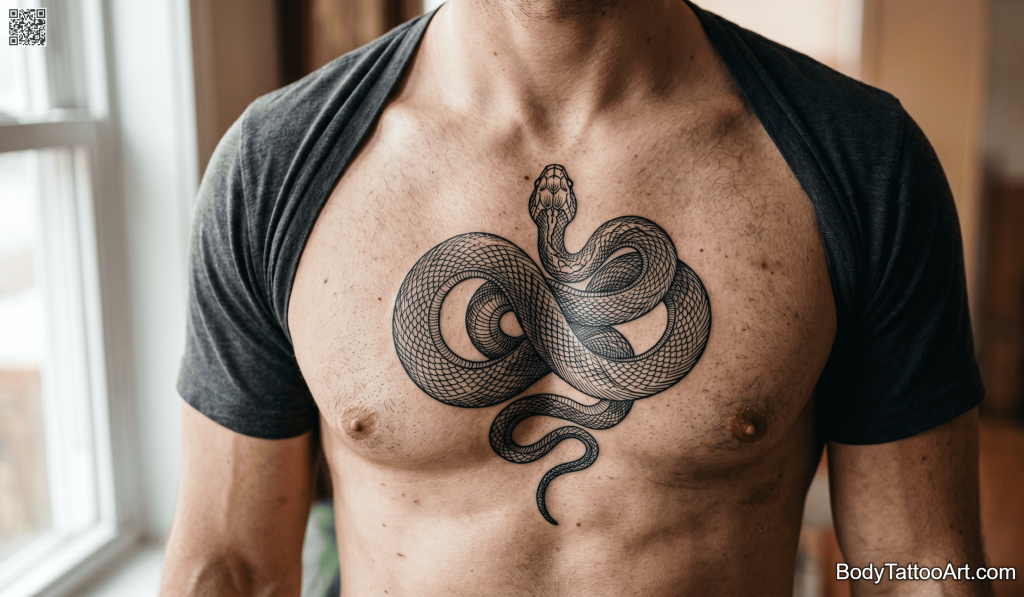
A snake coiled around a central point with its body made entirely of mandala-like linework — concentric rings, fine geometric patterns, and delicate filigree filling every section. The head is rendered more realistically to ground the design.
Placement: Sternum
Style: Ornamental / geometric Snake Tattoos
Why it stands out: The combination of an organic snake head with an intricate patterned body creates a visual conversation between the natural and the constructed. It’s unusual and deeply decorative.
Ideal for: Those who love ornamental tattoos, collectors wanting a centerpiece sternum piece.
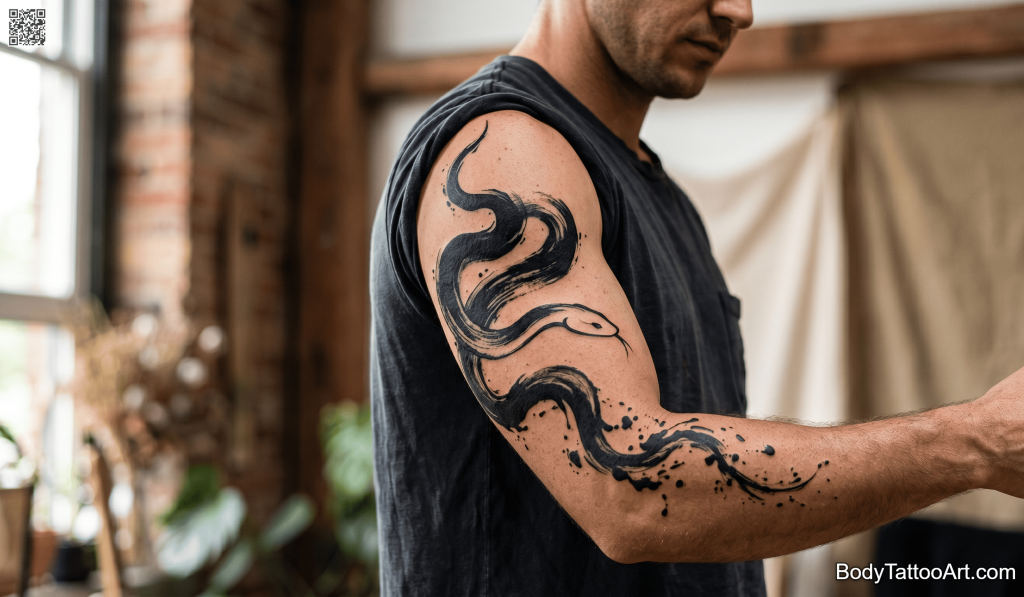
Painted in thick, expressive brushstrokes that reveal the hand of the artist in every line. The body feels spontaneous — ink splattered at the tail end, bold gestural strokes forming the mid-body, a clean minimal head emerging from the chaos.
Placement: Bicep
Style: Abstract / painterly blackwork Snake Tattoos
Why it stands out: Most snake tattoos aim for precision. This one celebrates expressiveness. The contrast between the loose, gestural body and a clean serpent head makes it visually exciting.
Ideal for: Artists, creatives, fans of abstract tattoo work.
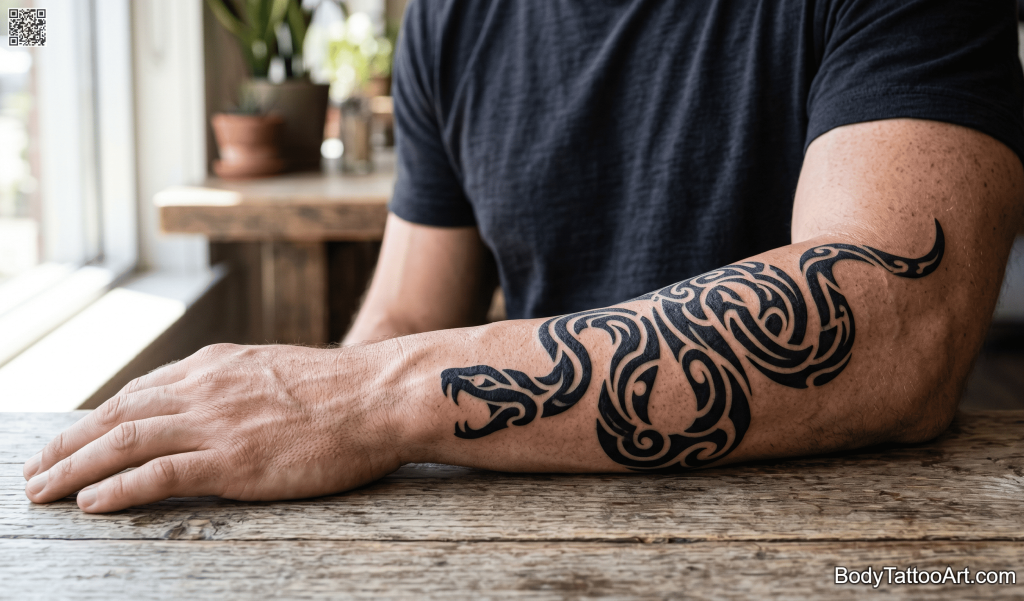
A bold tribal-style snake built from thick, sweeping black shapes — no outlines, just solid forms that together create the recognizable silhouette of a serpent. The composition flows with the arm’s natural contour.
Placement: Outer forearm
Style: Tribal blackwork Snake Tattoos
Why it stands out: Tribal snake tattoos are rare because few artists execute them without making them look dated. A well-composed version that respects the body’s lines is genuinely striking.
Ideal for: Fans of bold, graphic tattoos, those drawn to cultural tattoo traditions.
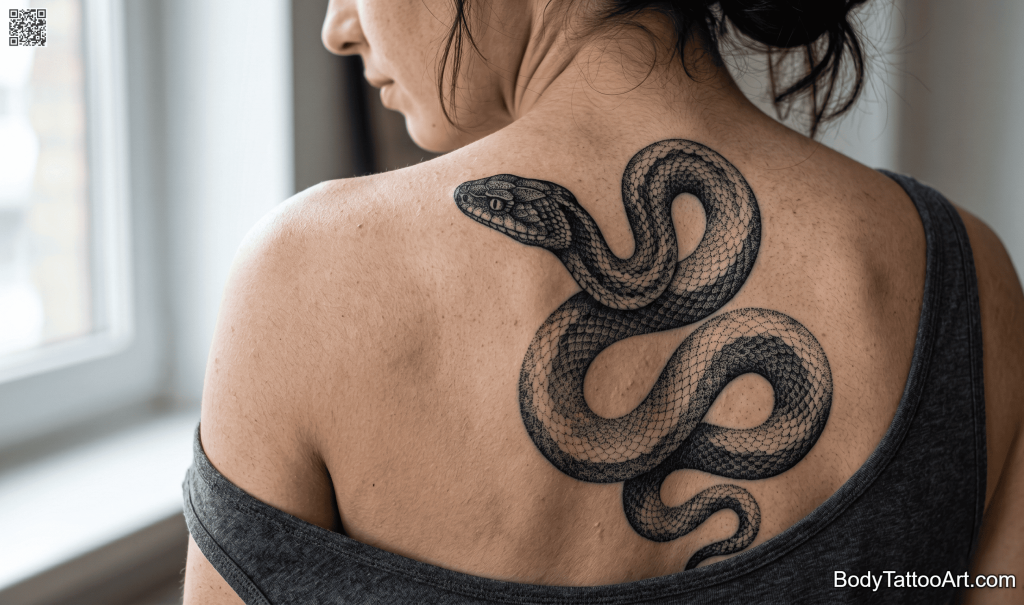
The entire snake is built from thousands of hand-placed stipple dots — dense clusters create the darkest areas, while the dots thin out to almost nothing in the lightest zones. The effect is photographic without using line or wash.
Placement: Upper back
Style: Stippling Snake Tattoos
Why it stands out: Stipple-only tattoos take extraordinary patience and skill. Up close, it looks abstract. From a distance, a fully realized snake emerges. That reveal effect is what sets this apart.
Ideal for: Collectors who appreciate technical tattoo craft, those who want statement back pieces.
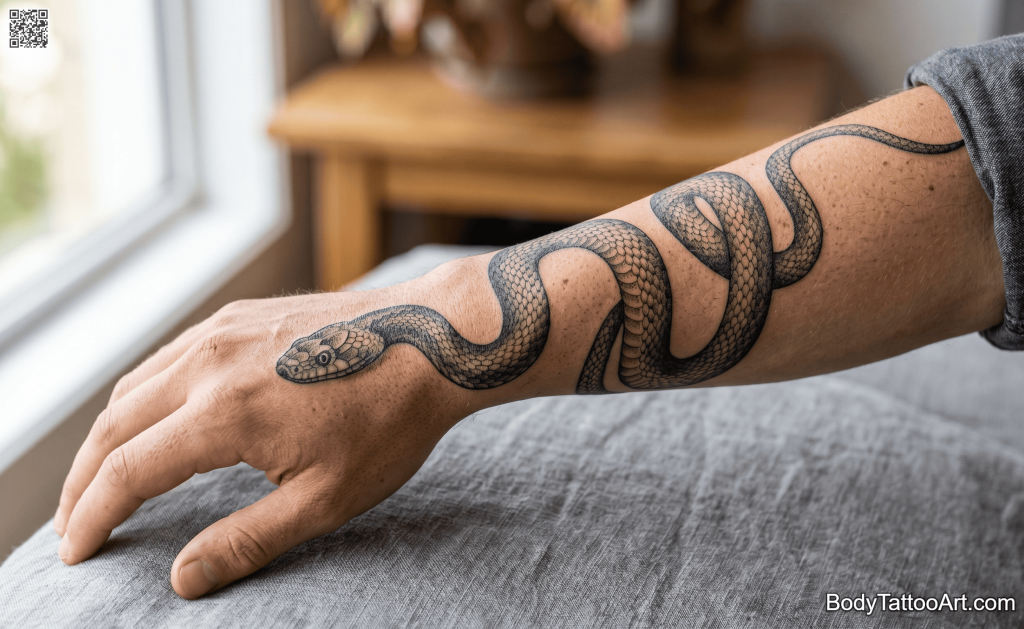
A single snake spirals around the full arm from wrist to elbow, its body wrapping in an even, balanced spiral. The scale texture is consistent throughout, and the head rests on the back of the hand.
Placement: Lower arm / half sleeve
Style: Black and grey realism Snake Tattoos
Why it stands out: The spiral wrap uses the arm’s cylindrical shape better than almost any other tattoo concept. It’s a placement that can only work on the body — not transferable to a canvas.
Ideal for: Sleeve collectors, those ready for a multi-session commitment.
If the idea of a half sleeve is appealing, the ivy tattoo guide shows how vine-like patterns pair naturally with serpent wraps for a botanical-meets-wildlife aesthetic. Similarly, those drawn to powerful animal imagery might also explore lion tattoo designs for pieces with a comparable commanding presence.
A serpent rendered entirely in parallel hatching lines — the kind of crosshatch technique seen in 18th-century engravings. The body looks as if it was carved into copperplate rather than inked into skin.
Placement: Chest
Style: Etching / engraving style Snake Tattoos
Why it stands out: Engraving-style tattoos are rare and visually distinct from anything else in the tattoo world. The density and direction of hatching lines create three-dimensional form without wash or gradients.
Ideal for: History buffs, fans of antique illustration, collectors who want something rarely seen.
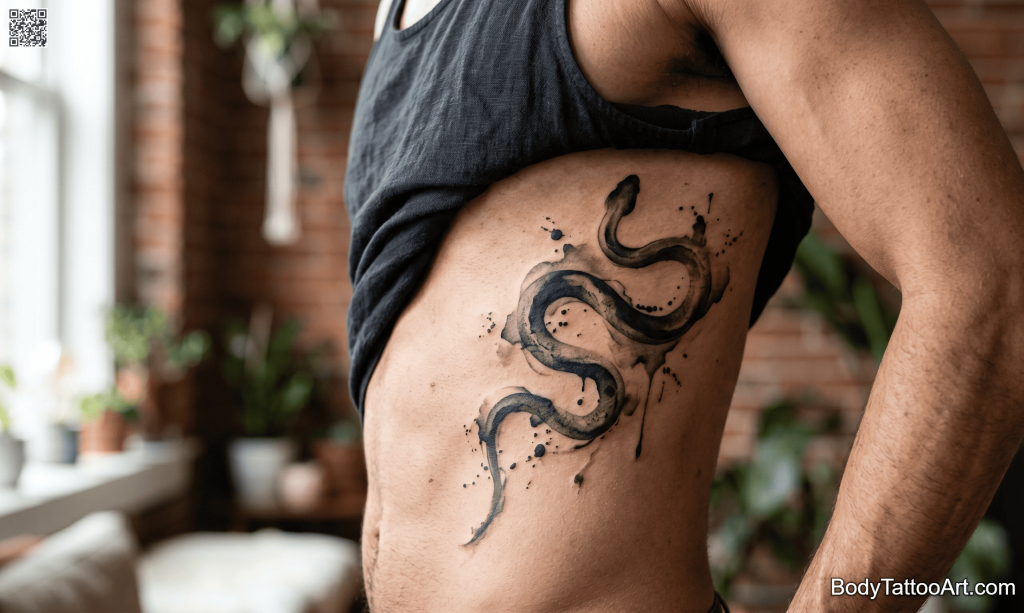
An abstract snake shape built from layered translucent washes of ink that bleed and blur beyond the form itself. The snake is identifiable but not rigid — the edges dissolve into loose wash strokes and splatter marks.
Placement: Ribcage / side body
Style: Watercolor blackwork Snake Tattoos
Why it stands out: Watercolor in black and grey creates a soft, painterly effect that stands apart from both traditional and realistic tattoos. The bleeding edges make the design feel alive and in motion.
Ideal for: Art school types, fans of experimental tattoo styles, those who want something emotionally expressive.
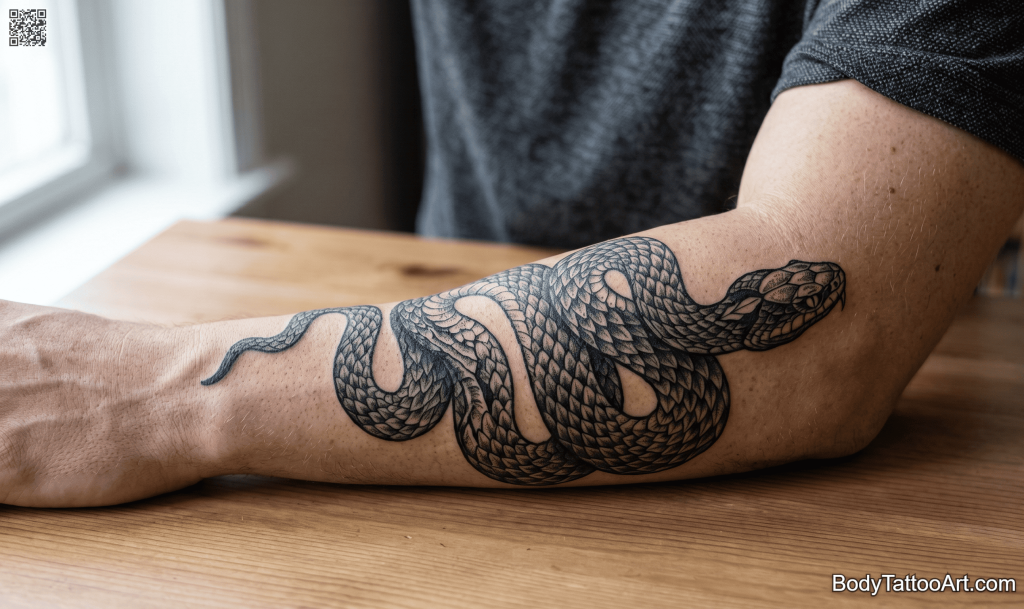
A snake drawn in a way that makes it appear as if its scales are a suit of armour — each individual scale is thick, dimensional, and overlapping with precise depth shading. The design has an almost medieval fantasy quality.
Placement: Forearm
Style: Illustrative / dimensional blackwork Snake Tattoos
Why it stands out: Most tattoos flatten the snake into two dimensions. This design actively fights that flatness, building the illusion of three-dimensional overlapping plates.
Ideal for: Fantasy lovers, gamers, collectors who love hyper-detailed illustrative work.
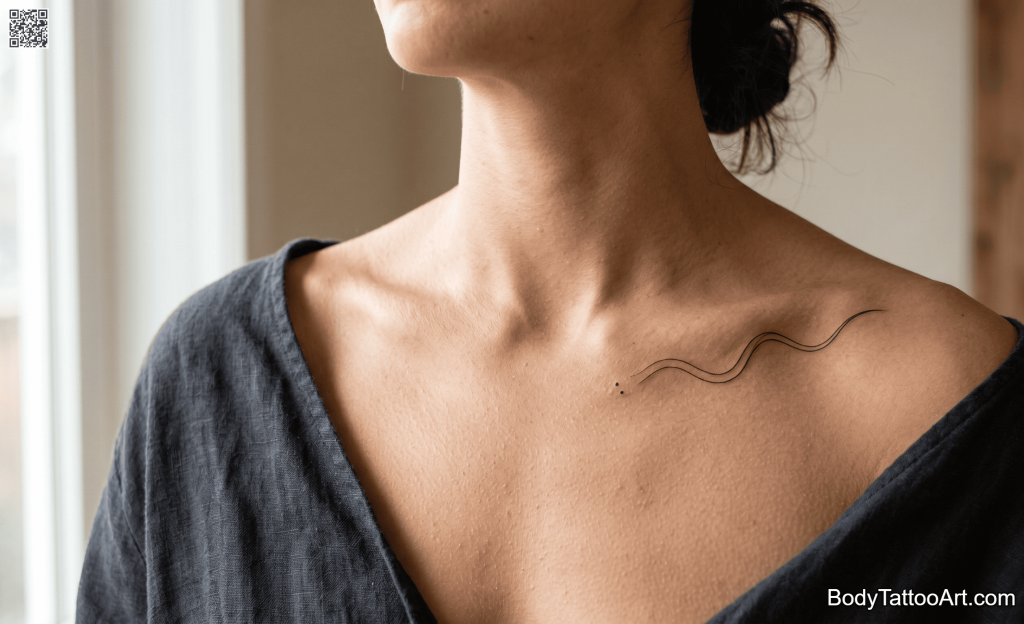
Reduced to its most essential element — a single undulating line that reads unmistakably as a snake in motion. The line varies in thickness from thick to hairline-thin as it curves across the skin, with two tiny dots for eyes at one end.
Placement: Collarbone
Style: Ultra-minimalist fine line Snake Tattoos
Why it stands out: There’s a real skill in removing everything unnecessary and still holding the image. This snake lives in reduction — less is genuinely more here.
Ideal for: Extreme minimalists, those getting their first tattoo, professionals needing something discreet.
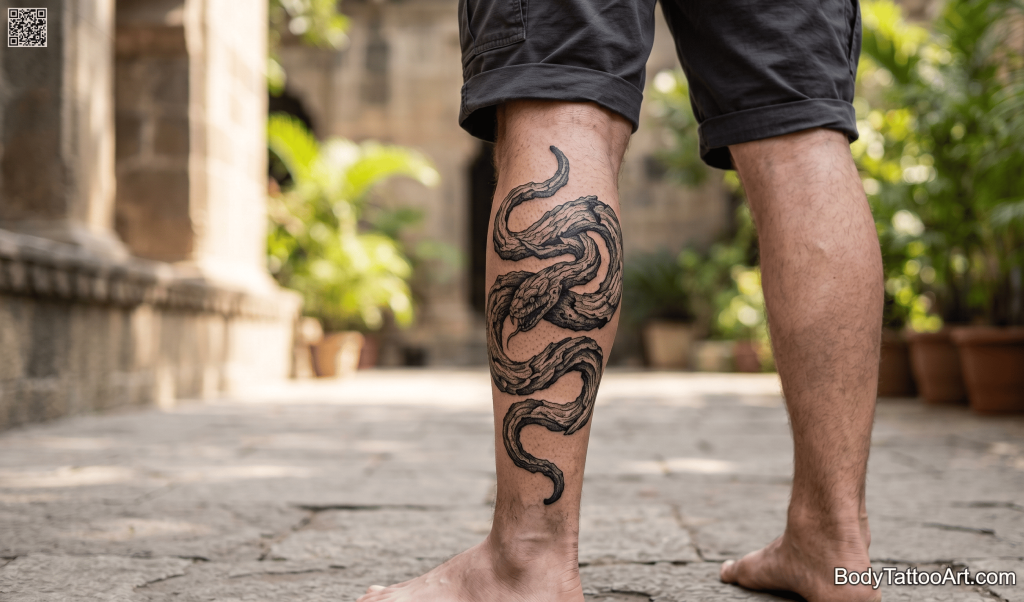
A snake whose entire body is textured to resemble tree bark — rough, furrowed, organic. The scales are replaced with bark-like ridges and fissures, making the snake feel ancient and rooted in nature.
Placement: Calf
Style: Textural blackwork Snake Tattoos
Why it stands out: The bark texture is completely unexpected on a serpent. It suggests age, stillness, and something elemental — almost like the snake has merged with the forest itself.
Ideal for: Nature lovers, those who want something unique and rarely seen.
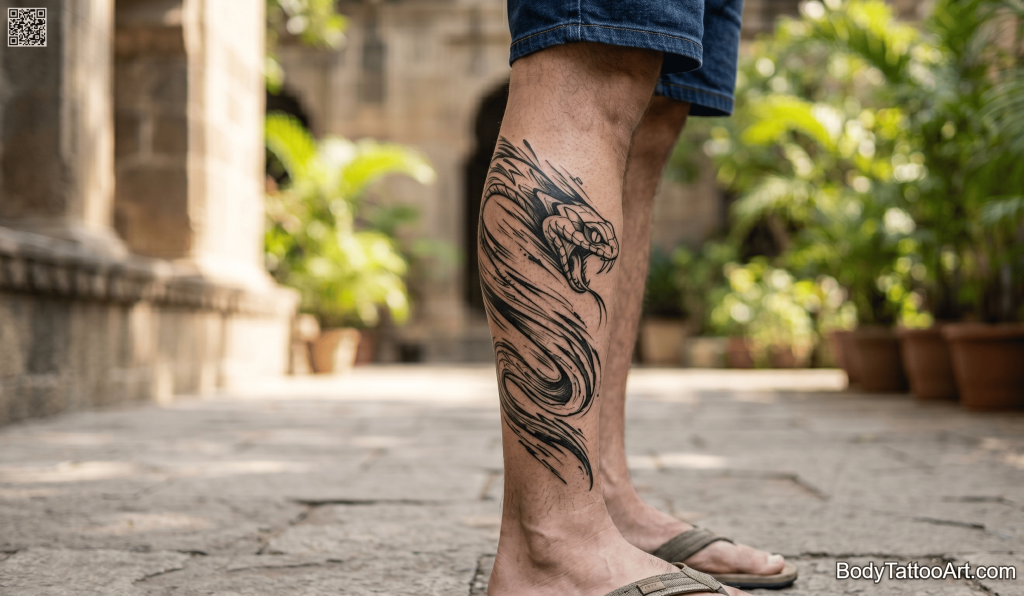
A snake shown in rapid motion with thick motion blur lines trailing behind it — a technique borrowed from comic book illustration. The head is crisp and detailed while the body breaks apart into speed streaks.
Placement: Shin
Style: Comic / graphic illustration Snake Tattoos
Why it stands out: The motion blur effect is almost never used in snake tattoos, but it works beautifully. It captures the snake mid-lunge, freezing a moment of pure speed.
Ideal for: Comic book fans, those who want a dynamic and energetic tattoo.
For those building a full leg piece, the tiger tattoo collection explores large-scale predator designs that pair naturally with a serpent on the opposing leg for a yin-yang effect.
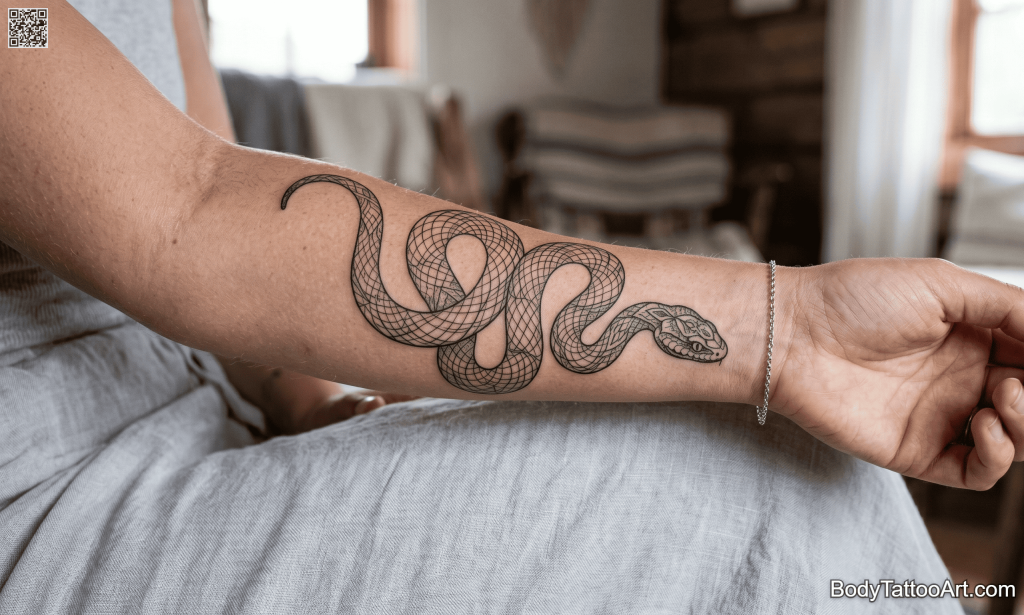
The snake’s body is covered in a web-like pattern of intersecting fine lines — like looking at the creature through a cracked glass or a delicate net. The underlying form is solid but the surface feels fragile.
Placement: Inner arm
Style: Fine line / ornamental Snake Tattoos
Why it stands out: The web texture layered over a serpent form creates an unusual tension — delicate surface over powerful form. It’s an unsettling combination that lingers.
Ideal for: Those who love layered, intricate designs, collectors drawn to dark elegance.
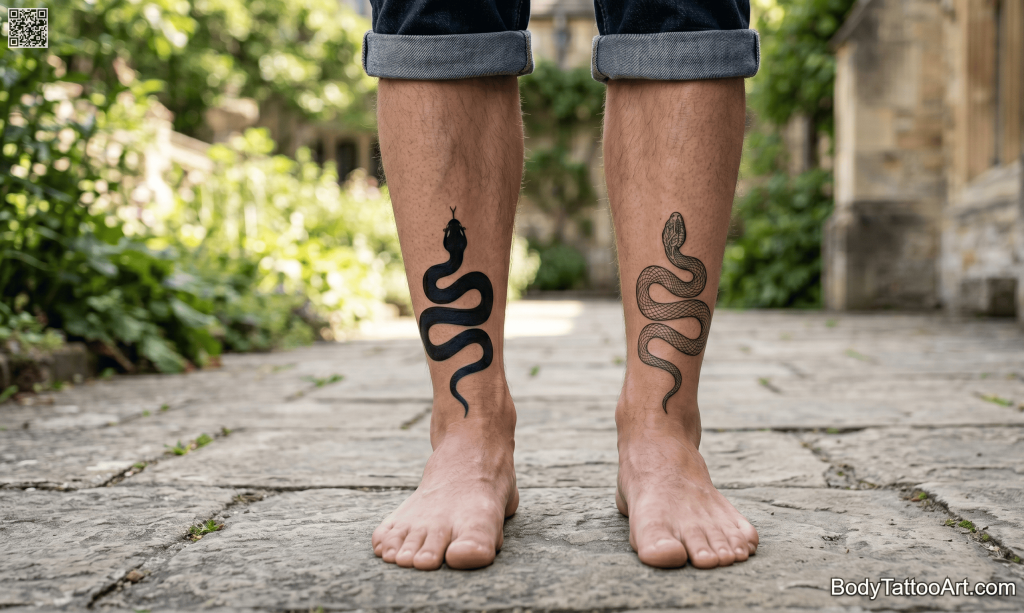
Two snake silhouettes — one solid black, one built purely from hatched lines — mirroring each other in a symmetrical composition. Together they form a balanced image; apart, each is a different interpretation of the same form.
Placement: Both ankles (one each)
Style: Graphic / blackwork Snake Tattoos
Why it stands out: The contrast between solid and hatched, dark and light, on opposing ankles creates a pair effect that’s unusual and thoughtfully composed.
Ideal for: Those wanting matching or paired tattoos, fans of conceptual tattoo ideas.
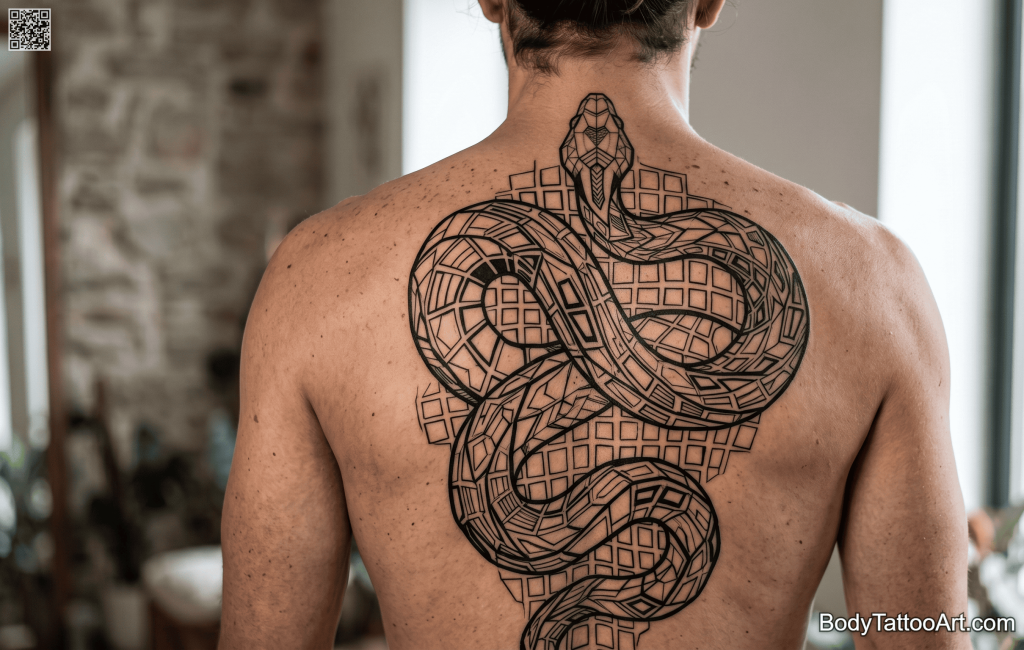
A snake body overlaid with a distorted grid — as if a graph grid has been warped and twisted to wrap around the serpent’s form. The effect is mathematical and strange, somewhere between science and art.
Placement: Upper back
Style: Abstract / geometric Snake Tattoos
Why it stands out: The grid overlay gives the snake an almost digital quality, like a 3D model rendered in wireframe. It’s intellectual and visually disorienting in the best way.
Ideal for: Mathematicians, engineers, fans of generative or algorithmic art.
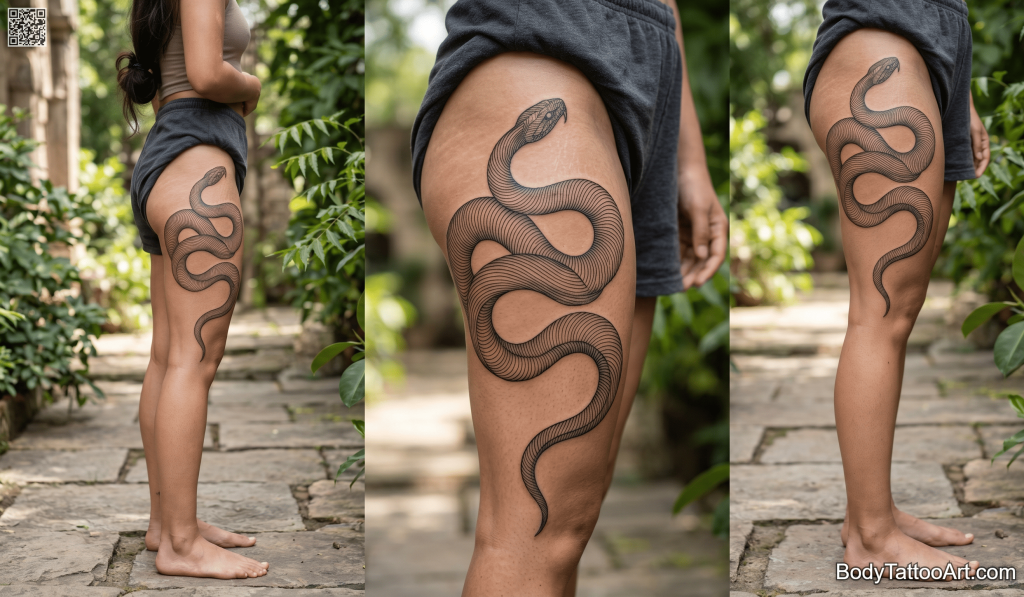
The snake is drawn using only cross-contour lines — parallel lines that follow the surface of the body rather than outlining it, revealing form through direction alone. No outlines, no fill, just curved parallel lines that sculpt a three-dimensional snake.
Placement: Thigh
Style: Fine line / contour drawing Snake Tattoos
Why it stands out: This technique is rarely used in tattooing and requires a deep understanding of form. The result looks like a classical drawing study rather than a tattoo.
Ideal for: Art history enthusiasts, collectors who appreciate technical concept-driven work.
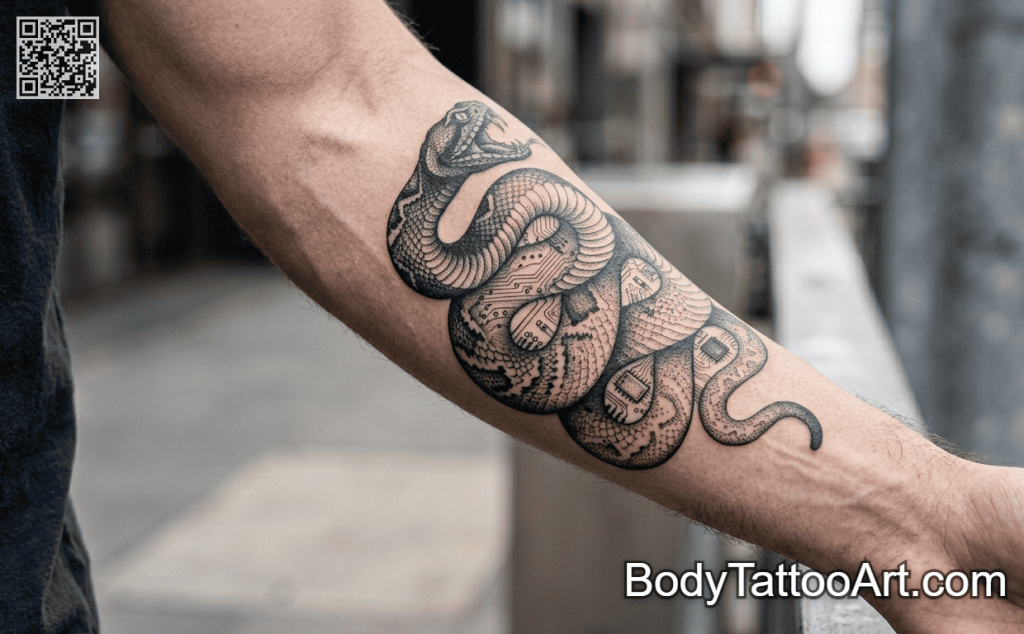
A snake whose internal structure is replaced by circuit board patterns — motherboard lines, nodes, and pathways visible through a semi-transparent skin rendering. The snake looks like living technology.
Placement: Forearm
Style: Cyberpunk / illustrative blackwork Snake Tattoos
Why it stands out: The circuit body treatment is an entirely different conceptual direction from any other tattoo on this list. It suggests a future where nature and technology coexist inside the same form.
Ideal for: Tech professionals, sci-fi fans, collectors who want something futuristic and unmissable.
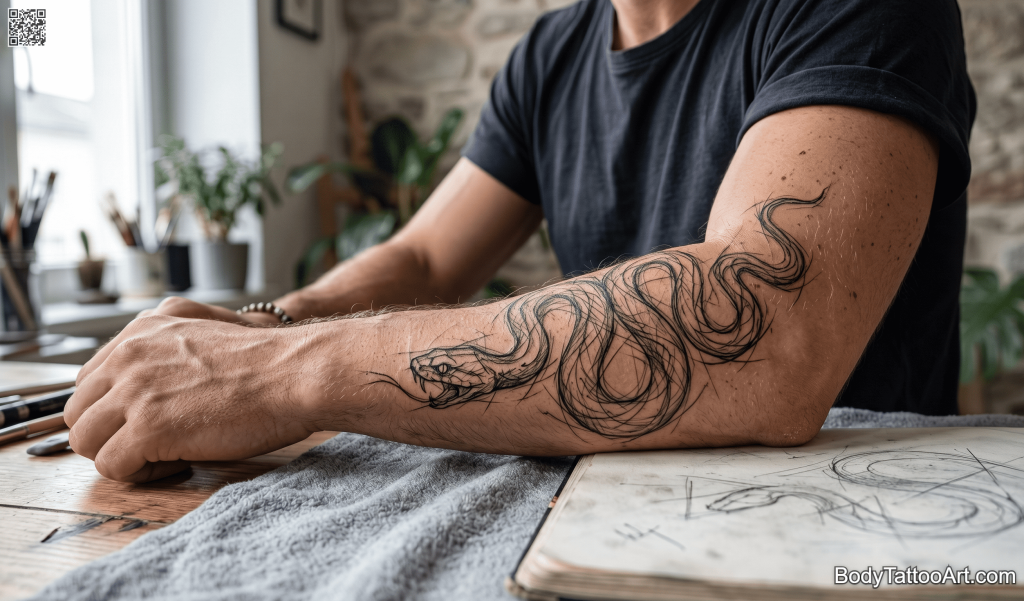
A snake drawn in loose, spontaneous sketch strokes — overlapping lines, visible construction lines left in, and an unfinished quality that feels intentional. It looks like a page from an artist’s sketchbook, permanently worn.
Placement: Inner forearm
Style: Sketch / raw linework Snake Tattoos
Why it stands out: The sketch aesthetic is deceptively difficult to execute well. When it works, it communicates artistic energy and a relaxed confidence that polished tattoos can’t replicate.
Ideal for: Artists, art students, those who want a tattoo that feels alive and in-progress.
Snake tattoos hold their ground no matter what style they’re executed in. From the most stripped-down single-line design to a full technical study in stipple or etching, the serpent form is versatile enough to carry any artistic vision.
What matters most is finding a composition that connects with the wearer — not just in meaning but in visual personality. A snake tattoo that fits the body’s natural lines, suits the individual’s aesthetic, and is executed by a skilled artist will always age well.
For those still exploring their options, other animal tattoo collections worth browsing include the Palm tattoo guide for nature-inspired alternatives, and the bamboo tattoo ideas collection for minimalist designs that pair beautifully with serpent pieces.
Snake tattoos remain one of the most timeless and adaptable choices in the world of body art — and these 26 designs prove exactly why.